Cause and effect: This clip by Jonny Thompson influenced this post.
I’ve written extensively (and, some might say, relentlessly) on the immorality of private property, particularly the theological nonsense that undergirds its supposed legitimacy. Locke’s first-come, first-served logic might have sounded dashing in the 17th century, but it now reads like a boarding queue at Ryanair: desperate, arbitrary, and hostile to basic decency.
Audio: NotebookLM podcast on this content.
The core problem? Locke’s formulation assumes land was once freely available, as if Earth were a kind of colonial vending machine: insert labour, receive title. But that vending machine was already jammed by the time most of humanity got a look-in. Worse, it bakes in two kinds of chauvinism: temporal (screw the future) and speciesist (screw anything non-human).
Parfit’s long-termism lays bare the absurdity: why should a bit of land or atmospheric stability belong to those who happened to get here first, especially when their stewardship amounts to strip-mining the pantry and then boarding up the exit?
And no, “mixing your labour” with the land does not miraculously confer ownership—any more than a damp bint lobbing a sword at you from a pond makes you sovereign. That’s not philosophy; that’s Arthurian cosplay.
So sad, really. Not tragic in the noble Greek sense, just pathetically engineered. Our collective addiction to money isn’t even organic – it’s fabricated, extruded like a synthetically flavoured cheese product. At least fentanyl has the decency to offer a high. Money promises only more money, like a Ponzi scheme played out on the global stage, with no exit strategy but death – or worse, a lifestyle brand.
Audio: NotepadLM podcast on this topic.
We’re told money is a tool. Sure. So’s a knife. But when you start sleeping with it under your pillow, stroking it for comfort, or stabbing strangers for your next fix, you’re not using it as a “tool” – you’re a junkie. And the worst part? It’s socially sanctioned. Applauded, even. We don’t shame the addict – we give him equity and a TED Talk.
The Chemical Romance of Currency
Unlike drugs, money doesn’t scramble your neurons – it rewires your worldview. You don’t feel high. You feel normal. Which is exactly what makes it so diabolical. Cocaine users might have delusions of grandeur, but capitalists have Excel sheets to prove theirs. It’s the only addiction where hoarding is a virtue and empathy is an obstacle to growth.
“We used to barter goods. Now we barter souls for subscriptions.”
The dopamine hit of a pay rise. The serotonin levels swell when your bank app shows four digits instead of three. These are chemical kicks masquerading as success. It’s not money itself – it’s the psychic sugar rush of “having” it, and the spiritual rot of needing it just to exist.
And oh, how they’ve gamified that need. You want to eat? Pay. You want shelter? Pay. You want healthcare? Pay – and while you’re at it, pay for the privilege of existing inside a system that turns your own exhaustion into a business model. You are the product. The addict. The asset. The mark.
The Fabrication of Need
Nobody needs money in the abstract. You need food. You need air. You need dignity, love, and maybe the occasional lie-in. Money only enters the picture because we’ve designed a world where nothing gets through the gates without it. Imagine locking the pantry, then charging your children rent for their own sandwiches. That’s civilisation.
“Money isn’t earned—it’s rationed. And you’re gaslit into thinking it’s your fault you’re hungry.”
They say money is freedom. That’s cute. Tell that to the nurse working double shifts while Jeff Bezos experiments with zero-gravity feudalism. In reality, money is a filtering device—who gets to be human, and who stays stuck being labour.
Crypto was supposed to be liberation. Instead, it became a libertarian renaissance fair for the hyper-online, still pegged to the same logic: hoard, pump, dump, repeat. The medium changed, but the pathology remained the same.
Worshipping the Golden Needle
Let’s be honest: we’ve built temples to this thing. Literal towers. Financial cathedrals made of mirrored glass, each reflecting our collective narcotic fantasy of “more.” We measure our worth in net worth. We rank our lives by percentile. A person’s death is tragic unless they were poor, in which case it becomes a morality tale about poor decisions and not grinding hard enough.
“You’re not broke—you’re just not ‘optimising your earning potential.’ Now go fix your mindset and buy this online course.”
We no longer have citizens; we have consumers. No neighbours – just co-targeted demographics. Every life reduced to its purchasing power, its brand affiliations, its potential for monetisation. The gig economy is just Dickensian poverty with a better UI.
Cold Turkey for the Soul
The worst part? There is no rehab. No twelve-step programme for economic dependency. You can’t detox from money. Try living without it and see how enlightened your detachment feels on an empty stomach. You’ll find that society doesn’t reward transcendence – it punishes it. Try opting out and watch how quickly your saintliness turns into homelessness.
So we cope. We moralise the hustle. We aestheticise the grind. We perform productivity like good little addicts, jonesing for a dopamine hit in the shape of a direct deposit.
“At least fentanyl kills you quickly. Money lets you rot in comfort—if you’re lucky.”
Exit Through the Gift Shop?
So what’s the answer? I’m not offering one. This isn’t a TEDx talk. There’s no keynote, no downloadable worksheet, no LinkedIn carousel with three bullet points and an aspirational sunset. The first step is admitting the addiction – and maybe laughing bitterly at the absurdity of it all.
Money, that sweet illusion. The fiction we’ve all agreed to hallucinate together. The god we invented, then forgot was a puppet. And now we kneel, transfixed, as it bleeds us dry one tap at a time.
Epilogue: The Omission That Says It All
If you need proof that psychology is a pseudoscience operating as a control mechanism, ask yourself this:
Why isn’t this in the DSM?
This rabid, irrational, identity-consuming dependency on money – why is it not listed under pathological behaviour? Why isn’t chronic monetisation disorder a clinical diagnosis? Because it’s not a bug in the system. It is the system. You can be obsessed with wealth, hoard it like a dragon, destroy families and ecosystems in pursuit of it, and not only will you escape treatment, you’ll be featured on a podcast as a “thought leader.”
“Pathology is what the poor get diagnosed with. Wealth is its own immunity.”
We don’t pathologise the addiction to money because it’s the operating principle of the culture. And psychology – like any well-trained cleric of the secular age – knows not to bite the gilded hand that feeds it.
And so it remains omitted. Undiagnosed. Unquestioned. The dirtiest addiction of all, hidden in plain sight, wearing a suit and handing out business cards.
Yuval Noah Harari, always ready with a digestible morsel for the TED-addled masses, recently declared that “democracy runs on trust, dictatorship on terror.” It’s a line with the crispness of a fortune cookie and about as much analytical depth. Designed for applause, not interrogation, it’s the sort of soundbite that flatters liberal sensibilities while sanding off the inconvenient edges of history.
Audio: NotebookLM podcast on this topic.
Let’s be honest: this dichotomy is not merely simplistic – it’s a rhetorical sedative. It reassures those who still believe political systems are like kitchen appliances: plug-and-play models with clear instructions and honest warranties. But for anyone who’s paid attention to the actual mechanics of power, this framing is delusional.
1. Trust Was Never Earned
In the United States, trust in democratic institutions was never some noble compact forged through mutual respect and enlightened governance. It was cultivated through exclusion, propaganda, and economic bribery. The post-WWII boom offered the illusion of institutional legitimacy – but only if you were white, male, middle-class, and preferably asleep.
Black Americans, Indigenous peoples, immigrants, women – none were granted the luxury of naïve trust. They were told to trust while being actively disenfranchised. To participate while being systemically excluded. So no, Harari, the machine didn’t run on trust. It ran on marketing. It ran on strategic ignorance.
2. Dictatorship Doesn’t Require Terror
Equally cartoonish is the notion that dictatorships subsist purely on terror. Many of them run quite comfortably on bureaucracy, passive conformity, and the grim seduction of order. Authoritarians know how to massage the same trust reflexes as democracies – only more bluntly. People don’t just obey out of fear. They obey out of habit. Out of resignation. Out of a grim kind of faith that someone – anyone – is in charge.
Dictatorships don’t extinguish trust. They re-route it. Away from institutions and toward strongmen. Toward myths of national greatness. Toward performative stability. It’s not that terror is absent—it’s just not the whole machine. The real engine is misplaced trust.
3. Collapse Is Bipartisan
The present moment isn’t about the erosion of a once-trustworthy system. It’s the slow-motion implosion of a confidence game on all sides. The old liberal institutions are collapsing under the weight of their hypocrisies. But the loudest critics – tech messiahs, culture warriors, authoritarian nostalgists – are no better. Their solutions are just new brands of snake oil in sleeker bottles.
Everyone is pointing fingers, and no one is credible. The public, caught between cynicism and desperation, gravitates either toward restoration fantasy (“make democracy work again”) or authoritarian theatre (“at least someone’s doing something”). Both are dead ends.
4. The Only Way Forward: Structural Reimagination
The only viable path isn’t restoration or regression. It’s reinvention. Systems that demand unconditional trust – like religions and stock markets – are bound to fail, because they rely on sustained illusions. Instead, we need systems built on earned, revocable, and continually tested trust – systems that can survive scrutiny, decentralise power, and adapt to complexity.
In other words: stop trying to repair a house built on sand. Build something else. Something messier, more modular, less mythological.
Let the TED crowd have their slogans. We’ve got work to do.
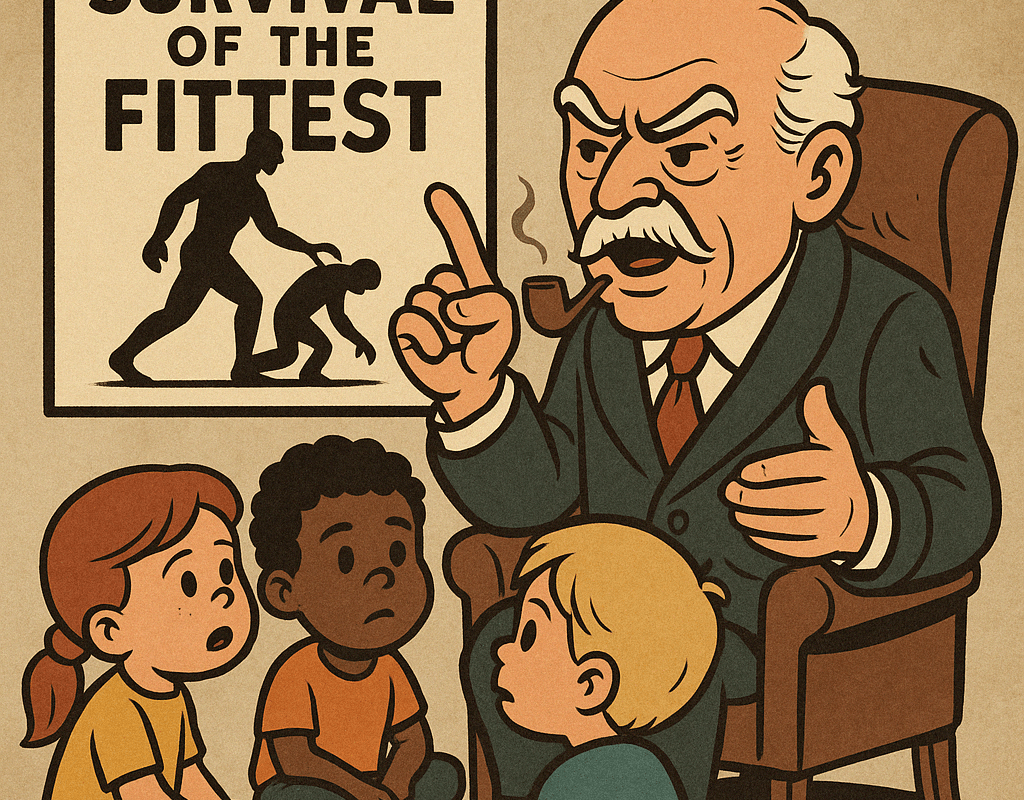
There is a kind of political necromancy afoot in modern discourse—a dreary chant murmured by pundits, CEOs, and power-drunk bureaucrats alike: “It’s just human nature.” As if this incantation explains, excuses, and absolves all manner of violent absurdities. As if, by invoking the mystic forces of evolution or primal instinct, one can justify the grotesque state of things. Income inequality? Human nature. War? Human nature. Corporate psychopathy? Oh, sweetie, it’s just how we’re wired.
What a convenient mythology.
Audio: NotebookLM podcast on this topic.
If “human nature” is inherently brutish and selfish, then resistance is not only futile, it is unnatural. The doctrine of dominance gets sanctified, the lust to rule painted as destiny rather than deviance. Meanwhile, the quiet, unglamorous yearning of most people—to live undisturbed, to coöperate rather than conquer—is dismissed as naïve, childish, and unrealistic. How curious that the preferences of the vast majority are always sacrificed at the altar of some aggressive minority’s ambitions.
Let us dispense with this dogma. The desire to dominate is not a feature of human nature writ large; it is a glitch exploited by systems that reward pathological ambition. Most of us would rather not be ruled, and certainly not managed by glorified algorithms in meat suits. The real human inclination, buried beneath centuries of conquest and control, is to live in peace, tend to our gardens, and perhaps be left the hell alone.
And yet, we are not. Because there exists a virulent cohort—call them oligarchs, executives, generals, kings—whose raison d’être is the acquisition and consolidation of power. Not content to build a life, they must build empires. Not content to share, they must extract. They regard the rest of us as livestock: occasionally troublesome, but ultimately manageable.
To pacify us, they offer the Social Contract™—a sort of ideological bribe that says, “Give us your freedom, and we promise not to let the wolves in.” But what if the wolves are already inside the gates, wearing suits and passing legislation? What if the protection racket is the threat itself?
So no, it is not “human nature” that is the problem. Cancer is natural, too, but we don’t celebrate its tenacity. We treat it, research it, and fight like hell to survive it. Likewise, we must treat pathological power-lust not as an inevitability to be managed but as a disease to be diagnosed and dismantled.
The real scandal isn’t that humans sometimes fail to coöperate. It’s that we’re constantly told we’re incapable of it by those whose power depends on keeping it that way.
Let the ruling classes peddle their myths. The rest of us might just choose to write new ones.
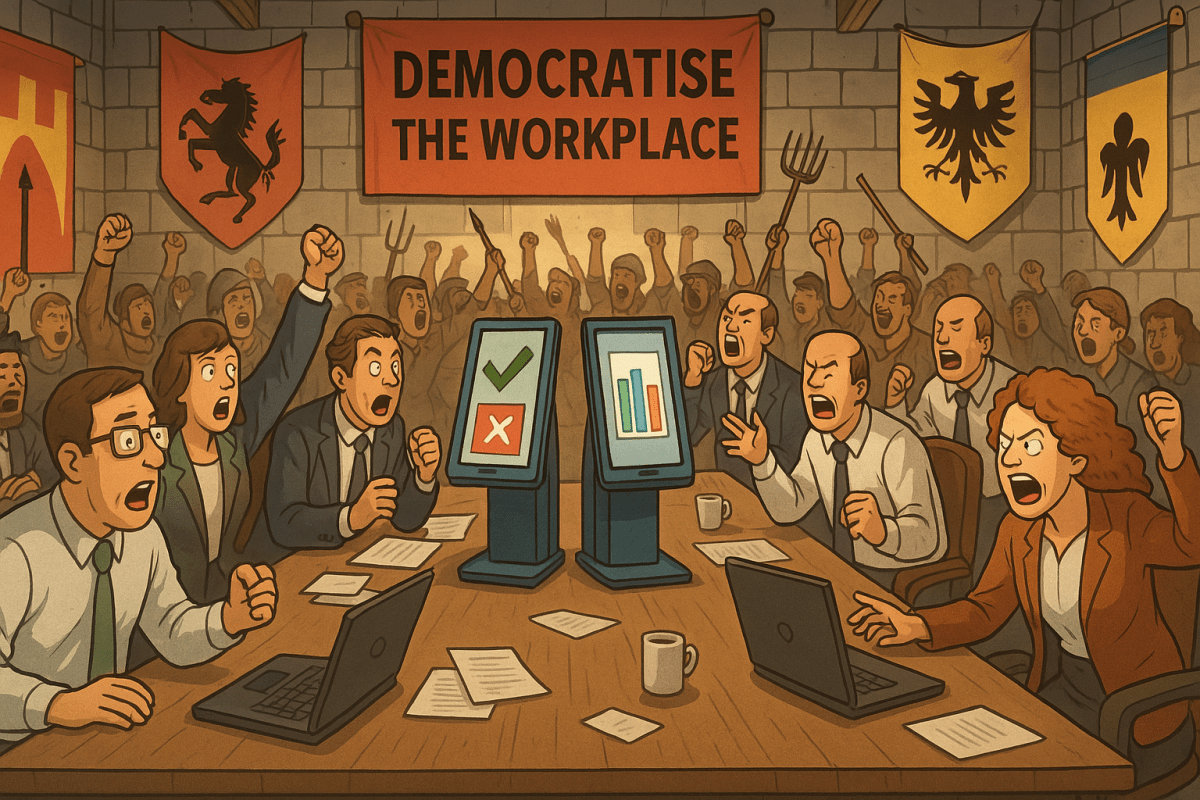
By the time we reach Chapter Seven of Technofeudalism: What Kills Capitalism, Yanis Varoufakis drops the ledger sheets and spreadsheets and starts sketching utopia in crayon. Entitled Escape from Technofeudalism, it proposes—brace yourself—a workplace democracy. It’s aspirational, yes. Compelling? Not particularly. Especially if, like me, you’ve long since stopped believing that democracy is anything more than a feel-good placebo for structural impotence.
Audio: NotebookLM podcast discussing this topic.
To be clear: the preceding chapters, particularly the first six, are sharp, incisive, and frankly, blistering in their indictment of today’s economic disfiguration. But Chapter Seven? It’s less an escape plan, more a group therapy session masquerading as an operational model.
So let’s take his proposal for Democratised Companiesapart, one charming layer at a time.
“Imagine a corporation in which every employee has a single share that they receive when hired…”
Splendid. One person, one vote. Adorable.
“All decisions – hiring, promotion, research, product development, pricing, strategy – are taken collectively…”
Because there’s nothing more efficient than a hiring committee comprised of thirty engineers, two janitors, a receptionist, and Steve from Accounts, whose main contribution is passive-aggressive sighing.
“…with each employee exercising their vote via the company’s intranet…”
Marvellous. We’ve now digitised the tyranny of the majority and can timestamp every idiotic decision for posterity.
“Equal ownership does not, however, mean equal pay.”
A relief. Until it doesn’t.
“Pay is determined by a democratic process that divides the company’s post-tax revenues into four slices…”
Here, dear reader, is where the cake collapses. Why, precisely, should a randomly-assembled group of employees—with wildly varying financial literacy—be entrusted to divide post-tax revenue like it’s a birthday cake at a toddler’s party?
And how often are these slices recalibrated? Each fiscal year? Every time someone is hired or fired? Do we amend votes quarterly or wait until the economic ship has already struck an iceberg?
Varoufakis does suggest preference voting to tackle allocation disputes:
“Any proposal to increase one slice must be accompanied by a proposal to reduce expenditure on one or more of the other slices…”
Fine. In theory, algorithmic voting procedures sound neat. But it presumes voters are rational, informed, and cooperative. If you’ve ever seen a corporate Slack thread devolve into emoji warfare, you’ll know that this is fiction on par with unicorns and meritocracy.
“The basic pay slice is then divided equally among all staff – from persons recently employed as secretaries or cleaners to the firm’s star designers or engineers.”
Ah yes, the ‘equality’ bit. Equal pay, unequal contribution. This isn’t egalitarianism—it’s enforced mediocrity. It might work in a monastery. Less so in a competitive tech firm where innovation requires both vision and differentiated incentive.
Now, on to bonuses, which are democratically determined by:
“…employees each given one hundred digital tokens to distribute among their colleagues…”
Welcome to Black Mirror: Workplace Edition. This is less economics, more playground politics. Who gets tokens? The charismatic chatterbox in the break room? The person who shared their lunch? The ghost employee who never shows up but emails back promptly?
And how, pray tell, does one evaluate the receptionist’s contribution relative to the lead engineer’s or the janitor’s? This isn’t peer review—it’s populism with a smiley face.
We’ve all seen “Teacher of the Year” competitions turn into contests of who had the cutest class poster or best cupcakes. Now imagine your livelihood depending on it.
In summary, democracy in the workplace may sound noble, but in practice, it’s the bureaucratic equivalent of herding caffeinated cats. It doesn’t even work in small groups, let alone an organisation of hundreds. Democracy—when applied to every function of an enterprise—is not liberation; it’s dilution. It’s design-by-committee, strategy-by-consensus, and ultimately, excellence-by-accident.
Escape from Technofeudalism? Perhaps. But not by replacing corporate lords with intranet polls and digital tokens. That’s not an exit strategy—it’s a cosplay of collectivism.
I’ve just finished Chapter 5 of Technofeudalism by Greek economist Yanis Varoufakis, and I can’t recommend it enough. Retiring from being a professional economist, I’d paused reading economic fare in favour of philosophy and fiction. Recently, I picked up Hobbes’ Leviathan and Graeber’s Bullshit Jobs, but this one called to me. I recall when it was released. I read some summaries and reviews. I heard some interviews. I thought I understood the gist. I did. But it goes deeper. Much deeper.
I considered Technofeudalism or Feudalism 2.0 as more of a political statement than a sociopolitical one. Now, I know better. Rather than review the book, I want to focus on a specific aspect that occurred to me.
In a nutshell, Varoufakis asserts that with Capitalism, we moved from a world of property-based rents to one of profits (and rents). We’ve now moved past this into a new world based on platform-based rents (and profits and property rents). Rent extraction yields more power than profits, again reordering power structures. Therefore, I think we might want to handle (read: tax) rents separately from profits.
Audio: NotebookLM podcast discussing this topic.
A Radical Proposal for Modern Taxation
Introduction: The Old Dream Reawakened
Economists have long dreamt of a world in which rent — the unearned income derived from control of scarce assets — could be cleanly distinguished from profit, the reward for productive risk-taking. Ricardo dreamt of it. Henry George built a movement upon it. Even today, figures like Thomas Piketty hint at its necessity. Yet rent and profit have grown entangled like ancient ivy around the crumbling edifice of modern capitalism.
Today, under what some call “technofeudalism,” the separation of rent from productive profit has become not merely an academic exercise but a matter of existential urgency. With rents now extracted not only from land but from data, networks, and regulatory capture, taxation itself risks becoming obsolete if it fails to adapt.
Thus, let us lay out a theoretical and applied map for what could — and arguably must — be done.
I. The Theoretical Framework: Defining Our Terms
First, we must operationally define:
Profit: income generated from productive risk-taking — investment, innovation, labour.
Rent: income generated from ownership or control of scarce, non-replicable assets — land, intellectual property, platforms, regulatory privilege.
Key Principle: Rent is unearned. Profit is earned.
This distinction matters because rent is an economic extraction from society’s collective value creation, whereas profit rewards activities that enlarge that pie.
II. Mapping EBITA: Where Rent Hides
EBITA (Earnings Before Interest, Taxes, and Amortisation) is the preferred metric of modern corporate reporting. Within it, rents hide behind several masks:
Property rental income
Intellectual property licensing fees
Monopoly markups
Platform access fees
Network effect premiums
Regulatory arbitrage profits
Parsing rent from EBITA would thus require methodical decomposition.
III. Theoretical Approaches to Decomposing EBITA
Cost-Plus Benchmarking
Estimate what a “normal” competitive firm would earn.
Treat any surplus as rent.
Rate-of-Return Analysis
Compare corporate returns against industry-normal rates adjusted for risk.
Excess returns imply rent extraction.
Monopolistic Pricing Models
Apply measures like the Lerner Index to estimate pricing power.
Deduce the rentier share.
Asset Valuation Decomposition
Identify earnings derived strictly from asset control rather than active operation.
Economic Value Added (EVA) Adjustments
Assign a competitive cost of capital and strip out the residual super-profits as rents.
IV. Toward Applied Solutions: Imposing Sanity on Chaos
In theory, then, we could pursue several applied strategies:
Mandated Rent-Adjusted Reporting
Require corporations to file a “Rent-Adjusted EBITA” metric.
Auditors would have to categorise income streams as “productive” or “rentier.”
Differential Taxation
Tax normal profits at a competitive corporate rate.
Tax rents at punitive rates (e.g., 70-90%), since taxing rents does not distort incentives.
Sector-Specific Rent Taxes
Levy special taxes on land, platforms, patents, and monopoly franchises.
Create dynamic rent-extraction indices updated annually.
Platform Rent Charges
Impose data rent taxes on digital platforms extracting value from user activity.
Public Registry of Rents
Create a global registry classifying rents by sector, firm, and mechanism.
Provide public transparency to rent-seeking activities.
V. The Political Reality: Clouds on the Horizon
Needless to say, the aristocracy of the digital age will not go gentle into this good night. Rentiers — whether in Silicon Valley, the City of London, or Wall Street — are deeply entwined with the political machinery that might otherwise regulate them.
Yet the costs of inaction are higher. If rent extraction continues to eclipse productive activity, the very legitimacy of markets — and democracy — will erode into cynicism, stagnation, and oligarchic decay.
Conclusion: The Choice Before Us
Separating rent from profit is not merely a technocratic tweak. It is a radical act — one that could reorient economic activity away from parasitic extraction and back toward genuine value creation.
In a world where algorithms are castles, platforms are fiefdoms, and data is the new serfdom, reclaiming the ancient dream of taxing rent is no longer optional. It is, quite simply, the price of our collective survival.
Given all of the clamouring about taxations and abolishing the Internal Revenue Service, affectionately known as the IRS. In Britain, one may be more aware of His Majesty’s Revenue and Customs (HMRC). In France, it’s Direction générale des Finances publiques (DGFiP).
Audio: NotebookLM podcast on this topic.
Given how up in arms the reincarnation of the NAZI party, disfectionately known as Republicans (or Republican’ts depending on your mood or persuasion), have been towards the IRS and taxation in general – they love to cosplay tossing crates of tea into harbours – I asked ChatGPT to clarify the originals of income taxes in the United States.
For the benefit of more casual readers, income taxes were unconstitutional – illegal – until 1913. These were snuck in under the guise of only applying to the wealthy, the 1% of the time. But once the floodgates were opened, the focus shifted to the 95%, increasingly exempting the wealthy. Even so, they still complain and evade.
Enough wittering. Here’s what ChatGPT had to say on the matter.
The Republican Party — yes, that bastion of “limited government” and “individual liberty” — was the main political force that promoted and passed the constitutional income tax that became the 16th Amendment.
To sprinkle a little more salt into the irony wound: it was under President William Howard Taft, a Republican, that the push for a constitutional amendment authorising federal income taxes really gained momentum. Congress proposed the 16th Amendment in 1909 (during Taft’s administration), and it was ratified by the states in 1913 — just in time for the modern federal leviathan to roll up its sleeves and plunge its greasy hands into everyone’s pockets.
Now, to be fair (or at least historically accurate), Taft and the Republicans framed it as a political counterattack against the Democrats’ attempts to impose income taxes via ordinary legislation — taxes which had been previously struck down by the Supreme Court in Pollock v. Farmers’ Loan & Trust Co. (1895). The amendment was sold as a “clarification” of federal powers. Think of it as constitutional tax laundering: put the amendment through, and voilà, what was once forbidden now becomes nobly sanctioned.
So yes — the same Republican Party that today wails about taxation like it’s the herald of the apocalypse, once upon a time delivered the federal income tax into America’s cradle. Swaddled it. Rocked it to sleep. Burped it.
I’ve gone entirely off the reservation (send help, or biscuits) and decided, in a fit of masochistic curiosity, to crack open Measure What Mattersby John Doerr—a business management tome that’s been gathering dust on my shelf longer than most CEOs last in post.
Spoiler Alert: I won’t be finishing it. Nor, frankly, should you.
Full disclosure before we all get the wrong idea: I find self-help books about as nourishing as a rice cake made of existential despair. Add “business” or “management” into the mix, and you’re cooking up something so vapid it could qualify as a greenhouse gas.
Audio: NotebookLM podcast of this content.
Measure What Matters reads less like a serious work of business philosophy and more like a self-important infomercial, peddling the sort of common sense you could overhear in a pub toilet after three pints. And, like any decent infomercial, it’s drenched in “inspirational” stories so grandiose you’d think Moses himself was consulting for Google.
Image: Midjourney’s rendering of a possible cover image. Despite the bell protruding from the crier’s head, I went with a ChatGPT Dall-E render instead.
I’m sure Doerr genuinely believes he’s handing down managerial tablets from Mount Sinai, and I’m equally sure he’s eating his own dog food with a knife and fork. But what gets served up here is a steaming dish of selection bias, smothered with a rich gravy of hand-waving nonsense.
What am I getting my knickers in a twist about? What’s this book actually about?
In short: three letters—OKR. That’s Objectives and Key Results, for those of you not fluent in MBA-speak. These mystical artefacts, these sacred runes, are supposed to propel your company from the gutter to the stars. Intel did it. Google did it. Ergo, you too can join the pantheon of tech demi-gods. (Provided, of course, you were already a billion-dollar operation before you started.)
Nobody’s going to argue that having goals is a bad idea. Nobody’s throwing the baby out with the Gantt chart. But goals are nebulous, wishy-washy things. “I want to travel” is a goal. “I will cycle and kayak my way to Edinburgh by the end of the year, preferably without dying in a ditch”—that’s an objective.
Businesses, being the lumbering beasts they are, naturally have goals. Goals for products, customers, market share, quarterly bonuses, and ritualistic victory dances in front of their crushed competitors. Nothing new there.
According to Doerr and the gospel of OKRs, however, the only thing standing between you and unassailable market dominance is the right set of buzzwords stapled to your quarterly reports. Apparently, Intel crushed Motorola not because of innovation, talent, or dumb luck—but because they set better OKRs. (History books, please update yourselves accordingly.)
Video: John Doerr’s 2018 TED Talk on this topic.
But wait, what’s an OKR again? Ah yes: we’ve done Objectives. Now for the Key Results bit. Basically, you slap some numbers on your wish list. If you’ve survived in business longer than a fruit fly, you’ve already met KPIs (Key Performance Indicators)—another Three Letter Acronym, because we live and die by alphabet soup. Key Results are KPIs wearing slightly trendier trainers.
Example: “We will be number one by the third quarter by prospecting a dozen companies and closing three deals by September.” Marvellous. Life-changing. Nobel-worthy. Now go forth and conquer.
Right. Now that I’ve saved you twenty quid and several hours of your life, let’s talk about why this book is still an exercise in masturbatory futility.
First, and most fatally, it’s predicated on selection bias so profound it should come with a health warning. Allow me to paint you a picture. Imagine we’re advising a football league. Every team sets OKRs: target weights, goal tallies, tackles, penalty avoidance—the works. Everyone’s focused. Everyone’s motivated. Everyone’s measuring What Matters™.
Come the end of the season, who wins? One team. Did they win because their OKRs were shinier? Because they ‘wanted it more’? Or, just maybe, did they win because competition is brutal, random, and often unfair?
This is the problem with false meritocracies and the illusion of control. It’s like thanking God for your touchdown while assuming the other team were all godless heathens who deserved to lose. It’s the same nonsense, in a suit and tie.
Will our winning team win next year? Doubtful. Did Intel lose ground later because they forgot how to spell OKR? No. Because the world changes, markets collapse, and sometimes you’re just standing on the wrong bit of deck when the ship goes down.
Then there’s the love affair with plans. In theory, lovely. In practice, arbitrary. You can set as many Objectives as you like, but what counts as a “win”? Is it profit? Market share? Not dying of ennui?
The free market worshippers among us love to preach that governments can’t plan effectively, unlike the rugged gladiators of capitalism. Funny how businesses, in their infinite wisdom, are then urged to behave like microcosmic Soviet Five-Year Planners, drowning in metrics and objectives. Topically, we are living through the charming consequences of governments trying to run themselves like corporations—newsflash: it’s not going splendidly.
In short: companies are not nations, and OKRs are not magic bullets.
What else is wrong with this book? Well, to start: it’s shallow. It’s smug. It peddles survivorship bias with the zeal of a televangelist. It confuses correlation with causation like an over-eager undergraduate. And most damning of all, it sells you the fantasy that success is just a matter of writing smarter lists, as if strategy, luck, market forces, and human frailty were irrelevant footnotes.
Measure What Matters doesn’t measure anything except the reader’s patience—and mine ran out somewhere around chapter five.
—or—How the Invisible Hand Became a Throttling Grip on the Throat of the Biosphere
As many frequent visitors know, I am a recovering economist. I tend to view economics through a philosophical lens. Here. I consider the daft nonsense of Pareto optimality.
Audio: NotebookLM podcast of this content.
There is a priesthood in modern economics—pious in its equations, devout in its dispassion—that gathers daily to prostrate before the altar of Pareto. Here, in this sanctum of spreadsheet mysticism, it is dogma that an outcome is “optimal” so long as no one is worse off. Never mind if half the world begins in a ditch and the other half in a penthouse jacuzzi. So long as no one’s Jacuzzi is repossessed, the system is just. Hallelujah.
This cult of cleanliness, cloaked in the language of “efficiency,” performs a marvellous sleight of hand: it transforms systemic injustice into mathematical neutrality. The child working in the lithium mines of the Congo is not “harmed”—she simply doesn’t exist in the model. Her labour is an externality. Her future, an asterisk. Her biosphere, a rounding error in the grand pursuit of equilibrium.
Let us be clear: this is not science. This is not even ideology. It is theology—an abstract faith-based system garlanded with numbers. And like all good religions, it guards its axioms with fire and brimstone. Question the model? Heretic. Suggest the biosphere might matter? Luddite. Propose redistribution? Marxist. There is no room in this holy order for nuance. Only graphs and gospel.
Jevons warned us…that improvements in efficiency could increase, not reduce, resource consumption.
The rot runs deep. William Stanley Jevons—yes, that Jevons, patron saint of unintended consequences—warned us as early as 1865 that improvements in efficiency could increase, not reduce, resource consumption. But his paradox, like Cassandra’s prophecy, was fated to be ignored. Instead, we built a civilisation on the back of the very logic he warned would destroy it.
Then came Simon Kuznets, who—bless his empirically addled soul—crafted a curve that seemed to promise that inequality would fix itself if we just waited politely. We called it the Kuznets Curve and waved it about like a talisman against the ravages of industrial capitalism, ignoring the empirical wreckage that piled up beneath it like bones in a trench.
Meanwhile, Pareto himself, that nobleman of social Darwinism, famously calculated that 80% of Italy’s land was owned by 20% of its people—and rather than challenge this grotesque asymmetry, he chose to marvel at its elegance. Economics took this insight and said: “Yes, more of this, please.”
And so the model persisted—narrow, bloodless, and exquisitely ill-suited to the world it presumed to explain. The economy, it turns out, is not a closed system of rational actors optimising utility. It is a planetary-scale thermodynamic engine fuelled by fossil sunlight, pumping entropy into the biosphere faster than it can absorb. But don’t expect to find that on the syllabus.
Mainstream economics has become a tragic farce, mouthing the language of optimisation while presiding over cascading system failure. Climate change? Not in the model. Biodiversity collapse? A regrettable externality. Intergenerational theft? Discounted at 3% annually.
We are witnessing a slow-motion suicide
We are witnessing a slow-motion suicide cloaked in the rhetoric of balance sheets. The Earth is on fire, and the economists are debating interest rates.
What we need is not reform, but exorcism. Burn the models. Salt the axioms. Replace this ossified pseudoscience with something fit for a living world—ecological economics, systems theory, post-growth thinking, anything with the courage to name what this discipline has long ignored: that there are limits, and we are smashing into them at speed.
History will not be kind to this priesthood of polite annihilation. Nor should it be.
We live in an age of two-dimensional minds trying to navigate a three-dimensional world—and doing it with all the grace of a toddler wielding a chainsaw. For over a generation, the US and UK have been polarised, Balkanised, and lobotomised by the Great Red vs. Blue Punch & Judy Show. Left, right. Us, them. Hero, villain. There is no nuance, no gradient, no middle ground. Just a glorious reduction of civilisation’s complexities into primary-coloured football teams for emotionally underdeveloped adults.
This is not politics. This is pantomime.
Audio: NotebookLM podcast on this topic.
And the real tragedy? The world isn’t even two-dimensional. It’s not even three. Try thinking of it as a cube—six sides at least, all pressing in at once, depending on your angle. Culture, history, class, geography, education, trauma, temperament, aesthetic preference—each a face of the cube. But tell that to the modern partisan and they’ll squint at you like you’ve just tried to explain jazz to a toaster.
No, to them, the world is flat. A line. A tug-of-war between two equally blinkered tribes dragging the rest of us into the pit. Pick a side or shut up, they shriek. If you’re not with us, you’re against us. If you don’t chant the correct slogans or signal the proper virtues, you’re obviously a heretic, a bigot, or—worst of all—centrist scum. They don’t want conversation; they want confirmation. Preferably in 280 characters or less.
Try introducing complexity and you’ll be accused of bothsidesism, moral cowardice, or—God forbid—thinking. It’s like throwing a Rubik’s cube into a toddler fight club.
This binary reductionism doesn’t stop at politics. Even gender—possibly the most nuanced and intimate aspect of human identity—has been flattened into a tug-of-war between biological essentialists and gender abolitionists, both sides wielding hashtags like holy relics. The irony? These same culture warriors still manage to marvel at rainbows, utterly unaware that their own worldview only permits two colours. How do they even process a traffic light?
The cult of the binary isn’t just intellectually bankrupt—it’s a threat to civilisation. We didn’t crawl out of the primordial ooze, develop language, invent calculus, and split the atom just so Karen and Kev from Facebook could reduce geopolitics to an episode of EastEnders. The world is messy. People are contradictory. Context matters. But nuance doesn’t trend.
We’re governed by algorithms, policed by outrage, and divided by design. The machinery of mass culture rewards the loudest, angriest, most wilfully ignorant voices, and we feed the beast like dopamine-addled pigeons pecking a lever. The cube has been flattened into a cartoon. And yet we wonder why everything feels broken.
So here’s a radical idea: what if we stopped flattening the world into a battlefield and started mapping it like a landscape? What if we admitted that not every problem has two sides—some have two hundred? What if we taught critical thinking instead of tribal loyalty? What if we made complexity sexy again?
But I digress. That might require imagination. And we’ve outsourced that to TikTok influencers and AI chatbots.
Meanwhile, the cube spins. And the rest of us try to hold on.





 Philosophics