Metanarrative Problem

Audio: Philosopher Bry Willis discusses this topic.

Postmodernism was summarised by Lyotard as having an incredulity toward metanarratives.

What does this mean? What are metanarratives, and why harbour incredulity toward them?

Audio: NotebookLM podcast on this topic.

Metanarratives are narratives. Stories presented through a lens with a certain perspective. These stories provide a historical account of how a culture arrived to where it has. They can be viewed as origin stories. Metanarratives are also teleological, as they provide the foundation to progress, to advance the culture to a better future. Embedded in these metanarratives are the rules and conditions necessary to navigate, both from the past and into the future.

We’ve got stories. In his book Sapiens: A Brief History of Humankind, historian, Yuval Noah Harari tells us how important stories are for having made human progress. Hooray for us!

This sounds good so far. Right? We’ve got Caesar, Cornwall, and Kahn. We’ve got triumph of us over others. Good prevailing over evil. Right over wrong. So why the incredulity?

Let’s keep in mind that Lyotard is suggesting incredulity and not rejection. The narrative could be fine and accurate enough. One might argue that the benefit of the narrative for the purpose of cohesion outweighs the detriments posed.

There are several notable problems with metanarratives.

Firstly, the past suffers from a cherry-picked survivorship bias. The story threads that don’t support the narrative are abandoned, and some threads are marginalised. So, there’s a dimensional problem. As with any historical account, one needs to adopt a perspective and create a story. Let’s not forget that the word history comes from the word story. In fact, French only has one term: l’histoire. History is story.

Secondly—and this is somewhat related to the survivorship bias problem—, is that we privilege the perspective we take to view this history. In his book, We Have Never Been Modern, Latour uses this line of argumentation to arrive at the conclusion that we have never been modern. It is only because we are here now and surveying history through a rearview mirror that we can even look into the past. And we feel that we have somehow overcome this past. The past was primitive, but we are modern. Some time in the future we’ll deservedly be viewed in the same light because that’s how progress works. But there is no reason to accept this privileged assignment. It’s a function of ego—and to be even more direct: hubris.

Lastly, there’s the issue of teleology. Through this privileged vantage, we orient toward some alleged destination. Like fate, it’s just there for the taking. The only barriers are time, not keeping your eyes on the prize, and not following the rules to get there. There’s an embedded deontology. Those other societies don’t understand what it takes. You need to follow this path, this religion, this sports team. Because this is the best there is.

But there are no crystal balls. We cannot divinate the future. There is no particular reason to believe that our imagined path is the best path. If you don’t believe this, just ask the culture next door.

I’d like to think that somehow Progressives would be more aware of this tendency—and perhaps in some sense they are, but it’s not very apparent pragmatically. I don’t want to get distracted by the notion of institutionalism, but that is evidence of taking a privileged position regarding the status quo—even if your vision of the future would take a different path than your more conservative brethren and sistren.

In closing, this has been a summary of the problem postmoderns have with metanarratives. It could be that the metanarrative you believe to be valid is valid. It could be that your religion is the true religion. It could be that your sports team is the best sports team. That your system of government is the best of all other alternatives. It’s more likely that you’ve convinced yourself that these things are true than them being true.

We can either adopt the perspective of Voltaire’s Dr Pangloss and consider our world to be the best of all possible worlds, or we can step back and consider that we haven’t exhausted all of the possibilities.


Anchor from Spotify

If you’re like me, you’ve noticed invitations to turn your blog posts into podcasts. I decided to give it a go.

There is a bit of added prep work, and they are still working out some kinks.

Check it out.

ADHD Drivers

I’m typing this on my mobile in fear.

Not trying to shame, but ADHD should disqualify a person from having a driver’s licence.
The next cigarette became the next snack became the next drink became readjusting the mirror became readjusting the seat became the next drink became the next application of lipstick became flicking an ash became changing the radio station became looking for a lighter to fire up the next cigarette  became opening a window became adjusting the temperature became rinse and repeat ad infinitum….or until the trip ends or distraction kills.

Opiates of the Masses

No, really.

Memories are fallible. I’d thought I had written on this topic of opiates and public policy at length. And perhaps I have. Just not here. Perhaps that’s a good thing. Searching my blog for my take on opiates, I find that I cite Marx’s ‘Religion is the opiate of the masses‘, four times—make that five. But nothing more.

Carl Hart recently published a book on his heroin use—Drug Use for Grown-Ups: Chasing Liberty in the Land of Fear. By some accounts, Carl might appear to be the stereotypical heroin addict in the United States. Well, he’s black, so there’s that. But that’s where the stereotype ends.

Carl Hart is a professor of neuroscience in the psychology department of Ivy League, Columbia University—at least before he published his book. I’ve not read his book, but at my blog I’ve provided a link to the Guardian article, which prompted this post.

The gist I get from having read the Atlantic article is that the public health narrative surrounding heroin and other illicit drugs is akin to the hype of the days when Reefer Madness was all the moral outrage. And make no mistake—this outrage has everything to do with moral one-upmanship and nothing to do with health outcomes. This is pure and simple cultural performativism signalling the higher ground one occupies. As is common enough, many people have actually internalised their misinformation and disinformation to the point they truly believe there is a medical basis to their belief systems. If they are at all introspective, they would see that morals and Calvinism have nothing to do with this purported health care policy. It’s a seemingly reasonable, logical place to arrive. No emotional element is necessary.

But allow me to step back for a moment. Am I saying that there are no possible harmful effect for consuming drugs and other chemicals? No. Am I claiming that no one has ever died as a result of chemical intoxication or overdose? No, again. Am I saying that drug abuse does not incapacitate some people? Nope. I am saying none of the above. I am claiming that hyperbole abounds, the causal connection is overattributed, and cofactors are ignored in favour of an orthodox etiology.

For the record, I am a teetotaler. I do not abuse or even use chemicals referred to as drugs—illicit or otherwise. I don’t drink alcohol, don’t smoke cigarettes. I don’t even drink coffee or covfefe. I do drink Coca Cola, so my big vice in this regard is caffeine. Even rarely do I take ibuprofen or acetaminophen.

As I note in my Defence of Capitalism post, it’s difficult to get good second-hand information of illicit drugs. The medical-industrial complex and the official police state peddle fear and disinformation. Whether they believe the information they dispense is true or not is irrelevant. What is important is the low truth content. It makes one wonder what to trust and what not to when these agencies routinely propagate falsehoods and misrepresent truth.

This misrepresentation isn’t limited to opiates. I found it interesting when Michael Phelps won gold at the Olympics, only to announce that he was the consummate pothead, and smoking weed was part of his daily routine. Here’s what the official Olympics website says about him, by the time he retired at Rio 2016 at the age of 31, Michael Phelps had collected a total of 23 golds, three silvers and two bronzes at the Olympics, a record-breaking haul that looks unlikely to be bettered for many years to come. So much for the lazy stoner stereotype. As marijuana becomes more accepted by mainstream culture, we come to notice that many of the so-called mental health issues were just fabricated. The purpose was to shroud a moral argument in medical legitimacy. Whether the healthcare industry was complicit or it was the law enforcement regime gone rogue is a separate question. Yet again, it undermines the legitimacy of any claims.

In 2020, the world encountered the Coronavirus, COVID-19. And medical expertise, particularly around immunology and the spread of pathogens, came into question. In the United States and United Kingdom, their misinformation was further exacerbated by administrations hostile to science. But given the history of misinformation for political purposes, it may be premature to blame the general public for being reluctant to trust the alarms. They’ve created the classic Boy Who Cried Wolf scenario. And so the question becomes what health information can one trust? And who is the authoritative source?

Listen to this as a podcast on Spotify

Defence of Capitalism

Product markets don’t function the way we’re taught.

Wearing my economist’s hat, I have issues with arguments advanced attempting to defend Capitalism. Technically, Capitalism is a system of production and not one of distribution, but idiomatically, people conflate it with a market system. Ignoring that modern economic systems use markets, I am commenting in this idiomatic sense. 

I’m not sure why some of us economists are intrigued with how the market works for drugs and prostitution, I have this in common with Steven Levitt’s Freakonomics, still a decent book.

Rather than focus on prostitution‘s service market, I prefer to attend to drugs and the product market. I’ll showcase how unregulated markets don’t work per textbook and Libertarian lore. Heroin and fentanyl make for a perfect use case.

BACKGROUND 

Fentanyl (AKA fetty) is sold retail through independent distributors. As is typical, each link in the chain takes a cut, selling for a higher unit price to capture margin. All of this is textbook behaviour. 

On the city streets, dealers sell to caseworkers, who sell to block boys. There are also watchers, an overhead expense that we’ll ignore. They represent a typical SG&A function. I’ll return to the distribution chain in a moment. 

Product is sold to dealers as weight. This might be kilos or ounces. I’m not sure they are so concerned with whether they use the metric or imperial system of measure.

Weight is a wholesale activity. Retail units are bags and bundles. Maybe logs. Bags are the smallest unit. It’s around 10mcg to 30mcg.1 A person is likely to consider a bag or even a half a dose. Some people will purchase a bag or two at a time. Heroin and fentanyl bags are the same size. They are waxed paper bags about 30mm wide by 3cm tall. These are typically folded in thirds an inserted into little zipper locked bags—like tiny sandwich bags.

Tiny Sandwich Bags

If you are buying irregularly or up to maybe 4 or 5 bundles at a time, you are most likely buying from the block—block boys. This is a cash and carry business. First come, first serve. A block is a small city block—a territory on one street from one cross-street to the next. Cross the street, and you are in a new territory. Turn the corner, and you’re in a new territory. And territories serve particular brands. More on this later, but you don’t go to the Gucci block to buy Chanel.

As a buyer, you have some freedom to select a block where you are trusted (mostly just not to be a cop or a snitch), but there is some rivalry, so if a seller on block A sees you buying from block B, it may pose problems if you later try to buy from A. Although these block boys are competing for your business, by and large they know each other. It’s like if the Kellogg’s guy runs into the General Mills guy whilst stocking in the cereal aisle. As long as you aren’t using the other’s allocated shelf space, you’re fine. No knives. No gunfights. It’s all good.

Bag of Heroin Compared with a US Penny

The price of fentanyl varies wildly by location. As of now, a bag of powder retails at between $5 and $10. The closer one is to a distribution hub, the cheaper. In Philadelphia, $5 is the norm. In Wilmington, Delaware, $10 is typical. Further south in Dover, one might pay as high as $20. The supply chain takes its toll. Supply and demand are at work as advertised, so we’re still operating in textbook territory. 

Bags are aggregated into bundles, which may range between 14 and 16 bags.2 Ten bundles compromise a log. 

Whilst for some users a bag or a portion is sufficient, tolerance is an issue. In order to feel the same effects, users need to increase their doses. Some users need to dose 7 or more bags.

Bags of Fentanyl Representing Various Stamps

For entry-level users, fentanyl is a relatively cheap high. A dose lasts about 4 hours. Heroin lasts about 8. For addicts, there’s a notable downside: withdrawal. Withdrawal symptoms are flu-like. They get worse before they get better, addicts prefer to remain dosed prior to they become symptomatic.  For the typical addict, the struggle is real.

For a person using half a bag every hour a day, the cost would be a manageable $30 a day. For the 7 to 8 bag user, they are looking at about 3 bundles a day, which might cost between $70 to $120 apiece, so between $210 and $360 a day. Putting 2 + 2 together,  you might realise how addiction and prostitutes arrive hand in hand. This is not an activity for minimum wage workers, especially when the dose ratchets up.

A Couple Bundles and a Bag of Fentanyl with Hot Water Stamp

What happened to the economic angle? It turns out that there are several product issues. On the street, brand matters…sort of. Fentanyl brands are known as stamps. Bags are stamped to indicate the source. And this is the first deviation from textbook theory. 

Brand names became prominent in the 19th century with bulk goods. When purchasing oatmeal from the general store, the consumer would gain confidence in the product based on the brand. Brand marketing has become fundamental to modern commerce.

Quaker Oats Brand Label circa 1906

A problem with brand stamps is that they are not reliable product indicators. They are more indicative of the retail seller than the source. It would be like visiting Walmart and buying Walmart oatmeal, but it reveals nothing of the quality. As street fetty is cut with tranquilisers (tranq) or other cheaper ingredients and fetty actually relates to a class of drugs as opposed to a specific chemical formula, the quality varies from 0 per cent fetty to something less than 100 per cent, as 100 per cent would not be typically found on the streets, primarily owing to margin requirements. Most users I’ve encountered are fine with the tranq admixture. In practice, people have their preferred tranq and ratio. Of course, this quality is subject to variation, too. Because of the aforementioned withdrawal issues, if there is not an adequate dose of fetty, the batch will not stop or reverse the withdrawal symptoms.

Unlike a brand label that a box of Raisin Bran cereal you just purchased contains Raisin Bran, a common analogy might be that one day you buy a box of Raisin Bran but discover when you consume it that you’ve been served Captain Crunch instead. Alternatively, when you arrive to make your purchase, your boy tells you that no one has Raisin Bran, but Captain Crunch is the same thing (I swear). 

A Tale of Two Cereals

Apart from quality, there is no weights and measures oversight. I’ve read that a bag of fetty weighs around 100mg to 300mg, but I can’t substantiate this. However, I have it by a trusted account that the weight ranges wildly from 0mg to something more—let’s say 300mg to be generous.

If this occurred in the regulated world, a person might return the product for a refund or exchange. This is not an option on the block.

Unlike a brand label that the 400g  box of Raisin Bran cereal you just purchased contains 400g of Raisin Bran, a common analogy might be that on one day you buy a 400g box of Raisin Bran, but instead of getting this quantity of Raisin Bran, you discover you’ve only got 350g of Raisin Bran—or maybe 350g box of Captain Crunch. If this occurred in the regulated world, a person might return the product for a refund or exchange. This is not an option on the block. And with the various dilution schemes, you might end up with salted Raisin Bran. No returns. No refunds.

In the regulated world, if Walmart is unreliable, you can go to go to Safeway instead. But in this unregulated world, Safeway is just as unreliable. The street can only sell what it has access to, and if they receive a batch of something unexpected, they still need to unload it. The TV and movies make it seem like these guys are quality control freaks, but they are all bottom feeders.

Punchline

The Libertarian wet dream is that markets are self-regulating and bad actors will be forced out of business. The drug trade demonstrates this not to be true.


1 I am not sure of the actual weights, as I’ve never weighed any. The information available on the Internet conflicts.

2 I’ve read that in some places, a bundle is 10 and the next larger portion is a brick, but this is not the case in the greater Philadelphia area. Much I’ve read on law enforcement sites does not reflect my experience, not does the information on official medical sites, so I question the veracity of the information being fed to the public. It feels like there is more morality shaming than science. More on this in a separate post.

Racism is Null

I recently engaged in a conversation about racism, and I won’t bore you with the larger debate. Instead, I’ll bore you with two threads.

  1. Taxonomically, modern humans have only one race
  2. Constructively, race is used as a proxy to otherwise justify otherness

Taxonomically, Homo sapiens is the species, and we so-called modern humans are Homo sapiens sapiens, which is an extended subspecies…and extended at that, perhaps a sub-subspecies.

Definitionally, race is an alternative name for a sub-subspecies, so technically, our current instantiation of humanity, version X.whatever, can be considered a race. However, as there are no extant human subspecies, there is clearly no need for racial delineation. The best we can muster is to say we’ve reserved a placeholder in the taxonomy.

To expand, in this taxonomy, Neanderthal and Australopithecus were competing species. Homo sapiens sapiens is meant to differentiate so-called modern humans from prior Homo sapins idaltu, from which we branched.

The summary is that there is no other extant parallel species to Homo sapiens and (clearly) no parallel subspecies to Homo sapiens sapiens.

Yet racists need races to operate on, and unless they are railing about races within other species, they’ve got no dog in this race. What to do?

How does one not only construct races where none exist but also convince others that this delineation is de facto race, if not de jure?

Colour and relatively recent geographical origin serve as good-enough proxies to differentiate classes under the guise of race. They create specious backstories et voilà.

As most people are decidedly neither scientific nor inquisitive, this is an easy feat. And it provides a sort of gossamer other against which to rail. This structure is so permeable, people have tossed religious affiliation into the mix with barely anyone noticing because race is just a code word for otherness.

The question becomes: how does one fight against something that doesn’t actually exist and whose definition morphs and adapts more readily than a virus?

DISCLAIMER: This post was written on my mobile, so it may have more flaws than usual. I reserve the right to edit it substantially when I have access to a full-size keyboard and monitor.

Disintegration Street

Riffing on my recent post, I wanted to provide a tab more perspective on my claim that postmodernism serves a purely disintegrative function. Anyone can disintegrate a narrative into constituent parts, but postmodernism provides no grounds for privileged reintegration, as this too can be disintegrated. So, whilst one is free to disintegrate and even to reassemble the parts, one is never in a position to claim that this is how it should be put together because this privileges the subject and another subject can always come along and privilege another perspective. Also, there is no PoMo toolkit available to reassemble the parts that I am aware of.

When I was a child, a neighbour owned and operating a demolition company. He disintegrated buildings. He kept some of the materials and sold some other for scrap. Whilst these materials could be repurposed and used in the construction of another building—or a picnic table—, this was not the function of the demolition company. It’s safe to say that no one was ringing him up under the premise that he had tools, so why won’t he build them a house. He knows houses, right?

This is the same problem we face when deconstructing a narrative with postmodern tools. If we want to construct something, we can, but we should expect that no matter what we do, the next wave can readily knock it down. And though we can rebuild more castles made of sand, they are all subject to the same forces.


* I admit that this title was lent from The Cure’s Fascination Street, which does happen to be on their album Disintegration.

The Cure – Fascination Street video

Conceptual Abstraction

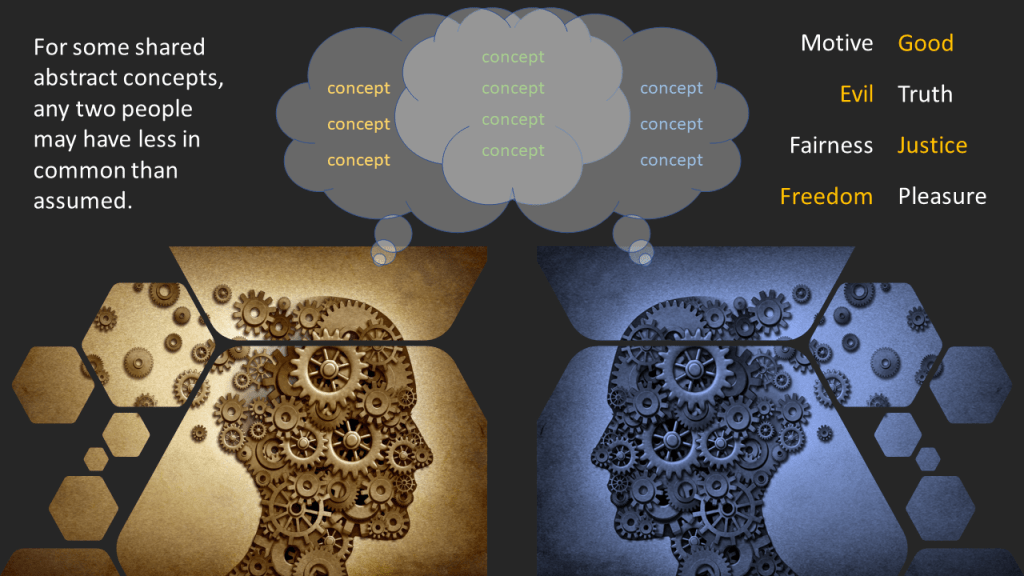
Shared Concept Image

I tend to go on about weasel words and the insufficiency of language, but I tend to get a lot of resistance by people who insist the chasm isn’t as expansive as I make it out to be. This makes me wonder how one might create a test to determine how much is similar and how much doesn’t.

To summarise my position, abstract concepts of this type are specious archetypes that cannot exist in the real world: truth, justice, freedom, fairness, and so on. The common thread here is almost always that they exist in the realm of morality, another false concept.

It seems to me that one could construct a sort of word cloud intersecting with a Venn diagramme. I’d assume that more articulate people would have more descriptors, thereby creating landscape with more details and nuance for any given concept.

Additionally, I could see a third dimension which would capture diametric meanings. There is also the issue of diverse contexts, e.g. in the case of justice, we have distributive, retributive, restorative, and procedural flavours, so one would need to be taken into account.

In everyday existence, I notice that these terms are good enough and have enough substance to trick people into believing not only that it’s real but that the are operating with a shared concept. My point is that it’s more apples and oranges. We could employ dimensions that make these appear to be similar.

  • Approximate spheroids
  • Fruits
  • Contain fruits
  • Have skin

Additional scrutiny would illustrate the differences.

  • Colour
  • Taste
  • Consistency

This difference between this concrete case is that we can observe the objects to compare and contrast, but with abstractions, we have a sort of survivorship bias in play. We remember what we agree on and forget or diminish the parts we don’t agree on. And we don’t necessarily even know the complete inventory of descriptors of our counterparts.

The image at the top of the page is not to scale. I don’t know what the percent breakdowns are, but I wouldn’t be surprised if in a situation where there were 10 possible descriptors, that only 4 would be commonly shared—so 40 per cent—, leaving 6 not in common—60 per cent.

In any case, I wonder if anyone has attempted this sort of inventory comparison. I haven’t even looked, do there could be tome upon tome published, but I don’t suppose so.

Foucault Identity

‘Do not ask who I am and do not ask me to remain the same: Leave it to our bureaucrats and our police to see that our papers are in order. At least spare us their morality when we write.’

—Michel Foucault, The Archaeology of Knowledge & the Discourse on Language

I am going to take liberal liberty with Foucault’s quote. This is another take on Heraclites’ ‘never the same man, never the same river’ quote. It can be taken as a commentary on identity and impermanence. Effectively, he is taking the position that the concept of identity is a silly question, so don’t bother asking about it. Then he defers to people who insist on it anyway.

To be fair, creating a sort of contiguous identity does simplify things and creates categorical conveniences.

Vendor: ‘Wasn’t it you who purchased that from me and promised to pay with future payments?

Zen: ‘There is no future. There is only now. And I am not the same person who purchased your car.

Perhaps this is where the saying, ‘Possession is 9/10 of the law‘, a nod to temporal presentism.

In any case, some systems are predicated on their being identity, so a person benefiting from that system will insist on the notion of identity.

Clearly, I’m rambling in a stream of consciousness, and it occurs to me that Blockchain offers a solution to identity, at least conceptually. In the case of Blockchain, one can always audit the contents of the past in the moment. And so it carries the past into the now.

If one were able to capture into an archive every possible historical interaction down to the smallest unit of space-time—neutral incident recording, indexing and retrieval challenges notwithstanding—, one could necessarily attribute the record with the person, so long as they are otherwise inseparable. (We’re all well-aware of the science fiction narrative where a person’s history or memory is disassociated, so there is that.)

Anyway, I’ve got other matters to tend to, but now this is a matter of historical record…

Trolly Dilemma

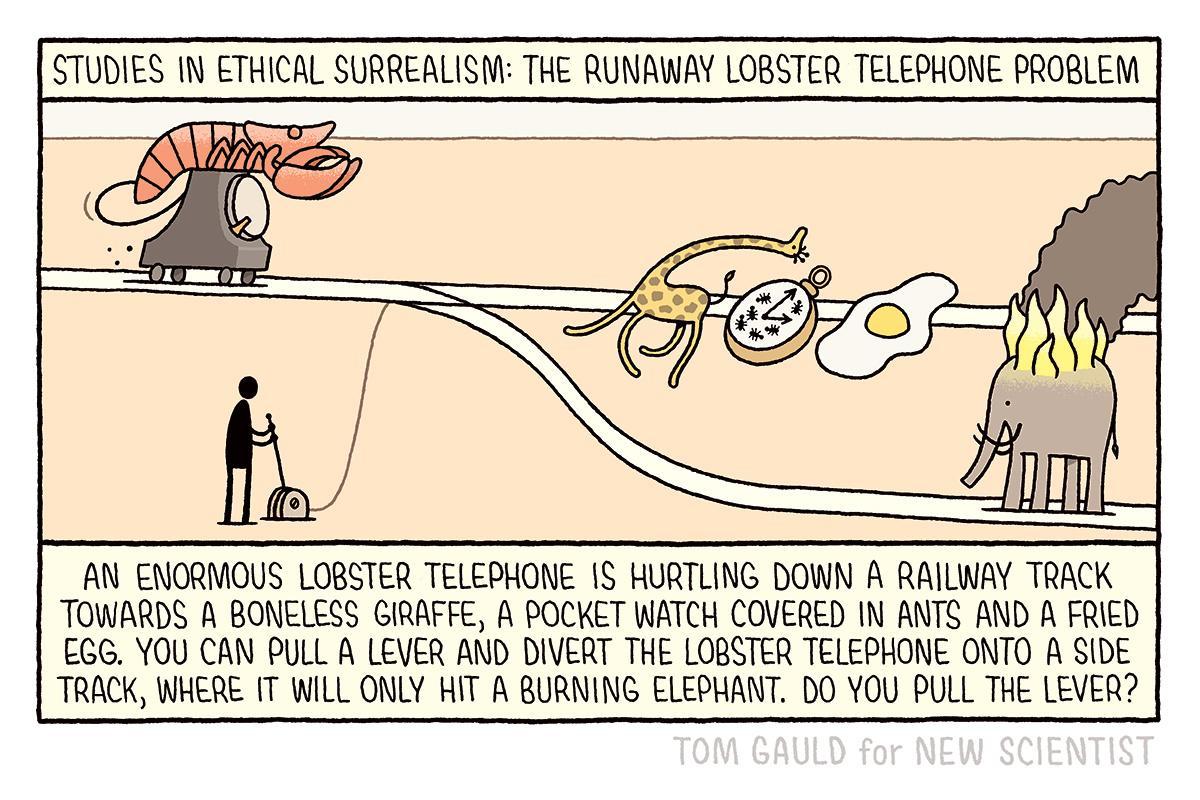
Tom Guald wants us to imagine a different trolly dilemma but with a different pair of options. Or is that the telephone game?

This image speaks for itself, so I won’t editorialise at the moment, save to mention that I find the scenario to be hilarious. If you like eating cooked lobster, I suppose that the elephant path makes the most sense—and of course, the elephant is already on fire.

What would you do?