What’s in a word?

Florida politicians have decided that ‘gay’ shan’t be uttered in their schools, their Senate having recently passed their ‘Don’t Say Gay‘ bill, a bill Tuesday that would prohibit “classroom discussion about sexual orientation or gender identity” in the state’s primary schools.

I don’t happen to agree with speech censorship, and I feel the politically correct speech vendetta is bollox. As a linguaphile, I don’t feel that words hold the meaning we ascribe to them. And I do feel it to be somewhat hypocritical for one group to say ‘don’t use words F, U, and N’ whilst simultaneously complaining that another side asks not to use other words—L, G, B, T, and Q’.

In the English-speaking West, we are concerned with words. Despite being raised hearing the familiar ‘sticks and stones may break my bones, but names shall never hurt me’, yet then worrying about hurtful words. It’s risible. Like the Floridian politicos, some people think words are magic—and not just like Harry Potter magic, or then again perhaps so.

I discovered when I lived in Japan that they don’t have swear words. This is a Western notion likely stemming from the repression generated by Abrahamic religions, commenced with not uttering the name of Jehova. And then we have levels of swear words. American and British English not only have different swear words, some of the same words fall into different offence-severity categories. I’ll get back to this. I recall when I studied French, pouring through my Larousse or Collins-Robert dictionary and seeing their asterisk system—ranging from 0 to 3.

Of course, 0-level words are everyday words one might choose to use in polite company. Level-1 words are considered to be mildly offensive. In English, these words might include damn, bitch, bastard, crap, or bollox—perhaps merde en français; level-2 words might be shit, bullshit, bollox, tits, arsehole, or asshole;—perhaps putain en français (not to be confused with poutine, which is not at all a swear word); level-3 words might include fuck and any of its derivatives, cocksucker, or cunt—perhaps pute en français. Interestingly, cunt is a level-3 word in American English, but more like a level-2 word in British English. At least it’s bandied about a lot more often. As for the French, con, operates at the same level as its British counterpart.

If this doesn’t convince the reader that it’s not all made up, I don’t know what will.

My point is that it’s not the words that hold the offence. It’s the intent behind them. For me, intent is just another weasel word. Unfortunately—and although entire legal systems are built on the concept—intent cannot be discerned. The culprit is intent, not lexical elements. And, yes, context is everything. Moderate politicians hoping on the PC bandwagon from the 1980s until now are the problem. Somehow, the wagon they hopped on is authoritarian and prescriptive—positions more often associated with people a bit further to the Right. But this still doesn’t address the notion of intent.

My position is that children are likely going to encounter same-sex couples. The agenda of those who don’t want it taught don’t want it to be normalised. Interestingly enough, Foucault—a notorious gay philosopher—argued against normalisation. It should be obvious that this would be his view given his position that normalisation is a control mechanism. Better to cherish the difference than to integrate.

Perception Is Not Reality

Nothing to add to what I’ve already said here. I just wanted to share another example of how our senses fill in what they expect rather than what is.

This photo is in black and white. It uses coloured grid lines to trick your brain into perceiving colour.

In other news, I just started reading Daniel Dennett’s classic Consciousness Explained. It starts with Brain in a Vat. Given that it was written in the late ’80s and published in the early ’90s, so it’s a bit behind the curve on the technology front. Artificial Intelligence—at least Machine Learning—wasn’t nearly as developed, and he didn’t quite grasp how fast and fast hardware and chip technology would advance in some 30 years. But this doesn’t alter the frame—just some peripheral details.

I’m not really even interested in consciousness. I favour Dennett’s take that consciousness is to the brain as wet is to water, so there’s not really any there there to find.

Monopoly on Reparations

Many places have histories of exploiting a group or groups to the advantage of others. Although this scenario applies to these people in a similar manner, I am thinking specifically of the exploitation and reparations due to the black and indigenous people of colour, BIPOC, in the United States.

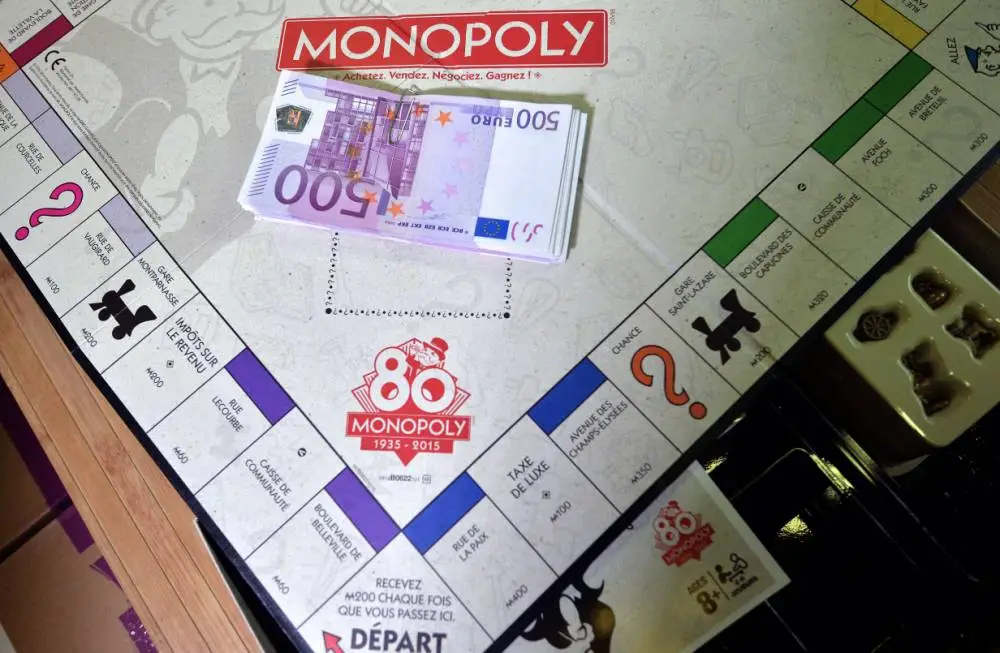
I believe that many people are familiar with Monopoly, the board game where, among other things, one accumulates properties and extracts rents from the other players. My intent is to illustrate with Monopoly the need for reparations, to illustrate why reparations are necessary to restore justice. This is a twist on John Rawls’ veil of ignorance thought experiment.

Slave auction advertisement

I have heard some people say that the past is the past, or if there were injustices in the past, that was ages ago, and now everyone has an equal chance. No special accommodations or affirmative actions are necessary. I don’t agree that this is true, but let’s just say for the sake of this exposition that opportunities are equal for everyone in a given society.

There are parallels between a game of Monopoly and the way we are thrown into this world. No one differs in this regard. We are all subject to a loin lottery.

Imagine that I already own all of the properties. You own none. Irrespective of how the game came to this condition, your chances of winning are nil to none. Now imagine that the reason for the disparate ownership was the result of a system of injustice perpetrated by the player I inherited my position from on the player you inherited yours.

No matter how fairly the game is from now until the end, if your starting place leaves me with all of the property and you without, your chances of winning are slim to none. Favouring tradition and inheritance already benefits some people over others, but when the benefit is the result of a pattern of injustices, it feels more egregious. Worse yet, even if I ‘give’ you Whitechapel Road, Baltic Avenue, or Rue Lecourbe and keep the rest, your chances have only slightly improved.

With the end of US Civil War and the emancipation proclamation, affected blacks were promised 40 acres and a mule. For most, this never happened. This remains an outstanding debt. And whilst 40 acres in some places would be a boon, not many today really need a mule, so descendants of slaves need to be made whole. Reparations are a way to accomplish this.

Reparations are payments in arrears to attempt to compensate for the centuries of an unbalanced playing field. And reparations should allow you to recover more than Whitechapel, Baltic, or Rue Lecourbe properties. At least get Bond Street, Pennsylvania Avenue, or Boulevard des Capucines. If you’ve played Monopoly, you’ll understand that this is still not enough.


Consciousness Is Religion

I expect that consciousness is a human nominative concept. Like religion, it will become smaller as science encroaches. In 1994, David Chalmers presented his idea of the hard problem of consciousness in a lecture, Toward a Scientific Basis of Consciousness, but I feel this is more due to the insufficiency of language than anything else. To me, consciousness isn’t well defined. It’s like a medical syndrome. It’s just a grouping of seemingly related conditions that haven’t yet been parsed. In time, it may be determined that they weren’t even related in the first place. Apophenia and cognitive dissonance are two significant human biases that affect perception.

At core, consciousness might be functionally reduced to that of an interpreter. Some have posited that the only thing that exists is ‘information’, whatever that means, so there only needs to be an interpreter—a translater. If that interpreter is defined as consciousness, then so be it. This appears to lead us to a Cartesian place—though it doesn’t follow that the self or ego exists. This would be a second-order event.

Anyway, just rambling. As seems to be the case lately, I’ve got little time to develop my thoughts. At least I’ve captured them for now.

Dear diary…

Nontonomy

Being critical of freedom, liberty, and autonomy is likely to make one the subject of scorn and derision. Most people tend to feel these things are self-evident attributes and goals, but they are all simply rhetorical functions. I was reading a passage in Mills’ On Liberty, where he posits

That the only purpose for which power can be rightfully exercised over any member of a civilized community, against his will, is to prevent harm to others. His own good, either physical or moral, is not a sufficient warrant … Over himself, over his body and mind, the individual is sovereign.

On Liberty, John Stuart Mill

It should come as no surprise that I question a position adopted by the Enlightenment Age. These geezers posited that many things were self-evident, but all of this is self-serving magical thinking, and there is no reason to have truck with any of it. These are all normative claims being dressed as positive, non-normative, ones, hoping to skirt scrutiny by employing a position of self-evidence.

I am generally critical of any notions of identity and self from the start, so affixing some attribute of power to it seems just silly.

It seems that I again am distilling this notion to a power equation. As a person, I want to claim power, if anything, over my self however that might be defined. And though, I would like this, too, it is nothing more than some emotional reaction.

Without delving into the depths of autonomy quite yet, on a proverbial desert island—as necessarily the case with any social constructs, where these notions are meaningless without a social context—adding a second person creates friction. Person A seemed to have full autonomy on this island—notwithstanding the other life forms on this island that are somehow never granted autonomy—now has had this autonomy reduced by the presence of Person B.

Firstly, Person A may have claimed this island to be their own. Given this, Person B is infringing on this autonomous decision, having arrived sequentially. Is Person B tresspassing? Does their presence harm Person B, be limiting their autonomy however slightly?

Mills’ concept is one of no harm: one is free to do what one chooses as so long as it doesn’t harm another. Accordingly, it says one is free to harm one’s self—essentially treating the self, the corpus, as personal property. Just as one could damage a piece of personal furniture, one could damage themself. I am not sure if Mills intend this to extend to suicide, but that’s not an important distinction here, so I’ll move on.

Let’s return to Person A on the island—only Person A is a woman and Person B is a fetus. What rights and autonomy does Person B now possess? For some, it has full autonomy; full personhood. Still, Person B is ostensibly trespassing, so does this autonomy even matter if it exists?

If you are Person X and own a house, and I, as Person Y, enter into it, how does this differ from A and B? Can you justify disallowing Person Y from exercising autonomy whilst supporting Person B? I don’t want to make this about abortion, so I’ll keep stop here.

Language Erosion

Those who know me know that linguistics was my first love—if only I thought it could have paid my bills. On balance, I am not a universalist—philosophically or linguistically. I love Noam Chomsky and I like Steven Pinker (notwithstanding his Enlightenment nonsense), but I am partial to theories that privilege disorder over order and language as erosion. This erosion is why grammar Nazis will always have something to complain about—and this doesn’t even take into account the distinction between spoken and written language that these folks refuse to recognise.

This WSJ article crossed my feed, and I was compelled to comment. Entropy is alive and well. Phonetic morphology favours erosion, and grammar is emergent. Although the evolutionary (devolutionary?) motion is complex, we can see where the once voiced K in knight and knee are now silent. Knight has been through the wringer, being reduced from a three-syllable word to only one—from /k nɪç t/ to /nɑ́jts/, now rhyming with night, which also retains the silent gh. For those who mock Cockney’s ‘Keef’ (as in Richards), the F /f/ phoneme takes less effort than TH /θ/. Although I wouldn’t be surprised to witness this TH to F drift in a hundred years, I would be surprised to find myself still alive and breathing. Written language retains vestiges of older pronunciations that confound many.

This is all I really wanted to say, though I can leave with other examples. In English, we see going to degrade to goin’ to and then to gonna. En français, on voit « il n’y a pas » se transforme en « n’y a pas » à « y’a pas » ou « ce n’est pas ce que je veux dire » devient « c’est pas c’que j’veux dire ».

In Support of War

Many of my co-workers live in Ukraine. Leading up to the current state of events, they reassured me not to listen to Western media accounts. Living in Kyiv—that my Russian colleagues scold me for not opting for Kiev—, these colleagues were shocked when their country began to be overrun, and they were forced to leave their city.

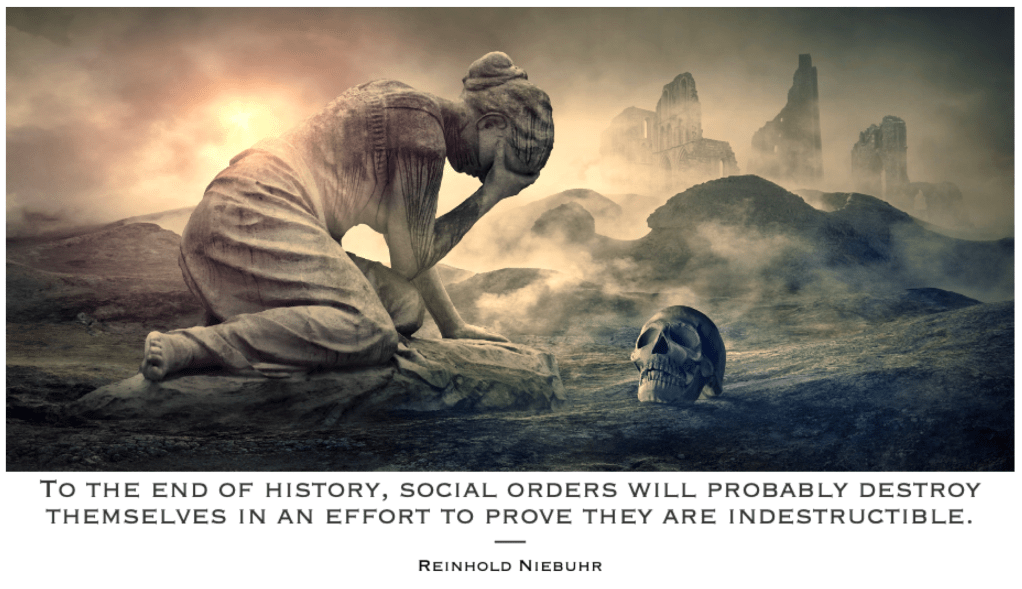
To the end of history, social orders will probably destroy themselves in an effort to prove they are indestructible. — Reinhold Niebuhr

Sadly, all politicians have their supporters. Thankfully, some parents raised their children to resist hapless politicians. This is bollox propaganda, but still.

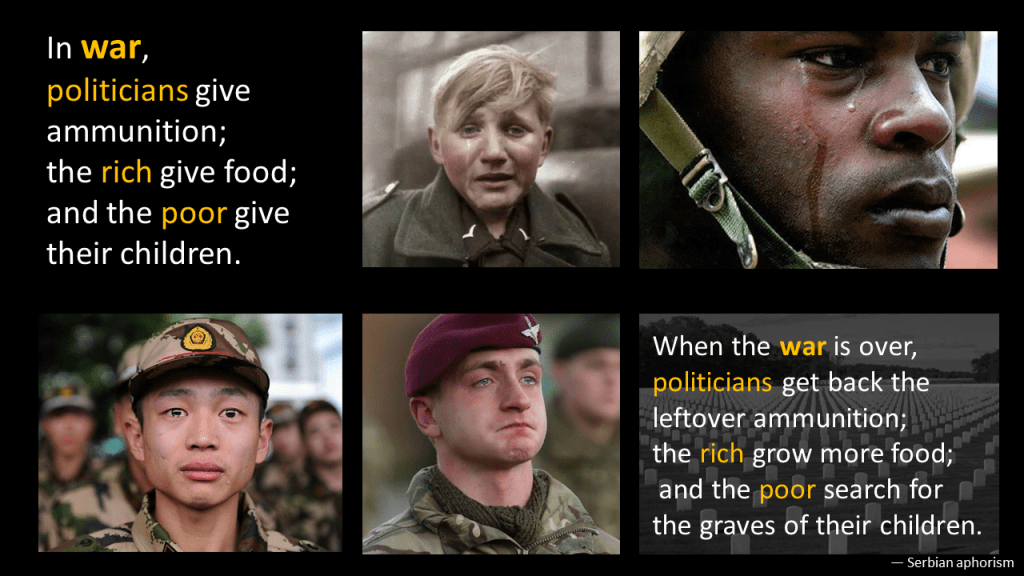
In war, politicians give ammunition; the rich give the food; and the poor give their children.

When the war is over, politicians get back the leftover ammunition; the rich grow more food; and the poor search for the graves of their children.

Serbian Aphorism

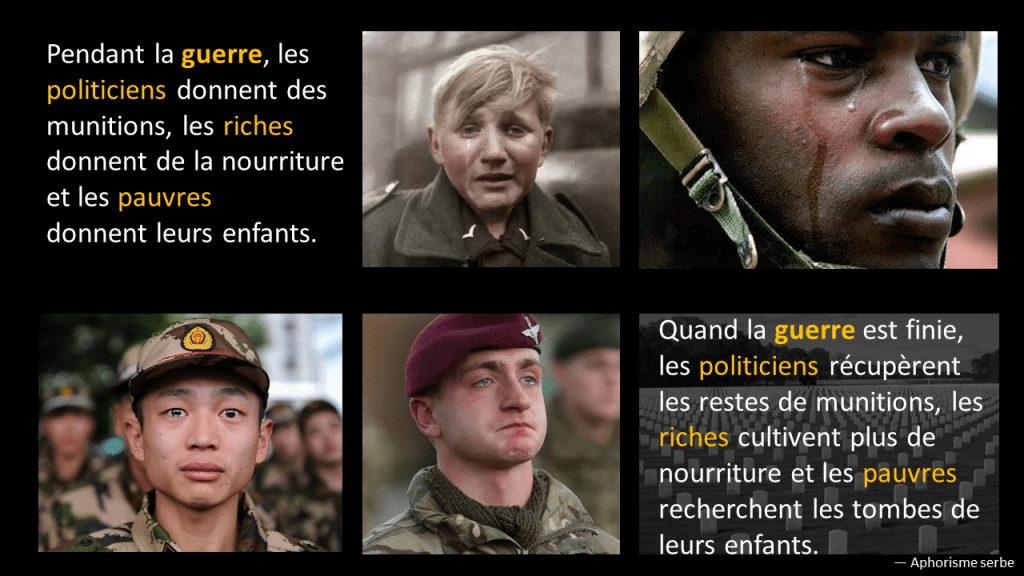
« Pendant la guerre, les politiciens donnent des munitions, les riches donnent de la nourriture et les pauvres donnent leurs enfants.

« Quand la guerre est finie, les politiciens récupèrent les restes de munitions, les riches cultivent plus de nourriture et les pauvres recherchent les tombes de leurs enfants. »

— Aphorisme serbe

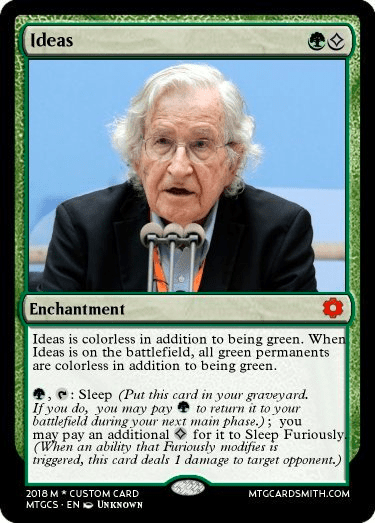
Colourless Green Ideas Sleep Furiously

I was thinking about a story idea, but it seems too daunting to attempt. Call it a mind experiment tethered to solipsism. The conceptual framework is this:

The premise is that ‘reality’ is generated in real-time—except there is no time; there is no space. All of this is constructed. Think of the sort of dream you may have experienced where physics-defying events occur. These dreams don’t care about the continuity of time or space. You can instantly be here and then there irrespective or where here and there are. One may even be in both places at once or nowhere at all. One can transform from one state to another or even be stateless. One doesn’t require an ego or a sense of I; rather, the I may shift without effort or it might dissolve. We are not encumbered by bodies. Vonnegut’s short story Unready to Wear—that for some reason indexed in my recollection as Pas prêts à porter.

In this world, perception is loaded into memory. But unlike a typical video game, the rest of the world is not a telos. It’s rather procedurally generated. In fact, even this is a poor analogy because the generation could be some stochastic process with no need to connect event 0 to event 1.

Empirically, events rely on preceding events. This is the world of cause and effect—a snooker ball collides with another and causes it to fall into a pocket; a stock price rises or falls, but these are not random events as they are inexorably linked to the past. As no one expects an unperturbed ball to jump into a pocket any sooner than one would expect a stock price to be truly random–to jump from 100 to 2 to 999 to 42. But with dreaming, all of this is possible.

Returning to the video game metaphor, what you see in the moment is all that is real. If you look in a particular direction, a table with a lamp and book on it might appear to be situated next to a chair; that registers as reality. But if you look away and then back, none of this needs to remain there. There needn’t be a table or a chair. Or there could be, but they don’t have to be the same table and chair; and there needn’t be a book.

In this reality, the mind—label it as you will—continually reconstructs whatever it wants to, simultaneously—apologies for the temporal terminology, but communication is restricted to the convention of shared meaning—and whatever it generates arrives with a plausible backstory. Given this, any history or relationships are always part of this fiction. Cognitive devices would be active to ensure this backstory appears to have continuity with our sense of the past; rather, it generates this plausible past. This past only has to be plausible in the moment—enough to hold the illusion together.

Consider a nebulous dream. These dreams don’t need to conform to conventions of time and space. But when we occasion to convey these dreams to a journal, a mate, or a therapist, we are forced to fit into a conventional spatiotemporal structure–first, this happened and I was here, and then that happened and I was there. But this was not the reality of the dream. This is subjectively experiential and so cannot be conveyed. In these dreams, there are no rules, but we apply structure that wasn’t really there in the first place; but we interpret time and space linearly and contiguously—even where no such structure exists. I think it would tedious to write and difficult to follow….. Perhaps better suited for an AI author.

To put a finer point on it, I’ll leave with a snippet. Let’s begin with the chair next to a table with a lamp and a book set upon it. You are a nuclear scientist on your way to a job interview at 3:30pm because why not?


A scheduled alarm awakens you. A clock on a bedside table reads 8 a.m. Your focus is on an interview this afternoon at 3:30, so you don the suit you’d set out the night before.

In the kitchen, you decline your partner’s offer of the soup he’s heated for lunch. He routinely eats soup for lunch on Thursdays.

The engine is still making a ticking sound, but you are distracted by the woman fussing with her makeup on the commuter train.

You’ve always preferred to take notes by hand with a fountain pen, having found the mass of the implement to add weight to your ideas.

Your wife, sipping café au lait on the sofa, smiles adoringly at you as you walk through the living room. She’s wearing that azure sweater she bought in Anchorage—or was it Chicago? The telephone rings.

“The captain has asked all passengers to fasten their seatbelts and prepare for a landing. We’ll be arriving at London Heathrow in about 20 minutes.” You close your laptop and acknowledge the flight attendant as she walks past.

You hang up the phone and tell your girlfriend it was a wrong number. You’re not sure that she believes you, but the barking dog distracts you. You don’t prefer to take lunch in public parks. You prefer the beach.

You pay for the trousers and accept the recommendation to purchase a leather belt. You’ve got to get back to your office. There’s not usually traffic at this hour. That’s why you left before 11.

Out of the corner of your eye, you catch a glimpse of your husband. What’s he doing in Sydney? You tell yourself that you must be mistaken and eat the last morsel on your plate, the waiter hovering with the check.

Ten more minutes you tell yourself as you glance at the clock on the wall. Don’t go off you plead with the alarm clock, but the cat walking across the bed tells you that this ten minutes will not be used catching up on sleep.

“Four. Seven minus three is four,” you offer.

“Very good. And what is seven plus three?”

This is your favourite part of Phantom, but you wonder what became of your date. On one hand, he seemed like a nice guy.

“There are only eleven. It says a dozen.”

You continue to read the same paragraph over and again but it doesn’t seem to make sense.

Why is that guy looking at you? He must know that you know that he’s staring.

You are trying to find the heat of the stage light so you can get into the shot. “Line?” you ask.

You lock the door of your hotel room behind you as imagine crashing on the bed in front of you, but you’ve just noticed that you’d forgotten your luggage.


As I just took a stream of consciousness approach save for actively quashing any semblance of contiguity. To be honest, I seriously considered entering snippets into a spreadsheet and then randomising the concepts. Another thought was to approach it like Mad Libs, but I opted for a more organic approach.

In the end, my goal was to dissolve concepts of sex or gender of time and place and of context in general. Looking back, it seems one could create continuity differently. In dreams I’ve experienced, I’ve awakened to discover an element in the environment likely inspired the events in a dream, so perhaps the ticking of the engine could have derived from the ticking of the alarm clock.

My initial goal was not one of continuity, but reading ex post facto, it might need something to keep attention—rather a string to follow out of the labyrinth. On the other hand, that is more of a testament to a need for some narrative.

And so it goes…

Shout out to Nick Bostrom’s essay Are You Living In a Computer Simulation?