Many racists, closeted and otherwise, cite The Bell Curve as proof that blacks are dumber than white people. Published in 1994, it’s controversial and bollocks. The first problem is with the notion of IQ testing itself, and then there’s the construction of the tests and relevance to aptitude. Anyone who’s read more than a handful of my posts know that I have long labelled the entire discipline of psychology a pseudoscience, so it would come as no surprise that a product of psychology is principally pseudoscience, too.
I’ve already moving on to new topics, so my parting point is that ordinary people find interpreting statistics to be an almost insurmountable challenge. Mark Twain recognised this in his quip, lies, damn lies, and statistics.
lies, damn lies, and statistics
Mark Twain
The problem is many professionals don’t understand statistics—even those whose function requires it. I was a professional statistician decades ago, so I have a certain fondness for it. I was even working on another post on the subject of the Simpson’s Paradox, but not quite yet—though it’s been weeks in the works. I am thinking about a post related to René Girard’s conflict theory as a lens and framework to understand the ‘insurrection’ at the US Capitol. I also want to react to the notion of metamodernism as a reaction to the conflict between modernism and postmodernism.
People influence one another and, when they’re together, they have a tendency to desire the same things, primarily not because those things are rare but because, contrary to what most philosophers think, imitation also bears on desire. Humans essentially try to base their being, their profound nature and essence, on the desire of their peers.
“Mimetic Desire: Shakespeare Rather than Plato.” When These Things Begin: Conversations with Michel Treguer, by René Girard and Trevor Cribben Merrill
Although I have some reservations—or at least reserve some latitude—, I tend to agree with Girard. Desire is a social construct. Desire is separate to needs. Desires are wants. As accomodated in Economics, we don’t need what we want, but we want what we need. We desire what we need.
we don’t need what we want, but we want what we need
What Girard is essentially saying is that I want what I want because you want it. This is independent of value in an economic sense. Memetically, the value of an object increases relative to the perceiver simply because another person wants it. In my reckoning, I’d separate want from desire or at least elevate desire to a higher degree of wanting.
Girard termed this triangular relationship between subject (you), object (the thing), and the mediator (the influencer) mimetic, to mimic. I suppose some of this might be considered to be memetic, but I also suppose that memes serve to simplify rather than serve as a distinct transmission vector.
circa 2016
My question is—exacerbated during this pandemic—how does this operate in isolation? I consider myself. I am not an ascetic by most definitions, but I am somewhat of a minimalist. My only ‘vices’ are my computer and my guitars. I used to be a professional musician—though most of that was spent on the other side of the console—and I was a Gibson snob. From the perspective of emotional desire, I still am. There is a certain nostalgia, but I don’t play out anymore, and I’m not seriously recording, so I don’t need the same perceived quality of an old Gibson.
Guitarists know that different guitars give different sounds. I’ve owned as many as 10 guitars at a time, and each had its purpose. Some was feel. This guitar was for Blues, this was other for Grunge, and that was for Jazz…and that for Fusion and that for a retro sound. This one had a fast neck, and this one sustained for days. This one was tuned à la Keith Richards, sans a string, to an Open G, and the was set up for Drop C, and of course there was the Standard-tuned one for good measure
Jason & Me circa 2012
Did I need 10 guitars? No. Did I need 1? Not really—not unless I wanted to be a musician, desired to be a musician, so the degree of freedom was l, given this other desire. Having 1 guitar for a guitar player is not the same as a painter with only one colour of paint, but it almost feels like it. It’s certainly a convenience, and it allows players to express themselves artistically.
The question isn’t why I desired a guitar, but why I wanted to be a musician, and of all the instruments, why the guitar—and why did I prefer this genre over that. I’ll admit that my tastes are rather eclectic, but all that says is that I mimic eclecticism or eccentrism. My parents are not eclectic. Most of my friends are mainstream whitebread people—none I’d deem eclectic.
I’m rambling. Just because I don’t remember the source of my desire doesn’t mean there is no source. Perhaps it’s a composite source. I can’t say. Perhaps the outcome I’m naming, say eclecticism, is incorrect, so I am seeking the wrong source.
circa 2004
My point was that I don’t need a Gibson to be satisfied. First, I’ve already owed them, and I don’t have the same performative needs. But I still want to play, and I still want to exercise some artistic freedom, so I still have a few guitars.
To wrap this up, I’ll leave with an unpaid mimitec endorsement of Harley Benton guitars. The last guitar I purchased was this Harley Benton Black Paisley TE70. It’s very fit, and I picked it up for about €200, which included shipping and handling. They are German-built. When I was a kid, a guitar at this price range would have be borderline unplayable and won’t sound shite-like. These aren’t €1,000 instruments, but you’d be hard pressed to find a 5x value differential. They are build solid and have been given extra care not previously seen in down-market instruments. If I wanted to spend another €200, I could upgrade the pickups and for a bit more swap out the electronics to bigger potentiometers—but I won’t. I was planning to splurge and spend €50 on locking machine heads. Nope. Good enough. At €200 a pop, I could afford all sorts of configurations, but even that desire has waned—at least a bit, at least for a while.
Amazon is threatening to pull the plug on Parler because of the content of its users. Google Play and Apple Store are pulling the Parler app from their offerings. These are private corporations and so are allowed to choose who they allow on their platforms, but these are dangerous grounds to tread. And it’s all too easy to fall into the mass hysteria—performative or otherwise—and let the mob rule.
Parler is a joke, but make no mistake this is the epitome fascist oligarchy and oligopoly. This is a concerted power play by the power brokers. The powers that be of the oligopoly are some of the same players as those of the oligopoly. And there is no mistaking the powers. They have the power to silence the president of the United States of America.
Olly, olly oxen free.
Let’s end-run around net neutrality.
Believe me. I feel that Donald J Trump is a vile person and a poor excuse for a human being. Viscerally, I wish they had silenced him 4 years ago—or 40, give or take. But this is clearly a shot over the bow.
A parallel in the public sector might be the way they got their foot in the door with income taxes back in the day. To pay for World War I, the US needed cash. Taxes are an easy scheme, but at the time most government operations were funded through tariffs, excise and use fees, and property taxes.
Taxing income was illegal, so there was a dilemma. But this dilemma had an easy solution. Let’s make incomes taxes legal, and we can tax the richest Americans the fair and modest amount of 1 per cent of income. The common man wouldn’t even notice.
Once taxing income was legal, the trojan horse having successfully breached the fortress, it was only a short while before the rates rose above 1 per cent and the tax base expanded to everyday workers, even as the wealthy moved away from an income-based existence to a capital gains-based one.
This is a textbook slippery slope.
Ferme-la!
My question is how does one get from ‘I disapprove of what you say, but I will defend to the death your right to say it’ to ‘Ferme-la!’ so easily?
I disapprove of what you say, but I will defend to the death your right to say it.
One if the biggest foci of postmodern philosophy is the metanarrative. Employment diversity is a place that the metanarratives go unquestioned by most. The most predominant aspect is the frame. Don’t accept it.
Inside this frame, some uncritically adopted narratives are as follows:
Work is good
Work builds character (proportionately to the effort exerted)
Work defines your value or worth as a human
Work signifies your place in society
Work is its own reward (except for monetary payment and recognition)
Value is defined by monetary achievement
Worth is defined by your place in an enterprise
And so on…
In this HBR article*, the frame has been established as a corporation and the diversity within this context. What this say by omission is that money and power is the measure of a meaningful existence. If only women were afforded a seat at this table—proportional to their population in society—, things will be even.
Women should start their own successful companies. Women should rise to the top of existing companies. Especially if they buy into the aforementioned narratives. Many women and men buy into this story lock, stock, and barrel (whatever that means), but only is you accept this as a frame is this relevant.
It’s easy to imagine a world where money is unnecessary, where labouring is unnecessary.
It’s easy to imagine a world where money is unnecessary, where labouring is unnecessary. Some have imagined a world without work, where people could instead pursue artistic endeavours, but this is just adopting a different set of narratives—like the person who exchanges drugs or alcohol for Jesus or some such. Out of the frying pan into the fire. This is the lie.
Interestingly, the HBR article makes these points:
Quantify gender equity in terms of economic gains for the company.
Hold leaders accountable for change by tying DEI metrics to performance reviews.
Offer development opportunities to increase gender intelligence, empathy, and self-efficacy.
Pull back the curtain on misperceived social norms.
Establish cross-gender professional relationships.
Frame, focus, and integrate interventions into core business outcomes and mission.
Notice that each of these operates from the perspective of the company. Granted, this is HBR, where the B is for Business, but still. Here’s the low down.
Gender equity will at some point increase your bottom line.
Create diversity metrics (and incentives) and tie them to performance review—presumably tied to the economic performance expected in bullet 1.
Educate your executives and staff to the misconceptions—so long as you don’t question the deeper metanarratives.
Essentially, the ask here is to establish male-female protégé-mentor relationships. Of course, this could be expanded to break binary gender stereotypes, too.
Back to business, frame the frame. But to tell the truth, I don’t even know how to interpret and summarise the provided example. It seems this is an admixture of points 1 and 2, given metrics should ladder up to stated objectives and outcomes.
asking for this equity in diversity is a short-term fix
In any case, asking for this equity in diversity is a short-term fix, but it’s unimaginative and buys into the worldview of the patriarchy. There is no reason to accept this prima facie. As with the notion of Democracy, I’d be willing to argue that the system itself is the problem and that any tinkering within the system is limited by the system itself.
* Apologies in advance if HBR has a paywall. Typically, the first 3 articles are free, but if you are like me that exhausts on day one.
How does one justify reason without reason? Isn’t this just circular reasoning— circular logic? Can one justify reason without employing reason? Can there be logic without reason?
The Age of Enlightenment is simultaneously the Age of Reason. Reason is the best path forward, and yet one can’t even board the train without a predisposition toward reason at the start.
This reminds me of the troubles the logical positivists encountered by claiming that everything need to be falsifiable, and yet this claim could not be falsified. It’s Hume’s ought problem.
One could employ empiricism, but can one arrive there alogically?
Is there a term for ‘not logical’ without the same baggage as illogical?
Alogical
Antilogical
Contralogical
Counterlogical
Delogical
Dislogical
Inlogical
Mislogical
Nonlogical
Oblogical
Unlogical
For example, a work of art is not (necessarily) logical, but neither is it illogical; this feels like improper usage. So, what prefix modifier would one employ to communicate ‘not within the sphere of logic’ in shorthand? Or is it just ‘not logical‘. That doesn’t seem quite right either.
I’m not a gamer. OK, so I have been known to play some games, but I’m not very good at them and don’t justify committing any significant time improving my playing skills. Besides, I’m fairly occupied outside of the gaming experience. Part of it, I think, is that games I don’t identify with the experience gaming offers. Driving games? No. Flying games? Nope. Shooting games? Nah. Puzzle games. For a few moments, then naw. Building games? Farming games? Role play games? Not so much. That said, many friends and associates play games, so I remain somewhat aware and occasionally participate badly. My son plays certain games, so I am aware enough to allow for a communication thread in the same way I am somewhat conscious of sports because my brother steeps himself in sports. But in practise, I couldn’t tell you the difference between Marcus Rashford and Alex Verdugo.
All of this said, I come upon a piece from a few months ago. Ultimately, it reads like a philosophy on gaming. In the piece, the author, Austin Walker reviews Watch Dogs: Legion and explains why it doesn’t live up to its meta potential. I haven’t played any of the Watch Dog games and might not ever, but his point seems to be that they had the best talent and could have been edgy, but they didn’t. He offers some possible solutions on the edge, but he leaves a fuller solution to the game makers.
For those unfamiliar with the context of Watch Dogs: Legion (as I was), it’s a collaborative anti-establishment game. It promises to rail against the oppressive, ultraconservative, fascist powers through collective action, but as Walker writes, this activity is performative. In the end, nothing changes beyond some superficiality.
Perhaps, this, itself, is the commentary: Nothing changes except at the margins, but I don’t think this was the intent. Instead, it’s about a place to redirect one’s anger and frustration, except there is no resolution. Perhaps it’s supposed to be more about the journey than the destination, but I’m not buying that either.
In any case, rather than summarise Walker’s work, I link to it to speak for itself. And despite its deficits, it still feels it reserves a space not yet occupied by other properties yet, so a little more imagination could inch it into just the right place.
For the record, the last game I enjoyed playing with friends was 7 Days to Die, which I’ve played on and off since 2013 or so. It’s come a long way since it was first released. Interestingly, it’s still in Alpha—some 8 years later, so I’m not sure what that even means anymore.
So, I’ve gone down a rabbit hole. Again. This time, it’s Žižek. Again. I’ve still not read any of Žižek’s own work, but people mention him often and he is a shameless self-promoter. In this video clip, he responds to whether gender is a social construct. Unfortunately, he conflates gender with sex, and his examples cite transsexuals not transgenders.
sex is about biological sex assignment
To set the stage, sex is about biological sex assignment—the sex category you are assigned into at birth: male, female, or other for some 1.8%. This is a simplistic categorisation: penis = male; vagina = female; both or neither: rounding error. In some cases, a decision is made to surgically conform the child to either male or female and ensure through prophylactic treatment that this isn’t undone hormonally in adolescence.
gender is about identity
Gender is about identity. As such, it is entirely a social construct. All identity of this nature is a function of language and society. In this world—in the West—, females wear dresses (if they are to be worn at all) and males don’t—kilts notwithstanding. In this world, sex and gender have little room for divergence. so the male who identifies as this gender (not this sex) is ostracised.
The example I usually consider first is the comedian Eddie Izzard—a cross-dresser. He’s probably a bad example because he does identify as a male. He just doesn’t wish to be constrained by male role restrictions and wants to wear the makeup that’s been reserved for women in the West at this time.
Žižek eventually gets to an argument about essentialism—so we’re back at Sorites paradoxes and Theseus again. At the start, I could argue that the sexual distinction has few meaningful contexts. For me, unless I am trying to have sex and/or procreate, the distinction is virtually meaningless. For others, only procreation remains contextually relevant. In this technological world, as Beauvoir noted in the late 1940s, strength differentials are not so relevant. End where they are, sex is not the deciding factor—it’s strength.
Žižek’s contention seems to be that the postmoderns (or whomever) disclaim essentialism in favour of constructivism but then resolve at essentialism as a defence because ‘now I am in the body originally intended’. I’ll argue that this is the logic employed by the person, but this person is not defending some academic philosophical position. They are merely engaging in idiomatic vernacular.
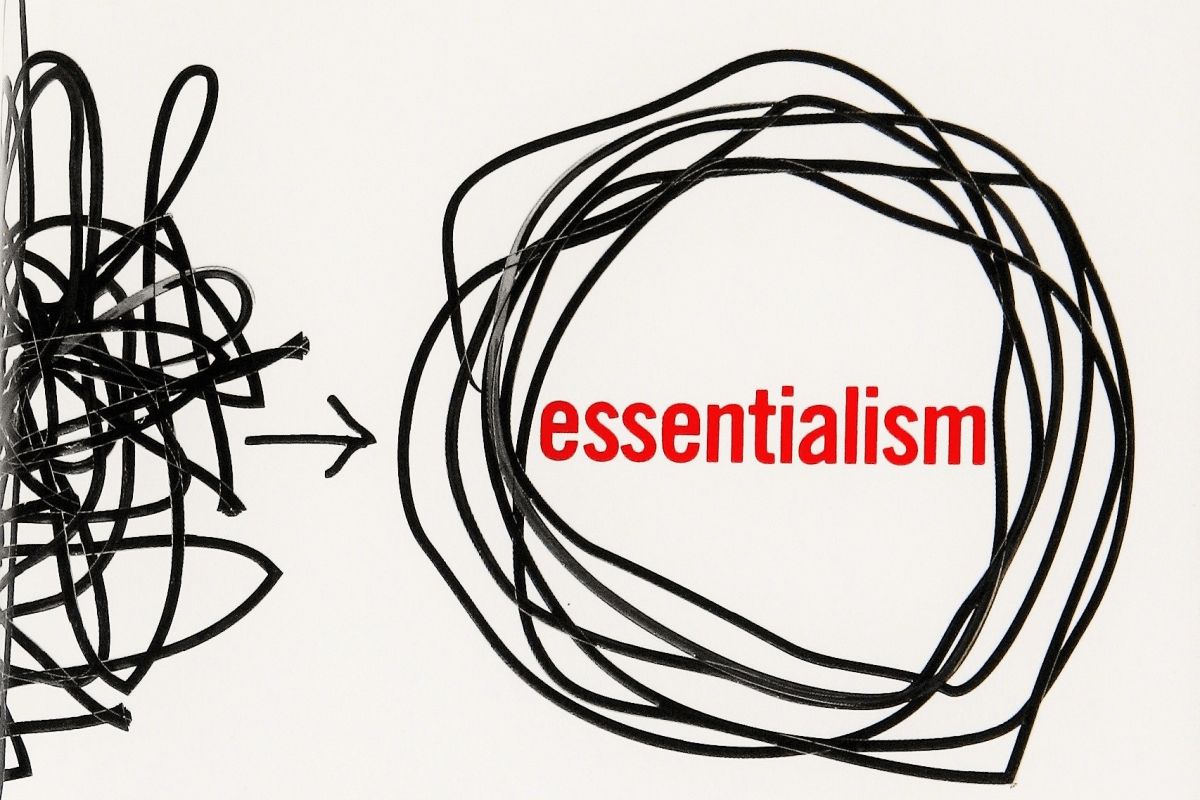
I am not deeply familiar with this space, and if the same person who is making a claim against essentialism is defending their actions with essentialism, then he’s got a leg to stand on. As for me, the notions of essentialism and constructivism are both constructed.
Mindfulness, as with yoga and other Eastern concepts, gets diluted for consumption by the West becoming McMindfulness. I learnt Buddhism circa 1980 in Japan, introduced by a friend from New Zealand. He translated for me because all services and teachings were given in Japanese. I won’t get into how the mind-body-spirit connection of yoga has devolved into an exercise regimen in the West.
Yoga
a Hindu theistic philosophy teaching the suppression of all activity of body, mind, and will in order that the self may realize its distinction from them and attain liberation
Most Westerners have attention spans of gnats, so many Eastern concepts need to be homogenised for the Western consumer and then dosed homoeopathically. Only then can the typical Westerner performatively claim to understand these Eastern notions. To be fair, some of the loss occurs because of the lack of depth of cultural understanding—the same loss happens from West to East as well—and some is language—the concept doesn’t have a direct translation, so we end up with close enough.
A simple but hopefully instructive anecdote might help. Westerners, especially English-speakers, are typically well-aware of the native Japanese speaker’s inability to articulate the L sound, and so ‘fried rice‘ is rendered something like ‘flied lice‘. Only, this not what’s being said. What we are hearing only approximates an L to our ears, but the L sound is not what’s being uttered. The Japanese language doesn’t have L or R phonemes, respectively /l/ and /r/. So the absence of the R-sound in Japanese and the lack of this alveolar sound in English brings us close to the L sound we presume to perceive. What they are saying is /ɹ/, which is in between these two sounds. They don’t have /l/ or /r/, and we don’t have /ɹ/, so the misinterpretation goes both ways. Only a person trained in this aspect of linguistics can map the relationship, but this mapping is imperfect but satisfactorily explanatory.
Mindfulness
the practice of maintaining a nonjudgmental state of heightened or complete awareness of one’s thoughts, emotions, or experiences on a moment-to-moment basis
Mindfulness is a member of the eightfold path of Buddhist doctrine. Mindfulness is about being conscious of ‘the world’ of one’s environment and yet not be focused or ‘attached’ to any particular aspect of it. it’s simply being aware. In Buddhism, the scope of mindfulness is particular to the dharma, of which the Four Noble Truths and the Eightfold Path are constituents, so technically speaking, one would need to have these aspects available in inventory.
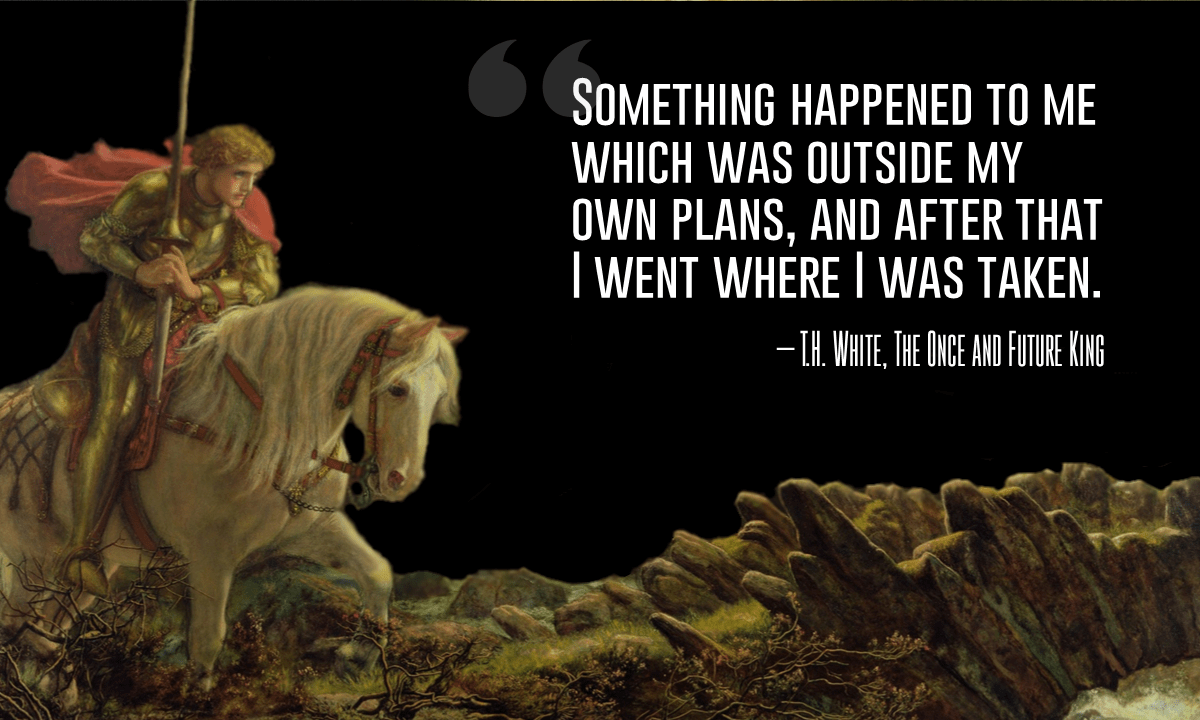
An Internet friend led me to this quote. I felt it was appropriate to share in reflection of 2020, not only for me but many people who were forced to go with the flow.
The quote reminded me of the mid-1990s, a time when I was steeped in the archetypal and depth psychology of Jung and Hillman. I also read a lot of works pertaining to the Holy Grail. I decided to composite the quote onto the cover image. I’m not asking for a holy grail. Let’s just hope 2021 fares better than 2020 by most accounts.
How Soon Is Now? Is there anything beyond now—is there a future? Was there a past? What better occasion to reflect on this than the turn of a new year, of a new decade?
Now is easy. It right here, and here, and here, and here… and interminable series of heres. The past is easy, too, we were there—the accumulation of former heres—, so at least we can claim it was real at the time—or as real as we could perceive and can imagine. Memory frailties notwithstanding, the past is indelible. Whether we are or can be aware is another story.
Past is different to history. Past is an event or events. We may not even become aware of these events until they have passed—perhaps centuries or millennia later. These may be historicised. History is a story. In French, the terms aren’t even separated. L’histoire is simultaneously a story and history, a reminder of how inextricable they are.
But what about the future? A conceptual future is a fairly new human construct. Some events occuring after now have happened since the beginning of time. In fact without time or the invention of a notion of time, there can be no future or past. It’s been said that time is what keeps everything from happening at once.
“Time is what keeps everything from happening at once.”
We talk about the future, but when we reference it now, it’s only some speculative future—some admixture of uncertainty and probabilities. There are no guarantees any given event will actually manifest, whether we will be there to experience it, or whether any future will even arrive. This is a known limitation of empiricism. That the sun has risen for some 4 billion years doesn’t guarantee it will rise tomorrow. There is nothing necessarily preventing the universe from ceasing to exist tomorrow or in an instant, pardoning the nomenclature of time.
Where our perception of now is already quite limited in scope and experience, any notion of future is decidedly worse. And of all of the possible threads and imagined threads, only one will manifest—unless you subscribe to parallel universe models, in which case you can still only experience one and only one, at least for the time being.
From the perspective of now, the future, like history, is just a story. In these times of COVID, we should realise that some stories hadn’t been written. Similar storylines had been imagined and authored, but the one that manifest was different still. Truth is stranger than fiction—and worse.
But does the future exist? Can we discuss the future other than conceptually? Is the notion of future reserved for a privileged few? One so-called cognitive bias is that humans favour now and near-term events over further future events? From an evolutionary perspective, this makes perfect sense. First, I am here now, and whether I am here to experience the future remains to be seen. This bias is the basis for why most people don’t save enough for a comfortable retirement—a retirement with a comparable standard of living and quality of life as one’s ‘productive’ years.
One consideration is expected lifespan. Actuarially, a person might be expected to live on average, say, 76 years. If people my family historically live to 65 and I expect to retire thereabouts, saving past that is inefficient—transferring wealth across generations notwithstanding. If I die at 65, there is no mismatch. If I die at 76, then oopsie. Retirement income and savings is predominantly a First-world problem—a challenge for people who live in an income-based, consumerist society, so worrying about the future takes on a more relevance.
Even if I expect my village, tribe, or family care for me in my twilight years, there is still a notion of future to consider. Will they be there for me. But from an evolutionary perspective, this doesn’t necessitate a future beyond a generation, so the probability of an uncertain event is lower than, say, a thousand years from now.
NB: What had been a concept riffing on Hoffman’s evolutionary argument against reality was intercepted by the related notion of the future. I hope to return to Hoffman presently—if the future allows.