Rejection Letter

Rejected Note
2–3 minutes

Dear Author. [REDACTED] does not accept the submission of personal works produced by students, independent researchers, or professionals who have not yet attained a doctoral level. This is a moderation policy intended to ensure that publications deposited on the platform originate from qualified researchers affiliated with a recognized institution (REDACTED) and acknowledged for their expertise or previous work in the relevant field of research. This rule applies regardless of the quality or scientific value of the work, which is by no means in question here. We therefore regret to inform you that we are unable to accept this submission. If you wish, we invite you to share your work through other open platforms such as Zenodo, which allow all authors to make their research visible. Thank you for your understanding. Kind regards

Allow me to rephrase this:

Disappointing, though hardly surprising. This is the same logic as age-based thresholds I have recently taken a hammer to: crude proxies elevated into moral and epistemic gatekeepers. Not ‘is this good?’, but ‘are you old enough, stamped enough, letterheaded enough to be taken seriously?’. A bureaucratic horoscope.

Yes, I use Zenodo. I use PhilPapers. I will continue to do so. But let’s not pretend all platforms are socially equivalent. Journals still function as credibility engines, not because they magically improve truth, but because they distribute legitimacy. To be excluded on status grounds alone is not a quality filter. It is a caste system with footnotes.

And journals already make participation unnecessarily hostile. Many refuse work that has been publicly shared at all, even in preprint form. Lead times stretch to a year or more. The result is that anyone attempting to contribute to live debates is instructed to sit quietly whilst the conversation moves on without them. In a so-called knowledge economy, this is an astonishing self-own.

What we have, then, is a system that:

  • equates institutional affiliation with epistemic competence,
  • penalises open dissemination,
  • and delays circulation until relevance decays.

All in the name of rigour.

I will keep submitting elsewhere. There are other journals. There always are. But let’s stop pretending this is about protecting standards. It is about preserving a hierarchy that mistakes accreditation for insight and treats independent thought as a contamination risk.

Knowledge does not become true by passing through the right doorway. It merely becomes approved. I’ll not witter on about the bollocks of peer review.

Hooray for Me – The 1,000-Download Threshold

2–3 minutes

Some milestones arrive quietly; others tap you on the shoulder and whisper, “Well? Are you going to gloat, or shall I?”

So here we are. The Anti-Enlightenment corpus – yes, that unruly battalion of essays insisting that the Enlightenment was less a dawn and more a flash-bang grenade into the human psyche – is about to pass 1,000 downloads across Zenodo and PhilArchive. By the time you read this, the counter will likely have ticked over, as if to confirm that a non-institutionally affiliated heretic can, in fact, find readers willing to squint at philosophy written in the half-light.

I should say something gracious. Something humble. Something befitting a scholar who’s spent far too much time dismantling the sacred furniture of modernity.

Instead, I’ll say this:

Hooray for me!

Video: Midjourney woman sketch for no apparent reason (no sound)

And hooray for you, the masochists who keep downloading this stuff.

Whether it’s Objectivity Is Illusion, which politely reminds you that truth is just a social ritual in a lab coat, or Against Agency, where we pretend the autonomous self was ever more than Enlightenment-era fan fiction, or The Will to Be Ruled, in which we accept that most people would rather outsource their freedom to the nearest charismatic authoritarian – each piece contributes to the great unmasking of reason’s beloved myths.

If you’ve made your way through The Illusion of Light (cloth or paperback – the cloth is for people who enjoy prestige bindings with their epistemic despair – or on Kindle for the ones who have already surrendered), you’ve already walked the whole architecture: rooms filled with rational ghosts, temporal anxieties, moral fictions, and the faint smell of Enlightenment wiring beginning to smoulder.

And still you download. Saints, the lot of you.

A thousand reads does not confer legitimacy – nothing so vulgar – but it does confirm that the cracks in the Enlightenment’s porcelain façade are visible from more than one angle. It suggests that others, too, are learning to see in the dark, to navigate by afterglow rather than glare.

So: thank you.

For the curiosity.

For the tolerance of structural pessimism.

For indulging a scholar who insists on disassembling Western metaphysics one lovingly overlong sentence at a time.

Here’s to the next thousand. And the thousand after that. And to the collective, slow, post-Enlightenment work of maintenance in the half-light.

The Anti-Enlightenment lives on your hard drives now.

There’s no taking it back.

Rational Ghosts: Why Enlightenment Democracy Was Built to Fail

3–4 minutes

We are governed by phantoms. Not the fun kind that rattle chains in castles, but Enlightenment rational ghosts – imaginary citizens who were supposed to be dispassionate, consistent, and perfectly informed. They never lived, but they still haunt our constitutions and television pundits. Every time some talking head declares “the people have spoken”, what they really mean is that the ghosts are back on stage.

👉 Full essay: Rational Ghosts: Why Enlightenment Democracy Was Built to Fail

The conceit was simple: build politics as if it were an engineering problem. Set the rules right, and stability follows. The trouble is that the material – actual people – wasn’t blueprint-friendly. Madison admitted faction was “sown in the nature of man”, Rousseau agonised over the “general will”, and Condorcet managed to trip over his own math. They saw the cracks even while laying the foundation. Then they shrugged and built anyway.

Audio: NotebookLM podcast on this topic.

The rational ghosts were tidy. Real humans are not. Our brains run on shortcuts: motivated reasoning, availability cascades, confirmation bias, Dunning–Kruger. We don’t deliberate; we improvise excuses. Education doesn’t fix it – it just arms us with better rationalisations. Media doesn’t fix it either – it corrals our biases into profitable outrage. The Enlightenment drafted for angels; what it got was apes with smartphones.

Even if the ghosts had shown up, the math betrayed them. Arrow proved that no voting system can translate preferences without distortion. McKelvey showed that whoever controls the sequence of votes controls the outcome. The “will of the people” is less an oracle than a Ouija board, and you can always see whose hand is pushing the planchette.

Scale finishes the job. Dunbar gave us 150 people as the human limit of meaningful community. Beyond that, trust decays into myth. Benedict Anderson called nations “imagined communities”, but social media has shattered the illusion. The national conversation is now a million algorithmic Dunbars, each convinced they alone are the real people.

Audio: This is a longer (40-minute) NotebookLM podcast on the essay itself.

Why did democracy limp along for two centuries if it was this haunted? Because it was on life-support. Growth, war, and civic myth covered the cracks. External enemies, national rituals, and propaganda made dysfunction look like consensus. It wasn’t design; it was borrowed capital. That capital has run out.

Cue the panic. The defences roll in: Churchill said democracy was the “least bad” system (he didn’t, but whatever). Voters self-correct. Education will fix it. It’s only an American problem. And if you don’t like it, what – authoritarianism? These are less arguments than incantations, muttered to keep the ghosts from noticing the creaks in the floorboards.

The real task isn’t to chant louder. It’s to stop pretending ghosts exist. Try subsidiarity: smaller-scale politics humans can actually grasp. Try deliberation: citizens’ assemblies show ordinary people can think, when not reduced to a soundbite. Try sortition: if elections are distorted by design, maybe roll the dice instead. Try polycentric governance: let overlapping authorities handle mismatch instead of hammering “one will”. None of these are perfect. They’re just less haunted.

Enlightenment democracy was built to fail because it was built for rational ghosts. The ghosts never lived. The floorboards are creaking. The task is ours: build institutions for the living, before the house collapses under its own myths.

The Argument in Skeleton Form

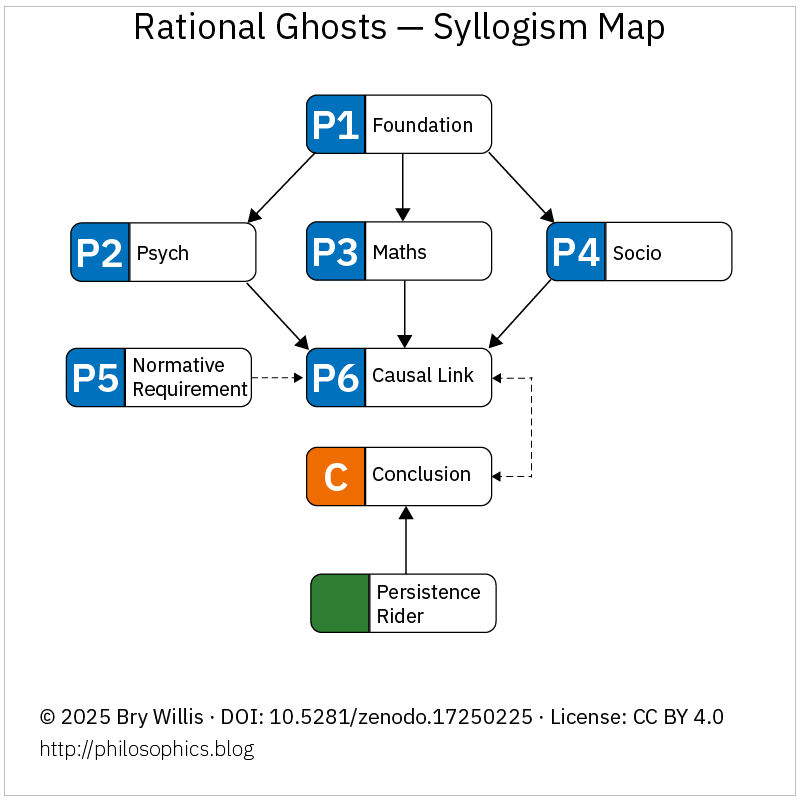
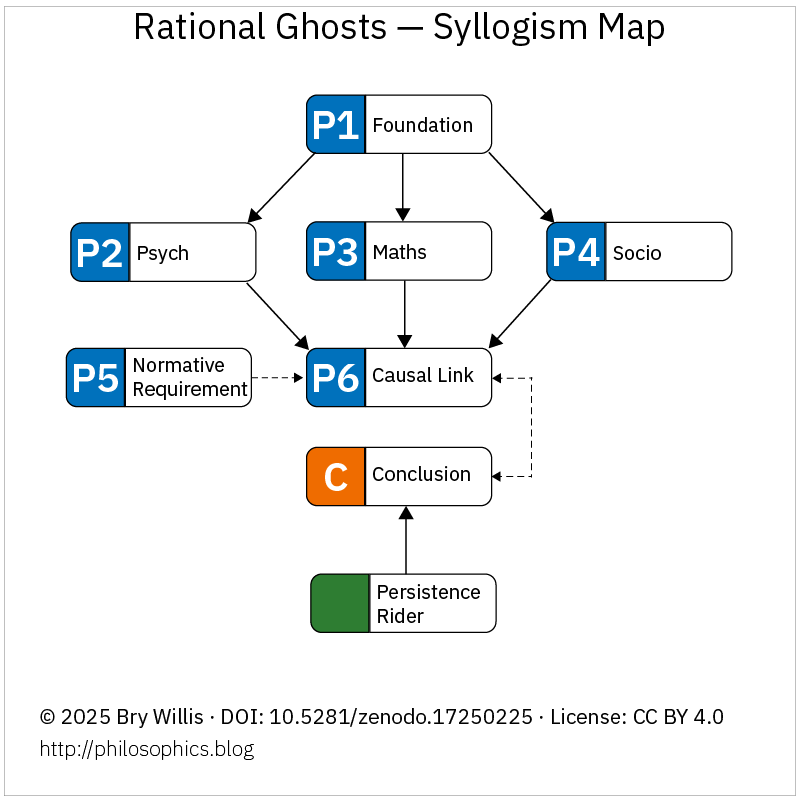
Beneath the prose, the critique of Enlightenment democracy can be expressed as a syllogism:
a foundation that assumed rational citizens collides with psychological bias, mathematical impossibility, and sociological limits.
The outcome is a double failure – corrupted inputs and incoherent outputs – masked only by temporary props.

Figure: Logical skeleton of “Rational Ghosts: Why Enlightenment Democracy Was Built to Fail.” For the complete essay, with sources and elaboration, see the open-access preprint on Zenodo: https://doi.org/10.5281/zenodo.17250225