🤔 If liberation now feels indistinguishable from exhaustion, what exactly have we been freed from?
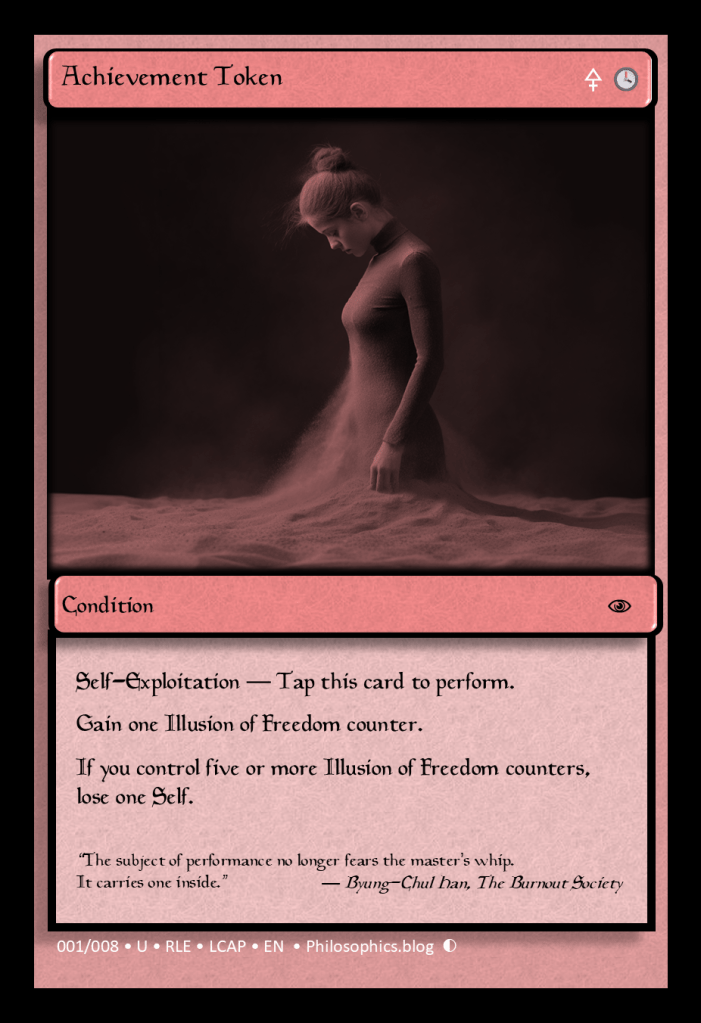
Image: Exhaustion means you’re working hard, and working hard means you’re good.
Han’s slender essay reads like a diagnosis of our psychic economy. The disciplinary society of ‘thou shalt’ has dissolved into the achievement society of ‘yes, I can’. We no longer rebel against authority; we internalise it, polishing our exhaustion until it gleams like ambition. Productivity replaces purpose. Rest becomes guilt. The subject, stripped of exterior constraint, now self-flagellates in the name of freedom.
We exploit ourselves and think we are free.
What Han captures is not mere fatigue but a civilisational pathology: the compulsion to optimise the self as though it were capital. Burnout is not the collapse of will but the logical conclusion of unlimited permission.
If liberation now feels indistinguishable from exhaustion, what exactly have we been freed from?
From the series Readings in Late Exhaustion – a Philosophics reflection on the maladies of modernity.
About the Series — Readings in Late Exhaustion
These cards belong to Readings in Late Exhaustion, a Philosophics project tracing the psychic and cultural costs of late capitalism.
Each card interprets a contemporary work of critical theory through the language of collectable gameplay, where identity, labour, and value become quantified acts.
The format itself is the critique: a system of self-expenditure disguised as achievement, reflection rendered as performance.
Let us disabuse ourselves of one of the workplace’s most cherished delusions: that Human Resources is there for the humans. HR is not your therapist, not your advocate, not your confessor. HR is an appendage of the organisation, and like all appendages, its nerve endings run straight back to the corporate brain. Its “concern” for your well-being is merely a prophylactic against lawsuits and productivity dips. The error is ours; we persist in mistaking the guard dog for a pet.
Audio: NotebookLM podcast on this topic.
Bal and Dóci’s 2018 paper in the European Journal of Work and Organizational Psychology (EJWOP) tears the mask off this charade. They demonstrate how neoliberal ideology has seeped, unseen, into both workplace practice and the very research that pretends to study it objectively. Through the lenses of political, social, and fantasmatic logics, they show that neoliberalism has convinced us of three dangerous fairy tales:
Instrumentality: people are not people but “resources,” as fungible as printer ink.
Individualism: you are not part of a collective but a lone entrepreneur of the self, shackled to your CV like a Victorian debtor.
Competition: you are locked in an endless cage fight with your colleagues, grinning through the blood as you “collaborate.”
These logics are then dressed up in fantasies to keep us compliant: the fantasy of freedom (“you’re free to negotiate your own zero-hours contract”), the fantasy of meritocracy (“you got that promotion because you’re brilliant, not because you went to the right school”), and the fantasy of progress (“growth is good, even if it kills you”).
Those of us with an interest in Behavioural Economics had naively hoped that the mythical homo economicus, that laughable caricature of a rational, utility-maximising automaton, would by now be filed under “anachronistic curiosities.” Yet in corporate domains, this zombie shuffles on, cosseted and cultivated by neoliberal ideology. Far from being discredited, homo economicus remains a protected species, as if the boardroom were some Jurassic Park of bad economics.
The brilliance and the horror is that even the academics meant to be studying work and organisations have been captured by the same ideology. Work and Organisational Psychology (WOP) too often frames employees as variables in a productivity equation, measuring “engagement” only in terms of its effect on shareholder value. The worker’s humanity is rendered invisible; the employee exists only insofar as they generate output.
So when HR offers you a mindfulness app or a “resilience workshop,” remember: these are not gifts but obligations. There are ways of making you responsible for surviving a system designed to grind you down. The neoliberal trick is to convince you that your suffering is your own fault, that if only you had been more proactive, more adaptable, more “employable,” you wouldn’t be so crushed beneath the wheel.
Bal and Dóci are right: the way forward is to re-politicise and re-humanise organisational studies, to see workers as humans rather than performance units. But until then, expect HR to keep smiling while sharpening its knives.



 Philosophics