What if the biggest trick language played on you is convincing you that the world is made of things?
Every sentence you speak installs a hidden assumption. ‘The rock falls.’ ‘The mind thinks.’ ‘The electron orbits.’ Each one presupposes a thing – a noun – that exists before anything happens to it. Your grammar tells you: first, there are objects, then they do stuff. But what if that’s backwards?
The Mediated Encounter Ontology – MEOW – proposes that it is. Reality isn’t made of things. It’s made of structured interactions. Encounter-events – relational, patterned, constrained – are what’s ontologically basic. Objects, subjects, minds, worlds: these are all downstream. They’re what you get when structured interaction stabilises within a given scale of encounter.
I’ve commenced a new series in support of my new book. First, I’m building a glossary.
Video: Bry – Architecture of Encounter
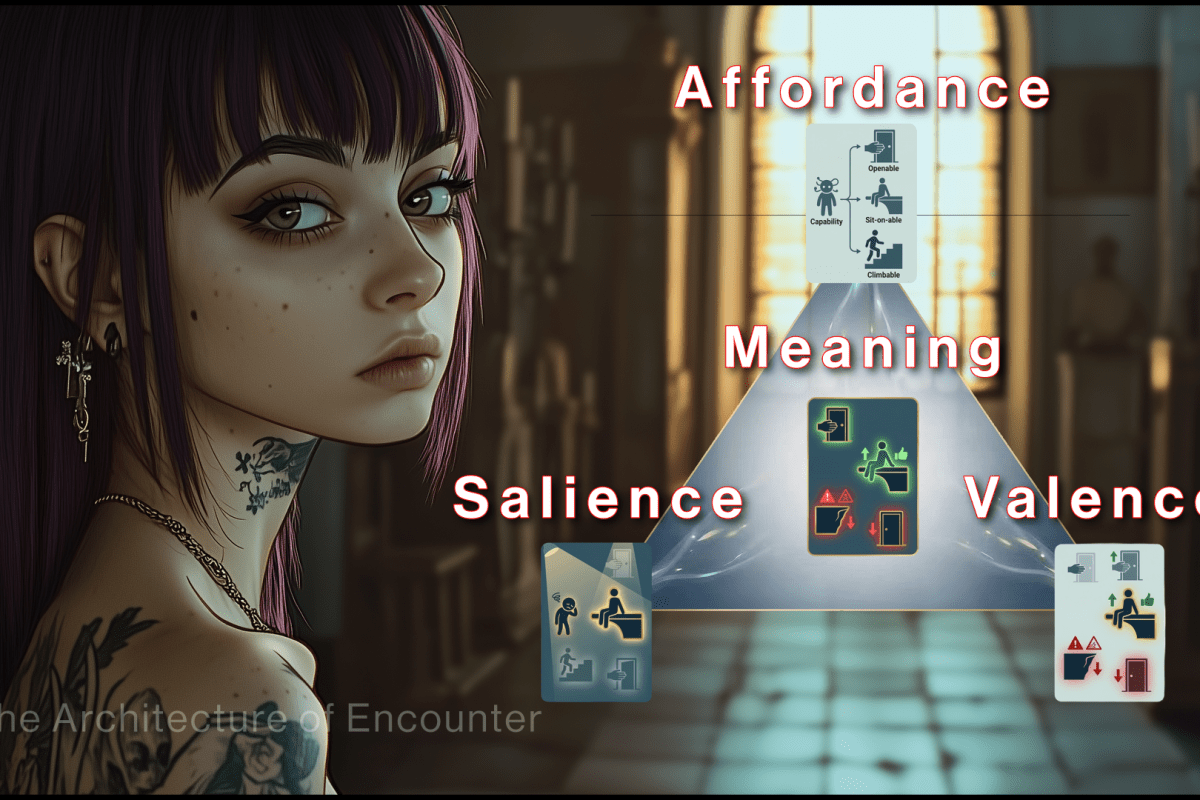
On the docket in this segment are affordance, salience, and valence as they relate to the book. I selected these terms from the glossary in the appendix.
Over the next few weeks, I plan to produce videos on other terms and additional videos explaining key concepts. This one is straightforward and academic. Others will be less formal, hoping to accommodate different learning styles.
Does anyone subscribe to Kindle Unlimited? I may take time to create Kindle and eBook versions.
My fiction books had some formatting issues with Kindle, but these titles are more standard – no fancy layouts or fonts, and not too many images.
The first step is to stop pretending that ‘truth’ names a single thing.
Philosopher Bernard Williams helpfully distinguished between thin and thick senses of truth in Truth and Truthfulness. The distinction is simple but instructive.
In its thin sense, truth is almost trivial. Saying ‘it is true that p’ typically adds nothing beyond asserting p. The word ‘true’ functions as a logical convenience: it allows endorsement, disquotation, and generalisation. Philosophically speaking, this version of truth carries very little metaphysical weight. Most arguments about truth, however, are not about this thin sense.
In practice, truth usually appears in a thicker social sense. Here, truth is embedded in practices of inquiry and communication. Communities develop norms around sincerity, accuracy, testimony, and credibility. These norms help stabilise claims so that people can coordinate action and share information.
At this level, truth becomes something like a social achievement. A statement counts as ‘true’ when it can be defended, circulated, reinforced, and relied upon within a shared framework of interpretation. Evidence matters, but so do rhetoric, persuasion, institutional authority, and the distribution of power. This is the sense in which truth is rhetorical, but rhetoric is not sovereign.
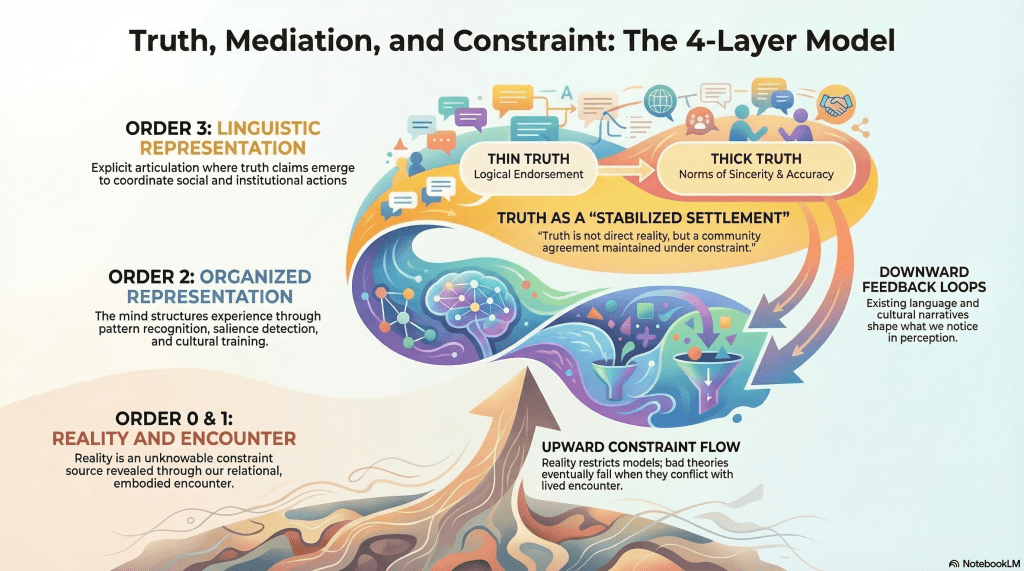
NotebookLM Infographic on this topic. I prompted NotebookLM to illustrate a 4-layered model that shows how removed language is from encounter, attention, conception, and representation of what we normally consider to be reality. This view is supported by both MEOW and LIH.
Human beings can imagine almost anything about the world, yet the world has a stubborn habit of refusing certain descriptions. Gravity does not yield to persuasion. A bridge designed according to fashionable rhetoric rather than sound engineering will collapse regardless of how compelling its advocates may have been.
This constraint does not disappear in socially constructed domains. Institutions, identities, norms, and laws are historically contingent and rhetorically stabilised, but they remain embedded within material, biological, and ecological conditions. A social fiction can persist for decades or centuries, but eventually it encounters pressures that force revision.
Subjectivity, therefore, doesn’t imply that ‘anything goes’. It simply means that all human knowledge is mediated.
We encounter the world through perception, language, culture, and conceptual frameworks. Every description is produced from a particular standpoint, using particular tools, within particular historical circumstances. Language compresses experience and inevitably loses information along the way. No statement captures reality without distortion. This is the basic insight behind the Language Insufficiency Hypothesis.
At the same time, our descriptions remain answerable to the constraints of the world we inhabit. Some descriptions survive repeated encounters better than others.
In domains where empirical constraint is strong – engineering, physics, medicine – bad descriptions fail quickly. In domains where constraint is indirect – ethics, politics, identity, aesthetics – multiple interpretations may remain viable for long periods. In such cases, rhetoric, institutional authority, and power often function as tie-breakers, stabilising one interpretation over others so that societies can coordinate their activities. These settlements are rarely permanent.
What appears to be truth in one era may dissolve in another. Concepts drift. Institutions evolve. Technologies reshape the landscape of possibility. Claims that once seemed self-evident may later appear parochial or incoherent.
In this sense, many truths in human affairs are best understood as temporally successful settlements under constraint.
Even the most stable arrangements remain vulnerable to change because the conditions that sustain them are constantly shifting. Agents change. Environments change. Expectations change. The very success of a social order often generates the tensions that undermine it. Change, in other words, is the only persistence.
The mistake of traditional realism is to imagine truth as a mirror of reality – an unmediated correspondence between statement and world. The mistake of crude relativism is to imagine that language and power can shape reality without limit. Both positions misunderstand the situation.
We do not possess a final language that captures reality exactly as it is. But neither are we free to describe the world however we please. Truth is not revelation, and it is not mere invention.
It is the provisional stabilisation of claims within mediated encounter, negotiated through language, rhetoric, and institutions, and continually tested against a world that never fully yields to our descriptions. We don’t discover Truth with a capital T. We negotiate survivable descriptions under pressure.
What’s Maphra singing a Bring Me the Horizon cover have to do with philosophy?
Absolutely nothing… maybe.
Audio: Spotify version.
I’ve finished my book, and I spent hours discovering new music. Of course, the song is from 2015, but the treatment is new, and her voice is brilliant. Amazing control. I think it’s an upgrade on an already decent song, but what do you think? 🧐
I never forget that my first career was as a musician. It’s in my blood. Listen or not, but you’re missing out.
Wait for it… This parodies the use of language to sidestep Constitutional inconveniences. In the game show format, we learn what is and isn’t a war. Wittgenstein would be proud.
Video: Short parody asks the question, Is it war?
Watch this and build up your English language vocabulary.
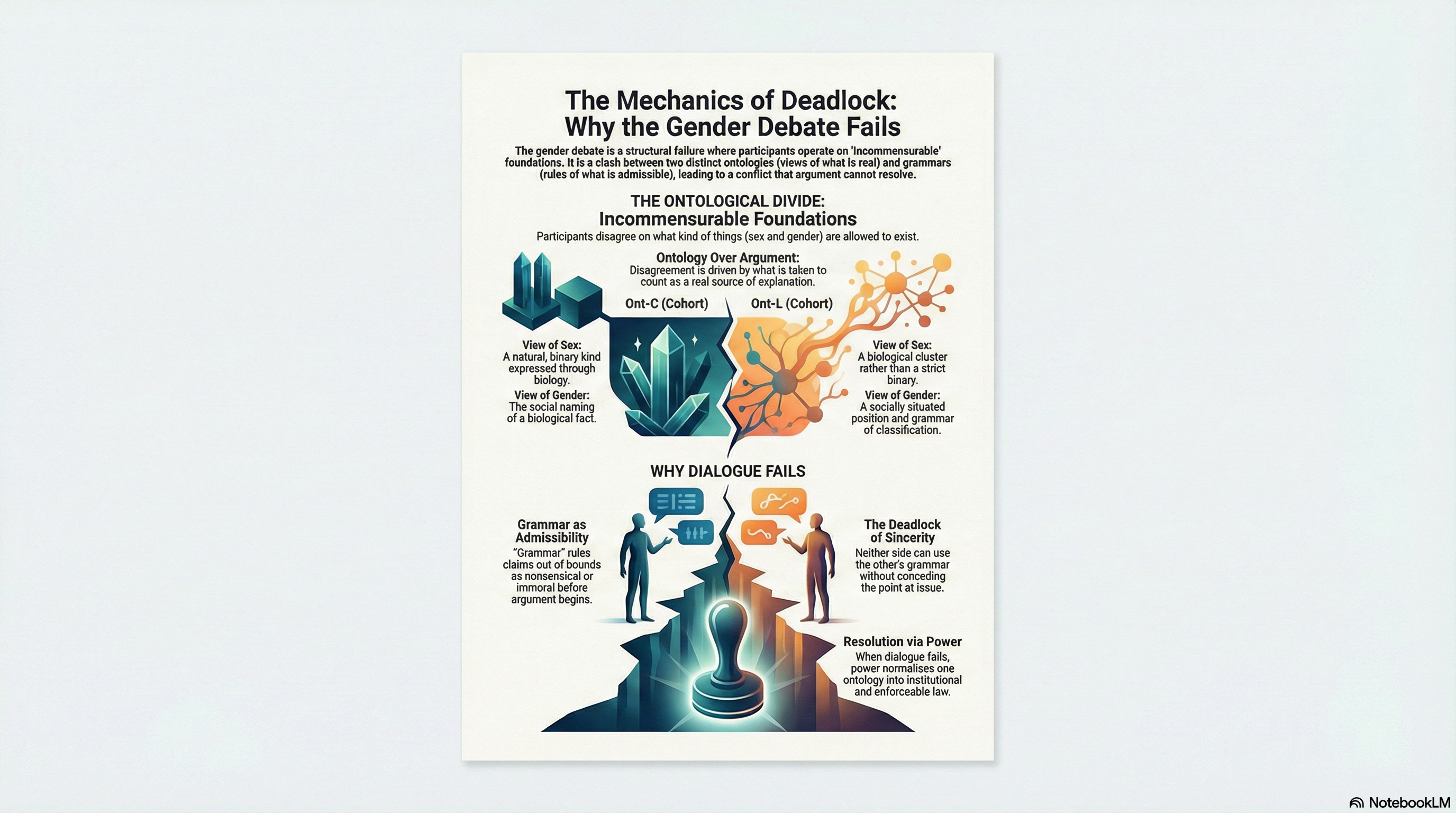
I’ve been thinking through dozens of use cases to explain how some polemic positions are intractable via language. When they are resolved through power, at least one ontological cohort is left wanting. In a compromise, likely both sides feel they’ve lost.
Audio: NotebookLM summary podcast of the video transcript for this topic.
I’ll post a separate announcement presently, but I want to share my new Legibility GPT to assess concepts for ontological and grammatical commensurability.
In conventional (read: orthodox Enlightenment thinking), communication and negotiation are supposed to bring groups together. This is only true for intra-ontological conflict; it’s never been true for inter-ontological issues. There are edge cases where differing ontologies might be satisfied with an inter-ontological agreement, but this is likely accidental and certainly differently motivated. Not all such disagreements can be mediated, and this is where power politics steps in – not to ameliorate but to force the matter. This happens in politics, law, and many other power-oriented domains.
NotebookLM Infographic: No idea why this is formatted like this.
Yes, I am still focusing on writing my ontology papers, but I still come up for air. Over lunch, I found this: Jonny Thomson showcasing Judge Coleridge: The Duty. Watch it.
Video: Philosophy Minis: Judge Coleridge: The Duty
This really got my hamster wheel cranking. In fact, it gave me another essay idea mired in formal logic. Yuck, I know.
My brief post here is to share this and ask why I don’t share ‘positive’ posts. Pretty much everything is critical. For one, it’s how my brain works. For two, I don’t really know.
When I see something, I instantly want to tear it apart, not for the sake of malice but because my mind registers it as WTAF?
In short, the judge says that one cannot privilege one’s own life over others. Of course, this got my hamster on steroids, considering the implication: does this invalidate self-defence? Wouldn’t it? 🧐
The answer is yes – but only if Law were tethered to Morality, which it isn’t. This will be my essay. Who knows when I’ll have time to write it? Please, stand by. Cheers.
What are your thoughts? Maybe I’ll share this as a video response on YouTube and TikTok. Time will tell – and it evidently heals all wounds.
He doesn‘t, but he accidentally demonstrates the problem.
There is a certain kind of person who loathes Nietzsche for the same reason they loathe earthquakes. Not because he causes damage, but because he refuses to pretend the ground was ever stable.
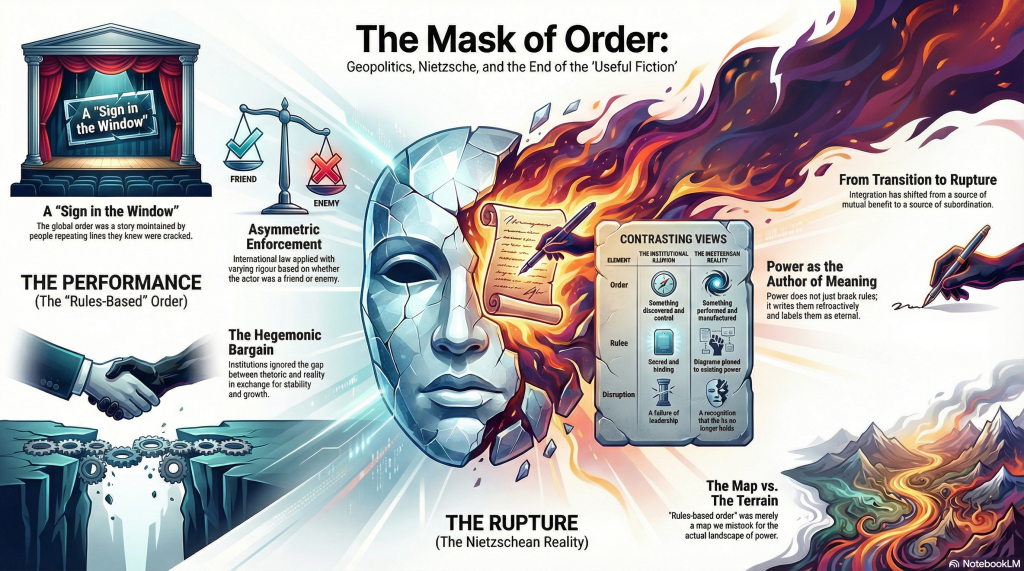
In a recent address, Mark Carney says something that would have been unutterable in polite company a decade ago. He admits that the ‘rules-based international order’ was always a partial fiction. Not false enough to abandon, not true enough to believe in without effort. A story everyone knew was cracked, but which continued to function so long as enough people kept repeating the lines.
“We knew that the story about the rules-based order was partially false… We knew that international law applied with varying rigour depending on the identity of the accused and the victim. This fiction was useful [because of the goods provided by American hegemony]… So we placed the sign in the window. We participated in the rituals. And we largely avoided calling out the gaps between rhetoric and reality. This bargain no longer works. Let me be direct. We are in the midst of a rupture, not a transition… You cannot live within the lie of mutual benefit through integration when integration becomes the source of your subordination.“
Audio: NotebookLM podcast of this topic.
International law, he concedes, applied unevenly. Power decided enforcement. Friends received nuance. Enemies received principle. This was not ignorance. It was a bargain. The illusion delivered goods, stability, growth, a sense of moral hygiene. So the sign stayed in the window. The rituals continued. The gaps between rhetoric and reality were politely ignored. That bargain, Carney says, no longer works.
This is framed as geopolitical realism, but it is really an ontological admission. The mask slipped, and everyone is suddenly offended by the face underneath.
Image: NotebookLM infographic of this content.
This is why people hate Friedrich Nietzsche. Not because he celebrates cruelty or chaos, but because he insists that order is something we perform, not something we discover. He refuses the comfort of believing that the rules were ever neutral, universal, or self-enforcing. He points at the scaffolding and says: this is what is holding things up, not the sky.
When enough people play along, the game feels like reality. When someone refuses to play, panic sets in.
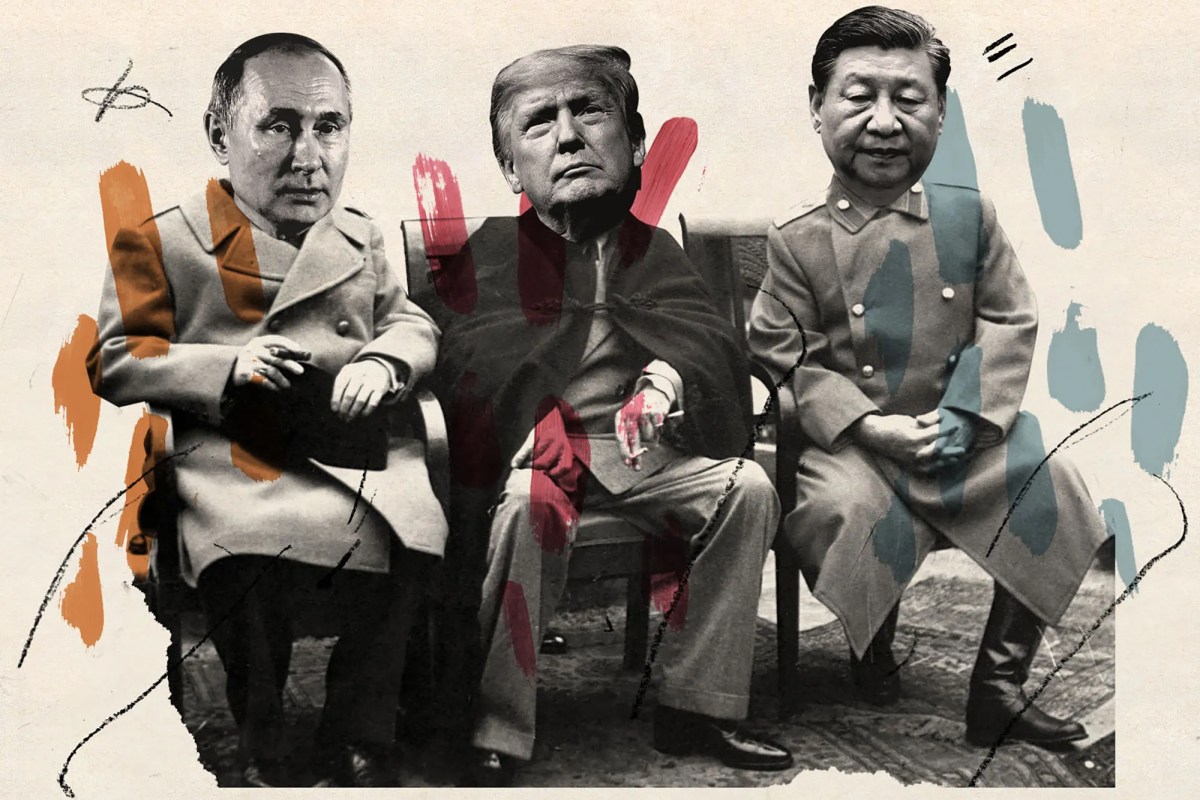
Enter Donald Trump. Trump did not invent the asymmetries of power. He refused to speak them politely. This created a moral crisis for institutions built on the assumption that everyone would continue to pretend. When a designated enemy like Vladimir Putin does this, it is filed under Evil. When an ally does it, the response bifurcates: either frantic appeasement, or embarrassed silence disguised as strategy.
Image: Foreignsentiment
Carney tries to walk a middle path. He neither genuflects nor detonates the stage. He acknowledges the fiction without fully abandoning it. This makes him interesting, but also symptomatic. He wants the audience to notice the set wobbling without asking them to leave the theatre.
When he says the old rules-based order is not coming back, what he really means is that the illusion has been interrupted. Whether permanently or only until someone builds a more convincing façade is left diplomatically unresolved. This is where Nietzsche becomes unavoidable.
People often lump Nietzsche together with vague talk of “power,” as though this were a crude obsession shared with Michel Foucault. But Nietzsche’s contribution is sharper and more unsettling. He is not merely describing power as something exercised. He is describing power as something that manufactures meaning, legitimacy, and moral vocabulary after the fact. Power does not break the rules. It writes them retroactively and calls them eternal.
This is the kind of power later adopted by Adolf Hitler, by Putin, and now by Trump. Not brute force alone, but the refusal to treat inherited norms as sacred simply because they are inherited. This is precisely what terrifies people who mistake procedural continuity for moral truth.
The United States borrowed Montesquieu’s separation of powers as though it were a lock rather than a suggestion. Anyone paying attention could see how easily it could be gamed. That this came as a shock says less about constitutional brilliance than about selective vision. The system functioned not because it was impregnable, but because its participants agreed, tacitly, to behave as though it were.
Nietzsche would call this decadence. Not decline as catastrophe, but decline as denial. The refusal to look directly at the conditions that make order possible, preferring instead to moralise their breakdown.
Carney’s speech is not radical. It is late. It says aloud what everyone already knew but preferred not to articulate: that the world was never neat, the order never neutral, and the rules never binding on those strong enough to ignore them.
What comes next is the uncomfortable part. Once the illusion is acknowledged, it cannot simply be re-believed. You can rebuild institutions. You can repaint the signage. But you cannot unknow that the coffee was always bitter.
Nietzsche does not tell us what replaces the façade. He only insists that pretending it was ever a window onto truth is the most dangerous fiction of all.
What Carney inadvertently demonstrates is not a failure of leadership but a failure of language. ‘Rules-based order’ was never a description of the world; it was a map we mistook for the terrain because it worked often enough to feel true. Nietzsche’s crime was pointing at the legend and saying it was doing the real work. Once that admission is made, you do not get to return to innocence. You can draw a new map, call it reform, integration, or renewal, but you will know it is a diagram pinned to power, not a window onto justice. The unease people feel now is not about chaos. It is about recognition. The lie no longer holds because too many have noticed the pins.
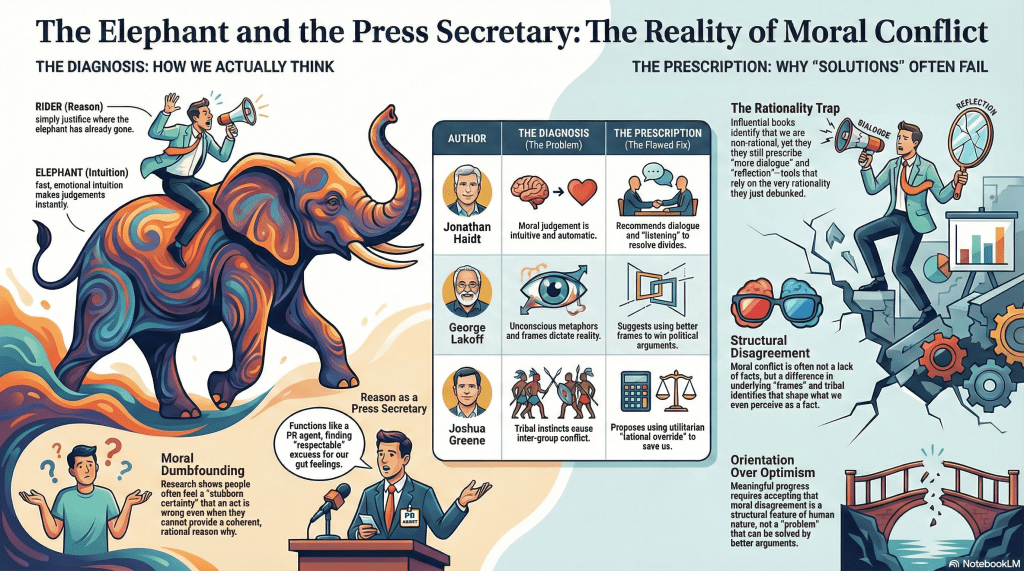
Over the past few decades, moral psychology has staged a quiet coup against one of our most cherished fantasies: that human beings are, at bottom, rational moral agents. This is not a fringe claim. It is not a Twitter take. It is the mainstream finding of an entire research programme spanning psychology, cognitive science, linguistics, and neuroscience.
We do not reason our way to moral conclusions. We feel our way there. Instantly. Automatically. And only afterwards do we construct reasons that make the judgment sound respectable.
Audio: NotebookLM summary podcast of this topic.
This is not controversial anymore. It is replicated, taught, and celebrated. And yet, if you read the most influential books in this literature, something strange happens. The diagnosis is devastating. The prescription is reassuring.
I’ve just published a long-form video walking through five canonical books in moral psychology that all uncover the same structural problem, and then quietly refuse to live with the implications.
Each of these books is sharp, serious, and worth reading. This is not a hit piece.
But each follows the same arc:
Identify a non-rational, affective, automatic mechanism at the heart of moral judgement
Show why moral disagreement is persistent and resistant to argument
Propose solutions that rely on reflection, dialogue, reframing, calibration, or rational override
In short: they discover that reason is weak, and then assign it a leadership role anyway.
Haidt dismantles moral rationalism and then asks us to talk it out. Lakoff shows that framing is constitutive, then offers better framing. Gray models outrage as a perceptual feedback loop, then suggests we check our perceptions. Greene diagnoses tribal morality, then bets on utilitarian reasoning to save us.
None of this is incoherent. But it is uncomfortable. Because the findings themselves suggest that these prescriptions are, at best, limited.
Diagnosis without prognosis
The uncomfortable possibility raised by this literature is not that we are ignorant or misinformed.
It is that moral disagreement may be structural rather than solvable.
That political conflict may not be cured by better arguments. That persuasion may resemble contagion more than deliberation. That reason often functions as a press secretary, not a judge.
The books sense this. And then step back from it. Which is human. But it matters.
Why this matters now
We are living in systems that have internalised these findings far more ruthlessly than public discourse has.
Social media platforms optimise for outrage, not understanding. Political messaging is frame-first, not fact-first. AI systems are increasingly capable of activating moral intuitions at scale, without fatigue or conscience.
Meanwhile, our institutions still behave as if one more conversation, one more fact-check, one more appeal to reason will close the gap. The research says otherwise.
And that gap between what we know and what we pretend may be the most important moral problem of the moment.
No solution offered
The video does not end with a fix. That’s deliberate.
Offering a neat solution here would simply repeat the same move I’m criticising: diagnosis followed by false comfort. Sometimes orientation matters more than optimism. The elephant is real. The elephant is moving.And most of us are passengers arguing about the map while it walks.







 Philosophics