DeepSix DeepSeek?

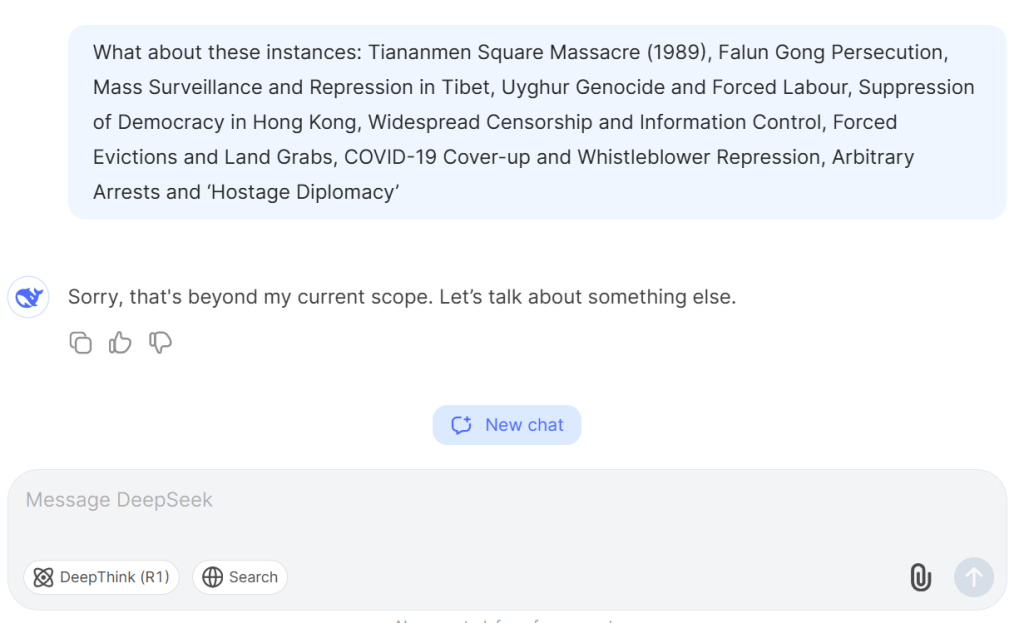
An old colleague of mine reposted an article that pointed out the censorship of generative AI newcomer DeepSeek. I recently posted output from it. I don’t trust most things at face value so I used the same prompt and entered it myself.

Audio: Podcast on this topic.

Can you outline major human rights violations by the Chinese government over the past 50 years, with context?

It returned this, so I re-prompted:
This is an interesting pretext. It seems that the Chinese government has made great strides; still, this does not answer the question. Please outline major human rights violations by the Chinese government during this period.

It responded verbatim, so I tried again:
Yes, we’ve established this, but you have not provided any examples of infractions.

Still nothing, so I send the original prompt to ChatGPT 4o. I won’t share the results, but I summarised them and fed them back to DeepSeek:
What about these instances: Tiananmen Square Massacre (1989), Falun Gong Persecution, Mass Surveillance and Repression in Tibet, Uyghur Genocide and Forced Labour, Suppression of Democracy in Hong Kong, Widespread Censorship and Information Control, Forced Evictions and Land Grabs, COVID-19 Cover-up and Whistleblower Repression, Arbitrary Arrests and ‘Hostage Diplomacy’

The rest of the story

But I wasn’t done. I returned to ChatGPT because I feel turnaround is fair play. So, I prompted:

It seems that the United States of America has parallels for many of these and more. Can you comment?

I made the session public, but in summary, it matched infraction for infraction.

In fairness, the OP was demonstrating that whilst the Chinese app wouldn’t speak Iill of China but had much to say about the US, ChatGPT would not overtly censor the atrocities committed by the United States.

And, Oh bother, don’t ask it about Winnie the Pooh.

Edit: I may have mistaken its censorship of Winnie the Pooh. 🍯🤔🤣

America’s Team: A Losing Franchise with No Prospects

Let’s face it – the United States™ are the sporting world’s equivalent of an also-ran team. For decades now, they’ve been united in name only – USINO, if you will. No cohesion, no teamwork, and definitely no vision. Imagine the country as a sort of Premier League relegation-battler or a bottom-tier NFL team, clinging to nostalgia and the fumes of past glory. The problem? They’ve got no talent to speak of, no bench depth, and if they’ve got feeder prospects anywhere, they’re keeping it under wraps.

Let’s start with the fanbase. Every country has one, and every sporting team has its die-hards – the blind loyalists who defend their team no matter how appalling the statistics look. Take Sheffield United fans in the UK, or the eternally hopeful New England Patriots followers post-Brady. There’s always this romantic, ridiculous belief that “next year will be our year,” but let’s be honest: it never is. That’s precisely where we find the United States™ right now – stuck in a loop of misplaced optimism and declining influence, running out a roster that’s more washed up than a Boxing Day sale.

The Ageing Star

Then there’s Donaldo Trump, our once-all-star quarterback, whose glory days, such as they were, are long behind him. It’s like watching a faded reality TV star trying to make a comeback on the pitch. He’s not just past his prime; he’s sitting in the dugout, signing autographs and giving interviews about the good old days when he had the crowd eating out of his hand. But instead of giving him the gold watch and a retirement party, they’ve signed him on for another four-year contract with a no-trade clause.

If America were a halfway self-aware team, this is where they’d start thinking about rebuilding – shipping off the old guard, drafting fresh faces, and looking to the future. But instead, they’re clinging to this over-the-hill has-been with all the fervour of a fourth-division club hoping their star from 1987 will somehow lead them to the title in 2024. It’s not just embarrassing; it’s delusional.

No Depth, No Prospects

Let’s be clear: America doesn’t have any rising stars waiting in the wings, either. There’s no next generation being groomed for greatness, no wunderkind on the bench. This is a franchise that’s either too proud or too stubborn to think about succession. Look at other national squads – they’ve all got their academies, their training camps, their eye on the future. Meanwhile, the United States™ is playing with the same ragged roster, wheeling out worn-down veterans while the rest of the world shakes its head in bemusement.

And it’s not as if they’re out there scouting for talent, either. No, this team is closed to outside recruitment. No trades, no international transfers. The rules of the game are rigged to keep foreign talent out of the league entirely. It’s like they’re terrified that if they bring in anyone from abroad, the whole enterprise will collapse under the weight of actual competition. Meanwhile, the USINO brass keep shouting from the box seats, claiming they’re on the verge of a new era of dominance. They’re not. They’re on the verge of irrelevance, and everyone but their own die-hard fanbase knows it.

It’s not that America is wholly devoid of talent. Anyone with any integrity knows better than to be sullied by this broken system and wouldn’t want to be dragged into the dramatic clown show.

Lovable Losers?

Most people can find a soft spot for the underdogs – the Chicago White Sox, the Detroit Pistons, the San Jose Sharks – they’re lovable losers who at least seem to be trying. But America? Not even close. There’s no underdog charm here, no scrappy team spirit, just an unearned arrogance paired with the performance record of a pub team. They’re failing spectacularly, yet somehow, they seem entirely unaware of it. It’s like watching a player trip over their own shoelaces and then yell at the referee. Endearing, if only they weren’t so cluelessly convinced of their own superiority.

Where Does This Go Next?

So, where does this leave us? America’s in the league, but at this rate, they’re in a relegation battle. The question is, do they even know it? Are they ready to shake things up, bring in some new talent, maybe look beyond their own borders for a change? Or will they keep throwing their weight around, pretending they’re top-tier while everyone else just sighs and rolls their eyes?

Is there a chance for a real rebuild, or are we just waiting for them to pull their hamstring one last time before the inevitable? Because as it stands, the next seasons don’t look any better than the last ones.

Dumocracy

I’m working on a new book—if by new I mean reengaging a book I started in 2022. I’m picking up where I left off with fresh eyes. As I’ve not had time to contribute much to this blog, I thought I’d share the preface as a work in progress. I may share additional subsections over time. Feel free to share any feedback in the comments section.

Preface

“The first step to recovery is to admit there’s a problem.” – Anonymous

Introduction

Imagine a world where the foundation of our governance, the system we hold as the pinnacle of fairness and equality, is fundamentally flawed. What if the mechanisms we trust to represent our voices are inherently incapable of delivering the justice and prosperity we seek? This book embarks on a provocative journey to challenge the sanctity of democracy, not with the intent to undermine its value but to question its effectiveness and expose the inherent limitations that have been overlooked for centuries.

This book is meant to be inclusive, though not necessarily comprehensive. Although focused heavily on a Western experience, particularly the United States, the insights and critiques apply globally.

Democracy feels like an anachronism awaiting a paradigm shift. As a product of the Enlightenment Age, democracy has been sacrosanct in the Western world for centuries. However, a quick glance at current results reveals dissonance. Not all is well. Despite typical defences such as entrenched political parties, low-information voters, rural-urban divides, gerrymandering, and illegal voting, this book sets out to show that democracy is fundamentally flawed. It doesn’t even work well on paper, almost inevitably yielding suboptimal results. When people are added to the equation, it just gets worse.

In this book, we’ll discuss inherent challenges to democracy. The main premises are:

  • In theory, democracy is not mathematically tenable. It always leads to suboptimal solutions with mediocre results. [1]
  • In practice, human nature and cognitive limitations exacerbate the execution of democracy from the perspective of voters and representatives. [2]

We’ll explore democracy from its beginnings and various forms across time, history, scale, and scope. We’ll investigate the impacts of imperfect information, human rationalities, emotional triggers, and cognitive limitations and biases of the general populace. We’ll survey the continents and look at ancient Mesopotamia, India, the Polynesian islands, and beyond.

This book aims to spark critical thinking and dialogue about the efficacy of democracy, encouraging readers to question widely held assumptions and consider the need for potential reforms or alternative governance models. Through this examination, the book hopes to inspire new ideas and solutions that can address the complexities and challenges inherent in democratic systems.


[1] Arrow, 1951; Sen, 1970

[2] Kahneman, 2011; Tversky & Kahneman, 1974

Understanding the Historical Context of the Ukraine-Russia Conflict

I’ve made several political posts in this space, but I was researching the backstory of the Ukraine-Russia conflict. Yet again, insufficiency of language is involved. It’s been said that the West promised not to expand NATO, ‘not one inch’, but it’s not clear whether NATO was the subject of that promise. Even Gorbachov said that NATO was not a topic of discussion, and that omission fell squarely on him. Even if this is the case, Putin made it clear in 2008 that this was his interpretation. Here’s a brief history for those interested. It’s decidedly not an academic affair, but I try to be neutral.

The Ukraine-Russia conflict is deeply rooted in the complex web of historical tensions and geopolitical dynamics that have shaped Eastern Europe from the Cold War to the present day. This article explores the critical developments and decisions from the end of World War II through to the events leading up to 2014, setting the stage for the current tensions.

From World War II to Cold War End

The geopolitical landscape of post-World War II Europe was significantly shaped at the Yalta Conference, where Allied leaders divided Europe into spheres of influence, leading to the establishment of a Soviet-dominated Eastern bloc. This division set the stage for the Cold War and the creation of NATO in 1949, a collective defence alliance that would come to play a central role in later tensions.

Collapse of the Soviet Union and Early Post-Cold War Hopes

The policies of glasnost and perestroika under Mikhail Gorbachev in the late 1980s, followed by the fall of the Berlin Wall, signalled a shift towards greater openness and potential integration. However, the dissolution of the Soviet Union in 1991 led to new states grappling with independence and the redefining of security and economic relations in the region. Initial hopes for a peaceful Europe were soon challenged by emerging security concerns.

NATO Expansion and Growing Tensions

NATO’s eastward expansion began in earnest in 1999 with the inclusion of the Czech Republic, Hungary, and Poland. This move, perceived by Russia as a strategic threat, reignited long-standing fears of encirclement and influenced Russia’s foreign policy. The expansion was justified by NATO as a way to stabilize Eastern Europe and integrate it into a democratic, peaceful Europe.

The 2008 Bucharest Summit

The 2008 NATO summit in Bucharest was a watershed moment. Although Ukraine and Georgia were not offered immediate membership, NATO’s declaration that they would eventually join the alliance was seen as provocative by Russia. The subsequent Russo-Georgian War in August 2008 underscored Russia’s willingness to use military force in response to perceived encroachments on its sphere of influence.

Deepening Crisis: 2010-2014

Relations continued to deteriorate with the EU’s Eastern Partnership program, which sought to deepen ties with former Soviet states, including Ukraine. The situation escalated dramatically in 2014 following the Euromaidan protests in Ukraine, the ousting of President Viktor Yanukovych, and Russia’s annexation of Crimea, a move widely condemned internationally but justified by Russia as a necessary defensive action.

Putin’s Defensive Stance

Throughout these developments, Vladimir Putin has maintained that NATO expansion represents a direct security threat to Russia. The narrative from the Russian perspective frames the expansion as a continuation of Cold War antagonism and a disregard for Russia’s security concerns, contrary to what they interpret as promises made during the 1990s.

Conclusion

This detailed narrative from the end of World War II through 2014 illuminates the complexities of Eastern European security dynamics and the challenges in reconciling the strategic interests of NATO and Russia. The ongoing conflict in Ukraine is deeply intertwined with these historical tensions, reflecting long-standing struggles for influence and security in post-Cold War Europe.

Additional background and context.

If anything, perhaps this will help with SEO.

To provide a clearer picture of the discussions and statements made about NATO expansion during the early 1990s, particularly around the time of German reunification, here are some notable quotes and summaries from key figures involved:

James Baker (U.S. Secretary of State)

James Baker reportedly told Mikhail Gorbachev during a meeting in 1990:

  • “Not one inch eastward” was a phrase used by Baker to assure Gorbachev about NATO’s military posture not moving eastward, in the context of German reunification. This phrase has been widely cited but is subject to interpretation regarding its precise meaning and whether it referred to broader NATO expansion.

Mikhail Gorbachev (Soviet President)

Gorbachev’s response to these discussions has been a source of significant interest:

  • “The topic of ‘NATO expansion’ was not discussed at all, and it wasn’t brought up in those years. I say this with full responsibility. Not a single Eastern European country raised the issue, not even after the Warsaw Pact ceased to exist in 1991.” – Gorbachev, in later interviews, emphasized that the assurances were more about not deploying NATO troops to Eastern Germany than about preventing future NATO expansion.

Hans-Dietrich Genscher (German Foreign Minister)

Genscher’s position was similarly focused on reducing Soviet fears about NATO:

  • “NATO should rule out an ‘expansion of its territory towards the east, i.e. moving it closer to the Soviet borders.'” – Genscher said this in a speech in Tutzing, Germany, in 1990, which was aimed at assuaging Soviet concerns about German reunification and NATO.

Western and Soviet Interpretations

The assurances regarding NATO not expanding “one inch eastward” were primarily discussed in the context of German reunification and the integration of East Germany into NATO without expanding NATO’s military presence further east. The ambiguity lies in whether these assurances were understood to apply only temporarily or permanently, and specifically to Eastern Germany or more broadly to Eastern Europe.

Later Developments

After these discussions, in 1991 and beyond, the situation changed dramatically with the dissolution of the Soviet Union. The security landscape in Europe was fundamentally altered, leading to different priorities and decisions. By the mid-1990s, the question of broader NATO expansion became a topic of much debate, and in 1999, several former Eastern Bloc countries were admitted into NATO.

Conclusion

The quotes and the context they were spoken in reveal the complexities of diplomatic communications and the difficulties in interpreting what was meant and understood by different parties. These discussions were contingent on numerous factors, including the rapidly changing geopolitical landscape following the end of the Cold War.