As the publication date of A Language Insufficiency Hypothesis (LIH) draws nearer, I feel it’s a good time to promote it (obviously) and to introduce some of the problems it uncovers – including common misperceptions I’ve already heard. Through this feedback, I now understand some of the underlying structural limitations that I hadn’t considered, but this only strengthens my position. As I state at the start of the book, the LIH isn’t a cast-in-stone artefact. Other discoveries will inevitably be made. For now, consider it a way to think about the deficiencies of language, around which remediation strategies can be developed.
Audio: NotebookLM summary podcast of this content.
Let’s clear the undergrowth first. The Language Insufficiency Hypothesis is not concerned with everyday ambiguity, garden-variety polysemy, or the sort of misunderstandings that vanish the moment someone bothers to supply five seconds of context. That terrain is already well-mapped, thoroughly fenced, and frankly dull.
Take the classic sort of example wheeled out whenever someone wants to sound clever without doing much work:
‘I made a 30-foot basket’.
Video: a woman making a large basket
If you’re a basketweaver, you picture an absurdly large basket and quietly question the maker’s life choices. If you’re watching basketball, you hear ‘score’. If you’re anywhere near the context in which the sentence was uttered, the meaning is obvious. If it isn’t, the repair cost is trivial. Add context, move on, live your life.
Language did not fail here. It merely waited for its coat. This is not the sort of thing the LIH loses sleep over.
The Groucho Marx Defence, or: Syntax Is Not the Problem
Logicians and armchair philosophers love to reach for jokes like Groucho Marx’s immortal line:
‘I shot an elephant in my pyjamas. Why it was wearing my pyjamas, I’ll never know’.
Video: A man and elephant in pyjamas (no sound)
Yes, very funny. Yes, the sentence allows for a syntactic misreading. No, nobody actually believes the elephant was lounging about in striped silk. The humour works precisely because the “wrong” parse is momentarily entertained and instantly rejected.
Again, language is not insufficient here. It’s mischievous. There’s a difference.
If the LIH were worried about this sort of thing, its ambitions would be indistinguishable from an undergraduate logic textbook with better branding.
Banks, Rivers, and the Myth of Constant Confusion
Likewise, when someone in a city says, ‘I went to the bank’, no sane listener imagines them strolling along a riverbank, unless they are already knee-deep in pastoral fantasy or French tourism brochures. Context does the heavy lifting. It almost always does.
Video: Rare footage of me trying to withdraw funds at my bank (no sound)
This is not a crisis of meaning. This is language functioning exactly as advertised.
Where the Trouble Actually Starts: Contestables
The LIH begins where these tidy examples stop being helpful. It concerns itself with Contestables: terms like truth, freedom, justice, fairness, harm, equality. Words that look stable, behave politely in sentences, and then detonate the moment you ask two people what they actually mean by them. These are not ambiguous in the casual sense. They are structurally contested.
In political, moral, and cultural contexts, different groups use the same word to gesture at fundamentally incompatible conceptual frameworks, all while assuming a shared understanding that does not exist. The conversation proceeds as if there were common ground, when in fact there is only overlap in spelling.
That’s why attempts to ‘define’ these terms so often collapse into accusation:
That’s not what freedom means. That’s not real justice. You’re redefining truth.
No, the definitions were never shared in the first place. The disagreement was smuggled in with the noun.
‘Just Ignore the Word’ Is Not a Rescue
A common response at this point is to suggest that we simply bypass the troublesome term and discuss the concrete features each party associates with it. Fine. Sensible. Often productive. But notice what this manoeuvre concedes. It does not save the term. It abandons it.
If meaningful discussion can only proceed once the word is set aside and replaced with a list of clarifications, constraints, examples, and exclusions, then the word has already failed at its primary job: conveying shared meaning. This is precisely the point the LIH is making.
The insufficiency is not that language is vague, or flexible, or context-sensitive. It’s that beyond a certain level of conceptual complexity, language becomes a confidence trick. It gives us the feeling of agreement without the substance, the appearance of communication without the transaction.
At that point, words don’t merely underperform. They mislead.
I commenced a series where I discuss the responses to the 2020 PhilPapers survey of almost 1,800 professional philosophers. This continues that conversation with questions 2 through 4 – in reverse order, not that it matters. Each is under 5 minutes; some are under 3.
For the main choices, you are given 4 options regarding the proposal:
Accept
Lean towards
Reject
Lean against
Besides the available choices, accepted answers for any of the questions were items, such as:
Combinations (specify which.) For the combos, you might Accept A and Reject B, so you can capture that here.
Alternate view (not entirely useful unless the view has already been catalogued)
The question is too unclear to answer
There is no fact of the matter (the question is fundamentally bollocks)
Agnostic/undecided
Other
Q4: The first one asks, ‘What is the aim of philosophy?’ Among the responses were:
Truth/Knowledge
Understanding
Wisdom
Happiness
Goodness/Justice
Before you watch the video, how might you respond?
Video: What is the aim of philosophy?
Q3: What’s your position on aesthetic value?
Objective
Subjective
Video: What is aesthetic value?
Q2: What’s your position on abstract objects?
Platonism (these objects exist “out there” in or beyond the world)
Nominalism (the objects are human constructs)
Video: Where do abstract objects reside?
Q1: What’s your position on à priori knowledge?
This video response was an earlier post, so find it there. This is asking if you believe one can have any knowledge apart from experience.
Yes
No
NB: I’ve recorded ten of these segments already, but they require editing. So I’ll release them as I wrap them up. Not that I’ve completed them, I realise I should have explained what the concepts mean more generally instead of talking around the topics in my preferred response. There are so many philosophy content sites, I feel this general information is already available, or by search, or even via an LLM.
What do you think – should I?
In the other hand, many of these sites – and I visit and enjoy them – support very conservative, orthodox views that, as I say, don’t seem to have progressed much beyond 1840 – Kant and a dash of Hegel, but all founded on Aristotelian ideas, some 2,500 years ago.
Spoiler alert, I think knowledge has advanced and disproved a lot of this. It turns out my brothers in arms don’t necessarily agree. Always the rebel, I suppose.
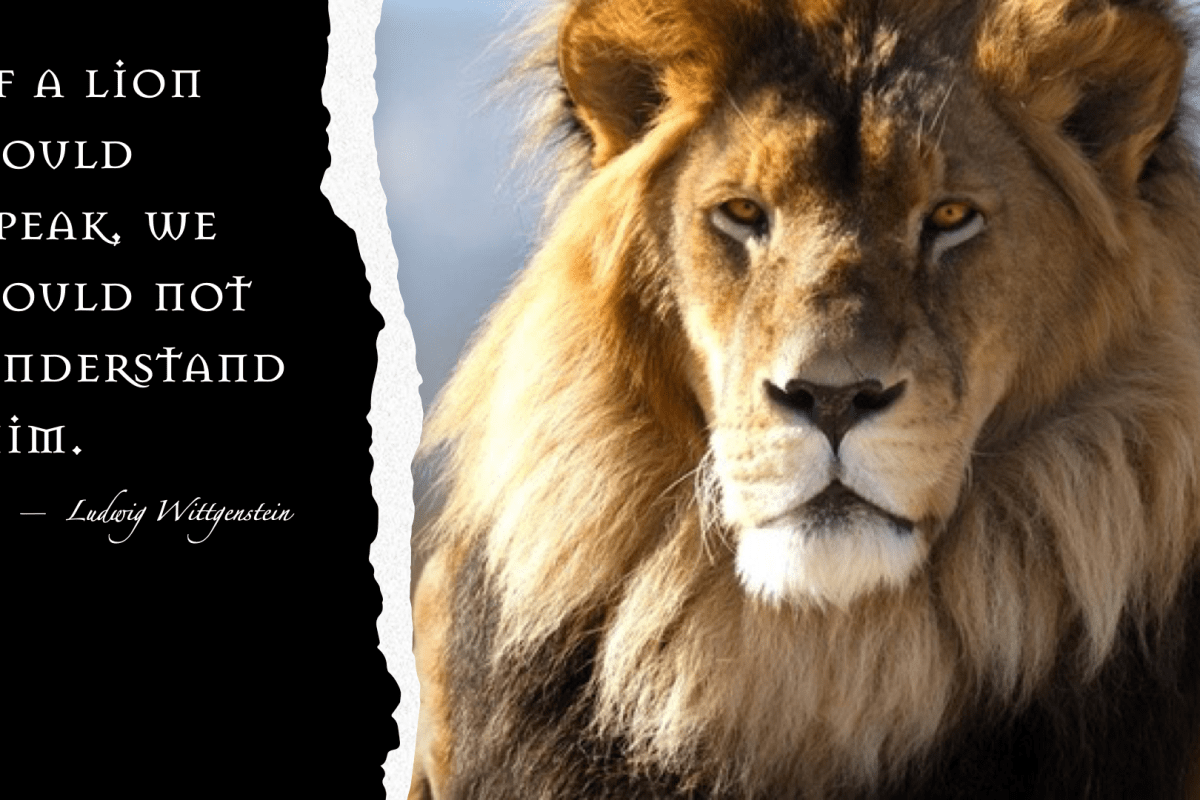
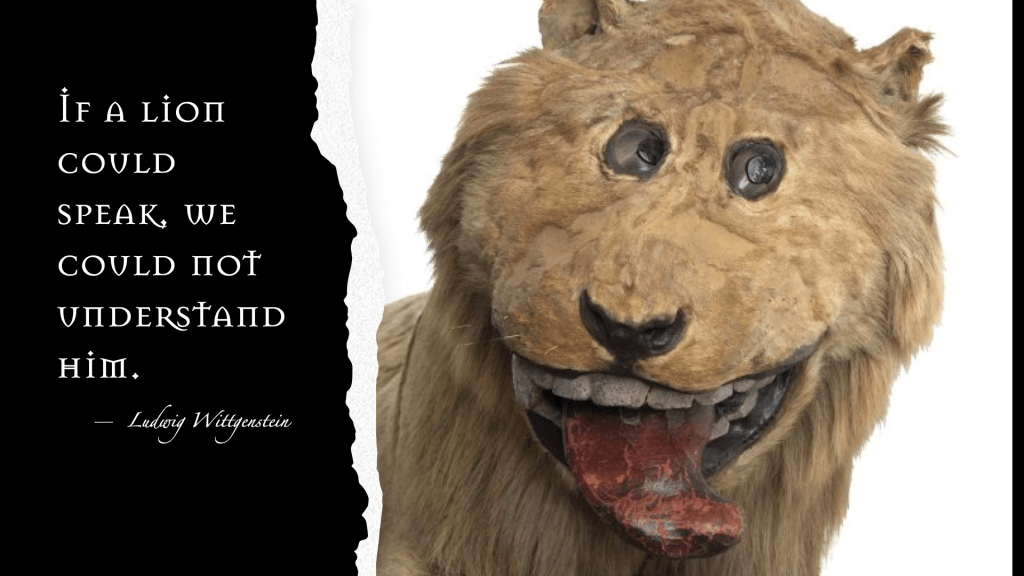
If a lion could speak, we could not understand him.
— Ludwig Wittgenstein
As much as I love Wittgenstein’s quote on language, I find it vastly more amusing aside the lion of Gripsholm Castle in Sweden. Because as talking lions come, this one is certainly more unintelligible than most.
If a lion could speak (Gripsholm Remix)
I also appreciate Daniel Dennett’s retort that if we could manage to communicate with this one talking lion—not, of course, this lion in particular—that it could not speak for the rest of lionity. (Just what is the equivalent of humanity for lions?)
If a lion could speak (traditional)
Ludwig Wittgenstein famously said, “If a lion could talk, we could not understand him.” ( [Philosophical Investigations] 1958, p. 223) That’s one possibility, no doubt, but it diverts our attention from another possibility: if a lion could talk, we could understand him just fine—with the usual sorts of effort required for translation between different languages—but our conversations with him would tell us next to nothing about the minds of ordinary lions, since his language-equipped mind would be so different. It might be that adding language to a lion’s “mind” would be giving him a mind for the first time! Or it might not. In either case, we should investigate the prospect and not just assume, with tradition, that the minds of nonspeaking animals are really rather like ours.
Daniel Dennet — Kinds of Minds: Toward an Understanding of Consciousness (p.18)




 Philosophics