Declaration of Independence

It’s July. The season of independence in the United States. Independence from the overt tyranny of Britain, but not from the tacit tyranny of their government—the government purported to be ‘of the people, by the people, and for the people‘ per Abraham Lincoln’s 1863 Gettysburg Address. As their Constitution reads, ‘We the People‘. Governments may be of the people and by the people, but governments are an emergent phenomenon as happens when oxygen and hydrogen combine just so and create water. Two gases combine to create a new substance—water. Some forget that, like water, government are a distinct element to the people that constitute it. Some think it resembles them. It doesn’t. It’s Hobbes’ Leviathan—or a Jabberwok.

In preparation for the traditional Summer season, I took to reading Derrida’s 1976 essay, Declarations of Independence. It was interesting, but I was hoping to get more from it. I decided to deconstruct the opening paragraph—the preamble—of the Declaration of Independence:

Deconstructing Binary Oppositions

Self-Evident vs. Non-Self-Evident

The Declaration boldly asserts that ‘these truths’ are ‘self-evident’,’ a claim that is nothing more than a rhetorical trick. By presenting these ideas as self-evident, the authors seek to place them beyond questioning, discouraging dissent and critical examination. In reality, these ‘truths’ are far from universal; they are the product of a specific cultural and historical context, shaped by the interests and perspectives of the privileged few who drafted the document.

Interrogating Assumptions and Hierarchies The Declaration of Independence asserts that certain truths are ‘self-evident’, implying that these truths are so obvious that they require no further justification. However, the concept of self-evidence itself is far from universally accepted. It is deeply embedded in the philosophical tradition of Enlightenment rationalism, which holds that reason and logic can reveal fundamental truths about the world.

  1. Philosophical Foundations of Self-Evidence
    • Enlightenment Rationalism: The idea of self-evidence relies heavily on Enlightenment rationalism, which posits that certain truths can be known directly through reason and are therefore beyond dispute. Philosophers such as René Descartes and Immanuel Kant emphasised the power of human reason to uncover self-evident truths. Descartes, for instance, argued for the self-evident nature of ‘Cogito, ergo sum‘ (‘I think, therefore I am’) as a fundamental truth (Descartes, Meditations on First Philosophy).
    • Critique of Rationalism: Critics of Enlightenment rationalism, including existentialists like Friedrich Nietzsche and phenomenologists like Martin Heidegger, argue that what is considered self-evident is often culturally and historically contingent. Nietzsche, for example, contended that what we take as ‘truth’ is a product of our perspective and historical context, not an absolute given (Nietzsche, Beyond Good and Evil).
  2. Cultural and Philosophical Contingency
    • Cultural Relativity: Different cultures and philosophical traditions may not find the same truths to be self-evident. For instance, the concept of individual rights as self-evident truths is a product of Western liberal thought and may not hold the same self-evident status in other cultural frameworks. In many Eastern philosophies, the focus is more on community and harmony rather than individual rights.
    • Subjectivity of Self-Evidence: The term ‘self-evident’ implies an inherent, unquestionable truth, yet what one group or culture finds self-evident, another may not. This variability reveals the instability and subjectivity of the claim. For example, in traditional Confucian societies, the emphasis is placed on hierarchy and duty rather than equality and individual rights, demonstrating a different set of ‘self-evident’ truths.
  3. Constructed Nature of Truth
    • Language and Context: Jacques Derrida’s concept of différance illustrates how meaning is not fixed but constantly deferred through language. What we consider to be “truth” is constructed through linguistic and social contexts. Derrida argues that texts do not have a single, stable meaning but rather a multiplicity of interpretations that change depending on the reader’s perspective and context (Derrida, Of Grammatology).
    • Social Construction: Michel Foucault’s analysis of power and knowledge further deconstructs the notion of objective truth. Foucault argues that what is accepted as truth is produced by power relations within society. Truths are constructed through discourses that serve the interests of particular social groups, rather than being objective or self-evident (Foucault, Discipline and Punish).

Created Equal vs. Not Created Equal

The Declaration’s claim that ‘all men are created equal’ is a blatant falsehood, a manipulative promise designed to appease the masses whilst maintaining the status quo. The glaring contradictions of slavery and gender inequality expose the hollowness of this assertion. Equality, as presented here, is nothing more than an ideological construct, a tool for those in power to maintain their dominance while paying lip service to the ideals of justice and fairness.

Creator vs. No Creator

The Declaration refers to a ‘Creator’ who endows individuals with rights, grounding its claims in a divine or natural law. This invokes a theistic worldview where moral and legal principles are derived from a higher power. However, Derrida challenges this by showing that the concept of a creator is a cultural and philosophical construct, not a universal truth.

The presence of the creator in the text serves to legitimise the rights it declares. However, this legitimacy is contingent on accepting the cultural narrative of a creator. Secular and non-theistic perspectives are marginalised by this assertion, revealing the ideological biases inherent in the Declaration. The authority of the declaration is thus shown to be dependent on particular beliefs, rather than an objective reality.

Unalienable vs. Alienable

The notion of ‘unalienable Rights’ is another empty promise, a rhetorical flourish designed to inspire loyalty and obedience. In practice, these supposedly inherent and inviolable rights are regularly violated and denied, particularly to those on the margins of society. The Declaration’s lofty language of ‘Life, Liberty and the pursuit of Happiness’ rings hollow in the face of systemic oppression and injustice. These rights are not unalienable; they are contingent upon the whims of those in power.

Conclusion

Through this deconstruction, we expose the Declaration of Independence for what it truly is: a masterful work of propaganda, filled with false promises and manipulative rhetoric. The document’s purported truths and self-evident principles are revealed as arbitrary constructs, designed to serve the interests of the powerful while placating the masses with empty platitudes.

As some celebrate this 4th of July, let us not be fooled by the high-minded language and lofty ideals of our founding documents. Instead, let us recognise them for what they are: tools of control and manipulation, employed by those who seek to maintain their grip on power. Only by constantly questioning and deconstructing these texts can we hope to expose the truth behind the facade and work towards a more genuine understanding of freedom and equality.

References

  • Jacques Derrida, “Declarations of Independence,” in Negotiations: Interventions and Interviews 1971-2001, ed. Elizabeth Rottenberg (Stanford: Stanford University Press, 2002).
  • Jacques Derrida, Of Grammatology (Baltimore: Johns Hopkins University Press, 1976).
  • Friedrich Nietzsche, Beyond Good and Evil (Cambridge: Cambridge University Press, 2002).
  • Michel Foucault, Discipline and Punish: The Birth of the Prison (New York: Vintage Books, 1995).
  • Immanuel Kant, Critique of Pure Reason (Cambridge: Cambridge University Press, 1998).
  • René Descartes, Meditations on First Philosophy (Cambridge: Cambridge University Press, 1996).
Objective Challenges

I’ve just published this video on YouTube, and I want to extend the commentary.

Video: What do Objective, Relative, and Subjective mean in philosophy?

Many people I’ve encountered don’t seem to grasp the distinctions between objective, subjective, and relative. Subjective and relative seem to be the biggest culprits of confusion. Let’s focus on morality just because.

There are really two main perspectives to adopt. If one believes in Objective Morality, one believes morality derives from some external source and is bestowed or mandated upon us. The source might be important to the believer, but it’s unimportant for this article. If one believes in Relative Morality then the source is socially dictated and has similar challenges to the notions of Social Contract Theory insomuch as one may not subscribe to the expectations.

For the Objective moralist, there may exist a schism between the expectations of the mandate and the subjective feelings of the individual. In fact, this may occur for Relative moralists as well. The individual will always maintain some subjective perspective on morality and then compare and contrast it with the higher order, whether Objective or Relative. In either case, acting on this subjective impulse risks being at odds with the members of the higher order. If this morality is codified into law – as it often is – then to act on that impulse makes one a criminal.

Take abortion for example. Whether this is an edict from God or just a social construct doesn’t matter. If one is in a society where abortion is seen as ‘bad’ or ‘wrong’, one’s subjective position on the matter is of little value. However, a Relativist society might also adopt a position of tolerance that is less likely to come from Objectivists.

A challenge is that a Subjectivist may only become apparent if one is counter the Relative or Absolute position. If your society is against abortion and you are, too, is this your subjective position or have you been indoctrinated with it and accept it uncritically, whether it’s deemed Objective or Relative.

Perhaps you feel that eating dogs or monkeys is immoral if not disgusting, but if you had been reared in a culture that does this, you might find it immoral to eat pork or beef. The question remains, is this a Subjective position, or did you merely inherit the Objective or Relative stance?

This question is very apparent in which religion one adopts. It is no surprise that the largest factor in which religion you choose is the religion of your family and their family and so on – so not so much a choice.

I was raised in a WASP family in New England among predominately Italian Roman Catholic peers. Despite this, I identified as an atheist early on. In my late teens, I stumbled on Buddhism and identified with it. However, I remain ignostic except when it encroaches on my personal autonomy – for example in the case of laws restricting access to safe abortions.

Rhetoric is Truth; Morality, Emotion

I’ve been reengaging with philosophy, though my positions haven’t changed recently. My last change was to shift from being a qualified material realist to a qualified idealist in the shape of Analytic Idealism. In most matters I can think of, I am an anti-realist, which is to say concepts like truth and morality are not objective; rather they are mind-dependent.

I’ve long been on record of taking the stance that Capital-T Truth, moral truths, are derived rhetorically. There is no underlying Truth, only what we are aggregately convinced of, by whatever route we’ve taken. As a moral non-cognitivist, I am convinced that morality is derived through emotion and expressed or prescribed after a quick stop through logic gates. Again, there is nothing objective about morality.

Truth and morality are subjective and relative constructs. They resonate with us emotionally, so we adopt them.

Were I a theist — more particularly a monotheist —, I might be inclined to be emotionally invested in some Divine Command theory, where I believe that some god may have dictated these moral truths. Of course, this begs the question of how these so-called “Truths” were conveyed from some spirit world to this mundane world. I have no such conflict.

But let’s ask how an atheist might believe in moral realism. Perhaps, they might adopt a Naturalistic stance: we have some natural intuition or in-built moral mechanism that is not mind-dependent or socially determined. I am not a naturalist and I don’t take a universalist approach to the world, so this doesn’t resonate with me. I can agree that we have an in-built sense of fairness, and this might become a basis for some aspects of morality, but this is still triggered by an emotional response that is mind-dependent.

Another curious thing for me is why non-human animals cannot commit immoral acts. Isn’t this enough to diminish some moral universal? In the end, they are an extension of language by some definition. No language, not even a semblance of morality.

Anyway, there’s nothing new here. I just felt like creating a philosophical post as I’ve been so distracted by my health and writing.

The Matter with Things: Chapter Eleven Summary: Science’s Claims on Truth

Chapter eleven is the first of three chapters discussing truth from the perspective of science. These chapters are followed by truth as seen from other perspectives, namely, reason and intuition.

Check out the table of contents for this series of summaries. I continue to render interstitial commentaries in grey boxes with red text, so the reader can skip over and just focus on the chapter summary.

The author posits that in the West, most of us trust science to deliver the truth of the matter, as “science alone holds out the promise of stable knowledge on which we can rely to build our picture of the world“. He admits that it does have value, but it has inherent limitations and yet draws us in like moths to a flame. Here, he distinguishes between the discipline and practice of science and Scientism as it is practised by laypeople. Science understands its place and domain boundaries. Scientism is omnipotent with delusions of grandeur that will never be realised.

Some philosophically naïve individuals become very exercised if they sense that the status of science as sole purveyor of truth is challenged

— Iain McGilchrist, The Matter with Things, chapter 10

Politicians who promote science as a bully pulpit prey on the public in a manner similar to bludgeoning them with religious notions.

Science is heavily dependent on the exercise of what the left hemisphere offers.

ibid.

The point the book makes is that like the turtles that go all the way down, science doesn’t have a grasp on what’s beyond the last turtle. Like trying to answer the toddler who can ask an infinite number of ‘why‘ questions, the scientist gets to a point of replying ‘that’s just the way things are’, or the equivalent of ‘it’s bedtime’.

Scientific models are simply extended metaphors. A challenge arises when a model seems to be a good fit and we forget about alternative possibilities getting locked into Maslow’s law of the instrument problem, where ‘to a man with a hammer, everything begins to look like a nail’. Moreover, the left hemisphere is fixated on instrumentation, so it’s always trying to presume a purpose behind everything. Nothing can just be.

This is likely where Scientism begins to trump science.

He quotes:

Dogmatism inevitably obscures the nature of truth.

— Alfred Whitehead

McGilchrist points out that a goal or promise of science is to be objective and take the subject out of the picture. Unfortunately, this is not possible as the necessity for metaphor ensures we cannot be extricated. Objectivity is legerdemain. We create a scenario and claim it to be objective, but there is always some subject even if unstated. He goes into length illuminating with historical characters.

The sciences do not try to explain, they hardly even try to interpret, they mainly make models … The justification of such a mathematical construct is solely and precisely that it is expected to work.

— John von Neumann

In fact, science itself is predicated on assumptions that have not and can not be validated through science.

In conclusion, McGilchrists wants to emphasise ‘that just because what we rightly take to be scientific truths are not ‘objective’ in the sense that nothing human, contingent and fallible enters into them, this does not mean they have no legitimate claim to be called true.’ ‘The scientific process cannot be free from assumptions, or values.’

Following this chapter are several pages containing dozens of plates of images.

The Matter with Things: Chapter Ten Summary: What Is Truth?

In this first chapter of the second section of The Matter with Things, Iain McGilchrist asks, What is Truth? Section two has a different focus than the first, which was focused on foundation building. From here on in, he wants to build on this foundation.

Check out the table of contents for this series of summaries. Note that I have rendered my interstitial commentaries in grey boxes with red text, so the reader can skip over and just focus on the chapter summary.

At first, he establishes that each hemisphere ‘thinks’ it knows the true truth and has the best vantage on reality. He makes it clear that a short chapter will not do the topic of truth the justice he feels it deserves and notes that others have written books on the matter. He just wants to make a few points and clarify his position.

As we discovered in the first section, the left and right hemispheres perceive the world differently. The right hemisphere experiences the world as it is presented in a Gestalt manner. This is contrasted by the left hemisphere which views the world as a symbolic re-presentation. It’s not unfair to say that the right hemisphere experiences the world directly whilst the left hemisphere views a cache of the world.

In this chapter, McGilchrist (Iain) attempts to convince the reader that one side is more correct or correct more often than the other and so is more veridical. As he says, the left hemisphere ‘is a good servant but a poor master’. Of course, if we had a third hemisphere [sic], we might think it could mediate the other two, but then we’d need a fourth and a fifth, ad infinitum to act as the new arbiter.

Spoiler Alert: The right hemisphere wins the battle on truth pretty much hands down.

He wants to make it clear to the reader that he is no strict idealist. There is a reality ‘out there’ apart from mental processes that objectively exists even in the absence of a subject. Reality is not exclusively a projection of the brain.

His choice rather relies on the correspondence theory of truth, which is to say that the hemisphere that conveys perceptions more correspondent to our perceived reality would be more veridical.

Here, I challenge his reasoning on two accounts. In the first place,each hemisphere may operate better in one context versus another. In the second case, there may be a consequential factor, which again distils down to context. In risk management, there are notions of probability of failure and consequence of failure. For example, a failure to recognise the truth of a matter (we’ll use truth as a proxy for ‘fact’), may be inconsequential. If I am assessing the probability of a pipe bursting in a nuclear facility and the pipe is connected to a sink to deliver tap water, the consequence of this failure is practically insignificant. But if I am assessing the probability of a pipe containing radioactive materials, even if the probability of failure is low, the consequence of failure may be catastrophic.

Evolutionarily speaking, if you mistake a garden hose for a venomous snake, the consequence of failure is trivial. Turn the tables, and mistake a snake for a garden hose, the consequence may be fatal. I am not attempting to claim that one hemisphere interprets the low consequence scenario and the other interprets the high. I simply want to raise this nuance.

He makes the point that if we compare some known authentic object to a recollection, we want to retain the one that is more accurate.

I see a similar challenge. Hypothetically, let’s say I present a red disc and manipulate the hemispheres to activate only one at a time, asking to recall the object. If the left says it’s red and the right says it’s a disc, which is more correct? Again, I am not claiming that this is a real scenario, but if one side possesses facts unavailable to the other side, we’ve got a problem in making a truth claim.

To reiterate, the left hemisphere is more analogous to a photograph or a video account whereas the right hemisphere is to be in the place that is being photographed. The right hemisphere is duratively presenced whilst the left is re-presented. We move from a nominative form to a verbial form of representing reality. This leads him to ask if ‘truth’ is a thing or a process.

He shifts to a linguistic argument. When people view ‘truth’ as a noun, as a thing, the expectation is that it is static. Moreover, the descriptors of truth are rendered mainly in the past tense—representation, fact, perfect, precise, certain, and concluded. He provides definitions. When viewed duratively, ‘truth’ becomes a process. It is an active relationship. It flows. It’s an intercourse.

We may not ever get to an agreed truth, but neither is every position valid. Interpreting a text, for example, may have several conflicting meanings, but the possible meanings are relatively finite.

Take a simple sentence such as, “The dog bit the hand that feeds him.” This could be meant literally or figuratively. We might imagine different dogs, hands and person to whom the hand is attached. Perhaps the hand is attached to a bonobo. Perhaps, it’s a robotic hand. These are among various possible interpretations, and we may not ever agree on the truth of the matter. However, we can rule out that a giraffe or a watermelon were central to this narrative for what it’s worth.

The bookgoes on to discuss the etymology of the word ‘truth’ and of its relationship to the word ‘true’ (faithful) which is further related to ‘trust’. I won’t exhaust his explanation.

He does discuss correspondence and coherence theories of truth and discounts others such as consensus theory and social constructivism. He cautions not to equate truth with correctness. This is a left hemisphere game insisting on dichotomising things.

The book declares the despite a general agreement on the source or nature of truth, there is something there, so don’t give up un it. In the end, he seems to settle for a Pragmatistic version à la William James.

Personally, I feel he and others are over-invested in the nature of truth. And inflate its meaning over ‘fact’. To me, Capital-T Truth is an archetype, but it doesn’t otherwise exist. We have facts, and truth is sort of a perfect version of a fact. Love is in the same category, though I know Iain would disagree with this assertion. Of course, James dismissed semantic argument as petty and insisted that people simply know the truth of something. I’ve always found this take to be dismissive. I also feel that Pragmatism is too steeped in Empiricism and loses hold of the notion that what happened yesterday may not in fact manifest today or not in the same way.

I’ll also argue as others have before me that (besides being archetypal) the term is a redundant filler word. On a minuscule level, if I say ‘The cup is red’, saying ,’It’s true that the cup is red adds nothing’. The equation was already asserted. This leaves one to wonder what the purpose of it is.

Returnng to the asymmetry of the hemispheres he cautions up not to take a position that one of the other side is correct. Rather, even though there is an asymmetry in value, there is still a synthesis.

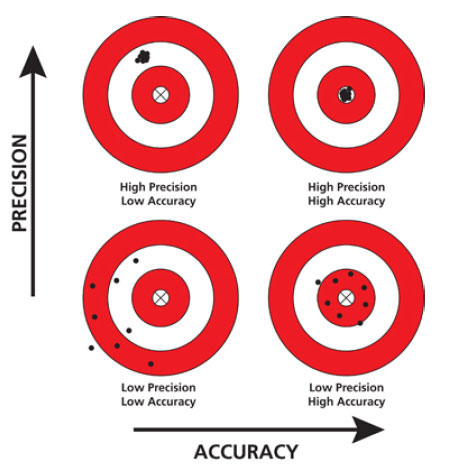
Iain uses the example of Newtonian and Einsteinian physics. At one point, they are practically synonymous and interchangeable. Only as we reach the speed of light does Newtonian physic exceed the bounds of its scope. He also educated the reader on the difference between precision and accuracy.

I like to view this in a musical context. If I play two notes together, say a B over an E, neither is more correct than the other. Notionally, I am playing an E5/B. This is neither an E or a B. The chord is the result of the two playing simultaneously. In this case E and B are both true and not true because the E5 is a synthesis. If I add a G# I get an E-major chord, subsequently adding a D renders an E7. In each of these cases, the truth of the notes, B, D, E, and G# remain true to their identity, but the fact is that the individuality is subsumed by the collective. This is the prevailing truth even though a person with perfect pitch can still individually identify the constituents of the chord. I don’t know if this is more confusion than necessary, but it helps me.

I’ve always like this illustration with target grouping, but this was not referenced by the book.

Image: Precision and Accuracy Chart

Interestingly, he cites Jay Zwicky’s definition: “Truth is the asymptotic limit of sensitive attempts to be responsible to our actual experience of the world … ‘sensitive attempts to be responsible’ means truth is the result of attention. (As opposed to inspection.) Of looking informed by love. Of really looking.” He accedes that there are degrees of truth.

Truth is the asymptotic limit of sensitive attempts to be responsible to our actual experience of the world

Jay Zwicky

This asymptosis is how I describe Truth in my Truth about Truth post.

As the chapter comes to a close, he leaves us with a twisted categorical syllogism,

  • [p1] All monkeys climb trees
  • [p2] The porcupine in a monkey
  • [ c ] The porcupine climes trees

This structure presents a valid argument. However, it is not sound. It follows the Socratic logical syntax:

  • [p1] M a P
  • [p2] S a M
  • [ c [ S a P

Because of our exposure to and experience with the external world, we can assess this argument to be unsound, which is to say untrue by observation. Without this context, we could not render this assessment. He discusses the way right- and left-hemisphere occluded subjects respond to this discrepancy. In summary, an isolated left hemisphere with defend the logical syntax over the lived experience.

In conclusion, the hemispheres take different paths to assess truth and often end up at different destinations. The left hemisphere sees truth as a thing whilst the right views it as a process.

What is real? What is true?

An online colleague published an essay on another essay (en français). The gist was to say that their ideas were the same save for whether a core foundation was reality or truth. I am going to stylise these and derivatives in capital initials, e.g., Real and Truth. I am not sure I see the connexion, and perhaps Lance will chime in here directly to correct any misunderstandings and fill in any holes.

Podcast: Audio rendition is this page content

At least in English vernacular, True and Real are close synonyms. I don’t feel they are as close as we may assume at first glance. I think each of these terms carries with it its own ambiguity and connotation, so a meaningful discussion may prove to be difficult.

I’m not sure if it’s a fair characterisation, but I feel that most people consider Real as what they can sense or experience. Some may not even allow for the experiential component. In my mind, metaphorically thinking, of course, a book might be real; an idea might be real; even the idea of a unicorn might be real, but unicorns are not real. If we want to claim unicorns as part of Reality or include it in the set of Reality, then it would be a second-order sort. Substituting Harry Potter for unicorns, the idea of Harry Potter is real, but Harry Potter is a figment. Of course, Harry Potter may be the name of a human or your pet otter, but this is not the manifest Harry Potter of the idea. And Harry Potter is not a unicorn.

Harry Potter is not a unicorn

I mention Harry Potter and, indeed, unicorns, because I have had people argue that these things are real. For me, they are off the table, whether real or imagined. I feel that some people may also reduce Real to material, so a Realist would be the same as a Materialist. That’s fine except we end up with obvious non-material stuff on the cutting room floor. What do we do with emotions and so-called qualia? Sure, some might equate emotions with biochemical reactions and some synaptic exchange in some parts of the brain, further articulated through facial and bodily expressions and gestures. For the Materialist, we may not yet know the mechanism, but it’s only a matter of time—in the same manner as atoms became protons and electrons, which became quarks with spins and colour, and this morphed into fields.

Being sympathetic to Analytic Idealism, I might argue that none of this is real because all we can experience is what we can sense, but what we sense is a second order of Reality. We can’t even experience the first-order variety. The usual analogy is to look at computer bits or the funky Matrix code, and it doesn’t reveal what we see or experience through the interface. In the case of the Matrix, the interface is their perceived reality. But perception isn’t Reality. At least Descartes suggests as much. If first-order Reality is unattainable, we can either consider this sensed and experienced world second order. This leaves our unicorns and Harry Potter to be third order. In this case, we might idiomatically consider the first-order to be understood to exist, but our use of Reality extends only to the second-order variety.

In any case, I don’t expect to resolve the mystery of Reality here and now, but it is a dialogue where accord is necessary to be on the same proverbial page.

But then what is True? What is Truth? I’ve written about this previously. Here, we are explicitly invoking the capital-T version of Truth, not the minuscule-t version where it’s synonymous with pedestrian ‘facts’ and tautologies. By True, are we asking what is objectively real—unadulterated by subjective experience, some universal and invariable condition? And is this Truth what is Real? Are there Truths that are not Real?

To sum it up, it is quite standard—although not universal by a long shot—to consider Real what we can experience whilst True is something that requires proof. A physical table might be real. Like unicorns, mathematic concepts may be true—I’d argue that this is tautological whilst others might defend some Platonic ideal—, but they are not real. They are an abstraction. I suppose my point is to not take these words for granted and presume they can be directly interchanged. I suppose in the adjective form, they are more apt to coincide—Is that a true Picasso? Is that a real Picasso? Clearly, when we are asking if it is real, we are asking if it is truly genuine rather than questioning its materiality.

It may be true that I am wittering away online in some masturbatory pseudo-intellectual frenzy, and the results may be virtually real, but I needed to let my mind wander for a bit. If you’ve gotten this far, bless your heart, and leave a comment.

And so it goes.

VIDEO: The Truth about Truth

I wrote about this content in 2019, but I wanted to revisit it for a video as well as create a podcast audio version.

Video: YouTube version of this page content
Podcast: Audio rendition of this page content

In today’s segment, I am going to share my perspectives on the truth about truth. To start, I’ll let the audience know that I do not believe in the notion of truth. I feel the term is ill-defined especially in the realm of metaphysics and morality. I feel that when most people employ the word ‘truth’, what they mean to say is ‘fact.’ That a fire engine is red, for example, may be a fact, if indeed the fire engine happens to be red, but it is not true. This is a misapplication of the term. If you employ truth as a direct synonym for fact, then this is not what’s being discussed here, and perhaps your time might be better spent watching some content by the Critical Drinker.   

My argument is that truth is not objective. Rather it is subjective and perspectival. I concede that there may be some objective truth out there somewhere, but it is not and will not ever be accessible to us because of limitations in our sense-perception faculties and cognitive limitations. Per Aristotle, we only have five senses with which we can connect to the world, and these senses are limited. If there is anything out there that would require another sense receptor—a sense receptor not available to us—, we would never be able to sense it, to even know of its existence. Perhaps the universe emits 100 sense signals, but we are only capable of receiving and translating five. We’d be oblivious to 95 per cent of reality.

I am not making any claims that this is the case, but human cognition is so limited, that we can’t even conceive of what another sense might be. If you can, please leave a comment.

To be clear, I am not talking about senses we know other species possess. Bats may have echolocation, and sharks may have electroreception. Some animals may have greater sensory acuity—superior vision and auditory senses, olfactory and gustatory, tactile, or whatever. Some can see into infrared or ultraviolet light spectra. Technology that includes biomimicry provides humans with microscopes for the microworld and telescopes for the macroworld. We have x-rays and sonar and radar, radios and televisions that extend our senses, but these provide no new sensory receptors.

Like the story of the blind people and the elephant, we are left grasping at parts. But even if we are able to step back to view the whole elephant, to hear the elephant, to touch and smell or even taste the elephant, if there is more to the elephant, we cannot know it. The same goes for ourselves.

I know that some people might inject gods or psychic or paranormal energy into this void, and sure, feel free, but I am looking beyond these pedestrian concepts. What else might there be?

But let’s depart this train and head in a different direction. I want us to focus on the senses we do have. For the typical human, sight is our primary arbiter of reality, at least as defined idiomatically. We tend to believe what we see, and what we see, we assume as real—even if we are later mistaken. I guess that wasn’t a unicorn or a pink elephant. I must have been hallucinating or dreaming. I could have sworn that was Auntie Em.

There are several competing theories around truth, but I’ll focus on the Correspondence theory, which is simply put, the notion that, proxying reality for truth, human perception corresponds with the real world. And a pragmatist might argue that’s close enough for the government.

Keep in mind that historically humans have contorted themselves into making calculations. Remember how long people had been tying themselves into knots to show planetary motion in a geocentric system creating epicycles and retrograde motion to map understanding to a perceived reality.

One might even argue that we’ve progressed. It wasn’t true or accurate then, but now it is. And perhaps it is. Let’s look at some illustrations.

NB: Due to an editorial mishap, this paragraph was dropped in the podcast, hence dropped from the video, which shared the podcast audio source. As such, this image was also not used in the video. This is unfortunate, as it was meant to introduce those with limited maths knowledge to the asymptotic curve, as described. Apologies, and I hope this serves to orient any travellers who may have lost their way at this point.

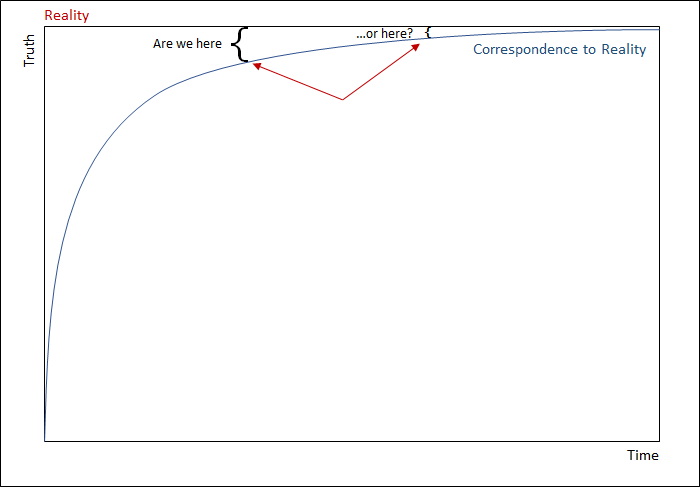
In this first illustration, we see Truth (or relative truthiness) on the Y-axis and Time on the X-Axis. On the top, we see a threshold representing Reality. In the plane, I’ve rendered an asymptotic curve, where over time, we get closer and closer to the Truth. But we never quite get there. More on this later.

The next illustration will help to demonstrate what’s happening.

Notice there is a gap between the curve and the Reality cap. For one thing, we don’t really know where we are relative to Reality. In the case of the geocentric system, we might have been at the leftmost space. Once we determined that the system is actually solar-centric, we might have moved right on the curve to close the gap. We might be tempted to defend that we’ve finally reached the truth, but we’d have been equally willing to make the same defence from the geocentric position, so we need to be mindful of the past.

Perhaps, this last example was too obvious. We feel comfortable staking a truth claim—or at least a claim of fact. So let’s look at another example.

Let’s re-use the same axes—Truth and Time—, but rather than an asymptotic curve, let’s presume something more polynomial in nature—or not particularly cyclic. Rather than retrograde motion in planets, let’s visit the supposed progress of Newtonian over Einsteinian physics.

This takes a bit more setup but bear with me.  In this case, I have taken liberties and illustrated the Einsteinian physics gap to capture an inferior vantage on reality over Newtonian physics. Granted, I need to rely on a bit of suspension of disbelief, but in the bigger picture, I am trying to convey a scenario where some new paradigm puts the prior knowledge in perspective.

In this instance, both Newtonian and Einsteinian flavours of physics are based on a materialistic, particles-based model, which is where the modern physics consensus resides. But, let’s say that consensus changes in such a way that it is determined that something else underlies reality, say consciousness per Analytic Idealism as proposed by Bernardo Kastrup or per Integrated Information Theory (IIT) as advanced by Donald Hoffman and others. As with retrograde motion, we might end up finding that we were barking up the wrong tree. This might be a bit different because the particles are a directly perceived manifestation of the underlying consciousness, but I wanted to create a scenario where knowledge thought to have advanced actually regressed, but this wasn’t revealed until a new perspective was available.

Yet again, an important aspect of note is that we don’t actually know the distance between our perceptions and real Reality.

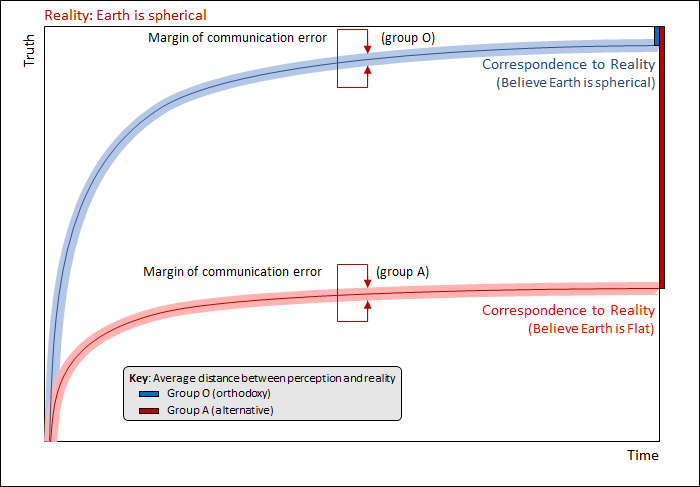
This last illustration builds upon the first asymptotic chart but has an in-built error margin meant to reflect language insufficiencies. There is some concept that people feel they grasp, but the consensus is not as unified as the group thinks.

I’ll share two examples, the first being the concept of justice. To me, Justice is what I deem a weasel word. It’s a word we commonly use, but it means different things to different people. To me, it’s a euphemism for vengeance by proxy, but for others, it transcends that and mirrors some impartial dispensation of just desert—some good old-fashioned law and order.

[Justice is] a euphemism for vengeance by proxy

Without getting stuck down some rabbit hole, my point is that if we aggregate these beliefs, the asymptotic curve represents an average consensus vantage rather than something as obvious as 2 plus 2 equals 4. On this note, allow me to clear the air.

Some viewers might be clamouring to say, “but 2 plus 2 equals four is true.” But this is tautologically true, which is to say that it’s true by definition. It’s a similar tautology to saying that it’s true that snow is white, or coal is black. We’ve already defined snow, white, coal, and black, so these may be facts, but they are true by definition.

Revisiting the chart, notice that there are two curves in the space. In this case, I illustrate competing truth claims from the perspective of an omniscient narrator. The case is whether the earth is an oblate spheroid or is flat. I am going to go out on a limb and assert the earth is spherical, as represented by the top blue curve—and we have some margin of error as to what that might mean. The bottom red curve depicts the perceived truth of the flat earthers, who also have some room for semantic error.

Given that I am presuming that I am in the right adopting the majority position—please be right—, the blue curve is closer to Reality than the red curve. Of course, in the event that the earth is really flat, then it proves my point that we don’t know where we are relative to truth, so we assume that the state of knowledge at any given time is what’s real.

Again, forgive my fanciful examples. Please don’t tell me that this spheroid versus planer earth is tautological too because you’d be correct, but I am already aware. They are just nonsensical illustrations. Nonetheless, I hope they’ve served to express a point.

I could have as well created curves that depicted two cohorts’ beliefs on the efficacy of tarot or astrology in predicting the future. I am sure that it might render somewhat like the last chart, but I’d also presume that both curves would have very low truth values as seen from an objective observer. Secretly, I hope tarot wins the truth battle.

Before I end our time together, I’d like to convey that for an Analytic Idealist, these charts might be more acceptable at face value. For a Realist, Naïve or otherwise, they may argue that this curve is not asymptotic and may in fact reach some tangency. I don’t happen to believe this is the case or I wouldn’t have spent my time assembling and presenting this. Time will tell. Or will it?

Blame On TikTok

A woman blames another for stealing her headphones. This viral video has been circulating in circles of mental health awareness and Karen syndrome.

My attention is otherwise occupied, so I won’t take time for a longer post, but I feel this illustrates my point that people just need to blame. It’s a knee-jerk response, and target accuracy is unnecessary, as this demonstrates.

tl;dr – Karen misplaced her headphones in her bag

From an evolutionary perspective, this also highlights theories supporting fitness over truth—fitness beats truth, FBT. Were that a rival stealing hard-earned food, better to apprehend or remediate than gather all the facts only to allow the culprit to escape. Of course, in cases like this, one gets false positives.

Unknown Dimensions

I mentioned in my last post about how Artificial Intelligence discovered a new variable—or, as the claim suggests, a new physics. This was a tie-in to the possible missing dimensions of human perception models.

Without delving too deep, the idea is that we can predict activity within dynamic systems. For example, we are all likely at least familiar with Newtonian physics—postulates such as F = ma [Force equals mass times acceleration or d = vt [distance equals velocity times time] and so on. In these cases, there are three variables that appear to capture everything we need to predict one thing given the other two that need to remain constant. Of course, we’d need to employ calculus instead of algebra if these are not constant. A dynamic system may require linear algebra instead.

When scientists represent the world, they tend to use maths. As such, they need to associate variables as proxies for physical properties and interactions in the world. Prominent statistician, George Box reminds us that all models are wrong, but some are useful. He repeated this sentiment many times, instructing us to ‘remember that models are wrong: the practical question is how wrong do they have to be to not be useful‘. But no matter how hard we try, a model will never be the real thing. The map cannot become the terrain, no matter how much we might expect it to be. By definition, a model is always an approximation.

All models are wrong but some are useful

George Box

In the Material Idealism post, the embedded video featuring Bernardo Kastrup equated human perception to the instrumentation panels of an aeroplane. Like the purported observer in a brain, the pilot can view the instruments and perform all matters of actions to manipulate the plane, including taking off, navigating through the environment, avoiding obstacles, and then landing. But this instrumentation provides only a representation of what’s ‘really’ outside.

Like mechanisms in the body, instrumentation can be ‘wired’ to trigger all sorts of warnings and alerts, whether breached thresholds or predictions. The brain serves the function of a predictive difference engine. It’s a veritable Bayesian inference calculator. Anil Seth provides an accessible summary in Being You. It relies on the senses to deliver input. Without these sense organs, the brain would be otherwise unaware and blinded from external goings on.

The brain cannot see or hear. It interprets inputs from eyes and ears to do so. Eyes capture light-oriented events, which are transmitted to the brain via optic nerves, and brain functions interpret this information into colour and shape, polarisation and hue, depth and distance, and so on. It also differentiates these data into friend or foe signals, relative beauty, approximate texture, and such. Ears provide a similar function within their scope of perception.

As mentioned, some animals have different sense perception capabilities and limitations, but none of these captures data not also accessible to humans via external mechanisms.

Some humans experience synesthesia, where they interpret certain stimuli differently, perhaps hearing colours or smelling music. We tend to presume that they are the odd ones out, but this assumption does not make it so. Perhaps these people are actually ahead of the rest of us on an evolutionary scale. I suppose time might sort that one out.

But here’s the point. Like the pilot, we can only experience what we are instrumented to experience, as limited to our sense perception and cognition faculties. If there are events not instrumented, it will be as if they don’t exist to the pilot. Can the pilot hear what’s happening outside?

This is the point of the AI experiment referenced above. Humans modelled some dynamic process that was presumed to be ‘good enough’, with the difference written off as an error factor. Artificial Intelligence, not limited to human cognitive biases, found another variable to significantly reduce the error factor.

According to the theory of evolution, humans are fitness machines. Adapt or perish. This is over-indexed on hereditary transmission and reproduction, but we are more vigilant for things that may make us thrive or perish versus aspects irrelevant to survival. Of course, some of these may be benign and ignored now but become maleficent in future. Others may not yet exist in our realm.

In either case, we can’t experience what we can’t perceive. And as Kastrup notes, some things not only evade perception but cannot even be conceived of.

I am not any more privileged than the next person to what these missing factors are nor the ramifications, but I tend to agree that there may be unknown unknowns forever unknowable. I just can’t conceive what and where.


I can’t wait to get back to my Agency focus.

Agency Be Damned

I don’t believe that humans have the agency presumed they have, so I’d like to set out to prove it—at least rhetorically. In the ages-old battle between free will and determinism, I’ve tended to lean toward the determinism camp, but there is something keeping me from gaining full membership. I feel that proving hard determinism may be too hard a nut to crack, so I am aiming at just the agency aspect.

There are two major themes in my thinking.

  1. Humans have no material agency
  2. Power structures require the presumption of agency

Although this concept has been rattling around my brain cage for a while and I still have a ways to go, I feel it will be helpful to sketch out my ideas. I feel inspired by people like Robert Sapolsky and Daniel Dennett. And I feel I can draw insights into counter-arguments from people like Jonathan Haidt, Joshua Greene, and even Steven Pinker. I feel that my experience in behavioural economics may be useful for additional context—people like Daniel Kahneman, Richard Thaler, and Dan Ariely. But I feel disheartened when it appears that Galen Strawson and his father before him, Peter Strawson, people much more connected and elevated in the field have been treading the same territory for decades — over half a century — ahead of me, thankfully beating a path but not necessarily making much headway. Perhaps I can build upon that foundation if not substantially at least perceptibly. Of course, the seminal work by Isaiah Berlin’s Two Concepts of Liberty.

We may act as we will, but we cannot will as we will.

Arthur Schopenhauer

Besides the aforementioned, a correspondent has suggested other source references. He shares: Physics, including quantum mechanics, is fully Lagrangian. According to Stanford’s Leonard Susskind, Lagrange derived his formalism from the principle of ‘Least Action’. Jean Buridan’s principle of ‘Equipoise’ renders a Lagrangian model of the world perfectly deterministic. So, the physical domain is not probabilistic; and all indeterminacy is actually epistemic indeterminability. He also suggets Thomas Hobbes’ “De Corpore”.

About my second point, my corresponent agrees:

I think your “meta” is right. We feel that we are “free agents”, and we don’t know to what to attribute our feeling that we freely choose; so we imagine that we have “free will”. In my view it also doesn’t exist – we really are, as Sapolsky describes, zombie robots – we just don’t (and cannot) know it. Free will is thus a mere (but compelling) illusion on both individual and emergent scales. And yes again: all of morality, jurisprudence, etc., depends on it.

Unattributed Correspondant

My correspondent is a professional philosopher who shall remain anonymous until such time as he agrees, if ever, to make his identity known. I am quiet aware that some of my ideas are contentious and polemic. Not everyone wishes to be mired in controversy.

Humans Have No Material Agency

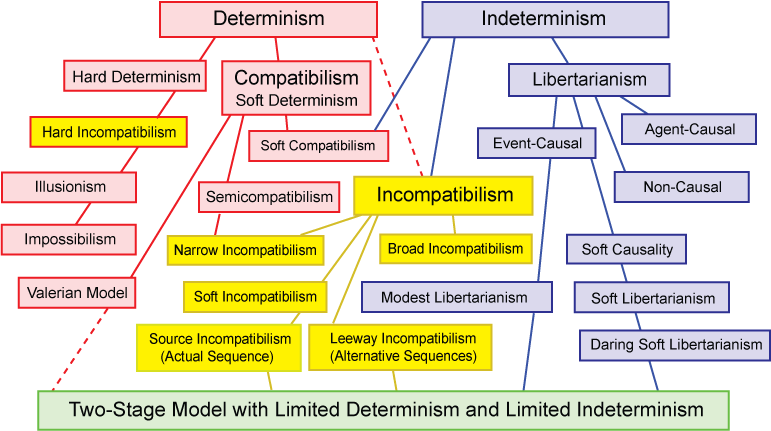
Humans have little to no agency. This is the point I am making in my Testudineous Agency post. From what I know until now, this likely qualifies as soft determinism, but this might shift as I acquire new nomenclature and taxonomic distinction. I’ve discovered this taxonomy of free will positions, though I am not well enough versed to comment on its accuracy or completeness. For now, it seems like a decent working model to serve as a starting point, but I am fully cognizant of possible Dunning-Kruger factors.

A Taxonomy of Free Will Positions

In essence, hard determinism says that the world is not probabilistic. Some event triggered the universe as we know it, and it will unfold according to the laws of physics whether or not we understand them. A weaker form, soft determinism, allows for some probability and trivial ‘agency’. I feel that Dennett supports soft determinism. I feel that because we, as ‘individuals’, are a confluence of multitudinous factors, we have little agency (interpreted as responsibility). More on this later.

Power structures require the presumption of agency

To be honest, the free will debate is only interesting to me in context. To me the context is power. The ‘meta’ of this is that society (and human ‘nature’) seem to need this accountability and culpability, but it doesn’t actually exist, so it is created as a social construct and enforced in a Foucauldian power relationship through government through jurisprudence mechanisms.

This is the part of the debate I haven’t heard much about. Sapolsky did write in Behave, chapter 20X, that criminal justice systems need to be reformed to account for diminished agency, and I’ll need to return to that to better comprehend his position and assertion.

The rest of the story

As a handy reference, these are the authors and books I’ve encountered to date and in no particular order:

Then there I those I have yet to read:

I’ve got a lot of essays and lecture notes not referenced plus general content from Reddit, Medium and other blogs sources, YouTube, podcasts, and so on. I probably should have documented some Classical philosophers, but I don’t generally find their argumentation compelling, though I might add them later.

The aim of this post is just to capture my intent—if it is indeed my intent. Oh, the questions and implications of a lack of agency. Please stand by.