The Emissary Who Forgot to Bow: On Erasmus, Wells, and the Delusion of Universal Reason

12–19 minutes

I was having an inappropriate chat with ChatGPT and, per Feyerabend, I once again discovered that some of the best inspirations are unplanned. The conversation circled around to the conflicting narratives of Erasmus and Wells. Enter, Plato, McGilchrist, and the Enlightenment – all living rent-free in my head – and I end up with this.

Audio: NotebookLM podcast on this topic.

I. The Proverb and Its Presumption

Erasmus sits at his writing desk in 1500-something, cheerful as a man who has never once questioned the premises of his own eyesight, and pens what will become one of the West’s most durable little myths: ‘In the land of the blind, the one-eyed man is king’. It arrives packaged as folk wisdom, the sort of thing you’re meant to nod at sagely over a pint. And for centuries, we did. The proverb became shorthand for a comfortable fantasy: that advantage is advantage everywhere, that perception grants sovereignty, that a man with superior faculties will naturally ascend to his rightful place atop whatever heap he finds himself on.

It’s an Enlightenment dream avant la lettre, really – this breezy confidence that reason, sight, knowledge, insight will simply work wherever they’re deployed. The one-eyed man doesn’t need to negotiate with the blind. He doesn’t need their endorsement, their customs, their consent. He arrives, he sees, he rules. The proverb presumes a kind of metaphysical meritocracy, where truth and capability are self-authenticating, where the world politely arranges itself around whoever happens to possess the sharper tools.

Image: Midjourney didn’t coöperate with my prompt for a one-eyed king. Trust that this king has only one.

It’s the intellectual equivalent of showing up in a foreign country with a briefcase full of sterling and expecting everyone to genuflect. And like most folk wisdom, it survives because it flatters us. It tells us that our advantages – our rationality, our education, our painstakingly cultivated discernment – are universally bankable. That we, the seeing, need only arrive for the blind to recognise our superiority.

Erasmus offers this with no apparent irony. He hands us a proverb that whispers: your clarity is your crown.

II. Wells Wanders In

Four centuries later, H.G. Wells picks up the proverb, turns it over in his hands like a curious stone, and proceeds to detonate it.

The Country of the Blind (1904) is many things – a fable, a thought experiment, a sly dismantling of Enlightenment presumption – but above all it is an act of literary vandalism against Erasmus and everything his proverb smuggles into our collective assumptions. Wells sends his protagonist, Nuñez, tumbling into an isolated Andean valley where a disease has rendered the entire population blind for generations. They’ve adapted. They’ve built a culture, a cosmology, a complete lifeworld organised around their particular sensorium. Sight isn’t absent from their world; it’s irrelevant. Worse: it’s nonsense. The seeing man’s reports of ‘light’ and ‘sky’ and ‘mountains’ sound like the ravings of a lunatic.

Nuñez arrives expecting Erasmus’s kingdom. He gets a psychiatric evaluation instead.

The brilliance of Wells’s story isn’t simply that the one-eyed man fails to become king – it’s how he fails. Nuñez doesn’t lack effort or eloquence. He tries reason, demonstration, patient explanation. He attempts to prove the utility of sight by predicting sunrise, by describing distant objects, by leveraging his supposed advantage. None of it matters. The blind don’t need his reports. They navigate their world perfectly well without them. His sight isn’t superior; it’s alien. And in a culture that has no use for it, no linguistic scaffolding to accommodate it, no social structure that values it, his one eye might as well be a vestigial tail.

The valley’s elders eventually diagnose Nuñez’s problem: his eyes are diseased organs that fill his brain with hallucinations. The cure? Surgical removal.

Wells lets this hang in the air, brutal and comic. The one-eyed man isn’t king. He’s a patient. And if he wants to stay, if he wants to belong, if he wants to marry the girl he’s fallen for and build a life in this place, he’ll need to surrender the very faculty he imagined made him superior. He’ll need to let them fix him.

The story ends ambiguously – Nuñez flees at the last moment, stumbling back toward the world of the sighted, though whether he survives is left unclear. But the damage is done. Erasmus’s proverb lies in ruins. Wells has exposed its central presumption: that advantage is advantage everywhere. That perception grants authority. That reason, clarity, and superior faculties are self-evidently sovereign.

They’re not. They’re only sovereign where the culture already endorses them.

III. Plato’s Ghost in the Valley

If Wells dismantles Erasmus, Plato hovers over the whole scene like a weary ghost, half scolding, half despairing, muttering that he told us this would happen.

The Allegory of the Cave, after all, is the original version of this story. The philosopher escapes the cave, sees the sun, comprehends the Forms, and returns to liberate his fellow prisoners with reports of a luminous reality beyond the shadows. They don’t thank him. They don’t listen. They think he’s mad, or dangerous, or both. And if he persists – if he tries to drag them toward the exit, toward the light they can’t yet see – they’ll kill him for it.

Video: Plato’s Cave

Plato’s parable is usually read as a tragedy of ignorance: the prisoners are too stupid, too comfortable, too corrupted by their chains to recognise truth when it’s offered. But read it alongside Wells and the emphasis shifts. The cave-dwellers aren’t wrong, exactly. They’re coherent. They’ve built an entire epistemology around shadows. They have experts in shadow interpretation, a whole language for describing shadow behaviour, social hierarchies based on shadow-predicting prowess. The philosopher returns with reports of a three-dimensional world and they hear gibberish. Not because they’re defective, but because his truth has no purchase in their lifeworld.

Plato despairs over this. He wants the prisoners to want liberation. He wants truth to be self-authenticating, wants knowledge to compel assent simply by virtue of being knowledge. But the cave doesn’t work that way. The prisoners don’t want truth; they want comfort shaped like reality. They want coherence within the system they already inhabit. The philosopher’s sun is as alien to them as Nuñez’s sight is to the blind valley.

And here’s the kicker: Plato knows this. That’s why the allegory is tragic rather than triumphant. The philosopher does see the sun. He does apprehend the Forms. But his knowledge is useless in the cave. Worse than useless – it makes him a pariah, a madman, a threat. His enlightenment doesn’t grant him sovereignty; it exile him from the only community he has.

The one-eyed man isn’t king. He’s the lunatic they’ll string up if he doesn’t learn to shut up about the sky.

IV. The Enlightenment’s Magnificent Blunder

Once you’ve got Erasmus, Wells, and Plato in the same room, the Enlightenment’s central fantasy collapses like wet cardboard.

Humanity’s great Enlightenment wheeze – that baroque fantasy of Reason marching triumphantly through history like a powdered dragoon – has always struck me as the intellectual equivalent of selling snake oil in a crystal decanter. We were promised lucidity, emancipation, and the taming of ignorance; what we got was a fetish for procedural cleverness, a bureaucratisation of truth, and the ghastly belief that if you shine a bright enough torch into the void, the void will politely disclose its contents.

The Enlightenment presumed universality. It imagined that rationality, properly deployed, would work everywhere – that its methods were culture-neutral, that its conclusions were binding on all reasonable minds, that the shadows in Plato’s cave and the blindness in Wells’s valley could be cured by the application of sufficient light and logic. It treated reason as a kind of metaphysical bulldozer, capable of flattening any terrain it encountered and paving the way for Progress, Truth, and Universal Human Flourishing.

This was, to put it mildly, optimistic.

What the Enlightenment missed – what Erasmus’s proverb cheerfully ignores and what Wells’s story ruthlessly exposes – is that rationality is parochial. It’s not a universal solvent. It’s a local dialect, a set of practices that evolved within particular cultures, buttressed by particular institutions, serving particular ends. The Enlightenment’s rationality is Western rationality, Enlightenment rationality, rationality as understood by a specific cadre of 18th-century European men who happened to have the printing press, the political clout, and the colonial apparatus to export their epistemology at gunpoint.

They mistook their own seeing for sight itself. They mistook their own lifeworld for the world. And they built an entire civilisational project on the presumption that everyone else was just a less-developed version of them – prisoners in a cave, blind villagers, savages waiting to be enlightened.

The one-eyed man imagined himself king. He was actually the emissary who forgot to bow.

V. McGilchrist’s Neuroscientific Millinery

Iain McGilchrist sits in the same intellectual gravity well as Plato and Wells, only he dresses his thesis up in neuroscientific millinery so contemporary readers don’t bolt for the door. The Master and His Emissary is essentially a 500-page retelling of the same ancient drama: the emissary – our little Enlightenment mascot – becomes so enamoured of his own procedures, abstractions, and tidy schemas that he forgets the Master’s deeper, embodied, culturally embedded sense-making.

McGilchrist’s parable is neurological rather than allegorical, but the structure is identical. The left hemisphere (the emissary) excels at narrow focus, manipulation, abstraction – the sort of thing you need to count coins or parse grammar or build bureaucracies. The right hemisphere (the Master) handles context, pattern recognition, relational understanding – the sort of thing you need to navigate an actual lifeworld where meaning is messy, embodied, and irreducible to procedures.

The emissary is supposed to serve the Master. Left-brain proceduralism is supposed to be a tool deployed within the broader, contextual sense-making of the right brain. But somewhere along the way – roughly around the Enlightenment, McGilchrist suggests – the emissary convinced itself it could run the show. Left-brain rationality declared independence from right-brain contextuality, built an empire of abstraction, and wondered why the world suddenly felt thin, schizophrenic, oddly two-dimensional.

It’s Erasmus all over again: the presumption that the emissary with one eye should be king. The same tragic misunderstanding of how worlds cohere.

McGilchrist’s diagnosis is clinical, but his conclusion is damning. Western modernity, he argues, has become pathologically left-hemisphere dominant. We’ve let analytic thought pretend it’s sovereign. We’ve mistaken our schemas for reality, our maps for territory, our procedures for wisdom. We’ve built cultures that privilege manipulation over meaning, extraction over relationship, clarity over truth. And we’re baffled when these cultures feel alienating, when they produce populations that are anxious, depressed, disenchanted, starved for something they can’t quite name.

The emissary has forgotten the Master entirely. And the Master, McGilchrist suggests, is too polite – or too injured – to stage a coup.

In McGilchrist’s frame, culture is the Master. Strategy, reason, Enlightenment rationality – these are the emissary’s tools. Useful, necessary even, but never meant to govern. The Enlightenment’s mistake was letting the emissary believe his tools were all there was. It’s the same delusion Nuñez carries into Wells’s valley: the belief that sight, reason, superior faculties are enough. That the world will rearrange itself around whoever shows up with the sharper implements.

It won’t. The valley doesn’t need your eyes. The cave doesn’t want your sun. And the Master doesn’t answer to the emissary’s paperwork.

VI. The Triumph of Context Over Cleverness

So here’s what these three – Erasmus, Wells, Plato – triangulate, and what McGilchrist confirms with his neuroscientific gloss: the Enlightenment dream was always a category error.

Reason doesn’t grant sovereignty. Perception doesn’t compel assent. Superior faculties don’t self-authenticate. These things only work – only mean anything, only confer any advantage – within cultures that already recognise and value them. Outside those contexts, they’re noise. Gibberish. Hallucinations requiring surgical intervention.

The one-eyed man arrives in the land of the blind expecting a kingdom. What he gets is a reminder that kingdoms aren’t built on faculties; they’re built on consensus. On shared stories, shared practices, shared ways of being-in-the-world. Culture is the bedrock. Reason is just a tool some cultures happen to valorise.

And here’s the uncomfortable corollary: if reason is parochial, if rationality is just another local dialect, then the Enlightenment’s grand project – its universalising ambitions, its colonial export of Western epistemology, its presumption that everyone, everywhere, should think like 18th-century European philosophes – was always a kind of imperialism. A metaphysical land-grab dressed up in the language of liberation.

The Enlightenment promised illumination but delivered a blinding glare that obscures more than it reveals. It told us the cave was a prison and the valley was backward and anyone who didn’t see the world our way was defective, uncivilised, in need of correction. It never occurred to the Enlightenment that maybe – just maybe – other cultures had their own Masters, their own forms of contextual sense-making, their own ways of navigating the world that didn’t require our light.

Wells understood this. Plato suspected it. McGilchrist diagnoses it. And Erasmus, bless him, never saw it coming.

VII. The Enlightenment’s Paper Crown

The Enlightenment liked to imagine itself as the adult entering the room, flicking on the light-switch, and announcing that, at long last, the shadows could stop confusing the furniture for metaphysics. This is the kind of confidence you only get when your culture hasn’t yet learned the words for its own blind spots. It built an entire worldview on the hopeful presumption that its preferred modes of knowing weren’t just one way of slicing experience, but the gold standard against which all other sense-making should be judged.

Call it what it is: a provincial dialect masquerading as the universal tongue. A parochial habit dressed in imperial robes. The Enlightenment always smelled faintly of a man who assumes everyone else at the dinner table will be impressed by his Latin quotations. And when they aren’t, he blames the table.

The deeper farce is that Enlightenment rationality actually believed its tools were transferrable. That clarity is clarity everywhere. That if you wheel enough syllogisms into a space, the locals will drop their incense and convert on sight. Wells disabuses us of this; Plato sighs that he tried; McGilchrist clinically confirms the diagnosis. The emissary, armed with maps and measuring sticks, struts into the valley expecting coronation and is shocked – genuinely shocked – to discover that nobody particularly cares for his diagrams.

The Enlightenment mistake wasn’t arrogance (though it had that in liberal supply). It was context-blindness. It thought procedures could substitute for culture. It thought method could replace meaning. It thought mastery was a matter of getting the right answer rather than belonging to the right world.

You can all but hear the emissary stamping his foot.

VIII. The Anti-Enlightenment Position (Such as It Is)

My own stance is drearily simple: I don’t buy the Enlightenment’s sales pitch. Never have. The promise of universal reason was always a conjuring trick designed to flatter its adherents into thinking that their habits were Nature’s preferences. Once you stop confusing methodological neatness with metaphysical authority, the entire apparatus looks less like a cathedral of light and more like a filing system that got ideas above its station.

The problem isn’t that reason is useless. The problem is that reason imagines itself sovereign. Reason is a brilliant servant, a competent emissary, and an atrocious king. Culture is the king; context is the kingdom. Without those, rationality is just an embarrassed bureaucrat looking for a desk to hide behind.

This is why I keep banging on about language insufficiency, parochial cognition, and the delightful way our concepts disintegrate once you wander too far from the lifeworlds that birthed them. The Enlightenment thought the human mind was a searchlight. It’s closer to a candle in a draughty hall. You can still get work done with a candle. You just shouldn’t be telling people it can illuminate the universe.

So the anti-Enlightenment move isn’t a call to smash the instruments. It’s a call to read the room. To stop pretending the emissary is the Master. To stop assuming sight is a passport to sovereignty. To stop wandering into other cultures – other caves, other valleys, other hemispheres – with a ruler and a smirk, convinced you’re about to be crowned.

Underneath these brittle idols lies the far messier truth that cognition is parochial, language insufficient, and ‘rationality’ a parlour trick we perform to impress ourselves. I’m not proposing a new catechism, nor am I pining for some prelapsarian alternative. I’m simply pointing out that the Enlightenment promised illumination but delivered a blinding glare that obscures more than it reveals.

The task, then, is to grow comfortable with the dimness. To navigate by flicker rather than floodlight. To admit that the world was never waiting to be made ‘clear’ in the first place.

This doesn’t mean abandoning reason. It means remembering that reason is the emissary, not the Master. It means recognising that our schemas are provisional, our maps incomplete, our procedures useful only within the cultures that endorse them. It means learning to bow – to culture, to context, to the irreducible messiness of lifeworlds we don’t fully understand and can’t procedurally master.

The one-eyed man never was king. At best, he was an enthusiastic tourist with a very noisy torch. The sooner he stops shining it into other people’s faces, the sooner we can get on with the far more interesting business of navigating a world that never promised to be legible.

Not a kingdom of sight. Just a world where the emissary remembers his place.

Path to the Fall

By fall, I don’t mean autumn except perhaps metaphorically speaking. The accompanying image illustrates a progression from the pre-Enlightenment reformation and the factors leading to the Modern Condition and increases in schizophrenia in people, societies, and enterprises.

Podcast: Audio rendition of this page content.

This image is essentially composited from a later chapter in Iain McGilchrist’s The Master and His Emissary. In it, he outlines a path that commences at the Reformation that led to Lutheranism and Protestantism and further to Calvinism (not separately depicted). Max Weber argued that Capitalism is inextricably linked to Calvinism and the workmanship ideal tradition.

McGilchrists argument is founded on the notion that Catholocism is a communally oriented belief system whilst Protestantism is focused on the individual and salvation through personal work. The essence of capitalism is the same.

Of course, history isn’t strictly linear. In fact, there are more elements than one could realistically account for, so we rely on a reduction. In concert with the Reformation but on a slight delay is the so-called Age of Enlightenment, the Age of Reason, which led not only to faith in science but then to the pathology of Scientism.

This Protestant-Scientismic nexus brought us to Capitalism and into the Industrial Revolution, where humans were devivified or devitalised, trading their souls to be pawns to earn a few shekels to survive. Capitalism and the Industrial Revolution led to Marxism, through Marx’s critique of Capitalism, but Marxism has the same fatal flaw as Capitalism inasmuch as it doesn’t view people as humans. It does afford them a slightly higher function as workers, but this still leaves humanity as a second-tier aspect and even historicity is elevated above as a sort of meta-trend or undercurrent.

From there, we transition to Modernity, which yields the modern condition and schizophrenics in one fell swoop. This is no coincidence.

Although I end this journey at Modernism, McGilchrist is also leery of the effects of post-modernism as well as philosophy itself as overly reductionist in its attempts to categorise and systematise, valuing signs and symbols over lived experience. His main complaint with postmodernism is that it moves from the objective perspective of Modernity to the subjective perspective, and so there remains no base foundation, which is the shared experience. I’m not sure I agree with his critique, but I’m not going to contemplate it here and now.

In the end, this journey and illustration are gross simplifications, but I still feel it provides valuable perspective. The challenge is that one can’t readily put the genie back into the bottle, and the question is where do we go from here, if not Modernism or Postmodernism. I shouldn’t even mention Metamodernism because that seems like an unlikely synthesis, as well-intentioned as it might be. McGilchrist gives examples of reversals in the trend toward left-hemisphere bias, notably the Romantic period, but that too was reversed, recommencing the current trajectory. My feeling is that if we continue down this dark path, we’ll reach a point of no return.

It seems to be that it’s growing at an increasing rate, like a snowball careening down a slope. It not only drives the left-dominant types further left because an analytical person would reinforce the belief that if only s/he and the world were more analytical things would be so much better—even in a world where net happiness is trending downward—, but it also forces this worldview on other cultures, effectively destroying them and assimilating them into the dark side, if I can borrow a Star Wars reference.

Epilogue

I wasn’t planning to share this story—at least not now. In another forum, I responded to a statement, and I was admonished by Professor Stephen Hicks, author of the book of dubious scholarship, Explaining Postmodernism.

I responded to this query:

If you’re a single mother and have a son I’d suggest putting him in a sport or martial arts to add some masculine energy to his life. It’s not a replacement for the actual father but it can help instil structure and discipline into the core of his being.

— Julian Arsenio

“Perhaps this world needs less discipline and structure, not more,” was my response, to which Hicks replied.

The quotation is not about “the world.” It is about boys without fathers. Evaluate the quotation in its context.

— Stephen Hicks

“Disciplined boys create a disciplined world. Not a world I’d prefer to create or live in. We need more right-hemisphere people. Instead, we are being overwhelmed by left hemisphere types, leading to Capitalism and the denouement of humanity as it encroaches like cancer, devouring or corrupting all it touches.

“In the end, it is about the world, which from a left hemisphere perspective is a sum of its parts. Right-hemisphere thinkers know otherwise,” was my reply. He responded,

You seem to have difficulty focusing. From a quotation about fatherless boys you free associate to [sic] weird psychology and global apocalptic [sic] pessimism. Pointless.

— Stephen Hicks

“I’ll suggest that the opposite is true, and perhaps you need to focus less and appreciate the Gestalt. This was not free association. Rather, it is a logical connexion between the disposition of the people in the world and lived reality.

“Clearly, you are a left-hemisphere structured thinker. The world is literally littered with this cohort.

“I suggest broadening your worldview so as not to lose the woods for the trees. I recommend Dr Iain McGilchrist as an apt guide. Perhaps reading The Master and His Emissary and/or The Matter with Things would give you another perspective. #JustSaying”

His final repartee is,

And still, rather than addressing the issue of fatherless boys, you go off on tangents, this time psychologizing about people you’ve zero first-hand knowledge of.

— Stephen Hicks

Feel free to interpret this as you will. For me, his attempt to limit discussion to some notion he had in his head and his failure to see the woods for the trees, as I write, suggests that he is a left-brain thinker. Having watched some of his videos, whether lectures or interviews, this was already evident to me. This exchange is just another proof point.

I considered offering the perspective of Bruno Bettleheim’s importance of unstructured play, but as is evidenced above, he is not open to dialogue. His preference appears to be a monologue. This is the left hemisphere in action. This is an example of how insidious this convergent thinking is, and it makes me worry about what’s ahead in a world of people demanding more structure and discipline. Foucault’s Discipline and Surveillance comes to the forefront.

Metaphor and Simile

Chapter 10 of The Master and His Emissary is titled The Enlightement, which is to say another chapter centred around a religious theme and paradigm shift. Only it isn’t. This chapter is focused mainly on metaphor and poetry, and that’s where I want to comment.

If you haven’t happened to have read the prior posts on The Master and His Emissary or The Matter with Things, I’ll summarise the functions of the left and right cerebral hemispheres. If you have, feel free to skip this paragraph. The left hemisphere is closing and convergent whilst the right hemisphere is expansive and divergent, The left is about naming, categorising, and analysing; the right is about experiencing the world as presenced. Where the right hemisphere is about presentation, the left is about re-representation. A challenge occurs when the re-presented view of the left supersedes the experiential view of the right. This is what occurs in a left-dominant brain.

Metaphor is a function of the right hemisphere. The left hemisphere considers metaphor to be a figure of speech. It trivialises it in one of two ways. Either, it reduces it to components that map to some other concepts—ignoring the parts that can’t be mapped—, or it assumes the metaphor to be whimsy and therefore without inherent value.

But metaphor is more than a figure of speech. It’s a figure of thought that can’t be reduced. Metaphor is like art or music and other residences of the right hemisphere. These things must be taken as whole entities and be considered in the manner of Gestalt.

Being analytical and representative, the left hemisphere can be educated. I could be wrong, but I don’t see how the right can be strengthened. It seems that its weakness is interference from the left, but the left is constantly wintering on that it’s always right, and all you need is to be more analytical. If you don’t have empathy, you can’t learn it. If you don’t understand metaphor, you’re pretty much out of luck. The same goes for anything in the experiential right hemisphere.

Might I be wrong? Sure, I’m no neuroscientist, but short of some external event, like a stroke, brain lesions, head trauma, or some such. I don’t see the vector. In a way, it’s like the advancement of technology. It’s difficult to stem the tide and reverse it. This is the challenge. In the West, we’ve been on a path to rationality and reason—left hemisphere fare—, which has shifted it further and further left. We just need more systems and processes.

Why the title, “Metaphor and Simile?” Metaphor resides in the province of the right hemisphere. Simile resides in the left. I remember listening to Joseph Campbell in the 1980s discussing the power of metaphor. Where metaphor is a mode of thought, simile is just a figure of speech. And it’s an analytical analogue. Love is like a rose. There’s a simple mapping. Love is a rose is more robust. John Lennon sings these lines in Mind Games.

Love is the answer and you know that for sure
Love is a flower you got to let it grow

Love is a flower. You got to let it grow. Grammatical structure aside—only an intractable problem for left-brainers—, this is a relatively simple metaphor, flowers grow and bloom; love grows and blooms. 

Follows are another few famous metaphors. These may feel more accessible than some others.

“All the world’s a stage, and all the men and women merely players. They have their exits and their entrances.”

William Shakespeare

“All our words are but crumbs that fall down from the feast of the mind.”

Khalil Gibran

This one is particularly interesting as it suggests how diminutive words are relative to that of the mind—mere crumbs.

“And your very flesh shall be a great poem.”

Walt Whitman

How shall your flesh be a great poem? No like a great poem, but to be a great poem.

I’ve talked about Robert Frost’s The Road Less Travelled previously.

Two roads diverged in a yellow wood,
And sorry I could not travel both
And be one traveler, long I stood
And looked down one as far as I could
To where it bent in the undergrowth;

Then took the other, as just as fair,
And having perhaps the better claim,
Because it was grassy and wanted wear;
Though as for that the passing there
Had worn them really about the same,

And both that morning equally lay
In leaves no step had trodden black.
Oh, I kept the first for another day!
Yet knowing how way leads on to way,
I doubted if I should ever come back.

I shall be telling this with a sigh
Somewhere ages and ages hence:
Two roads diverged in a wood, and I—
I took the one less traveled by,
And that has made all the difference.

This poem is replete with metaphors.

The road itself is a metaphor for life, and the forks are the choices we make. Interpreted from a post-Modern perspective, and as Frost said himself, the trick is that it doesn’t matter which path is taken. In any case, irrespective of which paths you take, it will still make all the difference.

I’ve digressed.

McGilchrist says societies and people are moving too far into a left-dominant worldview, which only reinforces and accelerates this worldview. I don’t know how reversible it is. It’s swung both ways before, but that was prior to Scientism. This and hubris are not a great combination. In the end, the probability of teaching someone metaphor is on par with teaching someone to appreciate a work of art or a piece of music.

McGilchrist says we need to regain this capacity for metaphor—and empathy and so on—, but this requires (in my mind) a paradigm shift. I don’t see it happening at an individual level. There would need to be a cultural shift, and that is unforeseeable from here at the moment.

Here’s the challenge as I see it. In saying that we need to regain the ability to understand metaphor without assuming it can be deconstructed without a loss of meaning, he doesn’t provide a path—at least not yet. I’ve got two chapters remaining, so perhaps he’ll offer some guidance or conceptual framework in one of them. Otherwise, the future looks bleak. Of course, humans are adaptable. Evolution works that way, but you can also veer down an evolutionary dead end without knowing your journey has no viable future until you get there. And that will make all the difference. 

The Matter with Things: Part 1 Chapter Orientation

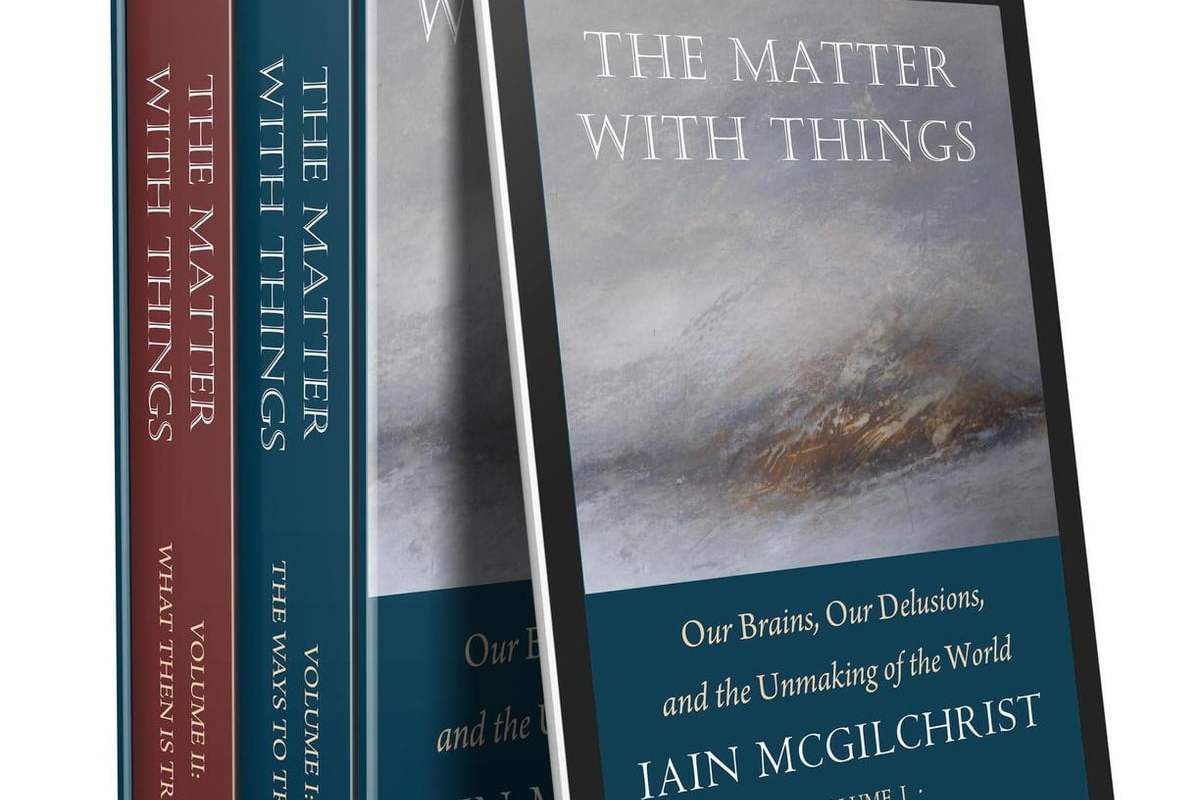
I can’t recommend Iain McGilchrist’s book, The Matter with Things, highly enough. I recommend reading The Master and His Emissary first. I didn’t figure this out until I started reading The Matter with Things, so I am reading them in parallel.

The book arrives as two volumes split into three sections. Part one is the foundation the rest of the book builds on. I’ve recently finished it and summarised each chapter, but I feel a high-level chapter orientation would be in order. Part one contains nine chapters:

  1. Some preliminaries: how we got here
  2. Attention
  3. Perception
  4. Judgment
  5. Apprehension
  6. Emotional and social intelligence
  7. Cognitive intelligence
  8. Creativity
  9. What schizophrenia and autism can tell us

Here’s the breakdown:

Some preliminaries: How we got here

As this book is a follow-up to The Master and His Emissary, published in 2008, Iain has already laid much of the foundation for it. Moreover, he doesn’t assume that you’ve already read The Master and His Emissary, and the work leading up to it, so this is what he outlines here as he drops hints of what’s to come in the chapters ahead.

Attention

This chapter reminds us that we cannot perceive what we don’t attend to, to pay attention to. The world outside just is, and we can attend to this or to that. From there, our perception will develop, perhaps, in turn, drawing out attention elsewhere.

As is a thread throughout, Iain uses various mental illnesses and split cerebral hemispheres to make his points. In this case, he tells us how neuro-atypical people have attention challenges, whether attending to the ‘wrong’ or otherwise inappropriate things or attending to too many things at once, flittering from this to that to the next thing without pause or resolution.

Perception

This chapter articulates how we perceive after attention has been focused. Perception is based on prior experience and knowledge combines with new sensory inputs.

Following the trend of people with hemisphere disturbances, Iain reminds us that people coming from different experiential places will perceive the same scenario differently. And if they are attending to the ‘wrong’ stimulus, their perception may be limited to that context, even if that micro-focused scope is otherwise correct.

Judgment

For some reason, Iain uses the American English spelling of Judgment, which in this case happens to be my preferred rendition, though my spell-checker disagrees.

In this chapter, we move from attention and perception to now being able to make judgements in this space. Of course, if we’ve attended to the ‘wrong’ thing leading to a variant perception, our judgment may be similarly out of order. Following the American trend, let’s say I am watching a baseball match, and the umpire calls a ball thrown out of the strike zone as a strike. If instead, my attention was distracted to another person in the stands picking his nose, my perception of the strike situation would be peripheral at best, and I would be in no place to make a judgment—about the pitch in any case. I may likely have plenty of judgment about the nose-picker.

In a nutshell, judgment is a left hemisphere function. The right hemisphere simply doesn’t care to judge. It’s a dispassionate observer taking in all without even categorising, let alone judging.

Apprehension

In this chapter, Iain explains that he is employing the term apprehension classically to mean to grasp or hold onto. This is a left hemisphere function as well. The right hemisphere is not grasping. Deficits in the right hemisphere don’t allow one to view the world in context as a whole. The left hemisphere will just see things are disconnected parts, so whilst we might grasp and apprehend, our comprehension is deficient. Without a robust big picture, we may just grasp at things indiscriminately.

Emotional and social intelligence

This chapter and the next are about intelligences. As the name suggests, this chapter is concerned with emotional and social intelligence. For me, I think of the Raymond character in Rain Man, itself the result of a misperception of the name Raymond for the phrase ‘Rain Man”. Raymond is devoid of emotional and social intelligence. He is limited to mechanistic cognitive intelligence and is a fine example of what one looks like without the other.

This chapter reminds us that the right hemisphere not only constructs our sense of self, but it also facilitates the construction of other selves, which allows us to empathise with others. It also allows us to assess intent. It allows us to see the value of the whole of society. Of which we are parts rather than thinking that we are simply parts that make up the whole. This is an important distinction. This is what happens with the ego of the left hemisphere denies the Gestalt of the right.

Cognitive intelligence

This second chapter on intelligence focuses on the cognitive variety. It’s what we think of when we consider IQ scores and such. It’s the reasoning part of the brain. It’s about rote learning and reciting trivia and perceived facts as re-presented by the left hemisphere.

Creativity

In this chapter on creativity, we are told that this is a right hemisphere function. To be creative, the best advice to keep the left hemisphere from engaging and interrupting. Creativity comes to us holistically. It is not the result of a process. It is an absence of process. Thinking and analysis are the antitheses of creativity. This is a case where less definitely is more.

What schizophrenia and autism can tell us

Each of the chapters touches on aspects of schizophrenia and other mental illnesses and situations where the hemispheres get disconnected or out of whack. In this chapter, Iain drives the point home with a focus on these cases and what it can tell us about these neuro-atypical conditions.  

People assume that schizophrenics and autism spectrum people are irrational, but this is precisely incorrect. In fact, it’s the opposite. These people are hyper-rational at the expense of empathy and social intelligence. It’s not a surprise that we are seeing more schizophrenics these days. Neither is it a surprise that we see a modern society that more and more resembles schizophrenia. But I digress.

Summary

This was only meant to give a high-level vantage to connect the chapters of part one of The Matter with Things. I give more comprehensive summaries on my blog. This will give you more of an idea, but my recommendation is to read the book itself as well as The Master and His Emissary which I recommend reading first. Don’t be like me. 

Seeing the World As It Is

Cubism reminds us that we don’t see the world as it is. We see pieces, and we fill in the gaps. From the front, we can’t see the back. From the top, we can’t see the bottom.

Video: YouTube Video


The illusion that, if we can see something clearly, we see it as it really is, is hugely seductive.
John Ruskin makes the point that clarity is bought at the price of limitation. He paints a scenario wherein we are asked to imagine viewing an open book and an embroidered handkerchief on a lawn. From a quarter mile away, the two are indistinguishable. Moving closer, we can see which is which, but we can neither read the book nor trace the embroidery. Closer still, we can read the text and trace the embroidery, but we can’t see the fibres of the paper or the threads of the kerchief. And we can’t simultaneously focus on both and see detail in each. Focusing on the book, we can look closer and see the watermark, the hills and dales in the paper’s surface. With a microscope, we can see more still, as infinitum.

But at which point do we see it clearly?


I’ve created a YouTube short. I have to admit that I dislike the format. Sixty seconds isn’t really enough time to convey a concept. There’s too much missing context, and no time to elaborate. Nonetheless, I was reading The Master and His Emissary and wanted to share a point. I don’t feel I succeeded. I posted it anyway, and here it is.

Cerebral Hemisphere Differences: Woods and Trees

Iain McGilchrist feels that the world is moving too much toward a left hemisphere-dominated world. This has happened before, ebbing and flowing, and perhaps it will change direction again at some point. Although this compartmentalised thinking has its roots at the beginning of the Age of Enlightenment, it has accelerated in the past century as specialisation has too many of us losing the woods for the trees.

Podcast: Audio rendition of this page content

Humans have “a sufficiently strong propensity not only to make divisions in knowledge where there are none in nature, and then to impose the divisions on nature, making the reality thus conformable to the idea, but to go further, and to convert the generalisations made from observation into positive entities, permitting for the future these artificial creations to tyrannise over the understanding.”

— Henry Maudsley, The Physiology and Pathology of the Mind,1867

I hope McGilchrist explores extreme right hemisphere dominance more in The Master and His Emissary, whether relatively due to a deficient left hemisphere or because of the right hemisphere running amok.

McGilchrist warns the reader time and again that both hemispheres are involved in many activities, and it is what they are doing or how they are processing the events that differ. But when we generalise some primary competencies—a decidedly left hemisphere activity—, we notice that the left hemisphere is about constrained thinking with a focus on elements rather than the whole as illustrated previously and creating a map to re-present those data.

A Woman’s Face in the Trees: Gestalt in Action

Conversely, the right hemisphere is about openness and experiencing the world as it is presented rather than a re-presentation. I likened this to a Zen approach. It would probably not be unfair to relate this to the Buddhist notion of oneness and selflessness.

Given Iain’s assessment, perhaps right hemisphere dominance is not our biggest concern at the moment. However, I perceive a potential problem. Given the right hemisphere’s proclivity toward Gestalt, I am concerned that it also overgeneralises things into a whole where they shouldn’t be connected, as such. Gestalt is what fills in spaces in perception to make it appear as a whole. I’ll consider this to be an interpolation. But if it interpolates wrong, we may incur fitness penalties. Aside from this, I consider extrapolation—or perhaps misidentified boundary states, which is to say we include aspects outside of the ‘real’ domain boundary and glom it onto the model because, cognitively speaking, we don’t know what to do with it or how to interpret it. Once it gets passed to the left hemisphere, it (incorrectly) codifies it, from that point onward being mis-re-presented.

So where the left hemisphere loses the woods for the trees, the right hemisphere annexes the neighbours’ woods.

The Unbearable Preciseness of Language

First, accept my heartfelt apology in advance for employing the word preciseness over precision. I was seeking a term closer to lightness, a conceit to the Unbearable Lightness of Being.

Audio: Podcast rendition of this page content

It appears that I am at odds with Iain McGilchrist if I am interpreting The Master and His Emissary correctly, His position is that verbal and written language is too precise for accurate communication. Gestures and facial queues are necessary to convey the entire payload; otherwise, it is easy to miss nuances in empathy and metaphor. Missing most are signals conveyed by the eyes, which are interpreted by the right hemisphere. The left hemisphere is more concerned with the mouth.

Before I get too far ahead of myself, the position I’ve asserted for years is that of the insufficiency of language. As diametric as this might seem at face value, I feel that it’s both, and it depends on the words and the contexts, though it feels that we are in disagreement here as well.

It’s long been said that the eyes are the window to the soul, and these people were onto something. The eyes convey emotional content to be interpreted by the right hemisphere. This hemisphere is all about seeing the big picture as well as metaphor.

The left hemisphere is more concerned with maps and symbols, so it is looking at the mouth and lips for minute details.

People with right hemisphere deficits can’t decode meta information conveyed by the eyes. Practically, this means that they can’t interpret metaphor, innuendo, sarcasm or humour. This is also the case for schizophrenics and people further right on the autism spectrum, including those with Asperger’s syndrome. I don’t know if the connexion between these psychological conditions and right hemisphere effects is due to a deficient right hemisphere or something related to the communication channel between the hemispheres. This has not yet been mentioned.

I also find it interesting that this deficit creates a situation where a sufferer can’t discern a joke from a lie, which is telling. In a manner of thinking, a joke is a bit of an untruth or stretching a fact or omitting some details to make a point, so without the larger context that this is the purpose of the joke, it might easily be interpreted as a lie.

All of this is interesting, but these are not the insufficiencies I am concerned with. In these cases, these deficits inhibit the receipt of relevant information. My contention involves the majority of people—the ones we term as ‘normal’.

One of my pet peeves is weasel words. Justice is a big one among these. I wonder if he feels that the Gestalt of the right hemisphere is what I am missing. This is the pornography the US Supreme Court judge, Potter Stewart, who says he can’t define it, but he’ll know it when he sees it. I say that this imprecision is meant to allow for arbitrary and capricious application on a whim or to meat some ulterior motive. This is decidedly not a problem of over-precision, and this is where I hold issue. Can it be too precise, too sharp to a point it needs the edges rounded? Yes. I can see that as well.

Intermission

I feel that missing non-verbal cues is a massive challenge for videoconference calls—even when the audience is one-to-one. First, the resolution needs to be high enough to see the eyes and face, so the person needs to be in frame and not one of several people barely discernible, presume, of course, that they are showing themselves on camera at the start.

Assuming that the resolution and lighting are appropriate and the person’s face is framed in a manner to reveal their eyes and mouth, gesticulation and body language are likely missing, so we are missing more non-verbal cues. I’ll also assume that we can discern aspects of prosody which as timbre, pitch, and intonation.

Add to this a videoconference with multiple participants. Sure, you might be able to see all of the faces, but there is still something missing from these thumbnail views. In some cases, I’ve seen long shots, say, in a conference room, but the detail is notably lacking. No nuance here.

Can we adapt to this situation? Yes, Of course. Should you meet in person where it’s possible and importance is of the utmost? Of course. You’d be a tone-deaf fool not to.

Epilogue

The last point I’d like to make about language being too precise is that for an erudite person like McGilchrist, it just might be, but most people don’t have large vocabularies and have barely adequate grammatical skills. They are hardly at risk of precision. An apt analogy might be to liken them to three-year-olds with crayons—no offence to three-year-olds with crayons. Plenty of people are a step or two above functional illiteracy, but that’s not saying much. To these people, language is less of a sword than it is a blunt instrument, a proverbial bag of bowling balls.

Voltaire once quipped that he’d have written a shorter letter if he had the time, noting the effort necessary for concision. The problem with trying to encode a message not conveyable by body language into a document is that its word count might need to double or treble, which I argue would at the same time reduce interest and comprehension, opening room to misinterpret the intent—all because missing non-verbal queues were lost.

In the end, I am doubling down on my position. Language is insufficient for all but the simplest and basic communication, and it is not too precise. The word McGilchrist is looking for is blunt.

Cerebral Hemisphere Differences: Pattern Definition

Continuing with a quick post based on observations in The Master and the Emissary by Iain McGilchrist, another example of hemispheral specialisation is illustrated in the image below.

Podcast: Audio rendition of this page content

A typical person will envisage this large S composited with smaller Ss (that could be replaced with any symbols, so there is nothing special about the S comprised of Ss) as represented by the centre image of the rendition of the bilateral interpretations.

Where there is left hemisphere damage, the right would envisage something more like the S on the right—seeing the big picture but losing detail. Where there is right hemisphere damage, the left would perceive something more like the S on the left, which is the detail of the composite Ss without recognising that they composed a bigger picture. This is conveyed in the aphorism of losing the woods for the trees whilst the former right hemisphere dominant view might not realise that the forest has trees.

But even this misses the point slightly because if you are viewing this as a typical person, you can assemble the Ss on the left and realise that it makes a larger S whereas a person with right hemisphere damage will just see a mass of Ss and not see the larger S shape. Moreover, it’s not that the right hemisphere wouldn’t ‘see’ the smaller composite Ss, it just wouldn’t put any significance on them, thus ignoring them and considering them to be background noise.

I really do want to share about the non-stereoscopic animals as well as another instalment from The Matter with Things. At least one of these is probable for the next post.