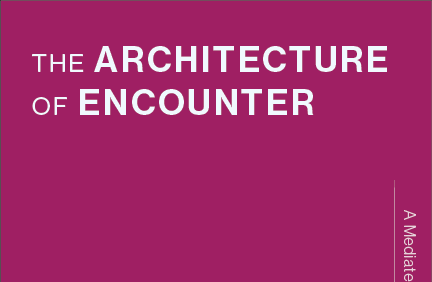
I’ve been writing. In fact, I’ve been clarifying A Mediated Encounter Ontology of the World (MEOW) and expanding and extending it into a book with a broader remit. This might well be the cover, following the monograph layout for Philosophics Press.
Image: Mockup of cover art.
As shown, the working title is The Architecture of Encounter: A Mediate Encounter Ontology. I’ve swapped the slate cover for a magenta in this volume.
So what’s it all about?
I’m not going to summarise the book here, but I’ll share some tidbits. I’ve settled on these chapter names:
The Mediated Encounter Ontology
Ontology
Subjecthood
Logic
Epistemology
Perception and Affordances
Language
Social Ontology
Realism
Application
The Normativity Frontier
Conclusion
Chapter 1, The Mediated Encounter Ontology, is a summary and update of the original essay, which will be included in full as an appendix item for reference, but this update will become canonical.
Chapter 2, Ontology: Interaction, Constraint, and the Rejection of Substance, will describe what I mean by ontology and what my proposed ontology looks like.
Chapter 3, Subjecthood: Modal Differentiation Within the Field, will explain how the subject-object relationship changes, and what a subject is in the first place.
Chapter 4, Logic: Coherence Grammar Under Constraint, will explain what logic is and how it operates in this paradigm.
Chapter 5, Epistemology: Convergence, Error, and the Structure of Justification, will describe what knowledge looks like. IYKYK.
Chapter 6, Perception and Affordances: Encounter as Orientation, extends Gibson’s work to comport with MEOW 2.0 (or 1.1).
Chapter 7, Language: Synchronisation, Ontological Grammar, and Structural Limits, explains how language works and how it limits our perception. We’re not talking Sapir-Whorf here, but what respectable language philosopher wouldn’t reserve a chapter for language?
Chapter 8, Social Ontology: Second-Order Constraint Systems. MEOW has a lot to say about first-order constraints, but there are higher-order considerations. I discuss them here.
Chapter 9, Realism: Cross-Perspectival Convergence and the Invariant Anchor, talks about the real elephant in the room. Since MEOW challenges both realism and idealism, we need to talk about it.
Chapter 10, Application: The Apophatic Mind, is mostly an observation on artificial intelligence as it relates to the mind-consciousness debate, primarily scoped around LLMs and similar machine processes.
Chapter 11. The Normativity Frontier, doesn’t yet have a subtitle, but this is where I discuss issues like normative ethics and morality.
I probably don’t need to tell you how Conclusion chapters work.
I expect to have 3 appendices.
Summary of commitments, which will summarise and distil key topics – so like a cheat sheet for reference – a bit more robust than a glossary.
Bibliography of reference material. As this is not an essay, it won’t be chock-full of citations – only a few, where I feel they are necessary. Much of this work represents years of thinking, and in many cases, the attribution has been lost; I remember the contents and not necessarily the attribution. I will prompt AI to fill in some missing pieces, but that’s that. The bibliography attempts to capture the general flavour.
The original MEOW essay. This is already freely available on several platforms, including Zenodo. Download it here if you haven’t already – or wait for the book.
The rest of the story
This book not only extends MEOW, but it also ties in concepts from A Language Insufficiency Hypothesis and other of my already published and yet unpublished work.
I expect to produce a decent amount of explanatory and support material, though to be fair, I tell myself that every time until I get distracted by the next project. I need a producer to manage these affairs.
I happened upon my copy of The Plague by Camus. I had forgotten that I had read it—likely during the COVID-19 debacle, but perhaps earlier.
The Plague is basically a deep dive into a city gone mad with disease. It’s set in Oran, Algeria, where things kick off with a sinister dead rat and spiral into full-blown disaster as a plague locks the city down. This isn’t just a survival story; it’s a gritty look at how people cope when the world turns upside down.
The city becomes a pressure cooker. Through characters like Dr Rieux, the down-to-earth doc who’s all about getting things done; Tarrou, the outsider with a shady past; and Father Paneloux, who’s trying to square God’s plan with the chaos, Camus throws some heavy questions at us. What do you do when there’s no escape? How do you keep your humanity when life’s going off the rails?
Camus keeps his cool, writing with a detached style that makes the unfolding horror hit even harder. It’s like he’s telling us to face up to the absurdity of life without flinching. The plague is more than a disease in Oran—it’s a symbol of all the random, harsh stuff life throws at us.
The Plague is raw and real. It doesn’t offer cosy reassurances; instead, it challenges you to look disaster in the eye and ask yourself: when everything falls apart, who will you become? This book isn’t just a read; it’s a challenge—a call to fight against despair, even when the odds are stacked against you.
In our exploration of fictions—nations, economies, money, legal systems, and even sports—we have uncovered the profound ways in which these constructs shape our reality. These fictions, born from collective agreements and sustained by shared belief, play pivotal roles in organizing societies, guiding behaviors, and fostering a sense of belonging and purpose. While they may not correspond to an objective, external reality, their effects are undeniably real and impactful.
Recognizing the fictional nature of these constructs challenges us to rethink our assumptions about truth and reality. It reveals the power of human imagination and the social nature of our existence. This awareness empowers us to question, reform, and innovate the fictions we live by, opening up possibilities for creating new social constructs that better align with our evolving values and aspirations.
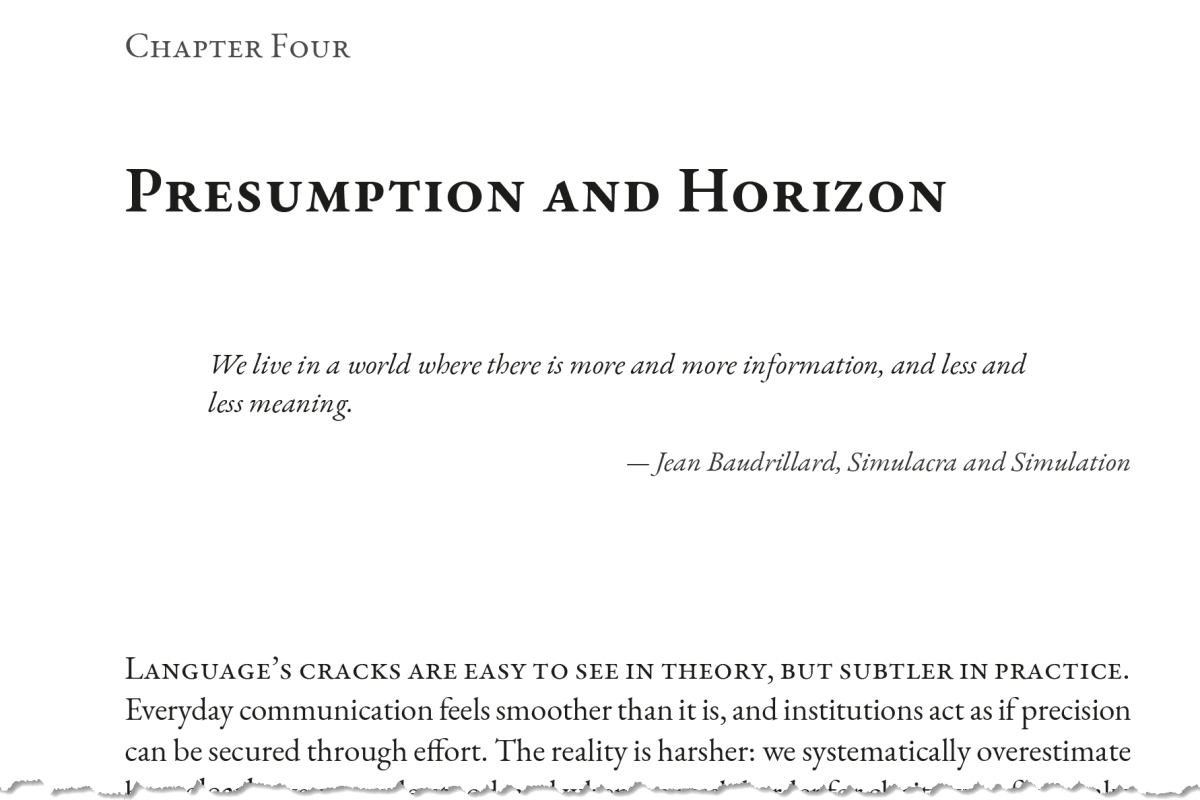
The historical and philosophical perspectives we have explored underscore the contingent and constructed nature of truth. Thinkers like Michel Foucault and Jean Baudrillard remind us that what we accept as truth is often a product of social and historical processes, shaped by power dynamics and collective narratives. This critical awareness invites us to engage with our social constructs more thoughtfully and responsibly.
The practical implications of this perspective are far-reaching. By understanding that economic systems, national identities, and legal frameworks are human-made, we can envision and implement alternative models that prioritize sustainability, equity, and inclusivity. Recognizing the power of belief and narrative in shaping our realities encourages us to foster transparency, inclusivity, and critical engagement in the construction and perpetuation of social fictions.
Ethically, we must approach the creation and maintenance of fictions with a commitment to the common good. The manipulation of these constructs for narrow interests can lead to exploitation and injustice. Therefore, it is crucial to ensure that our social constructs serve the interests of all members of society and reflect our collective values and aspirations.
In conclusion, living in a world of fictions is both a profound and practical reality. By embracing the constructed nature of our social realities, we affirm the human capacity for imagination and creativity. This recognition opens up possibilities for envisioning and creating new fictions that better reflect our values and guide us toward a more just, equitable, and sustainable future. Through critical engagement and thoughtful innovation, we can navigate the complexities of our social world with greater insight and intentionality, fostering a more dynamic and harmonious society.
Chapter eleven is the first of three chapters discussing truth from the perspective of science. These chapters are followed by truth as seen from other perspectives, namely, reason and intuition.
Check out the table of contents for this series of summaries. I continue to render interstitial commentaries in grey boxes with red text, so the reader can skip over and just focus on the chapter summary.
The author posits that in the West, most of us trust science to deliver the truth of the matter, as “science alone holds out the promise of stable knowledge on which we can rely to build our picture of the world“. He admits that it does have value, but it has inherent limitations and yet draws us in like moths to a flame. Here, he distinguishes between the discipline and practice of science and Scientism as it is practised by laypeople. Science understands its place and domain boundaries. Scientism is omnipotent with delusions of grandeur that will never be realised.
Some philosophically naïve individuals become very exercised if they sense that the status of science as sole purveyor of truth is challenged
— Iain McGilchrist, The Matter with Things, chapter 10
Politicians who promote science as a bully pulpit prey on the public in a manner similar to bludgeoning them with religious notions.
Science is heavily dependent on the exercise of what the left hemisphere offers.
ibid.
The point the book makes is that like the turtles that go all the way down, science doesn’t have a grasp on what’s beyond the last turtle. Like trying to answer the toddler who can ask an infinite number of ‘why‘ questions, the scientist gets to a point of replying ‘that’s just the way things are’, or the equivalent of ‘it’s bedtime’.
Scientific models are simply extended metaphors. A challenge arises when a model seems to be a good fit and we forget about alternative possibilities getting locked into Maslow’s law of the instrument problem, where ‘to a man with a hammer, everything begins to look like a nail’. Moreover, the left hemisphere is fixated on instrumentation, so it’s always trying to presume a purpose behind everything. Nothing can just be.
This is likely where Scientism begins to trump science.
He quotes:
Dogmatism inevitably obscures the nature of truth.
— Alfred Whitehead
McGilchrist points out that a goal or promise of science is to be objective and take the subject out of the picture. Unfortunately, this is not possible as the necessity for metaphor ensures we cannot be extricated. Objectivity is legerdemain. We create a scenario and claim it to be objective, but there is always some subject even if unstated. He goes into length illuminating with historical characters.
The sciences do not try to explain, they hardly even try to interpret, they mainly make models … The justification of such a mathematical construct is solely and precisely that it is expected to work.
— John von Neumann
In fact, science itself is predicated on assumptions that have not and can not be validated through science.
In conclusion, McGilchrists wants to emphasise ‘that just because what we rightly take to be scientific truths are not ‘objective’ in the sense that nothing human, contingent and fallible enters into them, this does not mean they have no legitimate claim to be called true.’ ‘The scientific process cannot be free from assumptions, or values.’
Following this chapter are several pages containing dozens of plates of images.
Children are ethically indisposed to think it’s wrong to eat animals. This article from the Journal of Environmental Psychology published a year ago looks into the schism and cognitive dissonance assuaging mechanisms in play.
This study relied on a small sample size (n=176), between the ages of 4 and 7 years living in a metropolitan area located in the southeastern region of the United States. The sample was otherwise diverse.
As this study was limited in geographic scope (see WIERD on a tangential note), it noted that eating habits vary by culture. For example, eating horse (or dog) meat is not condoned in the United States, but it is acceptable in many other places.
In summary, the childer were shown cards each with a picture of an item, whether a French fry, a horse, a cat, a fish, a tomato, and so on. At the start, they were asked to identify the item represented on the card. Next, they were asked to put the card into one of two bins, each decorated to approximate an animal or vegetation. Finally, they were asked to sort the cards into two areas, one represented by false teeth indicating edible products and a rubbish bin representing inedible items.
The subjects did a fair job of identifying the card items. They had very high image recognition of these particular animals. On the lower end of recognition were hamburger (ground beef patty), almonds, and shrimp. There was a difference between the older children and the younger children, but this may relate to the added acculturation their age would bring.
Without delving deeply into details, in this study, most 6- and 7-year-olds classified chicken, cows, and pigs as not OK to eat. The interesting cognitive trick is that these children also classified these derivative food items as non-animals thus removing the cognitive dissonance. No longer classified as an animal, their ethical framework remained internally coherent.
In discussing the results, many children were ill-informed about the source of various food products. Language games obscured the source. No one should eat a cow, but beef is fine—a hamburger is fine. Hot dogs grow on trees, don’t they?
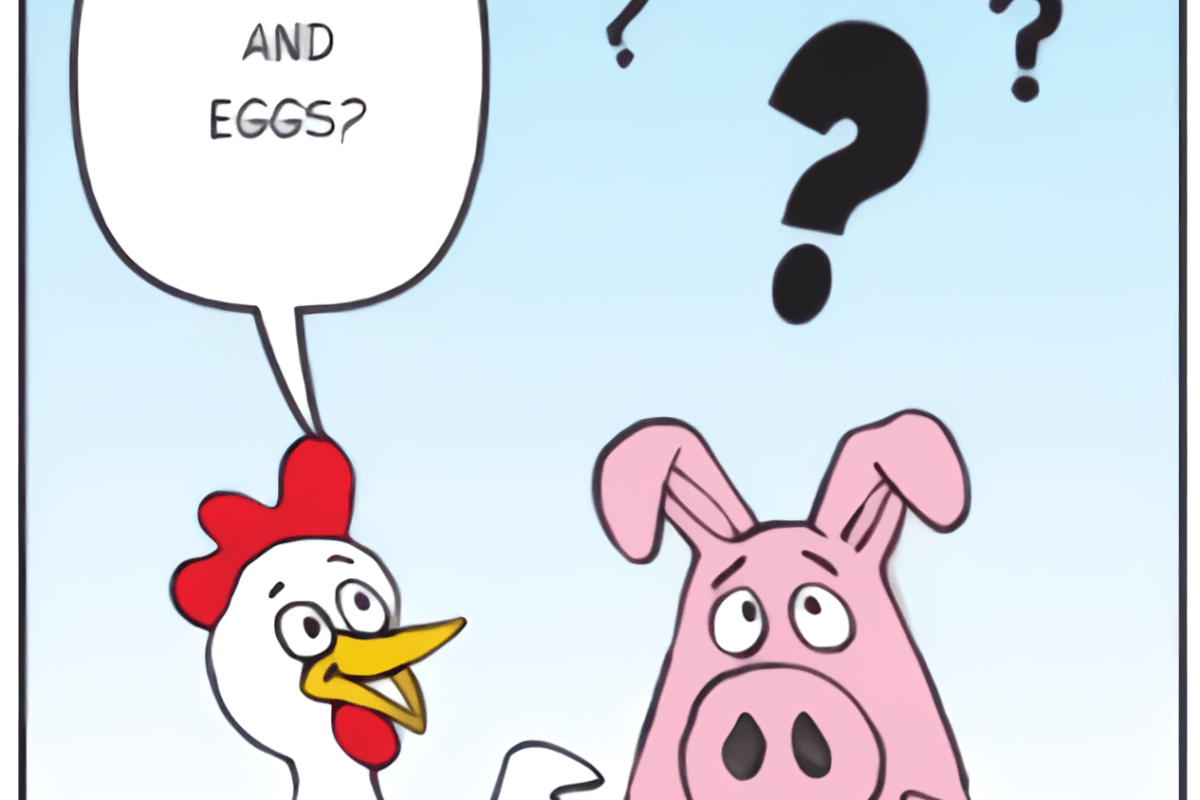
This reminds me of the story wherein a chicken and a pig are conversing, and the chicken suggests that it and the pig go into the restaurant business. The pig considers the proposition and declines by the rationale that it would be committed but the chicken would only be involved. Children may believe that hot dogs are a by-product like eggs, fur, or feathers—don’t get me started on the down used in pillows, jackets, and comforters—rather than grasping that the animals yield these products at the expense of their lives.
Some people grow up and realise the inconsistency of their ethics and actions, but they find any number of ways to reconcile their actions, noting that the activity is normal and natural.
FULL: DISCLOSURE: For the record, I eat chicken, turkey (on festive holidays in lieu of chicken), and I eat beef (that’s cows, for the uninformed). I also consume some animal byproducts, i.e., chicken eggs and cheese. I also wear leather. I was a vegetarian for about three years until I opted to become a chickenatarian. My life partners goaded me into eating beef, and so I’ve since added that. In all cases, I feel bad for eating defenceless, sentient beings. I’m not sure it serves as any consolation that I limit my consumption to these three animals—or even if it were only one. For the record, I don’t particularly like the taste of turkey or beef, but it’s not offensive like pork, coffee, or alcohol. Chicken, I like. Sorry chickens.
Video: Homer Simpson’s (not so) ethical dilemma
For the record, this is post number 500 on Philosophics. Perhaps I should write a post about it.
I have a confession to make. I finished reading the first volume of The Matter with Things about a month ago, and I took a break from reading more of it. I finally got around to continuing, and I read chapter twenty. When I got to the end and turned to the next chapter—chapter twenty-one—, it dawned on me that volume I ended at chapter nine. I had inadvertently skipped volume II and began volume III. Oopsie. I’m lucky it wasn’t a novel, having skipped ten chapters.
Since I’ve read it, I might as well summarise it, Spoiler alert: there are no spoilers to alert. As this chapter is more about exposition and colour, this summary will be much shorter than the summaries of the first volume. I don’t know if this will be a continuing trend. We’ll find out together.
This chapter is labelled the coincidentia oppositorum, the coincidence of opposites. Effectively, the chapter wants to impart three main points.
Symmetry
Firstly, asymmetry is the norm. Symmetry is the exception. We perceive things in opposites. This brings attention to bear. Line straight lines, symmetry does not exist in nature. It is something the left hemisphere perspective approximates. No face is symmetrical; planets are not symmetrical. In fact, if one manipulates an image of a face and mirrors one side as both to appear as a face, it becomes obvious that something is amiss.
Excess
The Ancient Greeks had a penchant for moderation. Buddhists have the Middle Path. Everything is poisonous in large enough quantities. Even poisons can be therapeutic at low doses. The point is to retain this perspective.
To be or not to be…or both
This is not about Schrodinger’s cat. We need to break ourselves of the habit of thinking in opposites. Not everything is a dichotomy—black and white. Some things are black and white—and not just a draughts board. McGilchrist opens the chapter with a nice Iriqois about two brothers who were seeming opposites but were nonetheless necessary. In a manner, this is the good versus evil story. Opposition strengthens us. Trees raised in a windless environment don’t have the strength of natural-grown trees.
This story is encapsulated in a story told by Rabbi Jonathan Sacks.
A faithful man finds in the scriptures that Rabbi X said that a certain thing was true. Later he finds that Rabbi Y said that the very same thing was false. He prays for guidance: ‘Who is right?’ God answers: ‘Both of them are right.’ Perplexed, the man replies: ‘But what do you mean? Surely they can’t both be right?’ To which God replies: ‘All three of you are right.’
In the chapter summary, McGlichrists ends with this:
Just as there is an asymmetry in the relationship of the hemispheres, there is an asymmetry in the coincidentia oppositorum. We need not just difference and union but the union of the two; we need, as I have urged, not just non-duality, but the non-duality of duality with non-duality; and we need not just asymmetry alone, or symmetry alone, but the asymmetry that is symmetry-and-asymmetry taken together.
Summary
As I mentioned at the start, this is a short summary. I really enjoyed this chapter and its lessons. It’s nice to be reminded of such things. This extends to the asymmetry of the hemispheres of the brain. As much as I don’t appreciate the imbalance of the left hemisphere in Modernity, I need to be reminded that we just need to tweak the dial a tab to the right. We don’t need the right hemisphere operating at eleven, to share a reference to Spinal Tap.
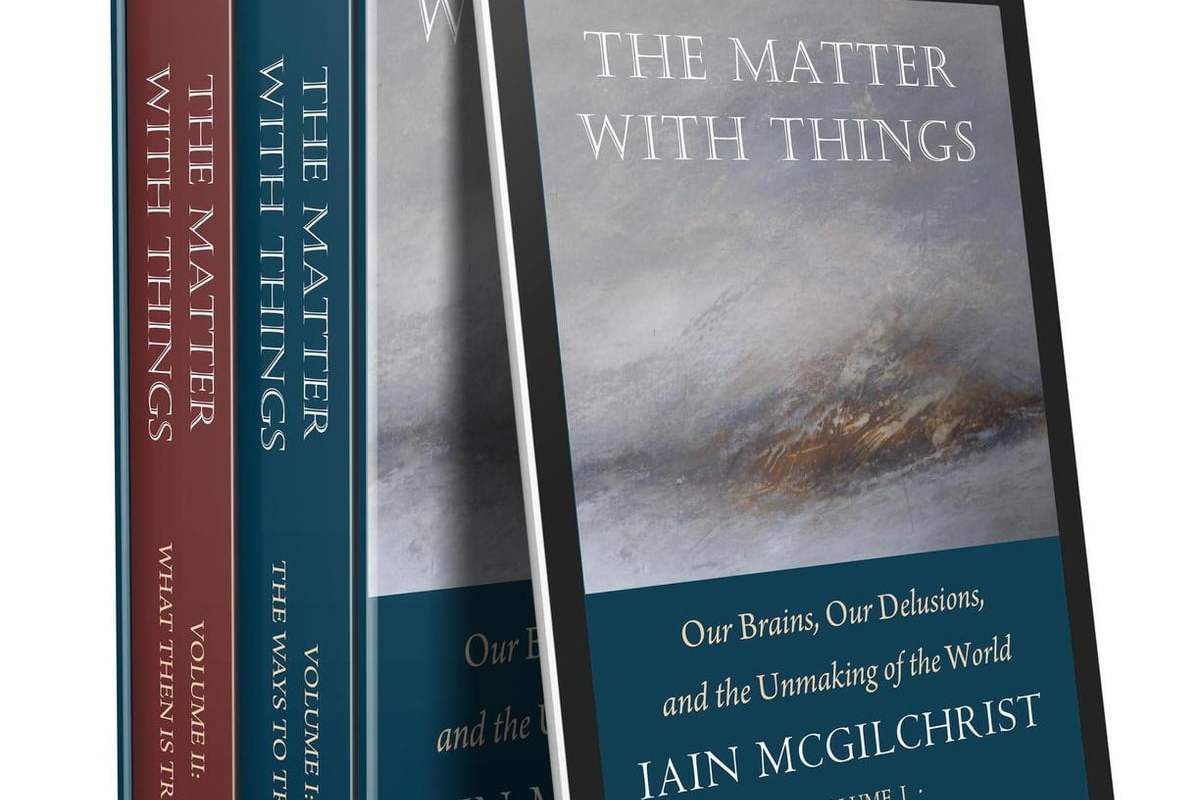
I can’t recommend Iain McGilchrist’s book, The Matter with Things, highly enough. I recommend reading The Master and His Emissary first. I didn’t figure this out until I started reading The Matter with Things, so I am reading them in parallel.
The book arrives as two volumes split into three sections. Part one is the foundation the rest of the book builds on. I’ve recently finished it and summarised each chapter, but I feel a high-level chapter orientation would be in order. Part one contains nine chapters:
As this book is a follow-up to The Master and His Emissary, published in 2008, Iain has already laid much of the foundation for it. Moreover, he doesn’t assume that you’ve already read The Master and His Emissary, and the work leading up to it, so this is what he outlines here as he drops hints of what’s to come in the chapters ahead.
Attention
This chapter reminds us that we cannot perceive what we don’t attend to, to pay attention to. The world outside just is, and we can attend to this or to that. From there, our perception will develop, perhaps, in turn, drawing out attention elsewhere.
As is a thread throughout, Iain uses various mental illnesses and split cerebral hemispheres to make his points. In this case, he tells us how neuro-atypical people have attention challenges, whether attending to the ‘wrong’ or otherwise inappropriate things or attending to too many things at once, flittering from this to that to the next thing without pause or resolution.
Perception
This chapter articulates how we perceive after attention has been focused. Perception is based on prior experience and knowledge combines with new sensory inputs.
Following the trend of people with hemisphere disturbances, Iain reminds us that people coming from different experiential places will perceive the same scenario differently. And if they are attending to the ‘wrong’ stimulus, their perception may be limited to that context, even if that micro-focused scope is otherwise correct.
Judgment
For some reason, Iain uses the American English spelling of Judgment, which in this case happens to be my preferred rendition, though my spell-checker disagrees.
In this chapter, we move from attention and perception to now being able to make judgements in this space. Of course, if we’ve attended to the ‘wrong’ thing leading to a variant perception, our judgment may be similarly out of order. Following the American trend, let’s say I am watching a baseball match, and the umpire calls a ball thrown out of the strike zone as a strike. If instead, my attention was distracted to another person in the stands picking his nose, my perception of the strike situation would be peripheral at best, and I would be in no place to make a judgment—about the pitch in any case. I may likely have plenty of judgment about the nose-picker.
In a nutshell, judgment is a left hemisphere function. The right hemisphere simply doesn’t care to judge. It’s a dispassionate observer taking in all without even categorising, let alone judging.
Apprehension
In this chapter, Iain explains that he is employing the term apprehension classically to mean to grasp or hold onto. This is a left hemisphere function as well. The right hemisphere is not grasping. Deficits in the right hemisphere don’t allow one to view the world in context as a whole. The left hemisphere will just see things are disconnected parts, so whilst we might grasp and apprehend, our comprehension is deficient. Without a robust big picture, we may just grasp at things indiscriminately.
Emotional and social intelligence
This chapter and the next are about intelligences. As the name suggests, this chapter is concerned with emotional and social intelligence. For me, I think of the Raymond character in Rain Man, itself the result of a misperception of the name Raymond for the phrase ‘Rain Man”. Raymond is devoid of emotional and social intelligence. He is limited to mechanistic cognitive intelligence and is a fine example of what one looks like without the other.
This chapter reminds us that the right hemisphere not only constructs our sense of self, but it also facilitates the construction of other selves, which allows us to empathise with others. It also allows us to assess intent. It allows us to see the value of the whole of society. Of which we are parts rather than thinking that we are simply parts that make up the whole. This is an important distinction. This is what happens with the ego of the left hemisphere denies the Gestalt of the right.
Cognitive intelligence
This second chapter on intelligence focuses on the cognitive variety. It’s what we think of when we consider IQ scores and such. It’s the reasoning part of the brain. It’s about rote learning and reciting trivia and perceived facts as re-presented by the left hemisphere.
Creativity
In this chapter on creativity, we are told that this is a right hemisphere function. To be creative, the best advice to keep the left hemisphere from engaging and interrupting. Creativity comes to us holistically. It is not the result of a process. It is an absence of process. Thinking and analysis are the antitheses of creativity. This is a case where less definitely is more.
What schizophrenia and autism can tell us
Each of the chapters touches on aspects of schizophrenia and other mental illnesses and situations where the hemispheres get disconnected or out of whack. In this chapter, Iain drives the point home with a focus on these cases and what it can tell us about these neuro-atypical conditions.
People assume that schizophrenics and autism spectrum people are irrational, but this is precisely incorrect. In fact, it’s the opposite. These people are hyper-rational at the expense of empathy and social intelligence. It’s not a surprise that we are seeing more schizophrenics these days. Neither is it a surprise that we see a modern society that more and more resembles schizophrenia. But I digress.
Summary
This was only meant to give a high-level vantage to connect the chapters of part one of The Matter with Things. I give more comprehensive summaries on my blog. This will give you more of an idea, but my recommendation is to read the book itself as well as The Master and His Emissary which I recommend reading first. Don’t be like me.
In the last chapters, the topics were about different intelligences. As we’ll see, intelligence is one of the factors for creativity, but there are more. Let’s crack on.
Podcast: Audio rendition of this page content
Content
Creativity is an elusive phenomenon that cannot only not be summoned at will, the very act of trying inhibits it. Unlike left-hemisphere-oriented intelligence, there are no simple tests for creativity because of their very nature. Assessing the left-hemisphere is relatively simple because it is systematic and any tests have definite known solutions—whether calculating some figure, solving a puzzle, choosing analogies, or recounting some trivia. There is no such test for creating something not yet created, but there are some proxies that most people categorically fail.
Psychologist, Colin Martindale, had this to say about the personal characteristics of creativity
“Creativity is a rare trait. This is presumably because it requires the simultaneous presence of a number of traits (e.g., intelligence, perseverance, unconventionality, the ability to think in a particular manner). None of these traits is especially rare. What is quite uncommon is to find them all present in the same person.”
— Colin Martindale
Whereas the left hemisphere is analytical, the right hemisphere (hence creativity) is a Gestalt. When given a difficult time-boxed challenge, the left hemisphere dominant individual who does not arrive at the expected response on time will commit to and defend an incorrect response (think escalating commitment), and the right hemisphere dominant individual will simply not commit to a response under the thought that there were still options to be explored.
Effectively, creativity can be broken down into three phases: preparation, incubation, and illumination.
In essence, for the creative individual, the best we can do is to leave well enough alone. Anything but space and permission will kill the creative impulse.
Preparation is simply the accumulation of a particular domain of knowledge. For an artist, it will be to understand, perhaps, colour, shape, texture, form, shadow, media, or so forth; for a musician, it might be to understand melody, harmony, tempo, timbre, dynamics, and so on; for a mathematician, it might be basic arithmetic, theories, proofs, and on and on. It’s also important to note that accumulated information in multiple domains also forms a foundation leveraged by many polymaths.
Incubation is simply waiting for something to grow in the prepared garden. Incubation is an unconscious activity and cannot be controlled or accessed by the conscious mind. In fact, conscious effort and introspection will serve only to impede cultivation. Digging up planted seeds to see how they are growing will only hinder the process.
Illumination is the final phase. Again, this is unwilled. Prepared and incubated flowers bloom. Of course, this is an imperfect metaphor because the ground must already have been fertile at the start. Tossing seeds on fallow ground still yields no blooms no matter how carefully attended.
In essence, for the creative individual, the best we can do is to leave well enough alone. Anything but space and permission will kill the creative impulse.
McGilchrist discusses generative, permissive, and translational requirements.
“The key element in generation seems to be the ability to think of many diverse ideas quickly, demanding breadth, flexibility and analogical thinking – seeing likeness within apparent dissimilarity.” This can be summed up as divergent thinking. This is the openness afforded by the right hemisphere as opposed to the convergent behaviour of the left. As it happens, this is where artificial intelligence falls flat as it is predicated on convergent activity.
The right hemisphere Gestalten surveys the environment and notes otherwise unperceived parallels. It is not a systematic approach. In the words of Oscar Wilde, “Education is an admirable thing. But it is well to remember from time to time that nothing that is worth knowing can be taught.”
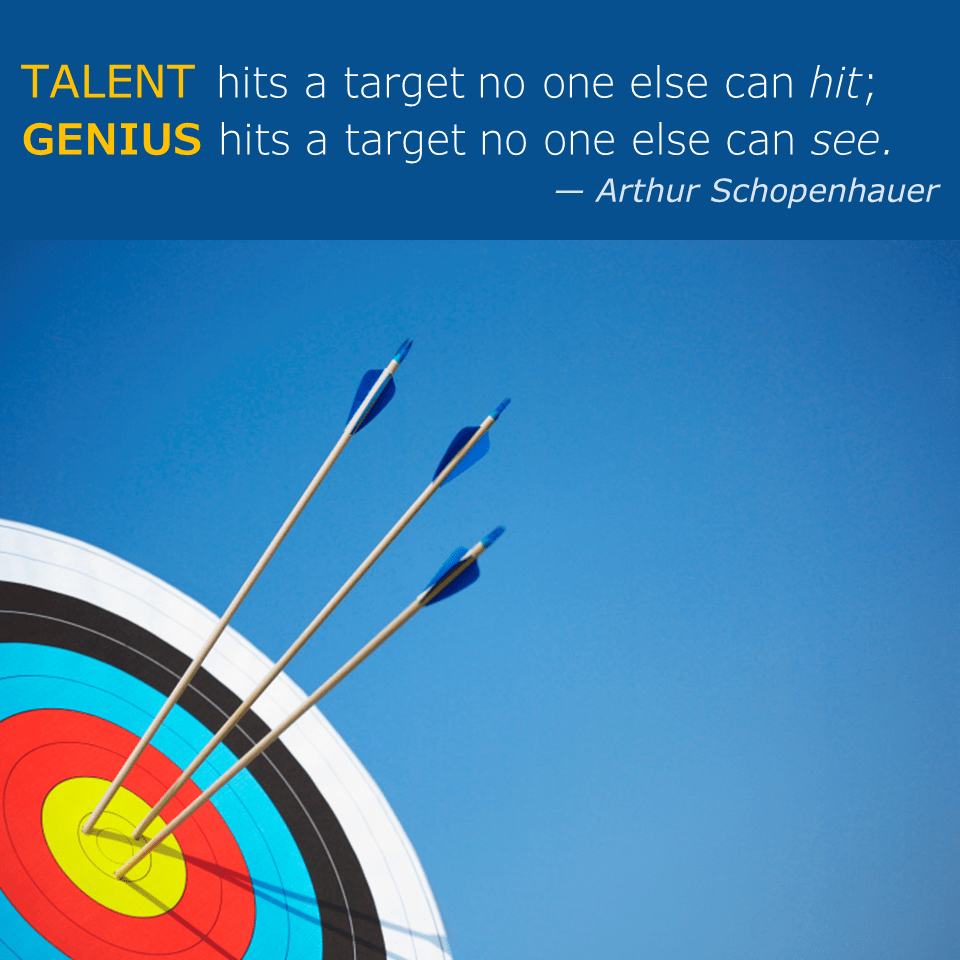
“Talent hits a target no-one else can hit; genius hits a target no-one else can see”.
Arthur Schopenhauer
Schopenhauer sums it up nicely, “Talent hits a target no-one else can hit; genius hits a target no-one else can see”.
Citing Isaac Asimov writing about Darwin’s insight, he notes that before Darwin, many people had read Malthus and studied species, but they lacked the creative spark that Darwin had.
Steve Jobs noted that
“Creativity is just connecting things. When you ask creative people how they did something, they feel a little guilty because they didn’t really do it, they just saw something. It seemed obvious to them after a while. That’s because they were able to connect experiences they’ve had and synthesize new things … A lot of people in our industry haven’t had very diverse experiences. So, they don’t have enough dots to connect, and they end up with very linear solutions without a broad perspective on the problem. The broader one’s understanding of the human experience, the better design we will have.”
— Steve Jobs
This is a failing of the business world and of specialisation more generally. McGilchrist writes, “Linear approaches and analytic thinking, characteristic of the left hemisphere, are fine in the right context, and may at a subsequent phase take part in creativity by narrowing things down and eliminating some of them, but on their own will not achieve creativity”.
There is a direct link between intelligence and creativity. Ego crushes creativity.
There is a direct link between intelligence and creativity. Ego crushes creativity.
He again cites Asimov:
“My feeling is that as far as creativity is concerned, isolation is required. The creative person is, in any case, continually working at it. His mind is shuffling his information at all times, even when he is not conscious of it …The presence of others can only inhibit this process, since creation is embarrassing.”
— Isaac Asimov
Some people excel at maths, but many are systematic and procedural left-hemisphere types; they apply logic and reason—insert tab A into slot B. The famous mathematicians understand the procedures, but their ideas come from intuition rather than reason. The left hemisphere doesn’t recognise this as a viable vector, and therein lies the rub. “Math is not about following directions; it’s about making new directions,” writes mathematician Paul Lockhart.
This is why we hear so many accounts of aha moments, something coming to one person in a dream or Isaac Newton’s falling apple anecdote.
“These thoughts did not come in any verbal formulation. I very rarely think in words at all. A thought comes, and I may try to express it in words afterward”
Albert Einstein
Einstein told Max Wertheimer, founder of Gestalt psychology, “These thoughts did not come in any verbal formulation. I very rarely think in words at all. A thought comes, and I may try to express it in words afterward”. Words are a left-hemisphere phenomenon.
Many accomplished musicians hear a piece whole. All they need to do is to compose it to staff paper or perform it. We hear this regularly: “I was driving from here to there and it just came to me. All I needed to do is to remember it long enough to get it down.”
I found McGilchrist’s inclusion of hemispheric damage quite interesting. He provides many examples of artists, composers, and poets, but I’ll only summarise them. For musicians and Artists with right hemisphere damage, those who even retained the urge to create did so at a lower quality level. However, those with left hemisphere damage operated at the same level and oftentimes at a higher level, without the inhibition and censorship of the left hemisphere.
It’s important to note that most people rely on both hemispheres. When I write left hemisphere dominant, I mean to say that either the right hemisphere simply underperforms or that the left hemisphere does not cede control back to the right hemisphere. Generally speaking, both hemispheres experience the world, and a strong right hemisphere will act as air traffic controller, or perhaps have the right of first refusal, but this is a loose metaphor because sometimes the left hemisphere just fields an experience and takes its best guess how to handle it even if it should have been fielded by the right hemisphere and even if the left hemisphere provides the wrong answer. The left hemisphere is the hemisphere of the ego and identity, so it is somewhat relentless and defensive even when it is wrong.
As a side note, I trust that political identity and escalating commitment are left-hemisphere activities and why modern Western politics feel so intractable.
After a strong argument for right hemisphere dominance and divergent thinking being hallmarks of creativity, he offers some counter-evidence and counters some of it.
A paper by Arne Dietrich and Riam Kanso co-authored a book citing instances of convergent thought processes that led to something innovative or creative. At the onset, McGilchrist calls them out for conflating problem-solving with creativity. In the end, the left hemisphere does play a role. He calls this the translational phase. Essentially, this is Mozart having heard his symphony and needing to put his thoughts to paper. Or the poet.
He goes off on a bit of a tangent noting how words pale concepts, and divergence and convergence are no exception. This fits in with my own insufficiency of language theory, but McGilchrist and I have different rationales for our arguments, so I’ll not side-track this summary.
He cites some statistics correlating creativity with mental health disorders and incidences of suicide. This will set the reader up perfectly for the next chapter about schizophrenia and autism.
Perspective
In summary, creativity has got me riled up more than in the previous chapters. This is partially due to how it comports with my own observations. I have always felt that humans are not very creative or innovative despite protests to the contrary. In fact, I’ve often commented when I’ve heard people say something like “artificial intelligence will never create the next…” Fill in the blank: Mozart, Picasso, Michelangelo, Nabokov, Wordsworth. Or Einstein. Of course, neither will a human be the next of these.
All these people are right cerebral hemisphere dominant. AI operates systematically, in the manner of the left hemisphere. None of these people built up systematically. Instead, their ideas were wholly formed, and their creations were reductive rather than additive. Famously, Michelangelo was to have said, “The sculpture is already complete within the marble block before I start my work. It is already there. I just have to chisel away the superfluous material.” He sees the solution first and then builds towards it.
In my professional life, I have been a strategist as a management consultant as well as a business analyst. In each case, I could quickly assess a situation and then spend weeks or months defending my intuition with words, diagrams, and numbers.
As a business analyst, I would offer a recommendation, and this would need to come with an estimate to deliver the recommendation. This figure would come to me in a matter of minutes. Then, per protocol, I would need to enter micro-level details into a pricing model so it could calculate from the ground up. First, this was time-consuming. Second, this would be circulated for review where different people would (almost invariably) reduce the number of hours estimated, typically due to pressure to reduce the cost. Ultimately, a number would be output and tendered to the client or the person footing the bill. Again (almost invariably), the number initially intuited was more accurate and reflective of what was ultimately invoiced. Unfortunately, business is a left-hemisphere endeavour, and that will be its Achilles’ heel and denouement.
This wraps up the chapter on Creativity. The next chapter is “what schizophrenia and autism can tell us”, and is the end of part one of The Matter with Things.
What are your thoughts and experiences with creativity now that you’ve heard McGilchrist’s take?
Chapter 6 of The Matter with Things is titled Emotional and Social Intelligence, following the previous chapters, Attention, Perception, Judgment, and Apprehension. Chapter 7 is about cognitive intelligence.
The gist of chapter 6 is to convey the importance of emotional and social intelligence in forming a full picture of the world. Absent these, reality becomes increasingly tenuous to retain a grip on because the left hemisphere just doesn’t have the emotional awareness to grasp the full picture.
Audio: Podcast version of this page content
Content
At the start, this chapter reminds us that the right hemisphere not only constructs our sense of self, but it also facilitates the construction of other selves, which allows us to empathise with others. It also allows us to assess intent. And it goes deeper than this.
McGilchrist shares some anecdotes about schizophrenic patients with impaired right hemispheres who believe that nothing is real and that people are play-acting. In hospital, they perceive the ward to be a stage and the medical staff to be actors.
As if by a control knob, changes to the right hemisphere may create a diminished sense of reality as well as an intensified sense—of being hyperaware. This is not dissimilar to certain claims by some with heightened lucidity; however, the data do not permit a clear-cut conclusion. On a related note, the intensified sense may also increase emotional reactions, so one might be more prone to crying—whether tears of joy or sadness.
Abnormal electrical activity in the right hemisphere can heighten a sense of familiarity leading to a sense of déjà vu. A diminished sense has the contrary effect, reducing a sense of familiarity, leading to a sense of jamais vu, ‘never before seen’, Related to déjà vu, there have been cases of déjà vécu, ‘already experienced’ (rather than seen). Together, over 86% of these phenomena are associated with the right hemisphere.
Recall that each hemisphere controls the body contralaterally, so the right hemisphere controls the left side of the body—hands and arms, eyes, and so on. And it’s deeper than this. For example, being the arbiter of empathy, the left hand (being controlled by the right hemisphere) is used for empathetic touch. Beyond humans, bottleneck dolphins tend to stroke other dolphins with their left flippers.
This affects humans and other animals with a sort of left-eye empathy that even affects how babies are held or otherwise attended to, preferring the left side of the body over the right.
Theory of mind (ToM), a topic in its own right, is a right hemisphere-dominant capability that allows us to empathise with another or to put ourselves into another’s shoes. This ability extends to other species like elephants, apes and dogs, whales and dolphins, crows and magpies, and goats and seals.
The left hemisphere is good at understanding the what of actions
The left hemisphere is good at understanding the what of actions, say picking up a cup or flicking a switch; it’s not so great at discerning the why. Recall in a previous chapter the case of the person with right hemisphere damage automatically picking up a pen or pencil but then not having anything particular in mind to write. The left hemisphere noticed the pen as a writing instrument and picked it up. Without the right hemisphere to provide the why, this person just kept accumulating writing implements.
This can be seen in children with autism. They recognise well enough that a person is doing something—performing some action—, but they just can’t understand why.
He tells us that “a huge body of evidence confirms that the right hemisphere is much superior to the left in receiving, interpreting, recalling or understanding anything that involves emotion.”
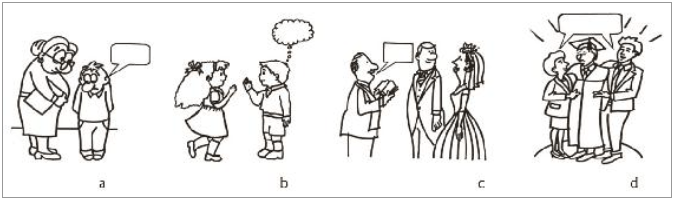
I’ll just share one example, and McGilchrist provides common responses from persons with both hemispheres intact as well as responses with right hemisphere deficits. For image b, a ‘normal’ response is for the respondent to fill in the boy’s talk bubble with ‘Boy, she’s cute.’ A couple of right hemisphere deficit responses were ‘I wonder how big her allowance is’ and ‘Let’s arm-wrestle’, obviously missing context.
The right hemisphere is responsible for understanding emotion, irony, jokes and humour—and the ability to tell the difference between jokes and lies. When told a joke and given an opportunity to fill in the punchline, the language of right hemisphere deficit patients ‘is often excessive and rambling; their comments are often off-colour and their humour is frequently inappropriate; they tend to focus on insignificant details or make tangential remarks’. Moreover, when asked to reconvey a story, the right hemisphere deficit people produced an ‘abundance of embellishments’ to it.
One subject with right hemisphere resection asked, ‘how do you feel?’ responded ‘With my hands’
Other right hemisphere functions are the ability to grasp the semantic nuance and intonation of a speaker. One subject with right hemisphere resection asked, ‘How do you feel?’ He responded, ‘With my hands,’ but he wasn’t joking.
People who have undergone a right hemispherectomy demonstrate a ‘shallow affect, rigidity, [and] lack of imagination’. The left hemisphere seems to prefer denotative speech whilst the right prefers connotative, hence a broader set of possible meanings. Interestingly, yet perhaps not surprisingly, clichés are the domain of the left hemisphere. Poetry and music reside on the right.
Wrapping up this chapter, the right hemisphere tends to serve as the emotional centre, save for anger, which is a left hemisphere activity.
Perspective
In summary, the left brain is very focused. Damage to the right hemisphere mimics the responses of autistic and schizophrenic individuals who interpret inputs differently and without nuance. This nuance often contains emotional or empathetic content that is lost on this cohort.
I am left wondering if schizophrenia and autism are right hemisphere problems, as it were, or if I would be reading into things to arrive at this conclusion.
Having completed Emotional and Social Intelligence next up is a chapter on Cognitive Intelligence. I hope you’ll join me.
What are your thoughts? What did you think of this chapter? Were there any surprises? Anything of particular interest?







 Philosophics