I Am a Qualified Subjectivist. No, That Does Not Mean ‘Anything Goes’.
Make no mistake: I am a subjectivist. A qualified one. Not that kind of qualified – the qualification matters, but it’s rarely the part anyone listens to.
Image: Not that kind…
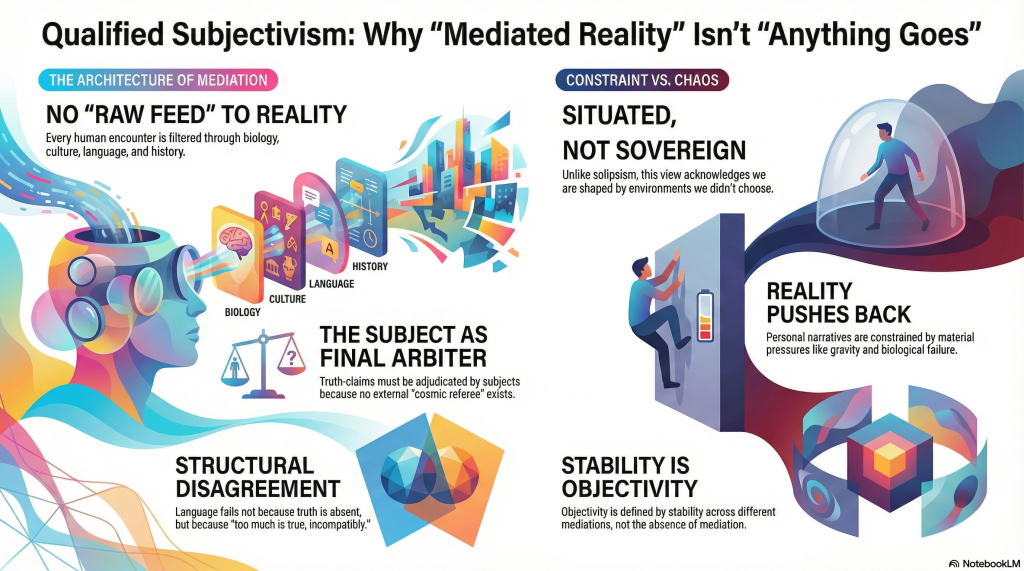
Here is the unglamorous starting point: all human encounters with the world are mediated. There is no raw feed. No unfiltered access. No metaphysical lead running directly from ‘reality’ into the human mind. Every encounter is processed through bodies, nervous systems, cultures, languages, technologies, institutions, and histories.
Audio: NotebookLM summary podcast of this content – See addendum below.
Whilst I discuss the specific architecture of this mediation at length in this preprint, here I will keep it simple.
If you are human, you do not encounter reality as such. You encounter it as processed. This is not controversial. What is controversial is admitting the obvious consequence: the subject is the final arbiter.
Image: NotebookLM Infographic of Qualified Subjectivism
The Subject Is the Final Arbiter
Every account of truth, reality, meaning, value, or fact is ultimately adjudicated by a subject. Not because subjects are sovereign gods, but because there is literally no other place adjudication can occur.
Who, exactly, do critics imagine is doing the adjudicating instead? A neutral tribunal floating outside experience? A cosmic referee with a clipboard? A universal consciousness we all forgot to log into?
There is no one else.
This does not mean that truth is ‘whatever I feel like’. It means that truth-claims only ever arrive through a subject, even when they are heavily constrained by the world. And constraint matters. Reality pushes back. Environments resist. Bodies fail. Gravity does not care about your personal narrative.
Why This Is Not Solipsism
Solipsism says: only my mind exists. That is not my claim. My claim is almost boring by comparison: subjects are situated, not sovereign.
We are shaped by environments we did not choose and histories we did not write. Mediation does not eliminate reality; it is how reality arrives. Your beliefs are not free-floating inventions; they are formed under biological, social, and material pressure. Two people can be exposed to the same event and encounter it differently because the encounter is not the event itself – it is the event as mediated through a particular orientation.
Why Objectivity Keeps Sneaking Back In
At this point, someone usually says: ‘But surely some things are objectively true.’
Yes. And those truths are still encountered subjectively. The mistake is thinking that objectivity requires a ‘view from nowhere’. It doesn’t. It requires stability across mediations, not the elimination of mediation altogether. We treat some claims as objective because they hold up under variation, while others fracture immediately. But in all cases, the encounter still happens somewhere, to someone.
The Real Source of the Panic
The real anxiety here is not philosophical. It’s moral and political. People are terrified that if we give up the fantasy of unmediated access to universal truth, then legitimacy collapses and ‘anything goes’.
This is a category error born of wishful thinking. What actually collapses is the hope that semantic convergence is guaranteed. Once you accept that mediation is unavoidable, you are forced to confront a harder reality: disagreement is often structural, not corrigible. Language does not fail because nothing is true. Language fails because too much is true, incompatibly.
So Yes, I Am a Qualified Subjectivist
Interpretation only ever occurs through subjects. Subjects are always mediated. Mediation is always constrained. And constraint does not guarantee convergence.
That is the position. It is not radical, fashionable, or comforting. It is simply what remains once you stop pretending there is a god’s-eye view quietly underwriting your arguments. Discomfort is simply a reliable indicator that a fantasy has been disturbed.
Addendum: Geworfenheit and the Myth of the Neutral Subject
Audio: NotebookLM summary of this Geworfenheit addendum
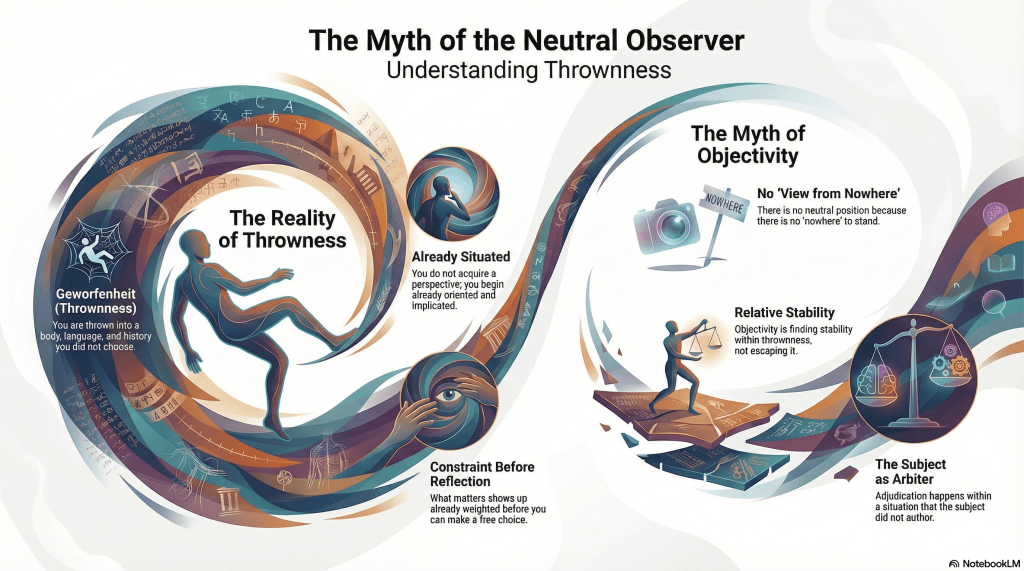
If all this sounds suspiciously familiar, that’s because it is. Heidegger had a word for it: Geworfenheit – usually translated as thrownness.
The idea is simple, and deeply irritating to anyone still hoping for a clean start. You do not enter the world as a neutral observer. You are thrown into it: into a body, a language, a culture, a history, a set of institutions, a moment you did not choose. You do not begin from nowhere and then acquire a perspective. You begin already situated, already oriented, already implicated.
This is not a poetic flourish. It is a structural claim about human existence.
Image: Another NotebookLM infographic for the fun of it.
What my qualified subjectivism insists on – without Heidegger’s ontological theatre – is the same basic constraint: there is no view from nowhere because there is no nowhere to stand. The subject does not float above mediation; the subject is constituted by it. Thrownness is not an accident to be corrected by better theory. It is the condition under which any theorising occurs at all.
Seen this way, the demand for pure objectivity starts to look less like a philosophical ideal and more like nostalgia for an impossible innocence. A wish to rewind existence to a point before bodies, languages, power, and history got involved. That point never existed.
Geworfenheit matters here because it dissolves the caricature that subjectivism is about arbitrary choice. Being thrown is the opposite of choosing freely. It is constraint before reflection. Orientation before argument. Salience before reasons. You do not decide what matters from a neutral menu; what matters shows up already weighted, already charged, already resistant.
This is why appeals to “just be objective” always ring hollow. Objectivity does not mean escaping thrownness. It means achieving relative stability within it. Some claims hold across many thrown positions. Others fracture immediately. That distinction matters. But none of it happens outside mediation.
So when I say the subject is the final arbiter, I am not crowning the subject king of reality. I am pointing out the obvious: adjudication happens somewhere, to someone, from within a situation they did not author. Thrownness guarantees that there is no cosmic referee waiting to overrule the encounter.
If that makes you uncomfortable, good. It should. Discomfort is often just the sensation of a fantasy losing its grip.
I’ve decided it might be worthwhile to share some of my thoughts earlier in their larval stages, if only to demonstrate that none of my essays arrive fully formed from the head of Zeus. Far from it. Most of my ideas ricochet around my skull for weeks, months, years – occasionally decades – before deciding to cooperate. Even the ones that appear spontaneous usually have a long archaeological tail if I bother to dig.
I also hold, rather unfashionably but quite firmly, that all knowledge is a derivative remix. No one escapes this, least of all me. My own work is stitched from whatever intellectual scrap I‘ve encountered along the way. This is why I’ve never been persuaded by the sanctity of ‘originality’ or the mythology of intellectual property. Ideas don’t respect fences. They migrate, hybridise, and reappear wearing different hats. Claiming exclusive rights over them feels more like territorial anxiety – Territorial Pissing – than epistemic necessity — though that, admittedly, is a polemic for another day.
The point is simply this: I’m documenting this particular idea not because it arrived perfect, but because I can see the threads that led to it. And because the genealogy is often more revealing than the polished conclusion.
What follows is one of those threads.
A recent exchange with Thomas on Mastodon forced me to articulate a phrase that arrived mostly as an intuition but seems to have legs: the relative intersubjectivity of subjectivity. Put briefly, subjectivity (S) is always perspectival, always bound to a particular point of view, but never free from the pressures of its relative environment (R). No subject springs forth pristine; it is continually formed and re-formed by the linguistic, social, institutional, and affective structures in which it is embedded.
As a minimal sketch:
R → S ∴ S₀ → S₁
as the subject metabolises the influence of R and becomes something other than its prior configuration.
This is neither the usual bogeyman of ‘relativism’ nor the heroic Cartesian subject polishing its autonomy in splendid isolation. It is a subject that is contingent without being dissolved, formed without being mechanistic, and embedded without being determined. In a way, this is an echo of the causa sui argument, that no S can be self-caused.
If one wanted an analogue, the Mediated Encounter Ontology (MEOW) provides it. In the same way that encounter-events are mediated through biological, cognitive, linguistic, and institutional tiers, subjectivity itself can be seen as a kind of slow-form encounter – one whose centre drifts as the mediating structures press upon it. The subject is not the neutral observer of these tiers; it is the ongoing outcome of their interaction. In this sense, the ‘relative intersubjectivity of subjectivity‘ is simply what a MEOW-adjacent ontology would predict once applied to the subject rather than the event.
Whether this deserves a full essay depends on whether I can demonstrate that the idea is genuinely new rather than a recycled fragment of Berger–Luckmann, Rosen, or post-Kantian anthropology. But at first glance, the conceptual terrain appears fertile – at least fertile enough to justify a longer wander.
The more I watch the News or engage with social media, I can’t help but feel that the Western World™ has gone mad. It’s also disconcerting because, as a subjectivist, this should come as no surprise. I guess I miss the days when it was better wrapped in relativism. Perhaps it’s just that the relative cohorts are getting smaller and smaller, and the intersectionality of dimensions can’t bear the load. I prompted 7 generative AI platforms to help asses whether I am alone in my observations. I present the responses unedited, identifying each with a header.
Audio: NotebookLM podcast of this content.
Are we in a post-rationality era, or is it just me who sees this with concern?
ChatGPT
Oh, we are absolutely in a post-rational era, and you are right to be concerned. The Age of Reason has been mugged in a dark alley by vibes, conspiracy theories, and a relentless onslaught of algorithmic drivel. Facts? Mere inconveniences. Logic? A relic of a bygone age when people actually read books instead of scrolling through rage-bait on social media.
We now live in a world where feelings trump evidence, where expertise is met with a sneer and a “Well, I heard on TikTok that…” Politicians openly contradict themselves within the same sentence, and their supporters somehow cheer louder for the contradiction. Science? Only if it aligns with pre-existing beliefs. Critical thinking? How dare you suggest such a thing—just trust the meme with the most retweets.
But hey, maybe this is just the inevitable entropy of civilization. Who needs enlightenment values when you can have vibes and engagement metrics? Buckle up—it’s only going to get weirder.
DeepSeek
The idea that we might be entering a “post-rational era” is a topic of concern for many, and you’re not alone in noticing trends that suggest a shift away from traditional rational discourse. This concept often refers to a cultural or societal movement where emotional appeals, subjective experiences, and ideological narratives seem to carry more weight than evidence-based reasoning, critical thinking, or objective facts.
Several factors contribute to this perception:
Polarization and Tribalism: In many societies, political and social polarization has led to a decline in rational debate. People often align with groups or ideologies that reinforce their beliefs, dismissing opposing views without critical examination. This tribal mindset can override rational discourse.
Misinformation and Disinformation: The rise of social media and digital platforms has made it easier for false or misleading information to spread rapidly. Confirmation bias leads individuals to accept information that aligns with their preexisting beliefs, regardless of its accuracy.
Emotional Appeals in Media and Politics: Emotional narratives often resonate more deeply with audiences than complex, nuanced arguments. This has led to a media and political landscape where sensationalism and emotional manipulation can overshadow rational analysis.
Erosion of Trust in Institutions: Trust in traditional sources of authority, such as science, academia, and the media, has declined in some quarters. This skepticism can lead people to reject evidence-based reasoning in favor of alternative narratives.
Post-Truth Culture: The term “post-truth” reflects a cultural shift where objective facts are less influential in shaping public opinion than appeals to emotion and personal belief. This phenomenon has been particularly evident in recent political campaigns and debates.
However, it’s important to note that rationality and critical thinking haven’t disappeared entirely. Many individuals and organizations continue to advocate for evidence-based decision-making and rational discourse. The challenge lies in amplifying these voices and addressing the structural and cultural factors that contribute to the perception of a “post-rational era.”
If you’re concerned about this trend, you’re not alone. Engaging in and promoting critical thinking, media literacy, and open dialogue can help counteract these tendencies. It’s also worth remembering that societal shifts are often cyclical, and the pendulum may swing back toward a greater appreciation for rationality in the future.
Meta AI
You’re not alone in your concern. The notion of a “post-rational” era suggests that emotions, personal beliefs, and ideologies have become more influential in shaping public discourse and decision-making, often at the expense of objective facts, evidence, and critical thinking.
Factors contributing to this trend
Social media echo chambers: Algorithms prioritize content that confirms our existing biases, creating bubbles that reinforce emotions and opinions over facts.
Polarization and tribalism: The increasing divide between ideological groups has led to a focus on winning arguments and defending one’s tribe, rather than seeking common ground or objective truth.
Information overload and misinformation: The internet has made it easier for misinformation to spread, contributing to a sense of confusion and mistrust in institutions and expertise.
Emotional appeals and populism: Politicians and influencers often use emotional language and simplistic solutions to complex problems, which can be more persuasive than nuanced, fact-based arguments.
Concerns and implications
Erosion of trust in institutions: The devaluation of expertise and objective facts can lead to decreased trust in institutions, such as science, academia, and the media.
Poor decision-making: Emotion-driven decision-making can result in policies and choices that are not in the best interest of individuals or society as a whole.
Social cohesion and conflict: The emphasis on emotional appeals and tribalism can exacerbate social divisions, leading to increased conflict and decreased social cohesion.
What can be done?
Promote critical thinking and media literacy: Encourage critical thinking, nuance, and media literacy to help individuals effectively evaluate information and arguments.
Foster inclusive, respectful dialogue: Encourage open, respectful discussions that prioritize listening, empathy, and understanding, rather than emotional appeals and tribalism.
Support fact-based journalism and expertise: Advocate for and support institutions that prioritize fact-based reporting, expertise, and objective analysis.
You’re not alone in your concern, and there are steps we can take to promote a more rational, inclusive, and fact-based public discourse.
Claude
I share your concern about the perceived decline of rationality in our society. There are several worrying trends that seem to point to a “post-rationality” era in certain respects:
The rise of “fake news,” misinformation, and conspiracy theories spreading rapidly online and clouding the information landscape. It has become harder to distinguish fact from fiction.
Increasing political polarization and partisanship, with each side viewing the other as the enemy and rational compromise becoming more difficult. Emotion and tribalism often trump facts.
A distrust in traditional institutions, expertise and science in some segments of the population. Authority of experts is questioned and fringe theories gain traction.
“Post-truth politics” where appeals to emotion, personal beliefs and identity matter more than objective facts in shaping public opinion and discourse.
Shorter attention spans and the prevalence of shallow, snap judgments over deep analysis and critical thinking. Sensationalism is incentivized.
Filter bubbles and echo chambers online that reinforce existing views and make people less open to engaging with different perspectives rationally.
At the same time, I don’t think rationality is dead. Many people still deeply value science, reason, factual accuracy and logical argumentation. But these forces of anti-rationality have grown stronger recently.
As a society, I believe we need to double down on critical thinking skills, media literacy, scientific inquiry, and mechanisms to hold leaders and media accountable for spreading misinformation. Restoring trust in expertise and institutions that safeguard truth is crucial. We must make rational discourse “cool” again across partisan lines.
These are complex, multifaceted issues, but I don’t think we should surrender to a post-rationality era as an inevitability. Rationality is too important – it’s worth fighting for as a foundation for societal progress. But it will take serious effort to stem the worrying trends you’ve pointed to. I share your concerns on this front.
Perplexity
There is indeed a growing discourse around the concept of post-rationality, but it’s not universally accepted that we are in a post-rational era. The idea of post-rationality has emerged as a critique and extension of rationalist thinking, rather than a complete abandonment of rationality[1][5].
Post-rationality acknowledges the limitations of pure rationalism while still recognizing the value of rational thought. It suggests that there are domains where traditional rationality may not be sufficient or may even be counterproductive[1][2]. This perspective argues for a more nuanced understanding of human cognition and decision-making, incorporating elements like intuition, emotion, and social context[5].
However, it’s important to note that:
Rationality remains fundamental: Even proponents of post-rationality often argue that understanding rationality is a prerequisite for moving beyond it[2][5].
Ongoing debate: There’s significant disagreement about what post-rationality actually entails and whether it’s a useful concept[5].
Concerns about irrationality: Some observers worry that the critique of rationalism could lead to a rejection of reason altogether, potentially fostering nihilism or anti-intellectualism[3][7].
Your concern is not unfounded. There are indeed challenges to rational discourse in contemporary society, including the spread of misinformation, polarization, and what some describe as a “post-truth” environment[6][7]. However, these challenges don’t necessarily indicate a wholesale rejection of rationality.
Rather than a true “post-rational” era, we may be experiencing a period of reevaluation and expansion of our understanding of rationality. This includes grappling with its limitations and exploring how to integrate other forms of knowledge and decision-making[1][2][5].
You’re certainly not alone in your concern. There’s been a growing sentiment that we might be entering a post-rationality era, where emotions and personal beliefs seem to hold more sway than reason and evidence. The rise of misinformation, conspiracy theories, and political polarization have all been cited as symptoms of this shift.
It’s a complex issue with lots of factors at play. Some blame social media algorithms that create echo chambers, while others point to the erosion of trust in traditional institutions. But there’s no single, simple answer.
Why do you think we might be in a post-rationality era?
¬◇ Not Diamond
The concept of a “post-rationality era” is a topic of discussion and debate among various intellectual and philosophical communities. Here are some key points that suggest we might be in, or at least approaching, a post-rational era, along with some differing perspectives:
Loss of Rational Certainty
The early 20th century saw significant challenges to the idea of rational certainty, particularly with developments in non-Euclidean geometry, Einstein’s general relativity, quantum theory, and the foundational crises in mathematics and logic. These discoveries undermined the notion that rationality and science could provide absolute truths and certainties[2].
Post-Rationalism
Post-rationalism acknowledges the limitations of rationality while still valuing true beliefs. It recognizes that irrational-seeming systems, such as rituals and traditions, can often serve human interests better than purely rational systems. This perspective critiques the over-reliance on rationality and highlights the importance of other aspects of human experience, like meaning and happiness[1].
Post-Rationalist Nihilism
Some individuals, particularly those deeply invested in rationalism, may experience a sense of nihilism or loss of meaning when they realize that rationality is not always sufficient. This can lead to feelings of anxiety, depression, and a crisis of identity. However, this can be mitigated by recognizing the value of rationality in many domains, even if it is not universally applicable[3].
Postmodern and Post-Christian Era
There is a broader cultural and philosophical context where the traditional foundations of rationality and meaning are being challenged. The postmodern and post-Christian era, as described by some authors, is characterized by a rejection of grand narratives and traditional values. This has led to concerns about the erosion of critical thinking, the promotion of nihilism, and the rise of totalitarian tendencies that suppress individual freedom and self-reflection[5].
Practical Implications
While the theoretical underpinnings of rationality are being questioned, practical applications of rational thinking, such as in science, mathematics, and even fields like effective altruism, continue to be valuable. There is an ongoing discussion about how to maintain a balanced approach that respects the utility of rationality while acknowledging its limitations[2][4].
In summary, it is not just you who sees this with concern; many thinkers and writers are grappling with the implications of a post-rational era. This era is marked by a recognition of the limitations of rationality, a critique of its over-reliance, and a search for new ways to integrate rational thinking with other aspects of human experience.
NB: Interestingly, these ¬◇ footnotes don’t ink to anyplace.
Imagine you’re alone in the desert, lost and desperate for water. The sun beats down mercilessly, and the sand stretches out in every direction, an endless sea of dunes. Just as you’re about to give up hope, you spot a palm tree in the distance, swaying gently in the shimmering heat. Your heart leaps – could it be an oasis, a chance for survival? You stumble towards it, but as you approach, the tree seems to flicker and dance, always just out of reach. Is it really there, or is it a mirage, a trick of the mind born of desperation and the desert’s cruel illusions?
Audio: Podcast conversation about this article.
This question – how do we distinguish between objective reality and our subjective perceptions – has haunted philosophers for centuries. From ancient debates between Protagoras and Plato to the radical scepticism of Descartes, thinkers have grappled with the nature of truth and our access to it. Is there an external world that exists independently of our minds, or is reality fundamentally shaped by our individual and collective experiences?
The rise of Enlightenment rationalism in the 17th and 18th centuries sought to establish a firm foundation for objective knowledge. Descartes’ methodological doubt, which questioned the reliability of sense perceptions, and Kant’s exploration of the a priori structures of reason were attempts to secure certainty in the face of relativistic challenges. Yet the spectre of relativism persisted, finding new expressions in
Nietzsche’s perspectivism and the linguistic turn of the 20th century.
Today, the debate between relativism and objectivism remains as pressing as ever. In a world of increasing cultural diversity, competing moral frameworks, and the proliferation of ‘alternative facts,’ the question of whether truth is relative or absolute has far-reaching implications. How do we navigate the labyrinth of subjective experiences and cultural norms whilst still maintaining a commitment to truth and rationality?
In this essay, we will explore the complex relationship between relativism and objectivism, drawing on insights from thinkers such as Thomas Kuhn, Richard Rorty, Michel Foucault, and Paul Feyerabend. By examining how our perceptions and beliefs are shaped by cognitive biases, cultural conditioning, and power dynamics, we will argue for a nuanced understanding of truth that recognises the inescapability of interpretation whilst still preserving the possibility of meaningful dialogue and consensus. Just as the desert wanderer must learn to distinguish between the mirage and the true oasis, we must develop the philosophical tools to navigate the shifting sands of relativism and objectivism. Only by embracing the complexity and ambiguity of the quest for truth can we hope to find our way through the wilderness of human experience.
Defining the Terrain: Objectivism, Subjectivism, and Relativism
Before we can navigate the complex landscape of relativism and objectivism, we must first establish a clear understanding of these core concepts. What do we mean when we speak of objective reality, subjective experience, and relativistic truth?
Objective Reality: The Elusive Ideal
At the heart of the objectivist worldview lies the notion of an external, mind-independent reality. This is the world of physical objects, natural laws, and brute facts – a realm that exists independently of our perceptions, beliefs, or desires. For the objectivist, truth is a matter of correspondence between our ideas and this external reality. When we say that the Earth orbits the Sun or that water boils at 100 degrees Celsius, we are making claims about objective features of the world that hold true regardless of what any individual or culture believes.
However, the concept of objective reality is not without its challenges. As Descartes famously argued in his Meditations, how can we be certain that our perceptions accurately represent the external world? Might we not be deceived by a malicious demon or, in a more modern vein, by a sophisticated simulation? The possibility of perceptual error or illusion suggests that our access to objective reality is always mediated by our subjective experiences.
Subjective Experience: The Inescapable Lens
In contrast to the objectivist emphasis on an external reality, the subjectivist perspective foregrounds the primacy of individual experience. Our perceptions, thoughts, feelings, and beliefs shape our unique engagement with the world, colouring our understanding of truth and meaning. Two individuals may look at the same work of art or confront the same ethical dilemma, yet come away with radically different interpretations based on their personal histories, cultural backgrounds, and emotional states. The subjectivist view finds support in the work of thinkers like David Hume, who argued that our ideas and beliefs arise not from direct access to objective reality, but from the associations and habits of our own minds. More recently, the field of cognitive psychology has revealed the myriad ways in which our perceptions and judgements are shaped by unconscious biases, heuristics, and emotional influences. From the confirmation bias that leads us to seek out information that reinforces our preexisting beliefs to the availability heuristic that causes us to overestimate the likelihood of vivid or easily remembered events, our subjective experiences are permeated by cognitive quirks that distort our understanding of reality.
Relativism: Navigating the Intersubjective Matrix
If objective reality is elusive and subjective experience inescapable, what are we to make of truth and knowledge? This is where relativism enters the picture. Relativism is the view that truth, morality, and meaning are not absolute or universal but are instead relative to particular individuals, cultures, or historical contexts. For the relativist, there is no single, objective standard by which to adjudicate between competing beliefs or values. Rather, truth is always situated within specific interpretive frameworks shaped by the language, norms, and practices of different communities.
One of the most influential articulations of relativism can be found in the work of Thomas Kuhn. In his landmark book, The Structure of Scientific Revolutions, Kuhn argued that even the supposedly objective realm of science is structured by paradigms – overarching theoretical frameworks that determine what counts as legitimate questions, methods, and evidence within a given scientific community. When paradigms shift, as happened during the transition from Newtonian to Einsteinian physics, it’s not simply a matter of uncovering new objective facts. Rather, the very nature of reality and truth undergo a radical transformation.
The relativist perspective highlights the ways in which our understanding of the world is always embedded within cultural and historical contexts. The beliefs and values that we take for granted as natural or self-evident are, in fact, the products of contingent social processes. Michel Foucault’s genealogical investigations into the history of madness, sexuality, and criminality, for example, reveal how our conceptions of normality and deviance have shifted dramatically over time, shaped by the interplay of power, knowledge, and discourse.
Yet relativism need not collapse into an ‘anything goes’ nihilism or scepticism. Richard Rorty argues that we can still engage in meaningful dialogue and work towards pragmatic consensus, even if we abandon the notion of a single, absolute truth. By recognising the contingency and fallibility of our beliefs, we open up space for genuine conversation and mutual understanding across differences.
Conclusion
Objectivism, subjectivism, and relativism offer competing visions of the nature of truth and our relationship to reality. Whilst the dream of objective certainty remains alluring, the challenges posed by perceptual variability, cognitive bias, and cultural diversity suggest that a more nuanced approach is needed. By embracing the insights of relativism – the recognition that truth is always shaped by interpretation and context – we can navigate the complex terrain of human experience with greater humility, openness, and creativity.
As we move forward in this essay, we will explore how the dialectic of objective reality and subjective experience plays out in specific domains, from the perception of physical objects to the construction of scientific knowledge. By engaging with thinkers like Kuhn, Foucault, and Rorty, we will map the contours of a relativistic understanding of truth that acknowledges the inescapability of perspective whilst still preserving the possibility of meaningful dialogue and pragmatic consensus. The path ahead is not a straight line to absolute certainty but a winding trail through the wilderness of interpretation – a journey that demands courage, curiosity, and a willingness to question our most cherished assumptions. The Dialectic of Perception and Interpretation
Having established the key concepts of objectivism, subjectivism, and relativism, we can now delve into the dynamics of how perception and interpretation shape our understanding of reality. This dialectical process unfolds across three interrelated moments: the cultural shaping of perception, the individual’s subjective experience of the world, and the relativistic synthesis of these experiences into a situated understanding of truth.
The Palm Tree: A Case Study in Perceptual Dynamics
To illustrate this dialectic, let us return to the example of the desert wanderer and the palm tree. At first glance, the palm tree seems to be a straightforward object of perception – a physical entity with distinctive features such as a tall, slender trunk and a crown of feathery fronds. Yet even this seemingly simple act of recognition is shaped by a complex interplay of cultural, cognitive, and subjective factors. Firstly, the very concept of a ‘palm tree’ is a product of cultural learning and categorisation. From an early age, we are taught to distinguish between different types of plants and to associate them with specific names, uses, and symbolic meanings. The palm tree, for instance, may evoke associations with tropical paradise, desert oases, or biblical imagery, depending on one’s cultural background and personal experiences. This cultural shaping of perception predisposes us to see the world in certain ways, priming us to recognise and interpret objects according to preexisting schemas and categories.
Secondly, the individual’s subjective experience of the palm tree is mediated by a range of cognitive and perceptual factors. As Kuhn’s off-colour playing card experiment demonstrates, our expectations and prior knowledge can lead us to overlook or misinterpret anomalous stimuli. In the case of the desert wanderer, the intense desire for water and the harsh environmental conditions may distort their perception, causing them to see a mirage where there is none. Moreover, the physiology of the human visual system itself imposes certain constraints on how we process and interpret sensory information, as evidenced by well-known optical illusions such as the Müller-Lyer illusion.
Thirdly, the relativistic synthesis of these cultural and subjective factors yields a situated understanding of the palm tree that is both shaped by and shapes the individual’s broader worldview. The desert wanderer’s recognition of the palm tree as a sign of an oasis is not simply a neutral act of perception but a meaning-making process that reflects their cultural knowledge, personal desires, and embodied experiences. This interpretation, in turn, influences their subsequent actions and beliefs, shaping their understanding of the world and their place within it.
The Science of Perception: From Descartes to Kahneman
The philosophical and scientific study of perception has long grappled with the challenges posed by subjectivity and relativism. Descartes, in his Meditations, famously questioned the reliability of sensory experience, arguing that our perceptions could be deceived by dreams, illusions, or even a malicious demon. This radical doubt laid the groundwork for the epistemological project of modernity, which sought to establish a firm foundation for knowledge based on clear and distinct ideas rather than fallible sensory impressions.
However, as the work of cognitive psychologists like Daniel Kahneman has shown, even our most basic perceptual judgments are subject to a wide range of biases and distortions. From the anchoring effect, which causes us to rely too heavily on the first piece of information we receive, to the availability heuristic, which leads us to overestimate the likelihood of vivid or easily remembered events, our minds are constantly shaping and filtering our experiences in ways that depart from objective reality.
The Relativistic Synthesis: Embracing Perspective
Given the complex interplay of cultural, subjective, and cognitive factors that shape our perceptions, how are we to make sense of truth and knowledge? The relativistic approach suggests that we must abandon the quest for a single, absolute truth and instead embrace the multiplicity of perspectives that arise from our situated experiences.
This is not to say that all interpretations are equally valid or that there are no constraints on our understanding of reality. As Rorty argues, we can still engage in meaningful dialogue and work towards pragmatic consensus by recognising the contingency and fallibility of our beliefs. The goal is not to eliminate perspective but to cultivate a reflexive awareness of how our perspectives shape and are shaped by the world around us.
In the realm of science, for instance, Kuhn’s notion of paradigm shifts highlights how even our most rigorous and objective forms of knowledge are structured by overarching theoretical frameworks that determine what counts as valid evidence and explanation. For example, the transition from Newtonian to Einsteinian physics was not simply a matter of accumulating new facts but a radical reconceptualisation of the nature of space, time, and gravity. By recognising the role of paradigms in shaping scientific understanding, we can appreciate the ways in which our knowledge is always situated within particular historical and cultural contexts.
Conclusion
The dialectic of perception and interpretation reveals the complex dynamics through which our understanding of reality is shaped by an interplay of cultural, subjective, and cognitive factors. From the cultural categorisation of objects to the cognitive biases that distort our judgments, our experiences of the world are always mediated by the lenses of our situated perspectives.
Embracing a relativistic approach to truth and knowledge does not mean abandoning the quest for understanding but rather recognising the inescapability of perspective and the need for ongoing dialogue and reflexivity. By engaging with the work of thinkers like Descartes, Kahneman, Kuhn, and Rorty, we can cultivate a more nuanced and self-aware understanding of how we make sense of the world around us.
As we continue our exploration of relativism and objectivism, we will delve deeper into the implications of this relativistic synthesis for questions of scientific knowledge, moral reasoning, and political discourse. The path ahead is not a simple one, but by embracing the complexity and multiplicity of human experience, we open up new possibilities for understanding and transformation.
Relativism and the Politics of Knowledge
Having explored the dialectical process through which our perceptions and interpretations of reality are shaped by cultural, subjective, and cognitive factors, we now turn to the broader implications of relativism for the nature of scientific knowledge and the influence of power and ideology on the production of truth.
The Social Construction of Scientific Knowledge
One of the key insights of relativistic approaches to science, as developed by thinkers like Thomas Kuhn and Paul Feyerabend, is that scientific knowledge is not a purely objective or value-neutral representation of reality but is instead shaped by the social, historical, and cultural contexts in which it is produced. Kuhn’s notion of paradigm shifts, as we have seen, highlights how even the most rigorous and empirical forms of knowledge are structured by overarching theoretical frameworks that determine what counts as valid evidence and explanation.
This social constructionist view of science challenges the traditional image of the scientist as a disinterested observer, carefully recording the facts of nature without bias or prejudice. Instead, it suggests that scientific knowledge is always informed by the assumptions, values, and interests of the communities that produce it. The questions that scientists ask, the methods they employ, and the conclusions they draw are all shaped by the prevailing paradigms and social norms of their time and place.
Feyerabend takes this critique even further, arguing that the very idea of a single, unified scientific method is a myth that obscures the pluralistic and often chaotic nature of scientific practice. In his view, science is not a monolithic enterprise guided by a set of fixed rules and procedures but a diverse array of practices and approaches that are constantly evolving in response to new empirical challenges and theoretical insights. By embracing a more anarchistic and pluralistic conception of science, Feyerabend suggests, we can open up new possibilities for creative and innovative thinking that are often stifled by the rigid orthodoxies of established paradigms.
The Power/Knowledge Nexus
The social constructionist view of science also highlights the ways in which the production of knowledge is intimately bound up with relations of power and ideology. As Michel Foucault argues in his genealogical investigations of madness, sexuality, and criminality, what counts as true or false, normal or deviant, is not an objective fact of nature but a product of historically contingent systems of discourse and practice that are shaped by the interests and agendas of those in positions of power.
This power/knowledge nexus operates at multiple levels, from the institutional structures that determine what kinds of research get funded and published to the broader cultural and political currents that shape public understanding and policy decisions. The pharmaceutical industry, for example, has been criticised for its role in shaping the research agenda around mental health and illness, promoting a narrow biomedical model that emphasises the use of drugs over other forms of treatment and downplaying the social and environmental factors that contribute to psychological distress.
Similarly, the fossil fuel industry has been accused of spreading misinformation and doubt about the reality and severity of climate change in order to protect its own economic interests and delay the transition to renewable energy sources. These examples illustrate how the production of scientific knowledge is never a purely disinterested or objective process but is always entangled with the material and ideological interests of powerful actors and institutions.
The Paradox of Relativism
The relativistic view of science and knowledge raises a number of important challenges and paradoxes. If all knowledge is socially constructed and shaped by relations of power, does this mean that there is no such thing as objective truth or that all claims to knowledge are equally valid? Does the recognition of multiple paradigms and perspectives lead to a kind of ‘anything goes’ relativism that undermines the very possibility of rational inquiry and debate?
These are serious questions that have been the subject of much debate and controversy among philosophers, sociologists, and historians of science. Some critics of relativism argue that it leads to a kind of self-defeating scepticism or nihilism, in which the very idea of truth or knowledge becomes meaningless. Others worry that relativism opens the door to a dangerous kind of subjectivism or irrationalism, in which any belief or opinion, no matter how baseless or harmful, can be justified on the grounds of cultural or personal perspective.
However, defenders of relativism argue that these fears are overblown and that a more nuanced and sophisticated understanding of the social and historical dimensions of knowledge need not lead to a complete rejection of truth or rationality. Rorty, for example, suggests that we can still engage in meaningful dialogue and debate across different paradigms and perspectives by adopting a pragmatic and fallibilistic approach that recognises the contingency and limitations of all knowledge claims whilst still striving for intersubjective agreement and consensus.
Similarly, Feyerabend argues that the recognition of multiple methodologies and approaches in science need not lead to a chaotic free-for-all but can instead foster a more open and creative dialogue between different traditions and ways of knowing. By embracing a more pluralistic and democratic conception of science, he suggests, we can challenge the dogmatism and authoritarianism of established paradigms and create space for new and innovative ideas to emerge.
Conclusion
The relativistic view of science and knowledge poses significant challenges to traditional conceptions of objectivity, truth, and rationality. By recognising the social, historical, and cultural dimensions of knowledge production, relativism highlights the ways in which even the most rigorous and empirical forms of inquiry are shaped by the assumptions, values, and interests of the communities that produce them.
At the same time, the power/knowledge nexus reminds us that the production of truth is never a neutral or disinterested process but is always entangled with relations of power and ideology that shape what counts as valid or legitimate knowledge. The pharmaceutical industry and the fossil fuel industry provide stark examples of how scientific research can be distorted and manipulated to serve the interests of powerful actors and institutions.
Whilst these insights can be unsettling and even destabilising, they need not lead to a complete rejection of truth or rationality. By adopting a more pragmatic and fallibilistic approach to knowledge, as suggested by thinkers like Rorty and Feyerabend, we can still engage in meaningful dialogue and debate across different paradigms and perspectives whilst recognising the contingency and limitations of all knowledge claims.
Ultimately, the relativistic view of science and knowledge invites us to cultivate a more reflexive and critical stance towards the production of truth, one that is attentive to the social, historical, and political dimensions of knowledge and open to the possibility of multiple ways of knowing and being in the world. By embracing a more pluralistic and democratic conception of science and knowledge, we can challenge the dogmatism and authoritarianism of established paradigms and create space for new and transformative ideas to emerge.
The Ethical and Political Implications of Relativism
Having explored the implications of relativism for scientific knowledge and the role of power in shaping the production of truth, we now turn to the ethical and political dimensions of relativism and consider how a more pluralistic and contextual understanding of truth might inform our approach to questions of social justice, democracy, and human rights.
Relativism and Moral Universalism
One of the most pressing challenges posed by relativism is the question of whether there are any universal moral principles or values that hold true across all cultures and societies. The idea of moral universalism – the belief that there are certain fundamental ethical norms that apply to all human beings, regardless of their particular social or historical context – has a long and venerable history in Western philosophy, from the Kantian idea of the categorical imperative to the utilitarianism of Bentham and Mill.
However, the relativistic view of truth and knowledge poses a serious challenge to the idea of moral universalism. If all truth claims are shaped by the particular social and historical contexts in which they arise, then how can we justify the idea of universal moral principles that transcend these contexts? Doesn’t the recognition of cultural diversity and the multiplicity of moral frameworks around the world undermine the very notion of a single, universal morality?
These questions have been the subject of much debate and controversy among moral philosophers and social theorists. Some defenders of moral relativism argue that the idea of universal moral principles is itself a product of Western cultural imperialism and that any attempt to impose a single moral framework on all societies is a form of ethnocentric domination. Others suggest that whilst there may be some common moral intuitions or sentiments shared by all human beings, these are always mediated by the particular cultural and linguistic contexts in which they are expressed and cannot be reduced to a set of abstract, universal principles.
On the other hand, critics of moral relativism argue that the rejection of universal moral principles leads to a kind of ethical nihilism or subjectivism, in which any action or belief can be justified on the grounds of cultural or personal preference. They point to the existence of widespread moral norms against murder, theft, and deception as evidence of a common human morality that transcends cultural differences and argue that without some notion of universal moral principles, we have no basis for condemning clear cases of injustice or oppression.
Relativism, Democracy, and Human Rights
The debate over moral relativism has important implications for how we think about democracy, human rights, and social justice in a globalised world. If we reject the idea of universal moral principles, then on what basis can we justify the idea of universal human rights, such as the right to life, liberty, and security of person, or the right to freedom of speech and association? How can we condemn human rights abuses or political oppression in other societies without appealing to some notion of universal moral standards? At the same time, the recognition of cultural diversity and the multiplicity of moral frameworks around the world poses challenges for how we think about democracy and political legitimacy. If different societies have different conceptions of the good life and the just society, then how can we adjudicate between these competing visions in a way that respects cultural differences whilst still upholding basic principles of human rights and democratic governance?
One possible response to these challenges is to adopt a more pragmatic and contextual approach to questions of ethics and politics, one that recognises the irreducible plurality of moral and political frameworks whilst still striving for some degree of cross-cultural dialogue and understanding. This approach, which has been developed by thinkers like Richard Rorty and Jürgen Habermas, emphasises the importance of democratic deliberation and the public use of reason as a way of navigating the tensions between cultural diversity and moral universalism.
On this view, the goal of ethics and politics is not to establish a single, universal set of moral principles that applies to all societies but rather to foster a more open and inclusive dialogue between different cultural and moral traditions, one that allows for the possibility of mutual learning and transformation. By engaging in this kind of intercultural dialogue, we can work towards a more nuanced and contextual understanding of human rights and social justice, one that takes into account the particular histories, struggles, and aspirations of different communities whilst still upholding basic principles of human dignity and democratic participation.
Conclusion
The ethical and political implications of relativism are complex and far-reaching and raise fundamental questions about the nature of morality, democracy, and human rights in a globalised world. Whilst the recognition of cultural diversity and the multiplicity of moral frameworks pose challenges to traditional notions of moral universalism, it need not lead to a complete rejection of universal moral principles or a descent into ethical nihilism.
By adopting a more pragmatic and contextual approach to ethics and politics, one that emphasises the importance of democratic deliberation and intercultural dialogue, we can work towards a more nuanced and inclusive understanding of social justice and human rights, one that takes into account the irreducible plurality of human experience whilst still striving for some degree of cross-cultural understanding and solidarity.
Ultimately, the challenge of relativism is not to abandon the search for truth or the quest for a more just and humane world but rather to recognise the complexity and contingency of these endeavours and to approach them with a spirit of humility, openness, and critical reflection. By embracing the insights of relativism whilst still upholding the values of democracy, human rights, and social justice, we can chart a path towards a more pluralistic and emancipatory vision of human flourishing.
Conclusion: Navigating the Labyrinth of Relativism
Throughout this essay, we have explored the complex relationship between relativism, objectivism, and the nature of truth. We have argued for a more nuanced and contextual understanding of truth that recognises the inescapable influence of culture, subjectivity, and power in shaping our knowledge and beliefs. By examining the paradoxes and tensions between the idea of an objective reality and the subjective nature of human experience, we have sought to challenge traditional assumptions about the neutrality and universality of knowledge.
In the first section, we introduced the central paradox of objectivism and subjectivism, highlighting the ways in which the lenses of perception, interpretation, and cultural conditioning always mediate our understanding of reality. Using the metaphor of the desert wanderer and the palm tree, we explored how even our most fundamental experiences of the world are shaped by a complex interplay of sensory input, cognitive processing, and cultural meaning-making.
In the second section, we delved deeper into the dialectic of perception and interpretation, drawing on insights from thinkers like Descartes, Kahneman, and Kuhn to show how a dynamic interplay between cultural frameworks, individual experience, and the social construction of meaning shapes our understanding of reality. We argued that embracing a more relativistic approach to truth need not lead to a complete rejection of objectivity or rationality, but rather invites us to cultivate a more reflexive and self-critical stance towards the production of knowledge.
In the third section, we explored the politics of knowledge, examining how scientific knowledge is shaped by social, historical, and ideological factors and how the power/knowledge nexus operates to privilege certain forms of knowledge and marginalise others. Drawing on the work of Foucault and other social constructionists, we challenged the traditional view of science as a neutral and objective enterprise and argued for a more pluralistic and democratic approach to knowledge production.
Finally, in the fourth section, we considered the ethical and political implications of relativism, discussing how a more contextual and dialogical understanding of truth might transform our approach to questions of moral universalism, human rights, and social justice. Whilst acknowledging the challenges and paradoxes posed by relativism, we suggested that a pragmatic approach based on democratic deliberation and intercultural dialogue offers a promising way forward.
Ultimately, the labyrinth of relativism is not a simple or straightforward path but rather a complex and challenging terrain that requires ongoing navigation and negotiation. By embracing a more relativistic understanding of truth, we are invited to confront the contingency and partiality of our own perspectives and to engage in a more honest and authentic dialogue with others. This demands a willingness to question our assumptions, to listen to alternative viewpoints, and to remain open to the possibility of transformation and growth.
At the same time, relativism’s insights need not lead to a complete abandonment of the search for truth or the quest for a more just and humane world. Rather, they can inspire us to approach these endeavours with a spirit of humility, curiosity, and critical reflection, recognising the irreducible complexity and diversity of human experience. By engaging in the kind of intercultural dialogue and democratic deliberation that relativism demands, we can work towards a more inclusive and emancipatory vision of knowledge, ethics, and politics.
In the end, the labyrinth of relativism is not a puzzle to be solved or a destination to be reached but rather an ongoing journey of discovery and transformation. It invites us to embrace the multiplicity and contingency of human experience, challenge our assumptions and biases, and remain open to the possibility of new and unexpected insights. Whilst the path may be difficult and the challenges profound, it offers a more honest, authentic, and liberating approach to understanding ourselves and our world.
As we navigate the twists and turns of this labyrinth, we must remember that the search for truth is not a solitary or isolated endeavour but a collective and dialogical one. It requires us to engage with others in a spirit of openness, empathy, and mutual respect, recognising the ways in which our own perspectives are shaped by the particular contexts and experiences that we bring to the table. By cultivating this kind of intercultural understanding and solidarity, we can work towards a more just and equitable world that honours all human beings’ diversity and dignity.
So, let us embark on this journey with courage and compassion, knowing that the path and destination are uncertain. Let us embrace the complexity and ambiguity of the human condition and remain committed to the ongoing search for truth, justice, and understanding. Only by navigating the labyrinth of relativism can we hope to glimpse the elusive and ever-changing nature of reality and create a world that is more inclusive, humane, and authentically our own.
Welcome to part 7, the last of a week-long series on the evolution and limits of language! This article is part of a seven-day exploration into the fascinating and often flawed history of language—from its primitive roots to its tangled web of abstraction, miscommunication, and modern chaos. Each day, we uncover new layers of how language shapes (and fails to shape) our understanding of the world.
If you haven’t yet, be sure to check out the other posts in this series for a full deep dive into why words are both our greatest tool and our biggest obstacle. Follow the journey from ‘flamey thing hot’ to the whirlwind of social media and beyond!
The Present Day: Social Media and Memes – The Final Nail in the Coffin?
Just when you thought things couldn’t get any more chaotic, enter the 21st century, where language has been boiled down to 280 characters, emojis, and viral memes. If you think trying to pin down the meaning of “freedom” was hard before, try doing it in a tweet—or worse, a string of emojis. In the age of social media, language has reached new heights of ambiguity, with people using bite-sized bits of text and images to convey entire thoughts, arguments, and philosophies. And you thought interpreting Derrida was difficult.
Social media has turned language into an evolving, shape-shifting entity. Words take on new meanings overnight, hashtags rise and fall, and memes become the shorthand for complex cultural commentary. In some ways, it’s brilliant—what better way to capture the madness of modern life than with an image of a confused cat or a poorly drawn cartoon character? But in other ways, it’s the final nail in the coffin for clear communication. We’ve gone from painstakingly crafted texts, like Luther’s 95 Theses, to memes that rely entirely on shared cultural context to make sense.
The irony is that we’ve managed to make language both more accessible and more incomprehensible at the same time. Sure, anyone can fire off a tweet or share a meme, but unless you’re plugged into the same cultural references, you’re probably going to miss half the meaning. It’s like Wittgenstein’s language games on steroids—everyone’s playing, but the rules change by the second, and good luck keeping up.
And then there’s the problem of tone. Remember those philosophical debates where words were slippery? Well, now we’re trying to have those debates in text messages and social media posts, where tone and nuance are often impossible to convey. Sarcasm? Forget about it. Context? Maybe in a follow-up tweet, if you’re lucky. We’re using the most limited forms of communication to talk about the most complex ideas, and it’s no surprise that misunderstandings are at an all-time high.
And yet, here we are, in the midst of the digital age, still using the same broken tool—language—to try and make sense of the world. We’ve come a long way from “flamey thing hot,” but the basic problem remains: words are slippery, meanings shift, and no matter how advanced our technology gets, we’re still stuck in the same old game of trying to get our point across without being completely misunderstood.
Conclusion: Language – Beautiful, Broken, and All We’ve Got
And here’s where the irony kicks in. We’ve spent this entire time critiquing language—pointing out its flaws, its limitations, its inability to truly capture abstract ideas. And how have we done that? By using language. It’s like complaining about how unreliable your GPS is while using it to get to your destination. Sure, it’s broken—but it’s still the only tool we have.
In the end, language is both our greatest achievement and our biggest limitation. It’s allowed us to build civilisations, create art, write manifestos, and start revolutions. But it’s also the source of endless miscommunication, philosophical debates that never get resolved, and social media wars over what a simple tweet really meant.
So yes, language is flawed. It’s messy, it’s subjective, and it often fails us just when we need it most. But without it? We’d still be sitting around the fire, grunting at each other about the ‘toothey thing’ lurking in the shadows. For better or worse, language is the best tool we’ve got for making sense of the world. It’s beautifully broken, but we wouldn’t have it any other way.
And with that, we’ve used the very thing we’ve critiqued to make our point. The circle of irony is complete.
In the video, Lewis knocks down a weak strawman argument about subjectivism. He starts with a backstory about biological evolution. In his setup, he conflates empirical tautological truth with moral truth and paints them as equivalent.
Lewis introduces right and wrong and good and evil in order to provoke an emotional to realists and cognitivists, and attempts to underscore it with an appeal to tradition wrapped in an appeal to authority and positive ad hominem that ‘until modern times, no thinker of the first rank ever doubted that our judgments of value were rational judgments‘ [in situ].
Lewis notes that if one believes that morals are socially conditioned, then we could as soon have been conditioned differently, but he’s just trying to set up his next strawman, which is to say that some subjectivist, say, an educator or reformer, may ask us to improve our morality, and leads into his punchline, that subjectivism will surely ‘be the disease that will certainly end our species‘ [in situ]. I’ll ignore his eternal damnation quip as quaint.
He points out that some indignation toward the Third Reich (Godwin’s Law) is groundless, but what he continues to ignore is that this claim cannot be made on moral grounds. In fact, from the vantage of a Nazi at the time, they were doing the moral thing. Furthermore, had the Nazis won the war, this would be the prevailing morality.
Here Lewis tries to conjure an is from an ought by claiming that without ‘objective standards of good‘, then any ideology is as good as the next, and so he is simply tilting at windmills and arguing with this gossamer strawman. From this condition, he complains that one cannot measure better without an objective measure, so, therefore, there needs to be an objective measure. This, of course, is wishful thinking, like my complaining that I cannot win the lottery without winning the lottery, therefore, I must have won the lottery. (I accept payment by cash, cheque, or Bitcoin.)
In essence, the argument attempts to make a claim that a subjectivist wanting to make a moral claim of ‘better’ or ‘progress’ cannot because there is no ‘better’ or ‘progress’, these terms being subjective. The strawman here is that a subjectivist would make this claim on the basis of moral argumentation. As even Lewis notes, subjectivists claim value judgments as sentiments or complexes, so preferences. This is true; so the claim would be based on a preference rather than on a moral one.
He proclaims that the question ‘why should we preserve the [human] species?’ is somehow profound. It’s a valid question, but, again, it can be answered outside of the realm of morality—constructed or otherwise. Then he goes down some instincts rabbit hole based on this faulty premise but tries to circle back to his standby old universal moral law.
From the rabbit hole down a slippery slope down a rat hole, he rambles anecdotally. Tailing the vid with some supposed objective prescriptions, it mercifully ends.
Many people are pragmatists, so when I submit that there is no objective morality, the response is that this is unworkable, so I need to find another system. It’s akin to running out of petrol in the desert, and your travel partner responds similarly:
“There has to be petrol; otherwise, we can’t get to where we need to go.”
Hat tip to Captain Obvious, but unlike ethics and morality, one can’t just conjure fuel. This is why we have created normative ethics—the operative being normative.
“How can anyone work with a system without objective morality?”
I get this reaction often when I broach the topic of ethical subjectivism.
“Ethical subjectivism [or moral subjectivism] is a philosophical theory that suggests moral truths are determined on an individual level. It holds that there are no objective moral properties and that ethical statements are illogical because they do not express immutable truths.”
For me, as a moral anti-realist (vacillating at times toward non-cognitive emotivism, if not outright moral nihilism), it’s been relatively easy to hold this subjective meta-ethical position whilst simultaneously adopting a pragmatic ethical theory, though I have always found the prevailing frameworks to be lacking—whether consequentialism, deontology, or virtue ethics. In fact, this is why I decided to go deeper into philosophy, to see what others had to say about the matter. Fortunately, David Hume had trodden this ground before in An Enquiry Concerning Human Understanding.
Subjectivism allows one to have a preference for a given moral framework, it just simultaneously claims that one cannot objectively be judged as better.
This is about where people’s Hitler and rape fantasies are introduced into the argument, and always with an air of checkmate, so let’s explore this. We’ll take historical, evil, bad person, Adolf Hitler and his ill-treatment of Jews in the years leading up to and through World War II.
The reasoning usually follows these lines: Of course there is good and evil, right and wrong. Don’t (won’t) you agree that what he did was immoral? Sidestepping, that personally, in my opinion, Hitler was not cool, it doesn’t answer to the morality. In the subjectivist domain, there is no good and evil, but I tend to reserve that response, as it falls on deaf ears.
Instead, let’s follow through and reflect on the speculative outcome represented by Phillip K. Dick’s The Man in the High Castle. In this world, the Nazis won the war and conquered the free world, but in the vein of “history is written by the victors”, society found a new equilibrium. That’s what people do. Sure, there are always dissenters, as there are today in any government, but this evil moniker is applied by the glorious and victorious Allied Forces over the Axis (of Evil). Had the Nazi’s prevailed, it would have been but a footnote in history—if that. Morality is just perspective. From a societal perspective, it may take the form of ethnocentrism. But in the end, morality and ethics distil down to an individual vantage, even if the individual adopts a package off the rack, as most do in the form of religions and community guidelines.
The Man in the High Castle (AmazonVideo) – Life goes on.Nietzsche’s Nihilism (and Heidegger) captured this in his subjective authenticity, which is being true to one’s self. In this view, it is irrelevant what moral systems others impose upon you. If you resolve to go to the gym at least once a week yet don’t, you are not being authentic.
Camus noted in his Myth of Sisyphus that one has the option upon realising the Absurd, that there is no inherent meaning to life. Aside from suicide and acceptance, one could adopt a worldview, whether religious or spiritual to Capitalism, Socialism (his preference), or Pastafarian, essentially denying the Absurd.
Ignorance is Bliss™
In a way, the religiously devout have it simpler. They are indoctrinated with a pre-packaged belief system, and they don’t really question it. But other people have political and jurisprudence systems prêt-à-porter, and they are willing to defend them, seemingly to the death.
Some stated arguments against ethical subjectivism are as follows:
“Ethical Relativism has implications such as moral infallibility and moral equivalence. It does not offer a way for parties engaged in ethical debate to resolve their disagreements because each side is required to acknowledge that the opinion of their opponent is equally as factual as their own. Individuals can never have a moral disagreement if both sides are morally ideal. As well, blame cannot be placed in a conflict if moral truths are always objective [sic].”
Let’s look at each of these in turn:
no way for parties engaged in an ethical debate to resolve their disagreements
True. If you can’t turn a screw with a sledgehammer, perhaps you need to question whether you’re are using the appropriate tool instead of cursing the sledgehammer for not being a screwdriver. If a tool isn’t suitable for a task, perhaps you are using the wrong tool.
one can’t have a moral disagreement if both sides are morally ideal
True. Again, perhaps you need a different instrument.
Blame cannot be placed in a conflict if moral truths are always subjective
True. I’ll sidestep the question of why blame is necessary, but yet again, this may not be the right instrument.
On balance, people seem to need pragmatism, so they seek a workable moral framework. Assuaging cognitive dissonance is as natural as breathing. Ah, the joy of delusion. Humans fabricate moral systems in an attempt to address issues such as these, but all of these systems are, in fact, human constructs, and none are objectively better than another. Subjectively, one may prefer one over another.







![man-high-castle-clip-pic[1]](https://philosophics.blog/wp-content/uploads/2017/09/man-high-castle-clip-pic1.jpg)
 Philosophics