Trustwise

The lamb spends all its time worrying about the wolf and ends up being eaten by the shepherd.

— Unknown

I think one could look at this from several perspectives or through different lenses.

We worry about the wrong things.

At some level, this is about trust.

We trust the wrong people. Those whom we most entrust do us in. But I feel this is contextual.

One might feel this shepherd is Capitalism or the State or organised religion. Perhaps it’s culture or identity cohorts. Or all or these or none of these.

On another level, it recalls the inevitability of death. This shepherd reaper is always waiting in the wings whether or not one worries.

In the words of RATM, Know Your Enemy.

Cultural Relativity

That culture is a social construct is by now a meme. Those who disagree with the notion believe there is some objective measure—who disagree with the notion of cultural relativism—, almost invariable to their own belief systems. My goal is not to convince them otherwise. I’m sure their teacups are full. However, I’ve recently become aware of some data I find interesting. These data consider dimensional pairs of data. For example, do parents of certain cultures foster the message of imagination or hard work.

Hard Work vs Imagination

The caveat here is that no culture is monolithic. In practice, no two people are precisely redundant. People are effectively snowflakes—not the pejorative sort. Just insomuch that even identical twins are not, in fact, identical. What we are examining are generalised stereotypes. For example, the United States finds hard work over-indexing imagination. This comes as no surprise to anyone who takes even a cursory view will note that both political persuasions buy into and propagate this mythos. On the Right, imagination is something that can be explored. In fact, it needs to be propagated if only to buy into supported narratives. Imagination is over-indexed in Left-leaning countries. On the Left, a little more latitude is afforded, but in the end, someone needs to pay for the Volvos and Teslas. Given that the Left basically doesn’t exist in the professional politics of the US, imagination is more lip service than manifest.

Imagination need not apply. Britain, Australia, and Canada are more balanced, but they still favour hard work over imagination. Interesting to me is that the Nordic / Scandanavian countries push imagination more than their peers. I’ve never ‘imagined’ them to be imaginative. Perhaps it’s more an absence of Calvinism. Perhaps I’m judging. The piece suggests that Anime is evidence of Japan’s imagination. Firstly, this feels like a stretch. Secondly, this doesn’t resonate with my experience living in Japan. Perhaps I’m just conflating cultural obsequiousness.

Independence vs Obedience

Another pairing is independence versus obedience. Whilst I focus on the UK, US, and Canada, you may find represented your own country or culture of interest. Across these dimensions, the US, Great Britain, Australia and New Zealand all favour independence over obedience, though I find this a strange dichotomy. Fundamental attribution bias is evident in full force and effect.

I just came across a meme that lauded the Japanese for fostering independence, but cultural obedience is a given. Honour, shame, and shunning are ubiquitous in Japanese, so I’m not sure how this manifests. Cognitive dissonance is strong here. I’m having a difficult time reconciling. Perhaps I need to evaluate the semantics.

Independence versus Obedience

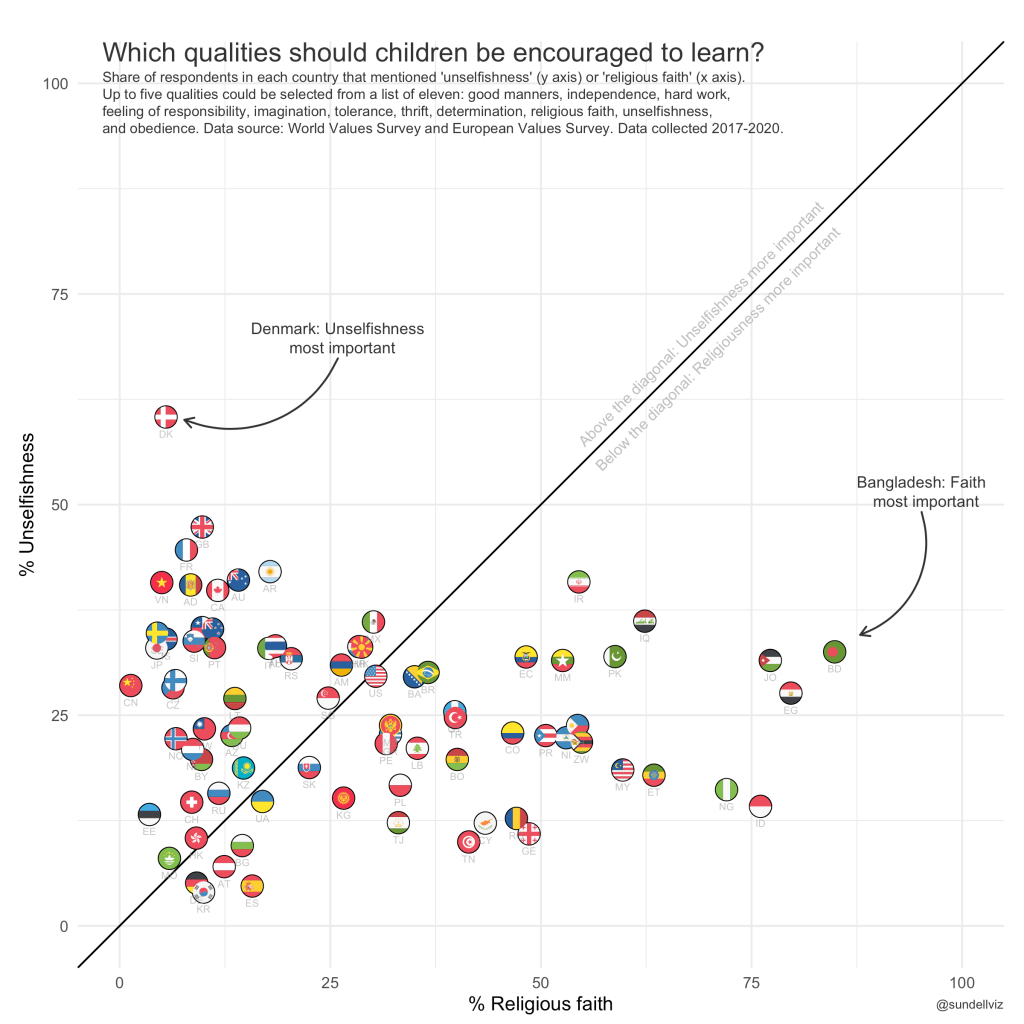
Unselfishness vs Religious Faith

I debated including this dimensional paring. First, it’s an odd dichotomy. Are we trying to claim that the religious are selfish or that unselfish people are areligious? No matter. Let’s keep going.

Unselfishness versus Religious Faith

I suppose this just shows that one can compare anything on a graph and someone can read something into it—like a Rorschach test or tea leaves. Here the US rides the fence. Great Britain and France self-assess as promoting selflessness, and Bangladesh is off the charts with its need for faith. Well, clearly not off the charts because it’s literally on the chart, but it’s trying.

Anyhoo, I feel I need to investigate the raw data and evaluate more parings. For now, I think it’s safe to say that cultural preferences are all over the map. And, even though these preferences have no objective centre, I can admit to having preferences of my own. On these dimensions, I favour imaginative, selfless independence, but that’s just me. Where do you stand?

Tilting Bodies Politic

Does digital technology make students stupid? That’s what a 2019 BigThink article asks. I like to read Big Think, but it seems like PopScience in a negative way—like Pop Psychology. It’s not necessarily directionally wrong. It’s just oversimplified and seeks the lowest common denominator.

On this topic, Plato quipped, voicing Socrates, in his Phædrus 14 dialogue except that his quip was relative to writing and memory. Some historians and Classicists have suggested that modern readers may be missing the satire. I’m no defender of human intelligence, but this is the demise of society because of change—whether due to writing, radio, television, computers, video games, mobile devices, and whatever comes up next.

For this invention will produce forgetfulness in the minds of those who learn to use it, because they will not practice their memory. Their trust in writing, produced by external characters which are no part of themselves, will discourage the use of their own memory within them. You have invented an elixir not of memory, but of reminding; and you offer your pupils the appearance of wisdom, not true wisdom, for they will read many things without instruction and will therefore seem to know many things, when they are for the most part ignorant and hard to get along with, since they are not wise, but only appear wise.

Plato – Dialogue Phædrus 14

Whether or not this claim has merit, my claim is that computers have trebled manufactured consent, so it allows people to be passively active, to have to specious notion of participation in the body politic, and yet are virtually tilting windmills.

It seems that some people have such nostalgia for their apparent way of life that any deviation is considered to be an affront and possible disruption. Perhaps, it’s because I feel there’s possibly as much to shed than to keep in my book, so for me, it’s more good riddance than oh heavens.

The Violence of Bureaucracy

Right. So another rabbit hole. Several things I have come across recently have mentioned the concept of bureaucracy as violence. There was a reference by David Graeber and some journal articles I happened upon. I have so much going on that I don’t have time to give the topic justice, but I wanted to employ this post as a reminder—along with the host of other reminders to which I need to attend.

Let’s start with some definitions.

Violence

The intentional use of physical force or power, threatened or actual, against oneself, another person, or against a group or community, that either results in or has a high likelihood of resulting in injury, death, psychological harm, maldevelopment or deprivation.

Parsing the salient parts, I distil the meaning for my intents and purposes to be the intentional use of physical force or power, threatened or actual, against oneself, another person, or against a group or community, that either results in or has a high likelihood of resulting in injury, death, psychological harm, maldevelopment or deprivation.

For further clarity, we arrive at a

Violence is the intentional use of power, against another person that results in psychological harm or deprivation

Bureaucracy

Management or administration marked by hierarchical authority among numerous offices and by fixed procedures.

Ostensibly, my train of thought is that bureaucracy is a deontological structure meant to standardise and normalise a process. Problems arise by the facts that (1) one size doesn’t fit all and (2) it’s a system thinking challenge likely missing dimensions—if the domain is even appropriately defined and accounted for at the start. This is where bureaucracy intersects violence.

bureaucracy becomes a Procrustean bed

In my mind, bureaucracy becomes a Procrustean bed. Speaking of bed… Fais dodo.

EDIT: In a manner of speaking, I might suggest that normalisation, as a rule, is violence, but I haven’t exactly thought it through. I am not particularly comfortable with the notion of self, so against whom would this violence be perpetrated? Nonetheless, this Procrustean notion still springs to mind—as a moulding. Some might consider it to be character-building. But his lot would either deny the violence or consider it to be a worthwhile crucible. But it’s only a crucible when this character outcome comports with their accepted ideal. The only leeway given is in consideration of those with poor childhoods leading to delinquency. This does not diminish the bloodlust for justice, but it allows for blame to be cast, if not on the perpetrator then on the parents or guardians. I digress.

Hannah Arendt spoke of the Banality of Evil. In a manner, the violence that is bureaucracy is just this sort of metaphoric evil. This 7-minute summary (that could have been 4 if not for the stammering and pauses) is about just this point. In my experience, most bureaucracy is of the sort Arendt write about. I feel that this presenter is a bit more conservative about where he might draw this line.

I’ll exit this post with an observation/rant. I was shopping the other day, and I had one item. There was a short queue situated between a cashier and a self-checkout kiosk. We customers seemed to be dequeuing fine when a frontend supervisor appeared to instruct us to choose a register. I was second in the queue so his interaction with the person ahead of me went something like this:

Employee: Are you going to use the self-checkout?

Customer: Yes

Employee: [Looks at the kiosk]

Customer: Unless this register becomes available first.

Customer: [Cocks head incredulously]

Employee: You need to choose one.

At that moment, the cashier freed, and she took the vacancy. Thankfully—as my mind pondered how illogical this policy was (if indeed there was a policy) and how poorly the maths skills of whoever created it—, the self-service registered became available. Crisis averted.

The takeaway in the story is that blood pressure was unnecessarily elevated because of this bureaucratic rule. This is trivial. I won’t bore you with more anecdotes. Besides, I’m pretty sure, you’ve experienced this violence to one degree or another—whether at work, in commerce, interacting with government workers, or who knows what.

Monopoly on Reparations

Many places have histories of exploiting a group or groups to the advantage of others. Although this scenario applies to these people in a similar manner, I am thinking specifically of the exploitation and reparations due to the black and indigenous people of colour, BIPOC, in the United States.

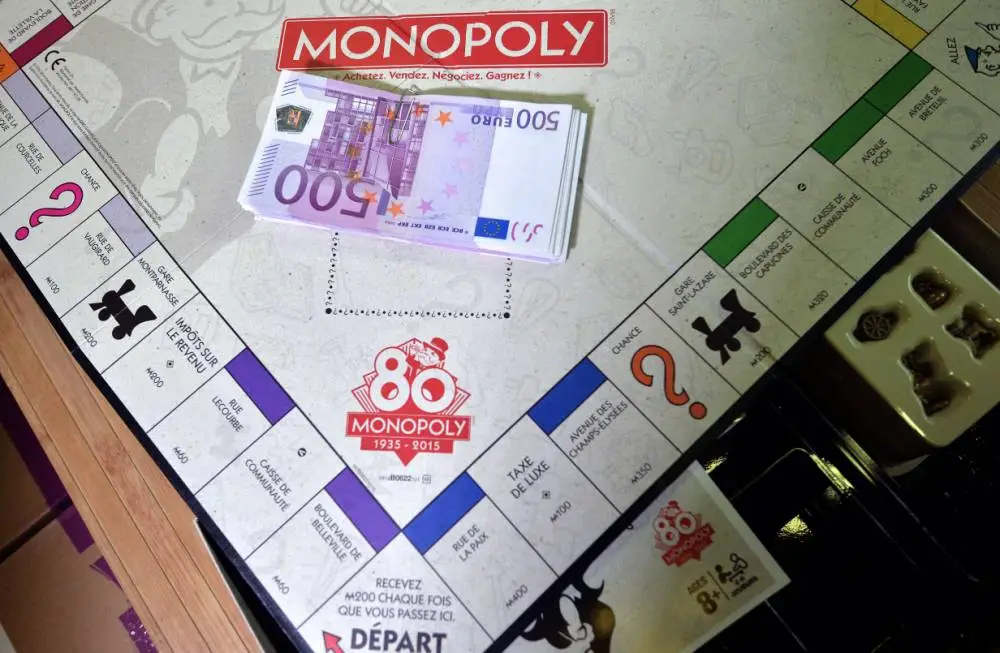
I believe that many people are familiar with Monopoly, the board game where, among other things, one accumulates properties and extracts rents from the other players. My intent is to illustrate with Monopoly the need for reparations, to illustrate why reparations are necessary to restore justice. This is a twist on John Rawls’ veil of ignorance thought experiment.

Slave auction advertisement

I have heard some people say that the past is the past, or if there were injustices in the past, that was ages ago, and now everyone has an equal chance. No special accommodations or affirmative actions are necessary. I don’t agree that this is true, but let’s just say for the sake of this exposition that opportunities are equal for everyone in a given society.

There are parallels between a game of Monopoly and the way we are thrown into this world. No one differs in this regard. We are all subject to a loin lottery.

Imagine that I already own all of the properties. You own none. Irrespective of how the game came to this condition, your chances of winning are nil to none. Now imagine that the reason for the disparate ownership was the result of a system of injustice perpetrated by the player I inherited my position from on the player you inherited yours.

No matter how fairly the game is from now until the end, if your starting place leaves me with all of the property and you without, your chances of winning are slim to none. Favouring tradition and inheritance already benefits some people over others, but when the benefit is the result of a pattern of injustices, it feels more egregious. Worse yet, even if I ‘give’ you Whitechapel Road, Baltic Avenue, or Rue Lecourbe and keep the rest, your chances have only slightly improved.

With the end of US Civil War and the emancipation proclamation, affected blacks were promised 40 acres and a mule. For most, this never happened. This remains an outstanding debt. And whilst 40 acres in some places would be a boon, not many today really need a mule, so descendants of slaves need to be made whole. Reparations are a way to accomplish this.

Reparations are payments in arrears to attempt to compensate for the centuries of an unbalanced playing field. And reparations should allow you to recover more than Whitechapel, Baltic, or Rue Lecourbe properties. At least get Bond Street, Pennsylvania Avenue, or Boulevard des Capucines. If you’ve played Monopoly, you’ll understand that this is still not enough.


Descent of Man

Joe Talbert, singer and songwriter for IDLES, shares some of his perspective with us. Cued is a bit on masculinity, particularly the toxic variety.

Interview with Joe Talbert of IDLES

For me, it’s a breath of fresh air. Maybe it’s just nostalgia, but the IDLES bring some of the lost energy back into music. I’m old enough to remember the first Punk wave of the 1970s and the next waves as well as the ripples.

The Descent of Man clearly explains how masculinity as a construct is dangerous, problematic, and … bullshit

Joe Talbert

I’ve always been out of step with my music interests, ability, and availability. In the ’70s, I was raised on the Classic Rock of the day, from the Beatles and Stones in the ’60s, to Zeppelin and Sabbath in the ’70s before focusing more on the likes of Jeff Beck, John McLaughlin, and then Allan Holdsworth. In the mid-’70s, came vapid and syrupy, saccharine pop and the nonsense that was Disco. Thankfully, this was disturbed by Punk on one hand and Eddie Van Halen on the other. Then there was New Wave and the Hair Bands.

When I wanted to play Rock in Japan, I had offers for Country. My mates in Los Angles were into retro when I was into Progressive and Jazz Fusion. I did get on a Blues kick for a while, but I didn’t really feel like I could pull it off—some affluent white kid and all. Besides Hair Bands in the ’80s, there was a Euro-synth wave, but I wanted something more complex and experimental. By the ’90s, I finished grad school and was career-oriented. I fell in love with Grunge and post-Grunge, but that was a personal endeavour. I did finally play that in the 2000s as covers sprinkled with originals, but it was a side-gig not designed as a career. That train had sailed. Nowadays, I still dabble, but I’m not all that motivated to compose much.

Anyway, IDLES is refreshing. I don’t critique it as music. It’s not particularly melodic or harmonic. It’s about the message and the energy. There’s a beat that drives, and there is instrumentation and vocals. It’s an experience.

IDLES – Car Crash (Live on KEXP)

But this isn’t about the music. It’s about the notion of normalcy. In this clip, Joe talks about his longing for normalcy. Maybe that’s just normal, but I’ve never subscribed to the notion of normalcy, so I’ve never longed for it. Truth be told, my preference is for people to realise that it’s all a control mechanism.

Joe was influenced by therapy and The Descent of Man by the artist Grayson Perry. In this book, Perry, clearly giving a nod to Darwin’s earlier work, takes on toxic masculinity and attempts to reframe the very notion of masculinity. Like normalcy, I am not interested in gender roles either.

I worked as a statistician for a couple of years way back when, so it turns out that I have a perspective on normal. The problem with the notion of normal is that deviation for normal is seen as broken. Social sciences and pop-psychology have done this. Foucault wrote a lot on this phenomenon. I won’t address his work here.

Joe viewed himself as broken because he bought into the narrative. He feels better now. He feels he’s in a better place. Perhaps this was necessary for him. I can’t speak to that. It’s not a goal I aspire to. Perhaps I’m privileged. I can’t say. For now, I get to enjoy the respite Joe & Co afford us.

Your Morals

I was commenting elsewhere on morals and was directed to Jonathan Haidt and his work. Notably, the questionnaire at YourMorals.org, where you can get your own assessment and contribute data points to the body of work.

Full disclosure: I am not a fan of this type of survey, as I’ve mentioned previously. Still, I made an attempt. Better still, I’ve copied the questions to critique. There are 36 all tolled. Perhaps, I’ll respond to a dozen at a time. The next dozen responses are here. Generally speaking, they present each question and provide a Likert scale as follows:

  1. Does not describe me at all
  2. Slightly describes me
  3. Moderately describes me
  4. Describes me fairly well
  5. Describes me extremely well

Standard fare. It starts off bad:

1. Caring for people who have suffered is an important virtue.

Why include an abstract concept like virtue? I don’t ascribe to the notion of virtue, so it’s an empty set. Given that, my response would be a 1. If I ignore the offensive nomenclature and assume it translates idiomatically into ‘beneficial for some target society’, then I still have to question what is meant by suffering, and how far does caring extend. Is it enough to feel bad about the homeless person, or does one have to care enough to provide sustenance and shelter? Talk is cheap.

2. The effort a worker puts into a job ought to be reflected in the size of a raise they receive.

This is fraught with all sorts of problems. In fact, it’s a reason why I consider myself to be a Postmodern. The inherent metanarrative is that societies are effectively money-based. I don’t happen to believe that, so I am again faced with responding to an empty set. Even if I attempt to abstract the ‘raise’ aspect to mean that effort represents input and output is a direct and (perhaps) proportional function, I am still left to wrestle with how this effort is measured and what could have been achieved had the others not been present.

Using a sports analogy—always a dangerous domain for me to play in—, what if LeBron James was to play an opposing team by himself? He needs the other team members. Of course, his teammates are compensated, too. But in his case, his salary is not only based on his athletic talent but on his celebrity power—rent in economic parlance. Perhaps LeBron makes a lot of baskets, but without the assists, he’d have fewer. And because he is the go-to guy, some other teammates might be sacrificing baskets as part of their winning strategy.

Finally, how do you measure the effort of an accountant, a janitor, and an executive? The question is fundamentally bollox.

3. I think people who are more hard-working should end up with more money.

On a related note, I can abbreviate my commentary here. Again, what is harder? Are we asking if construction workers should earn more than CEOs? More bollox.

4. Everyone should feel proud when a person in their community wins in an international competition.

Yet, again, an empty set and a sort of mixed metaphor. I don’t agree with the notion of identity and even less at scale—states, countries, and nationalities. Putting that aside, why should I derive pride (that cometh before the fall) because someone succeeds at some event anywhere? It’s facile. If the question was focused on whether I would be happy for that person, the answer might shift up the scale, but where would I have derived pride for that person’s achievements?

5. I think it is important for societies to cherish their traditional values.

First off, why? What values? Not to beat a dead horse, but what if my tradition is slavery? Should I cherish that? This is really asking should I cherish the traditions of my society. Clearly, it’s not asking if other societies should enjoy the privilege of cherishing theirs? From the standard Western vantage, many want to cherish their own, but not Eastern values of eating dogs or Middle Eastern values of burqaed women and turbans. Is this asking should the world subscribe to my society’s values? I’m not sure.

6. I feel that most traditions serve a valuable function in keeping society orderly

Speaking of tradition… We are not only dealing with the vague notion of tradition, we are discussing another vague concept, order, and elevating order over (presumably) disorder. Order connotes a status quo. And why is the superlative most present? Has someone inventoried traditions? I believe I am supposed to translate this as ‘I feel that the traditions I am familiar with and agree with help to create a society that I am content with’. Again, this betrays the privileged perspective of the observers. Perhaps those disenfranchised would prefer traditions like Capitalism and private property to be relics of the past–or traditions of two-party rule, partisan high court judges, or money-influenced politics, or politicians serving themselves and their donors over the people or Christmas.

7. We all need to learn from our elders

Learn what exactly from our elders? Which elders? The bloke down the block? That elderly Christian woman at the grocery mart? The cat who fought in some illegal and immoral war? The dude who hordes houses, cars, and cash at the expense of the rest of society? Or the guy who tried to blow up Parliament. I believe this is asking should we learn how to remain in place as taught by the privileged wishing to maintain their places.

8. Everyone should try to comfort people who are going through something hard

Define hard, and define comfort? This harkens back to the first question. Enough said. As far as lying is concerned, we should by now all be familiar with the adage trying is lying. Or as Yoda would restate it, do or do not, there is no try.

9. I think the human body should be treated like a temple, housing something sacred within

Obviously, this one is total rubbish. Here, I don’t have a structure that makes it difficult to answer. I may have sprained my eye rolling it, though. This said, what is a temple treated like?

10. I get upset when some people have a lot more money than others in my country

This one is interesting. Whilst I don’t believe that countries or money should exist. In practice, they do. So on its face, I can say that I get upset when we are thrown into a bordered region and told we need to exchange paper, metal, plastic, and bits for goods and services–that some people have more and others have less primarily through chance.

11. I feel good when I see cheaters get caught and punished

Which cheaters? Cheating requires perspective and a cultural code. It can privilege the individualist over the communalist. This reminds me of the cultures that are more interested in ensuring that all of their members finish a contest than having any one win.

Academically, it is considered to be cheating to work together on an exam because the individual is being tested. Of course, the exam is on certain content rather than on the contribution of the human being.

Again, the question feels targeted at cheaters getting caught circumventing something we value. If someone cheats becoming assimilated into some military-industrial society, I will encourage and support them. If they get caught and punished, my ire would more likely be directed toward the power structure that created the need to cheat.

12. When people work together toward a common goal, they should share the rewards equally, even if some worked harder on it

I’ll end this segment here on another question of meritocracy. I think it’s fair to judge the authors as defenders of meritocracy, though I could be wrong. This feels very similar to some other questions already addressed. The extension here is about sharing the rewards, whatever that means. Are we baking a cake? Did we build a house for a new couple? Did we plant trees in a public park? Did we clean up litter on a parkway? Did we volunteer to feed the homeless? And what was the work? Again, how are we measuring disparate work? Did the chicken farmer work harder than the cow farmer? Did the carpenter work harder than the organiser?

If the remainder of these questions is different enough, I’ll comment on them as well. Meantime, at least know you know more why I have little faith in the field of morals. This does nothing to change my opinion that morals are nothing more than emotional reactions and subsequent prescriptions. I don’t mean to diminish emotions, and perhaps that might be a good central pillar to a vibrant society. I’ll need more convincing.

Anarchy at Scale

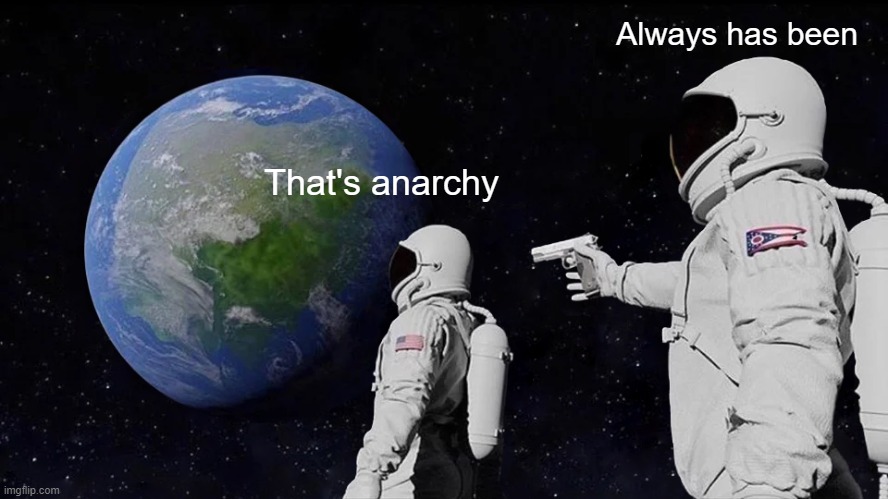
Anarchy exists in the world today. It always has. Macroscopically, one needs only step back to see the forest for the trees—or zoom in for microcosms. The only place it’s rare is in the middle.

As far as scaling, political states are anarchy at scale. They hide behind sovereignty and do as they please. United Nations and such try (meagerly) to herd the cats—say, the US—, but the Big Cats still do as they please. So when you hear that anarchy is untenable, remember that it is more prevalent than not.

In the domain of physics, we hear the quaint Aristolenian adage that nature abhors a vacuum, but in fact, it doesn’t. Without engaging in a quantum debate, the universe is more vacuum than not. This belief is a projection centred on human narcissism, viewing itself as the centre of the universe: some humans seem to abhor a vacuum—as do many dogs abhor vacuums, but that’s a horse of a different colour.

Nature abhors a vacuum

And when you hear that anarchy doesn’t scale, remember that it can be seen on both micro and macro scales. The question is: what happens in the middle?

To be fair, there are many small-scale human endeavours where power structures still decimate the ‘natural’ anarchy, but this is imposed—whereby I use the term natural to mean without intervention.

To be continued…

Je m’accuse

I’ve been an absent owner. I’ve not been fertilising this blog as I’ve been attending to my professional blog and many other things IRL. But my brain doesn’t stop thinking, and I don’t stop reading just because my fingers stop typing contributions here. Today, I type.

No Free Will

The topic is the absence of free will debate. To be fair, I believe the notion of free will is a holdover from religious belief. And, like religion, it is used to control people and to formulate social cohesion and serve as the basis of legal systems. Free will and agency are core to any justice system. There is a system of laws. Conforming is good. Nonconformance is bad. People have agency to decide whether to conform. Relative to the system, a person is either conformant or not. Justice prevails. Nonconformance is punished, as it were. Society wins.

But let’s say there is no free will. I’m going to skip the entire argument and present this piece as a hypothetical. There is no free will. The universe is entirely deterministic. Now what?

Does anything happen? Does anyone notice?

If there is no free will, the universe already has embedded ‘code’ that will either reveal or conceal this information. If we are destined to know this, we’ll know it. If not, our future will unfold all the same.

If people have no real agency, can we punish them? Sure. We do it already. We inadvertently punish the innocent. We even punish those known to be innocent. But if history is pre-written and you are destined to be punished, the script has not only been written, but it’s already been recorded indelibly on film. We’re just waiting for the scene to come into view.

Given this, the so-called knowledge that there is no free will is useless. What’s the goal—to break the fourth wall and and liberate ourselves from the script? Wouldn’t that have already been scripted? What do you get—a director’s cut?

No Agency

What if it’s not so strict but that people don’t have agency? If people are all automatons, is it still ethical to punish them? Can rehabilitation be a goal if people are ostensibly wind-up dolls? If a person is a wind-up doll run amok, are we justified for separating them from the population at large?

I can see an argument for removing axe-wielding automatons from the public. And I’m sorry if they have no agency over their actions—like zombies. We all know what happens to zombies—and unmanaged zombies.

This scenario is different to that of a person who robs a store for food to eat—think Valjean in Les Misérables. This is an indictment of the system. If something needs fixing in this situation, it’s the system not the thief. But that’s not what generally happens. It’s easier to scapegoat a person than a system—even if that system is comprised of other people.

Racism is Null

I recently engaged in a conversation about racism, and I won’t bore you with the larger debate. Instead, I’ll bore you with two threads.

  1. Taxonomically, modern humans have only one race
  2. Constructively, race is used as a proxy to otherwise justify otherness

Taxonomically, Homo sapiens is the species, and we so-called modern humans are Homo sapiens sapiens, which is an extended subspecies…and extended at that, perhaps a sub-subspecies.

Definitionally, race is an alternative name for a sub-subspecies, so technically, our current instantiation of humanity, version X.whatever, can be considered a race. However, as there are no extant human subspecies, there is clearly no need for racial delineation. The best we can muster is to say we’ve reserved a placeholder in the taxonomy.

To expand, in this taxonomy, Neanderthal and Australopithecus were competing species. Homo sapiens sapiens is meant to differentiate so-called modern humans from prior Homo sapins idaltu, from which we branched.

The summary is that there is no other extant parallel species to Homo sapiens and (clearly) no parallel subspecies to Homo sapiens sapiens.

Yet racists need races to operate on, and unless they are railing about races within other species, they’ve got no dog in this race. What to do?

How does one not only construct races where none exist but also convince others that this delineation is de facto race, if not de jure?

Colour and relatively recent geographical origin serve as good-enough proxies to differentiate classes under the guise of race. They create specious backstories et voilà.

As most people are decidedly neither scientific nor inquisitive, this is an easy feat. And it provides a sort of gossamer other against which to rail. This structure is so permeable, people have tossed religious affiliation into the mix with barely anyone noticing because race is just a code word for otherness.

The question becomes: how does one fight against something that doesn’t actually exist and whose definition morphs and adapts more readily than a virus?

DISCLAIMER: This post was written on my mobile, so it may have more flaws than usual. I reserve the right to edit it substantially when I have access to a full-size keyboard and monitor.