Not really, but I’ve had visitors from these countries visit here in the past 7 days. Whilst I either try to be culturally inclusive or admit where I am obviously off, I live in the United States at the time and it just colours my perspective in the same manner it would be coloured if I was spending a lot of time steeped in some other cultural setting.
I am aware that people visit blogs for different reasons. Some are searching for confirming views or to broaden a perspective; others are scratching their heads and asking if people actually think like this or that. In all cases, you are welcome. You are also welcome to share your agreements or disagreements.
What I find most interesting are my subscribers (or whatever WordPress names them). from what I can tell, at least three-quarters of subscribers to Philosophics would appear to have views counter to my own. Of course, they are welcome, but it seems that a have a lot of, let’s say, ‘spiritual’ subscribers, where I hold antithetical if not diametrically opposed views. I’ll presume this is to keep a pulse on a different perspective, which I admire.
Nothing more to say at the moment. Just taking a quick break to give a special shoutout to anyone who has visited from one of these countries. If ‘Unknown Region‘ is some interdimensional visitor, you are still welcome. Thanks for stopping by.
In other news, Boris Johnson resigns. Another Conservative politician hits the bin. I’m neither Conservative nor Liberal, so I think I am in a place where I can comment as a disinterested observer. Of course, I am not fully disinterested; I am rather apathetic to it all. None of my horses is in the prevailing parties.
As I’ve been reading (too much) Jonathan Haidt, of all things, a Liberal apologist for Conservatives aimed at a Liberal audience. I have to wonder why Conservative politicians are so corrupt.
Hear me out. Before you accuse me of a hack job, allow me to explain. Are Liberal politicians corrupt? Of course, they are. Probably as corrupt. By and large, they have the same handlers and funding sources. But then why call out Conservatives as being corrupt?
According to Haidt and his Moral Foundations Theory (MFT), Conservatives collectively have more moral dimensions than Liberals and they have elevated ‘disgust’ triggers. This is what makes them more obsessed with ‘purity’.
According to MFT, Liberals have two moral dimensions: Care and Fairness, regarding the left side of the value pairs. Conservatives share these, but they also include Loyalty, Authority, and Sanctity.
“The Righteous Mind: Why Good People Are Divided by Politics and Religion,” Haidt 2012
I am distracted for a moment by the epiphany that this explains a lot about why American police units operate the way they do—dysfunctionally from the Liberal and minority perspective. Whilst they care and want ‘fairness’, how they care is typically different (though there are clear overlaps), and ‘fairness’ means something different to them. Next, dogpile on loyalty, authority, and sanctity.
Loyalty is to their group of other blue lives as well as their nationalistic and paternal fealty. Authority is them. They are the authority, and this is an inviolable relationship. Don’t question it. And then there’s sanctity. We need to clean up the neighbourhoods and cleanse them of criminals. The dirty people need to be taken off the streets as we perform our moral duties.
And I’m back. Whilst this intermission was a diversion, it is at the same time on point because they share this worldview with Conservative politicians—tough on crime, law and order. But what I am calling out is that if this is their worldview, they should be measured by a higher standard.
Distracted again, this also explains a lot about the outrage over Julian Assange, Chelsea Manning, and Edward Snowden. Each of these people exposed unfathomable corruption, and Conservatives want their heads on platters. This reflects their viewing of the world through a deontological lens and as measured by a different sense of fairness.
I am not judging here. I am merely pointing out that their loyalty to country (or whatever) trumps the fairness mechanism. In a way, they see it as unfair that someone would have the audacity to betray their (notably corrupt) government. They even buy into the argument that they could have used the reporting mechanisms in place rather than air the dirty laundry in the public forum. These people find no discomfort in maintaining state secrets, even when the secrecy is for nefarious intent.
Back again. My point is that if these are primary drivers for Conservatives—fundamental attribution bias notwithstanding—, why do they subvert their own morals? For Liberals, there is no such subversion because they don’t believe these are relevant moral dimensions. This bleeds into the abortion debate—the sanctity of life: Life is sacred (and too much hypocrisy on the Right to unpack here), so you need to abide by moral code. Let’s not run astray again.
Wrapping this up, even if Conservatives are no more or less corrupt than Liberals, they are claiming to have a higher standard and yet they fail to abide by it. For a Conservative to call out a Liberal for the same violation is rather silly because the Liberal never agreed to the Terms & Conditions at the start.
Done
As I was mistyping the title, I realised that ‘resigns’ is ‘reigns’ with an inserted ‘s’. Nothing more.
Je m’accuse. I am as guilty as the next bloke when it comes to constructing false dichotomies. I like reading Steven Pinker, Jonathan Haidt, and Joshua Greene, though I disagree with some fundamental aspects. Having put Time Reborn to bed, I’ve reengaged with The Righteous Mind and it’s dawned on me what goes against my grain. In retrospect, it should have been obvious all along, and perhaps it was. When I read works by these cats, I catch myself saying, ‘Yeah, but…’. A lot.
To be fair, I’ve not read much of Greene, so I’ll focus on the other two, Haidt in particular. From what I can tell, Greene is cut from the same cloth. I’ll elaborate. When I cite Haidt, just know that I mean the other two and their ilk.
Haidt divides the world into Liberals and Conservatives. This is the false dichotomy. I’m aware that I recently expounded on the political spectrum, but this is more than that. Whether this would be better depicted as further Left on the political spectrum or another dimension is open to debate.
I believe the biggest dissonance I feel against this common perspective is that these guys are all Liberals. In particular, they are Ivory Tower Liberals™—paternalistic know-it-alls. Upon reflection, Cass Sunstein falls into this category: paternalistic intellectuals. I don’t mean this pejoratively, but each of these is a privileged prescriptivist. But that’s not my beef.
The other common thread is that these people are all institutionalists. This brings everything into focus. These people are defenders of Enlightenment Age morality, so they’ve all adopted the same metanarrative.
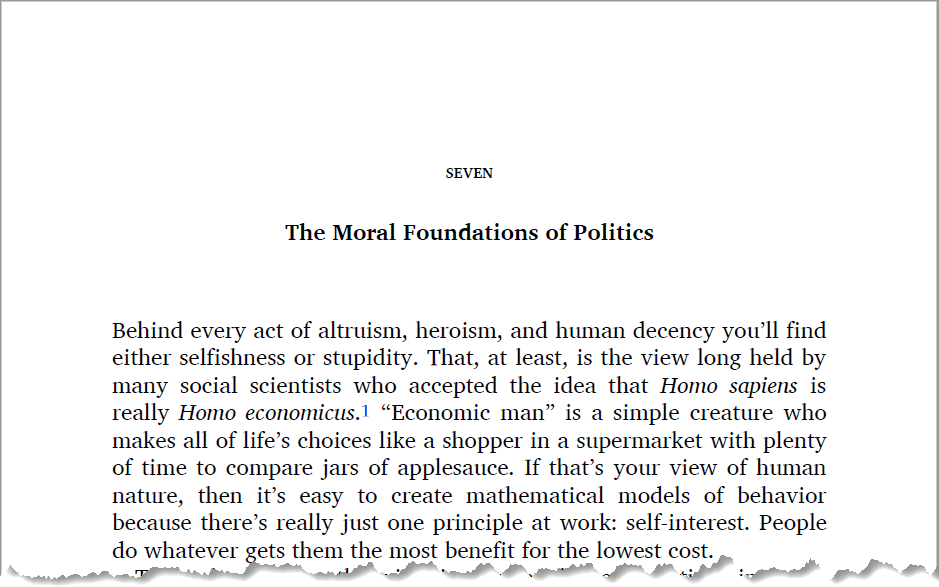
The Righteous Mind – Chapter 7
Haidt’s observations are accurate enough, but only within the frame of institutionalism—a frame I reject. This leaves my perspective out of view and unrepresented. In chapter seven, he establishes his action pairs that serve to divine moral truths about a person’s foundational political beliefs. He argues, like Pinker, that the mind is not a Blank Slate. He adopts neuroscientist Gary Marcus’ definition of innate:
“Nature bestows upon the newborn a considerably complex brain, but one that is best seen as prewired—flexible and subject to change—rather than hardwired, fixed, and immutable.”
— Gary Marcus, The Birth of the Mind (2004)
He further morphs Marcus’ ideas into this:
Nature provides a first draft, which experience then revises.… “Built-in” does not mean unmalleable; it means “organized in advance of experience.”
— Jonathan Haidt, The Righteous Mind (2012)
Given this background, Haidt invented these action pairs:
Care – Harm
Fairness – Cheating
Loyalty – Betrayal
Authority – Subversion
Sanctity – Degradation
I suppose I could reserve an entire post to disintegrate these. Suffice it to say that, categorically, I have issues with the meta of some of them—particularly, the last four. I am more accepting of the care – harm dichotomy, so my commentary would be more nuanced, especially in light of the scenario he cited, which shed light on his own thought processes.
I’m getting off track. The point I want to make is that these shared perspectives on society and identity, respectively macro- and microcosmic, make sense in an institutional framework, but is less necessary otherwise. And although Haidt attempts to defend his positions as not being invasive [my words, not his], this is simply because he accepts the underlying metanarratives blindly.
I’ll probably return to expound on this later, but for now, I am on to other things. Meantime, here is a review from a European, who rightly points out that this is a book written by an American for an American audience, even if he feels it is more universally applicable.
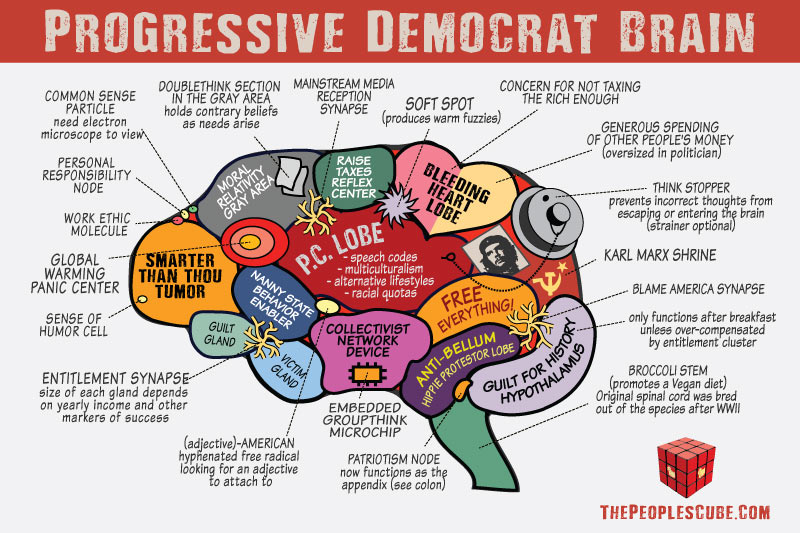
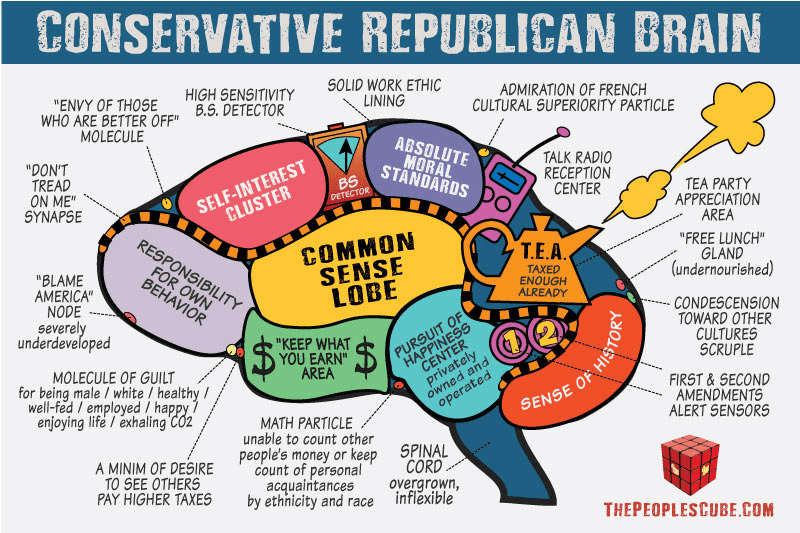
Out of a sense of fairness, I’ve included the Conservative brain image.
Agency is going through the same fits as religion. When Nietzsche regarded society around him at the time, he declared that God is dead and asked now what? This is precisely the same challenge in different clothes.
Preserving “law and order” without a concept of real responsibility is a daunting task.
Dan Dennett
Without a God to use as a bully pulpit and mechanism of fear, how could we keep people in line in cohesive societies? Without the notion of human agency to allow for responsibility and blame, how can we keep people in line in cohesive societies? Only the predicate has changed, but the question remains, do we persist in lying for the so-called greater good? This is similar to the Santa Claus myth to keep young children in line.
If nobody is responsible, not really, then not only should the prisons be emptied, but no contract is valid, mortgages should be abolished, and we can never hold anybody to account for anything they do. Preserving “law and order” without a concept of real responsibility is a daunting task.
—Dan Dennett, “Reflections on Free Will” (naturalism.org)
One might like to think that lying is psychologically pathological, but it seems to be a significant part of the human condition. The fundamental question doesn’t appear to be ‘should I tell the truth’, but rather ‘Can I get away with lying?’ Despite all the talk of Truth and integrity, this seems to be the default state of humans. This renders integrity just another lie. But you knew that already, but let’s not fall into another Foucauldian rabbit hole.
We no longer have any sympathy today with the concept of ‘free will’: we know only too well what is is — the most infamous of all the arts of the theologian for making mankind ‘accountable’. . . Everywhere accountability is sought, it is usually the instinct for punishing and judging which seeks it… the doctrine of will has been invented essentially for the purpose of punishment, that is of finding guilty.
— Twilight of the Idols: ‘The Four Great Errors’, 7
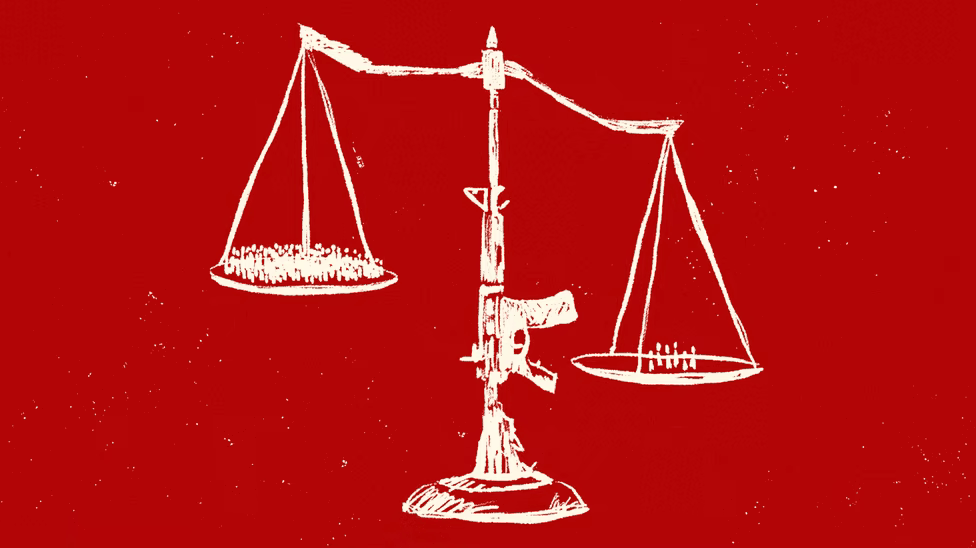
I chatted with an associate this evening about the gun debate in America. For some reason, gun control is again a hot topic. He believes that guns, like drugs, should be treated as mental health issues.
Click an image to read the referenced article.
The Atlantic: An ER Doctor’s ‘Third Way’ Approach to the Gun CrisisThe Atlantic: The Real Reason America Doesn’t Have Gun Control
Full Disclosure: I do not believe that the Second Amendment of the United States confers unrestricted rights to own a gun. Full stop. I believe this is a perversion by activist Supreme Court justices of the original intent of the grammatically-challenged Forefathers of that cursed country.
The mental health topic brought my attention to the question of tolerance and normalisation. Mental health, an interest of psychology has a sordid past. At its very core is the idea that humans can be normalised, that they can be categorised into normal and abnormal behaviours, and what is deemed normal might have some room for variation, but this tolerance doesn’t really allow for much discrepancy.
Normalisation expects to bring people into some basic conformity—give or take. The problem is that this is contextual and the acceptable range changes over time and place. Many behaviours previously considered abnormal are now acceptable, and some acceptable behaviours are no longer tolerated. Some of these changes have flip-flopped legal status as well. It’s just a game to some people.
Tolerance takes a position that there is no normal, per se. Some people just have different ideas.
Here is a clip of an interview with Dr Oz ( né Mehmet Cengiz Öz) where he illustrates my position. I’ll disintegrate it next.
Dr Oz explains why he does not support legalisation of marijuana
Transcript
Reporter: What is your stance on [the legalisation of] marijuana?
Dr Oz: … There are not enough Pennsylvanians to work in Pennsylvania, so giving them pot so they stay home… I don’t think [is] an ideal move. I also don’t want to breed addiction to marijuana. It’s not physical addiction; it’s emotional addiction, but I don’t want young people to think they have to smoke a joint to get out of their house in the morning. We need to get Pennsylvanians back at work you got to give them their mojo, and I don’t want marijuana to be a hindrance to that. I also don’t want people operating heavy machinery and driving by me when they’ve been taking their fourth joint of the day. But there are other issues that are plaguing Pennsylvanians. We’re a border state, practically, … because they’re flying illegal immigrants up here from the border in the middle of the night … but they’re also getting their narcotics up here really easily.
So, let’s break down this word salad. This will reveal some of Dr Oz’ and my worldview biases.
Neither Oz nor I advocate the use of marijuana or other recreational drugs. However, Oz wants to make or keep it illegal and criminalised. I do not agree. I feel they should regulate it and tax it. Although I neither advocate nor endorse the use of any of these herbs and chemicals, I feel they should do this for all drugs. [And if we are going to make these chemicals illegal, let’s not be hypocrites and make nicotine, alcohol, and caffeine illegal.] I’m not advocating this. I’m just saying adopt a position and maintain it with integrity.
There are not enough Pennsylvanians to work in Pennsylvania.
First, Oz is a wage slaver. Next, the unemployment rate for PA was 4.9% in March, so this does not appear to be a problem.
so giving them pot so they stay home… I don’t think [is] an ideal move.
Oz makes an unsubstantiated connection between the legalisation of marijuana and staying home—being lazy or unmotivated.
I also don’t want to breed addiction to marijuana.
Marijuana is not known to be addictive. As a doctor, Oz knows this.
It’s not physical addiction; it’s emotional addiction
Here, Oz backtracks, but he also introduces an unsubstantiated claim. If you are interested in why I consider psychology pseudoscience, follow this link to explain DSM changes in this area.
but I don’t want young people to think they have to smoke a joint to get out of their house in the morning
Oz makes a total non-sequitur here. Nothing he has mentioned this far would lead to this conclusion. If someone already feels this way, its legal status is irrelevant. Enough said.
We need to get Pennsylvanians back at work you got to give them their mojo, and I don’t want marijuana to be a hindrance to that.
This is more Calvinistic wage slavery advocacy. Again, he is equating the consumption of marijuana with being unmotivated. Perhaps he should challenge Micheal Phelps to a swimming race. If motivation is the issue, perhaps he rather favours legalising amphetamines—but I supposed he’d have a preconceived rationale for that, too.
I also don’t want people operating heavy machinery and driving by me when they’ve been taking their fourth joint of the day.
Where does the number four come from? Is four different to one or two? Has this been studied? Is he saying this doesn’t already happen? Does he believe that current intoxication laws and incapacitation regulations aren’t in place?
We’re a border state, practically…
Where to start… Pennsylvania is a border state. It borders New York, New Jersey, Ohio, Delaware, Maryland, and West Virginia. If one counts for the water border of Lake Erie, one might be able to argue that it shares an international border with Canada—although, I feel that’s a stretch. At that point, one wouldn’t be far from considering Hawaii to border California. It’s only water. He does say practically, so perhaps that’s his out.
because they’re flying illegal immigrants up here from the border in the middle of the night
Wait a minute… Geezer’s talking about the southern border between the United States and Mexico. (That’s where brown people live.) The fewest number of states between Mexico and Pennsylvania is four, but that’s stretching it. Something tells me that Oz is at least an elitist and at worst a racist. I’m a sad panda.
Another non-sequitur. Somehow, Oz is trying to create a link between marijuana and narcotics whilst also contending that legalising marijuana would somehow affect these illegal flights. Wait, are the flights illegal or just the passengers? How does he know that either is illegal? And does it have to be at night? I get the feeling that Oz watches too much television. Perhaps that’s what we should criminalise. So many questions.
but they’re also getting their narcotics up here really easily
OK? Perhaps we should contract with them to transport the marijuana up here if they are so efficient. Or would it be better to grow it locally? Racists tend to be nationalists and would likely favour a Made In America policy—unless they can exploit brown people. Or Oz can employ otherwise unemployed Pennsylvanians on his pot plantations. Where does it end?
What does this have to do with normalisation and toleration?
People like Dr Oz want to mainstream people, a concept some familiar with special education might remember—get the people in line with the herd. Proper people—normal people—are supposed X and Y and Z. Toleration allows that there may be people with descriptively ‘normal’ traits and behaviours, but there should not necessarily be a penalty for noncompliance.
When I was an undergrad student, I had a side job as a shift supervisor at an Au Bon Pain in Boston. On an occasion, one worker, let’s call her Mary, was arguing with another worker that we’ll call Marie. Mary said she was not going to make any more sandwiches because she had already made twice as much as Marie. Although I understand the notion of fairness she was invoking, I reminded her that she was being paid by the hour, not the piece. As long as she was still on the proverbial clock, she would continue to make sandwiches. Although I didn’t press this point, I could have hired Marie to watch Mary make sandwiches. In fact, I suppose I was hired to watch them both make sandwiches.
The point is—Mary’s perception aside—that there was no reason to presume these two should produce an equal number of sandwiches in an hour, a day, or a month.
I mention this because—getting back to Oz’ drugs scenario—if people are happy getting high on heroin and nodding out on Kensington Ave, that’s their issue, not Oz’ and not mine. If Pennsylvania needs workers and can’t get them, figure out how to attract workers. Don’t create a situation so bad that the alternate to work is just the lesser of two evils. This reminds me of a story from my consulting days.
Without dropping any names, I was hired by a company to ‘deflect’ some costs. The high-level concept was to redirect people from a relatively expensive call centre to cheaper self-service. I reminded them of the Principle of least effort.
Essentially, I conveyed that people are inherently lazy—echoing Carl Jung. People will take the path of least resistance. If it’s easier for them to call, they’ll call; if it’s easier to self-serve, they’ll do that.
“So we should make it more difficult for customers to call?” was how this was interpreted.
“You should make it easier to self-serve.”
I’m still shaking my head to this day. What humans will do to other humans in the name of commerce.
I am a racist. Well, to the extent that there is only one extant human race but some choose to construct races out of ethnicities, skin colour, and other allele expressions, I am a racist. It’s difficult to escape the distinction that the perpetrators and targets or victims of these fabricated races.
The haters need to create a target group to feel superior over. The do-gooders need to be able to identify groups who have been harmed or historically underserved. Of course, there is a right way and then there’s this wrong way. In a manner of speaking, it’s an easier effort to broad-brush people into race categories. No mind that they have no basis in biology or in science more broadly. These people have issues with science, mainly because they don’t feel fully included in their designation as soft scient and social science. They get pretty defensive when they get called out as pseudoscience, but if the shoe fits. Playing these race games only underscores the pseudoscience charge.
All of this said—or by this tepid definition—, I am a racist. Here’s why.
I am a racist
When I see a person from a designated group, I consciously reflect: that’s a human who’s been identified as an other—sort of like an endangered species, they need to be protected. Sure they can protect themselves, but they need assistance. Besides, they deserve extra attention because of so many centuries of not only neglect but of malice. Perhaps not that person in particular, but since we’re broad-brushing.
Where my racism comes into play is that I’ll smile and nod; I’ll engage in phatic exchange; I’ll hold a door; I’ll recognise them as a person—as a human; I’ll feel a slight boost of empathy and compassion. I’ll see this person as different, whereas without this constructed designation, I’d only see another person. But I’ve been instructed to see them as different.
Growing up around Boston in the 1970s, a time of desegregation and forced bussing, my best friend was a negro. That’s how we labelled blacks or African-Americans or whatever the latest label is. He was very aware of his colour. We’d joke about it as kids tend to do. He was coloured. I was a cracker. To us, his colour (or race, if you prefer) meant nothing to us.
My family were racist, though they’d deny it. To them, Lenny, my friend, wasn’t an individual. He was a part of that larger race construct. Sure, he was an individual, too. He was my friend who played baseball with me and shot hoops in the driveway. But to me as a child, race didn’t yet exist. I hadn’t yet been indoctrinated into the race nonsense. Lenny may have experienced things differently.
Don’t get me wrong, looking back, Lenny did conform to racial stereotypes. His dad was an absent parent, an alcoholic shipworker, who spent more time at the shipyard and in bars. I barely even saw him. His mum was a large woman, who was very nice to me but was frustrated with her lot in life and the lack of emotional support from her husband.
Lenny was the youngest of three brothers, but he had a younger sister, Karen. His brothers were high school basketball stars, as it were, in a suburb. Tookey was the oldest and tallest. His given name was Raymond, but only his parents called him Ray. Steve* was also a football star, who went on to play at Boston University during the Doug Flutie years.
It wasn’t until I joined the military that I learned about race. This was mainly about the people of colour who had joined the military owning to economic necessity and the promise of a better life. This outlook was not unique to what we now refer to as BIPOC. The majority of enlisted personnel were victims of the system they at least tacitly believed in. If I were to be so bold, I’d say there were two flavours, the bitter and the hopeful. I won’t elaborate further.
Eventually, I moved to Los Angeles and was steeped in Hispanic/Latino culture—primarily from Mexico and Central America. Again, I was an observer. I participated with people connected to this culture. I don’t particularly abide by any culture. I don’t view it as important, but this also means that I have no culture to defend either. Maybe that’s a significant difference. If I’ve got no cultural ego to defend, then I am not threatened by other cultures that I might feel as encroaching.
Don’t get me wrong. Whilst I tolerate cultural expression and say ‘to each their own‘, I do find traditional clothing and rituals to be silly or quaint. But so do I find some of this silly in what would be said to be my cultural heritage, whether ethnically to Norway or nationally to the United States. I’ll spare the commentary.
I picked up enough conversational Spanish to get by—mostly phatic speech and politesse—, so if I am interacting with a Spanish speaker, I will use what words I know: gracias, de nada, compromiso, desculpa, por favor, and even pendejo doesn’t go to waste. I’ve also been known to utter merci, danke, spasibo, xièxiè nǐ, or domo arrigato (mister roboto, cuz let’s be honest here).
This is my racism or my sensitivity to culture. To be honest—and why not be honest, am I right?—, this has not always been without controversy. Arbitrarily, I might spam gracias, merci, or domo to a whitebread American. In most instances, they’ll nod and acknowledge the intent and accept it or respond with no problem, you’re welcome, or even de nada or de rien. I’ve even gotten a German bitte in response to a domo, so I suppose I am not alone.
I think it’s safe to say that most Americans know what grazie or merci mean. Perhaps not domo. In one encounter, I said domo to a non-Japanese Asian and was immediately derided with an I’m not Japanese. From her perspective, she may have felt that she had been homogenised into being Asian and she wanted to be identified as whatever her heritage was. She never shared this information with me. Perhaps she was Korean or Cambodian, Vietnamese or Laotian, Chinese or whatever. But she did communicate that she wasn’t Japanese. She might have been under the impression that from my perspective, I saw that all Asians look alike.
From my perspective, I could have as alternatively exchanged a merci. This would not have likely triggered the same emotional response—I’m not French. On the one hand, I felt bad for triggering her—despite that not having been my intent. On the other hand, I didn’t feel I needed to engage her free-floating rage. So I’m a racist.
In my own defence, studies show that people are more able to discern people within their own ethnicity. I’ve shared this story before. When I lived in Tokyo, I was dating a woman whose dad was Japanese and her mum was Chinese. I had met her once, and I was to meet her at a train station. I’d be lying if I told you I had no trepidation about not being able to recognise her in a crowd. My, perhaps narcissistic, consolation was that she’d recognise me being taller and ‘Caucasian’. I can’t really say ‘whiter’ because although I was brought up to identify Asians as yellow (and Indigenous Americans as red), most Japanese were a lighter shade of pale than I (or most so-called ‘white’ Americans) were. I’ve always been suspicious of these colour attributes, but I won’t go even further down this rabbit hole.
In the end, I see colour. I see the history.
In the end, I see colour. I see the history. Even though my family didn’t even move to the United States until World War II, somewhat exempting me from culpability, I still recognise the injustice that still prevails. With empathy, I want things to be better—to be more inclusive—, but cultural homogenisation is not the approach I support. I support tolerance.
If I feel that a certain costume is silly, so be it. I don’t have to wear it. When I was growing up in the 1970s, I felt that my own clothing options were silly—polyester and bellbottoms? No thank you. This is just a preference thing. I don’t like to wear headcovers—hats or caps. Do I care if you wear a headcover? No. Might I think you look silly? Sometimes. Do you want to know what else I think looks silly? Beards? What’s even worse? Moustaches—or as I am more apt to call them, pornstaches. Am I going to judge you are being less of a person because of any of these? No. I could go on and on about my reaction to certain accoutrements, but I’ll let you in on a secret: I have worked and interacted with people who prefer to present themselves in these ways, and these people have risen to the occasion and disappointed in the same ratio as people who dressed like me or looked more like me, so clearly it’s not a factor.
In summary—and despite the fact that there is only one human race—, I admit to being a racist. I do recognise that negative and positive stereotypes exist, as well as I know that these are vague generalisations. I know white people who can dance and Asians who suck at maths. I know Mexicans who aren’t gardeners and Italians who couldn’t cook to save their lives. I even know black people who can swim—but not my friend Lenny; he can’t swim. Sometimes stereotypes happen to encapture a person.
* As I was writing this, I decided to perform a Google search for Lenny. We lost contact decades ago because he adopted Jehova’s Witness religious beliefs that didn’t allow him to socialise with persons outside of his religion, so we parted ways. But I did locate Steve. I reached out to Steve on LinkedIn. Unless I’m mistaken, we probably haven’t communicated with each other since 1978—that’s 44 years— when he went off to college. I always admired Steve, the way we sometimes admire our big brothers. Steve was Lenny’s big brother, and Lenny looked up to both of his big brothers.
Steve responded on LinkedIn. We exchanged best wishes. Maybe one day I’ll ask him about his experience with race. It doesn’t seem to be a topic one can engage in because of the lack of shared perspective and the hot button triggers just waiting to be tripped.
I’ve never really liked the concept of normal being applied to behaviour, whether individually or societally. At a micro level, it might be fine, and one can assess a deviation from a norm, but at a macro level, we have averages of averages, so how many dimensions need to be out of calibration and for how long to be considered abnormal.
Moreover, statistically speaking, where we have a normal (Gaussian) distribution, we might consider a mean and a certain variance or standard deviation from that mean to be normal, but the reaction to deviance is asymmetrical.
An example that comes to mind is that of cheating. It is well documented that humans are predictably cheaters (and liars). Nonetheless, there are two measures of normalcy. There is a fundamental attribution bias in play.
We view ourselves as basically honest and justify occasions when we act the same way. Regarding the chart below, we like to believe that cheating is uncommon. In fact, we chastise or otherwise punish cheaters.
Descriptive versus Prescriptive Normalcy
Full disclosure this is not to scale nor representative of actual data. It’s merely an illustrative tool for conversation.
Prescriptive Normalcy
The bottom range in green represents the accepted and prescribed normal range of cheating. In this example, it might be anticipated that an average person might cheat on things like their taxes, their diets, not returning extra change at a vendor, and so on, about a third of the time, give or take. Anything more would be considered abnormal and unacceptable. Anything less and the person might be considered to be uptight or a goody-two-shoes, perhaps like Ned Flanders of the Simpsons franchise.
Ned Flanders – Hokily Dokily
Descriptive Normalcy
In practice, people operate well outside of this range. As illustrated by the top red range, people tend to cheat closer to two-thirds of the time. If a person is caught cheating, they are treated as being well outside of the prescribed range, society will look upon them harshly despite this actually being normal behaviour for those judging, those who know that they are guilty of the same activity.
One reason for the overreaction may be to signal that they are among the righteous. Here, it’s good to remember Jung’s quip: The brighter the light, the darker the shadow.
The brighter the light, the darker the shadow
Carl Jung
Intelligence Quotient
If I use IQ* for a reference, normal is the mean plus or minus a standard deviation (or sigma [σ]) of 16 points, so between 84 and 116. In the early to mid-20th century, clinical psychology nomenclature grouped IQs by bands:
Later moron was replaced by moderate mental retardation or moderate mental subnormality with an IQ of between 35 and 49. As with many things, and in the case of IQ, an observation above the norm is associated as better with an observation below the norm being considered as worse.
* IQ has many problems. At first, an IQ of 100 is supposed to represent the average (mean) of a population, yet the average IQ of the world population is just over 82, a number outside and below the 1σ threshold. In the United States, the average IQ is an unremarkable 97% (ranking 26 among 199 countries). Japan and Taiwan top the list at over 106. In fact, Asian countries comprise the top 6 slots. Canada, Australia, and the United Kingdom are almost an even 100, falling ever so short. at 99 and change. Guatemala, Liberia, Sierra Leone, and Nepal fall at the bottom of the ranking, each with average IQs under 50.
I don’t believe that humans have the agency presumed they have, so I’d like to set out to prove it—at least rhetorically. In the ages-old battle between free will and determinism, I’ve tended to lean toward the determinism camp, but there is something keeping me from gaining full membership. I feel that proving hard determinism may be too hard a nut to crack, so I am aiming at just the agency aspect.
There are two major themes in my thinking.
Humans have no material agency
Power structures require the presumption of agency
Although this concept has been rattling around my brain cage for a while and I still have a ways to go, I feel it will be helpful to sketch out my ideas. I feel inspired by people like Robert Sapolsky and Daniel Dennett. And I feel I can draw insights into counter-arguments from people like Jonathan Haidt, Joshua Greene, and even Steven Pinker. I feel that my experience in behavioural economics may be useful for additional context—people like Daniel Kahneman, Richard Thaler, and Dan Ariely. But I feel disheartened when it appears that Galen Strawson and his father before him, Peter Strawson, people much more connected and elevated in the field have been treading the same territory for decades — over half a century — ahead of me, thankfully beating a path but not necessarily making much headway. Perhaps I can build upon that foundation if not substantially at least perceptibly. Of course, the seminal work by Isaiah Berlin’s Two Concepts of Liberty.
We may act as we will, but we cannot will as we will.
Arthur Schopenhauer
Besides the aforementioned, a correspondent has suggested other source references. He shares: Physics, including quantum mechanics, is fully Lagrangian. According to Stanford’s Leonard Susskind, Lagrange derived his formalism from the principle of ‘Least Action’. Jean Buridan’s principle of ‘Equipoise’ renders a Lagrangian model of the world perfectly deterministic. So, the physical domain is not probabilistic; and all indeterminacy is actually epistemic indeterminability. He also suggets Thomas Hobbes’ “De Corpore”.
About my second point, my corresponent agrees:
I think your “meta” is right. We feel that we are “free agents”, and we don’t know to what to attribute our feeling that we freely choose; so we imagine that we have “free will”. In my view it also doesn’t exist – we really are, as Sapolsky describes, zombie robots – we just don’t (and cannot) know it. Free will is thus a mere (but compelling) illusion on both individual and emergent scales. And yes again: all of morality, jurisprudence, etc., depends on it.
Unattributed Correspondant
My correspondent is a professional philosopher who shall remain anonymous until such time as he agrees, if ever, to make his identity known. I am quiet aware that some of my ideas are contentious and polemic. Not everyone wishes to be mired in controversy.
Humans Have No Material Agency
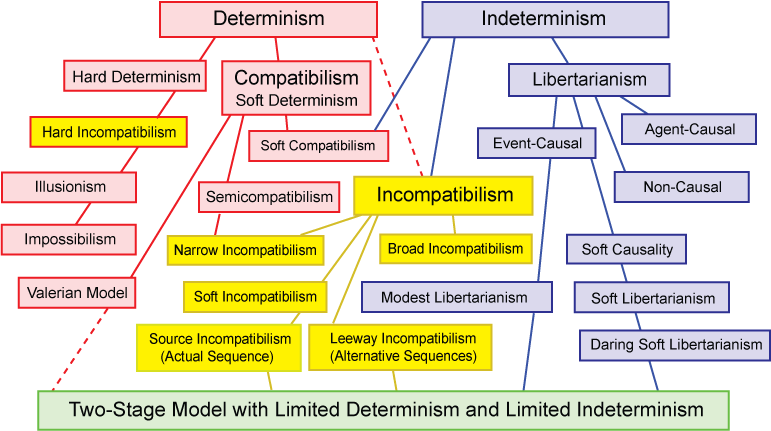
Humans have little to no agency. This is the point I am making in my Testudineous Agency post. From what I know until now, this likely qualifies as soft determinism, but this might shift as I acquire new nomenclature and taxonomic distinction. I’ve discovered this taxonomy of free will positions, though I am not well enough versed to comment on its accuracy or completeness. For now, it seems like a decent working model to serve as a starting point, but I am fully cognizant of possible Dunning-Kruger factors.
A Taxonomy of Free Will Positions
In essence, hard determinism says that the world is not probabilistic. Some event triggered the universe as we know it, and it will unfold according to the laws of physics whether or not we understand them. A weaker form, soft determinism, allows for some probability and trivial ‘agency’. I feel that Dennett supports soft determinism. I feel that because we, as ‘individuals’, are a confluence of multitudinous factors, we have little agency (interpreted as responsibility). More on this later.
Power structures require the presumption of agency
To be honest, the free will debate is only interesting to me in context. To me the context is power. The ‘meta’ of this is that society (and human ‘nature’) seem to need this accountability and culpability, but it doesn’t actually exist, so it is created as a social construct and enforced in a Foucauldian power relationship through government through jurisprudence mechanisms.
This is the part of the debate I haven’t heard much about. Sapolsky did write in Behave, chapter 20X, that criminal justice systems need to be reformed to account for diminished agency, and I’ll need to return to that to better comprehend his position and assertion.
The rest of the story
As a handy reference, these are the authors and books I’ve encountered to date and in no particular order:
I’ve got a lot of essays and lecture notes not referenced plus general content from Reddit, Medium and other blogs sources, YouTube, podcasts, and so on. I probably should have documented some Classical philosophers, but I don’t generally find their argumentation compelling, though I might add them later.
The aim of this post is just to capture my intent—if it is indeed my intent. Oh, the questions and implications of a lack of agency. Please stand by.
In chapter 71, Ultimate Responsibility, in Intuition Pumps and Other Tools for Thinking, author and philosopher, Daniel Dennett presents a counterargument to the notion that an agent, a person, is not absolutely responsible for their actions. He questions some premises in the ‘the way you are’ line of argumentation, but I question some of his questions.
Here is a nice clear version of what some thinkers take to be the decisive argument. It is due in this form to the philosopher Galen Strawson (2010): 1. You do what you do, in any given situation, because of the way you are. 2. So in order to be ultimately responsible for what you do, you have to be ultimately responsible for the way you are—at least in certain crucial mental respects. 3. But you cannot be ultimately responsible for the way you are in any respect at all. 4. So you cannot be ultimately responsible for what you do.
Dennett, Daniel C.. Intuition Pumps And Other Tools for Thinking (p. 395). W. W. Norton & Company. Kindle Edition.
Dennett continues.
The first premise is undeniable: “the way you are” is meant to include your total state at the time, however you got into it. Whatever state it is, your action flows from it non-miraculously.
Dennett and I are in agreement with Strawson. There is not much to see here. It’s akin to saying the now is the result of all past events until now. This is “the way you are”.
The second premise observes that you couldn’t be “ultimately” responsible for what you do unless you were “ultimately” responsible for getting yourself into that state—at least in some regards.
This second premise asserts that one cannot be responsible for any action that one had no part in performing. Two scenarios come immediately to mind.
First, you are not responsible for being born. As Heidegger notes, we are all thrown into this world. We have no say in when or where—what country or family—or what circumstances.
Second, if one is hypnotised or otherwise incapacitated, and then involved in a crime, one is merely a cog and not an agent, so not responsible in any material sense.
But according to step (3) this is impossible.
Whilst Dennett fixates on the absolute aspect of the assertion, I’d like to be more charitable and suggest that we still end up with a sorites paradox. Dennett will return to this one, and so shall I.
So step (4), the conclusion, does seem to follow logically. Several thinkers have found this argument decisive and important. But is it really?
As Dennett invalidates step (3), he insists that the conclusion is also invalid. He asserts that the notion of absolute responsibility is a red herring, and I argue that Dennett doesn’t get us much further, perhaps redirecting us with a pink herring.
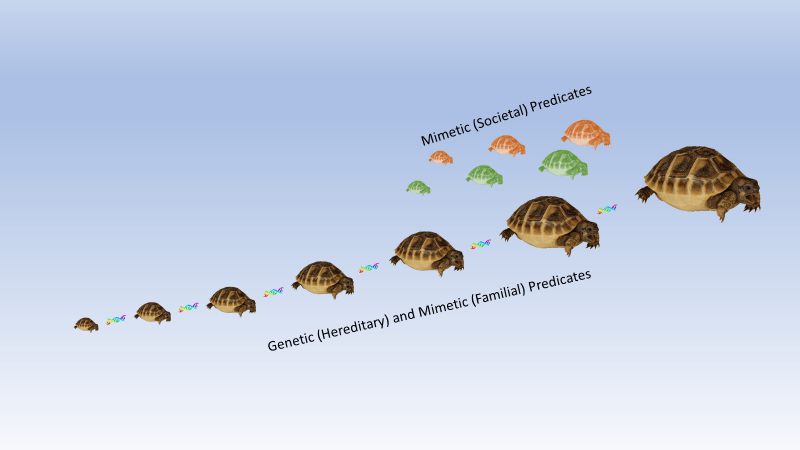
I’ve created an image with tortoises to make my point. There are actually two points I wish to make. The first point is to determine where the responsibility is inherited. This point is meant to articulate that the world can not be strictly deterministic and yet one can still not have significant agency. The second point is that culpability is asserted as a need, and acceptance of this assertion is the problem.
Testuditude
The image depicts an evolution of an agent, with time progressing from left to right. The tortoise on the right is a product of each of the recursive tortoises to its left. The image means to convey that each subsequent tortoise is a genetic and social and social product of each tortoise prior. Of course, this is obviously simplified, because tortoises require pairs, so feel free to imagine each precedent tortoise to represent a pair or feel free to add that level of diagrammatic complexity.
This is not meant to distinguish between nature and nurture. Instead, the claim is that one is a product of both of these. Moreover, as genetic, epigenetic, and mimetic influences are transmitted in family units, they also occur through social interaction and the environment, as represented by the orange and green tortoises.
…if one is a product of genetic and mimetic forces, how much agency remains for culpability?
The point here is that if one is a product of genetic and mimetic forces, how much agency remains for culpability? Each person is an emergent unit—autonomous, yes, and yet highly programmed.
If I programme a boobytrap to kill or maim any intruder, the boobytrap has no agency. I assert further, that the maker of that boobytrap has no more responsibility than the killing device.
The old hand grenade wired to a doorknob boobytrap trick
But who do we blame? you ask, and that’s precisely the problem. Asking questions doesn’t presume answers. This is a logical fallacy and cognitive bias. This heuristic leaves us with faulty jurisprudence systems. Humans seem hardwired, as it were, to blame. Humans need to believe in the notion of free will because they need to blame because they need to punish because vengeance is part of human nature to the extent there is human nature. There seems to be a propensity to frame everything as a causal relationship. Dennett calls this the Intentional stance. To borrow a from Dennett…
This instinctual response is the source in evolution of the invention of all the invisible elves, goblins, leprechauns, fairies, ogres, and gods that eventually evolve into God, the ultimate invisible intentional system.
Dennett, Daniel C.. Intuition Pumps And Other Tools for Thinking (p. 374). W. W. Norton & Company. Kindle Edition.
Fire Trap in Home Alone
Sins of the Fathers (and Mothers)
Let’s wrap this up with a sorites paradox. As I’ve already said, I agree with Dennett that the absolute aspect is unnecessary and undesired. The question remains how much agency™ does a person have once we account for the other factors? Is it closer to 90 per cent or 10 per cent? Apart from this, what is the threshold for culpability? Legal systems already have arbitrary (if not capricious) thresholds for this, whether mental capacity or age, which basically distils back to the realm of capacity.
I have no basis to even venture a guess, but that’s never stopped me before. I’d argue that the agency is closer to zero than to one hundred per cent of the total, and I’d propose that 70 per cent feels like a reasonable threshold.
I could have sworn I’d posted a position on this after I read Robert Sapolsky’s Behave. Perhaps it’s never made it out of drafts.
In closing, I don’t think we need to settle the question of determinism versus free will to recognise that even without strict determinism, personal agency is still severely limited, and yet as our political systems presume a level of rationality that is not apparent, so do legal systems presume a level of agency not present.
A social connection posted a piece on Humberto Maturana’s idea of “aesthetic seduction”. I found it interesting, so I wanted to understand more. Performing a Google search, I landed on The Edge, where I found an interesting comment by Dan Dennett. I share it in its entirety.
Philosopher; Austin B. Fletcher Professor of Philosophy, Co-Director, Center for Cognitive Studies, Tufts University; Author, From Bacteria to Bach and Back
Post hoc ergo propter hoc! “After this, therefore because of this.” Francisco Varela is a very smart man who, out of a certain generosity of spirit, thinks he gets his ideas from Buddhism. I’d like him to delete the references to Buddhist epistemology in his writings. His scientific work is very important, and so are the conclusions we can draw from the work. Buddhist thinking has nothing to do with it, and bringing it in only clouds the real issues.
There are striking parallels between Francisco’s “Emergent Mind” and my “Joycean Machines.” Francisco and I have a lot in common. In fact, I spent three months at CREA, in Paris, with him in 1990, and during that time I wrote much of Consciousness Explained. Yet though Francisco and I are friends and colleagues, I’m in one sense his worst enemy, because he’s a revolutionary and I’m a reformer. He has the standard problem of any revolutionary: the establishment is — must be — nonreformable. All its thinking has to be discarded, and everything has to start from scratch.
We’re talking about the same issues, but I want to hold on to a great deal of what’s gone before and Francisco wants to discard it. He strains at making the traditional ways of looking at things too wrong.
Dennett’s response is a critique of Francisco Varela, which is not the part that interests me. What caught my eye is his distinction between revolutionary and reformer. And it dawned on me—perhaps re-dawned might be a better verb, or to illuminate or intensify, to shine a light.
I consider myself to be introspective, and times like these allow me to be self-critical. I view myself as a revolutionary as far as expectations go. This makes me impatient with little tolerance for the marginal changes that attendant with reformism.
Being a revolutionary doesn’t make one a Utopian—a common critique—, that one is seeking perfection. From my perspective, when things are so far off course or misaligned, incremental changes don’t seem to be enough.
Moreover, reform is a political misdirection tactic I am leery of. So, irrespective of core beliefs, I feel even a reformist should be wary of the tactic. In politics, sometimes new ideas arise that are not in concert with the prevailing orthodoxy but are building mass. The idea is to retain the status quo as much as possible. The tactic is to find the smallest least disruptive sliver and find a way to integrate it in a manner for the mass to diminish and to be able to claim concordance.
The first example that pops into my mind is the Affordable Care Act (AKA Obamacare) in the United States, which is not exactly affordable not all that caring, though it is a reformist act. Even the main alternative of Universal Single-Payer insurance wasn’t that revolutionary, making the delusion of the solution and the adopted approach all that much more disappointing.
Industrial and post-industrial countries have solved this problem, so it’s not revolutionary unless one considers being over a hundred years late to the party to be particularly impressive. Moreover, there are programmes in the United States, i.e. Medicare, that are ostensibly single-payer programmes. In fact, one approach suggested was to expand Medicare to include everyone. This was dubbed Medicare Part E.
What this exposes is that the Reform-Revolution debate is a sorites challenge. The reformers consider the Medicare Part E proposal to be radical or revolutionary whilst I viewed it as a couple more millimetres away from the original Obamacare promises. Since the status quo started from such a limited position, when they ended up with is a milquetoast implementation.
To me, the debate is about paradigm shift versus glacial change. As for me, when I regard the battle between the Democrats and Republicans in the United States, I am not satisfied with any solution that sees these parties still standing post-solution. As a revolutionary thinker, I don’t need to toss out the proverbial baby with the bathwater, but let’s lose the bathwater and at least the sieve of a tab. Of course, I argue that the direction the so-called Enlightenment has taken the Western world, which is different to the argument made by prior traditionalists, so I can see a lot of room for change—revolutionary change. In the case of implementing Enlightenment beliefs, they took the idea of revolution a bit more literally than was perhaps necessary, but since it was more about a power grab than some broader promise of freedom, I suppose it was necessary. Meet the new bosses, same as the old boss.
“Equality of rights under the law shall not be denied or abridged by the United States or by any state on account of sex.”
The United States doesn’t constitutionally protect women. This is where reformism gets you. Per Wikipedia,
The Equal Rights Amendment (ERA) is a proposed amendment to the United States Constitution designed to guarantee equal legal rights for all American citizens regardless of sex. Proponents assert it would end legal distinctions between men and women in matters of divorce, property, employment, and other matters. The first version of an ERA was written by Alice Paul and Crystal Eastman and introduced in Congress in December 1923.
Wikipedia — Equal Rights Amendment
If you read 1923 and wonder if that’s a typo, it’s not. It’s been almost 100 years and women still have no guarantee of equal rights. Women had only been granted voting rights with the ratification of the 19th Amendment to the Constitution on August 18, 1920.
For a country founded on the principle that all people are created equal, this feels like it should be considered to be a redundant act…
My bad, the US Declaration of Independence reads “We hold these truths to be self-evident, that all men are created equal, that they are endowed by their Creator with certain unalienable Rights, that among these are Life, Liberty and the pursuit of Happiness”. This is just men. And when this was written BIPOC did not fully qualify as men. Reformists have almost got that sorted out by now right? 1776 seems like almost yesterday. Change comes slowly.
By now, I’m rambling semi-coherently, so I’ll close this down. Keep in mind the foundation of your interlocutor. Is s/he a reformist or a revolutionary? Determine where on the scale s/he falls. You might save yourself a lot of time. Time Is on My Side is only a song not a recipe for living.


















 Philosophics