
More precisely, I need less sleep and longer days – preferably twice as long. I’ve been writing almost non-stop for the better part of a week: fourteen- to sixteen-hour days, fuelled by irritation and the stubborn belief that if I just keep reading, something will finally click into place.
I’m not complaining. This is a virtuous cycle.
Reading leads to writing. Writing demands more reading. Eventually, the loop closes into something that looks suspiciously like progress.
Still, there’s a bottleneck.
Because some of this work – the work I’m most excited about – I’m deliberately not publishing yet. Journals, bless their glacial hearts, don’t much care for prior publication. So ideas sit in limbo for six to eighteen months, locked in a room like argumentative houseplants, slowly growing sideways.
From the perspective of someone who thinks in public, this is maddening.
Now add AI to the mix.
This is where things get dangerous.
I’ll feed ChatGPT a thesis, a skeletal structure, notes, and references. I ask what I’m missing. It obliges – often helpfully – by pointing me toward adjacent thinkers and relevant literature, complete with page numbers. From there, I verify, hunt down the sources, skim, read, discard, or integrate.
And every so often, I stumble across something that makes me swear out loud.
This week, it was Bernard Williams.

I’ve cited Ethics and the Limits of Philosophy before. But this time, I actually sat down and read it properly. Which immediately prompted the thought:
Why didn’t I read this sooner?
Williams dismantles moral objectivity with the calm precision of someone who knows the Enlightenment project has already lost – he just hasn’t told everyone yet. Thick and thin moral concepts, locality, non-extensibility, the collapse of universal moral reason at scale – yes, yes, yes. He published this in 1985. Fine. I’ll survive.
But then I went further.
Williams shows that morality fails between people at scale.
I argue that it fails within a single person over time.
That became my second paper.
And this is where things went off the rails.
Because in the course of writing that paper, I dipped into Hart’s The Concept of Law and Endicott’s Vagueness in Law. These are not fringe polemics. These are law textbooks. For law students. People allegedly trained to parse language for a living.


And what I found was… astonishing.
Let me paraphrase the admissions:
First:

Endicott: “By upsetting the standard view of adjudication, the book reaches conclusions that some people find horrible: when the law is vague, judicial decision- making will in some cases be unconstrained by the law. It is impossible in principle for judges always to treat like cases alike. Predictability in the law is to some extent unattainable. Moreover, I argue in Chapter 9,2 that vagueness cannot be eliminated from law. These conclusions might seem to imply that the rule of law is, at least to some extent, conceptually impossible.”
Then:
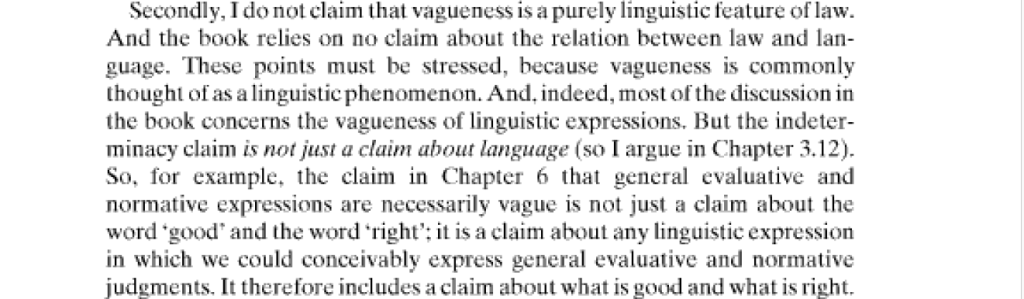
Endicott: “Secondly, I do not claim that vagueness is a purely linguistic feature of law. And the book relies on no claim about the relation between law and language. These points must be stressed, because vagueness is commonly thought of as a linguistic phenomenon. And. indeed, most of the discussion in the book concerns the vagueness of linguistic expressions. But the indeterminacy claim is not just a claim about language (so I argue in Chapter 3.12). So. for example, the claim in Chapter 6 that general evaluative and normative expressions are necessarily vague is not just a claim about the word ‘good’ and the word ‘right1: it is a claim about any linguistic expression in which we could conceivably express general evaluative and normative judgments. It therefore includes a claim about what is good and what is right.”
Then, almost casually:
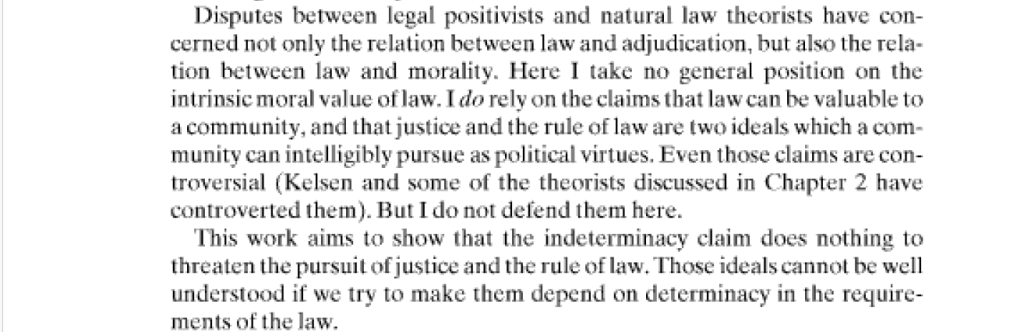
Endicott: “Disputes between legal positivists and natural law theorists have concerned not only the relation between law and adjudication, but also the relation between law and morality. Here I take no general position on the intrinsic moral value of law. I do rely on the claims that law can be valuable to a community, and that justice and the rule of law are two ideals which a com- munity can intelligibly pursue as political virtues. Even those claims are controversial (Kelsen and some of the theorists discussed in Chapter 2 have controverted them ). But I do not defend them here. This work aims to show that the indeterminacy claim does nothing to threaten the pursuit of justice and the rule of law. Those ideals cannot be well understood if we try to make them depend on determinacy in the requirements of the law.”
Say what?
Read together – not even uncharitably – the message is clear:
Law is indeterminate.
Indeterminacy is unavoidable.
And whether law is good, just, or valuable is… optional.
The subtext isn’t even hiding.
Law is a power structure first.
If it happens to align with justice, fairness, or communal value, well, lovely. A bonus. Champagne all round.
This does not sit well with a sceptical cynic.
What really broke me, though, wasn’t the argument itself. Philosophers make grim claims all the time. What broke me was the silence around it.
How does this pass under the radar?
How do cohorts of law students – drilled in textual analysis, trained to read footnotes like tea leaves – not trip over this elephant stampede? How do they graduate believing they’re upholding inalienable rights, rather than participating in a managed system of coercion that occasionally behaves itself?
Self-preservation, I suppose.
Wilful ignorance.
Professional cosplay.
I’ve seen this before.
As an economist, ask the wrong foundational question, and you’re instantly radioactive. Persona non grata. Careers don’t end with explosions — they end with polite silence and no invitations.
I probably should have committed to heterodox philosophy from the start.
Or stayed a musician.
I remember leaving graduate school, putting on a suit, and feeling like I was wearing a costume. Cosplay, before we had the word. “Business professional” as a role, not an identity.
I’ve always felt intellectually capable of doing whatever I set out to do. My temperament, however, has never agreed to play along.
Which is perhaps why diagnosing ontologies comes so naturally. Once you see the scaffolding, you can’t unsee it – whether it’s metaphysics, jurisprudence, or a corporate department pretending it has a mission.
Then David Graeber came along with Bullshit Jobs, and I remember thinking:
Thank God. It’s not just me.
So yes. I need a break.
I need sleep.
I need silence.
I need to stop reading law books that accidentally admit they’re about power and then act surprised when someone notices.
Mostly, I need to type:
WTAF?
And then go outside.



 Philosophics