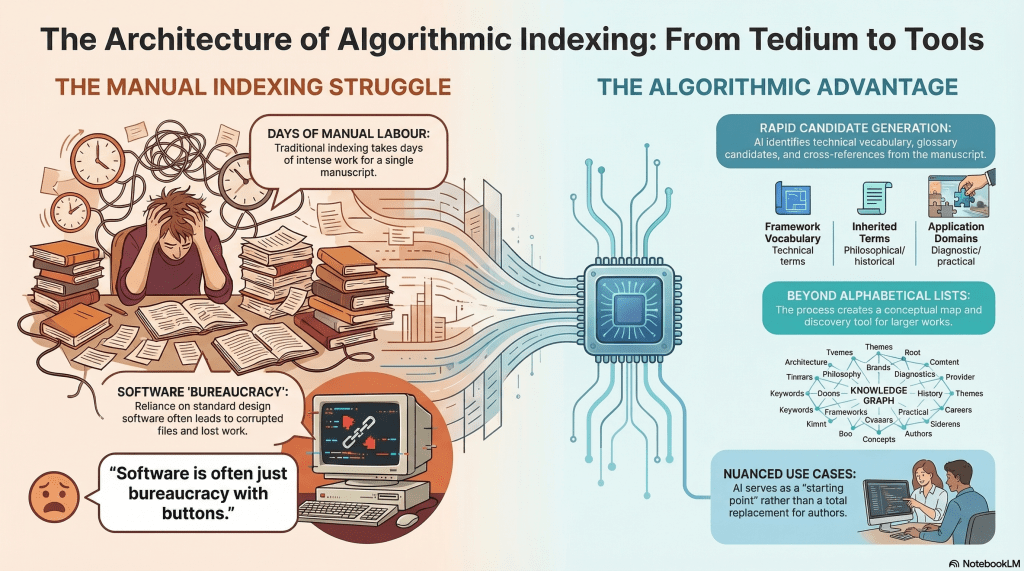
The Indexing Abyss: A Cautionary Tale in Eight Chapters

There, I said it.

I’m almost finished with A Language Insufficiency Hypothesis, the book I’ve been labouring over for what feels like the gestation period of a particularly reluctant elephant. To be clear: the manuscript is done. Written. Edited. Blessed. But there remains one final circle of publishing hell—the index.

Now, if you’re wondering how motivated I am to return to indexing, consider this: I’m writing this blog post instead. If that doesn’t scream avoidance with an airhorn, nothing will.

Audio: NotebookLM podcast on this topic.

I began indexing over a month ago. I made it through two chapters of eight, then promptly wandered off to write a couple of novellas. As you do. One started as a short story—famous last words—and evolved into a novella. The muse struck again. Another “short story” appeared, and like an unattended sourdough starter, it fermented into a 15,000-word novelette. Apparently, I write short stories the way Americans pour wine: unintentionally generous.

With several unpublished manuscripts loitering on my hard drive like unemployed theatre majors, I figured it was time to release one into the wild. So I did. I published the novelette to Kindle, and just today, the paperback proof landed in my postbox like a smug little trophy.

And then, because I’m an unrepentant completionist (or a masochist—jury’s out), I thought: why not release the novella too? I’ve been told novellas and novelettes are unpopular due to “perceived value.” Apparently, people would rather buy a pound of gristle than 200 grams of sirloin. And yet, in the same breath, they claim no one has time for long books anymore. Perhaps these are different tribes of illiterates. I suppose we’ll find out.

Let’s talk logistics. Writing a book is only the beginning—and frankly, it’s the easy part. Fingers to keyboard, ideas to page. Done. I use Word, like most tragically conventional authors. Planning? Minimal. These were short stories, remember? That was the plan.

Next comes layout. Enter Adobe InDesign—because once you’ve seen what Word does to complex layouts, you never go back. Export to PDF, pray to the typographic gods, and move on.

Then there’s the cover. I lean on Illustrator and Photoshop. Photoshop is familiar, like a worn-in shoe; Illustrator is the smug cousin who turns up late but saves the day with scalable vectors. This time, I used Illustrator for the cover—lesson learnt from past pixelation traumas. Hardback to paperback conversion? A breeze when your artwork isn’t made of crayon scribbles and hope.

Covers, in case you’ve never assembled one, are ridiculous. Front. Back. Spine. Optional dust jacket if you’re feeling fancy (I wasn’t). You need titles, subtitles, your name in a legible font, and let’s not forget the barcode, which you will place correctly on the first attempt exactly never.

Unlike my first novel, where I enlisted someone with a proper design eye to handle the cover text, this time I went full minimalist. Think Scandinavian furniture catalogue meets existential despair. Classy.

Once the cover and interior are done, it’s time to wrestle with the publishing platforms. Everything is automated these days—provided you follow their arcane formatting commandments, avoid forbidden fonts, and offer up your soul. Submitting each book takes about an hour, not including the time lost choosing a price that balances “undervalued labour” and “won’t scare away cheapskates.”

Want a Kindle version? That’s another workflow entirely, full of tortured formatting, broken line breaks, and wondering why your chapter headings are now in Wingdings. Audiobooks? That’s a whole other circus, with its own animals and ringmasters. Honestly, it’s no wonder authors hire publishers. Or develop drinking problems.

But I’m stubborn. Which brings us full circle.

I’ve now got two books heading for daylight, a few more waiting in the wings, and one bloody non-fiction beast that won’t see release until I finish the damn index. No pseudonym this time. No hiding. Just me, owning my sins and hoping the final product lands somewhere between “insightful” and “mercifully short.”

So yes, life may well be a journey. But indexing is the bit where the satnav breaks, the road floods, and the boot falls off the car. Give me the destination any day. The journey can fuck right off.

Language Insufficiency, Rev 3

I’m edging ever closer to finishing my book on the Language Insufficiency Hypothesis. It’s now in its third pass—a mostly subtractive process of streamlining, consolidating, and hacking away at redundancies. The front matter, of course, demands just as much attention, starting with the Preface.

The opening anecdote—a true yet apocryphal gem—dates back to 2018, which is evidence of just how long I’ve been chewing on this idea. It involves a divorce court judge, a dose of linguistic ambiguity, and my ongoing scepticism about the utility of language in complex, interpretative domains.

At the time, my ex-wife’s lawyer was petitioning the court to restrict me from spending any money outside our marriage. This included a demand for recompense for any funds already spent. I was asked, point-blank: Had I given another woman a gift?

Seeking clarity, I asked the judge to define gift. The response was less than amused—a glare, a sneer, but no definition. Left to my own devices, I answered no, relying on my personal definition: something given with no expectation of return or favour. My reasoning, then as now, stemmed from a deep mistrust of altruism.

The court, however, didn’t share my philosophical detours. The injunction came down: I was not to spend any money outside the marital arrangement. Straightforward? Hardly. At the time, I was also in a rock band and often brought meals for the group. Was buying Chipotle for the band now prohibited?

The judge’s response dripped with disdain. Of course, that wasn’t the intent, they said, but the language of the injunction was deliberately broad—ambiguous enough to cover whatever they deemed inappropriate. The phrase don’t spend money on romantic interests would have sufficed, but clarity seemed to be a liability. Instead, the court opted for what I call the Justice Stewart Doctrine of Legal Ambiguity: I know it when I see it.

Unsurprisingly, the marriage ended. My ex-wife and I, however, remain close; our separation in 2018 was final, but our friendship persists. Discussing my book recently, I mentioned this story, and she told me something new: her lawyer had confided that the judge disliked me, finding me smug.

This little revelation cemented something I’d already suspected: power relations, in the Foucauldian sense, pervade even our most banal disputes. It’s why Foucault makes a cameo in the book alongside Nietzsche, Wittgenstein, Saussure, Derrida, Borges, and even Gödel.

This anecdote is just one straw on the poor camel’s back of my linguistic grievances, a life filled with moments where language’s insufficiency has revealed itself. And yet, I found few others voicing my position. Hence, a book.

I aim to self-publish in early 2025—get it off my chest and into the world. Maybe then I can stop wittering on about it. Or, more likely, I won’t.