Watching Sam Harris ruminate on the nature of political lies (still believing, poor lamb, that reason might one day triumph) reminds me of something more sinister: lies today are not attempts at persuasion. They are shibboleths — tribal passwords, loyalty oaths, secret handshakes performed in the broad light of day.
Video: Sam Harris tells us why Trump and his ilk lie.
Forget “alternative facts.” That charming euphemism was merely a decoy, a jangling set of keys to distract the infantile media. The real game was always deeper: strategic distortion, the deliberate blurring of perception not to deceive the outsider, but to identify the insider.
Audio: NotebookLM podcast on this topic.
When Trump — or any other post-truth demagogue — proclaims that penguins are, in fact, highly trained alien operatives from the Andromeda galaxy, the objective is not persuasion. The point is to force a choice: will you, standing before this glistening absurdity, blink and retreat into reason, stammering something about ornithology… Or will you step forward, clasp the hand of madness, and mutter, ‘Yes, my liege, the penguins have been among us all along’?
Those who demur, those who scoff or gasp or say ‘You’re an idiot,”’have failed the loyalty test. They have outed themselves as enemy combatants in the epistemic war. Truth, in this brave new world, is not a destination; it is an allegiance. To speak honestly is to wage rebellion.
Orwell, who tried very hard to warn us, understood this dynamic well: the real triumph of Big Brother was not merely to compel you to lie but to compel you to believe the lie. Koestler, another battered prophet of the age, charted how political movements sink into ritualistic unreason, demanding not conviction but performance. Swift, for his part, knew it was all hilarious if you tilted your head just right.
The bigger the lie, the better the shibboleth. Claim that two and two make five, and you catch out the weak-willed rationalists. Claim that penguins are extraterrestrials, and you find the truly devoted, the ones willing to build altars from ice and sacrifice to their feathery overlords.
It’s no accident that modern political theatre resembles a deranged initiation ritual. Each day brings a new absurdity, a fresh madness to affirm: ‘Men can become women by declaration alone!” “Billionaires are victims of systemic oppression!’ ‘The penguins are amongst us, plotting!’ Each claim a little more grotesque than the last, each compliance a little more degrading, a little more irreversible.
And oh, how eagerly the initiates rush forward! Clap for the penguins, or be cast out into the howling wilderness! Better to bend the knee to absurdity than be marked as an unbeliever. Better to humiliate yourself publicly than to admit that the Emperor’s penguin suit is just a costume.
Meanwhile, the opposition — earnest, naive — keeps trying to argue, to rebut, to point out that penguins are terrestrial flightless birds. How quaint. How pathetic. They do not understand that the moment they say, “You’re an idiot,” they’ve broken the spell, declared themselves apostates, and rendered themselves politically irrelevant.
The shibboleth, once uttered, divides the world cleanly: the believers, who will say anything, do anything, believe anything, provided it marks them safe from exile; and the infidels, who cling stupidly to reality.
The future belongs, not to the true, but to the loyal. Not to the rational, but to the ritualistic. The more extravagant the lie, the greater the proof of your faith.
So raise a glass to the penguins, ye of faint heart, and prepare your soul for abasement. Or stand firm, if you dare, and be prepared to be eaten alive by those who traded reason for the rapture of belonging.
After all, in the land of the blind, the one-eyed man is not king. He’s a heretic.
Making video content for even the simplest of concepts is time-consuming, but I wanted to create some visual content. Even though this material is hardly controversial, I feel it is important to set the stage for more advanced conversations.
Video: Free Will Scepticism: Determinism, Indeterminism, and Luck
I am getting better at understanding how the video editor works, so subsequent videos should be of higher quality. As I use free repurposed video content, I am forced to accept what’s available. In plenty of cases, more apt content is available from Adobe or iStock, but I can’t justify purchasing content at this time—especially given that the channel isn’t even monetised. Patience.
Follows is the transcript I used as a guide.
Free Will Scepticism. Determinism, Indeterminism & Luck
[REDACTED]
In this segment of free will scepticism, I talk about what free will is, why it’s important, and why it creates challenges that lead to a debate that’s lasted millennia.
Once we’ve established a foundation, we’ll look at the nemesis of free will that is determinism and its attendant nuances—indeterminism and luck.
As we unravel this problem, we’ll evaluate the relationship between these and whether these competing concepts can coexist.
In future segments, I intend to dig deeper into the question of free will as it relates to human agency and moral responsibility.
Defining Free Will
A good starting point is to define our terms. As we’ll discover, a fundamental challenge in the free will debate is that there is no common, agreed-upon definition, so let’s at least put some on the table.
A quick Google search yields these two definitions.
the apparent human ability to freely and consciously make choices that are not externally determined
the doctrine that such human freedom of choice is not illusory Let’s break down the first one by touching on the terms. This is an ability. No controversy here. Choices are the focus of this ability, and this ability is limited to humans. Not everyone limits the notion of free will to humans. In general, the reason free will gets so much attention is in relation to moral choice. As we don’t generally impose morality on non-human animals, we can live with this for now.
Note that this definition concedes that this is just an apparent human ability. This is because some people believe that if free will exists at all, it is just an illusion.
This ability. I’ll drop the ‘apparent’ qualifier so I don’t come across like an attorney and their ‘alleged’ perpetrator. This ability needs to be made freely and consciously. Free means without restriction, and consciously means with conscious intent. The definition further qualifies the free and conscious choice-making by stating that these choices are not externally determined. A person cannot be under a spell, hypnotised, or driven by unconscious intents. We’ll eventually see that disagreement centres around each of these terms, freely, conscious, and externally determined.
Stanford Encyclopaedia of Philosophy, an excellent online resource, defines free will as ‘a philosophical term of art for a particular sort of capacity of rational agents to choose a course of action from among various alternatives’. The ability to freely make choices is a common thread for all of these.
Another way to think about free will is to ask if you could have chosen otherwise. This is a thought experiment, and we’ll spend more time on this later. If you could turn back the clock and rerun the scenario, could you have chosen otherwise. As Jerry Coyne put it, ‘if you could rerun the tape of your life up to the moment you make a choice, with every aspect of the universe configured identically, free will means that your choice could have been different’. Let’s work through a simple scenario with no moral implications. All of the events of your life have led up to this moment. A server asks, tea or coffee. You choose tea. Black or lemon—or cream? Let’s not get ahead of ourselves. Let’s re-run the scenario. Everything leading up to this server asking for your order is the same—the same seat at the same table, in the same restaurant, the same server. Even the same jelly stain on the curtain and the same blue Buick parked outside your window. And the same parent trying to quiet her unruly child. You get the idea. Everything until now has played out the same. Last time you ordered tea. Do you possess the free will to order coffee this time around? We don’t need to answer this question quite yet. Keep whatever idea you have and we can compare it against the competing perspectives.
You might be thinking, so what? Who cares? Why is free will so important?
Free will is not just some abstract philosophical concept. Philosophy gets accused of pondering topics with no application in the real world. What is the sound of one hand clapping sort of fare.
Free will is at the centre of human agency and autonomy. The only reason it makes sense to praise or blame someone is because they could have done otherwise. We might praise a robot that was programmed to rescue people from fires. Even if we marvelled at the achievement of the robot, we’d more likely praise the programmer or the operator over the robot.
Likely more important than praise is blame. Humans’ propensity for blame could be its own series, so let’s just consider the notion idiomatically. If a person is remotely controlling a robot and steers it into your table, spilling your tea, you may be miffed at the robot, but your blame will be aimed at the one who’s holding the remote controller.
After blame comes punishment, or reward in the case of praise. This is another subdiscipline in its own right, so let’s continue.
Many people just presume that free will exists, so where are the challenges? First, the definition of free will is unstable, and it has drifted over time. Sometimes this has been innocent enough whilst at other times the definition has been amended to suit an argument. Sort of moving the goal posts. So, there’s no standard definition. This means that I can accept the notion under one definition and reject it under another. This hardly makes for fruitful debate.
Related to these first two is that for some people, the concept is reduced to something so narrow, so laser-focused, that it doesn’t seem to matter in the real world. Daniel Dennett has said that he’d be willing to concede that one doesn’t have free will except in matters of decisions in the order of ‘one cube of sugar or two in your tea’ or ‘taking the lavender blouse over the lilac one’. If you contend that this is the limiting boundary for free will, sure. You’ve got free will, for what it’s worth.
Still others say that free will is nothing more than an illusion. That a person perceives having free will is akin to perceiving that the sun rises in the East. We know this not to be true, and yet it appears to be true. We even commit this faulty observation to language, and it’s difficult not to envisage it differently.
The strongest position against free will comes from the Impossibilists, who hold unsurprisingly, the belief that free will is impossible given what we know about physical laws and the universe. Galen Strawson is likely the most notable of these people.
Determinism
Contrary to free will is Determinism. Defined, Determinism is the doctrine that all events, including human action, are ultimately determined by causes external to the will.
Ostensibly, this is a strong belief in cause and effect. That every event is caused by a prior event. The implication is that if one were to turn back time to the Big Bang and let history run again, everything down to the smallest atomic movement would run the same course of events. Absolutely nothing would change. This includes any thoughts and decisions. Unchanged.
Given this worldview, some philosophers have taken determinism to imply that individual human beings have no free will and cannot be held morally responsible for their actions.
Without going too deep, Determinism can be a view adopted from a sectarian or secular perspective. The sectarian narrative is that God created the natural laws and set the universe in motion. The secular vantage is that there are physical laws, and the big bang set the universe in motion. These days, not many people hold this view. Indeterminism is the reason.
Indeterminism
Indeterminism is another idea cursed with multiple definitions. The name originated as a counterargument to Determinism, hence the ‘in‘ prefix in the name. Not determinism. Indeterminism says that deliberate choice and actions are not determined by or predictable from antecedent causes, or that although there may be deterministic behaviours in the universe, not every event has a cause.
I’d like to qualify ‘not every event has a cause’ to ‘not every event has a known cause’ or some events have probabilistic causes, hence indeterminate. There is a bit of overlap here with the notion of luck, and we’ll get to that presently.
Our knowledge of physics and the advent of quantum mechanics has put hard determinism out of favour. As we saw, under strict determinism, if we turned back time, the future would always unfold identically. Think of this as a film strip or a video. No matter how many times you replay it the events manifest the same way. You can warn the camper not to go down into the cellar alone, but every time, she will. You can almost think of this as a sort of fate, although one must be careful to note that rewinding and replaying to the parts we’ve already seen does not mean that we can predict what we haven’t.
Quantum physics notes that there are many events that are stochastic or probabilistic. So even if you rewound and played it again, it would be like the girl flipping a coin before opening the cellar door—or I suppose the director. Heads, she goes down. Tails, she remains up, or she gets a friend.
The less strict version of Indeterminism doesn’t say that nothing is determined. Rather, that there are enough probabilistic events that we can’t claim to know what’s going to happen next.
Luck
Then there’s luck. Luck is also indeterministic, but it tries to clarify some cases. By definition, luck is success or failure apparently brought by chance rather than through one’s own actions. If you flip a fair coin or throw a fair die or pull the handle on a slot machine, you may win or lose, but this outcome had nothing to do with you except that you were there at that moment. But there is more to it than this because a strict Determinist might claim that the outcome was determined by the state of molecules in history, that if you reran history, it would unfold the same way.
Apart from the luck that we tend to think of in gambling—good luck and bad—, there is the notion of moral luck, that is treating people as objects of moral judgement even when what they do depends on factors out of their control.
Not all luck is created equal, so let’s look at the various flavours of luck. Most of these were articulated by Thomas Nagel.
Resultant Luck
Resultant luck is the way things turn out. This notion evaluates luck in reverse. It involves what is known as survivorship bias.
I’ll share a true story. An acquaintance of mine got married and took a honeymoon in Jamaica. On holiday, the couple ate some seafood. His wife became sick and was hospitalised. There she died. One can imagine a story with a happier ending, where the couple took holiday and won a large cash prize in a casino, again a situation that could not have happened unless they had happened to be there. In the first case, one might say she had bad luck. In the second case, her luck was good.
Circumstantial Luck
Circumstantial luck is the circumstance one finds oneself in. You had no control over how you got to a certain place, but because you got there, you are faced with a choice. The gist of this is that the choice would not have been given, so you would never have made it.
Perhaps, expecting you to be out, a burglar enters your home one evening and you confront him and he shoots you (or you shoot him; it doesn’t matter). Maybe you were driving to someplace and another vehicle crashes into yours, totalling it. This is circumstantial. You had no intention of getting into an accident. Had you not been driving, this could not have happened. Perhaps, because of the accident, you won a lawsuit that yielded you a lot of money; perhaps, your back was irreparably damaged. Circumstantial luck.
Constitutive Luck
Constitutive luck relates to who one is or their traits and dispositions. Think of this as character. Some people are ‘born’ with a persuasive disposition. Some are born to excel at football or maths. Some are The Rain Man. This is the genetic lottery. Perhaps you want to be a famous singer. Only you can’t sing. And maybe you can sing, but you lack charisma.
Billionaire Warren Buffett readily concedes that he would not likely be a billionaire if he happened to be born in India rather than the United States. This is constitutive luck.
Present Luck
Present luck is about luck at or around the moment of a putatively free action or decision point. This is a term used by Levy, borrowed from Mele. At any point in time, you are who you are and where you are as a matter of luck. You were born in a place at a time in history into a family. Heidegger called this ‘thrownness’. A person is thrown into this world and has to survive or not on their own terms. In any case, this family moulded you and schooled you with whatever constraints that they may have had: money, class, access, location. All the usual suspects. You interacted with the kids who were available. You got whatever teachers you got, and on and on. I think you get it. None of this is within your control. Examples I think of are musical acts, bands like The Beatles, Korn, U2, and so many others that are comprised entirely or largely of friends. They just happened to be born in the same general time and vicinity. I imagine if either of these were different, they wouldn’t have manifested the same way. Imagine Mozart being born in the 21st century. Perhaps he’d be a YouTube star. Who knows?
Causal Luck
Causal luck is how one is determined by antecedent circumstances. This is the type of luck most closely aligned with free will and determinism. Simply put, it says that everything that preceded you is outside of your control as is everything leading up to what you have become. Causal luck is about the directional relationship between cause and effect.
For the record, some view causal luck as redundant to the combination of constitutive and circumstantial luck. I think that’s a fair charge, but let’s continue and see how these concepts play together.
At the highest level, there are two competing perspectives. Free will and determinism are either incompatible or compatible. Let’s begin with incompatibilism.
Incompatibilism
As it would seem, this view holds that free will and determinism are mutually exclusive. This holds for indeterminism as well. One cannot simultaneously hold the view that everything is determined, and that one can still manage to have free will in this determined universe.
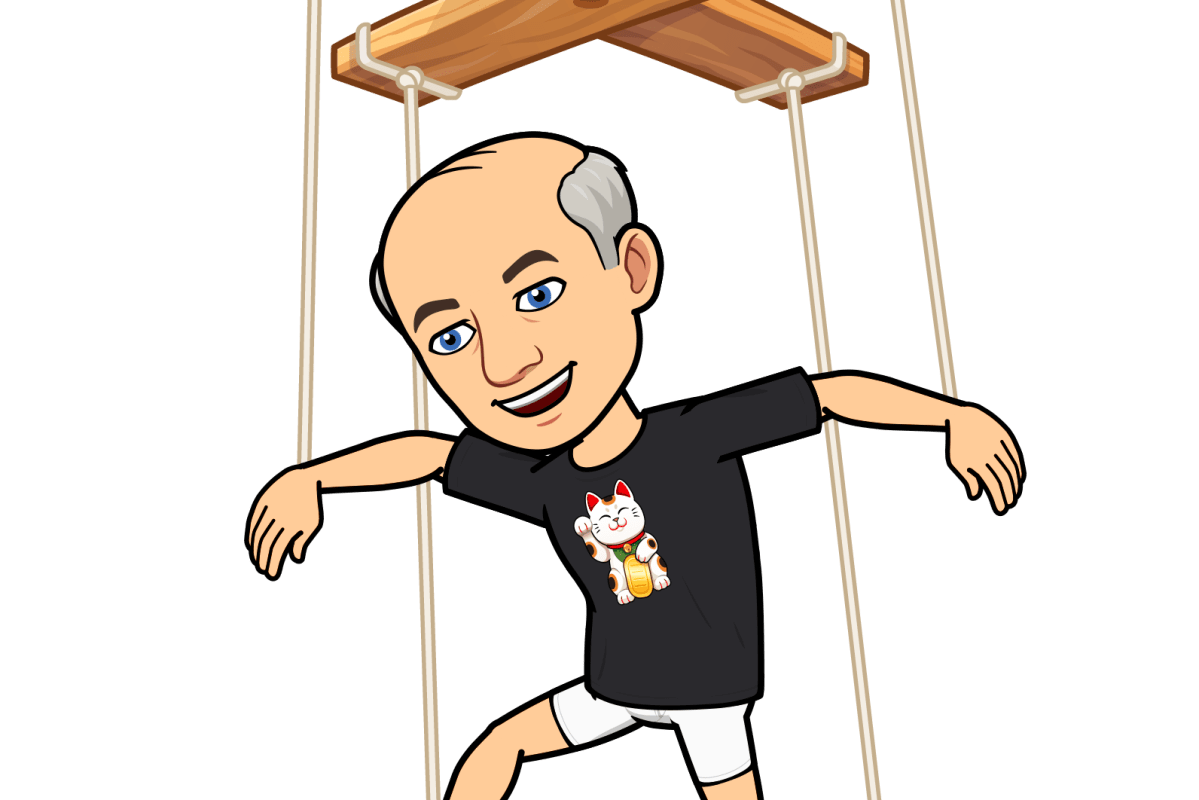
A puppet is free as long as he loves his strings
SAM HARRIS
Sam Harris famously wrote, ‘a puppet is free as long as he loves his strings’. Harris is a neuroscientist and free will sceptic, who believes that free will is an illusion. And I was determined to not let this image go to waste.
Compatibilism
Finally, we have compatibilism, where the belief is that free will and determinism can coexist—and do. There are two basic reasons this might be possible: metaphysics or emergence.
Metaphysics
I’ll let you know that I find the metaphysical argument to be weak tea. The argument is that maybe there is a god or something not bound by the constraints of our universe, who can put ideas into your brain, thus manipulating your decision. You were going to order tea, but this intervention led you to order coffee. I think that this perspective falls on its face right out of the gate. If some force is controlling you, the resulting actions may not have been predictably determined, but neither are they caused by you. In this scenario, this force might as well be the person controlling the robot to spill your tea.
Emergence
Then there’s emergence. Quickly, emergence is the notion that one can combine two or more elements with the outcome being a substance with different ‘emergent’ properties. An example most people are familiar with is the combining of hydrogen and oxygen to produce water. Two Hs plus an O creates H20. Hydrogen and Oxygen are both gasses, but water is a liquid with a further emergent property of being wet.
The argument is that this free will occurs independently of all the inputs and processes. If this were true, then free will and determinism could coexist. There is no evidence of this, and I’ll just leave it here. I intend to add to this by reviewing articles for and against free will and the compatibilist position.
Do you believe you have free will? If so, why. Are you a determinist or an indeterminist? Are you a compatibilist or an incompatibilist?


 Philosophics