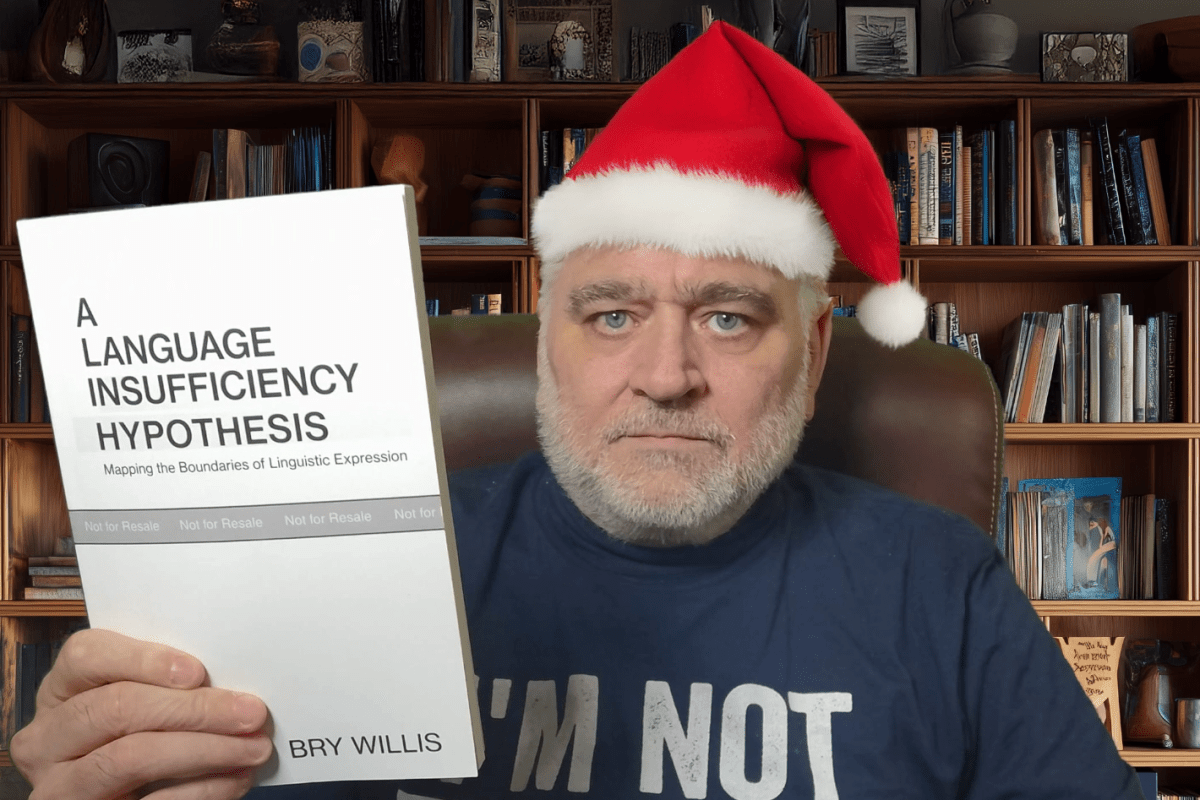
Happy Christmas.
I’m no fan of holidays. I neither enjoy nor celebrate Christmas. I’m acutely aware of its commercial excesses and its religious inheritance, two institutions I find, at best, tiresome and, at worst, actively corrosive. Whether that’s abhorrence or simple loathing is a distinction I’ll leave to braver souls.
Still, calendars exist whether one consents to them or not, and this piece happens to land today. If Christmas is your thing, by all means, have at it. Sincerely. Rituals matter to people, even when their metaphysics don’t survive inspection.
What follows is not a defence of the season, nor a seasonal moral. It’s a small human moment that happens to involve Santa, which is to say a costume, a script, and a public performance. What interests me is not the symbolism, but what happens when the performance yields just enough to allow someone else to be seen on their own terms. If nothing else, that feels like a tolerable use of the day.
What Legibility?
When I use the term legibility, it’s usually as a pejorative. It’s my shorthand for reductionism. For the way human beings are flattened into checkboxes, metrics, market segments, or moral exemplars so they can be processed efficiently by institutions that mistake simplification for understanding.
But legibility isn’t always a vice.
Most of us, I suspect, want to be legible. Just not in the ways we are usually offered. We want to be seen on our own terms, not translated into something more convenient for the viewer. That distinction matters.
In the video above, a deaf child meets Santa. Nothing grand happens. No lesson is announced. No slogan appears in the corner of the screen. Santa simply signs.
The effect is immediate. The child’s posture changes. Her attention sharpens. There’s a visible shift from polite endurance to recognition. She realises, in real time, that she does not need to be adapted for this encounter. The encounter has adapted to her. This is legibility done properly.
Not the synthetic legibility of television advertising, where difference is curated, sanitised, and arranged into a reassuring grid of representation. Not the kind that says, we see you, while carefully controlling what is allowed to be seen. That version of legibility is extraction. It takes difference and renders it harmless. Here, the legibility runs the other way.
Santa, already a performative role if ever there was one, doesn’t stop being performative. The costume remains. The ritual remains. But the performance bends. It accommodates. It listens. The artifice doesn’t collapse; it becomes porous.
I’m wary of words like authenticity. They’ve been overused to the point of meaninglessness. But I do think we recognise performatism when we see it. Not in the technical sense of speech acts, but in the everyday sense of personas that ring hollow, gestures that exist for the camera rather than the people involved. This doesn’t feel like that.
Of course, the child could already connect. Deaf people connect constantly. They persevere. They translate. They accommodate a world that rarely meets them halfway. Nothing here ‘grants’ her humanity. What changes is the tightness of the connexion.
The shared language acts as a verbal proxy, a narrowing of distance. You can see the moment it clicks. He speaks her language. Or rather, he speaks a language that already belongs to her, even if calling it ‘hers’ is technically imprecise. Mother tongue is a slippery phrase. Irony does some of the work here.
The point is not inclusion as spectacle.
It’s recognition without reduction.
Legibility, in this case, doesn’t make her smaller. It makes the interaction larger. And that, inconveniently for our systems and slogans, is what most people have been asking for all along.


 Philosophics