
I Am a Qualified Subjectivist. No, That Does Not Mean ‘Anything Goes’.
Make no mistake: I am a subjectivist. A qualified one. Not that kind of qualified – the qualification matters, but it’s rarely the part anyone listens to.

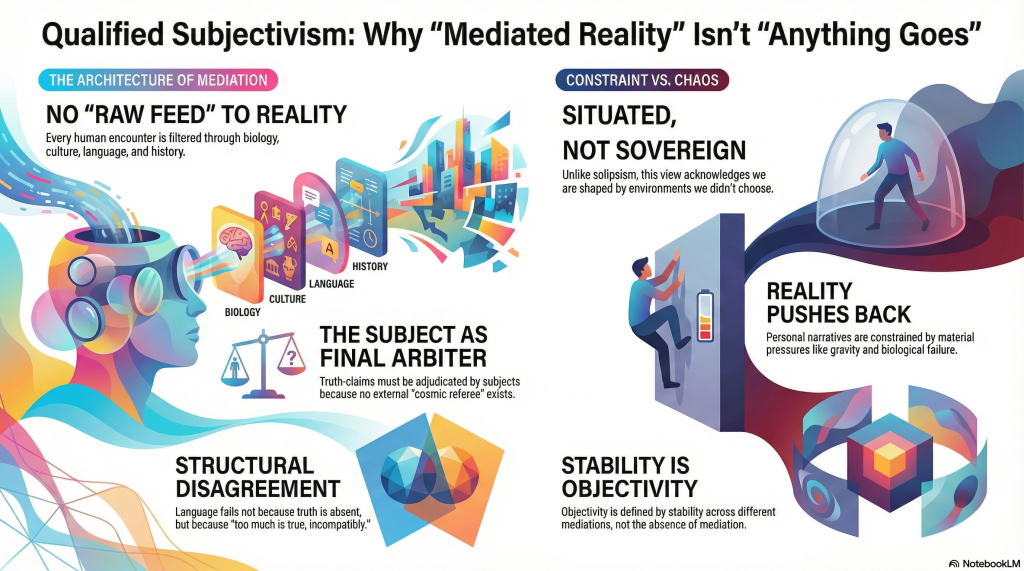
Here is the unglamorous starting point: all human encounters with the world are mediated. There is no raw feed. No unfiltered access. No metaphysical lead running directly from ‘reality’ into the human mind. Every encounter is processed through bodies, nervous systems, cultures, languages, technologies, institutions, and histories.
Whilst I discuss the specific architecture of this mediation at length in this preprint, here I will keep it simple.
If you are human, you do not encounter reality as such. You encounter it as processed. This is not controversial. What is controversial is admitting the obvious consequence: the subject is the final arbiter.
The Subject Is the Final Arbiter
Every account of truth, reality, meaning, value, or fact is ultimately adjudicated by a subject. Not because subjects are sovereign gods, but because there is literally no other place adjudication can occur.
Who, exactly, do critics imagine is doing the adjudicating instead? A neutral tribunal floating outside experience? A cosmic referee with a clipboard? A universal consciousness we all forgot to log into?
There is no one else.
This does not mean that truth is ‘whatever I feel like’. It means that truth-claims only ever arrive through a subject, even when they are heavily constrained by the world. And constraint matters. Reality pushes back. Environments resist. Bodies fail. Gravity does not care about your personal narrative.
Why This Is Not Solipsism
Solipsism says: only my mind exists. That is not my claim. My claim is almost boring by comparison: subjects are situated, not sovereign.
We are shaped by environments we did not choose and histories we did not write. Mediation does not eliminate reality; it is how reality arrives. Your beliefs are not free-floating inventions; they are formed under biological, social, and material pressure. Two people can be exposed to the same event and encounter it differently because the encounter is not the event itself – it is the event as mediated through a particular orientation.
Why Objectivity Keeps Sneaking Back In
At this point, someone usually says: ‘But surely some things are objectively true.’
Yes. And those truths are still encountered subjectively. The mistake is thinking that objectivity requires a ‘view from nowhere’. It doesn’t. It requires stability across mediations, not the elimination of mediation altogether. We treat some claims as objective because they hold up under variation, while others fracture immediately. But in all cases, the encounter still happens somewhere, to someone.
The Real Source of the Panic
The real anxiety here is not philosophical. It’s moral and political. People are terrified that if we give up the fantasy of unmediated access to universal truth, then legitimacy collapses and ‘anything goes’.
This is a category error born of wishful thinking. What actually collapses is the hope that semantic convergence is guaranteed. Once you accept that mediation is unavoidable, you are forced to confront a harder reality: disagreement is often structural, not corrigible. Language does not fail because nothing is true. Language fails because too much is true, incompatibly.
So Yes, I Am a Qualified Subjectivist
Interpretation only ever occurs through subjects. Subjects are always mediated. Mediation is always constrained. And constraint does not guarantee convergence.
That is the position. It is not radical, fashionable, or comforting. It is simply what remains once you stop pretending there is a god’s-eye view quietly underwriting your arguments. Discomfort is simply a reliable indicator that a fantasy has been disturbed.
Addendum: Geworfenheit and the Myth of the Neutral Subject
If all this sounds suspiciously familiar, that’s because it is. Heidegger had a word for it: Geworfenheit – usually translated as thrownness.
The idea is simple, and deeply irritating to anyone still hoping for a clean start. You do not enter the world as a neutral observer. You are thrown into it: into a body, a language, a culture, a history, a set of institutions, a moment you did not choose. You do not begin from nowhere and then acquire a perspective. You begin already situated, already oriented, already implicated.
This is not a poetic flourish. It is a structural claim about human existence.
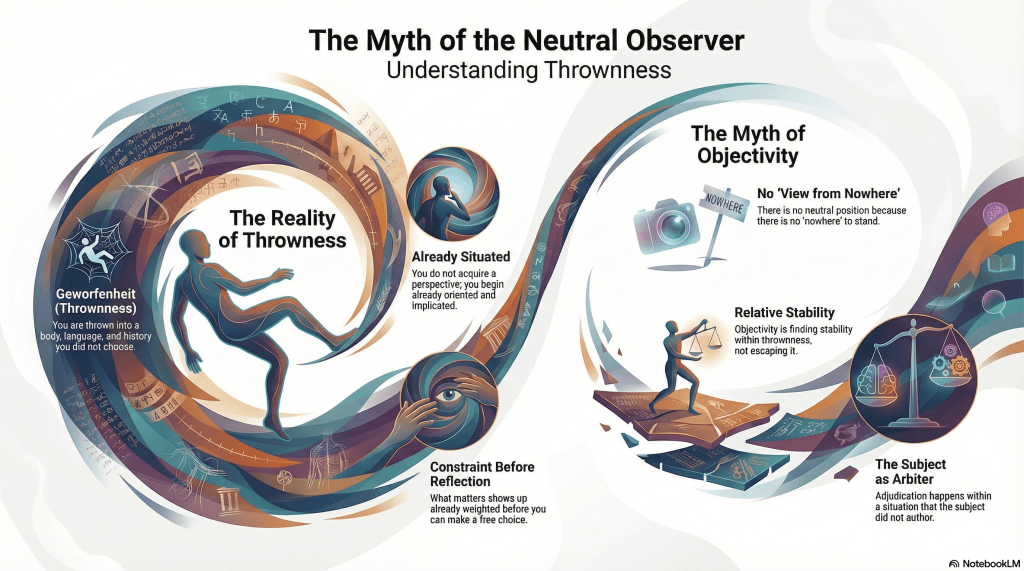
What my qualified subjectivism insists on – without Heidegger’s ontological theatre – is the same basic constraint: there is no view from nowhere because there is no nowhere to stand. The subject does not float above mediation; the subject is constituted by it. Thrownness is not an accident to be corrected by better theory. It is the condition under which any theorising occurs at all.
Seen this way, the demand for pure objectivity starts to look less like a philosophical ideal and more like nostalgia for an impossible innocence. A wish to rewind existence to a point before bodies, languages, power, and history got involved. That point never existed.
Geworfenheit matters here because it dissolves the caricature that subjectivism is about arbitrary choice. Being thrown is the opposite of choosing freely. It is constraint before reflection. Orientation before argument. Salience before reasons. You do not decide what matters from a neutral menu; what matters shows up already weighted, already charged, already resistant.
This is why appeals to “just be objective” always ring hollow. Objectivity does not mean escaping thrownness. It means achieving relative stability within it. Some claims hold across many thrown positions. Others fracture immediately. That distinction matters. But none of it happens outside mediation.
So when I say the subject is the final arbiter, I am not crowning the subject king of reality. I am pointing out the obvious: adjudication happens somewhere, to someone, from within a situation they did not author. Thrownness guarantees that there is no cosmic referee waiting to overrule the encounter.
If that makes you uncomfortable, good. It should. Discomfort is often just the sensation of a fantasy losing its grip.


 Philosophics