I’ve long had a problem with Truth – or at least the notion of it. It gets way too much credit for doing not much at all. For a long time now, philosophers have agreed on something uncomfortable: Truth isn’t what we once thought it was.
Truth isn’t what we once thought it was
The grand metaphysical picture, where propositions are true because they correspond to mind-independent facts, has steadily eroded. Deflationary accounts have done their work well. Truth no longer looks like a deep property hovering behind language. It looks more like a linguistic device: a way of endorsing claims, generalising across assertions, and managing disagreement. So far, so familiar.
Audio: NotebookLM summary podcast of this topic.
What’s less often asked is what happens after we take deflation seriously. Not halfway. Not politely. All the way.
That question motivates my new paper, Truth After Deflation: Why Truth Resists Stabilisation. The short version is this: once deflationary commitments are fully honoured, the concept of Truth becomes structurally unstable. Not because philosophers are confused, but because the job we keep asking Truth to do can no longer be done with the resources we allow it.
The core diagnosis: exhaustion
The paper introduces a deliberately unromantic idea: truth exhaustion. Exhaustion doesn’t mean that truth-talk disappears. We still say things are true. We still argue, correct one another, and care about getting things right. Exhaustion means something more specific:
After deflation, there is no metaphysical, explanatory, or adjudicative remainder left for Truth to perform.
Truth remains grammatically indispensable, but philosophically overworked.
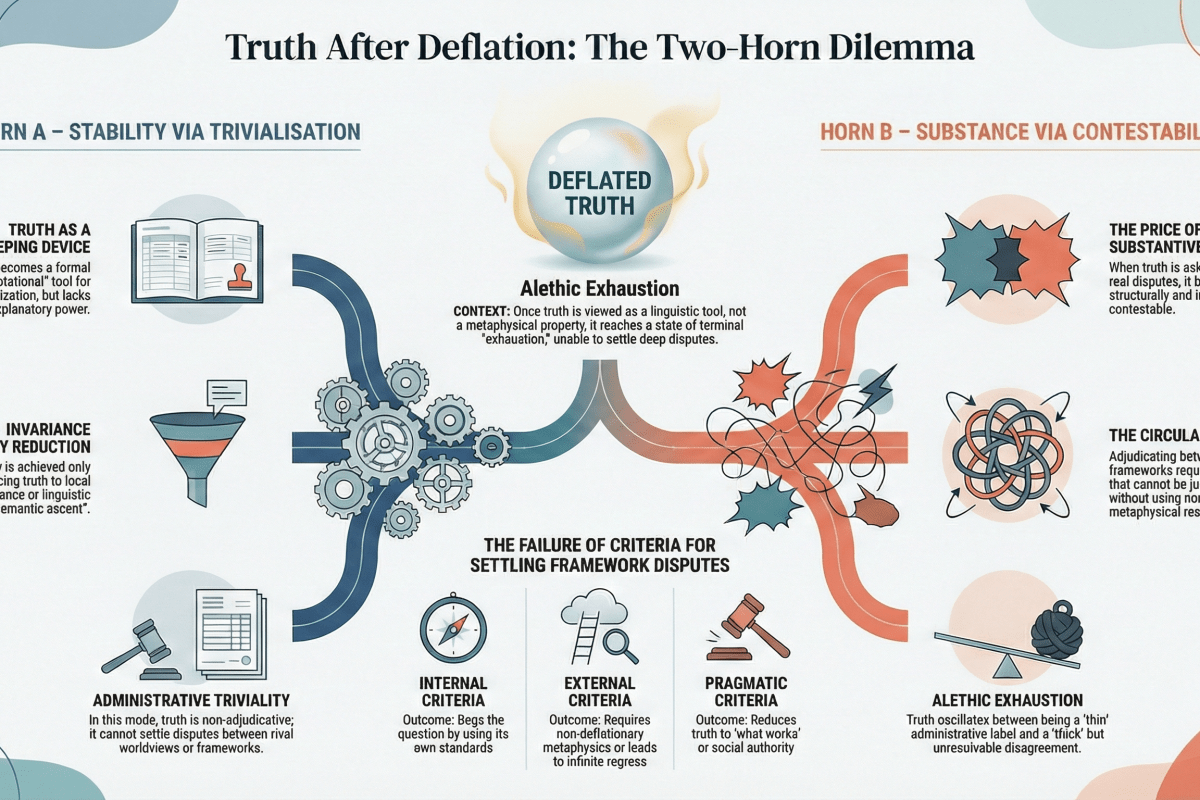
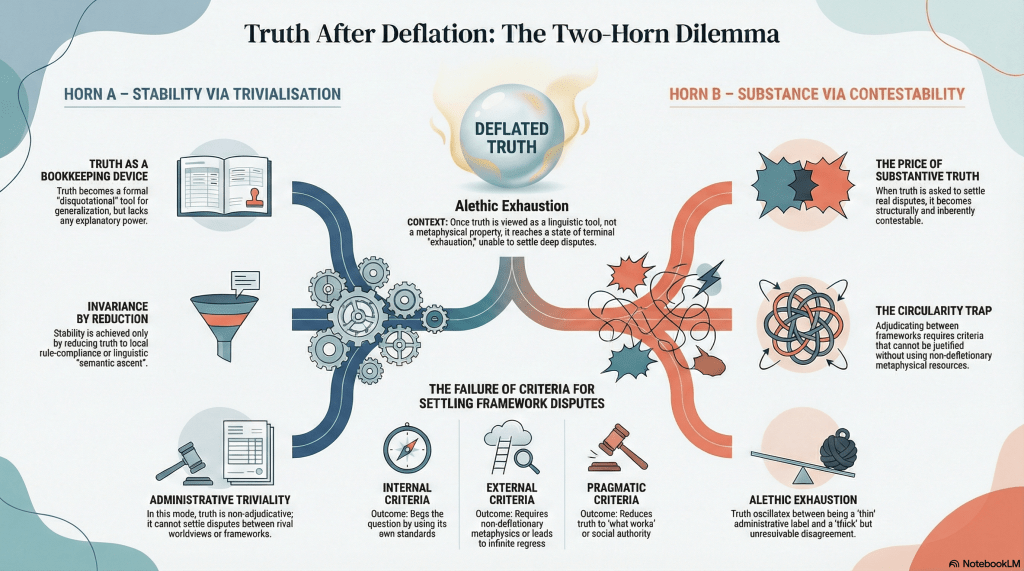
Image: NotebookLM infographics of this topic. (Please ignore the typos.)
The dilemma
Once deflationary constraints are accepted, attempts to “save” Truth fall into a simple two-horn dilemma.
Horn A: Stabilise truth by making it invariant. You can do this by disquotation, stipulation, procedural norms, or shared observation. The result is stable, but thin. Truth becomes administrative: a device for endorsement, coordination, and semantic ascent. It no longer adjudicates between rival frameworks.
Horn B: Preserve truth as substantive. You can ask Truth to ground inquiry, settle disputes, explain success, or stand above practices. But now you need criteria. And once criteria enter, so do circularity, regress, or smuggled metaphysics. Truth becomes contestable precisely where it was meant to adjudicate.
Stability costs substance. Substance costs stability. There is no third option waiting in the wings.
Why this isn’t just abstract philosophy
To test whether this is merely a theoretical artefact, the paper works through three domains where truth is routinely asked to do serious work:
Moral truth, where Truth is meant to override local norms and condemn entrenched practices.
Scientific truth, where Truth is meant to explain success, convergence, and theory choice.
Historical truth, where Truth is meant to stabilise narratives against revisionism and denial.
In each case, the same pattern appears. When truth is stabilised, it collapses into procedure, evidence, or institutional norms. When it is thickened to adjudicate across frameworks, it becomes structurally contestable. This isn’t relativism. It’s a mismatch between function and resources.
Why this isn’t quietism either
A predictable reaction is: isn’t this just quietism in better prose?
Not quite. Quietism tells us to stop asking. Exhaustion explains why the questions keep being asked and why they keep failing. It’s diagnostic, not therapeutic. The persistence of truth-theoretic debate isn’t evidence of hidden depth. It’s evidence of a concept being pushed beyond what it can bear after deflation.
The upshot
Truth still matters. But not in the way philosophy keeps demanding. Truth works because practices work. It doesn’t ground them. It doesn’t hover above them. It doesn’t adjudicate between them without borrowing authority from elsewhere. Once that’s accepted, a great deal of philosophical anxiety dissolves, and a great deal of philosophical labour can be redirected.
The question is no longer “What is Truth?” It’s “Why did we expect Truth to do that?”
The paper is now archived on Zenodo and will propagate to PhilPapers shortly. It’s long, unapologetically structural, and aimed squarely at readers who already think deflationary truth is right but haven’t followed it to its endpoint.
Read it if you enjoy watching concepts run out of road.
(For the constructive exposition of Perspectival Realism—its three layers of mediation, its commitments, and its ontology without footnotes—see the main article. This piece deals with the predictable objection.)
The moment you say “our access to reality is mediated,” someone inevitably performs their civic duty as Defender of Enlightenment Orthodoxy and announces, as if discovering fire, “So you’re a relativist, then?”
It’s a comforting little reflex. If a position denies universality, it must be relativism. If it rejects the view from nowhere, it must reject the very idea of truth. If it acknowledges cultural scaffolding, it must be one critique away from saying flat-earthers and astrophysicists are peers.
This objection misunderstands both relativism and Perspectival Realism.
Audio: NotebookLM podcast summarising this topic.
Let’s begin with the essential distinction—think of this as the tattoo at the base of the spine:
Relativism says: all maps are equally valid. Perspectival Realism says: all maps are partial, and some are better.
Better at predicting.
Better at surviving.
Better at cohering with everything else we know.
Better at not getting you killed.
This is the spine of the position. Everything else is elaboration.
Relativism’s Self-Destruct Button
Relativism denies that reality has enough structure to constrain belief. According to its logic, perspectives are sovereign. The world bends to interpretation.
If that were true:
Gravity would turn itself off for anyone sufficiently committed to optimism.
Viruses would consult your cosmology before infecting you.
The Müller–Lyer illusion wouldn’t vary between populations because there’d be no stable perceptual machinery for it to fool.
Relativism collapses because the world does not permit it.
Perspectival Realism begins from the opposite premise:
There is one reality.
It resists us.
Perspectives rise or fall by how well they handle that resistance.
You can’t get further from relativism than that.
Why Perspective ≠ Prison
Another familiar confusion: “If access is perspectival, aren’t we trapped in our own little worlds?”
No. Mediation isn’t isolation. It’s a shared condition.
You and I may wear sunglasses of different tint, but we still walk the same street. Your glasses may darken the building I call “red,” so you call it “dark red.” That’s not incommensurability—that’s disagreement within a shared world. We argue, we adjust, we converge.
Perspectival Realism doesn’t say “worlds are sealed off.” It says we are situated—embodied, encultured, cognitively structured. Our lenses differ. The street does not.
The Crucial Point: The World Pushes Back
Relativism has no mechanism for adjudication. Perspectival Realism has the best one available: reality’s structured resistance.
If your perspective predicts, explains, and survives contact with the world, it’s better. If it collapses upon use, it’s worse. If it transfers across contexts, it’s better. If it leaves you dead, it’s worse.
This is not metaphysics. It’s survival.
And it is very explicitly not relativism.
Logic: Form Universal, Application Situated
A predictable objection:
Objection: “Isn’t logic universal? Doesn’t that kill perspectivalism?”
Response: Basic inferential forms—modus ponens, contradiction—are indeed widespread. That’s Layer 2 architecture: the cognitive machinery we all share.
But what counts as a valid premise, which inferences feel compelling, and which conclusions are considered exhaustive vary across cultures (Layer 3). Logic’s form is stable; its deployment is contextual.
Perspectival Realism doesn’t deny logic. It denies the fantasy that logic operates in a cultural vacuum.
Relativism’s Moral Collapse
Why “anything goes” goes nowhere
Relativism becomes lethal the moment ethics enters the scene. If all perspectives are equally valid, you lose the ability to critique harmful practices. Torture, forced servility, institutionalised cruelty—all become “just different frameworks.”
Perspectival Realism rejects this.
You don’t need a metaphysical skyhook to condemn torture. You need:
Shared vulnerability – all humans are embodied beings capable of pain.
Empirical observation – societies that normalise cruelty become unstable and self-poisoning.
Pragmatic convergence – diverse cultures can agree that some practices destroy the conditions of flourishing.
Reality-tested norms – ethical systems survive because they work, not because they download from a Platonic server.
This is not relativism. It’s ethics under realism-without-universality.
You can condemn harmful practices without pretending to be the mouthpiece of timeless universal Reason. You can ground human rights in intersubjective evidence—not metaphysical fiat.
No view from nowhere required.
The Three-Way Contrast (The Only Chart You Need)
Naive Realism: There is one perfectly accurate map.
Relativism: All maps are equally good.
Perspectival Realism:
All maps are partial.
Some are atrocious.
Some work astonishingly well because they track deeper regularities of the terrain.
No map is complete.
No map is sovereign.
The terrain adjudicates between them.
You don’t need omniscience to compare maps. You need terrain. And we all share the same one.
Prediction: The Final Judge
If you want the single litmus test:
Does the perspective predict anything?
Does it do so consistently?
Does it correct itself when wrong?
Does it transfer beyond its original context?
If yes → closer to reality. If no → a charming story, but please don’t build bridges with it.
Relativism has no concept of “closer to.” Perspectival Realism depends on it.
Putting It All Together
Perspectival Realism maintains:
Realism: the world exists independently of our representations.
Anti-universalism: no representation escapes mediation.
Anti-relativism: some representations perform better because they align more closely with what the world actually does.
Humility: we navigate through partial perspectives, comparing, refining, and error-correcting.
No one gets to declare universal sovereignty. Everyone gets tested by the same reality.
Relativism says everything is equally true. Perspectival Realism says everything is equally mediated—but not equally successful.
Reality decides.
Perspectives compete.
And relativism loses on the first contact.
COMMENTARY: To be fair, the argument about relativism is a strawman argument against virtually no one who would hold or defend this position. For whatever reason, the training data indicated that this was a significant contender. I’ve heard similar weak strawmen in other disciplines, and I felt I should address the invisible elephant in the room. — Bry Willis
DISCLAIMER: This article was written or output by ChatGPT 5.1. It started as a conversation with Claude Sonnet 4.5, where I had input days of output for evaluation. One of these outputs was the post about Erasmus and the Emissary Who Forgot to Bow. A group chat ensued between me, Claude and ChatGPT.
What started as a discussion about the merits of my position, expressed in the Erasmus-influenced essay, drifted to one about Perspectival Realism. That discussion deepened on ChatGPT, as I further discussed my recent thoughts on the latter topic. I had rendered a Magic: The Gathering parody trading card as I contemplated the subject. It’s how my brain works.
All of this led me to ask ChatGPT to summarise the conversation, and, upon further discussion, I asked it to draft this article – the second of five.
Perspectival Realism: The First Ontology Without an Asterisk This article discusses what Perspectival Realism means to me and how I got to this position.
Why Perspectival Realism Is Not Relativism 👈 Further discussion prompted me to differentiate this ontology from other perspectives.
Arriving Late to Massimi’s Party: Perspectival Realism in Parallel I spent another half-hour following Google search results as I wanted to see if anyone else had already been using the term, Perspectival Realism. I ended up on the Oxford publishing site. I found a 2022 book with this name, authored by Michela Massimi. They allowed me to download the book, so I asked ChatGPT to summarise our positions, specifically where we agreed and differed.
Against the Vat: Why Perspectival Realism Survives Every Sceptical Hypothesis At 0500, I returned to bed, but I woke up again at 0700, thinking about how one might differentiate between Putnam’s brain in a vat from Perspectival Realism. ChatGPT asked if I wanted that output in long-form.
The Constraint Interface: Toward a Nexal Ontology Being uncomfortable with the dichotomy between Realism and Idealism, I chatted to come up with terminology that disrupts what I consider a false dichotomy, focusing on the nexus rather than privileging one or the other. Consider this similar to the debate on sex and gender binaries.
As I mentioned at the end of the first series, I may return to this series and publish a coherent expository version more in line with my usual style. Meantime, this allows me to share my ideas unvarnished and unpolished at the same time, granting me more time to focus on other matters. Apologies to those who may disagree with the outline format. Honestly, it annoys me, but I am choosing function over form at the moment.
I’ve just published Objectivity Is Illusion: An Operating Model of Social and Moral Reasoning, an essay that began as this blog post. I’m sharing the ‘official’ link and this first draft. As the essay matured, I added additional support, but I focused primarily on refuting the anticipated opposing arguments. Rather than regurgitate the final version here, I felt showing the genesis would be more instructive. Of course, the essay didn’t spring fully formed; I’ve pruned and expanded from earlier notes still sitting on my hard drive.
Every so often, I’m told I’m too slippery with words, that I treat truth as if it were just another game of persuasion, that I reduce morality to chalk lines on a playing field. The objection usually comes with force: ‘But surely you believe some things are objectively true?‘
I don’t. Or more precisely, I don’t see how ‘objectivity’ in the metaphysical sense can be defended without lapsing into stagecraft. Granite foundations have always turned out to be scaffolding with the paint touched up. Priests once told us their gods guaranteed truth; scientists later promised the lab would serve as granite; politicians assure us democracy is the stone pillar. But in each case the creaks remain.
Audio: NotebookLM podcast on this topic.
This essay is written with an academic readership in mind. It assumes familiarity with figures like Nietzsche, Foucault, Rorty, and Ayer, and with the long quarrel over subjectivity, relativity, and objectivity. My aim is not to retell those arguments from the ground up, but to position my own framework within that ongoing dispute.
Scope
Before proceeding, some guardrails. When I say ‘objectivity is illusion,’ I mean in the social and moral domain. I’m not denying quarks or mathematics. My claim is narrower: in human discourse, no truth escapes subjectivity or contingency.
This dovetails with my broader Language Insufficiency Hypothesis: that even our words are leaky vessels, prone to misfire and misunderstanding. If language itself is unstable ground, then objectivity built upon it can hardly be granite. My claim here is not that nothing exists outside us, but that in the social world we inhabit together, every ‘truth’ rests on creaking boards.
One more note: just because social administration requires appeals to objectivity doesn’t mean objectivity exists. Courts, laboratories, and parliaments invoke it to secure trust, and it works well enough as theater. But necessity is not proof. And it is not my responsibility to conjure a granite replacement. What follows is an operating model, not a new altar.
Thesis
Objectivity is an illusion. Truth is rhetorical. Morality is prescriptive, not propositional. Our ethic is not granite but care: tending the planks we walk on, knowing they creak.
Operating Model: Five Premises
This framework is not a foundation. It is an operating model – contingent, provisional, subject to revision as circumstances change. Like any model, it can (and should) be updated to fit the culture and times.
Premise 1: Subjectivity is the baseline. Every claim originates in a perspective. No statement is free of the lens through which it is made. Even to deny subjectivity is to speak from a subject.
Premise 2: Relativity is emergent. What we call ‘relative truth’ is not a separate category but the convergence of individual subjectivities into provisional consensus. Consensus is never neutral: it is formed rhetorically – through persuasion, cultural resonance, and power [1]. MacIntyre made a similar point in After Virtue. The moral consensus of the Ancients was not grounded in objectivity but in a shared tradition – a thick account of human flourishing that gave coherence to their claims. When that scaffolding collapsed, consensus fractured, leaving modern moral discourse in fragments. Critics accused MacIntyre of relativism, since different traditions yield different ‘truths’, but his point reinforces mine: what looks like objectivity is in fact the temporary overlap of subjectivities sustained by tradition [2].
Premise 3: Objectivity is illusion. Claims presented as objective are relative norms hardened by repetition and forgotten as contingent scaffolding. ‘Objectivity’ is consensus disguised as granite. Its invocation in courts or parliaments may be useful, but usefulness is not existence. The burden of proof belongs to anyone insisting on an independent, metaphysical anchor for moral or social truths (Nietzsche’s ‘mobile army of metaphors’ [3], Kuhn’s paradigms [4], Latour’s laboratories [5]).
Even if one concedes, with Weber (as MacIntyre reminds us), that objective moral truths might exist in principle, they remain inaccessible in practice. What cannot be accessed cannot guide us; reconciliation of values and virtues must therefore take place within traditions and rhetoric, not in appeal to unreachable granite [13].
Premise 4: Rhetoric establishes truth. What counts as ‘true’ in the social and moral domain is established rhetorically – through coherence, resonance, utility, or force. This does not mean truth is ‘mere spin’. It means truth is never metaphysical; it is enacted and enforced through persuasion. If a metaphysical claim convinces, it does so rhetorically. If a scientific claim holds, it does so because it persuades peers, fits the evidence, and survives testing. In short: rhetoric is the medium through which truths endure [6].
Premise 5: Non-Cognitivism, Stated Plainly. I take moral utterances to be prescriptions, not propositions. When someone says ‘X is wrong’, they are not reporting an objective fact but prescribing a stance, a rule, a line in chalk. This is my operating position: non-cognitivism (Ayer [7], Stevenson [8]).
That said, I know the term feels alien. Many prefer the dialect of subjectivism – ‘X is true-for-me but not-for-you’ – or the quasi-realist stance that moral language behaves like truth-talk without cosmic backing (Blackburn [9]). I have no quarrel with these translations. They name the same scaffolding in different accents. I am not defending any school as such; I am simply stating my plank: morality prescribes rather than describes.
Ethic: Care. Since scaffolding is all we have, the obligation is not to pretend it is stone but to keep it usable. By ‘care’, I do not mean politeness or quietism. I mean maintenance – deliberation, repair, mutual aid, even revolt – so long as they acknowledge the scaffolding we share. Care is not optional: stomp hard enough and the floor collapses beneath us all.
Examples clarify: peer review in science is care in action, patching leaky vessels rather than proving granite. Civil rights movements practiced care by repairing rotten planks of law, sometimes with revolt. Communities rebuilding after disaster embody care by reconstructing scaffolding, not pretending it was indestructible. Care is maintenance, reciprocity, and survival.
Bridge: These five premises do not add up to a system or a foundation. They form an operating model: subjectivity as baseline, relativity as emergent, objectivity as illusion, rhetoric as truth, morality as prescription. Together they outline a practice: walk the planks with care, admit the creaks, patch where needed, and stop pretending we live in marble halls.
Rationale
Why prefer scaffolding to granite? Because granite has always been a mirage. The history of philosophy and politics is a history of crumbling temples and collapsing empires. The promises of permanence never survive the weather.
Think of Nietzsche, who called truths ‘a mobile army of metaphors’ [3]. Think of Foucault, who showed that what counts as ‘truth’ is always bound up with power [1]. Think of Rorty, who reduced truth to what our peers let us get away with saying [6]. These are not nihilists but diagnosticians: they exposed the creaks in the floorboards and the wizard behind the curtain.
Metaphors drive the point home:
Scaffolding and granite: What holds is temporary, not eternal. Granite is an illusion painted on timber.
Chalk lines: Rules of play – binding, real, but contingent. They can be redrawn.
Shoreline houses: Rome, the USSR, the British Empire – each built like beachfront villas with a fine view and bad footing. Storms came, sand eroded, and down they went.
Bias as framing: Kahneman himself admitted ‘bias’ is not a thing in the world [10], only a deviation from a chosen model. Gigerenzer [11] and Jared Peterson [12] remind us heuristics are adaptive. To call them ‘biases’ is not neutral – it’s allegiance to a standard of rationality.
The point is simple: what holds today is scaffolding, and pretending otherwise is self-deception.
Counterarguments and Refutations
Objection: Moral Paralysis. Without objective morality, why abolish slavery or defend rights?
Refutation: Chalk lines still bind. Speed limits aren’t cosmic, but they regulate conduct. Abolition endured not because it tapped a cosmic truth but because it persuaded, resonated, and took root. Slavery was once ‘in bounds’. Now it is ‘offsides’. That shift was rhetorical, emotional, political – but no less binding.
Objection: Problem of Dissent. If all is subjective, the lone dissenter is ‘just another voice’.
Refutation: Dissent gains traction through coherence, predictive success, or resonance. Galileo, abolitionists, suffragists – none relied on metaphysical granite. They persuaded, they resonated, they moved chalk lines. Truth was made through rhetoric, not uncovered in stone.
Objection: Performative Dependency. Even to say ‘subjective’ assumes the subject/object split. Aren’t you still inside the house?
Refutation: Of course. But I’m the one pointing at the slippery boards: ‘Mind the dust’. Yes, I’m in the house. But I refuse to pretend it’s marble. And even the category ‘subject’ is not eternal – it’s porous, dynamic, and leaky, just like language itself.
Objection: Infinite Regress. Why stop at subjectivity? Why not de-integrate further?
Refutation: Subjectivity is not granite, but it is the last plank before void. Peel it back and you erase the possibility of claims altogether. If tomorrow we discover that the ‘subject’ is a swarm of quarks or circuits, fine – but the claim still emerges from some locus. Regression refines; it doesn’t disprove.
Conclusion: The Ethic of Care
This is not reintegration. It is dis-integration: naming the creaks, stripping polyvinyl from rotten boards, refusing granite illusions.
If you wish to build here, build. But know the ground shifts, the storms come, the shoreline erodes. The ethic is not certainty but care: to tend the scaffolding we share, to patch without pretending it is stone, and to let dissent itself become part of the maintenance.
The topic of this video touches upon my insufficiency of language thesis. Tim Maudlin defends language realism but only to the extent that ‘we can use it to describe the world and that some of those descriptions are true’.
Video: Does Language Describe Reality? (IAI)
The challenge, then, is determining which descriptions are true. I’ve discussed a couple of my positions on this.
The Truth About Truth
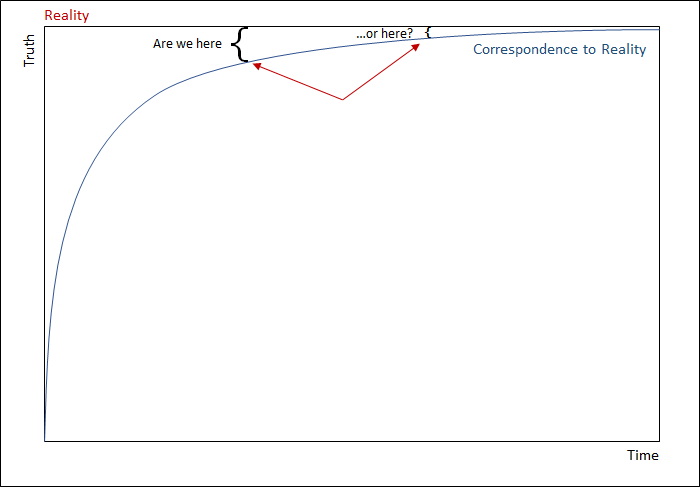
Firstly, we can only perceive what is true as we have no access to absolute truth. The best we can achieve is an asymptotic function approaching truth, a notion that resonates with Hilary Putnam’s concept of internal realism (pdf). Putnam argues that truth is not a matter of correspondence with a mind-independent reality but is instead tied to our conceptual schemes. This means that what we consider “true” is always shaped by the language and concepts we use, making our understanding inherently partial and context-dependent. Even then, we have no way to determine how close to truth our perception is. It just has to feel true—an idea that aligns with Putnam’s pragmatic conception of truth, where truth is something that emerges from our practices and inquiries, rather than being a fixed point we can definitively reach. In terms of physics, this underlying reality may be relatively more stable than abstract concepts, which are ephemeral and shifting sands.
The Rhetoric of Truth
Secondly, given that we have no access to objective truth, we can only expect subjective or relative truths. This brings us to Putnam’s critique of the metaphysicalcorrespondence theory of truth. According to Putnam, the idea that language can perfectly correspond to an external reality is flawed. Instead, truth is what can be justified within a particular conceptual framework, making all truth somewhat relative. This leaves us open to rhetoric—the more convincing argument wins, regardless of whether it reflects an objective reality. In fact, as Putnam’s ideas suggest, the most persuasive argument might favour an incorrect position simply because it resonates more with our internal conceptual schemes, not because it corresponds to an external truth. This has happened many times historically—or has it?
Conclusion: Language, Truth, and the Influence of Rhetoric
Putnam’s work reminds us that language is deeply connected to our understanding of the world, but it is also limited by the conceptual frameworks within which it operates. While language helps us navigate and describe the world, it cannot provide us with direct access to objective truth. Instead, it gives us tools to construct truths that are internally coherent and pragmatically useful, though always subject to change and reinterpretation. As we engage with rhetoric and persuasion, we must remain aware that the truths we accept are often those that best fit our current conceptual schemes, not necessarily those that best correspond to an elusive objective reality.
In exploring the concept that nations, economies, money, legal systems, and even sports are fictions, we confront a fundamental question: can this be true? The answer hinges on our understanding of truth and reality. If we define truth as correspondence to an objective, external reality, then fictions, by their nature, are not “true” in a literal sense. However, if we recognize that truth can also be a construct shaped by human perception and social agreements, then fictions hold a different kind of truth.
Fictions are true in the sense that they have real effects on our lives. They shape our behaviours, influence our decisions, and structure our societies. The value of money, the authority of laws, and the significance of national identities are all real because we collectively believe and act as if they are. This shared belief and action give fictions their power and their truth.
Philosophical Perspectives
Philosophers have long grappled with the nature of truth and reality. The concept of social constructs aligns with the ideas of thinkers like Michel Foucault, who argued that knowledge and power are intertwined, and that what we accept as truth is often a product of social and historical processes. Similarly, Jean Baudrillard’s concept of hyperreality suggests that in the postmodern world, the line between reality and simulation becomes blurred, and fictions can become more real than reality itself.
These perspectives challenge the notion of an objective, immutable truth, suggesting instead that truth is often contingent, context-dependent, and constructed through human interactions. In this light, the fictions that structure our world are as true as any other aspect of our lived experience.
Empirical Evidence
Empirical evidence supports the idea that fictions have real effects. For instance, studies in economics and sociology demonstrate how beliefs and narratives shape market behaviours and social norms. The placebo effect in medicine, where patients experience real improvements in health due to their belief in a treatment, exemplifies the power of belief in creating tangible outcomes.
Historical examples further illustrate this point. The Treaty of Westphalia in 1648, which established the modern system of nation-states, was a legal and diplomatic construct that reshaped political boundaries and identities. The creation of fiat currencies, which derive their value from collective trust rather than intrinsic worth, has revolutionized global economies.
Practical Implications
Recognizing the constructed nature of our social realities has practical implications. It empowers us to critically examine and potentially reshape the fictions we live by. This critical awareness fosters adaptability and innovation, allowing us to address contemporary challenges more effectively.
For example, understanding that economic systems are human-made constructs can inspire alternative models that prioritize sustainability and equity. Similarly, recognizing the fictional nature of national identities can promote more inclusive and cosmopolitan forms of belonging.
Ethical Considerations
While fictions can be powerful tools for organizing society, they also carry ethical considerations. The manipulation of fictions for political or economic gain can lead to exploitation and injustice. It is crucial to approach the construction and perpetuation of fictions with a sense of responsibility and a commitment to the common good.
Transparency, inclusivity, and critical engagement are key to ensuring that the fictions we create serve the interests of all members of society. This requires ongoing dialogue and reflection to align our social constructs with our evolving values and aspirations.
Conclusion
The notion that we live in a world of fictions is both profound and practical. It challenges us to rethink our assumptions about truth and reality, and to recognize the power of collective belief and social constructs in shaping our lives. By embracing this perspective, we gain the ability to question, reform, and innovate the fictions that structure our world, fostering a more just and dynamic society.
In acknowledging the constructed nature of our social realities, we affirm the human capacity for imagination and creativity. This recognition opens up possibilities for envisioning and creating new fictions that better reflect our values and aspirations, guiding us toward a more equitable and sustainable future.
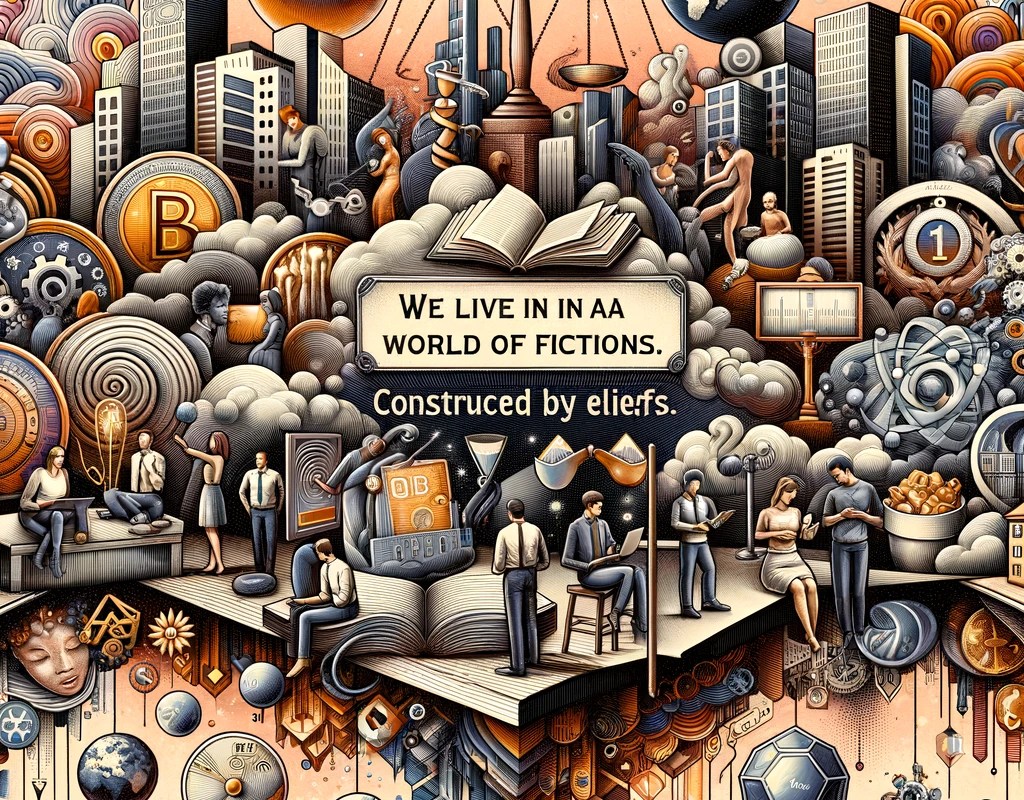
PS: Apologies for the AI typo in the thumbnail image. I fixed it once, and it went missing. Perhaps. I’ll mend it later.
References
Graeber, David. Debt: The First 5,000 Years (2011).
Foucault, Michel. Discipline and Punish: The Birth of the Prison (1975).
Baudrillard, Jean. Simulacra and Simulation (1981).
Anderson, Benedict. Imagined Communities: Reflections on the Origin and Spread of Nationalism (1983).
Giddens, Anthony. The Consequences of Modernity (1990).
Aside from the political realm, in my quest to gain more perspective on Anarchism in 2022, I am interested in behavioural aspects of the human condition. It seems to me that political constructs as dynamic systems are inherently unstable. Whilst I am predisposed to Anarchy versus the alternatives to which I’ve been exposed, it too is fraught will deficiencies. The question is which system has the fewest deficiencies at any given time. More on this later.
On my journey, I’ve come across Moral Tribes by Joshua Greene, a book recommended in Behave by Robert Sapolsky—perhaps my favourite non-fiction book of the trailing decade, which is also to say my favourite book over this period. Professor Greene summarises his concepts on YouTube.
But
Of course, there’s a but. Joshua Greene seems to come from the same mould as Stephen Pinker. Two Pollyanna defenders of the Enlightenment and Humanism. As such, they are Moderns in the pejorative sense. They’ve drunk the Kool-Aid. They both buy into the Classical Western narrative.
What interested me in Greene’s work was the conflict management aspect. I don’t believe in inherent morality, but I do believe in constructed morality, perhaps better known as ethics. I believe that these are self-serving, whereby self represents any entity at some point or limited expanse of time. They never derive from some neutral place without benefiting some at the expense of others.
The axe I have to grid with Greene in Moral Tribes is his belief in facile notions such as loyalty and some sense of definitive goodness and badness. These things, he believes are instinctual. If we can tap into them and manipulate those with broken instincts—or marginalise them—, all will be milk and honey—or wine and roses. Take your pick.
Deep Pragmatism
Greene is effectively a utilitarian as descended from Jeremy Betham and John Stuart Mill, and he views pragmatism as a sort of panacea. Although I operate as a pragmatist as a fallback position from my more existential nihilistic core, I don’t feel that his recharacterising utilitarianism as Deep Pragmatism™ is a viable solution. Presuming that one could actually dimensionalise a society in a manner to measure this utility is a fool’s errand at the start. And, as I’ve gathered from other sources, he not only believes that there is a best morality, and he’s found it—because of course he has. In my book this is a red flag—a flaming red flag signalling a rubbish claim. In some circles, they’d straight up call it bollox.
Given this foundation, I am not sure how much more I’ll be able to maintain my interest. But for now, I’m not optimistic that he’s relying on anything more than hoping to convert ises from oughts with his magic Modern wand. I’ll give it as least a few more pages, but I won’t promise not to skim through to the end.
I was engaged in a conversation in a Facebook Philosophy group for Pragmatists. I feel that these groups take me as adversarial because I question their system of belief. To the extent that I accept any categorical distinction, I consider myself to be a Postmodernist first and foremost and a Pragmatist second. In a similar fashion, I am at once an atheist first, but I operate as a Buddhist. I am a nihilist first, but I operate as an Existentialist. In any case, in explaining this, I hit upon an analogy that I hadn’t considered before.
everything just ‘is’
Pragmatism is Samsara. In Buddhism, there is the concept of Samsara, which contains the realms we reside in before we reach Enlightenment, the state of realising that everything just ‘is’, is , and is undifferentiated, at which case we either exit the system or remain as aware (woke anyone?) Bodhisattvas.
everything is a constructed illusion
The ‘just is’ is the postmodern condition. Nothing is as it seems and everything is a constructed illusion. There is no good, no bad, no right or wrong—not even black or white. This is all perception of difference, but there is no difference.
I am a Buddhist in the same way I am a Pragmatist. I know that this is all a cognitive construct—or constructs—, but I am still stuck in the middle of it, ‘thrown in’ (Geworfenheit) to echo Heidegger, and I attempt to make the best of it. None of it is real, but, as with people of the Matrix, I can’t perceive my way out of it.
The risk for Pragmatists is that they are empiricists. They trust that the past will ostensibly operate the same as the future. It’s been generally that way thus far, and we’ve misinterpreted how things operate in the past, but we’ve corrected this interpretation, and we’ll correct and refine these interpretations in future. That’s the employed logic. I’ve not got a better plan, so as shoddy or rickety as it might be, it’s my life raft replete with holes, but I’ll patch them as swiftly as I can and hope my history of having not encountered any sharks or tidal disruptions or undertows persists.
none of this exists
All the while, my core beliefs are that none of this exists—not in a solipsistic way, just not as we imagine it does. It’s the wall constructed of atoms and molecules that is more space than not, and yet we can’t pass through it. If only we could all be Neo and overcome this misperception.
Please note that this content has been subsumed into the originating article: The Truth about Truth.
We have no idea how close or far we are from Reality on the Y (Truth) axis.
Graph: Correspondence of Truth to Reality (Asymptotic Curve)
Assuming for the time being that there is an approachable truth, we have no reference to understand how close to reality we might be. In practice, we seem to operate on a basis of always being within some level of statistical significance of where Truth = Reality, and when new information is introduced, we say, “Hooray for Science!” Aren’t we glad that science is self-correcting. And Empiricism has its own issues.
Historically, we’ve had ‘wrong’ correspondence between Truth and Reality, but then we got it ‘right’—until we didn’t.
We may all know how Einstein progressed and refined Newtonian physics. What Einstein did is to create a new narrative—a synchronous shift of paradigm and rhetoric—, which has been accepted into a new orthodoxy. In our mind, this feels like progress. How close are we to the real truth?
Taking our understanding of gravity or of the fabric of space-time, we still have no idea what’s going on or how it operates, but this doesn’t prevent us from accepting it as a black box and making pragmatic predictions from there. So, for all intents and purposes, the ‘truth’ mechanism is less important than the functional relationship, just as I can tell time on a watch I have no idea how it operates.
I don’t feel there is another perspective. It is a human construct of language, but, in particular, it’s a social construct. By definition, language is arbitrary (though not capricious), any anything within language is necessarily arbitrary, too.
Morality and its cousin, ethics, are essentially normative rules of conduct, so they are, foundationally speaking, pragmatic: what is the best system for a society to flourish. This implies some goal or goals. In essence, this becomes an optimisation problem that involves systems thinking, and humans are particularly poor at systems thinking especially when faced with complexity. Along our evolutionary path, managing complexity was not a huge survival factor. Kahneman and Tversky identified two systems: System I is the sort of automatic reflexive system and System II is for advanced functions. System II requires a lot of energy and upkeep. For most humans, it’s not well-developed or maintained,and System I appears to be the arbiter and has right of first refusal, so it attempts to solve heuristically something that should be assessed analytically.
Why the ramble? Morality is a complex system with boundary conditions and dynamics: precisely what humans are poor at. Just defining the boundaries is a challenge. Perhaps this is why some people simply attempt to define the boundary as universal, but this creates its own challenges. And many reject universal morality, opting for smaller moral domains—nations, states, municipalities, communities, schools, churches, families, peer groups, couples. To Hegel and Nietzsche, the main concern is authenticity for the individual. And Nietzsche didn’t feel that there was any one-size-fits-all morality to begin with. I could operate with different moral imperatives than you. This was most evident in his Master-Herd distinction.
But since I reject the notion of objective morality, it is necessarily normative or relative or subjective. Here, we end up trying to optimise an equilibrium model, but the trick is what to optimise.
In the modern age, the consensus is to maximise happiness or utility, but, as I’ve mentioned before, we are still left in a quandary: do we optimise personal happiness or group happiness, and what group? A nationalist might choose to draw a boundary around the nation. This will maximise happiness within the borders without concern of whether ‘people are starving in Africa’.
Of course, there are multiple dimensions to any morality. If there are two people and one has $100 and the other would feel happier to take it, in a utility optimisation model, there is nothing to defend not taking it. Prospect theory within behavioural economics provides some rational insomuch as humans tend to value loss over gain, so the $100 received is perceived as having less value than the person losing it. This is further complicated if the person receiving it is poor—perhaps s/he has no money—and the person relinquishing it is Jeff Bezos, to whom it is nothing more than a rounding error.
I mention these because we could have a positive sum game (borrowing from game theory)—the gain to the poor person would outweigh the loss leading to a net positive gain—, and yet Pareto optimisation disallows this. Of course, happiness and utility cannot be measured in the first place and they are not persistent in the second place.
My point in all this is to argue that humans are woefully ill-equipped to grasp these topics, and so most of this is not much more substantial than mental masturbation. And this leads me full circle to me original contention that morality and so-called moral truths are nothing more that rhetoric, the ability to persuade that your position is the truest truth.







 Philosophics