Having just finished Never Let Me Go by Kazuo Ishiguro, I’ve now cracked open my first taste of Cioran—History and Utopia. You might reasonably ask why. Why these two? And what, if anything, do they have in common? Better yet—what do the three of us have in common?
Audio: NotebookLM podcast on this topic.
Recently, I finished writing a novella titled Propensity (currently gathering metaphorical dust on the release runway). Out of curiosity—or narcissism—I fed it to AI and asked whose style it resembled. Among the usual suspects were two names I hadn’t yet read: Ishiguro and Cioran. I’d read the others and understood the links. These two, though, were unknown quantities. So I gave them a go.
Ishiguro is perhaps best known for The Remains of the Day, which, like Never Let Me Go, got the Hollywood treatment. I chose the latter, arbitrarily. I even asked ChatGPT to compare both books with their cinematic counterparts. The AI was less than charitable, describing Hollywood’s adaptations as bastardised and bowdlerised—flattened into tidy narratives for American palates too dim to digest ambiguity. On this, we agree.
What struck me about Never Let Me Go was its richly textured mundanity. That’s apparently where AI saw the resemblance to Propensity. I’m not here to write a book report—partly because I detest spoilers, and partly because summaries miss the point. It took about seven chapters before anything ‘happened’, and then it kept happening. What had at first seemed like a neurotic, wandering narrative from the maddeningly passive Kathy H. suddenly hooked me. The reveals began to unfold. It’s a book that resists retelling. It demands firsthand experience. A vibe. A tone. A slow, aching dread.
Which brings me neatly to Cioran.
History and Utopia is a collection of essays penned in French (not his mother tongue, but you’d never guess it) while Cioran was holed up in postwar Paris. I opted for the English translation—unapologetically—and was instantly drawn in. His prose? Electric. His wit? Acidic. If Ishiguro was a comparison of style, then Cioran was one of spirit. Snark, pessimism, fatalistic shrugs toward civilisation—finally, someone speaking my language.
Unlike the cardboard cut-outs of Cold War polemics we get from most Western writers of the era, Cioran’s take is layered, uncomfortably self-aware, and written by someone who actually fled political chaos. There’s no naïve idealism here, no facile hero-villain binaries. Just a deeply weary intellect peering into the abyss and refusing to blink. It’s not just what he says, but the tone—the curled-lip sneer at utopian pretensions and historical self-delusions. If I earned even a drop of that comparison, I’ll take it.
Both Ishiguro and Cioran delivered what I didn’t know I needed: the reminder that some writers aren’t there to tell you a story. They’re there to infect you with an atmosphere. An idea. A quiet existential panic you can’t shake.
I’ve gotten what I came for from these two, though I suspect I’ll be returning, especially to Cioran. Philosophically, he’s my kind of bastard. I doubt this’ll be my last post on his work.
I neither champion nor condemn tradition—whether it’s marriage, family, or whatever dusty relic society is currently parading around like a prize marrow at a village fête.
Audio: NotebookLM podcast on traditional families.
In a candid group conversation recently, I met “Jenny”, who declared she would have enjoyed her childhood much more had her father not “ruined everything” simply by existing. “Marie” countered that it was her mother who had been the wrecker-in-chief. Then “Lulu” breezed in, claiming, “We had a perfect family — we practically raised ourselves.”
“We had a perfect family; we practically raised ourselves.”
Now, here’s where it gets delicious:
Each of these women, bright-eyed defenders of “traditional marriage” and “traditional family” (cue the brass band), had themselves ticked every box on the Modern Chaos Bingo Card: children out of wedlock? Check. Divorces? Check. Performative, cold-marriage pantomimes? Absolutely—and scene. Their definition of “traditional marriage” is the vintage model: one cis-male, one cis-female, Dad brings home the bacon, Mum weeps quietly into the washing-up. Standard.
Let’s meet the players properly:
Jenny sprang from a union of two serial divorcées, each dragging along the tattered remnants of previous families. She was herself a “love child,” born out of wedlock and “forcing” another reluctant stroll down the aisle. Her father? A man of singular achievements: he paid the bills and terrorised the household. Jenny now pays a therapist to untangle the psychological wreckage.
Marie, the second of two daughters, was the product of a more textbook “traditional family”—if by textbook you mean a Victorian novel where everyone is miserable but keeps a stiff upper lip about it. Her mother didn’t want children but acquiesced to her husband’s demands (standard operating procedure at the time). Marie’s childhood was a kingdom where Daddy was a demigod and Mummy was the green-eyed witch guarding the gates of hell.
Lulu grew up in a household so “traditional” that it might have been painted by Hogarth: an underemployed, mostly useless father and a mother stretched thinner than the patience of a British Rail commuter. Despite—or because of—the chaos, Lulu claims it was “perfect,” presumably redefining the word in a way the Oxford English Dictionary would find hysterical. She, too, had a child out of wedlock, with the explicit goal of keeping feckless men at bay.
And yet—and yet—all three women cling, white-knuckled, to the fantasy of the “traditional family.” They did not achieve stability. Their families of origin were temples of dysfunction. But somehow, the “traditional family” remains the sacred cow, lovingly polished and paraded on Sundays.
Why?
Because what they’re chasing isn’t “tradition” at all — it’s stability, that glittering chimera. It’s nostalgia for a stability they never actually experienced. A mirage constructed from second-hand dreams, glossy 1950s propaganda, and whatever leftover fairy tales their therapists hadn’t yet charged them £150 an hour to dismantle.
Interestingly, none of them cared two figs about gay marriage, though opinions about gay parenting varied wildly—a kettle of fish I’ll leave splashing outside this piece.
Which brings us back to the central conundrum:
If lived experience tells you that “traditional family” equals trauma, neglect, and thinly-veiled loathing, why in the name of all that’s rational would you still yearn for it?
Societal pressure, perhaps. Local customs. Generational rot. The relentless cultural drumbeat that insists that marriage (preferably heterosexual and miserable) is the cornerstone of civilisation.
Still, it’s telling that Jenny and Marie were both advised by therapists to cut ties with their toxic families—yet in the same breath urged to create sturdy nuclear families for their own children. It was as if summoning a functional household from the smoking ruins of dysfunction were a simple matter of willpower and a properly ironed apron.
Meanwhile, Lulu—therapy-free and stubbornly independent—declares that raising oneself in a dysfunctional mess is not only survivable but positively idyllic. One can only assume her standards of “perfect” are charmingly flexible.
As the title suggests, this piece questions traditional families. I offer no solutions—only a raised eyebrow and a sharper question:
What is the appeal of clinging to a fantasy so thoroughly at odds with reality? Your thoughts, dear reader? I’d love to hear your defences, your protests, or your own tales from the trenches.
Although the rating was not bad – 3.8 as of this writing – the reviews told a different story.
The first half of the book was worthwhile as it was a thought provoking description of how early societies may have developed social systems to encourage group cooperation and discourage harmful behaviors. The second half however was a rambling, preachy, and judgemental dissertation on postmodernism using the all too familiar tropes of social justice dialog. Overall it was poorly written though some of that may be due to translation. There is too little useful material here to justify its purchase.
Firstly, this version is from a German edition. Some people feel that some structure and communication value was lost in translation. In any case, he’s accused of being verbose and circumlocutory.
Amazon describes this book as “a sweeping history,” but the only thing sweeping about it was what I wanted to do with it under the nearest rug.
Secondly, it may be somewhat derivative of Nietzsche’s work on the same topic.
The book is rambling and incoherent, the author makes wild assertions about things that happened before recorded history, leaps from one train of thought to another, poo poos the ideas of religion but frequently quotes Nietzsche as the infallible source of knowledge…
Tonyo (reviewer)
In any case, the topic interests me, but I don’t see myself reading it any time soon.
—or—How the Invisible Hand Became a Throttling Grip on the Throat of the Biosphere
As many frequent visitors know, I am a recovering economist. I tend to view economics through a philosophical lens. Here. I consider the daft nonsense of Pareto optimality.
Audio: NotebookLM podcast of this content.
There is a priesthood in modern economics—pious in its equations, devout in its dispassion—that gathers daily to prostrate before the altar of Pareto. Here, in this sanctum of spreadsheet mysticism, it is dogma that an outcome is “optimal” so long as no one is worse off. Never mind if half the world begins in a ditch and the other half in a penthouse jacuzzi. So long as no one’s Jacuzzi is repossessed, the system is just. Hallelujah.
This cult of cleanliness, cloaked in the language of “efficiency,” performs a marvellous sleight of hand: it transforms systemic injustice into mathematical neutrality. The child working in the lithium mines of the Congo is not “harmed”—she simply doesn’t exist in the model. Her labour is an externality. Her future, an asterisk. Her biosphere, a rounding error in the grand pursuit of equilibrium.
Let us be clear: this is not science. This is not even ideology. It is theology—an abstract faith-based system garlanded with numbers. And like all good religions, it guards its axioms with fire and brimstone. Question the model? Heretic. Suggest the biosphere might matter? Luddite. Propose redistribution? Marxist. There is no room in this holy order for nuance. Only graphs and gospel.
Jevons warned us…that improvements in efficiency could increase, not reduce, resource consumption.
The rot runs deep. William Stanley Jevons—yes, that Jevons, patron saint of unintended consequences—warned us as early as 1865 that improvements in efficiency could increase, not reduce, resource consumption. But his paradox, like Cassandra’s prophecy, was fated to be ignored. Instead, we built a civilisation on the back of the very logic he warned would destroy it.
Then came Simon Kuznets, who—bless his empirically addled soul—crafted a curve that seemed to promise that inequality would fix itself if we just waited politely. We called it the Kuznets Curve and waved it about like a talisman against the ravages of industrial capitalism, ignoring the empirical wreckage that piled up beneath it like bones in a trench.
Meanwhile, Pareto himself, that nobleman of social Darwinism, famously calculated that 80% of Italy’s land was owned by 20% of its people—and rather than challenge this grotesque asymmetry, he chose to marvel at its elegance. Economics took this insight and said: “Yes, more of this, please.”
And so the model persisted—narrow, bloodless, and exquisitely ill-suited to the world it presumed to explain. The economy, it turns out, is not a closed system of rational actors optimising utility. It is a planetary-scale thermodynamic engine fuelled by fossil sunlight, pumping entropy into the biosphere faster than it can absorb. But don’t expect to find that on the syllabus.
Mainstream economics has become a tragic farce, mouthing the language of optimisation while presiding over cascading system failure. Climate change? Not in the model. Biodiversity collapse? A regrettable externality. Intergenerational theft? Discounted at 3% annually.
We are witnessing a slow-motion suicide
We are witnessing a slow-motion suicide cloaked in the rhetoric of balance sheets. The Earth is on fire, and the economists are debating interest rates.
What we need is not reform, but exorcism. Burn the models. Salt the axioms. Replace this ossified pseudoscience with something fit for a living world—ecological economics, systems theory, post-growth thinking, anything with the courage to name what this discipline has long ignored: that there are limits, and we are smashing into them at speed.
History will not be kind to this priesthood of polite annihilation. Nor should it be.
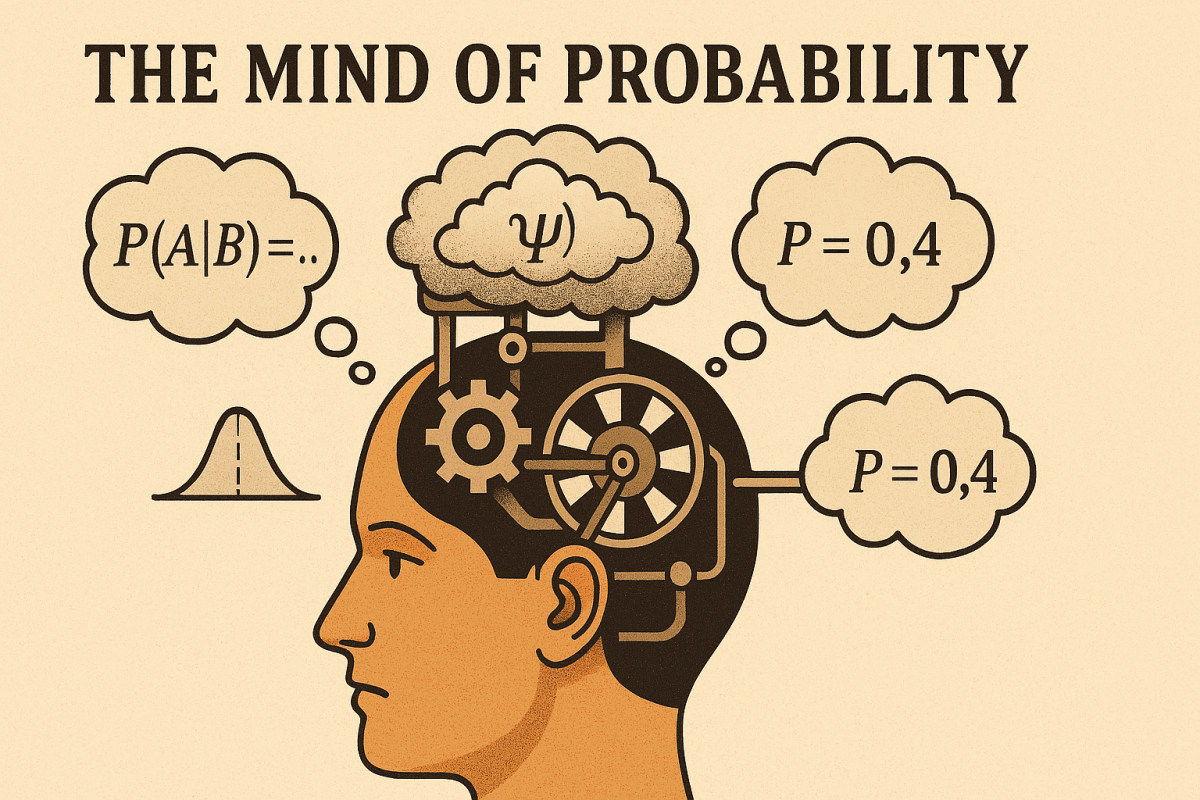
The contestation over the definition of probability is alive and well—like a philosophical zombie that refuses to lie down and accept the tranquilliser of consensus. Despite over three centuries of intense mathematical, philosophical, and even theological wrangling, no single, universally accepted definition reigns supreme. Instead, we have a constellation of rival interpretations, each staking its claim on the epistemological turf, each clutching its own metaphysical baggage.
Audio: NotebookLM podcast on this topic.
Let us survey the battlefield:
1. Classical Probability (Laplacean Determinism in a Tuxedo)
This old warhorse defines probability as the ratio of favourable outcomes to possible outcomes, assuming all outcomes are equally likely. The problem? That assumption is doing all the heavy lifting, like a butler carrying a grand piano up five flights of stairs. It’s circular: we define probability using equiprobability, which itself presumes a notion of probability. Charming, but logically suspect.
2. Frequentist Probability (The Empiricist’s Fantasy)
Here, probability is the limit of relative frequencies as the number of trials tends to infinity. This gives us the illusion of objectivity—but only in a Platonic realm where we can conduct infinite coin tosses without the coin disintegrating or the heat death of the universe intervening. Also, it tells us nothing about singular cases. What’s the probability this specific bridge will collapse? Undefined, says the frequentist, helpfully.
3. Bayesian Probability (Subjectivity Dressed as Rigor)
Bayesians treat probability as a degree of belief—quantified plausibility updated with evidence. This is useful, flexible, and epistemically honest, but also deeply subjective. Two Bayesians can start with wildly different priors and, unless carefully constrained, remain in separate probabilistic realities. It’s like epistemology for solipsists with calculators.
4. Propensity Interpretation (The Ontology of Maybes)
Karl Popper and his ilk proposed that probability is a tendency or disposition of a physical system to produce certain outcomes. Sounds scientific, but try locating a “propensity” in a particle collider—it’s a metaphysical ghost, not a measurable entity. Worse, it struggles with repeatability and relevance outside of controlled environments.
5. Logical Probability (A Sober Attempt at Rationality)
Think of this as probability based on logical relations between propositions—à la Keynes or Carnap. It aims to be objective without being empirical. The problem? Assigning these logical relations is no easier than choosing priors in Bayesianism, and just as subjective when it comes to anything meaty.
6. Quantum Probability (Schrödinger’s Definition)
In quantum mechanics, probability emerges from the squared modulus of a wave function—so this is where physics says, “Shut up and calculate.” But this doesn’t solve the philosophical issue—it just kicks the can into Hilbert space. Interpretations of quantum theory (Copenhagen? Many Worlds?) embed different philosophies of probability, so the contestation merely changes battlegrounds.
Current Status: War of Attrition
There is no universal agreement, and likely never will be. Probability is used successfully across the sciences, economics, AI, and everyday reasoning—but the fact that these wildly different interpretations all “work” suggests that the concept is operationally robust yet philosophically slippery. Like money, love, or art, we use it constantly but define it poorly.
In short: the contestation endures because probability is not one thing—it is a shape-shifting chimera that serves multiple masters. Each interpretation captures part of the truth, but none hold it entire. Philosophers continue to argue, mathematicians continue to formalise, and practitioners continue to deploy it as if there were no disagreement at all.
And so the probability of this contest being resolved any time soon? About zero. Or one. Depending on your interpretation.
My reaction to Yuval Noah Harari’s Nexus continues with Chapter 4, “Errors: The Fantasy of Infallibility.” Spoiler alert: Harari makes a critical misstep by overly defending so-called self-correcting institutions compared to non-self-correcting ones.
Harari provides a solid account of how religious institutions and other dogmatic ideological constructs are slow to change, contrasting them with relatively faster self-correcting systems like science. Once again, he underscores the tension between order and truth—two critical dimensions in his worldview and cornerstones of Modernist beliefs.
Audio: Podcast conversation on this topic.
I agree with Harari that the lack of self-correction in institutions is problematic and that self-correction is better than the alternative. However, he overestimates the speed and efficacy of these self-correcting mechanisms. His argument presumes the existence of some accessible underlying truth, which, while an appealing notion, is not always so clear-cut. Harari cites examples of scientific corrections that took decades to emerge, giving the impression that, with enough time, everything will eventually self-correct. As the environment changes, corrections will naturally follow—albeit over long spans of time. Ultimately, Harari makes a case for human intervention without recognising it as an Achilles’ heel.
Harari’s Blind Spot
Harari largely overlooks the influence of money, power, and self-interest in these systems. His alignment with the World Economic Forum (WEF) suggests that, while he may acknowledge its fallibility, he still deems it “good enough” for governance. This reflects a paternalistic bias. Much like technologists who view technology as humanity’s salvation, Harari, as a Humanist, places faith in humans as the ultimate stewards of this task. However, his argument fails to adequately account for hubris, cognitive biases, and human deficits.
The Crux of the Problem
The core issue with Harari’s argument is that he appears to be chasing a local maxima by adopting a human-centric solution. His proposed solutions require not only human oversight but the oversight of an anointed few—presumably his preferred “elite” humans—even if other solutions might ultimately prove superior. He is caught in the illusion of control. While Harari’s position on transhuman capabilities is unclear, I suspect he would steadfastly defend human cognitive superiority to the bitter end.
In essence, Harari’s vision of self-correcting systems is optimistic yet flawed. By failing to fully acknowledge the limits of human fallibility and the structural influences of power and self-interest, he leaves his argument vulnerable to critique. Ultimately, his belief in the self-correcting nature of human institutions reflects more faith than rigour.
As the clock ticks us into 2025, a peculiar tale has surfaced in the blogosphere: a dark twist on the classic fable of the “wolf in sheep’s clothing,” served with a side of nihilistic absurdity. If you haven’t read it yet, you can find the original story over at Blog for Chumps. It’s a biting little narrative that turns traditional moralising on its head. Here’s why it deserves your attention.
Audio: NotebookLM Podcast on this topic.
The Tale in Brief
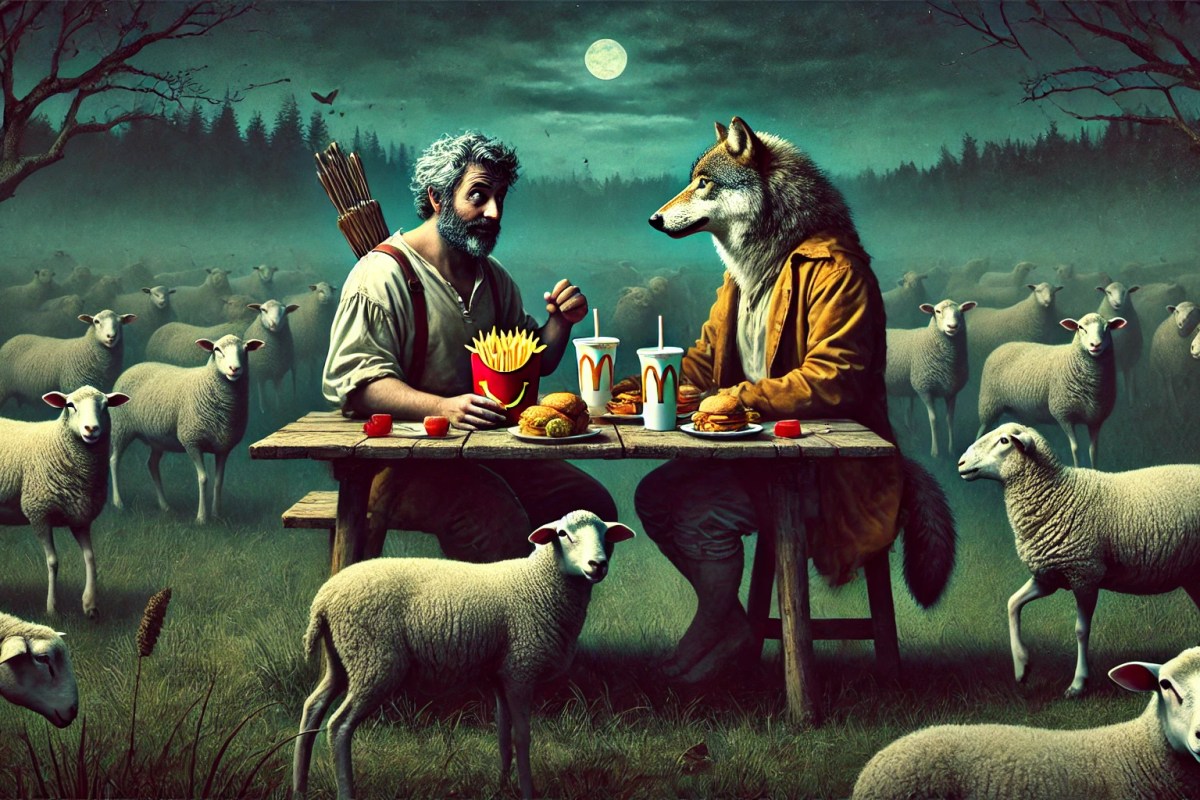
A hungry wolf, tired of dodging vigilant shepherds, decides to forgo subterfuge altogether. He waltzes into the flock, making no effort to hide his predatory nature. A naïve lamb follows him, and predictably, the wolf claims his meal. Later, the wolf returns to the sheepfold, where the shepherd — instead of protecting his flock — teams up with the wolf. Together, they butcher a sheep before abandoning the scene entirely to indulge in McDonald’s, leaving the traumatised sheep to accept their grim new reality.
Not exactly bedtime reading for the kids.
Themes: A Cynical Mirror to Our World
This tale is not merely a grotesque subversion of pastoral simplicity; it’s a scalpel slicing into the rotting carcass of modern society. Here’s what lurks beneath its woolly surface:
1. Cynicism Towards Authority
In most fables, the shepherd embodies protection and care. Here, he’s a collaborator in senseless violence. The shepherd’s betrayal critiques the notion of benevolent authority, suggesting that those entrusted with safeguarding the vulnerable often act in their own interests or, worse, align themselves with destructive forces. Sound familiar? Think political complicity, corporate greed, or any number of modern failures of leadership.
2. Normalisation of Atrocity
The sheep, described as cognitively intact, accept their grim reality without resistance. This isn’t a story about oblivious innocence; it’s about the horrifying human capacity to adapt to systemic violence. It reflects how people, faced with injustice, often acquiesce to their oppressors rather than challenge the status quo.
3. Inversion of Expectations
The wolf doesn’t even bother with the traditional sheepskin disguise. His audacity mirrors the brazen nature of modern exploitation, where bad actors operate in plain sight, confident in the public’s apathy or resignation. It’s a commentary on the erosion of shame, accountability, and even the pretence of decency.
4. Absurdity and Nihilism
The shepherd and wolf ditch their victim to grab fast food, trivialising the violence they’ve inflicted. The juxtaposition of archaic brutality with banal consumerism is absurd yet disturbingly resonant. It suggests that, in our era, even cruelty can be relegated to a footnote in the pursuit of comfort or convenience.
Symbols: Layers of Meaning
The tale brims with symbolic resonance:
The Wolf: A stand-in for unchecked greed or predatory systems, the wolf’s brazen behaviour highlights the dangers of apathy and unchallenged power.
The Shepherd: His betrayal symbolises the failure of institutions — governments, corporations, or other entities — to protect those they claim to serve.
The Sheep: Far from being simple-minded, the sheep’s acceptance of their grim new reality is a biting critique of societal complacency.
McDonald’s: A modern symbol of triviality and consumerism, it underscores the absurdity of senseless violence in a world driven by shallow comforts.
A Stark Commentary on Power Dynamics
At its core, the story is a brutal satire of power and complicity. Though ostensibly adversaries, the shepherd and wolf unite to exploit the powerless. It’s a chilling reminder of how often power structures protect their own interests at the expense of the vulnerable.
The sheep’s passive acceptance is equally damning. It forces readers to confront their own role as silent witnesses or even complicit actors in systems of oppression. What happens when we’re no longer shocked by atrocity but instead integrate it into the fabric of our existence?
The Satirical Edge
What makes this story particularly effective is its dark, sardonic, and unapologetically hyperbolic tone. It revels in absurdity while delivering a grim truth about human nature. The shepherd and wolf’s nonchalance is as hilarious as it is horrifying, making the tale an unsettling mirror of a society where injustice and apathy often go hand in hand.
Final Thoughts
This fable may be short, but its implications are vast. It’s a cautionary tale about the dangers of complacency, the betrayal of trust, and the absurdity of modern priorities. More importantly, it’s a call to resist the normalisation of harm — to recognise wolves and shepherds for what they are and demand better from ourselves and those in power.
So, as we usher in a new year, let this tale serve as a grim reminder: the wolf doesn’t always need a disguise, and the shepherd isn’t always your friend. Sometimes, they’re just two blokes on their way to McDonald’s.
The cat is out. And it has been replaced by a weasel. Yes, dear reader, you’ve entered the strange, paradoxical world of Schrödinger’s Weasel, a universe where words drift in a haze of semantic uncertainty, their meanings ambushed and reshaped by whoever gets there first.
Now, you may be asking yourself, “Haven’t we been here before?” Both yes and no. While the phenomenon of weasel words—terms that suck out all substance from a statement, leaving behind a polite but vacuous husk—has been dissected and discussed at length, there’s a new creature on the scene. Inspired by Essentially Contested Concepts, W.B. Gallie’s landmark essay from 1956, and John Kekes’ counterpoint in A Reconsideration, I find myself stepping further into the semantic thicket. I’ve long held a grudge against weasel words, but Schrödinger words are their sinister cousins, capable of quantum linguistic acrobatics.
To understand Schrödinger words, we need to get cosy with a little quantum mechanics. Think of a Schrödinger word as a linguistic particle in a state of superposition. This isn’t the lazy drift of semantic shift—words that gently evolve over centuries, shaped by the ebb and flow of time and culture. No, these Schrödinger words behave more like quantum particles: observed from one angle, they mean one thing; from another, something completely different. They represent a political twilight zone, meanings oscillating between utopia and dystopia, refracted through the eye of the ideological beholder.
in the realm of Schrödinger’s Weasel, language becomes a battlefield where words are held hostage to polarising meanings
Take socialism, that darling of the Left and bugbear of the Right. To someone on the American political left, socialism conjures visions of Scandinavia’s welfare state, a society that looks after its people, where healthcare and education are universal rights. But say socialism to someone on the right, and you might find yourself facing the ghost of Stalin’s Soviet Union – gulags, oppression, the Cold War spectre of forced equality. The same word, but two worlds apart. This isn’t simply a “difference of opinion.” This is linguistic quantum mechanics at work, where meaning is determined by the observer’s political perspective. In fact, in the case of Schrödinger words, the observer’s interpretation not only reveals meaning but can be weaponised to change it, on the fly, at a whim.
What, then, is a Schrödinger word? Unlike the classic weasel words, which diffuse responsibility (“some say”), Schrödinger words don’t just obscure meaning; they provoke it and elicit strong, polarised responses by oscillating between two definitions. They are meaning-shifters, intentionally wielded to provoke division and rally allegiances. They serve as shibboleths and dog whistles, coded signals that change as they cross ideological boundaries. They are the linguistic weasels, alive and dead in the political discourse, simultaneously uniting and dividing depending on the audience. These words are spoken with the ease of conventional language, yet they pack a quantum punch, morphing as they interact with the listener’s biases.
Consider woke, a term once employed as a rallying cry for awareness and social justice. Today, its mere utterance can either sanctify or vilify. The ideological Left may still use it with pride – a banner for the politically conscious. But to the Right, woke has become a pejorative, shorthand for zealous moralism and unwelcome change. In the blink of an eye, woke transforms from a badge of honour into an accusation, from an earnest call to action into a threat. Its meaning is suspended in ambiguity, but that ambiguity is precisely what makes it effective. No one can agree on what woke “really means” anymore, and that’s the point. It’s not merely contested; it’s an arena, a battlefield.
What of fascism, another Schrödinger word, swirling in a storm of contradictory meanings? For some, it’s the historical spectre of jackboots, propaganda, and the violence of Hitler and Mussolini. For others, it’s a term of derision for any political stance perceived as overly authoritarian. It can mean militarism and far-right nationalism, or it can simply signify any overreach of government control, depending on who’s shouting. The Left may wield it to paint images of encroaching authoritarianism; the Right might invoke it to point fingers at the “thought police” of progressive culture. Fascism, once specific and terrifying, has been pulled and stretched into meaninglessness, weaponised to instil fear in diametrically opposed directions.
Schrödinger’s Weasel, then, is more than a linguistic curiosity. It’s a testament to the insidious power of language in shaping – and distorting – reality. By existing in a state of perpetual ambiguity, Schrödinger words serve as instruments of division. They are linguistic magic tricks, elusive yet profoundly effective, capturing not just the breadth of ideological differences but the emotional intensity they provoke. They are not innocent or neutral; they are ideological tools, words stripped of stable meaning and retooled for a moment’s political convenience.
Gallie’s notion of essentially contested concepts allows us to see how words like justice, democracy, and freedom have long been arenas of ideological struggle, their definitions tugged by factions seeking to claim the moral high ground. But Schrödinger words go further – they’re not just arenas but shifting shadows, their meanings purposefully hazy, with no intention of arriving at a universally accepted definition. They are not debated in the spirit of mutual understanding but deployed to deepen the rift between competing sides. Kekes’ critique in A Reconsideration touches on this, suggesting that the contestation of terms like freedom and democracy still strives for some level of shared understanding. Schrödinger words, by contrast, live in the gap, forever contested, forever unresolved, their ambiguity cherished rather than lamented.
Ultimately, in the realm of Schrödinger’s Weasel, language becomes a battlefield where words are held hostage to polarising meanings. Their superposition is deliberate, their ambiguity cultivated. In this brave new lexicon, we see language not as a bridge of understanding but as a weapon of mass disinformation – a trick with all the precision of quantum mechanics but none of the accountability. Whether this ambiguity will one day collapse into meaning, as particles do when measured, remains uncertain. Until then, Schrödinger’s Weasel prowls, its meaning indeterminate, serving whichever agenda is quickest to claim it.
In an idealised vision of science, the laboratory is a hallowed space of discovery and intellectual rigour, where scientists chase insights that reshape the world. Yet, in a reflection as candid as it is disconcerting, Sabine Hossenfelder pulls back the curtain on a reality few outside academia ever glimpse. She reveals an industry often more concerned with securing grants and maintaining institutional structures than with the philosophical ideals of knowledge and truth. In her journey from academic scientist to science communicator, Hossenfelder confronts the limitations imposed on those who dare to challenge the mainstream — a dilemma that raises fundamental questions about the relationship between truth, knowledge, and institutional power.
I’ve also created a podcast to discuss Sabine’s topic. Part 2 is also available.
Institutionalised Knowledge: A Double-Edged Sword
The history of science is often framed as a relentless quest for truth, independent of cultural or economic pressures. But as science became more institutionalised, a paradox emerged. On the one hand, large academic structures offer resources, collaboration, and legitimacy, enabling ambitious research to flourish. On the other, they impose constraints, creating an ecosystem where institutional priorities — often financial — can easily overshadow intellectual integrity. The grant-based funding system, which prioritises projects likely to yield quick results or conform to popular trends, inherently discourages research that is too risky or “edgy.” Thus, scientific inquiry can become a compromise, a performance in which scientists must balance their pursuit of truth with the practicalities of securing their positions within the system.
Hossenfelder’s account reveals the philosophical implications of this arrangement: by steering researchers toward commercially viable or “safe” topics, institutions reshape not just what knowledge is pursued but also how knowledge itself is conceptualised. A system prioritising funding over foundational curiosity risks constraining science to shallow waters, where safe, incremental advances take precedence over paradigm-shifting discoveries.
Gender, Equity, and the Paradoxes of Representation
Hossenfelder’s experience with gender-based bias in her early career unveils a further paradox of institutional science. Being advised to apply for scholarships specifically for women, rather than being offered a job outright, reinforced a stereotype that women in science might be less capable or less deserving of direct support. Though well-intentioned, such programs can perpetuate inequality by distinguishing between “real” hires and “funded outsiders.” For Hossenfelder, this distinction created a unique strain on her identity as a scientist, leaving her caught between competing narratives: one of hard-earned expertise and one of institutionalised otherness.
The implications of this dilemma are profound. Philosophically, they touch on questions of identity and value: How does an individual scientist maintain a sense of purpose when confronted with systems that, however subtly, diminish their role or undercut their value? And how might institutional structures evolve to genuinely support underrepresented groups without reinforcing the very prejudices they seek to dismantle?
The Paper Mill and the Pursuit of Legacy
Another powerful critique in Hossenfelder’s reflection is her insight into academia as a “paper production machine.” In this system, academics are pushed to publish continuously, often at the expense of quality or depth, to secure their standing and secure further funding. This structure, which rewards volume over insight, distorts the very foundation of scientific inquiry. A paper may become less a beacon of truth and more a token in an endless cycle of academic currency.
This pursuit of constant output reveals the philosopher’s age-old tension between legacy and ephemerality. In a system driven by constant publication, scientific “advancements” are at risk of being rendered meaningless, subsumed by an industry that prizes short-term gains over enduring impact. For scientists like Hossenfelder, this treadmill of productivity diminishes the romantic notion of a career in science. It highlights a contemporary existential question: Can a career built on constant output yield a genuine legacy, or does it risk becoming mere noise in an endless stream of data?
Leaving the Ivory Tower: Science Communication and the Ethics of Accessibility
Hossenfelder’s decision to leave academia for science communication raises a question central to contemporary philosophy: What is the ethical responsibility of a scientist to the public? When institutional science falters in its pursuit of truth, perhaps scientists have a duty to step beyond its walls and speak directly to the public. In her pivot to YouTube, Hossenfelder finds a new audience, one driven not by academic pressures but by genuine curiosity.
This shift embodies a broader rethinking of what it means to be a scientist today. Rather than publishing in academic journals read by a narrow circle of peers, Hossenfelder now shares her insights with a public eager to understand the cosmos. It’s a move that redefines knowledge dissemination, making science a dialogue rather than an insular monologue. Philosophically, her journey suggests that in an age where institutions may constrain truth, the public sphere might become a more authentic arena for its pursuit.
Conclusion: A New Paradigm for Scientific Integrity
Hossenfelder’s reflections are not merely the story of a disillusioned scientist; they are a call to re-evaluate the structures that define modern science. Her journey underscores the need for institutional reform — not only to allow for freer intellectual exploration but also to foster a science that serves humanity rather than merely serving itself.
Ultimately, the scientist’s dilemma that Hossenfelder presents is a philosophical one: How does one remain true to the quest for knowledge in an age of institutional compromise? As she shares her story, she opens the door to a conversation that transcends science itself, calling us all to consider what it means to seek truth in a world that may have forgotten its value. Her insights remind us that the pursuit of knowledge, while often fraught, is ultimately a deeply personal, ethical journey, one that extends beyond the walls of academia into the broader, often messier realm of human understanding.
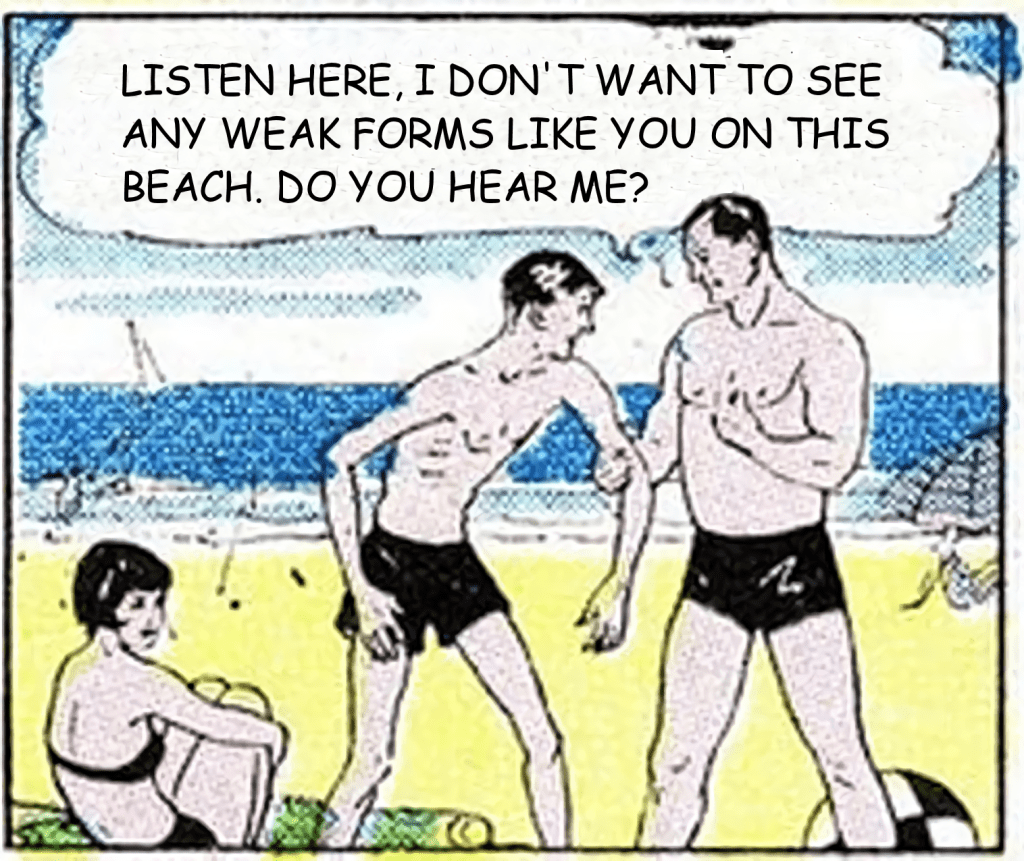
I have been so utterly distracted by YouTube this weekend. In this case, it’s a video by Dr Geoff Lindsey explaining weak forms of the English language.
Podcast: Audio rendition of this page content
Much of my work life involves speaking either with non-native English speakers or speakers of English who may be quite well versed in English and yet have a certain rigidity in their execution. Along with local accents, this makes the language feel unnatural to a native speaker.
A common challenge is the adoption of weak forms. Following the principle of least effort, language speakers are lazy. In fact, one may extrapolate this morphology to predict where language may drift next. One example that comes to mind is the American habit of uttering flap Ts over ‘real’ Ts that require slightly more effort to produce.
In English, one says the words, butter, water, doctor, and sister as /ˈbʌtə/,/ˈwɔtəɹ/, /ˈdɒktə/, /ˈsɪstə(ɹ)/ whilst in American English, using the flap T sound, one says (respelt in parentheses) /ˈbʌdəɹ/ (buhd-er), / ˈwɔdəɹ/ (wahd-er), /ˈdɔkdɚ/ (dok-der), /ˈsɪsdər/ (sis-der). Whether the pronunciation of the R is rhotic or non-rhotic is another issue altogether.
But this is about something a bit different. It’s about weak forms, particularly vowels that can be weakened from the strong vowel sound to the shwa (/ə/) sound. It turns out that we do this a lot. In fact, more often than not. Rather than a rehash from the video, I’ve cued it to where Tom Hiddleston recites Lord Byron’s So We’ll Go No More a Roving.
So, we'll go no more a roving
   So late into the night,
Though the heart be still as loving,
   And the moon be still as bright.

For the sword outwears its sheath,
   And the soul wears out the breast,
And the heart must pause to breathe,
   And love itself have rest.

Though the night was made for loving,
   And the day returns too soon,
Yet we'll go no more a roving
   By the light of the moon.
As it happens, much of the difference between native English and English as spoken by non-natives is the hyper-diction heard by choosing the strong rather than the weak form of certain words.







 Philosophics