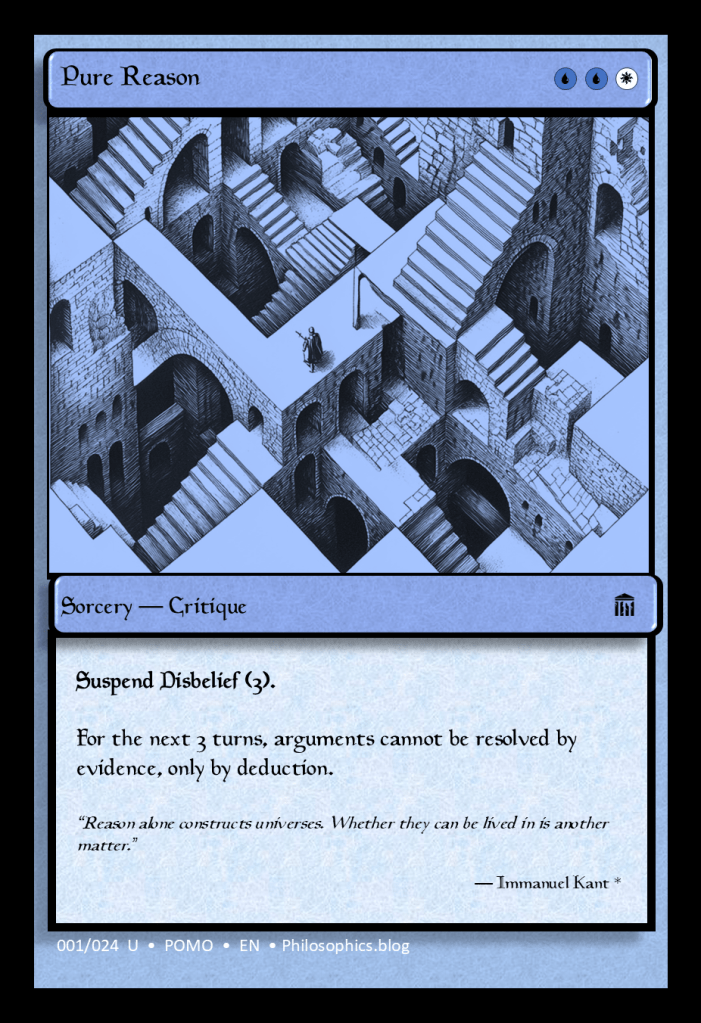
If reason had a landscape, it would look like this card: a maze of ascending and descending staircases, forever rational yet going nowhere. Kant might have called it a Critique of Pure Geometry.
Pure Reason, the first card in the Postmodern set, isn’t so much an homage to Kant as it is a cautionary reconstruction. It honours his ambition to build a universe from deduction while quietly mourning the price of that construction: alienation from experience.
Image: Card 001 from the Postmodern Set — Philosophics.blog
The Meta
Suspend Disbelief (3). For the next three turns, arguments cannot be resolved by evidence, only by deduction.
Audio: NotebookLM podcast of this topic.
The rule text re-enacts Kant’s method. In the Critique of Pure Reason, he cordoned off the realm of empirical evidence and tried to chart what the mind could know a priori – before experience. The card’s mechanic enforces that isolation. For three turns, players must reason in a vacuum: no appeals to observation, no touchstones of reality, only deduction.
It’s a temporary world built entirely of logic, an echo of the transcendental playground Kant envisioned. The effect is powerful but sterile – thought constructing universes that can’t sustain life.
The flavour text says it plainly:
“Reason alone constructs universes. Whether they can be lived in is another matter.”
— Immanuel Kant
That line, of course, is apocryphal, but it captures the essence of his project: reason as world-maker and prison architect in one.
The Architecture of Thought
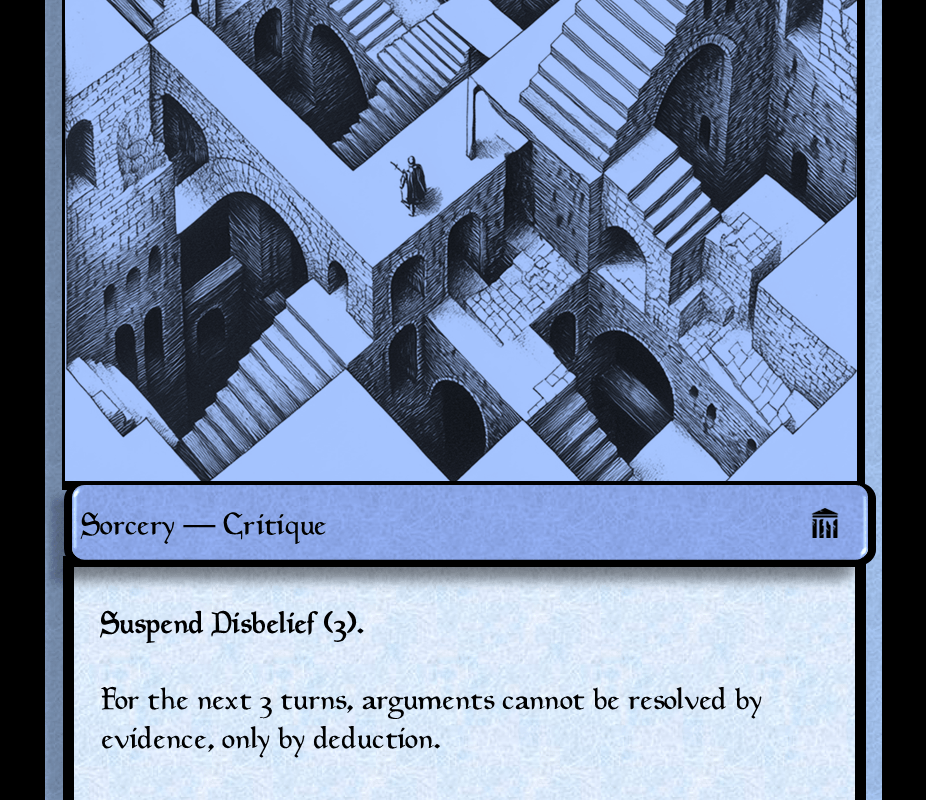
The artwork mirrors Escher’s impossible staircases – a labyrinth of pure geometry, ordered yet uninhabitable. Each path is internally consistent, logically sound, but spatially absurd. This is Kant’s transcendental edifice made visual: coherent on paper, dizzying in practice.
The lone figure standing in the maze is the transcendental subject – the philosopher trapped within the architecture of his own cognition. He surveys the world he has built from categories and forms, unable to escape the walls of his own reason.
It’s a neat metaphor for Enlightenment hubris: the belief that reason can serve as both foundation and roof, requiring no support from the messy ground of existence.
Kant’s Double Legacy
Kant’s Critique was both the high point and the breaking point of Enlightenment rationality. It erected the scaffolding for science, ethics, and aesthetics but revealed the fault lines beneath them. His insistence that the mind structures experience rather than merely reflecting it gave birth to both modern idealism and modern doubt.
Every philosopher after him – Hegel, Nietzsche, Husserl, Derrida – has been trying either to escape or to inhabit that labyrinth differently. Pure Reason captures this tension: the glory of construction and the tragedy of confinement.
My Take
Reason is a magnificent liar. It promises order, clarity, and autonomy, but its perfection is its undoing. It abstracts itself from life until it can no longer recognise its own maker. Kant’s world is flawless and airless – a rational utopia unfit for breathing creatures.
I view Pure Reason as the archetype of the Enlightenment illusion: the attempt to found a living world on the logic of dead forms. What he achieved was monumental, but the monument was a mausoleum.
The card, then, is not just a tribute to Kant but a warning to his descendants (ourselves included): every system of thought eventually turns into an Escher print. Beautiful, consistent, and utterly unlivable.
When I was seriously exploring music, I started from the artists I enjoyed and searched their roots and influences and cascaded back. In the 1970s, this was to look at the roots of Eric Clapton, Jimmy Page, and Keith Richards. I’d be brought back to James Burton or Elmore James; I’d find Robert Johnson, BB King, Muddy Waters and Hubert Sumlin (Howlin’ Wolf); and I’d find John Lee Hooker, and Chuck Berry. And then, I’d dg further to find Son House, T-Bone Walker, and Big Bill Broonzy. Although I grew to appreciate these originals, I still preferred the reinvigorated versions of my youth.
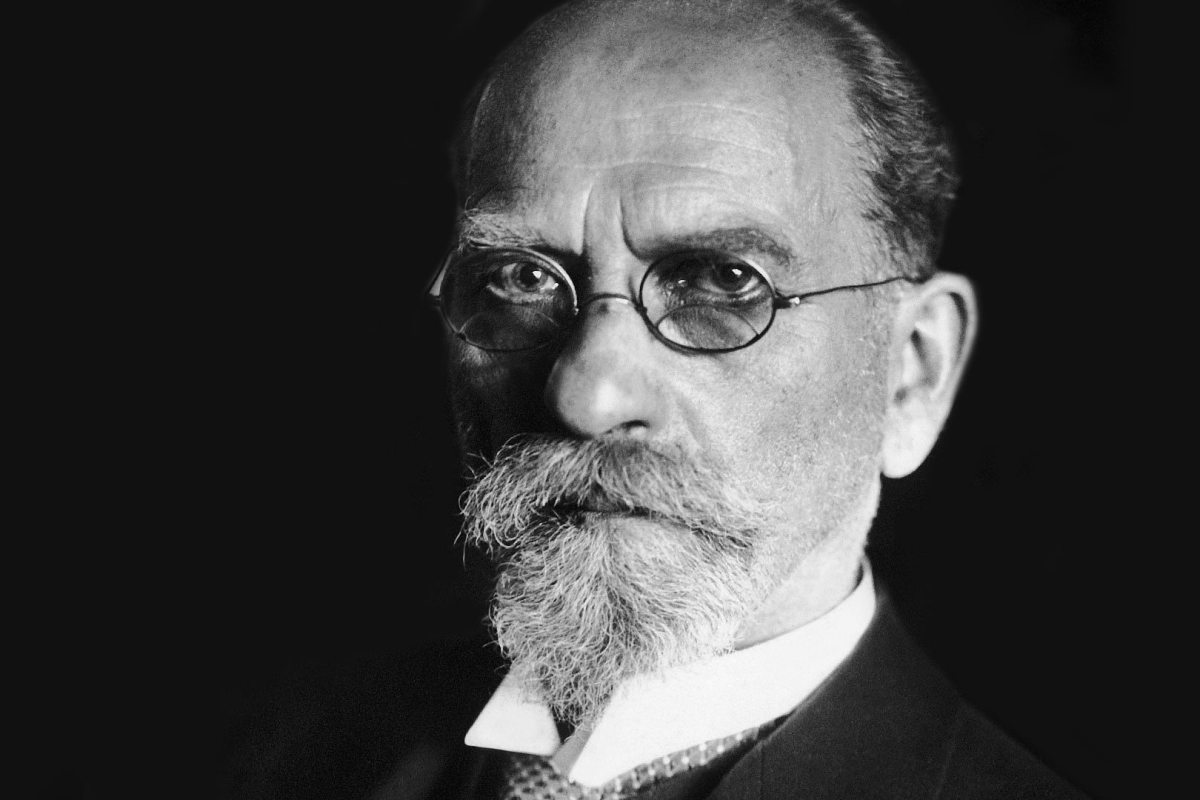
In philosophy, I seem to have taken a somewhat similar path. In particular, it’s a journey back to Husserl. I was exposed to essence and being most probably through Sartre. this brought me to Heidegger that brought me to Husserl. To be fair there was a large gap between Sartre and Heidegger and a fairly long gap from then until Husserl. I’ve come upon Husserl’s name time and again but I deprioritised him, He seemed always to be the AND of Heidegger, sort of like how Garfunkel was the AND of Simon.
But I thought that Heidegger was the root—the source, as Son House might have been to the Blues. Given the connection of Husserl and Heidegger, I’m not sure that Dasein‘s genesis is clear cut. Moreover, I believe it’s a pedestrian German world, that fancy pants academes wish to evermore preserve in amber as a stand-in to being there, though Heidegger insisted that the meaning was more nuanced and in some way I could consider that it prefigured Derrida’s privileged pairs highlighted in his Deconstruction.
I’ve commenced reading Husserl’s’ Ideas, and my takeaway at this point is his eidetic facts.

 Philosophics