I must have missed the memo. Disinterested has merged into uninterested. Disinterested used to mean you mean impartial; now it means not interested. Whereas uninterested means not interested in a topic.
I am not strictly a prescriptivist when it comes to language, but it does provide a certain level of efficiency in communication. Descriptively, one needs to interpret conversation through some local lens, but one can’t persist a description for too long because it might have drifted the next time you try to apply it. Imagine having to negotiate meaning and intent every time we engage in communication.
Uninterested means not interested in a topic.
A car was a vehicle last week, but those are now called ABC because this week car means XYZ—only to have to reevaluate this shared meaning in the next contextual engagement.
Disinterested used to mean not being interested in the outcome.
Disinterested used to mean not being interested in the outcome. But that’s changed. It seems that now, in order to provide clarity of communication, we need to use the word impartial so as not to introduce the ambiguity now embedded in disinterested.
Recently, I was speaking with a well-educated linguaphile, and I mentioned that I was looking for a disinterested person to mediate a debate. This man is in his eighties, yet he immediately interpreted disinterested as uninterested. When I shared my understanding of the meaning, he conveyed that he was unfamiliar with that parsing. This came as a surprise to me because he is a psychiatrist and psychoanalyst—quite the word wordsmith in a Jungian sort of way. I presumed that he would have understood the distinction and nuance in the interpretation. Once I clarified, he adopted my meaning—at least within the scope of our conversation. This said, I might drop disinterested from my vocabulary altogether. I’ll retain uninterested in the way a always have, and I’ll employ impartial where I would have heretofore employed disinterested.
Did you get this memo? Do you use disinterested and uninterested as close synonyms or do you retain the nuance?
“There is no spoon” is a classic line from The Matrix. Reality is a construct. I agree, but I’m not sure I believe that we can get under this reality to experience it differently. And this might hinge on a distinction between experience and perception.
Losing Ourselves is a book just published in the US and forthcoming (July 2022) in the UK promoting the Buddhist notion of no-self or selflessness. I’ve been partial to Buddhism since, when I lived outside of Tokyo, I was exposed to it in 1980.
Book Cover: Losing Ourselves
For me, this intersects with my anti-Agency endeavour. If the Self is a construct, there is no Agent, and without an agent, there is no Agency. I realise that this is a meta-position and not uncontroversial, but I do like to collect ideas and perspectives in my quiver.
Obviously, there seems to be a strong drive (at least in the West) to construct selves, not the least of which serves the purpose of an object to confer praise or blame. Interestingly, I’ve heard much about objectification, but not many seem to care about this form. It’s more about sub-objectification.
It’s OK to parse the person from the fabric of the universe, but don’t further disintegrate that person.
The self is a construction. Although we can form memories at an early age, this is possibly why we can’t remember our earliest years, as our sense of self had yet to be constructed and realised. Not all people construct or even define ‘self’ in the same way, per Strawson’s ‘selves’ and other notions of selflessness.
I understand when Strawson (and others) says he does not feel the same sense of continuity as others with strong senses of self believe. I don’t know what a person, who truly believes in selflessness or the total denial of the self, feels—a person who totally embodies the Buddhist concept that everything is one and any division is an illusion.
In the West, there are entire industries fleecing the public of billions upon billions of dollars on the notion of the self, strengthening the self and how others perceive one’s self from an outside-in perspective—psychology and its progeny of self-help reaping the lion’s share.
For the record, although I agree with both Strawson’s and the Buddhist perspective, I am still under the illusion (as I am with agency) that I have a self and agency. Unlike the Neo character in The Matrix, I haven’t discovered how to break the illusion to find the man behind the curtain, but I do feel a sense of discontinuity or lack of contiguity.
Einstein was wrong. Time is not the relative factor in space-time. Space is. Time is constant. Here’s a lecture on the topic of the book.
Lee Smolin Public Lecture: Time Reborn
As a result of a discussion with a colleague, on the possibility of variability or mutability of so-called physical laws, he recommended Lee Smolin’s book Time Reborn: From the Crisis in Physics to the Future of the Universe. He mentioned that it would be suitable as an audiobook. Since I had a credit on Audible, I decided to use it so I could listen to this without deep scrutiny and a need for taking notes.
There is a nice review in the Guardian from 2013. I suppose I am a bit behind the times.
Whilst running errands, I listened to the Preface and Introduction. I stopped at the start of the first chapter, and am debating whether to continue. Given his setup, I don’t believe I am Smolin’s target audience. Many of the beliefs he is attempting to dispel, I already don’t hold. Yet I don’t feel that I need to hold time as a constant to hold them. He seems to feel otherwise.
Preface
For the record, Lee Smolin is a theoretical physicist, who has written several books in this space. Quickly, recapping some of his points:
He provides examples of various illusions humans tend to be swayed by:
Matter appears to be smooth but turns out to be made of atoms
Atoms seem indivisible but turn out to be built of protons, neutrons, and electrons
Protons and neutrons are further made of still more elementary particles called quarks
The sun appears to go around the Earth, but it’s the other way around
Smolin relates that the prevailing perspective today is that time is an illusion—name-dropping Plato and Einstein, who hold this view. He conveys that he used to share this belief, but now he disagrees—whence the book. He tells us:
Not only is time real, but nothing we know or experience gets closer to the heart of nature than the reality of time.
— Lee Smolin, Time Reborn
Next, he posits that some people believe in timeless events—events outside of time, eternal and not a function of time. Here’s where he goes off the rails in my book.
“We perceive ourselves as living in time, yet we often imagine that the better aspects of our world and ourselves transcend it. What makes something really true, we believe, is not that it is true now but that it always was and always will be true.”
Evidently, he feels or felt this way. I am sure many others. I am not among them.
“What makes a principle of morality absolute is that it holds in every time and every circumstance.”
My position is that all morality is a social construct, so this doesn’t resonate with me.
“We seem to have an ingrained idea that if something is valuable, it exists outside time.”
Again, I am not in his intended audience.
“We yearn for “eternal love.” We speak of “truth” and “justice” as timeless.”
Love, truth, and justice are all human constructs—weasel words.
“Whatever we most admire and look up to — God, the truths of mathematics, the laws of nature — is endowed with an existence that transcends time. We act inside time but judge our actions by timeless standards.”
Yet again, I am unburdened by these beliefs.
Nothing transcends time, not even the laws of nature. Laws are not timeless. Like everything else, they are features of the present, and they can evolve over time.
— Lee Smolin, Time Reborn
I think that this quote is a reason this book was recommended to me. I do believe that the properties that comprise laws can evolve over time. I’m not sure if this is by a probabilistic process or something else. There are a few possible implications. One is that the laws at the onset of the universe may have been different, making the understanding of that time more challenging if not impossible. I don’t know if I believe in multiverses, and I doubt I may ever live long enough to discover. However, even if there is only one universe, per the name, perhaps universes can exist sequentially and when one dies another appears with a different set of initial conditions and properties. Borrowing from evolution, perhaps these survive or perish based on the viability of this combination.
Smolin goes on to posit that, ‘thinking in time is not relativism but a form of relationalism‘.
He continues,
“Truth can be both time-bound and objective when it’s about objects that exist once they’ve been invented, either by evolution or human thought.”
— Lee Smolin, Time Reborn
I’m not sure he is going to define truth, but I believe he conflates moral truths with axiomatic or tautological truths. Perhaps it doesn’t matter because both are constructed.
Smolin makes it clear that he is not a determinist, but unless you take the view he is proposing, as a physicist, you almost have to be. As he says regarding Determinism, theoretically. a person could suss out a mathematical equation to predict every future event. He also considers this belief to be a metaphysical vestige of religion.
Introduction
According to [the] dominant view, everything that happens in the universe is determined by a law, which dictates precisely how the future evolves out of the present. The law is absolute and, once present conditions are specified, there is no freedom or uncertainty in how the future will evolve.
— Lee Smolin, Time Reborn
He continues to describe a deterministic system without mentioning indeterminism, which may be a more prominent belief given what we understand about quantum mechanics. He claims that this perspective diminishes time for several reasons. Inflating or at least elevating time is important for his thesis, and I am thinking that this is more an act of wishful thinking.
He takes a stab at the inherent reductionism of physics—it reduces everything to parts until there are no longer subparts, at which point the process fails—and explains that by adopting this approach, one needs to get outside of the universe to make some evaluations, but this is impossible. And this might be a true statement, but so what? The answer is not to make up a story that creates an environment where that’s no longer necessary.
Smolin reiterates over and again about timeless laws in a time-bound universe, but I question his notion of timelessness. He admits that he has no grand theory—just an idea he hopes others can pursue and build upon. Emergent properties appear to be an emerging theme.
Leibniz is next up, in particular his principle of sufficient reason. Leibniz’ vision is a relational universe composed of a network of relationships—the space is simply the absence of things. He contrasts this with Newton’s view that space is absolute and serves as the container for things. He sets up a future chapter that he says establishes that Leibniz’ vantage precludes the possibility of absolute time, but I don’t see this as a challenge for those of us who believe that time is constructed in the first place.
The Newtonian view prevailed until Einstein resurrected Leibnitz with his general relativity theory of space and time. The trending vogue is about relationalism, whether biology or information science.
He cites the challenges of maintaining Locke’s views on autonomy and personal liberties in a deterministic world (again leaving indeterminism unmentioned).
And he’s back on the emergence of emergence. (I was in the midst of writing a post on emergence when this interrupted my flow. I suspect it should be forthcoming in time.)
Falling
As it turned out, I ran another errand and listened to the first chapter of part 1. It is about gravity and parabolas, but I shan’t recount it here, save to note that he seems to be of the opinion that many people have the desire to transcend the bounds of human life. He may be right. I am not one of these people.
Happiness was never important. The problem is that we don’t know what we really want. What makes us happy is not to get what we want. But to dream about it. Happiness is for opportunists. So I think that the only life of deep satisfaction is a life of eternal struggle, especially struggle with oneself. We all remember Gordon Gekko, the role played by Michael Douglas in Wall Street. What he says, breakfast is for wimps, or if you need a friend buy yourself a dog. I think we should say something similar about happiness. If you want to remain happy, just remain stupid. Authentic masters are never happy; happiness is a category of slaves.
— Slavoj Žižek (Guardian Web Chat, 6 October 2014 (revised 8 October 2014))
I agree with most of Žižek’s sentiment here. I dissect it into four elemental blocks, three of which I care about.
Žižek talks Happiness
Element One
Happiness was never important. The problem is that we don’t know what we really want. What makes us happy is not to get what we want. But to dream about it. Happiness is for opportunists.
Seeking happiness is similar to the enterprise seeking growth. Like growth, happiness is an outcome or a side effect. There is no sense in pursuing it for its own sake.
Herbert Simon noted in the mid-1950s that people satisfice—a portmanteau of satisfying and sufficing—rather than optimise. Behavioural economics has run with this in the past few decades.
The challenge is that people don’t know what they want, so they are easy prey for marketers hoping to attract their interest. These are the opportunists.
Most people tend to behave like they are on rudderless ships easily buffeted this way and that. Easily lured by the call of the sirens, the call of marketers and other hucksters peddling happiness. There is the occasional Odysseus cum Ulysses, the metaphor for restraint—but not of self-control because even Homer realised how ridiculous of a notion that is.
Self-help and fashion industries extract billions from not-quite happy consumers who buy into the false promises and hype. Social media is toxic with these same promises, like the life coach earning some 30K a year dispensing advice.
You need to dream. Dream big. Such and such and so and so had dreams, and look at them. If they didn’t have a dream, they wouldn’t have attained whatever it was they had dreamed. These other losers? They don’t have the right dreams or they aren’t big enough. The universe isn’t going to pay attention to small dreams. You need to attract its attention. Perhaps, these other people just don’t know how to dream. They aren’t doing it right. But I can teach you how to dream for a few shekels.
The problem is that research shows that happiness—by whatever measure—is fleeting. And it fleets fast—usually a matter of weeks. Some people have dispositions that facilitate their happiness. It just takes less for these people to be content. Perhaps they define happiness subjectively as being content. Maybe your threshold is too high. Maybe they are kidding themselves. Does it matter? Perhaps they are not comparing themselves with others, the root of unhappiness.
John Lennon penned a lyric, dream, dream away. What more can I say?
Element Two
So I think that the only life of deep satisfaction is a life of eternal struggle, especially struggle with oneself.
I disagree with Žižek here, but perhaps I am deluding myself. I don’t subscribe to the notions of self or of identity. These are fictions. Finding oneself is just as much a distraction as anything else. You might do this, read books, write blogs, play piano, play cricket, learn Tai Chi, or drink chai tea.
This is where I find myself at odds with Existentialist—the philosophers who admit that there is no meaning to life but who insist people must make it, e.g., Sartre with politics, Camus with Art, or Kierkegaard with his personal religious experience.
Element Three
We all remember Gordon Gekko, the role played by Michael Douglas in Wall Street. What he says, breakfast is for wimps, or if you need a friend buy yourself a dog. I think we should say something similar about happiness.
I’ve got nothing to write here, which is why I left it out of the graphic. Go buy yourself a dog.
Element Four
If you want to remain happy, just remain stupid. Authentic masters are never happy; happiness is a category of slaves.
This is an obvious nod to Nietzsche and his master and her aesthetic. Masters have their own ethics and outlook, but the pursuit or maintenance and appearance of power are more important than happiness. The herd, which is to say most people, seek the elusive goal of happiness.
Abortion rights and a woman’s right to choose are on quick repeat in the latest news cycles as the SCOTUS has signalled that it wished to remove a woman’s right to choose. For most of us, it’s plainly obvious that this is codifying religious moral doctrine into law—Judeo-Christian beliefs to be more precise. This Christian belief is predicated on the notion that life is sacred.
In the West or at least in the United States citizens are inundated with this religious tripe, literally from infancy. It’s presented as sacrosanct, but this is not a universal belief.
One of my favourite stories in David Graeber’s Debt: The First 5,000 Years was the recounting of French philosopher Lucien Levy-Bruhl’s anecdotal observation that a man saved from drowning proceeded to ask his rescuer for remuneration for having saved his life.
As Graeber puts it, a man saved from drowning who proceeded to ask his rescuer to give him some nice clothes to wear, or another who, on being nursed back to health after having been savaged by a tiger, demanded a knife. One French missionary working in Central Africa insisted that such things happened to him on a regular basis:
You save a person’s life, and you must expect to receive a visit from him before long; you are now under an obligation to him, and you will not get rid of him except by giving him presents.
In the early decades of the twentieth century, the French philosopher Lucien Levy-Bruhl, in an attempt to prove that “natives” operated with an entirely different form of logic, compiled a list of similar stories: for instance, of a man saved from drowning who proceeded to ask his rescuer to give him some nice clothes to wear, or another who, on being nursed back to health after having been savaged by a tiger, demanded a knife.
The interesting thing for me is the way this flips the sanctity of life narrative on its head. As Westerners, it is not only beat into our heads—whether secular or sectarian—, and this sanctity becomes the crux of the pro-life [sic] anti-abortion argument. But this sanctity is just another human construct. Part of the ‘be fruitful, go forth and multiply’ logic. This is arguably just more human hubris.
Of course, this is a slippery slope. Start undermining this narrative, and you start to see eugenic apologists coming out of the woodwork. In fact, we aren’t really that far removed from this notion. Whenever we encounter common enemies, one of the first tactics is to vilify and dehumanise them, so as to soothe the psyche, making it justify killing these subhuman species. In the end, the human mind is very facile.
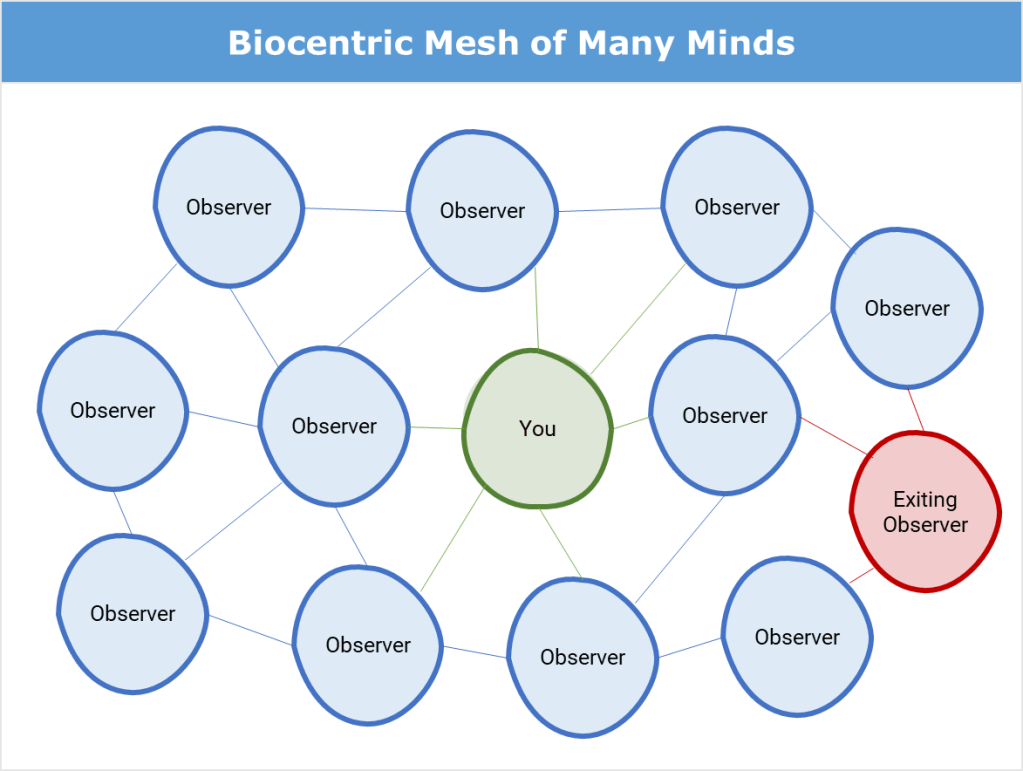
Perhaps, and as much as I see social aspects as constructed, I wouldn’t count on reality being constructed whole cloth from a web of observers. This is ostensibly what Robert Lanza’s biocentric view attempts to say. I’m not buying it.
Biocentric Mesh of Many Minds
As I understand it—admittedly from a single BigThink article, so there’s that—Lanza is trying to one-up Descartes and jump into the domain of Wittgenstein’s many minds conundrum. I suppose that this is another dualistic theory, but I am not likely to spend many cycles on it in the near term.
My question is that if at Time0, a reality is projected—my word—by the many minds, and at Time1, You enter the picture, and at Time2, the Exiting Observer is leaving the picture. how is reality shaped by these events? And are they events, or are they merely imagined? Is this an entirely solipsistic endeavour? Is this like Star Trek’s Borg? You will be assimilated. Resistance is futile.
Borg: You will be assimilated. Resistance is futile.
This also feels a lot like Jung’s Collective Unconscious on steroids. I’ll stop commenting here for now and consider this nothing more than a distraction. And I am not ready to jump on a panpsychism bandwagon any time soon.
An idea that Galen Strawson mentions is that of the self and the case of self and selves. I’ll presume he also considers the case of no-self, but I haven’t heard his position on this—at least not yet.
About the No-Self
In the East, Buddhism teaches the notion of no-self or non-self. Anattā (अनत्ता) captures the idea of the everchanging. By this doctrine, nothing is permanent. Any separation from this is merely an illusion. In principle, this leads to the Four Noble Truths:
Life is suffering
Suffering is due to attachment
This attachment can be overcome
There is a path to achieve this (the eight-fold path)
Life just is suffering.
There are many incantations of this, but these four capture the essence. The points here are that life just is suffering. No one escapes this fate—not wealth nor power—because we become attached to these things. The self (or Ego) is another attachment. In identity politics, people tend to get upset when you don’t accept or at least identify with their self-perception. Personally, I don’t believe in identity, but I understand how it is meant idiomatically, so I can operate in this space.
About the Selves
What Strawson says (at the risk of misinterpreting him egregiously), is we have many selves. We are a composite of time slices. As he quipped, each Planck time moment is a new self. We tend to construct these selves into a single self—I suppose in the manner that a 2-hour film shot at 60 frames a second would consist of 432,000 frames and yet have a continuity analogous to a self.
Self, No-Self, Selves Depictions
About the Self
In the West, the notion of self is as ubiquitous and uncritically accepted as rights, private property, and Democracy. As their Declaration of Independence reads, some things are self-evident. This self is obviously constructed, so let’s look at how these selves are merged.
Selves to Self
Cognitive processes function to stitch these time-sliced selves into a cohesive narrative about ourselves. In fact, it tends to pick out keyframes of memorable events. Strawson posits that there are (at least) two types of people: Those who create these identity narratives, and those who don’t. Given the pressure toward self, especially in the West, it may be awkward or uncomfortable for those who don’t toe the line in this arena. And if you don’t abide to the notion of self, don’t worry, you’ll be burdened with at least one, more likely one per person you interact with—or observed by. As in the US justice system promises relative to legal representation, if you don’t have one, one will be appointed for you. (I’ll spare you another psychology cum pseudoscience rant.)
There are two types of people: Those who create these identity narratives, and those who don’t
Some religions attempt to solve compositing the selves into a self by introducing a soul that acts as a core. In some belief systems, this sole is even able to serve as a core for some future incarnation and some versions of karma carry with it burdens of past lives.
I am partial to the Selves interpretation. Some Gestalt and apophenia—not to be confused with apotheosis, albeit perhaps related—serve to do the heavy lifting. I don’t think that any (or at least many) people disagree with the idea, even if one is partial to the notion of a self, that a person is not the same at 1, 10, and 100. We can identify this person as Sanjit, at each observation, but Sanjit is materially different at each point. We just construct a narrative as in the case of the film frames. I can’t imagine it’s easy for a person indoctrinated into a world of ‘self’ that seriously grasping a sense of ‘non-self’.
It seems, I’m disrtracted and rambling at the moment, so I’ll end here. I think I’ve captured the essence of my thoughts.
Three years late, but a mate of mine shared this with me and it got me to thinking — sort of. No synapses were harmed (or likely even engaged) in the construction of this post.
No synapses were harmed in the construction of this post.
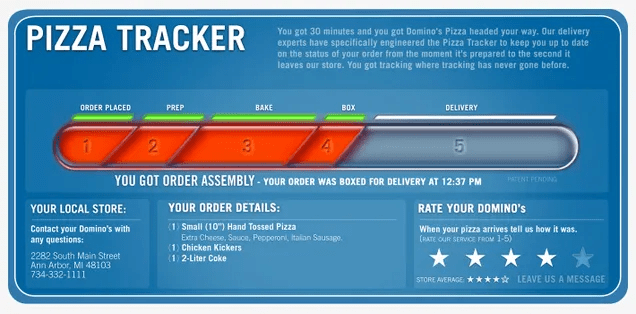
Domino’s has a pizza tracker app, where a person can track their order from intake to delivery. Only the tracker does not reflect what’s actually occurring. It’s merely a facade built on historical timing. The pizza-making process is very well regimented, so at a macro-level, it may appear to work. If on average, a pizza takes 30 minutes from order to the time it shows up at your door, and your delivery conforms to this average, you’ll be none the wiser that the details didn’t otherwise happen to comport.
Pizza Tracker Concept
I feel that it’s almost fair to consider this app analogous to our cognitive processes. The details don’t really matter, so long as the stimulus-response corresponds to our expectations. Unlike the actual process underlying the manufacture and delivery process, we don’t have direct access to reveal the ‘reality’.
Around the same time as Domino’s fakery was being revealed, they did make progress by at least relaying GPS details via the app. Given that this probably accounts for most of the variability in their process, it would make sense to address this earlier than later.
My point is not to take a deep dive into the technology or remark on the integrity of this approach. I only wanted to point out that most customers might not have even questioned the progress meter. Others may have their own questions.
Meme Blowback
In the end, the state of the process could be transmitted, but it could actually slow the process by introducing additional steps, so the cost of conveying reality may outweigh the benefits. I’m not the one to make that call. Meantime, pizza’s up.
The lamb spends all its time worrying about the wolf and ends up being eaten by the shepherd.
— Unknown
I think one could look at this from several perspectives or through different lenses.
We worry about the wrong things.
At some level, this is about trust.
We trust the wrong people. Those whom we most entrust do us in. But I feel this is contextual.
One might feel this shepherd is Capitalism or the State or organised religion. Perhaps it’s culture or identity cohorts. Or all or these or none of these.
On another level, it recalls the inevitability of death. This shepherd reaper is always waiting in the wings whether or not one worries.








 Philosophics