Ground News

I like to stay updated on the news of the day, so I just registered for a Ground News account. Ground News is a news aggregator. They gather news and categorise it by political leaning and the publication’s record on factuality. Their claim is to reveal blind spots so help people not get caught in perspective bubbles. It also shows when a story is picked up predominantly by one side or another. I’ve seen ads for this on many channels and have for a while, so it’s likely that you have, too. This is not an ad.

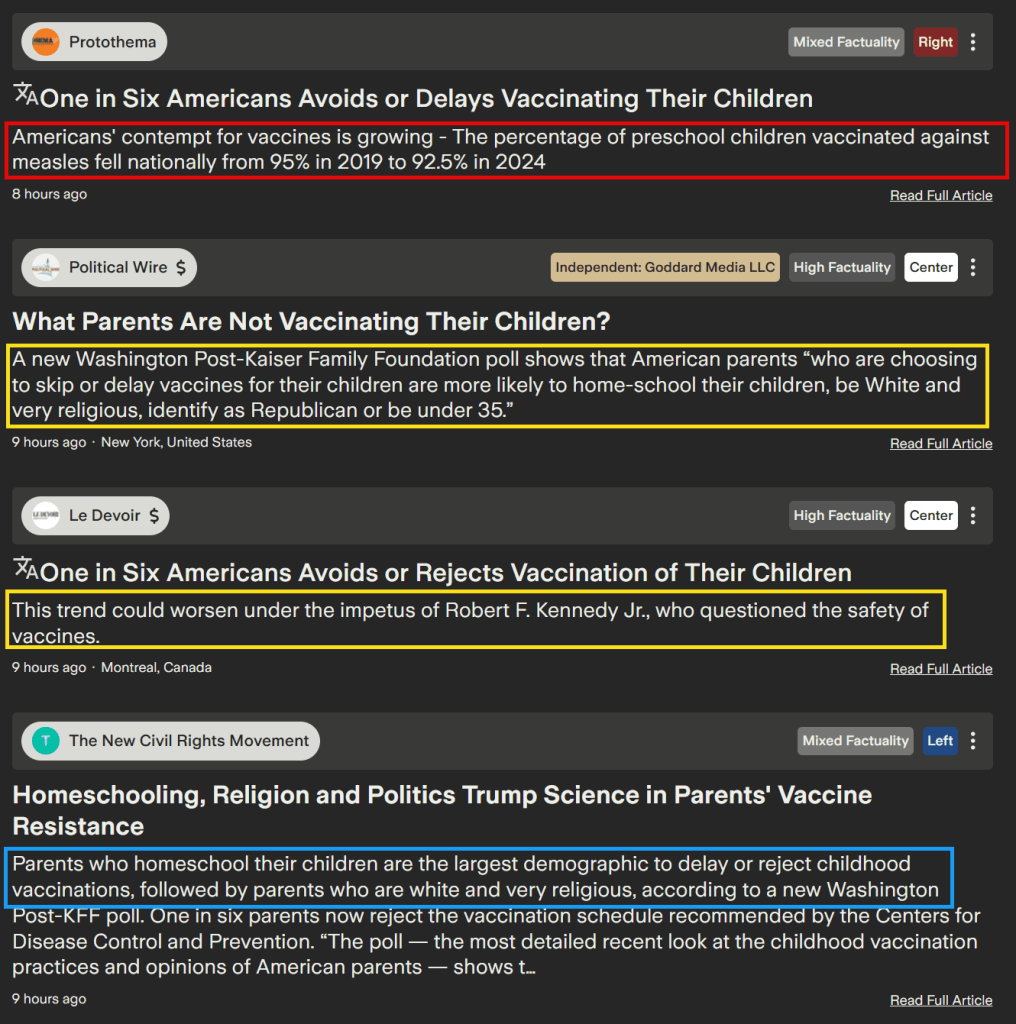
This article attracted my attention, not because of the content but because of the headline. As a statistician, this bothers me. As a communicator, the damage is trebled. I don’t receive any compensation for clicking the link. I include it for reference for those who are not familiar with the service.

Image: Ground News Screengrab

Notice the choice of writing, ‘1-in-6 parents reject vaccine recommendations‘.

Two things shine through.

  1. The use of ‘reject’ – a negative verb.
  2. The use of ‘1-in-6’ – the figure accompanying the negative verb – 17%.

Statistically, this means that 5-in-6 parents follow vaccine recommendations – 83%.

This is the summary view. Scan down, and notice the Left-leaning Raw Story references a ‘staggering number’ of parents who reject vaccines. Notice also how the language softens – the claim is revised to ‘delay or reject’. Without clicking into the story, what is this breakdown? I’m not sure, but this is what sensationalism looks like to attract clicks.

Image: Ground News Summary View

Interestingly, the outlets tend to use different language and give different attention. What percentage of this is due to political bias and which is benign editorial licence is unclear.

On balance, the articles – Left, Right, and Centre – unanimously note that vaccine use is down, incidences of measles are up, RFK policies appear to be exacerbating the health management issue. The worst offenders are ‘very’ religious, white, politically conservative people. This cohort aligns with the RFK and the current administration.

The poll also found that parents who have postponed or avoided vaccinating their children tend to be white, conservative, and highly religious, and some choose to homeschool.

For this story, one of the sources was Greek and another French. Some claim to be behind a paywall, but this didn’t pose a problem for me. Perhaps they offer some complementary views.

Separately, on the right-hand side of the top image, there is a bias indicator: It shows that 57% of the reports were from Left-leaning journals, 36% Centre, leaving the remaining 7% to Right-leaning sources.

Image: Updated Bias Distribution

When I returned to write this post, I noticed that the reporting had changed as more Centre-focused reports picked up the story.

If I were to guess, this story shines a negative light on the Right, so they may just be waiting for the news cycle to pass.

In the (Right-facing) Greek story I read, the reporting wasn’t materially different to the other stories, which is to say they don’t try to render the story through rose-colour glasses.

The Lie That Invented Whiteness

“What is up with us white people?” asks John Biewen in his TEDx talk The Lie That Invented Racism. It’s the sort of line that makes a roomful of middle-class liberals laugh nervously, because it’s the kind of question we’d rather leave to other people – preferably the ones already burdened with the consequences of our civilisational mess. But Biewen’s point, following Ibram X. Kendi, is that race is not some primordial fact, a tragic misunderstanding of melanin levels. It was invented, quite literally, by a Portuguese royal propagandist in the fifteenth century, and it has been paying dividends to “us” ever since.

Video: TEDx Talk with John Biewen

Yes, invented. Not discovered like a continent, not unearthed like a fossil, not deduced like a law of motion. Fabricated. Gomes de Zurara, a court chronicler under King Afonso V, was tasked with writing a stirring tale to justify Portugal’s shiny new business model: kidnapping Africans and selling them like cattle. Zurara obligingly lumped every tribe and tongue south of the Sahara into a single category – “the Blacks,” beastly and conveniently inferior – and thus performed the intellectual sleight of hand that would metastasise into centuries of racial taxonomy. It wasn’t science. It wasn’t reason. It was marketing.

And here lies the exquisite irony: this happened at the dawn of Modernity, that self-anointed Age of Reason. The Enlightenment’s sales pitch was universality – “all men are created equal,” etc. – but tucked in the fine print was the little caveat that “man” actually meant white, European, propertied man. Everyone else? Barbaric, uncivilised, or in need of civilising at the end of a whip. Modernity congratulated itself on escaping medieval superstition while simultaneously cooking up the most profitable superstition of all: that human worth can be ranked by pigmentation.

Audio: NotebookLM podcast discusses this topic.

This is why racism has proved so stubborn. If it were merely a misunderstanding, like thinking the Earth is flat, we’d have grown out of it. But racism was never about confusion; it was about utility. A well-tuned lie, weaponised to justify land theft, slavery, and empire, then codified into law, census, and property rights. As Kendi and others point out, race became the scaffolding for a political economy that had to square Christian salvation with chains and sugar plantations. Voilà: whiteness – not as an identity, but as a racket.

And yet, “good white people” (Dow’s term, delivered with that Minnesota-nice grimace) still act as though racism is a tragic but external drama: Black people versus hood-wearing villains, while we clap politely from the sidelines. But there are no sidelines. Whiteness was built to privilege us; neutrality is just complicity in better shoes. As historian Nell Irvin Painter reminds us, the Greeks thought they were superior, yes – but on cultural, not chromatic grounds. Race, as a concept, is a modern fix, not a timeless truth.

So what’s the moral? Stop romanticising the Enlightenment as though it were some grand emancipation. It was also a bureaucracy for inequality, a rationalisation engine that could make even human trafficking sound like a noble project. To dismantle racism is not to cleanse an ancient superstition but to tear out one of Modernity’s central operating systems.

The uncomfortable fact – the one Dow leaves hanging like smoke after the torch march – is this: if whiteness was invented for profit, then dismantling it is not philanthropy. It is debt repayment. And debt, as any bank will tell you, compounds with interest.

The Cult of Officer Safety: How SCOTUS Legalised Fear

In the great American theatre of liberty, there’s one character whose neuroses we all must cater to: the police officer. Not the civil servant. Not the trained professional. No, the trembling bundle of nerves with a badge and a gun. According to the United States Supreme Court, this anxious figure is so vulnerable that the Constitution itself must bend to accommodate his fear. I’m not sure I have less respect for these people than for most other professions.

Audio: NotebookLM podcast on this topic.

Let’s review.

In Pennsylvania v. Mimms (1977), the Court held that police can order a driver out of their vehicle during any lawful traffic stop—no suspicion, no cause, just vibes. Why? Because the officer might get nervous otherwise.

Fast-forward to Maryland v. Wilson (1997), and that same logic is extended to passengers. That’s right: even if you’re just catching a ride, you too can be ordered out and subject to scrutiny because, well, a cop might be spooked.

The rationale? “Officer safety.” A phrase so overused it may as well be stamped on every judge’s gavel and stitched into every uniform. Forget that you’re a citizen with rights; forget that the Fourth Amendment was intended to restrain arbitrary power. If your mere presence makes Officer Skittish feel a bit antsy, the law now permits him to act like he’s clearing a war zone.

It’s worth asking – gently, of course, so as not to alarm anyone in uniform – why exactly we entrust our most coercive state powers to individuals apparently one errant movement away from fight-or-flight mode?

Rather than raising the bar for police conduct, these rulings lower the bar for constitutional protections. Rather than requiring police to be calm, competent, and capable under pressure, the Court concedes that they’re none of those things and therefore need extra authority to compensate.

So here’s a radical suggestion: What if “officer safety” wasn’t a get-out-of-liberty-free card? What if we demanded emotional resilience and psychological stability before issuing guns and power? What if, instead of warping the law around the most paranoid members of the force, we removed them from the force?

But no. Instead, we get jurisprudence that treats every routine traffic stop like a potential ambush. And to ensure our jittery guardian gets home safe, you, dear citizen, will be the one legally disarmed.

So buckle up – because your rights don’t mean much when the man with the badge is afraid of his own shadow.

On Trumpian Language and the Institutional Erosion of MeaningTrumpian Language Debate

“All that is necessary for evil to triumph is for a few words to go missing from the bylaws.” — not Edmund Burke, but it ought to be.

The Trump administration—America’s reigning monarch of meaningless bombast—has done it again. This time, with an executive order so linguistically cunning it deserves a Pulitzer for Subtextual Menace.

Issued on 30 January 2025, the decree known as “Defending Women from Gender Ideology Extremism” (because, of course, it couldn’t just be called Let’s Erase Legal Protections for People We Don’t Like) removed “political affiliation” and “marital status” from the list of protected classes within certain federal frameworks.

And the result? According to documents unearthed by The Guardian, VA doctors can now legally refuse treatment to patients based on their politics or marital status. You know, because being a Democrat apparently makes you too much of a pre-existing condition.

Naturally, the VA and White House are insisting this means absolutely nothing. “Don’t worry,” they coo. “No one’s actually doing it.” Ah yes, the old Schrödinger’s Protections defence—simultaneously removed and unchanged, invalid but somehow still effective.

But here’s the point—and where it ties to the Language Insufficiency Hypothesis I’ve been peddling like a raving madman at the crossroads of post-structuralism and bureaucratic despair: language isn’t just failing to communicate meaning—it’s being weaponised to obscure it.

The Erosion of Meaning Through Omission

This isn’t the blunt-force idiocy of Orwell’s Newspeak. This is something more elegant—more insidious. This is legislative lacunae. It’s what happens when not saying something says everything.

The words “political affiliation” and “marital status” weren’t replaced. They weren’t clarified. They were simply deleted. Erased like a bad tweet, like a conscience, like a veteran with the wrong bumper sticker.

This is language subtraction as a tool of governance.

We’re not criminalising dissent. We’re just making it legally ignorable.

We’re not discriminating against the unmarried. We’re just no longer required to treat them the same.

It’s the bureaucratic cousin of the dog-whistle: not quite audible in court, but perfectly clear to the base.

The Slippery Slope is Now a Slip-n-Slide

This is how you rewrite civil rights without the fuss of saying so. You just… remove the language that once held the dam in place. Then, when the flood comes, you feign surprise:

“Oh, dear. Who could have guessed that removing protections would result in people being unprotected?”

(Everyone. Everyone could have guessed.)

This is not a bug in the legal language. It’s the feature. The silence is the speech act. The absence is the argument.

This is what I mean by language insufficiency: not merely that our words fail to convey truth, but that their very structure is liable to be gamed—exploited by those who understand that ambiguity is power.

Beyond Intentionality: The Weaponised Void

In philosophy of language, we often debate intentionality—what the speaker meant to say. But here we’re in darker waters. This isn’t about intention. It’s about calculated omission.

The executive order doesn’t declare war on Democrats or single mothers. It simply pulls the thread and lets the tapestry unravel itself.

It’s an act of rhetorical cowardice disguised as administrative efficiency.

This is the Trumpian genius: use language like a stage magician uses sleeves. Distract with one hand, disappear with the other.

Final Diagnosis: Policy by Redaction

We now inhabit a political climate where what is not said carries more legal force than what is. Where bylaw gaps become policy gateways, and where civil rights die not with a bang, but with an elision.

So no, the VA hasn’t yet denied a Democrat a blood transfusion. But the table has been set. The menu revised. The waitstaff told they may now “use discretion.”

Language doesn’t merely fail us. It is being made to fail strategically.

Welcome to the new America: where rights aren’t removed—they’re left out of the memo.


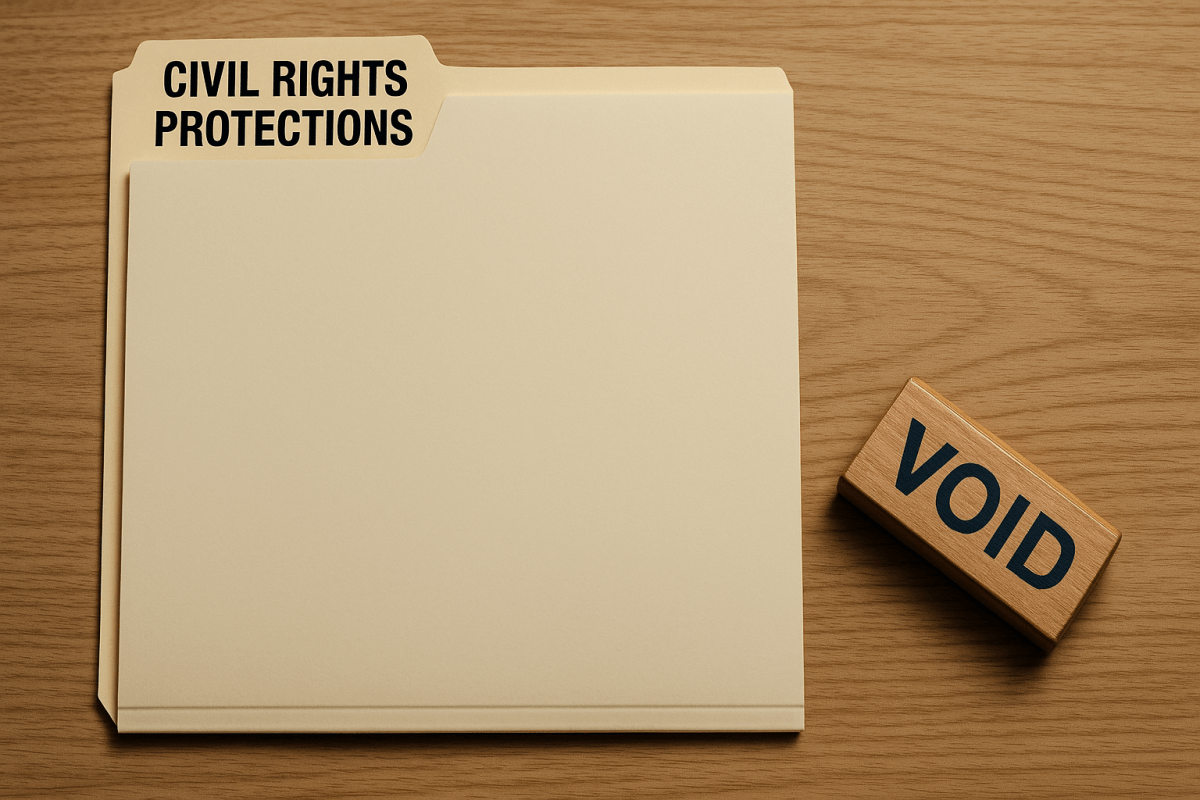
Yet again, ChatGPT renders an odd image. Can’t be bothered to amend it.

Can One Obstruct Justice in a Place It Doesn’t Exist?

ICE is out in force again, dragging brown bodies out of homes in Los Angeles like it’s some righteous carnival of due process. Another day, another federal theatre production titled Law and Order: Ethnic Cleansing Unit, where men with guns and names like Chad or Hank mistake cruelty for patriotism and paperwork for moral clarity.

Audio: NotebookLM podcast on this topic.

Naturally, critics of these raids are now being threatened with that great juridical cudgel: “obstructing justice.” Yes, you heard that right. If you interfere – say, by filming, shouting, refusing to roll over like a good little colonial subject – you are obstructing justice. As though justice were something you could actually put your hands on in the United States without a hazmat suit and a decade of appeals.

Let’s be clear. There is no justice here to obstruct. What you are obstructing is bureaucratic violence wrapped in legal latex. You are obstructing a system that functions like a vending machine for state-sanctioned trauma: insert immigrant, extract ruin.

Justice: The Imaginary Friend of Empire

Ah, “justice.” That hallowed ideal trotted out whenever the state wants to put a boot through your front door. The U.S. has long since traded its Justice for Security Theatre and capitalist choreography. The blindfold is still there, sure – but these days, it’s a branded sleep mask from Lockheed Martin, and the scales are rigged to weigh white tears heavier than brown bodies.

Let’s run through the usual suspects:

  • ICE – America’s own domestic Gestapo, but with better PR and significantly worse fashion.
  • CBP – Border fetishists whose job seems less about national defence and more about satisfying their Freud-bereft fantasies of control.
  • SCOTUS – That great moral weather vane, spinning wildly between “originalist necromancy” and outright lunacy, depending on how recently Thomas and Alito read Leviticus.
  • Congress – An assembly of millionaires cosplaying as public servants, holding hearings on “the threat of immigration” while outsourcing their lawn care.

And of course, the President – whichever septuagenarian husk happens to be in office – offers the usual bromides about order, safety, and enforcement, all while the real crimes (you know, the kind involving tax fraud, corporate pollution, or drone strikes) go entirely unmolested.

Can You Obstruct a Simulation?

If you stand in front of a deportation van, are you obstructing justice, or merely interrupting the bureaucratic excretion of empire? It’s the philosophical equivalent of trying to punch a hologram. The system pretends to uphold fairness while routinely violating its own principles, then charges you with “obstruction” when you call out the sleight of hand.

This is not justice. This is kabuki. A ritual. A performance piece sponsored by Raytheon.

A Modest Proposal

Let’s just be honest and rename the charge. Not “Obstruction of Justice”—too ironic, too pompous. Call it what it is: Obstruction of Procedure, Obstruction of Power, or if we’re being especially accurate: Obstruction of the Industrial Deportation Complex™. Hell, add a corporate sponsor while you’re at it:

You are being charged with Obstruction of Justice, Presented by Amazon Web Services.

Because when justice itself is a ghost, when the rule of law has become the rule of lawfare, the real obscenity is pretending any of this is noble.

Final Thought

So no, dear reader, you’re not obstructing justice. You’re obstructing a machine that mistakes itself for a moral order. And if you’re going to obstruct something, make it that.

The Trust Myth: Harari’s Binary and the Collapse of Political Credibility

Yuval Noah Harari, always ready with a digestible morsel for the TED-addled masses, recently declared that “democracy runs on trust, dictatorship on terror.” It’s a line with the crispness of a fortune cookie and about as much analytical depth. Designed for applause, not interrogation, it’s the sort of soundbite that flatters liberal sensibilities while sanding off the inconvenient edges of history.

Audio: NotebookLM podcast on this topic.

Let’s be honest: this dichotomy is not merely simplistic – it’s a rhetorical sedative. It reassures those who still believe political systems are like kitchen appliances: plug-and-play models with clear instructions and honest warranties. But for anyone who’s paid attention to the actual mechanics of power, this framing is delusional.

1. Trust Was Never Earned

In the United States, trust in democratic institutions was never some noble compact forged through mutual respect and enlightened governance. It was cultivated through exclusion, propaganda, and economic bribery. The post-WWII boom offered the illusion of institutional legitimacy – but only if you were white, male, middle-class, and preferably asleep.

Black Americans, Indigenous peoples, immigrants, women – none were granted the luxury of naïve trust. They were told to trust while being actively disenfranchised. To participate while being systemically excluded. So no, Harari, the machine didn’t run on trust. It ran on marketing. It ran on strategic ignorance.

2. Dictatorship Doesn’t Require Terror

Equally cartoonish is the notion that dictatorships subsist purely on terror. Many of them run quite comfortably on bureaucracy, passive conformity, and the grim seduction of order. Authoritarians know how to massage the same trust reflexes as democracies – only more bluntly. People don’t just obey out of fear. They obey out of habit. Out of resignation. Out of a grim kind of faith that someone – anyone – is in charge.

Dictatorships don’t extinguish trust. They re-route it. Away from institutions and toward strongmen. Toward myths of national greatness. Toward performative stability. It’s not that terror is absent—it’s just not the whole machine. The real engine is misplaced trust.

3. Collapse Is Bipartisan

The present moment isn’t about the erosion of a once-trustworthy system. It’s the slow-motion implosion of a confidence game on all sides. The old liberal institutions are collapsing under the weight of their hypocrisies. But the loudest critics – tech messiahs, culture warriors, authoritarian nostalgists – are no better. Their solutions are just new brands of snake oil in sleeker bottles.

Everyone is pointing fingers, and no one is credible. The public, caught between cynicism and desperation, gravitates either toward restoration fantasy (“make democracy work again”) or authoritarian theatre (“at least someone’s doing something”). Both are dead ends.

4. The Only Way Forward: Structural Reimagination

The only viable path isn’t restoration or regression. It’s reinvention. Systems that demand unconditional trust – like religions and stock markets – are bound to fail, because they rely on sustained illusions. Instead, we need systems built on earned, revocable, and continually tested trust – systems that can survive scrutiny, decentralise power, and adapt to complexity.

In other words: stop trying to repair a house built on sand. Build something else. Something messier, more modular, less mythological.

Let the TED crowd have their slogans. We’ve got work to do.

Taxation and Representation

Given all of the clamouring about taxations and abolishing the Internal Revenue Service, affectionately known as the IRS. In Britain, one may be more aware of His Majesty’s Revenue and Customs (HMRC). In France, it’s Direction générale des Finances publiques (DGFiP).

Audio: NotebookLM podcast on this topic.

Given how up in arms the reincarnation of the NAZI party, disfectionately known as Republicans (or Republican’ts depending on your mood or persuasion), have been towards the IRS and taxation in general – they love to cosplay tossing crates of tea into harbours – I asked ChatGPT to clarify the originals of income taxes in the United States.

For the benefit of more casual readers, income taxes were unconstitutional – illegal – until 1913. These were snuck in under the guise of only applying to the wealthy, the 1% of the time. But once the floodgates were opened, the focus shifted to the 95%, increasingly exempting the wealthy. Even so, they still complain and evade.

Enough wittering. Here’s what ChatGPT had to say on the matter.

Did ChatGPT just call me a troll?

Elites Ruined It For Everyone

David Brooks and the Hollowing Out of Conservatism

David Brooks is the quintessential old-school Conservative—the kind who once upheld a semblance of ideological coherence. He belongs to the pre-Reagan-Thatcher vintage, a time when Conservatism at least had the decency to argue from principles rather than blind tribalism. We could debate these people in good faith. Those days are gone. The current incarnation of Conservatism contains only homoeopathic traces of its Classical™ predecessor—diluted beyond recognition.

The Degeneration of Conservatism

The rot set in with Reagan, who caught it from Thatcher. Greed and selfishness were laundered into virtues, repackaged as “individual responsibility,” and the party’s intellectual ballast began to erode. By the time Bush II’s administration rolled in, Neo-Conservatism had replaced any lingering Burkean ethos, and by Trump’s tenure, even the pretence of ideology was gone. Conservatism-in-Name-Only—whatever Trump’s brand of reactionary nihilism was—swallowed the party whole. Do they even call themselves Conservatives anymore, or has that ship sailed along with basic literacy?

Click here to take the worldview survey

To be fair, this didn’t go unnoticed. Plenty of old-school Republicans recoiled in horror when Trump became their figurehead. Before the 2016 election, conservative pundits could barely contain their disdain for his incompetence, lack of moral compass, and general buffoonery. And yet, once they realised he was the party’s golden goose, they clambered aboard the Trump Train with the enthusiasm of lottery winners at a payday loan office. His staunchest critics became his most obsequious apologists. What does this tell us about their value system? Spoiler: nothing good.

Brooks’ Lament

Which brings us back to Brooks, who now bemoans the death of Conservative values. On this, we agree. Where we part ways is on whether those values were worth saving. Say you’re boarding a train from New York to Los Angeles. Conservatism might argue that a Miami-bound train is still a train, so what’s the problem? It’s the same vehicle, just going somewhere else. Except, of course, Conservatism has always insisted on the slow train over the fast train—because urgency is unseemly, and progress must be rationed.

If I’m an affluent middle-classer, I might prefer Conservatism’s careful incrementalism—it keeps my apple cart stable. Admirable, if you enjoy tunnel vision. Progressives, by contrast, recognise that some people don’t even have apple carts. Some are starving while others hoard orchards. To the Conservative, the poor just aren’t trying hard enough. To the Progressive, the system is broken, and the playing field needs a serious re-levelling. Even when Conservatives acknowledge inequality, their instinct is to tiptoe toward justice rather than risk disrupting their own affluence.

The Fallacy of Objective Reality

Leaving politics for philosophy, Brooks predictably rails against Postmodernism, decrying relativism in favour of good old-fashioned Modernist “reality.” He’s horrified by subjectivism, as though personal interpretation weren’t the foundation of all human experience. Like Jordan Peterson, he believes his subjective truth is the objective truth. And like Peterson, he takes umbrage at anyone pointing out otherwise. It feels so absolute to them that they mistake their own convictions for universal constants.

As a subjectivist, I accept that reality is socially mediated. We interpret truth claims based on cognitive biases, cultural conditioning, and personal experience. Even when we strive for objectivity, we do so through subjective lenses. Brooks’ Modernist nostalgia is touching but delusional—akin to demanding we all agree on a single flavour of ice cream.

The Existential Problem

And so, I find myself in partial agreement with Brooks. Yes, there is an existential crisis. The patient has a broken leg. But our prescriptions differ wildly. I won’t offer a metaphor for that—consider it your homework as a reader.

Brooks is likely a better writer than a public speaker, but you may still find yourself nodding along with some of his arguments. If you’re a “true” Christian Conservative—if you still believe in something beyond crass self-interest—he may well be preaching to the choir. But let’s be honest: how many in that choir are still listening?

The Greatest Loss in American History: Donald Trump Wins (And Loses) the Presidency

I couldn’t resist posting this unedited from ChatGPT. Here’s what led to it: I just finished Mark Fisher’s Capitalist Realism. Fisher mentioned the 1974 Warren Beatty film The Parallax View. I generally don’t connect well with film or video as media, but I stashed the title in my memory. A few hours later, I read an article mentioning the film, with the claim, “Of everything lost in the age of streaming, no film genre casualty is as regrettable — or as ripe for a comeback — as the paranoid political thriller.”

Rather than trying to enjoy the film as a whole, I decided to concentrate on the plot and meta-massaging. As expected, I didn’t like the movie, but I understand why Fisher mentioned it. It renders rather like a weak tea version of a Kafka story. Unlike more contemporary fare, it’s a classic work of postmodernism, having no resolution.

After watching it, I engaged with Rotten Tomatoes and IMDB for reviews and context before prompting ChatGPT.

Asking about the film itself, this was the tail end of its response:

Then I asked what Žižek thought about it, but it turns out that he had written about a book with the same title. When I asked about Fisher, it:

Finally, I posed this query: I recently read Capitalist Realism. Although penned during the 2007-08 financial meltdown and released in 2009, it feels as relevant today as then. In fact, it seems to have foreshadowed the time between.

It’s reply is this post—and without further comment…


And so, history lurches forward with all the grace of a three-legged cow on roller skates. Donald J. Trump, the billionaire reality TV star turned political apocalypse, has once again won the presidential vote of the United States of America—only to lose the presidency to Kamala Harris. If that sentence gave you an aneurysm, congratulations, you’re now officially in 2025.

How did we get here? More importantly, why does this make absolutely no sense? Ah, but sense, dear reader, is an antiquated relic of a bygone era, much like democracy, coherent election results, and the idea that facts matter.

A Triumph for the Ages (Sort of)

Let’s be clear: Donald Trump won the popular vote. That’s what his supporters will scream into the void—or at least into their social media echo chambers where dissent is met with a virtual Second Amendment response. The red-capped faithful, still clutching their tattered “Stop the Steal” banners from the last electoral circus, are convinced that this was finally their moment of redemption.

Except, well… he lost.

Enter Kamala Harris, the political equivalent of cold toast, somehow managing to slide into the Oval Office despite Trump’s “win.” The courts, the states, the Electoral College, and whatever eldritch horror lurks beneath the Capitol all conspired—again!—to keep The Donald out of power. Or so the narrative goes.

The Electoral College Strikes Again

Ah, the Electoral College. America’s favourite 18th-century fever dream. Once again, this labyrinthine system of delegate-wrangling has managed to produce a result that defies logic, mathematics, and possibly the laws of physics. Trump, against all odds (and against, presumably, some very sweaty legal advisors), has pulled off the impossible: winning while losing.

Some claim voter suppression, others cry fraud, and a few brave souls are out there trying to explain complex election mechanics to an audience that still thinks “covfefe” was a divine prophecy. But the reality is simpler: Trump, like a political Schrödinger’s cat, is simultaneously victorious and defeated. He has transcended the normal bounds of electoral outcomes, achieving a state of quantum presidency, neither fully here nor fully gone.

What Happens Next?

Riots? Lawsuits? A new line of Trump-branded commemorative “I Won Again!” hats? Place your bets, because at this stage, America is basically one large, over-budget reality show and no one knows what the next episode holds.

For Kamala Harris, the challenge is clear: govern a nation where half the country believes she stole the election, and the other half is still googling “How does the Electoral College work?” As for Trump, he will do what he does best—declare victory, launch a thousand lawsuits, and, inevitably, turn the entire thing into a business opportunity.

And so, dear reader, the United States stumbles forward, democracy battered but still standing, a house divided but too stubborn to fall. Until next time, buckle up—it’s going to be a hell of a ride.

Surveying Modernity

A Brief, Brutal Experiment in Categorising Your Worldview

This month, I’ve been tinkering with a little project—an elegant, six-question survey designed to assess where you land in the great intellectual mess that is modernity.

Audio: Podcast discussion about this post.

This isn’t some spur-of-the-moment quiz cooked up in a caffeine-fueled haze. No, this project has been simmering for years, and after much consideration (and occasional disdain), I’ve crafted a set of questions and response options that, I believe, encapsulate the prevailing worldviews of our time.

It all began with Metamodernism, a term that, at first, seemed promising—a bold synthesis of Modernism and Postmodernism, a grand dialectic of the ages. But as I mapped it out, it collapsed under scrutiny. A footnote in the margins of intellectual history, at best. I’ll expand on that in due course.

The Setup: A Simple, Slightly Sadistic Ternary Plot

For the visually inclined (or the masochistically curious), I initially imagined a timeline, then a branching decision tree, then a Cartesian plane before landing on a ternary plot—a three-way visual that captures ideological leanings in a way a boring old bar chart never could.

The survey itself is brief: six questions, each with five possible answers. Submit your responses, and voilà—you get a tidy little ternary chart plotting your intellectual essence, along with a breakdown of what your answers signify.

Methodology: Half-Rigorous, Half-Reckless

I am, after all, a (recovering) statistician, so I’ve tried to uphold proper methodology while also fast-tracking certain safeguards for the sake of efficiency. If there’s enough interest, I may expand the survey, adding more questions or increasing response flexibility (tick boxes instead of radio buttons—revolutionary, I know).

Privacy Concerns? Relax. I’m not harvesting your data for some nefarious scheme. No personally identifiable information is collected—just a timestamp, session ID, and your browser’s language setting. I did consider tracking IP addresses to analyze regional trends but ultimately scrapped that idea.

In the future, I may add an optional email feature for those who wish to save and track their responses over time (assuming anyone is unhinged enough to take this more than once).

The Rest of the Story: Your Feedback, My Amusement

Since this is a personal project crafted in splendid isolation, I’d love to hear your thoughts. Are the questions reasonable? Do the response options make sense? Does the summary feel accurate? Is the ternary chart decipherable, or have I constructed a glorified inkblot test?

As an academic, economist, and statistician, I had never encountered a ternary chart before embarking on this, and now I rather enjoy it. That said, I also find Nietzsche “intuitive,” so take that as you will.

If this gains traction, expect follow-up content—perhaps videos, podcasts, or further written explorations.

Your Move

Take the survey. It’s painless, requiring mere minutes of your life (which is, let’s be honest, already wasted online). And because I’m feeling generous, you can even generate a PDF to stick on your fridge, next to your collection of expired coupons and disappointing takeout menus.

Click here to take the survey.

Let’s see where you stand in the grand, chaotic landscape of modernity. Or at least, let’s have a laugh trying to make sense of it.

DISCLAIMER: The Modernity Worldview Survey is not scientific. It is designed as an experiment to provide directional insights. It is hosted on Google Cloud and subject to its availability and performance limitations.