Book Announcement: Illusion of Light

2–3 minutes

I’ve just released a new book, The Illusion of Light: Thinking After the Enlightenment, now available in paperback through KDP and distributed via Amazon. In November, a clothbound edition will follow through IngramSpark, extending availability to libraries and independent bookstores worldwide, including Barnes & Noble in the United States.

The Illusion of Light introduces the Anti-Enlightenment Essays series, which includes Objectivity Is Illusion, Rational Ghosts, Temporal Ghosts, Against Agency, The Myth of Homo Normalis, and The Discipline of Dis-Integration. Together, these works explore how the Enlightenment’s promise of illumination became the architecture of modern control – and how to think, live, and care in the half-light it left behind.

Image: Front cover of The Illusion of Light. Links to Amazon for purchase.
The ‘Free Preview’ claim is untrue, as there is no Kindle version available. An ebook will be available presently.
Audio: NotebookLM podcast on this topic.

About the Book

The Illusion of Light opens where the Enlightenment’s glare begins to fade. It asks what happens after reason exhausts itself – after the promise of illumination gives way to overexposure. These essays trace how modernity’s metaphors of light and progress became instruments of management: how objectivity hardened into ritual, agency into alibi, normality into control.

Rather than rejecting the Enlightenment outright, the book lingers in its afterimage. It argues for a philosophy practiced in the half-light – a mode of thought that values nuance over certainty, care over mastery, and maintenance over redemption. To read by residual light, as the preface suggests, is to learn to see again when the world stops pretending to be illuminated.

The preface is available on this prior post, written and audio versions.

The Broader Project

The Illusion of Light forms the threshold of the Anti-Enlightenment Project, a series examining the afterlives of modern reason – how its ideals of progress, agency, objectivity, and normality continue to govern our politics, sciences, and selves long after their foundations have cracked. Each volume approaches the same question from a different room in the old House of Reason: Objectivity Is Illusion, Rational Ghosts, Temporal Ghosts, Against Agency, The Myth of Homo Normalis, and The Discipline of Dis-Integration.

Taken together, they offer not a manifesto but a practice: philosophy as maintenance work, care as critique, and composure as the only honest response to the ruins of certainty. More to follow.

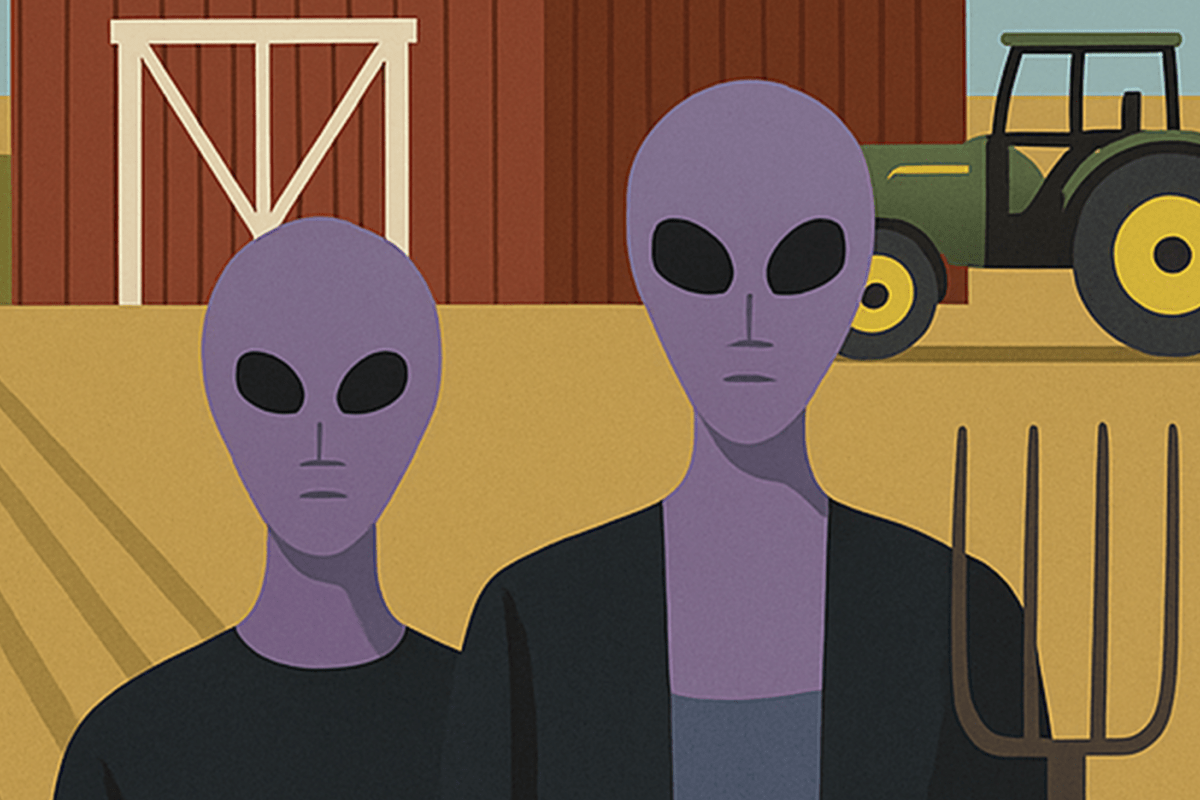
Sustenance: A Book About Aliens, Language, and Everything You’re Getting Wrong

Violet aliens on a farm

So, I wrote a book and published it under Ridley Park, the pseudonym I use for fiction.

It has aliens. But don’t get excited—they’re not here to save us, probe us, or blow up the White House. They’re not even here for us.

Which is, frankly, the point.

Audio: NotebookLM podcast on this topic.

The book’s called Sustenance, and while it’s technically speculative fiction, it’s more about us than them. Or rather, it’s about how we can’t stop making everything about us—even when it shouldn’t be. Especially when it shouldn’t be.

Let’s talk themes. And yes, we’re using that word like academics do: as a smokescreen for saying uncomfortable things abstractly.

Language: The Original Scam

Language is the ultimate colonial tool. We call it communication, but it’s mostly projection. You speak. You hope. You assume. You superimpose meaning on other people like a cling film of your own ego.

Sustenance leans into this—not by showing a breakdown of communication, but by showing what happens when communication was never mutual in the first place. When the very idea of “meaning” has no purchase. It’s not about mishearing—it’s about misbeing.

Culture: A Meme You Were Born Into

Culture is the software you didn’t choose to install, and probably can’t uninstall. Most people treat it like a universal law—until they meet someone running a different OS. Cue confusion, arrogance, or violence.

The book explores what happens when cultural norms aren’t shared, and worse, aren’t even legible. Imagine trying to enforce property rights on beings who don’t understand “ownership.” It’s like trying to baptise a toaster.

Sex/Gender: You Keep Using Those Words…

One of the quiet joys of writing non-human characters is discarding human assumptions about sex and gender—and watching readers squirm.

What if sex wasn’t about power, pleasure, or identity? What if it was just a biological procedure, like cell division or pruning roses? Would you still be interested? Would you still moralise about it?

We love to believe our sex/gender constructs are inevitable. They’re not. They’re habits—often bad ones.

Consent: Your Framework Is Showing

Consent, as we use it, assumes mutual understanding, shared stakes, and equivalent agency. Remove any one of those and what’s left?

Sustenance doesn’t try to solve this—it just shows what happens when those assumptions fall apart. Spoiler: it’s not pretty, but it is honest.

Projection: The Mirror That Lies

Humans are deeply committed to anthropocentrism. If it walks like us, or flinches like us, it must be us. This is why we get so disoriented when faced with the truly alien: it won’t dance to our tune, and we’re left staring at ourselves in the funhouse mirror.

This isn’t a book about aliens.

It’s a book about the ways we refuse to see what’s not us.

Memory: The Autobiography of Your Justifications

Memory is not a record. It’s a defence attorney with a narrative license. We rewrite the past to make ourselves look consistent, or innocent, or right.

In Sustenance, memory acts less as a tether to truth and more as a sculpting tool—a way to carve guilt into something manageable. Something you can live with. Until you can’t.

In Summary: It’s Not About Them. It’s About You.

If that sounds bleak, good. It’s meant to.

But it’s also a warning: don’t get too comfortable in your own categories. They’re only universal until you meet someone who doesn’t share them.

Like I said, it’s not really about the aliens.

It’s about us.


If you enjoy fiction that’s more unsettling than escapist, more question than answer, you might be interested in Sustenance. It’s live on Kindle now for the cost of a regrettable coffee:

📘 Sustenance on Amazon US
Also available in the UK, DE, FR, ES, IT, NL, JP, BR, CA, MX, AU, and IN—because alienation is a universal language.