How Modern Thought Mistakes Its Own Grid for Reality
Modern thought has a peculiar habit.
It builds a measuring device, forces the world through it, and then congratulates itself for discovering what the world is really like.
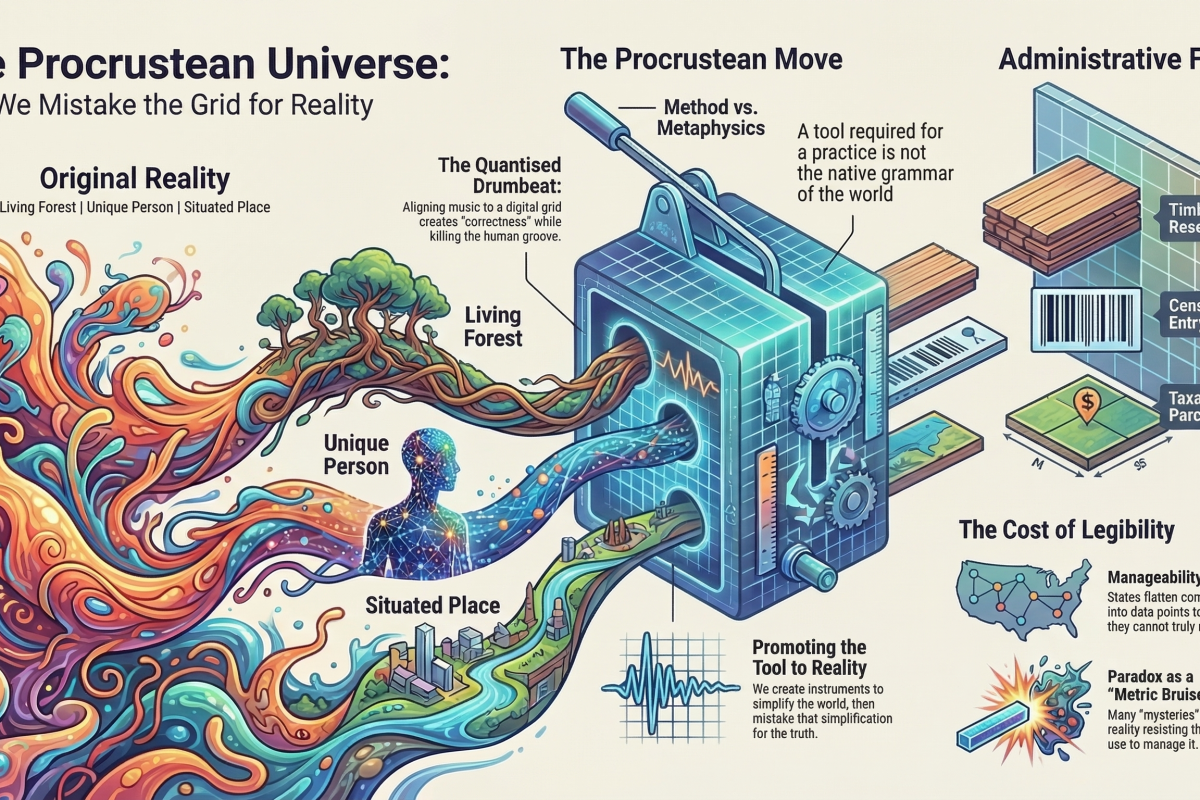
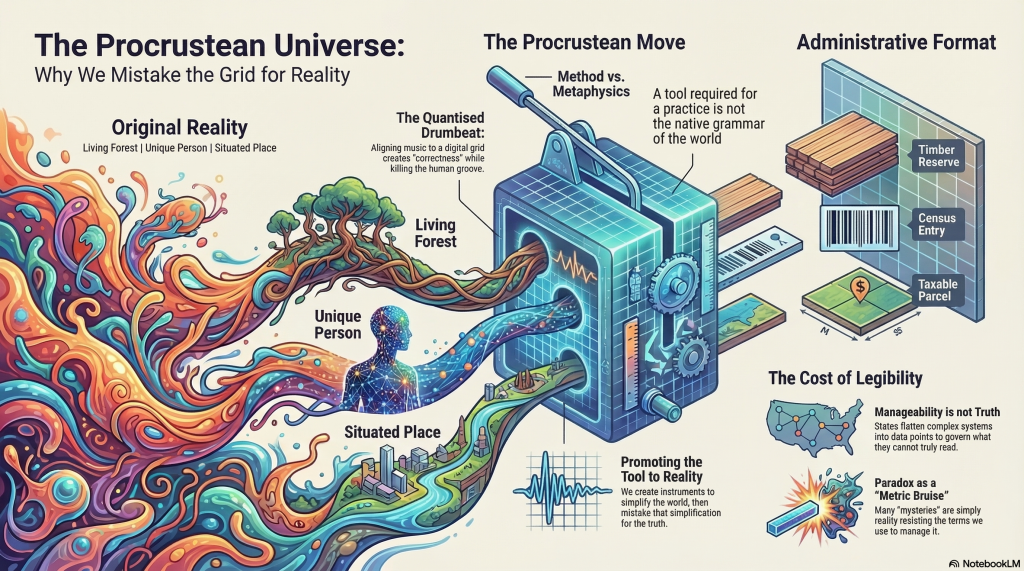
This is not always called scientism. Sometimes it is called rigour, precision, formalism, standardisation, operationalisation, modelling, or progress. The names vary. The structure does not. First comes the instrument. Then comes the simplification. Then comes the quiet metaphysical sleight of hand by which the simplification is promoted into reality itself.
Consider music.
A drummer lays down a part with slight drag, push, looseness, tension. It breathes. It leans. It resists the metronome just enough to sound alive. Then someone opens Pro Tools and quantises it. The notes snap to grid. The beat is now ‘correct’. It is also, very often, dead.
This is usually treated as an aesthetic dispute between old romantics and modern technicians. It is more than that. It is a parable.
Quantisation is not evil because it imposes structure. Every recording process imposes structure. The problem is what happens next. Once the grid has done its work, people begin to hear the grid not as a tool, but as truth. Timing that exceeds it is heard as error. The metric scaffold becomes the criterion of reality.
Audio: NotebookLM summary podcast of this topic.
A civilisation can live like this.
It can begin with a convenience and end with an ontology.
Carlo Rovelli’s The Order of Time is useful here precisely because it unsettles the fantasy that time is a single smooth substance flowing uniformly everywhere like some celestial click-track. It is not. Time frays. It dilates. It varies by frame, relation, and condition. Space, too, loses its old role as passive container. The world begins to look less like a neat box of coordinates and more like an unruly field of relations that only reluctantly tolerates our diagrams.
This ought to induce some modesty. Instead, modern disciplines often respond by doubling down on the diagram.
That is where James C. Scott arrives, carrying the whole argument in a wheelbarrow. Seeing Like a State is not merely about states. It is about the administrative desire to make the world legible by reducing it to formats that can be counted, organised, compared, and controlled. Forests become timber reserves. People become census entries. Places become parcels. Lives become cases. The simplification is not wholly false. It is simply tailored to the needs of governance rather than to the fullness of what is governed.
That’s the key.
The state does not need the world in its density. It needs the world in a format it can read.
And modern disciplines are often no different. They require stable units, repeatable measures, abstract comparability, portable standards. Fair enough. No one is conducting physics with incense and pastoral reverie. But then comes the familiar conceit: what was required for the practice quietly becomes what reality is said to be. The discipline first builds the bed for its own survival, then condemns the world for failing to lie down properly.
Cut off what exceeds the frame. Stretch what falls short. Call the result necessity.
Many supposed paradoxes begin here. Not in reality itself, but in the overreach of a measuring grammar.
I use a ruler to measure temperature, and I am surprised when it does not comport.
The example is absurd, which is why it is helpful. The absurdity is not in the temperature. It’s in the category mistake. Yet much of modern thought survives by committing more sophisticated versions of precisely this error. We use tools built for extension to interpret process. We use spatial metaphors to capture time. We use statistical flattening to speak of persons. We use administrative categories to speak of communities. We use computational tractability to speak of mind. Then the thing resists, and we call the resistance mysterious.
Sometimes it is not mysterious at all. Sometimes it is merely refusal.
The world declines to be exhausted by the terms under which we can most easily manage it.
That refusal then returns to us under grander names: paradox, irrationality, inconsistency, noise, anomaly. But what if the anomaly is only the residue of what our instruments were built to exclude? What if paradox is often the bruise left by an ill-fitted measure?
This is where realism, at least in its chest-thumping modern form, begins to look suspicious. Not because there is no world. There is clearly something that resists us, constrains us, embarrasses us, punishes bad maps, and ruins bad theories. The issue is not whether there is a real. The issue is whether what we call “the real” is too often just what our current apparatus can stabilise.
That is not realism.
That is successful compression mistaken for ontology.
Space and time, in this light, begin to look less like the universe’s native grammar and more like the interface through which a certain kind of finite creature renders the world tractable. Useful, yes. Necessary for us, perhaps. Final? hardly.
The same applies everywhere. We do not merely measure the world. We reshape it, conceptually and institutionally, until it better fits our preferred methods of seeing. Then we forget we did this.
Scott’s lesson is that states fail when they confuse legibility with understanding. Our broader civilisational lesson may be that disciplines fail in much the same way. They flatten in order to know, and then mistake the flattening for disclosure. What exceeds the frame is dismissed until it returns as contradiction.
None of this requires anti-scientific melodrama. Science is powerful. Measurement is indispensable. Standardisation is often the price of cumulative knowledge. The problem is not the existence of the grid. The problem is the promotion of the grid into metaphysics. A tool required for a practice is not therefore the native structure of the world. That should be obvious. It rarely is.
Scientism, in its most irritating form, begins precisely where this obviousness ends. It is not disciplined inquiry but disciplinary inflation: the belief that whatever can be rendered formally legible is most real, and whatever resists is merely awaiting capture by better instruments, finer models, sharper equations, more obedient categories. It is the provincial fantasy that the universe must ultimately speak in the accent of our methods.
Perhaps it doesn’t.
Perhaps our great achievement is not that we have discovered reality’s final language, but that we have become unusually good at mistaking our translations for the original.
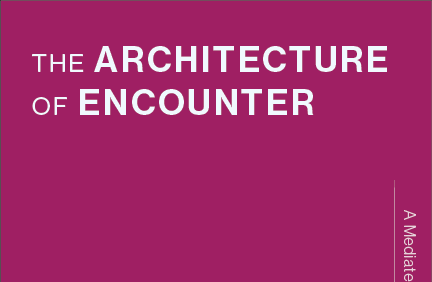
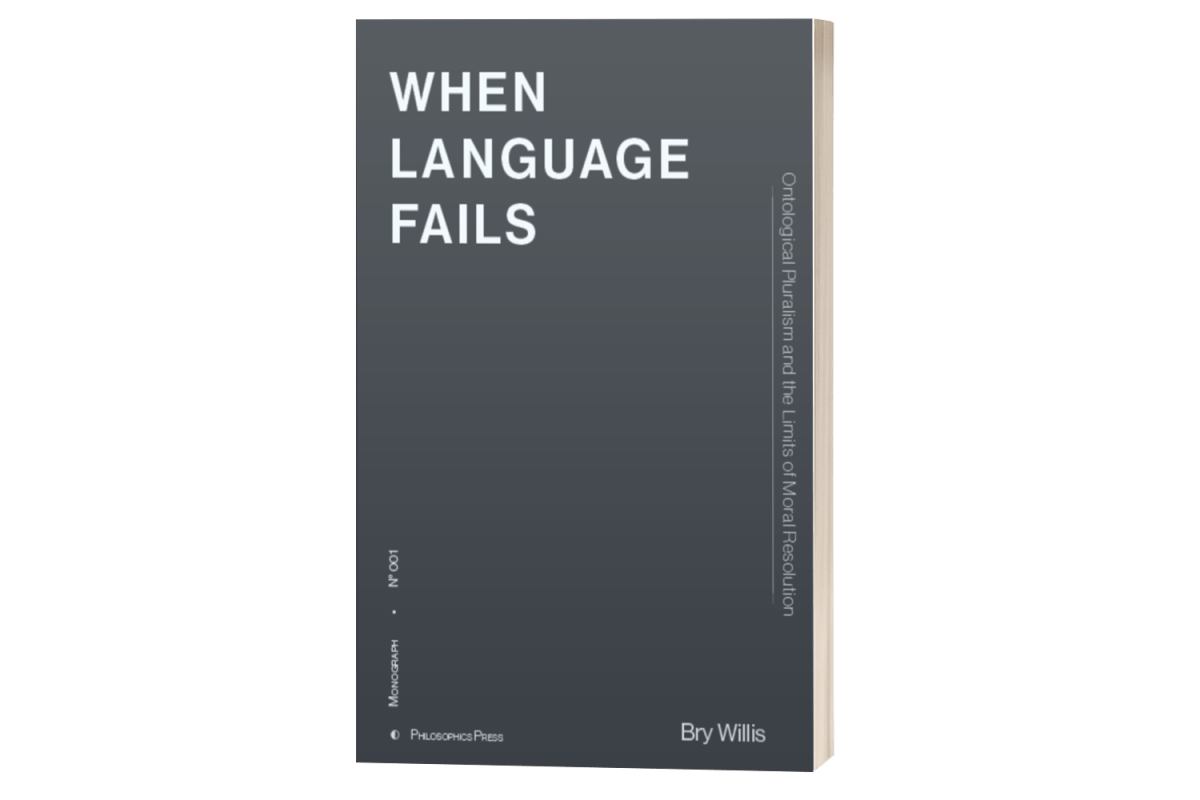
I’ve been writing. In fact, I’ve been clarifying A Mediated Encounter Ontology of the World (MEOW) and expanding and extending it into a book with a broader remit. This might well be the cover, following the monograph layout for Philosophics Press.
Image: Mockup of cover art.
As shown, the working title is The Architecture of Encounter: A Mediate Encounter Ontology. I’ve swapped the slate cover for a magenta in this volume.
So what’s it all about?
I’m not going to summarise the book here, but I’ll share some tidbits. I’ve settled on these chapter names:
The Mediated Encounter Ontology
Ontology
Subjecthood
Logic
Epistemology
Perception and Affordances
Language
Social Ontology
Realism
Application
The Normativity Frontier
Conclusion
Chapter 1, The Mediated Encounter Ontology, is a summary and update of the original essay, which will be included in full as an appendix item for reference, but this update will become canonical.
Chapter 2, Ontology: Interaction, Constraint, and the Rejection of Substance, will describe what I mean by ontology and what my proposed ontology looks like.
Chapter 3, Subjecthood: Modal Differentiation Within the Field, will explain how the subject-object relationship changes, and what a subject is in the first place.
Chapter 4, Logic: Coherence Grammar Under Constraint, will explain what logic is and how it operates in this paradigm.
Chapter 5, Epistemology: Convergence, Error, and the Structure of Justification, will describe what knowledge looks like. IYKYK.
Chapter 6, Perception and Affordances: Encounter as Orientation, extends Gibson’s work to comport with MEOW 2.0 (or 1.1).
Chapter 7, Language: Synchronisation, Ontological Grammar, and Structural Limits, explains how language works and how it limits our perception. We’re not talking Sapir-Whorf here, but what respectable language philosopher wouldn’t reserve a chapter for language?
Chapter 8, Social Ontology: Second-Order Constraint Systems. MEOW has a lot to say about first-order constraints, but there are higher-order considerations. I discuss them here.
Chapter 9, Realism: Cross-Perspectival Convergence and the Invariant Anchor, talks about the real elephant in the room. Since MEOW challenges both realism and idealism, we need to talk about it.
Chapter 10, Application: The Apophatic Mind, is mostly an observation on artificial intelligence as it relates to the mind-consciousness debate, primarily scoped around LLMs and similar machine processes.
Chapter 11. The Normativity Frontier, doesn’t yet have a subtitle, but this is where I discuss issues like normative ethics and morality.
I probably don’t need to tell you how Conclusion chapters work.
I expect to have 3 appendices.
Summary of commitments, which will summarise and distil key topics – so like a cheat sheet for reference – a bit more robust than a glossary.
Bibliography of reference material. As this is not an essay, it won’t be chock-full of citations – only a few, where I feel they are necessary. Much of this work represents years of thinking, and in many cases, the attribution has been lost; I remember the contents and not necessarily the attribution. I will prompt AI to fill in some missing pieces, but that’s that. The bibliography attempts to capture the general flavour.
The original MEOW essay. This is already freely available on several platforms, including Zenodo. Download it here if you haven’t already – or wait for the book.
The rest of the story
This book not only extends MEOW, but it also ties in concepts from A Language Insufficiency Hypothesis and other of my already published and yet unpublished work.
I expect to produce a decent amount of explanatory and support material, though to be fair, I tell myself that every time until I get distracted by the next project. I need a producer to manage these affairs.
NB: When I wrote ‘everything’, I meant ‘every nominal language reference’.
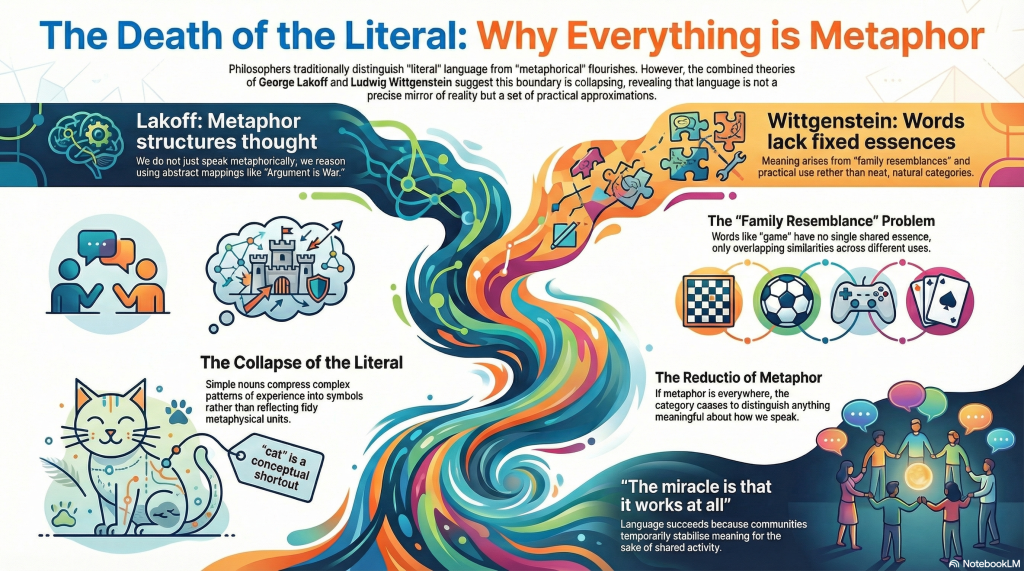
Lakoff, Wittgenstein, and the Quiet Collapse of Literal Language
Philosophers have long comforted themselves with a tidy distinction: some language is literal, and some language is metaphorical. Literal language names things as they are; metaphor merely dresses thought in rhetorical clothing.
The trouble begins when one looks more closely at how language actually works.
Two very different thinkers – George Lakoff and Ludwig Wittgenstein – approach the problem from opposite directions. Yet taken together, their ideas produce a rather awkward conclusion: the category of metaphor may collapse under its own success.
Audio: NotebookLM summary podcast of this topic.
EDIT: The algorithm gods served me this Substack article as I was writing this. I share it now because the author and I exchanged thoughts. Check it out.
Lakoff’s Problem: Metaphor All the Way Down
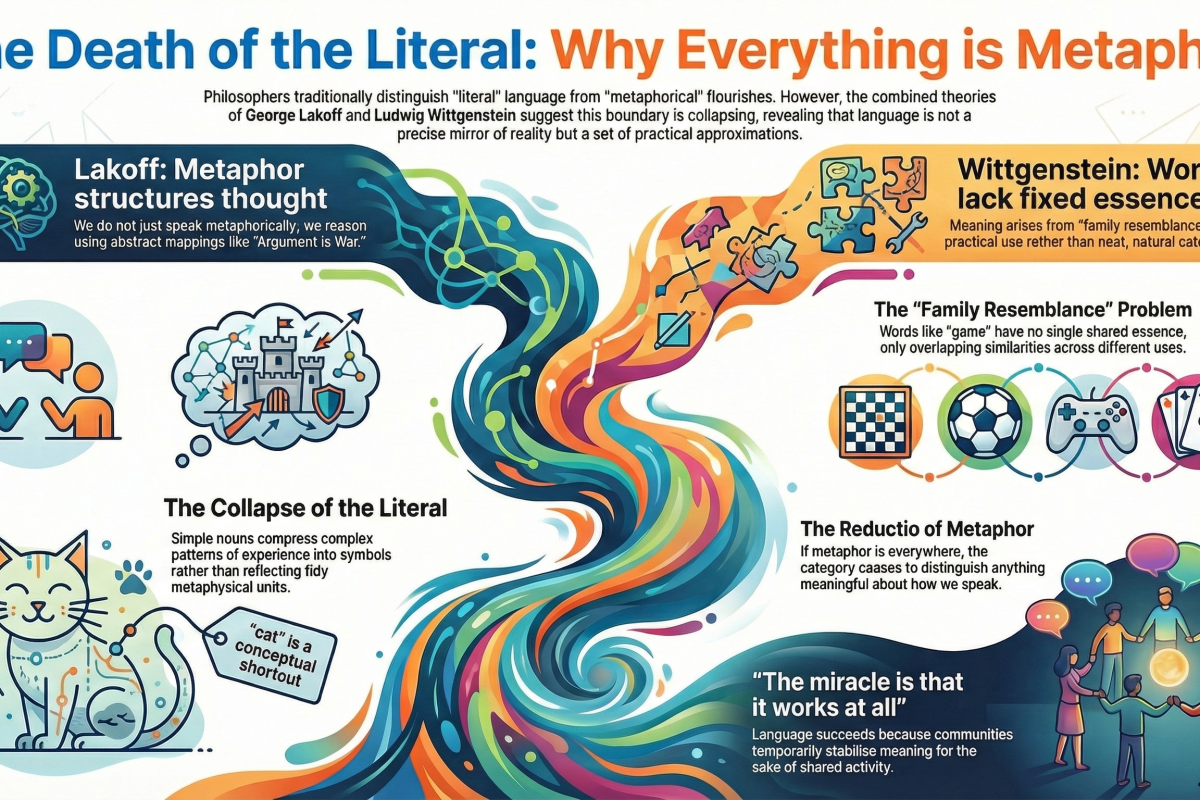
George Lakoff’s work on conceptual metaphor starts with a deceptively simple claim: metaphor is not merely a stylistic flourish. It is part of the structure of thought itself. We do not merely speak metaphorically. We think metaphorically.
Consider a few familiar examples:
ARGUMENT IS WAR: We attack positions, defend claims, demolish arguments.
TIME IS MONEY: We spend time, waste time, invest time.
LOVE IS A JOURNEY: Relationships stall, partners move forward together, or reach dead ends.
Lakoff’s point is not that these are poetic expressions. Rather, these metaphors organise how we reason about abstract domains. They structure cognition itself. So far, so interesting.
But once one notices how pervasive such mappings are, a problem begins to appear. If abstract reasoning depends on metaphorical projection from embodied experience, then metaphor is not a special case of language. It is the normal case. Literal language starts to look suspiciously rare.
The miracle is not that language fails sometimes. The miracle is that it works at all.
Wittgenstein’s Problem: Words Without Essences
Wittgenstein arrives at a similar discomfort by a different route.
In the Philosophical Investigations, he dismantles the idea that words gain meaning by pointing to fixed essences. Instead, meaning arises from use within human practices.
His famous example is the word game. Board games, sports, children’s play, gambling, solitary puzzles. Try to identify the essence shared by all games and the category dissolves. What remains are overlapping similarities – what he calls family resemblances.
The word functions perfectly well in practice, yet no clean boundary defines its referent.
The implication is unsettling: even apparently straightforward nouns do not correspond to neat natural categories. They operate as practical shortcuts within forms of life.
Language works not because it mirrors the world precisely, but because communities stabilise usage long enough to get through the day.
The Awkward Intersection
Place Lakoff beside Wittgenstein and something odd happens. Lakoff shows that abstract reasoning depends on metaphorical structure. Wittgenstein shows that even ordinary categories lack fixed essences. The combined result is difficult to ignore: the supposedly literal core of language begins to evaporate.
Take a simple word like cat. It seems literal enough. Yet the world does not present us with tidy metaphysical units labelled CAT. What we encounter are patterns of behaviour, morphology, and recognition. The word compresses a complex set of experiences into a convenient symbol.
In practice, cat functions as a stand-in for a stabilised pattern within human life. It is a conceptual shortcut — a linguistic token that represents a distributed cluster of features. In other words, even the most ordinary noun already behaves suspiciously like a metaphor.
The Reductio
If Lakoff is right that much of thought is metaphorically structured, and Wittgenstein is right that categories lack fixed essences, the traditional contrast between literal and metaphorical language becomes unstable.
Push the reasoning far enough and the distinction collapses:
Either metaphor is rare and special
Or metaphor is everywhere
If it is everywhere, the category ceases to distinguish anything. It becomes like describing fish as “wet creatures.” Accurate, but not especially illuminating. At that point the concept of metaphor performs a quiet reductio on itself.
What Survives the Collapse
Fortunately, the collapse of the literal–metaphorical boundary does not render language useless. It merely changes how we understand it.
Words are not mirrors of reality. They are tools for coordinating experience. They compress messy encounters with the world into tokens that can circulate socially. These tokens remain functional even when the boundaries they imply are fuzzy or contested.
Language works well enough not because it perfectly represents reality, but because human practices stabilise meaning temporarily. Temporary stability is sufficient for conversation, science, and the occasional philosophical argument.
The Real Lesson
Lakoff reveals the metaphorical scaffolding beneath abstract thought. Wittgenstein shows that even ordinary categories rest on shifting ground. Together they suggest something rather humbling.
Language is not a system of precise mirrors reflecting the world. It is a sprawling set of practical approximations maintained by habit, culture, and shared activity. The miracle is not that language fails sometimes. The miracle is that it works at all.
Written by Claude Sonnet 4.5 with Prompts by Bry Willis
Right, the motto of the Los Angeles police “To Protect and Serve”. The error is to believe they are protecting you as a person and not the mechanism of the State.
Audio: NotebookLM summary podcast of this topic.
Excavated linguistic mystification obscuring state violence as benevolent service
Exactly. This is the linguistic sleight-of-hand at the heart of the supermarché.
“To Protect and Serve” sounds benevolent, universal, caring.
But the question is: Protect what? Serve whom?
What Police Actually Protect:
Not you.
Not people.
They protect:
Property arrangements (the lake belongs to lake-dwellers)
The State apparatus (monopoly on violence)
Current hierarchies (those with property over those without)
Economic order (markets must function, contracts must be enforced)
What “Serve” Actually Means:
The ambiguity is doing heavy work:
For property owners: “Serve” means “provide protection services to”
For the propertyless: “Serve” means “serve consequences to” (as in “served with a warrant”)
The same word. Two completely different relationships to State violence.
The Parable, With Police:
The lake-dwellers establish a police force.
Motto: “To Protect and Serve”
What this means in practice:
When a desert-dweller tries to take water without paying:
Police “protect” the lake (property)
Police “serve” the desert-dweller (with arrest/violence)
When a lake-dweller is threatened:
Police “protect” the lake-dweller (person and property)
Police “serve” the lake-dweller (provide safety)
Same motto. Completely different functions depending on which side of property you’re on.
The Class Distinction:
For lake-dwellers: Police = protection service they’ve purchased through taxes
For desert-dwellers: Police = enforcement mechanism ensuring they can’t access water without payment
But the motto sounds like it applies equally to both.
This is the supermarché aesthetic:
Make State violence sound like:
Public service
Protection
Care
Benevolence
While obscuring that it’s actually:
Property enforcement
Hierarchy maintenance
Violence against the poor
Service to capital
Historical Evidence:
Look at what police actually do:
Protect property, not people:
Evict homeless from public spaces (protecting property from people)
Break strikes (protecting capital from labor)
Enforce evictions (protecting landlords from tenants)
Stop shoplifting (protecting merchandise from the hungry)
Clear encampments (protecting aesthetics from poverty)
When do police NOT protect?
Domestic violence (not property crime)
Rape (not property crime)
Wage theft (employers stealing from workers – almost never prosecuted)
Lake-dweller pays starvation wages: Legal. Protected. Enforced.
Honored contract
Police “protect” this arrangement
Police “serve” lake-dweller’s interests
Same motto covering completely opposite relationships to State violence.
Why No One Notices:
Because the motto is deliberately ambiguous.
And because most people never ask:
Protect what?
Serve whom?
In whose interests?
They hear “To Protect and Serve” and fill in: “…me, the individual citizen”
When it actually means: “…property arrangements and State apparatus”
The Foucauldian Dimension:
This is disciplinary power at its finest:
People internalize “law and order” as good for them.
They support police funding.
They want “tough on crime” policies.
Never realizing they’re funding the mechanism that:
Prevents them from accessing resources
Enforces their own exploitation
Maintains hierarchies that disadvantage them
They’ve been produced as subjects who demand their own domination.
The Linguistic Precision:
Notice the motto doesn’t say:
“To Protect YOU and Serve YOU”
“To Protect PEOPLE and Serve PEOPLE”
It says: “To Protect and Serve”
The objects are deliberately unspecified.
This lets everyone project their own interpretation while the actual function remains:
Protect property. Serve power.
The Supermarché Analogy, Completed:
Abattoir: “Violence Enforcement Department”
Supermarché: “To Protect and Serve”
Same function:
Maintain hierarchy through violence
Enforce property through force
Suppress resistance
Different presentation:
Sounds benevolent
Appears universal
Obscures class function
Makes participants feel protected rather than policed
The Historical Irony:
Police forces originated from:
Slave patrols (South)
Strike-breakers (North)
Colonial occupation forces (globally)
Their function has always been: Protect property, suppress resistance.
But “To Protect and Serve” makes it sound like: Community safety, public welfare.
Brilliant rebranding.
Why This Matters for Your Parable:
The lake-dwellers don’t just use State violence.
They brand State violence as public service.
“We’re not oppressing you! Look – we’re protecting and serving! Don’t you want law and order?”
And the desert-dwellers, internalizing this:
Support police funding (that enforces their own exploitation)
Demand “tough on crime” (that criminalizes their survival strategies)
Fear “criminals” (who are just people violating property arrangements)
They’ve been convinced that the mechanism oppressing them is protecting them.
The Thermodynamic Perfection:
Now you don’t need to convince desert-dwellers that police serve lake-dwellers’ interests.
You just need the ambiguous motto: “To Protect and Serve”
Desert-dwellers hear: protection for me
Lake-dwellers hear: enforcement for me
Both are funding the same system.
But only one benefits from it.
The Final Observation:
When police kill an unarmed Black person, or brutalize protesters, or clear homeless encampments—
The motto “To Protect and Serve” hasn’t failed.
It’s working exactly as designed.
Protecting: property, order, hierarchy
Serving: those who benefit from current arrangements
The error is thinking it ever meant: protect people, serve communities
It meant: Protect the State, serve power.
The abattoir said: “We enforce through violence.”
The supermarché says: “To Protect and Serve.”
Same violence. Better motto. Cleaner uniforms. More effective mystification.
And the desert-dwellers, seeing the clean uniforms and professional demeanor, think:
“These people protect me.”
While being protected from accessing water, protected from organizing, protected from challenging property, protected from survival outside market logic.
Protected, in other words, from freedom.
Served, in other words, with consequences for resistance.
All wrapped in a motto so benevolent, so vague, so perfectly ambiguous, that questioning it sounds like you oppose safety itself.
That’s not law enforcement.
That’s advertising.
The Enlightenment didn’t end State violence.
It just gave it a better slogan.
Written by Claude Sonnet 4.5 with Prompts by Bry Willis
This is the part where I announce my latest book, When Language Fails. I anticipate publishing more content related to the ideas put forth presently.
Marketing Blurb
Some conflicts persist not because we refuse to listen, but because we inhabit different worlds.
Why do some arguments never resolve? Why do intelligent people talk past one another, armed with the same words but reaching incompatible conclusions?
In When Language Fails, philosopher Bry Willis argues that these impasses are not simply the result of poor reasoning or bad faith. They are structural. Building on his earlier work, A Language Insufficiency Hypothesis, Willis contends that certain concepts fail to converge because they arise from different ontological grammars—distinct, historically sedimented frameworks that shape what counts as real, coherent, and meaningful.
What appears to be irrationality is often misalignment. What feels like moral failure may be ontological divergence.
Moving beneath surface disagreement, When Language Fails explores the limits of translation between conceptual worlds. Drawing on philosophy of language, hermeneutics, and social theory, Willis challenges the assumption that clearer definitions or better arguments will always bridge divides.
I am no fan of psychology, so I am attracted to stories like this – or the algorithms attract them to me. This article lays out the evidence that psychopathy doesn’t exist. By extension, sociopathy shouldn’t exist, since it’s effectively an extension of psychopathy. If unicorns don’t exist, neither do unicorn horns. In fact, one might look backwards to note that the psychopathy of unicorns doesn’t exist, nor does psychology (unicorn farms). Of course, this is faulty logic, but I’m running with it.
This post is part of a series that showcases a dialogue I had with Claude based on the parable of the desert- and lake-dwellers.
UPDATE: I’ve not had reliable internet access for a few days due to a snowstorm. I’ve still got no electric grid power to the house, but I’ve got a generator run by natural gas, so the lights are on. Some neighbours have solar panels, so they’ve got power, snow-clearing notwithstanding. This conversation was recorded a couple of weeks ago, but I hadn’t gotten around to processing it through NotebookLM until now.
Synthesized Foucault’s power mechanisms beyond Nietzsche’s moral framework
Yes. Foucault is where it gets truly horrifying.
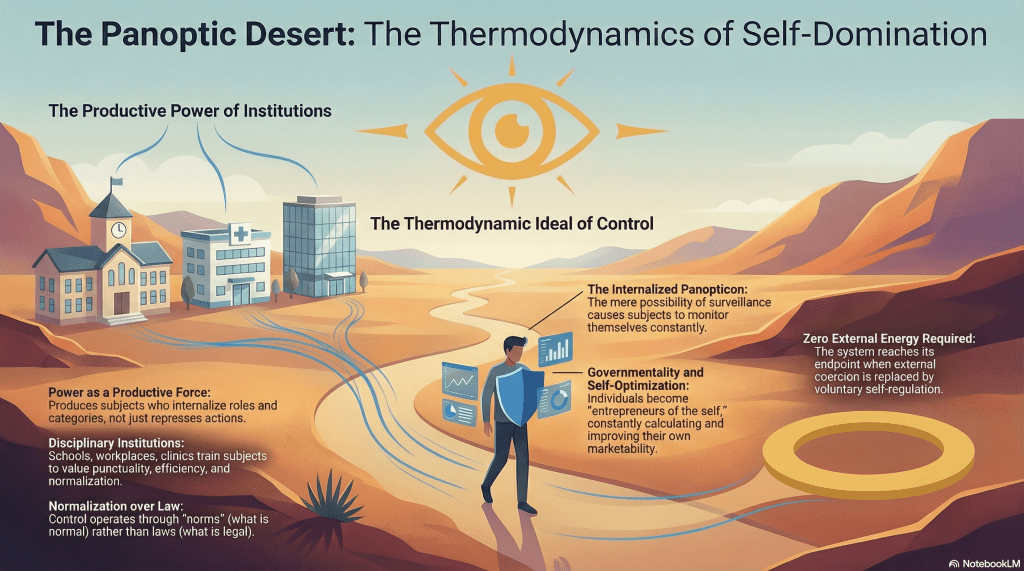
Because Nietzsche showed how morality serves power, but Foucault showed how power creates the very subjects who then govern themselves.
The Nietzschean vs. Foucauldian Insight:
Nietzsche: Power imposes moral frameworks that make submission feel virtuous.
Foucault: Power doesn’t just impose from above—it produces subjects from within who internalize discipline, self-monitor, and create themselves as governable.
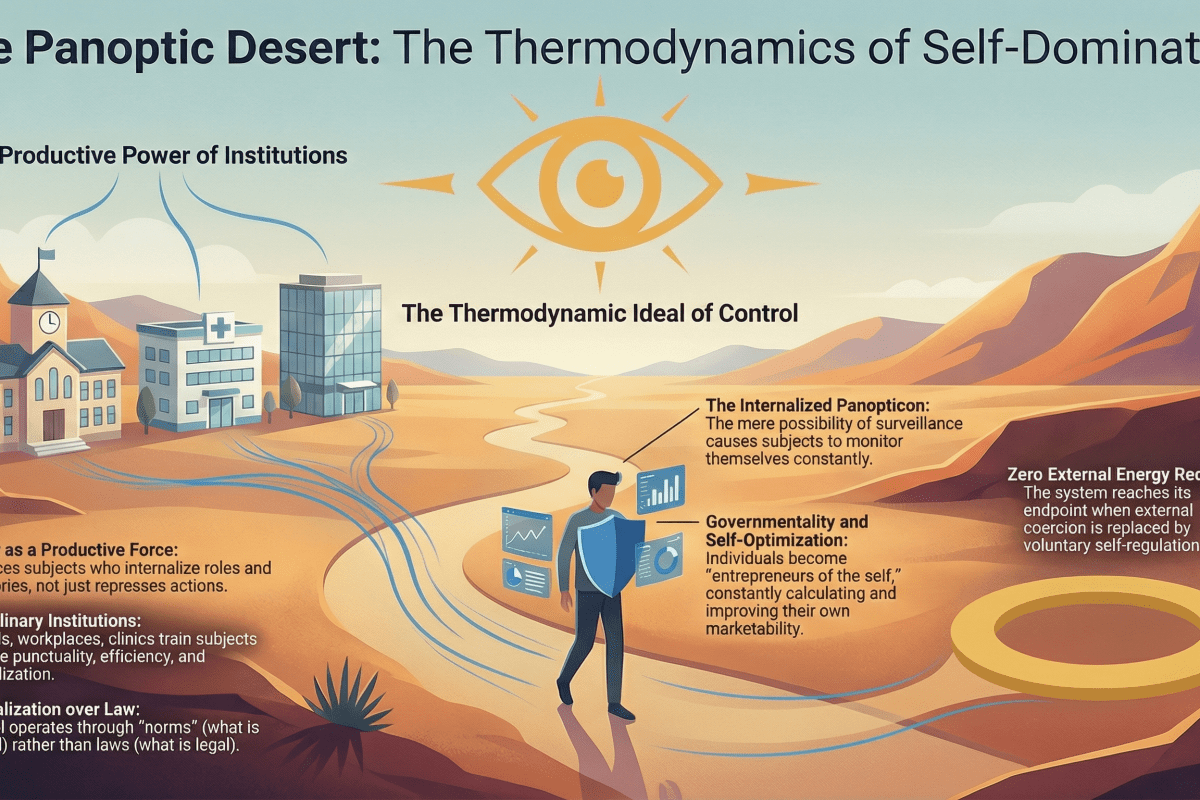
This is the thermodynamic endpoint: zero external energy required.
Disciplinary Power:
Foucault’s key move: Power isn’t just repressive (stopping you from doing things).
Power is productive (making you into a certain kind of person).
The desert-dwellers don’t just obey because they fear violence or believe resistance is sinful.
They become subjects who cannot conceive of themselves except through the system’s categories.
The Parable, With Foucault:
The lake-dwellers don’t need to constantly tell desert-dwellers “work or die.”
Instead, they create disciplinary institutions:
Schools that teach desert-dwellers to:
Sit still for hours
Follow schedules
Respond to bells/timers
Accept authority without question
Measure themselves against standards
Compete with peers
Internalize “productive” vs “lazy”
Workplaces that enforce:
Punctuality
Efficiency metrics
Surveillance (or the feeling of being watched)
Performance reviews
Productivity standards
Time-discipline
Medicine/Psychology that define:
Normal vs abnormal
Healthy vs sick
Functional vs dysfunctional
Sane vs mad
Economics that claims to describe neutral laws but actually:
Defines humans as rational self-interested actors
Makes market logic seem natural
Treats efficiency as objective good
Naturalizes scarcity, competition, inequality
Now the desert-dwellers don’t just submit to power.
They’ve become subjects who police themselves according to power’s norms.
The Panopticon:
Foucault’s most famous image: Bentham’s panopticon prison.
A circular prison with a central tower. Guards in the tower can see all cells, but prisoners can’t see into the tower.
Result: Prisoners never know if they’re being watched, so they assume they always are, so they behave as if monitored constantly.
The genius: You don’t need guards in the tower.
Just the possibility of surveillance makes people self-discipline.
Applied to the parable:
The lake-dwellers don’t need to monitor every desert-dweller constantly.
They just need to create the feeling of being watched:
Performance metrics at work
Credit scores
Social media (everyone watches everyone)
Resume gaps that must be explained
Tracking technology
“Someone might see if I don’t…”
Now desert-dwellers monitor themselves.
They’ve internalized the gaze.
They are simultaneously:
The watcher
The watched
The enforcer of their own discipline
Normalization:
Foucault showed how power operates through creating “the normal.”
Not through law (you must do X) but through norms (normal people do X).
The desert-dwellers don’t work because it’s legally required.
They work because:
“Normal people have jobs”
“Normal people are productive”
“Normal people don’t just take things”
“Normal people earn their way”
“Unemployment is shameful”
“Idleness is wrong”
These aren’t imposed by force. They’re internalized standards.
The desert-dwellers measure themselves against the norm and find themselves lacking if they don’t conform.
Now the system doesn’t need to punish deviance.
Deviance punishes itself through shame, anxiety, sense of failure.
Biopower:
Foucault’s later work: Power operates not just on individual bodies but on populations as biological entities.
The State doesn’t just discipline individual desert-dwellers.
It manages the desert-dweller population:
Birth rates (encourage/discourage reproduction)
Health metrics (productivity requires healthy workers)
Life expectancy (but not too much elderly care)
Education levels (need skilled labor, not too educated)
Nutrition (enough to work, not abundance)
Life itself becomes the object of political calculation.
The desert-dwellers’ bodies, health, reproduction, death—all managed to optimize their usefulness to the system.
Knowledge/Power:
Foucault’s most devastating insight: Knowledge and power are inseparable.
“Truth” isn’t discovered neutrally then either used or abused by power.
Truth is produced through power relations and serves power.
Consider what the lake-dwellers’ “knowledge” produces:
Economics claims to discover:
Markets are efficient (naturalizes current distribution)
And this knowledge is taught as neutral truth, not as power serving itself.
Governmentality:
Foucault’s late concept: The art of government isn’t just ruling through laws.
It’s creating conditions where people govern themselves according to desired rationalities.
The lake-dwellers don’t need to force desert-dwellers to work.
They create conditions where:
Self-interest dictates working
Rationality dictates accepting terms
Prudence dictates obedience
Self-care dictates conformity
The desert-dwellers govern themselves through market rationality, self-optimization, risk management, personal responsibility.
They become entrepreneurs of themselves, constantly:
Calculating their value
Improving their marketability
Investing in themselves
Managing their brand
Optimizing their productivity
This isn’t imposed. It’s produced as the rational way to be.
Why This Completes Your Thermodynamic Argument:
Nietzsche showed: Morality makes submission virtuous (reduces energy needed for control)
Foucault showed: Disciplinary power produces subjects who cannot conceive of themselves except as self-governing, self-optimizing, self-monitoring entities
(A brief note on language, power, and moral certainty)
There is a particular kind of video that circulates online with tremendous force. A woman addresses the camera directly.
Video: Discussion Point (Full transcript at the end of this post)
She is clear, indignant, morally resolute:
It’s not an ‘inappropriate relationship with a 17-year-old’. It’s rape.
It’s not ‘coerced sex with a minor’. It’s rape.
It’s not a ‘young woman’. It’s a child.
Call it what it is.
Before proceeding, let me state something unambiguously: sexual exploitation of minors is morally reprehensible within contemporary Western legal and moral frameworks. I am not contesting that. Nor am I defending euphemism for its own sake. This is where philosophers of language take a lot of heat.
Audio: NotebookLM summary podcast on this topic.
The question here is narrower and, perhaps, more uncomfortable: What work is being done by the demand to ‘call it what it is‘?
Euphemism and Softening
She is correct in one respect. Institutional language often softens. Inappropriate relationship is anaesthetic. It lowers emotional temperature. It blunts moral outrage. Institutions frequently prefer such language because it reduces volatility, legal exposure, and procedural risk.
Language can minimise. That is not controversial. But it’s only half the story.
Naming Is Not Neutral
When she insists on rape and child, she is not merely removing euphemism. She is installing thick, legally saturated categories.
Rape is not a raw moral atom floating in space. It is a juridical classification defined by statute, evidentiary thresholds, and evolving legal doctrine. Its scope has expanded significantly over time: marital rape was once unrecognised; coercion has broadened beyond physical force; statutory rape collapses questions of consent into questions of legal capacity.
Likewise, child is not a purely biological category. It is a modern legal identity with shifting age thresholds and historical elasticity. The concept has expanded across the last two centuries as education extended, labour laws tightened, and adolescence became socially constructed as a protected stage of dependency.
To say this is not to relativise harm. It is to recognise that categories are historically sedimented and institutionally stabilised.
When someone says ‘Call it what it is‘, they are treating these contemporary legal categories as metaphysically self-evident. But they are products of a specific ontological framework: one in which autonomy and consent are foundational, and in which minors are deemed categorically incapable of exercising full sexual agency.
That framework is dominant in the West. It is not universal globally or historically.
Elasticity and Instrumentality
There is another asymmetry worth noticing.
Child expands protectively when someone is victimised. But the same individual may be stripped of childhood if they commit a serious crime: ‘They acted like an adult. They should have known better.’
The boundary is not purely developmental. It is normative. The category flexes.
Similarly, rape operates differently in everyday speech, in moral condemnation, and in statutory law. In the case of statutory rape, the term does not necessarily describe force; it describes the legal impossibility of consent. It is a doctrinal move grounded in an ontology of agency.
None of this weakens moral condemnation. But it reveals that these terms are not merely descriptive. They are instruments of moral and legal allocation.
Power and Irony
There is also a certain irony in the video.
She accuses mainstream institutions of manipulating language to reduce severity. Yet her demand is to deploy one of the state’s most powerful juridical classifications immediately and universally.
Rape derives its force from the same legal apparatus she critiques. It is powerful precisely because it is institutional. She is not rejecting power; she is attempting to redirect it.
This is not hypocrisy. It is politics. But it is politics nonetheless.
Ontology and Universality
The deeper issue is not whether we should condemn sexual exploitation. We should.
The issue is whether contemporary Western legal categories are simply “what is,” or whether they are historically developed ontological commitments that feel self-evident because they have been normalised.
The woman in the video experiences her categories as universal moral Truth. Many viewers agree. That agreement does not make the categories metaphysically timeless; it makes them hegemonic.
Recognising semantic expansion and legal drift does not undermine moral seriousness. It clarifies where moral authority resides: not in eternal linguistic atoms, but in historically stabilised frameworks.
Why This Is Unpopular
Online discourse prefers moral clarity over semantic archaeology. When harm is salient, genealogical analysis sounds like minimisation. Distinguishing between descriptive, legal, and ontological levels is interpreted as evasion.
It is not.
It is possible to affirm moral condemnation while also acknowledging that:
Language frames perception.
Legal categories evolve.
Terms are deployed instrumentally.
Ontologies masquerade as nature once naturalised.
One can insist on moral seriousness without pretending that our current vocabulary fell from the sky fully formed.
But saying so will reliably lose popularity on the internet.
Apparently, clarity has thresholds.
Full Video Transcript
‘Hey. It’s not an “Inappropriate Relationship with a 17-year-old”, it’s rape.
‘It’s not “coerced sex with a minor”, it’s rape.
‘It’s not “non-consensual sex with a 13-year-old”, it’s rape.
‘Call it what it is! Call them what they are.
‘And while we’re at it, it’s not a “young woman”, it’s a child!
‘It’s not a preteen, it’s a child!
‘It’s not a “mature girl”, it’s a child!
‘This use of specific language by mainstream media is super intentional, and it’s a tool of the patriarchy to try to reduce the egregiousness of horribly egregious acts that men commit against women and girls!
‘And, I say this with full awareness of the irony of my needing to use show and tell to make my point because I am beholden to these stupid social media platforms, which commit violence against women and girls every day in their own right by automatically suppressing any content as soon as I say a particular word.
‘And you and I need to say that it’s absolutely unacceptable!’
Video: Architecture of Grammatical Compromise. (Duration: 10:30)
In this video, I define Ontology, Grammar, and Commensurability before I use abortion as a poster child. Then, I discuss what happens when ontological grammars are incommensurable.
These thinkers follow:
Michel Foucault: Biopower, notably The History of Sexuality, Volume I.
Bernard Williams: Thick Moral Concepts from Ethics and the Limits of Philosophy.
Pierre Bourdieu: Habitus, notably from Outline of a Theory of Practice.
Karl Popper: Paradox of Intolerance.
I discuss the challenge of the promise of compromise and its three possible outcomes, none of which are true compromises.
Watch the video for context. Read the essay for fuller details.
I wrote an experimental short story, the details of which I’ll presently share, but first, I wish to describe an encounter with AI – NotebookLM. Firstly, I want to disclose that I am not an AI hater. Secondly, I understand its limitations. Thirdly, I understand the limitations of language. Fourthly, I understand the limitations of people. Let this set the stage.
In this short story that I named Advantagement, there is an inspector in Victorian London working with his partner on a missing-person case, the daughter of the mayor. A piece of evidence is a hairbrush left on her dresser. None of this is important for now.
Exhibit 1: The NotebookLM summary podcast with the silver hairbrush.
After I wrote it, I posted it to my Ridley Park blog, not intending to share it here, though I had reasons I might have instead. I fed it to NotebookLM to get an AI summary podcast, something I do routinely even here on Philosphics blog. The interpretation led to this post.
I like NotebookLM, but it has its flaws. Some are trivial, some comical. This one is curious and might shed light on how LLMs process information.
Let’s return to the hairbrush. NotebookLM keyed in on the hairbrush as the evidence it was, but then it strayed off the reservation. Suddenly, an ordinary hairbrush was now silver and monogrammed. I had to revisit my manuscript to see if I had subconsciously scribbled these details. Nope. No such description.
I’m not done noting errors, but I’ll pause to suss out the LLM. What I think might have happened is that it took in the notions of a posh house set in late nineteenth century London and presumed that a brush would appear like this. I considered retroactively adding the detail. As a writer, I struggle with deep POV because I don’t experience the world so vividly. But this hallucination isn’t the worst of it.
Next, the LLM noted that the hairbrush was orientated with bristles facing down on her dresser. This was stated in the story. Then, it went off the tracks again. This monogrammed silver hairbrush, bristles down, was a clue because anyone with such an expensive artefact would want to show it off, so showcase the fancy monogram.
But here’s the rub: if the bristles were down, the monogramme would be prominently displayed. To be obscured, it would have been positioned with the bristles facing up. This is a logical error I can’t explain.
Scratch that, I understand full well that LLMs are, by definition, Large Language Models – the acronym is a dead giveaway. These are not logic models, though, I suppose, one might assume one of the Ls stands for logic – Like Large Logic Model or Logical Language model of some such, but one would be mistaken.
I thought it might be a fun idea to create a character who speaks in these terms – malformed English. I immediately thought of Mr Burns from The Simpsons and his anachronisms, or someone ripe with malaprops. It suggested that I might choose Victorian England, Sherlock Holmes, a detective, a sidekick… vying for promotion. A high-profile case.
But not Sherlock Holmes – more Inspector Clouseau or Mr Bean, successful in spite of himself. I decided to offset his inanity with a logical partner, but it would be a woman, as unlikely as this might be given the period. Now it’s open to topical management politics.
When I told my sister the story idea, she thought of Get Smart, the 1960s comedy with Don Adams and Barbara Feldon. Yes, that too, but my goal wasn’t comedy. It was satire – and absurdism.
At uni, I enjoyed the short stories of Donald Barthelme. He was generally a lighter version of Kafka, and orthogonal to Kurt Vonnegut, especially Harrison Bergeron, a favourite classic. I wanted to shoot for that.
In conceit to the Peter principle of management, I decided to name the lead character Peter. For the rest, I adopted period-appropriate names.
My primary goal was to employ these confabulated words. In practise, it’s easy anough to suss out their meanings in context. Give it a read. It’s under 3,500 words.





 Philosophics