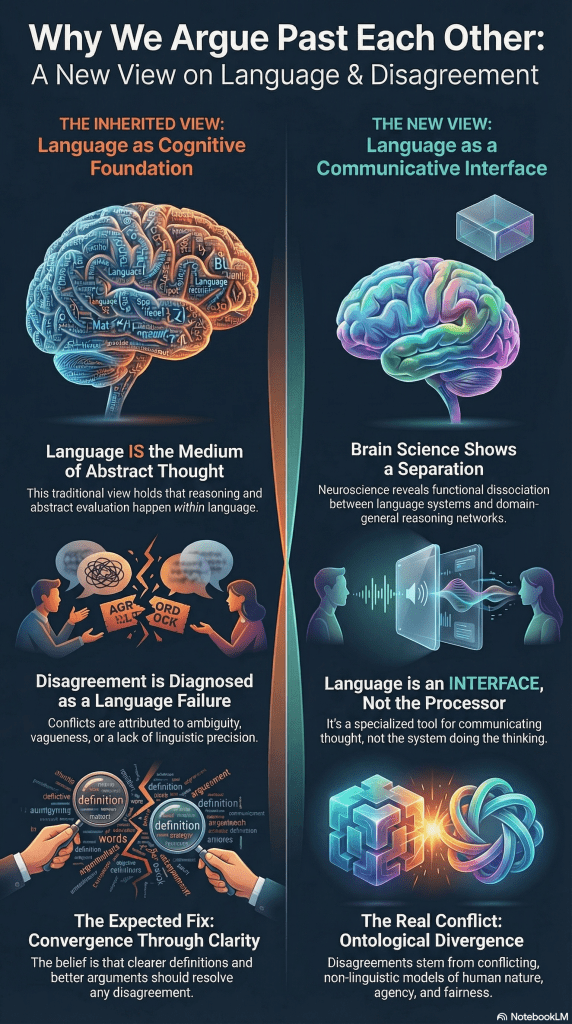
I’ve just published an essay following on the work of cognitive neuroscientist Evelina Fedorenko (cover image). It arrives on the heels of A Language Insufficiency Hypothesis (LIH). A companion essay is in the works.
Language as Interface strengthens the position of LIH, explaining why moral issues fail before language is even engaged. Her work also leads me to believe that we should revisit 20th-century accounts of the history of language.
Audio: NotebookLM summary podcast of the underlying essay.
The essay I am working on now explains why this extends to emotional language more generally.
Meanwhile, read the essay or listen to the podcast summary.
I’m not a fan of IQ as a general metric. Let us be done with the cult of the clever. Let us drag the IQ score from its pedestal, strip it of its statistical robes, and parade it through the streets of history where it belongs—next to phrenology, eugenics, and other well-meaning pseudosciences once weaponised by men in waistcoats.
The so-called Intelligence Industrial Complex—an infernal alliance of psychologists, bureaucrats, and HR departments—has for too long dictated the terms of thought. It has pretended to measure the immeasurable. It has sold us a fiction in numerical drag: that human intelligence can be distilled, packaged, and ranked.
Audio: NotebookLM podcast on this topic.
What it measures, it defines. What it defines, it controls.
IQ is not intelligence. It is cognitive GDP: a snapshot of what your brain can do under fluorescent lights with a timer running. It rewards abstraction, not understanding; speed, not depth; pattern recognition, not wisdom. It’s a test of how well you’ve been conditioned to think like the test-makers.
This is not to say IQ has no value. Of course it does—within its own ecosystem of schools, bureaucracies, and technocracies. But let us not mistake the ruler for the terrain. Let us not map the entire landscape of human potential using a single colonial compass.
True intelligence is not a number. It is a spectrum of situated knowings, a polyphony of minds tuned to different frequencies. The Inuit hunter tracking a seal through silence. The griot remembering centuries of lineage. The autistic coder intuiting an algorithm in dreamtime. The grandmother sensing a lie with her bones. IQ cannot touch these.
To speak of intelligence as if it belonged to a single theory is to mistake a monoculture for a forest. Let us burn the monoculture. Let us plant a thousand new seeds.
A Comparative Vivisection of Intelligence Theories
Theory / Model
Core Premise
Strengths
Blind Spots / Critiques
Cultural Framing
IQ (Psychometric g)
Intelligence is a single, general cognitive ability measurable via testing
Predicts academic & job performance; standardised
Skewed toward Western logic, ignores context, devalues non-abstract intelligences
Western, industrial, meritocratic
Multiple Intelligences (Gardner)
Intelligence is plural: linguistic, spatial, musical, bodily, etc.
Recognises diversity; challenges IQ monopoly
Still individualistic; categories often vague; Western in formulation
Liberal Western pluralism
Triarchic Theory (Sternberg)
Intelligence = analytical + creative + practical
Includes adaptability, real-world success
Still performance-focused; weak empirical grounding
Western managerial
Emotional Intelligence (Goleman)
Intelligence includes emotion regulation and interpersonal skill
Useful in leadership & education contexts
Commodified into corporate toolkits; leans self-help
Western therapeutic
Socio-Cultural (Vygotsky)
Intelligence develops through social interaction and cultural mediation
Recognises developmental context and culture
Less attention to adult or cross-cultural intelligence
Soviet / constructivist
Distributed Cognition / Extended Mind
Intelligence is distributed across people, tools, systems
Breaks skull-bound model; real-world cognition
Hard to measure; difficult to institutionalise
Post-cognitive, systems-based
Indigenous Epistemologies
Intelligence is relational, ecological, spiritual, embodied, ancestral
Holistic; grounded in lived experience
Marginalised by academia; often untranslatable into standard metrics
Global South / decolonial
Conclusion: Beyond the Monoculture of Mind
If we want a more encompassing theory of intelligence, we must stop looking for a single theory. We must accept plurality—not as a nod to diversity, but as an ontological truth.
Intelligence is not a fixed entity to be bottled and graded. It is a living, breathing phenomenon: relational, situated, contextual, historical, ecological, and cultural.
And no test devised in a Princeton psych lab will ever tell you how to walk through a forest without being seen, how to tell when rain is coming by smell alone, or how to speak across generations through story.
It’s time we told the Intelligence Industrial Complex: your number’s up.
But this post isn’t about the book. It’s about what all good books should do: make you think.
If you’ve followed my writing over the years, you’ll know that I have little patience forpsychology, which I regard as the astrology to neuroscience’s astronomy. Reading Fisher’s Capitalist Realismhas only reinforced this perspective.
Frankly, I should do away with psychology altogether. Much of it—no, not just the vacuous self-help drivel clogging the internet and bookstore shelves—is pseudoscience. To its credit, it did function as a stepping stone to neuroscience, but that’s like crediting alchemy for modern chemistry.
Psychology’s greatest sin? Missing the forest for the trees—or, more precisely, ignoring the structural forces that shape the so-called individual. Western capitalism, ever eager to monetize everything, finds it far easier (and more profitable) to blame the individual rather than the system. It’s like the old joke about the man searching for his lost keys under the streetlamp, not because that’s where he dropped them, but because that’s where the light is. It’s just more convenient (and profitable) that way.
Enter psychology: the perfect tool for a society steeped in narcissism and instant gratification. Feeling anxious? Depressed? Alienated? Just take a pill! Never mind the material conditions of your existence—your stagnant wages, your crushing debt, your eroding sense of community. No, the problem is you, and conveniently, there’s a profitable solution waiting on the pharmacy shelf.
Sure, psychology has made some strides in attributing behaviours to neurotransmitters—dopamine, serotonin, norepinephrine, and the rest of the usual suspects. And sure, pharmaceuticals can sometimes treat symptoms effectively. But they are just that: symptoms. The root cause? Often stressors imposed by the very society we refuse to scrutinize. And guess what rarely makes the diagnostic checklist? The system itself.
We need to zoom out and see the whole damn forest. We need to ask the hard questions—run the classic five whys to get to the root of the problem. And spoiler alert: the answer isn’t some chemical imbalance in your head.
This is the caption on the sign for this segment. The sign advertises a solution, which is to “Vote for DEMOCROBOT… The first party run by artificial intelligence”. It also promises to “give everyone a living wage of £1436.78 a week”.
I have been very vocal that I find the idea of humans governing humans is a bad idea at the start. By and large, humans are abysmal system thinkers and easily get lost in complexity. This is why our governments and economies require so much external energy and course correction. Not only were they poorly designed and implemented, but they’re also trying to manage a dynamic system—a complex system. It won’t work.
What about bots and artificial intelligence? The above image was posted elsewhere, and a person commented that our governments are already filled with artificial intelligence. I argued that at best we’ve got pseudo-intelligence; at worse, we’ve got artificial pseudo-intelligence, API.
The challenge with AI is that it’s developed by humans with all of their faults and biases in-built.
The challenge with AI is that it’s developed by humans with all of their faults and biases in-built. On the upside, at least in theory, rules could be created to afford consistency and escape political theatre. The same could be extended to the justice system, but I’ll not range there.
Part of the challenge is that the AI needs to optimise several factors, at least, and not all factors are measurable or can be quantified. Any such attempt would tip the playing field one way or another. We might assume that at least AI would be unreceptive to lobbying and meddling, but would this be the case? AI—or rather ML, Machine Learning or DL, Deep Learning—rely on input. It wouldn’t take long for interested think tanks to flood the source of inputs with misinformation. And if there is an information curator, we’ve got a principle-agent problem—who’s watching the watcher?—, and we may need to invoke Jeremy Bentham’s Panopticon solution.
One might even argue that an open-source, independently audited system would work. Who would be auditing and whose interpretation and opinion would we trust? Then I think of Enron and Worldcom. Auditors paid to falsify their audit results. I’d also argue that this would cause a shift from the political class to the tech class, but the political class is already several tiers down and below the tech class, so the oligarchs still win.
This seems to be little more than a free-association rant, so I’ll pile on one more reflection. Google and Facebook (or Meta) have ethical governing bodies that are summarily shunned or simply ignored when they point out that the parent company is inherently unethical or immoral. I wouldn’t expect much difference here.
I need a bot to help write my posts. I’ll end here.
Following Emotional and Social Intelligence and the rest, Chapter 7 of The Matter with Things is Cognitive Intelligence.
In the last chapter, we learned that Emotional and Social Intelligence are the provinces of the right hemisphere. In this chapter, we discover more of the same. Whilst the left hemisphere has its duties and functions, it’s primarily a delegate. Let’s jump right in.
Podcast: Audio rendition of this page content
Under the old pseudoscientific mode of thinking, the left hemisphere was the logical side whilst the right hemisphere was creative. It turns out that this is not correct. At its core, intelligence is about understanding. Keep in mind that there are multiple kinds of intelligence—not referring to multiple intelligence theory, per se. Besides the emotional and social sort discussed at length in the last chapter, there is a sort of rote intelligence. This is where the left hemisphere excels. The left hemisphere is symbolic and algorithmic. It has facilitated the making of computers and other instruments that allow us to extend our intelligence, but these are not sources of intelligence. In a conceit to his previous book, The Master and His Emissary, McGilchrist notes that the left brain is effectively the emissary, the junior partner in the relationship, and not really even a partner as the right hemisphere seems to call all the shots when it’s intact.
He tells a story about a geneticist who declared to a biologist that the notion of intelligence was quite meaningless. The biologist retorted that he (the geneticist) was unintelligent, and the two never spoke again. Clearly, the notion is that whilst it may be ill-defined, it nonetheless contains meaning.
I share the working definition of intelligence that he shared, taken from the journal Intelligence and cited in the Wall Street Journal in 1994.
Intelligence is a very general mental capacity which, among other things, involves the ability to reason, plan, solve problems, think abstractly, comprehend complex ideas, learn quickly and learn from experience. It is not merely book learning, a narrow academic skill, or test taking smarts. Rather, it reflects a broader and deeper capability for comprehending our surroundings – ‘catching on’, ‘making sense’ of things, or ‘figuring out’ what to do.
As noted, there are several flavours of intelligence, even if they are attempted to be captured as G, general intelligence. This can be separated into crystallised intelligence (Gc) and fluid intelligence (Gf). Crystallised intelligence is more culturally bound than fluid intelligence and is more the domain of the left hemisphere. Generally, this is what IQ tests aim to measure.
Two criticisms of IQ tests are the cultural bias and the rote nature of the tests. As it happens, trends show that IQ is generally on the rise despite a feeling that people are getting dimmer. This may be because this rise represents the shift toward left hemisphere thinking, an alarming topic he’ll cover more in future chapters. We’re witnessing a trade-off between creative thinkers for intelligent rote automatons—the type of people more easily supplanted by computers and automation. Even as IQs are apparently increasing, undergraduate professors are complaining in higher numbers about how unprepared their incoming students are. I can add my experience anecdotally to this list. I recall chatting with a physics professor who complained that he had to devote some 20 per cent of his class time to teach students the same prerequisite maths, which meant that he had to cut this from his intended time to teach physics.
As a student, one of my physics teachers said he wouldn’t demerit much for maths errors because this was, after all, a physics course. Again, this was a reaction to many students not being prepared. They just had different approaches to handling the deficits. And don’t get me started on grade inflation.
The right hemisphere is the realm of fluid intelligence and is activated more in gifted persons. This affords creative problem-solving.
The right hemisphere is the realm of fluid intelligence and is activated more in gifted persons. This affords creative problem-solving.
Let me editorialise here in place. Sometimes we hear that this or that person is good at maths, but it turns out that this is not a simple declaration. A person who studies geometry, trigonometry, and calculus and can perform the functions may simply perform all of this rote activity in the left hemisphere. Because someone can do maths a few levels above us may feel like this person is good at maths, but this may not make this person actually good at maths.
A few years ago, I read the introduction to a book whose title I’ve long forgotten. In this introduction, the author had excelled at left hemisphere maths and got his bachelor’s and master’s degrees in mathematics. Whilst pondering whether to pursue a PhD, in a moment of self-reflection, he decided not to. He was an A student and the pride of his family, but he had to work hard at maths. Then he considered some of the other classmates who seemed to perform the tasks effortlessly. He could do maths, but they could think maths.
This reminds me of the story of a young Carl Gauss whilst he was still in elementary school. Don’t worry. I’ll get back to the summary presently. Gauss’ teacher was hoping to keep the students occupied, so he assigned them the task of summing the numbers 1 through 100.
Eight-year-old Gauss considered the problem. He noticed a pattern and worked out the answer in his head after a few seconds—5050. Gauss excelled at maths naturally. He noticed that pairing each ascending integer from 0 to 100 created values of 100; 1 and 99; 2 and 98, 3 and 97 … 49 and 51. There are 50 such groupings with a product of 5,000 and 50 left over, so 5,050. Easy Peezy.
And now we return to regularly scheduled programming.
Another interesting characteristic of the hemispheres is that the left hemisphere operates serially whilst the right hemisphere operates in parallel, metaphorically speaking, of course. The right hemisphere is the Gestalt operator, which is a problem as McGilchrist sees it given the leftward shift in the sciences, losing the woods for the trees. Moreover, as we are forced into the constraints of business and bureaucracies, we are forced into a left hemisphere perspective, which may create a vicious epigenetic cycle or a downward spiral.
Perspective
In summary, the right hemisphere not only contributes to the majority of emotional and social intelligence as discussed in the last chapter, but it is also the workhorse of cognitive power.
Before ending, I want to share one more elucidation. I was reading elsewhere about critical thinking, and an example given was an emergency room nurse triaging patients—prioritising the treatment of patients. I wholly disagree. This is algorithmic thinking, not critical thinking. It could easily be done by a computer. In fact, in the late 1980s, I was working with so-called expert systems, which were the AI hype of the day in wave 3.0. We are now in wave 4.0 and it is still hype. Only nowadays it’s deep learning, machine learning, visual recognition, edge computing, and robotic process automation. The only difference is that technology has driven costs down, so they are more accessible to more people and can be run on more powerful computers. For the uninitiated, there is no intelligence in artificial intelligence. So, it’s less artificial and more non-existent.
Yet again, I am left wondering what this left hemisphere is good for. It seems to do less than 20 per cent of the work and does half of that poorly. Not exactly someone you’d pick for your team. Of course, I wouldn’t want to sacrifice my left hemisphere, but still.
That about wraps up the chapter on Cognitive Intelligence. Next up is chapter eight on Creativity. If you think this will focus more on the right hemisphere, I’ll bet you’re right. I hope you’ll join me.
What are your thoughts on intelligence and the hemispheres’ split duties? Did anything surprise you? Was there anything of particular interest?
A mate of mine since grade four recently shared an article with me. We’ve been acquainted since the early ’70s and have remained in touch on and off along the way. He ended up attending university with a degree in Political Science whilst I took the Economics route. Not only are our world views are different, but they were also different then, and they are differently different today. Still, we respect each other’s differences and know where we converge—our love of music and the socio-political sphere—and diverge—which music and what aspects of the socio-political sphere. This has no material impact on this post, but he is more of a pragmatic optimist whilst I lean toward pragmatic realism—whatever that even means. Perhaps I’ll share our political courses in future.
This friend shared with me an article on the five universal laws of human stupidity. I gave him a short response, but even as I was responded, I had more I wanted to articulate, and this place is reserved for musings of just this sort.
The article establishes a premise that people generally underestimate human stupidity. I am pretty sure I don’t underestimate human stupidity. Yet I question whether this perspective is misanthropic or good old fashioned realism. To voice it is to be accused of being a misanthrope. Within the perspective of the ternary chart I’ve been developing, the answer differs if one is Modern versus Postmodern. And to be clear, Moderns at one time claim to be abject Humanists, and yet I hear often how stupid this or that person is—or even people are in general—, and yet they counterbalance that with some hope for humanity—humans as a viable species.
Before tackling the issue of stupidity, let’s establish a frame. I tend to accept the theory of multiple intelligences. Perhaps, I don’t wholly agree or even feel the model captures the domain entirely, but conceptually, I feel that what we term intelligence can be dimensionalised. Whether these dimensions can be measured is a separate story—and my answer is a no—, but it can be conceptualised. Some have argued that all the theory of multiple intelligences does is to name the dimensions already accounted for in a grand intelligence model. Although I agree that these dimensions can be aggregated to capture weighted measures, I disagree that this is occurring. I am also sceptical as to whether this can be accomplished meaningfully.
However, one couches it, if we believe that intelligence is a thing and we can dimensionalise it, this also leaves open the door to the absent position. If we have a rating scale between 0 and 100 representing intelligence, where at some point an entity is considered to be functionally intelligent and then gradations of increasing degrees of superior intelligence, then we can also run the scale in the other direction—100 minus the intelligence value.
In practice, this is how the old IQ system worked. On the upside, we get average to genius; on the downside, we’ve got imbeciles, morons, and idiots—and of course, we’ve got the more general category of stupid. And if we allow for multiple intelligences, we get the contrary situation of multiple stupidities.
Standard multiple intelligence theory proposes that intelligence can be assessed along nine dimensions. Even if we excel on a few of the 9 proposed dimensions, we are still left deficient in the rest.
There have been studies performed where the multiple intelligences of medical professionals were assessed. Aggregated, these people typically marginally excel in rote learning and (believe it or not) interpersonal skills but can’t necessarily balance a chequebook. And they are notably deficient in the rest. To add insult to injury, many of these people overcompensate by feigning interest in matters of culture.
I am fully aware that this is a sweeping generalisation, but the point remains that one can excel in 2 or 3 dimensions, yet still be stupid in the remaining 6 or 7. If you consider the so-called progress of human civilisation, it has ‘advanced’ because of the intellectual contributions of very few: There are only so many Newtons and Einsteins among us—and Rembrandts and Picassos or Beethovens and Mozarts. We debate when AI will reach singularity and defend that AI can never be a Shakespeare, but fail to note that even qualitatively, the best we can amass is some homoeopathic quantity of these people. But when I point out that given the opportunity I wouldn’t have hired some 90+ per cent of my university or grad school classmates, who graduated with me because although they technically passed the course material, they were, as is the topic at hand, stupid. These are normal, ordinary people. They have jobs, families and relationships, and have hobbies and activities they excel at. Still, on balance, stupid sums up their totalities. On LinkedIn, every now and again I read posts on the Imposter Syndrome, how you are not an imposter. Not to be politically incorrect, but you are an imposter. But take comfort, so is everyone else. This is what Judith Butler means by performativism. This is Sartre’s waiter. Stay in your lane, and you’ll be fine. This is the Modern world. It’s also why Moderns have such a problem with Postmoderns who point out these things. In short and in sum: people are ostensibly stupid. Get over it. It could be worse.
Omnipotence and hubris are strong cognitive defences against cognitive dissonances. We may be familiar with Dunning-Kruger‘s chart that depicts how people over-estimate their topical knowledge, but we may not be aware that this overestimation is not limited to the scope of neophytes.
Many racists, closeted and otherwise, cite The Bell Curve as proof that blacks are dumber than white people. Published in 1994, it’s controversial and bollocks. The first problem is with the notion of IQ testing itself, and then there’s the construction of the tests and relevance to aptitude. Anyone who’s read more than a handful of my posts know that I have long labelled the entire discipline of psychology a pseudoscience, so it would come as no surprise that a product of psychology is principally pseudoscience, too.
I’ve already moving on to new topics, so my parting point is that ordinary people find interpreting statistics to be an almost insurmountable challenge. Mark Twain recognised this in his quip, lies, damn lies, and statistics.
lies, damn lies, and statistics
Mark Twain
The problem is many professionals don’t understand statistics—even those whose function requires it. I was a professional statistician decades ago, so I have a certain fondness for it. I was even working on another post on the subject of the Simpson’s Paradox, but not quite yet—though it’s been weeks in the works. I am thinking about a post related to René Girard’s conflict theory as a lens and framework to understand the ‘insurrection’ at the US Capitol. I also want to react to the notion of metamodernism as a reaction to the conflict between modernism and postmodernism.







 Philosophics