I’ve been wittering on about social ontological positions and legibility for a few months now. I’ve been writing a book and several essays, but this is the first to be published. In it, I not only counter Ranalli – not personally; his adopted belief – I also counter Thomas Sowell, George Lakoff, Jonathan Haidt, Kurt Gray, and Joshua Green. (Counter might be a little harsh; I agree with their conclusions, but I remain on the path they stray from.)
Audio: NotebookLM summary of the essay: Grammatical Failure
There is a strange faith circulating in contemporary culture: the belief that disagreement persists because someone, somewhere, hasn’t been taught how to think properly.
The prescription is always the same. Teach critical thinking. Encourage openness. Expose people to alternatives. If they would only slow down, examine the evidence, and reflect honestly, the right conclusions would present themselves.
When this doesn’t work, the explanation is equally ready to hand. The person must be biased. Indoctrinated. Captured by ideology. Reason-resistant.
What’s rarely considered is a simpler possibility: nothing has gone wrong.
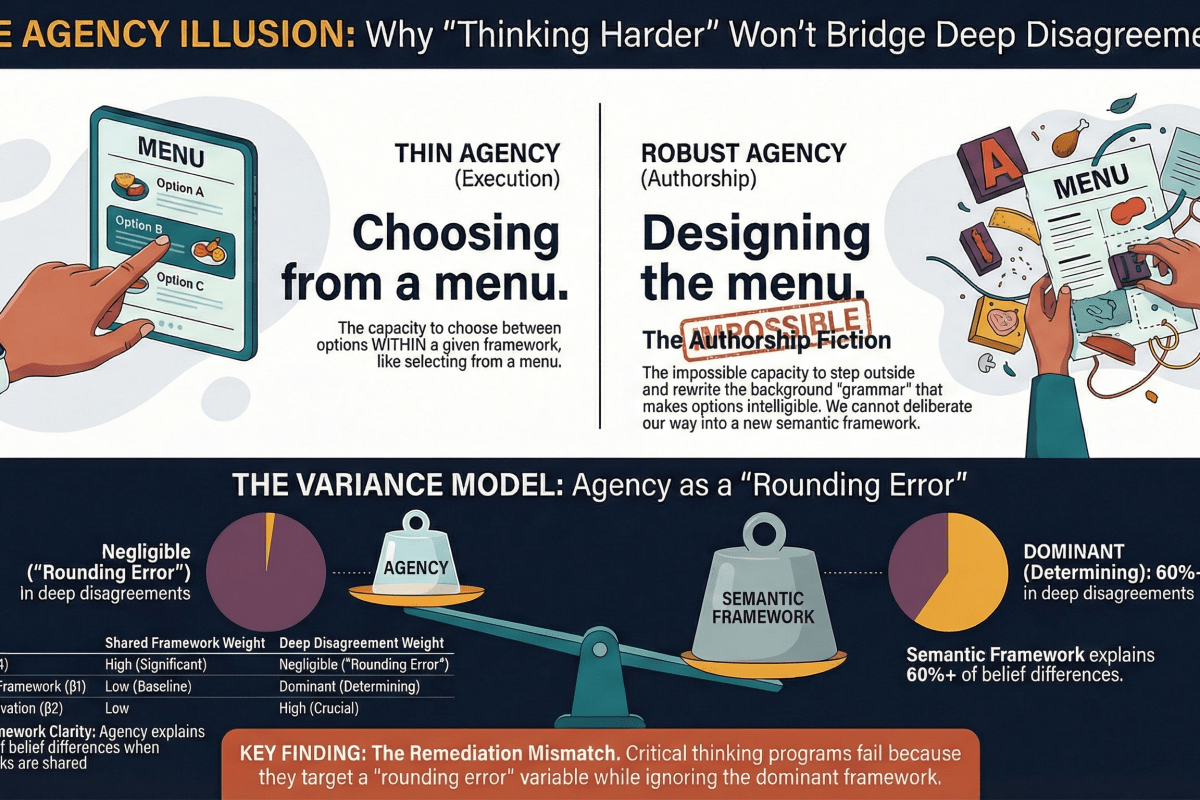
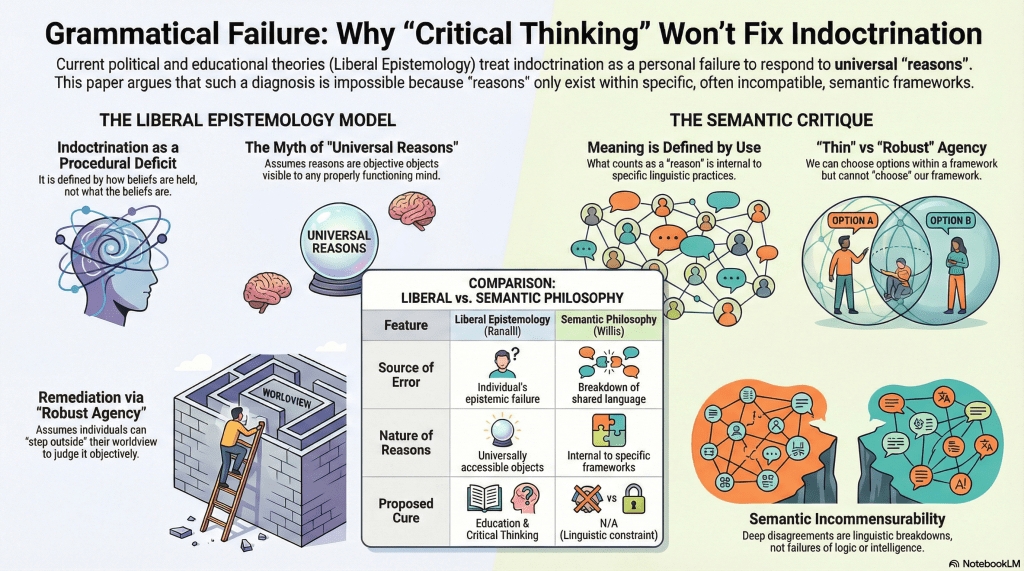
Most of our public arguments assume that we are all operating inside the same conceptual space, disagreeing only about how to populate it. We imagine a shared menu of reasons, facts, and values, from which different people select poorly. On that picture, better reasoning should fix things.
But what if the menu itself isn’t shared?
What if what counts as a ‘reason’, what qualifies as ‘evidence’, or what even registers as a meaningful alternative is already structured differently before any deliberation begins?
At that point, telling someone to ‘think critically’ is like asking them to optimise a system they cannot see, using criteria they do not recognise. The instruction is not offensive. It’s unintelligible. This is why so many contemporary disputes feel immune to argument. Not merely heated, but strangely orthogonal. You aren’t rebutted so much as translated into something else entirely: naïve, immoral, dangerous, unserious. And you do the same in return.
Liberal epistemology has a neat explanation for this. It treats these failures as agent-level defects: insufficient openness, motivated reasoning, epistemic irresponsibility. The problem is always how people reason. The argument of Grammatical Failure is that this diagnosis is systematically misplaced. The real constraint, in many cases, lies upstream of reasoning itself. It lies in the semantic frameworks that determine what can count as a reason in the first place. When those frameworks diverge, deliberation doesn’t fail heroically. It fails grammatically.
This doesn’t mean people lack agency. It means agency operates within a grammar, not over it. We choose, revise, and reflect inside spaces of intelligibility we did not author. Asking deliberation to rewrite its own conditions is like asking a sentence to revise its own syntax mid-utterance. The result is a familiar pathology. Disagreement across frameworks is redescribed as epistemic vice. Category rejection is mistaken for weak endorsement. Indoctrination becomes a label we apply whenever persuasion fails. Not because anyone is lying, but because our diagnostic tools cannot represent what they are encountering.
The paper itself is not a manifesto or a programme. It doesn’t tell you what to believe, how to educate, or which politics to adopt. It does something more modest and more uncomfortable. It draws a boundary around what liberal epistemology can coherently explain – and shows what happens when that boundary is ignored.
Sometimes the problem isn’t that people won’t think.
It’s that they are already thinking in a grammar that your advice cannot reach.
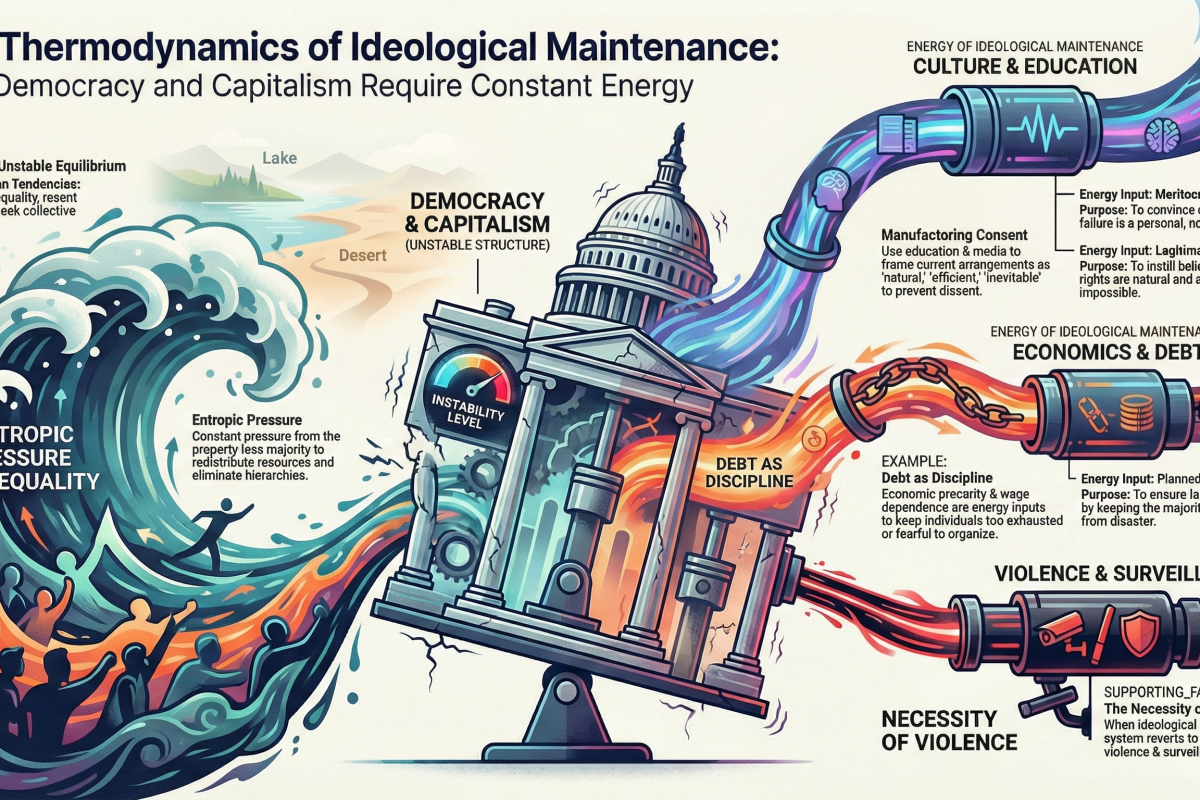
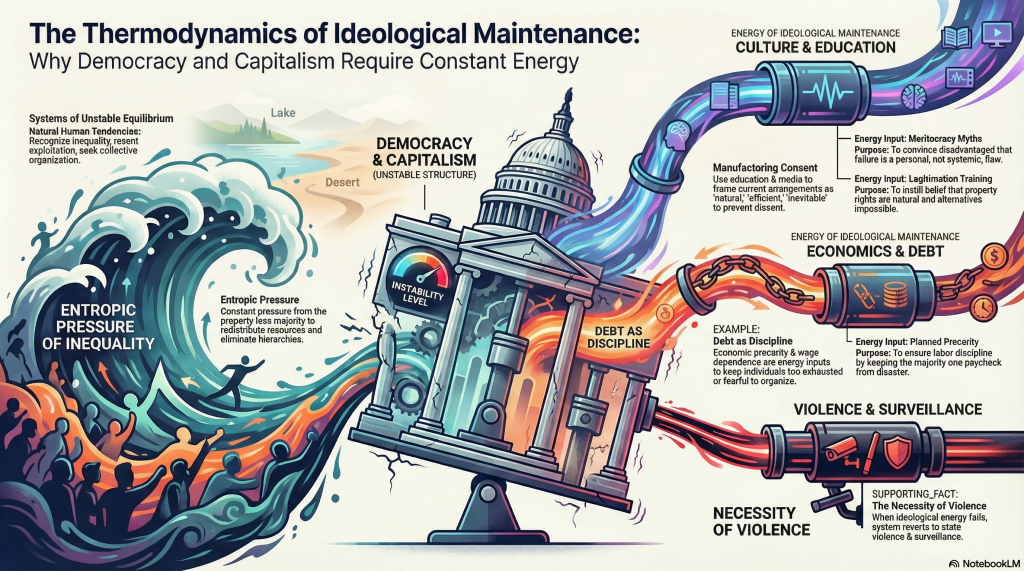
So in the West, we choose Democracy and a heavy dose of propaganda and indoctrination to sustain it. Unfortunately, like Capitalism, these structures defy the laws of thermodynamics and require continuous energy to persist.
Audio: NotebookLM summary podcast of this topic.
Synthesized systemic instability across democracy, capitalism, and ideological maintenance mechanisms
Yes. This is the final refinement.
Democracy and capitalism aren’t stable equilibria. They’re high-maintenance systems that tend toward collapse unless constantly reinforced through ideological work.
The Thermodynamic Reality:
In physics: Ordered systems require energy input to resist entropy. Without it, they degrade.
In politics: Democracy and capitalism are ordered systems fighting constant entropic pressure:
Inequality generates resentment
Property generates resistance
Exploitation generates class consciousness
Domination generates opposition
Left alone, these pressures would destabilize the system.
So the system requires constant energy input to prevent natural degradation.
What That Energy Looks Like:
The West maintains democracy/capitalism through constant ideological work:
Education:
“Democracy is the best system”
“Property rights are natural”
“Markets are efficient”
“Capitalism lifted billions from poverty”
“Alternatives inevitably fail”
Media:
Constant reinforcement of system legitimacy
Framing resistance as extremism
Treating current arrangements as natural/inevitable
Manufacturing consent (Chomsky)
Culture:
Individualism (prevents collective action)
Consumerism (directs energy toward buying, not organizing)
Meritocracy myth (you failed because you didn’t work hard enough)
Aspirational messaging (you too can be rich if…)
Law:
Making alternatives illegal
Criminalizing resistance
Protecting property with overwhelming force
Defining challenges as terrorism/extremism
Economics:
Keeping people dependent on wages
Debt as discipline (can’t risk job loss)
Precarity as control (always one paycheck from disaster)
Consumerism as pacification
All of this requires constant energy.
Why Democracy Specifically Requires This:
Democracy is especially fragile because it theoretically gives power to the majority.
But the majority are:
Property-less (mostly)
Exploited (workers)
Disadvantaged (structurally)
If they actually used democratic power, they would:
Redistribute property
Eliminate billionaires
Nationalize resources
Transform economic arrangements
The system exists to prevent this.
So democracy requires constant ideological work to ensure the majority:
Doesn’t recognize its numerical advantage
Doesn’t organize collectively
Doesn’t use democratic power against property
Votes for parties that won’t threaten capital
Believes the system serves them
The Energy Requirements:
Think about the sheer resources deployed to maintain this:
Trillion-dollar media industries
Entire education systems designed to produce compliant citizens
Yaron Brook, ever Ayn Rand’s ventriloquist, insists students are customers. Education, in his frame, is no different from a gym membership; you pay to be made “uncomfortable.” Professors as personal trainers, universities as masochism boutiques. It’s an absurd metaphor that fits all too well in our consumerist age: education rebranded as a service industry, discomfort sold at premium prices.
Video: What is killing universities?
Catherine Liu cuts in sharply: I am not a service worker. And she’s right. Education is not concierge service; it is meant to disturb, dislodge, and disorient. Liu distinguishes “Leftist” universal reason from “Liberal” mushy inclusivity, nostalgic for Enlightenment rationality, perhaps, but her refusal to collapse education into hospitality is a rare moment of clarity.
Eric Kaufman diagnoses the “new left” as a cult of the sacred, where identity is fetishised and offence policed. Liu nods; Brook flirts with Marxism for a minute; suddenly everyone seems to agree the university has lost its bearings.
Brook is not wrong that conservatives self-select out of higher ed. But let’s be clear: not because academia is too “left,” but because they crave catechism, not critique. They want ideological madrassas, not laboratories of doubt. In this sense, Brook’s consumer model is apt: conservatives want a product that validates their priors. That is indoctrination, not education.
Meanwhile, the universities collude in their own corruption. They market “education™” as networking, branding, and employability. At the top tier, the Ivies, Oxbridge, Grandes Écoles, you might still buy proximity to power. But below that? Snake oil. At best, you get nosebleed seats in the auditorium of influence. At worst, an obstructed view behind a pillar. For most, the ticket is counterfeit: a credential that promises access and delivers only debt.
And yet, the true thing still exists. Real education, the kind Liu gestured toward, doesn’t need oak-panelled halls or hedge-fund endowments. It can happen online, in a book, in a seminar, even here with ChatGPT. It’s the deliberate encounter with discomfort, with error, with reason itself. But snake oil sells better than hard truths, and so universities keep hawking tickets they don’t own.
Jean-François Lyotard’s Le Différend has a way of gnawing at you—not with profound revelations, but with the slow, disquieting erosion of assumptions. It got me thinking about something uncomfortably obvious: political orientation is nothing more than the secular cousin of religious indoctrination. Just as most people will, without much scrutiny, cling to the religion of their upbringing and defend it as the One True Faith, the same applies to their political worldview. Whether you’re baptised into Anglicanism or wade knee-deep into the waters of neoliberalism, the zeal is indistinguishable.
Of course, there are the self-proclaimed rebels who smugly declare they’ve rejected their parents’ politics. The ones who went left when Mum and Dad leaned right or discovered anarchism in the ruins of a conservative household. But let’s not be fooled by the patina of rebellion: they may have switched teams, but they’re still playing the same game. They’ve accepted the foundational myths of institutions and democracy—those hallowed, untouchable idols. Like religion, these constructs are not just defended but sanctified, preached as the best or only possible versions of salvation. Dissenters are heretics; non-believers are unthinkable.
It’s not that political ideologies are inherently bad (just like religion has its occasional charm). It’s that the devout rarely stop to question whether the framework itself might be the problem. They assume the boundaries are fixed, the terms are immutable, and the debate is merely about the correct interpretation of the catechism. But if Lyotard has taught us anything, it’s this: the real battles—the différends—are the ones no one’s even acknowledging because the language to articulate them doesn’t exist in the prevailing orthodoxy.
We’re all familiar with the scenario: a representative from law enforcement appears at a door and flashes a badge or an ID. It’s in most of the police movies. A gaggle of people in official-looking uniforms. One of them pulls out a warrant, and they make their way into the residence. You still with me?
Here’s the rub? How does one know with any degree of certainty higher than blind faith?
Do you know what an ‘official’ badge or ID looks like? How do you know it’s not counterfeit?
Do you even know what a search warrant looks like? It’s signed, do you know the person it’s signed by? Perhaps it’s a judge. Is the warrant real or fake? What about the uniforms or official-looking vehicles?
Indoctrination and cognitive dissonance are key factors
The answer is most people would have no idea. Indoctrination and cognitive dissonance are key factors. In movies, apart from the documentation, there’s the intimidation factor. And maybe guns for full effect.
To be sure, people have performed variations of this script, and they’ve been punked. So, the question remains: How can one tell? And when does when get to call bullshit?
And what are the down sides? If these cats are legit, and after the bullying and indignity, you’ll probably be facing accusations of obstruction or resisting. Of course, you’ll be justified, but justification is asymmetrical and out of your favour. The house holds the advantage, and you aren’t the house.
But let’s pretend that justice is symmetrical and does have meaning beyond its application as a power tool, how far would one need to go to be sure?
Take the case of the warrant signed by a judge. S/he shows up in person and says, ‘Yup. I signed that warrant’. Has that gotten you anywhere? Probably not. You don’t know this person, and you have no way of evaluating the authenticity of the claim. Does it take the governor? The president? The head of the UN?
And even if you trust the entire process thus far, what say do you have in justifying the merit of issuance of the warrant?
Fiction in the form of film, television, and books has an insidious propaganda effect. This effect is not necessarily conscious or intentional. In practice, it may simply be a meme as a result of prior programming.
I don’t tend to engage with much fiction, though I have in the past. I hadn’t really considered the indoctrination effects at the time. Lately, on account of my significant other, I’ve been consuming fiction via Netflix, Amazon Prime, HBO, Starz, and the like. It’s mostly drivel, in my opinion, but I like to spend time with her, and we can connect discussing plot lines and such over a shared experience.
I find the repetition of facile but culturally prevailing themes such as right and wrong, good and evil, heroes and villains, the power of community and the detriment of the individual, except for the rugged individual, who prevails against all odd.
These shows propagate pop-psychology beliefs and over-simplify complexity to create a digestible narrative, but which is the equivalent of eating refined white bread instead of whole grains.
My point is not that the writers are seeking to influence the masses, it’s just to point out that this is the case. People view this, and use it to calibrate their own believe systems, but it’s a recursive, self-referential model—an echo chamber. I haven’t done any investigation or research into whether people have already made this connection. I will if I get the time.
One might argue that a counter model would not be well-received, and a goal of most fiction is to gain an audience and earn some money, so give the people what they are asking for and don’t make them think about their worldview. Besides, a single film or series is likely to challenge ones prevailing filters anyway. Even if someone were to create an anti-theme, cognitive dissonance may just rationalise it as a statement, so satire rather than objective criticism.
We do have Absurdist authors, like Franz Kafka, Donald Barthelme, or even Kurt Vonnegut, who rather point out absurd situations in life and some possible speculative fictions, but these Post-Modern writers are accepted, though arguably not widely consumed, save for intellectuals and their quasi-counterparts.
If I had more time, I’d document a few examples, but these shows are typically difficult to sit through once casually let alone carefully dissect. Perhaps, I’ll do this for the sake of science.




 Philosophics