The Burnout Society – Byung-Chul Han

1–2 minutes
A digital MTG trading card titled “Achievement Token – Condition.” The image shows a human figure shaped like an hourglass, sand flowing through its body as if time and self are draining away. The design echoes the colours of oxidised red and muted graphite, symbolising burnout and the illusion of productivity within modern capitalist culture.
Image: Exhaustion means you’re working hard, and working hard means you’re good.

Han’s slender essay reads like a diagnosis of our psychic economy. The disciplinary society of ‘thou shalt’ has dissolved into the achievement society of ‘yes, I can’. We no longer rebel against authority; we internalise it, polishing our exhaustion until it gleams like ambition. Productivity replaces purpose. Rest becomes guilt. The subject, stripped of exterior constraint, now self-flagellates in the name of freedom.

What Han captures is not mere fatigue but a civilisational pathology: the compulsion to optimise the self as though it were capital. Burnout is not the collapse of will but the logical conclusion of unlimited permission.

If liberation now feels indistinguishable from exhaustion, what exactly have we been freed from?
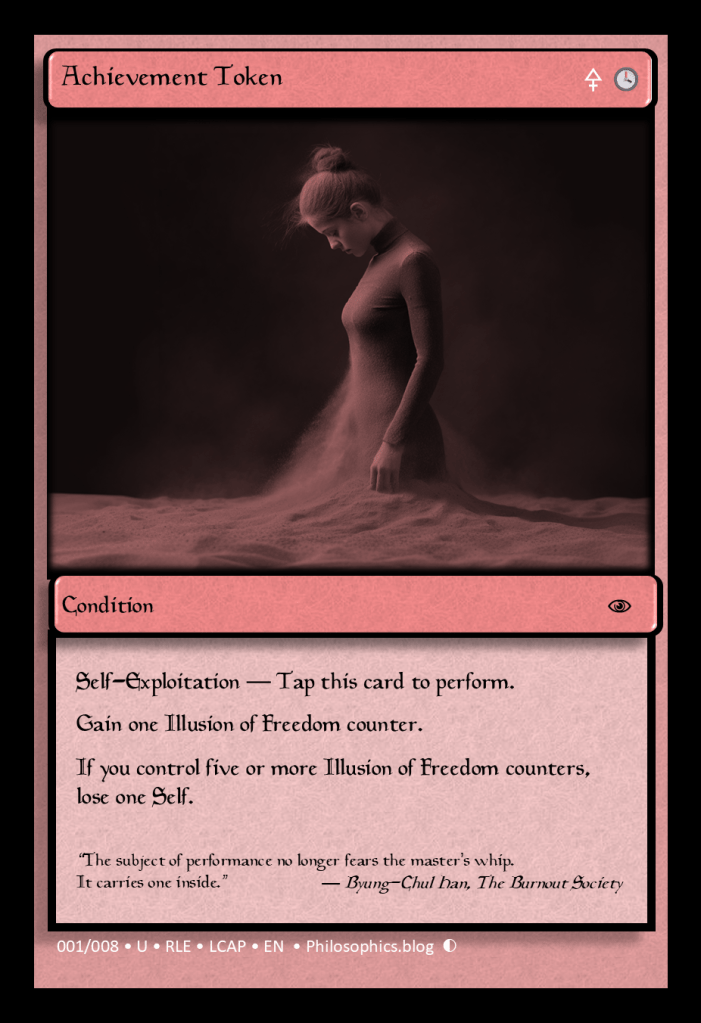
From the series Readings in Late Exhaustion – a Philosophics reflection on the maladies of modernity.


About the Series — Readings in Late Exhaustion

These cards belong to Readings in Late Exhaustion, a Philosophics project tracing the psychic and cultural costs of late capitalism.

Each card interprets a contemporary work of critical theory through the language of collectable gameplay, where identity, labour, and value become quantified acts.

The format itself is the critique: a system of self-expenditure disguised as achievement, reflection rendered as performance.

Edition: RLE / LCAP — Philosophics Press


Baudrillard in Latex: Why The Matrix Was Right About Everything Except Freedom

2–3 minutes

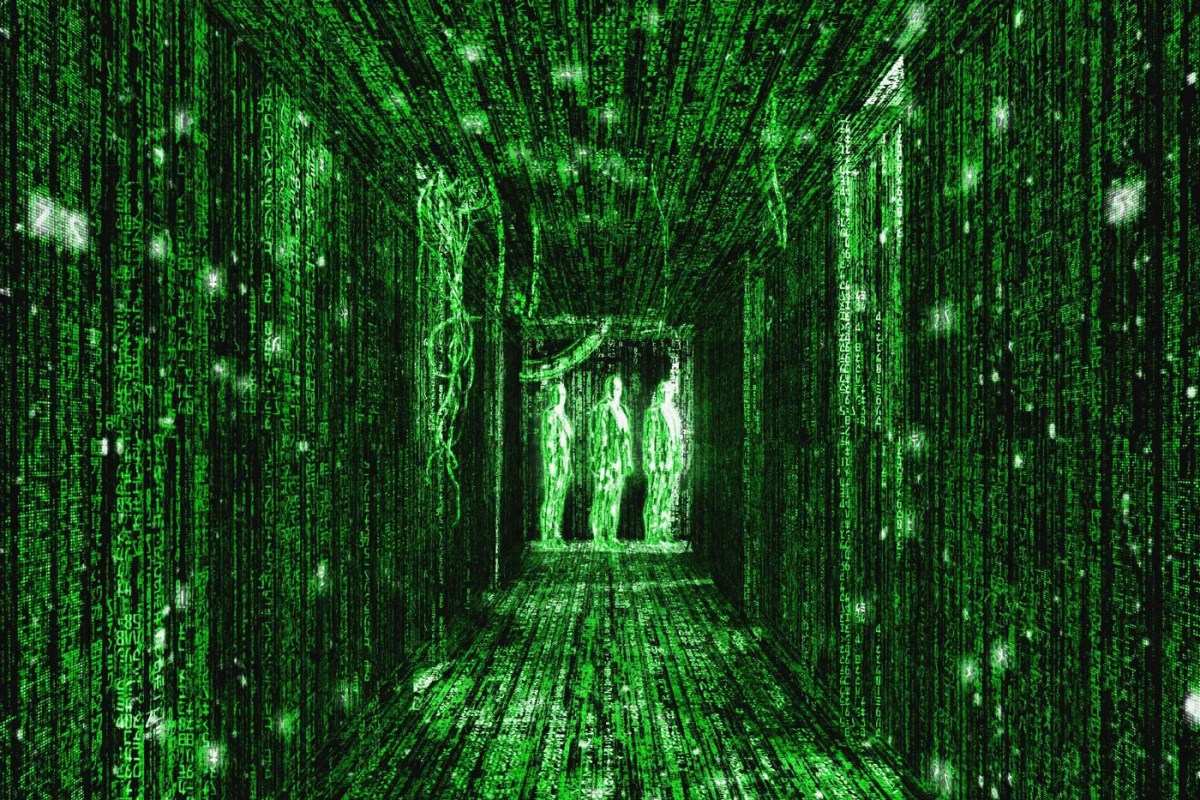
In the late 1990s, the Wachowskis gave us The Matrix – Keanu Reeves as Neo, the Chosen One™, a man so bland he could be anyone, which was the point. Once he realised he was living inside a simulation, he learned to bend its laws, to dodge bullets in slow motion and see the code behind the curtain. Enlightenment, Hollywood-style.

Audio: NotebookLM podcast on this topic.

But here’s the twist, the film itself couldn’t stomach: realising the simulation doesn’t free you from it.

Knowing that race and gender are social constructs doesn’t erase their architecture. Knowing that our economies, legal systems, and so-called democracies are fictions doesn’t get us out of paying taxes or playing our assigned roles. “The social contract” is a collective hallucination we agreed to before birth. That and a dollar still won’t buy you a cup of coffee.

Baudrillard, whose Simulacra and Simulation the film name-dropped like a trophy, argued that simulation doesn’t hide reality – it replaces it. When representation becomes indistinguishable from the thing it represents, truth evaporates, leaving only consensus. We don’t live in a system of power; we live in its performance.

The Matrix got the metaphor half right. It imagined the bars of our cage as a digital dream – glossy, computable, escapable. But our chains are older and subtler. Rousseau called them “social”, Foucault diagnosed them as “biopolitical”, and the rest of us just call them “normal”. Power doesn’t need to plug wires into your skull; it only needs to convince you that the socket is already there.

You can know it’s all a fiction. You can quote Derrida over your morning espresso and tweet about the collapse of epistemic certainty. It won’t change the fact that you still have rent to pay, laws to obey, and identities to perform. Awareness isn’t liberation; it’s just higher-resolution despair with better UX.

Neo woke up to a ruined Earth and thought he’d escaped. He hadn’t. He’d only levelled up to the next simulation – the one called “reality”. The rest of us are still here, dutifully maintaining the system, typing in our passwords, and calling it freedom.

NB: Don’t get me wrong. I loved The Matrix when it came out. I still have fond memories. It redefined action films at the time. I loved the Zen messaging, but better mental acuity doesn’t grant you a pass out of the system.

Refeshing, Žižek

What a relief. After trudging through a couple of so-called ‘popular’ books, it’s refreshing to read something that actually reflects the complexity of reality.

The first essay in Slavoj Žižek’s Against Progress is titled Progress and Its Vicissitudes. It opens with a nod to the opening scene of The Prestige, directed by Christopher Nolan. But Žižek, as always, takes it further. He unearths something far more sinister in the magician’s sleight of hand—something unsettlingly perceptible to the young girl who witnesses the trick.

Life isn’t always what it seems on the surface. It isn’t as neat or digestible as our perceptions make it out to be. Žižek embarks on a scathing critique of the concept of progress, dismantling its conventional interpretations and exposing the often-overlooked consequences that lurk beneath its glossy exterior. He unravels the paradoxes and failures inherent in the notion of progress, urging readers to rethink their blind faith in the idea of a linear march towards a utopian future.

Defining ‘progress,’ he argues, is akin to laying claim to the future. But whose future? And at what cost? He interrogates the competing visions that shape human possibility, questioning whether, in the face of our cascading ecological, social, and political crises, things can actually improve—and what ‘better’ even means. He skewers various ideologies—neoliberalism, populism, and the self-improvement industrial complex—for their roles in manipulating and distorting the very concept of progress.

From a postmodernist perspective, Žižek’s analysis aligns with the scepticism towards grand narratives and universal truths that define postmodern thought. He deconstructs the monolithic idea of progress, revealing it as a construct that conveniently conceals underlying power structures and exclusions. By exposing the ‘squashed dead birds’—the inevitable collateral damage of progress—he underscores just how arbitrary and manufactured our notions of advancement really are.

Moreover, Žižek’s critique echoes the postmodernist fixation on desire, denial, and disavowal. He examines how different visions of progress systematically exclude or sacrifice certain elements and how these dynamics manifest across cultural phenomena, from Hollywood blockbusters to decolonisation movements. His analysis reinforces the postmodernist conviction that meanings are never fixed—they are fluid, contested, and often riddled with contradiction.

In the end, Against Progress is not just a critique—it’s an invitation. An invitation to abandon the comforting illusion of an inevitable march towards something better and to face the messy, contingent reality of human existence head-on.

Can We Just Stop Talking About Free Will

The problem with free will is that we keep dwelling on it. Really, this has to stop.

Owen D. Jones, The End of (Discussing) Free Will, 18 March 2012

This quote was made by Owen Jones in an article published in 2012. I share it because I feel the author is not only being cavalier but wrongly so. According to the bio at the end of the article, Owen D. Jones is a professor of law and biological sciences at Vanderbilt University. As I see it, the problem is not some theoretical—What is the sound of one hand clapping?—pseudo-problem. Human agency is the basis of our legal and jurisprudence systems.

Like good magicians, people like Owen want to redirect your focus to neuroscience and consciousness rather than have to explain how the causal engine that is the brain manifests itself ex nihilo.

Doubling down on my causa sui position, humans may be able to make constrained solutions, and yet they never have control over the constrained system they inherit. I discuss this at length elsewhere, but I wanted to address this comment forthright.

I’ll leave with a quote I tend to trot out a lot.

It is difficult to get a man to understand something when his salary depends on his not understanding it.

— Upton Sinclair, prepared speech, I, Candidate for Governor (1935)

Free will is a necessary illusion for power structures to propagate or they will lose a cornerstone of their control mechanisms. And since humans want to feel they are in control, they are willing to accept the downside for the illusion of an upside.