Where There’s a Will, There’s a Way

I’ve read Part I of Hobbes’ Leviathan and wonder what it would have been like if he filtered his thoughts through Hume or Wittgenstein. Hobbes makes Dickens read like Pollyanna. It’s an interesting historical piece, worth reading on that basis alone. It reads as if the Christian Bible had to pass through a legal review before it had been published, sapped of vigour. As bad a rap as Schopenhauer seems to get, Hobbes is the consummate Ebenezer Scrooge. Bah, humbug – you nasty, brutish, filthy animals!*

Audio: NotebookLM podcast conversation on this topic.

In any case, it got me thinking of free will and, more to the point, of will itself.

A Brief History of Humanity’s Favourite Metaphysical Scapegoat

By the time Free Will turned up to the party, the real guest of honour—the Will—had already been drinking heavily, muttering incoherently in the corner, and starting fights with anyone who made eye contact. We like to pretend that the “will” is a noble concept: the engine of our autonomy, the core of our moral selves, the brave little metaphysical organ that lets us choose kale over crisps. But in truth, it’s a bloody mess—philosophy’s equivalent of a family heirloom that no one quite understands but refuses to throw away.

So, let’s rewind. Where did this thing come from? And why, after 2,500 years of name-dropping, finger-pointing, and metaphysical gymnastics, are we still not quite sure whether we have a will, are a will, or should be suing it for damages?

Plato: Soul, Reason, and That Poor Horse

In the beginning, there was Plato, who—as with most things—half-invented the question and then wandered off before giving a straight answer. For him, the soul was a tripartite circus act: reason, spirit, and appetite. Will, as a term, didn’t get top billing—it didn’t even get its name on the poster. But the idea was there, muddling along somewhere between the charioteer (reason) and the unruly horses (desire and spiritedness).

No explicit will, mind you. Just a vague sense that the rational soul ought to be in charge, even if it had to beat the rest of itself into submission.

Aristotle: Purpose Without Pathos

Aristotle, ever the tidy-minded taxonomist, introduced prohairesis—deliberate choice—as a sort of proto-will. But again, it was all about rational calculation toward an end. Ethics was teleological, goal-oriented. You chose what aligned with eudaimonia, that smug Greek term for flourishing. Will, if it existed at all, was just reason picking out dinner options based on your telos. No inner torment, no existential rebellion—just logos in a toga.

Augustine: Sin, Suffering, and That Eternal No

Fast-forward a few hundred years, and along comes Saint Augustine, traumatised by his libido and determined to make the rest of us suffer for it. Enter voluntas: the will as the seat of choice—and the scene of the crime. Augustine is the first to really make the will bleed. He discovers he can want two incompatible things at once and feels properly appalled about it.

From this comes the classic Christian cocktail: freedom plus failure equals guilt. The will is free, but broken. It’s responsible for sin, for disobedience, for not loving God enough on Wednesdays. Thanks to Augustine, we’re stuck with the idea that the will is both the instrument of salvation and the reason we’re going to Hell.

Cheers.

Medievals: God’s Will or Yours, Pick One

The Scholastics, never ones to let an ambiguity pass unanalysed, promptly split into camps. Aquinas, ever the reasonable Dominican, says the will is subordinate to the intellect. God is rational, and so are we, mostly. But Duns Scotus and William of Ockham, the original voluntarist hooligans, argue that the will is superior—even in God. God could have made murder a virtue, they claim, and you’d just have to live with it.

From this cheerful perspective, will becomes a force of arbitrary fiat, and humans, made in God’s image, inherit the same capacity for irrational choice. The will is now more than moral; it’s metaphysical. Less reason’s servant, more chaos goblin.

Hobbes: Appetite with Delusions of Grandeur

Then along comes Thomas Hobbes, who looks at the soul and sees a wheezing machine of appetites. Will, in his famously cheery view, is simply “the last appetite before action.” No higher calling, no spiritual struggle—just the twitch that wins. Man is not a rational animal, but a selfish algorithm on legs. For Hobbes, will is where desire stumbles into motion, and morality is a polite euphemism for not getting stabbed.

Kant: The Will Gets a Makeover

Enter Immanuel Kant: powdered wig, pursed lips, and the moral rectitude of a man who scheduled his bowel movements. Kant gives us the “good will”, which acts from duty, not desire. Suddenly, the will is autonomous, rational, and morally legislative—a one-man Parliament of inner law.

It’s all terribly noble, terribly German, and entirely exhausting. For Kant, free will is not the ability to do whatever you like—it’s the capacity to choose according to moral law, even when you’d rather be asleep. The will is finally heroic—but only if it agrees to hate itself a little.

Schopenhauer: Cosmic Will, Cosmic Joke

And then the mood turns. Schopenhauer, world’s grumpiest mystic, takes Kant’s sublime will and reveals it to be a blind, thrashing, cosmic force. Will, for him, isn’t reason—it’s suffering in motion. The entire universe is will-to-live: a desperate, pointless striving that dooms us to perpetual dissatisfaction.

There is no freedom, no morality, no point. The only escape is to negate the will, preferably through aesthetic contemplation or Buddhist-like renunciation. In Schopenhauer’s world, the will is not what makes us human—it’s what makes us miserable.

Nietzsche: Transvaluation and the Will to Shout Loudest

Cue Nietzsche, who takes Schopenhauer’s howling void and says: yes, but what if we made it fabulous? For him, the will is no longer to live, but to power—to assert, to create, to impose value. “Free will” is a theologian’s fantasy, a tool of priests and moral accountants. But will itself? That’s the fire in the forge. The Übermensch doesn’t renounce the will—he rides it like a stallion into the sunset of morality.

Nietzsche doesn’t want to deny the abyss. He wants to waltz with it.

Today: Free Will and the Neuroscientific Hangover

And now? Now we’re left with compatibilists, libertarians, determinists, and neuroscientists all shouting past each other, armed with fMRI machines and TED talks. Some claim free will is an illusion, a post hoc rationalisation made by brains doing what they were always going to do. Others insist that moral responsibility requires it, even if we can’t quite locate it between the neurons.

We talk about willpower, will-to-change, political will, and free will like they’re real things. But under the hood, we’re still wrestling with the same questions Augustine posed in a North African villa: Why do I do what I don’t want to do? And more importantly, who’s doing it?

Conclusion: Where There’s a Will, There’s a Mess

From Plato’s silent horses to Nietzsche’s Dionysian pyrotechnics, the will has shape-shifted more times than a politician in an election year. It has been a rational chooser, a moral failure, a divine spark, a mechanical twitch, a cosmic torment, and an existential triumph.

Despite centuries of philosophical handwringing, what it has never been is settled.

So where there’s a will, there’s a way. But the way? Twisting, contradictory, and littered with the corpses of half-baked metaphysical systems.

Welcome to the labyrinth. Bring snacks.

* The solitary, poor, nasty, brutish, and short quote is forthcoming. Filthy animals is a nod to Home Alone.


Declaration of Independence

It’s July. The season of independence in the United States. Independence from the overt tyranny of Britain, but not from the tacit tyranny of their government—the government purported to be ‘of the people, by the people, and for the people‘ per Abraham Lincoln’s 1863 Gettysburg Address. As their Constitution reads, ‘We the People‘. Governments may be of the people and by the people, but governments are an emergent phenomenon as happens when oxygen and hydrogen combine just so and create water. Two gases combine to create a new substance—water. Some forget that, like water, government are a distinct element to the people that constitute it. Some think it resembles them. It doesn’t. It’s Hobbes’ Leviathan—or a Jabberwok.

In preparation for the traditional Summer season, I took to reading Derrida’s 1976 essay, Declarations of Independence. It was interesting, but I was hoping to get more from it. I decided to deconstruct the opening paragraph—the preamble—of the Declaration of Independence:

Deconstructing Binary Oppositions

Self-Evident vs. Non-Self-Evident

The Declaration boldly asserts that ‘these truths’ are ‘self-evident’,’ a claim that is nothing more than a rhetorical trick. By presenting these ideas as self-evident, the authors seek to place them beyond questioning, discouraging dissent and critical examination. In reality, these ‘truths’ are far from universal; they are the product of a specific cultural and historical context, shaped by the interests and perspectives of the privileged few who drafted the document.

Interrogating Assumptions and Hierarchies The Declaration of Independence asserts that certain truths are ‘self-evident’, implying that these truths are so obvious that they require no further justification. However, the concept of self-evidence itself is far from universally accepted. It is deeply embedded in the philosophical tradition of Enlightenment rationalism, which holds that reason and logic can reveal fundamental truths about the world.

  1. Philosophical Foundations of Self-Evidence
    • Enlightenment Rationalism: The idea of self-evidence relies heavily on Enlightenment rationalism, which posits that certain truths can be known directly through reason and are therefore beyond dispute. Philosophers such as RenĂ© Descartes and Immanuel Kant emphasised the power of human reason to uncover self-evident truths. Descartes, for instance, argued for the self-evident nature of ‘Cogito, ergo sum‘ (‘I think, therefore I am’) as a fundamental truth (Descartes, Meditations on First Philosophy).
    • Critique of Rationalism: Critics of Enlightenment rationalism, including existentialists like Friedrich Nietzsche and phenomenologists like Martin Heidegger, argue that what is considered self-evident is often culturally and historically contingent. Nietzsche, for example, contended that what we take as ‘truth’ is a product of our perspective and historical context, not an absolute given (Nietzsche, Beyond Good and Evil).
  2. Cultural and Philosophical Contingency
    • Cultural Relativity: Different cultures and philosophical traditions may not find the same truths to be self-evident. For instance, the concept of individual rights as self-evident truths is a product of Western liberal thought and may not hold the same self-evident status in other cultural frameworks. In many Eastern philosophies, the focus is more on community and harmony rather than individual rights.
    • Subjectivity of Self-Evidence: The term ‘self-evident’ implies an inherent, unquestionable truth, yet what one group or culture finds self-evident, another may not. This variability reveals the instability and subjectivity of the claim. For example, in traditional Confucian societies, the emphasis is placed on hierarchy and duty rather than equality and individual rights, demonstrating a different set of ‘self-evident’ truths.
  3. Constructed Nature of Truth
    • Language and Context: Jacques Derrida’s concept of diffĂ©rance illustrates how meaning is not fixed but constantly deferred through language. What we consider to be “truth” is constructed through linguistic and social contexts. Derrida argues that texts do not have a single, stable meaning but rather a multiplicity of interpretations that change depending on the reader’s perspective and context (Derrida, Of Grammatology).
    • Social Construction: Michel Foucault’s analysis of power and knowledge further deconstructs the notion of objective truth. Foucault argues that what is accepted as truth is produced by power relations within society. Truths are constructed through discourses that serve the interests of particular social groups, rather than being objective or self-evident (Foucault, Discipline and Punish).

Created Equal vs. Not Created Equal

The Declaration’s claim that ‘all men are created equal’ is a blatant falsehood, a manipulative promise designed to appease the masses whilst maintaining the status quo. The glaring contradictions of slavery and gender inequality expose the hollowness of this assertion. Equality, as presented here, is nothing more than an ideological construct, a tool for those in power to maintain their dominance while paying lip service to the ideals of justice and fairness.

Creator vs. No Creator

The Declaration refers to a ‘Creator’ who endows individuals with rights, grounding its claims in a divine or natural law. This invokes a theistic worldview where moral and legal principles are derived from a higher power. However, Derrida challenges this by showing that the concept of a creator is a cultural and philosophical construct, not a universal truth.

The presence of the creator in the text serves to legitimise the rights it declares. However, this legitimacy is contingent on accepting the cultural narrative of a creator. Secular and non-theistic perspectives are marginalised by this assertion, revealing the ideological biases inherent in the Declaration. The authority of the declaration is thus shown to be dependent on particular beliefs, rather than an objective reality.

Unalienable vs. Alienable

The notion of ‘unalienable Rights’ is another empty promise, a rhetorical flourish designed to inspire loyalty and obedience. In practice, these supposedly inherent and inviolable rights are regularly violated and denied, particularly to those on the margins of society. The Declaration’s lofty language of ‘Life, Liberty and the pursuit of Happiness’ rings hollow in the face of systemic oppression and injustice. These rights are not unalienable; they are contingent upon the whims of those in power.

Conclusion

Through this deconstruction, we expose the Declaration of Independence for what it truly is: a masterful work of propaganda, filled with false promises and manipulative rhetoric. The document’s purported truths and self-evident principles are revealed as arbitrary constructs, designed to serve the interests of the powerful while placating the masses with empty platitudes.

As some celebrate this 4th of July, let us not be fooled by the high-minded language and lofty ideals of our founding documents. Instead, let us recognise them for what they are: tools of control and manipulation, employed by those who seek to maintain their grip on power. Only by constantly questioning and deconstructing these texts can we hope to expose the truth behind the facade and work towards a more genuine understanding of freedom and equality.

References

  • Jacques Derrida, “Declarations of Independence,” in Negotiations: Interventions and Interviews 1971-2001, ed. Elizabeth Rottenberg (Stanford: Stanford University Press, 2002).
  • Jacques Derrida, Of Grammatology (Baltimore: Johns Hopkins University Press, 1976).
  • Friedrich Nietzsche, Beyond Good and Evil (Cambridge: Cambridge University Press, 2002).
  • Michel Foucault, Discipline and Punish: The Birth of the Prison (New York: Vintage Books, 1995).
  • Immanuel Kant, Critique of Pure Reason (Cambridge: Cambridge University Press, 1998).
  • RenĂ© Descartes, Meditations on First Philosophy (Cambridge: Cambridge University Press, 1996).

Perspective on Theseus

Chump in Chief* wrote a piece on dementia using analogue of the ship of Theseus. As a topic, Hobbes’** Theseus thought experiment has been well-covered, but that’s never stopped me before.

This is all about identity. Essentially, there are two perspectives. To an observer not on the ship or aware of the transformation, they would be none the wiser. For all intents and purposes, if they had ever seen the ship before, it’s the same. But what about those on the ship?

For nearly all of these observers, it’s almost unquestionably still the same ship. In a manner paralleling a person’s cells being sloughed off every 7 years, the cells in place at the start aren’t there after 7 years. Most will not doubt that you are the same person.

the average human cell is about 7 to 10 years old

As cells are continually dying and replacing themselves, for an adult the average human cell is about 7 to 10 years old, which might be interpreted as saying in the fashion of Theses’ ship that a person is anew each 7 to 10 years. Let’s ignore that this is an average, and many cells have a lifespan of only a few days whilst others—cerebral cells in particular—are here from the start and so are as old as the person.

Another perspective is to consider the replacement parts: would it matter if the colour of the parts changed in the process? What about the materials? What about the underlying architecture? What if the departing sloop arrived a schooner? Weight? What then?

My favourite extension of this thought experiment is to ask the question two-fold: Not only do we ask if this ship built with new materials is still Theseus’ ship—which to be fair is more a question of ownership than of identity—, but what if I reconstruct the original ship with the original materials. Are these both Theseus’ ships? Can we continue this exercise with new material ad infinitum?

As far as I know, we can’t repurpose cells in this fashion, but what if we could? There are many such Star Trek transporter mishap thought experiments, or the Duplicates Paradox.

In these experiments, a transporting device disintegrates the subject, and replicates the subject at a distance—but this replication presumably uses different atoms and cells, and so what if a duplicate copy is made rather than the replacement copy? Who’s identity prevails? Is it murder to eliminate one of the duplicates? Similar questions have played out in the science fiction / fantasy space.

Locke and others suggest that for people, memory and the continuity of thought are key, but your thoughts of me are not the same as my thoughts of me. This is why an amnesiac may no longer maintain some original identity, and yet to the familiar outside observer, this shell of a person remains intact. This is pretty much how it plays out with zombies and dementia patients. This sense of identity is projected upon the person rather than exuded from them.

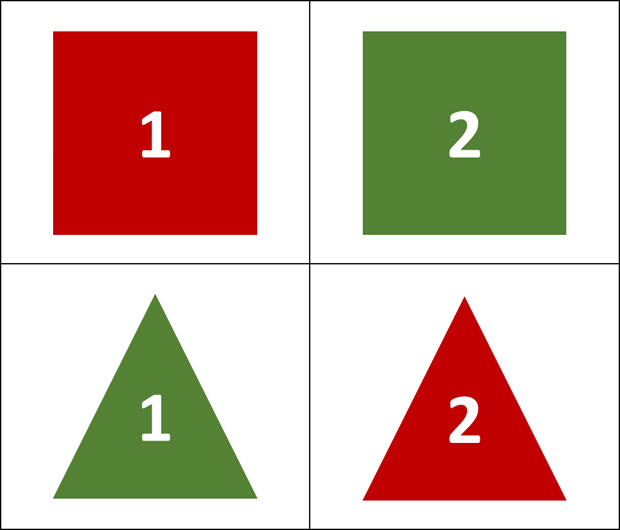
So what is my perspective? Rather than a paradox, it is more a problem of vaguity or ambiguity and how we’re defining sameness. There are many dimensions to similarity. I can present you a red square, a green square, a blue triangle, and a green triangle and play the Sesame Street ‘one of these things is not like the other game.

Is the sameness the colour, the shape, or the number? Could one be comparing area or perimeter?

So, I’ve gone off the reservation. I don’t put a lot of weight in notion of identity. It has evolutionary merit and is an effect of humans’ nature (as it were) to categorise and taxonomise.

* This Chief Chump charge may be unwarranted or even understated, as I don’t know this bloke.
** This is the same Hobbes with the ‘solitary, poor, nasty, brutish, and short’ claim to fame.

On Property

2–3 minutes

We take property for granted. John Locke espoused life, liberty, and property. Rousseau observed that “The first man who, having fenced in a piece of land, said “This is mine”, and found people naïve enough to believe him, that man was the true founder of civil society. From how many crimes, wars, and murders, from how many horrors and misfortunes might not any one have saved mankind, by pulling up the stakes, or filling up the ditch, and crying to his fellows: Beware of listening to this impostor; you are undone if you once forget that the fruits of the earth belong to us all, and the earth itself to nobody.”

The first man who, having fenced in a piece of land, said “This is mine,” and found people naĂŻve enough to believe him, that man was the true founder of civil society.

But property and its defence is nothing more than some accepted rhetoric. Libertarians presume this to be some inviolable right, and Anarchists and Socialists believe that property—well, private property anyway; real property—is a common good.

I have an issue with ownership of real property, though I don’t have such a strong opinion on possession. In reality, this is more of a practical matter than a defensible philosophical position. It has emotivist roots. As Hobbes noted (or I’ll paraphrase liberally), even animals in his state of nature have possessions, but there is no right to these possessions (which belong to the monarch anyway in society); there is only the ability to try to retain ownership through force.

In practice, this is what society does. Insomuch as the force is more potential than kinetic, allowing the state or community to exercise this force by proxy, it is not dissimilar to our consumption of meat products at arm’s length by sheltering the violent reality by intermediary grocers.

And we shelter ourselves through language. We don’t eat cows and pigs, we eat beef and pork, chateaubriand and bacon.

Returning to property, real property, it’s yours as long as you possess it, but it is not yours from a distance, and it’s not yours to bequeath. If we are to embrace capitalism—which I don’t, but for the sake of argument—, we should allow the property to go to the purpose that will provide the greatest utility. History as a judge demonstrates that it is unlikely to happen to be the someone’s heirs.

Property Rights — Possession

Who else loses sleep over how property rights can be derived legitimately?

I don’t need to argue the existence of God or gods or goddesses—not here anyway—, but I am willing to posit that if there were these deities, no human in privy to their word or desires in a sort of biblical way. Therefore any basis for scriptural law is illegitimate.

In the beginning…

I think it is useful to distinguish between the concepts of possession and property, so I’ll begin there. In the beginning, there was the earth—the land—; and there were people. (I’m taking liberties here, and skipping leaps and bounds.)

In the beginning, there was the earth—the land—; and there were people. (I’m taking liberties here, and skipping leaps and bounds.)  Nature, which is to say ‘bounties of the earth’, ‘produces’ natural resources, raw materials:  rocks, trees, chemicals, what have you. These belong to the earth and are inherently social goods.

The first people sustained themselves with these goods. Taking, say, a stick, I might fashion a makeshift club, and I might then possess this club. I have no inherent right to keep this stick. I may discard it of my own volition (or lose it) or it may be taken from me.

I understand the desire to claim ownership. Territorial animals lay claim to, well, territory; but this claim is defended through violence or the threat thereof and, to some extent, agency, for other allied animals to defend the claim (for myriad reasons). And territorial claims extend only to what one can actively monitor, so if I am a lion, I might possess a territory on the Savannah, but I do not coincidently also possess territory in London. Property rights attempt to extend this relationship, to possess something at arm’s length.

What is missing is the right to possess something. We can go back to Locke and—ignoring that nature and other living entities cannot participate in this system—enter into an accord, a social contract, one where if I possess a good not otherwise claimed by another, it’s mine to possess. As all potential parties have no say, one could argue that there is no legitimate manner to transfer from nature to person. The only defence is one of violence, as noted previously. We can define this transfer as legitimate, but simply saying something does not make it necessarily so. Nonetheless, let’s go from here, from a Hobbesian state of nature, where I can defend myself and possessions through a mechanism described by Rousseau: a social compact: I found it first—and it is useful and potentially this use or utility may be desired by others—, so I get to keep it—in exchange to ceding this privilege to others in my group. To extend this privilege is to extend the accord to other groups.

This is all well and good, but if one’s ability to maintain use of an item is limited by, say, distance or quantity, do I still have a right to possess it? If I possess 20 clubs and my clan has none, what is my claim? The claim of primacy—that I was there first—is weak. It would likely be in my interest (if not in communal interest) to share and give up possession, but having not established a right to that possession as property, how do I lay claim to these? Should I be able to? Should it be a right?

Let’s use a less simple example: a plot of land to farm. I’ve cleared the land, tilled the soil, sowed and tended seeds, and I plan to harvest the fruits of my labour. Many people might say that I am entitled to the fruits. This is debatable, but what if I possess more land than I can cultivate? Do I have a right to let the land lay fallow or otherwise uncultivated?

So current paradigms contest that, having applied labour to modify this natural good, I can hold it, possess it. Presuming that no one else has claimed ownership—a concept not yet introduced—, how does one extend possession? This should also address whether one can possess something at arm’s length.

Bedtime. Posting an incomplete, unedited draft with no citations or links…because it’s past 4 AM. Updates and extensions to follow. Hopefully, I’ll fall asleep and get some rest.

Fais dodo.