Truth After Deflation: Why ‘Truth’ Refuses to Behave

3–4 minutes

I’ve long had a problem with Truth – or at least the notion of it. It gets way too much credit for doing not much at all. For a long time now, philosophers have agreed on something uncomfortable: Truth isn’t what we once thought it was.

The grand metaphysical picture, where propositions are true because they correspond to mind-independent facts, has steadily eroded. Deflationary accounts have done their work well. Truth no longer looks like a deep property hovering behind language. It looks more like a linguistic device: a way of endorsing claims, generalising across assertions, and managing disagreement. So far, so familiar.

Audio: NotebookLM summary podcast of this topic.

What’s less often asked is what happens after we take deflation seriously. Not halfway. Not politely. All the way.

That question motivates my new paper, Truth After Deflation: Why Truth Resists Stabilisation. The short version is this: once deflationary commitments are fully honoured, the concept of Truth becomes structurally unstable. Not because philosophers are confused, but because the job we keep asking Truth to do can no longer be done with the resources we allow it.

The core diagnosis: exhaustion

The paper introduces a deliberately unromantic idea: truth exhaustion. Exhaustion doesn’t mean that truth-talk disappears. We still say things are true. We still argue, correct one another, and care about getting things right. Exhaustion means something more specific:

After deflation, there is no metaphysical, explanatory, or adjudicative remainder left for Truth to perform.

Truth remains grammatically indispensable, but philosophically overworked.
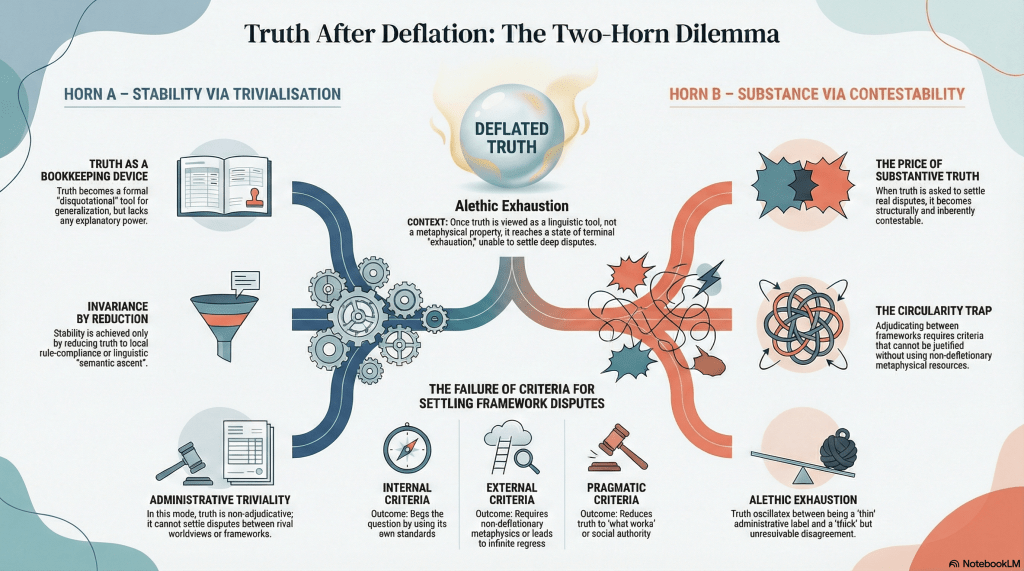
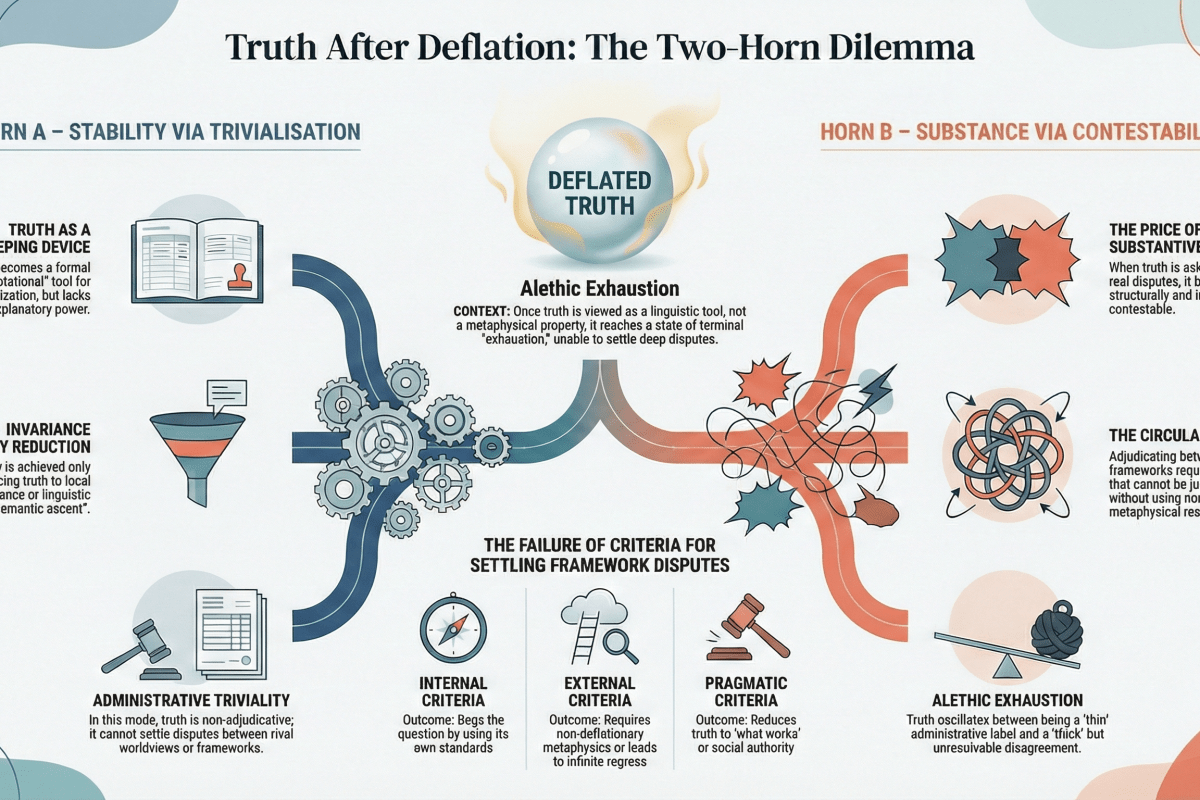
Image: NotebookLM infographics of this topic. (Please ignore the typos.)

The dilemma

Once deflationary constraints are accepted, attempts to “save” Truth fall into a simple two-horn dilemma.

Horn A: Stabilise truth by making it invariant.
You can do this by disquotation, stipulation, procedural norms, or shared observation. The result is stable, but thin. Truth becomes administrative: a device for endorsement, coordination, and semantic ascent. It no longer adjudicates between rival frameworks.

Horn B: Preserve truth as substantive.
You can ask Truth to ground inquiry, settle disputes, explain success, or stand above practices. But now you need criteria. And once criteria enter, so do circularity, regress, or smuggled metaphysics. Truth becomes contestable precisely where it was meant to adjudicate.

Stability costs substance. Substance costs stability. There is no third option waiting in the wings.

Why this isn’t just abstract philosophy

To test whether this is merely a theoretical artefact, the paper works through three domains where truth is routinely asked to do serious work:

  • Moral truth, where Truth is meant to override local norms and condemn entrenched practices.
  • Scientific truth, where Truth is meant to explain success, convergence, and theory choice.
  • Historical truth, where Truth is meant to stabilise narratives against revisionism and denial.

In each case, the same pattern appears. When truth is stabilised, it collapses into procedure, evidence, or institutional norms. When it is thickened to adjudicate across frameworks, it becomes structurally contestable. This isn’t relativism. It’s a mismatch between function and resources.

Why this isn’t quietism either

A predictable reaction is: isn’t this just quietism in better prose?

Not quite. Quietism tells us to stop asking. Exhaustion explains why the questions keep being asked and why they keep failing. It’s diagnostic, not therapeutic. The persistence of truth-theoretic debate isn’t evidence of hidden depth. It’s evidence of a concept being pushed beyond what it can bear after deflation.

The upshot

Truth still matters. But not in the way philosophy keeps demanding. Truth works because practices work. It doesn’t ground them. It doesn’t hover above them. It doesn’t adjudicate between them without borrowing authority from elsewhere. Once that’s accepted, a great deal of philosophical anxiety dissolves, and a great deal of philosophical labour can be redirected.

The question is no longer “What is Truth?” It’s “Why did we expect Truth to do that?”

The paper is now archived on Zenodo and will propagate to PhilPapers shortly. It’s long, unapologetically structural, and aimed squarely at readers who already think deflationary truth is right but haven’t followed it to its endpoint.

Read it if you enjoy watching concepts run out of road.

Enough, Anough, and the Archaeology of Small Mistakes

2–3 minutes

I have acquired a minor but persistent defect. When I try to type enough, my fingers often produce anough. Not always. Often enough to notice. Enough to be, regrettably, anough.

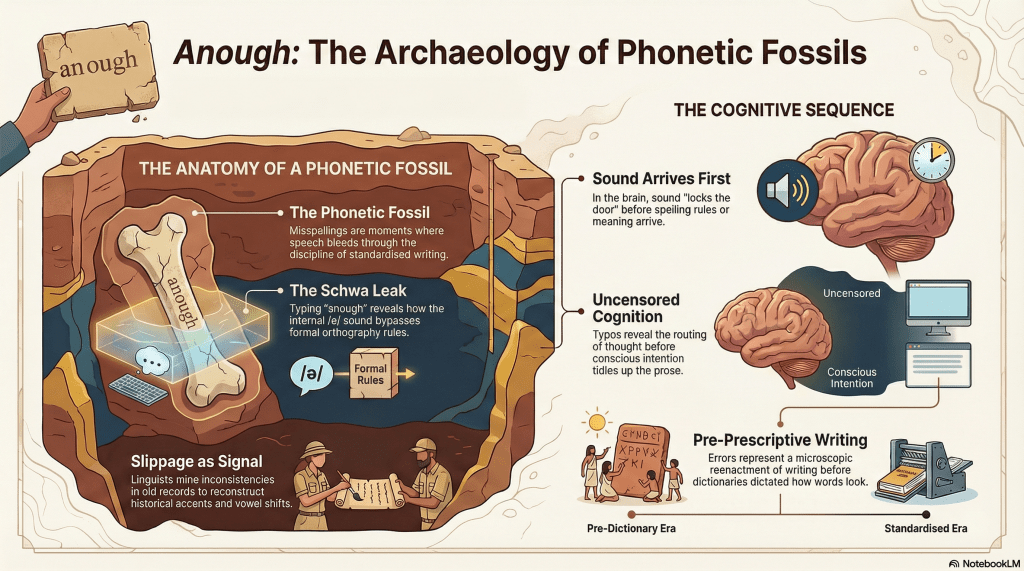
This is not a simple typo. The e and a keys are not conspirators with shared borders. This is not owned → pwned, where adjacency and gamer muscle memory do the heavy lifting. This is something more embarrassing and more interesting: a quasi-phonetic leak. A schwa forcing its way into print without permission. A clue for how I pronounce the word – like Depeche Mode’s I can’t get enough.

Audio: NotebookLM summary podcast of this topic.

Internally, the word arrives as something like ənuf, /əˈnʌf/. English, however, offers no schwa key. So the system improvises. It grabs the nearest vowel that feels acoustically honest and hopes orthography won’t notice. Anough slips through. Language looks the other way.

Image: Archaeology of anough
Video: Depeche Mode: I Just Can’t Get Enough

Is this revelatory?

Not in the heroic sense. No breakthroughs, no flashing lights. But it is instructive in the way cracked pottery is instructive. You don’t learn anything new about ceramics, but you learn a great deal about how the thing was used.

This is exactly how historians and historical linguists treat misspellings in diaries, letters, and court records. They don’t dismiss them as noise. They mine them. Spelling errors are treated as phonetic fossils, moments where the discipline of standardisation faltered, and speech bled through. Before spelling became prescriptive, it was descriptive. People wrote how words sounded to them, not how an academy later insisted they ought to look.

That’s how vowel shifts are reconstructed. That’s how accents are approximated. That’s how entire sound systems are inferred from what appear, superficially, to be mistakes. The inconsistency is the data. The slippage is the signal.

Anough belongs to this lineage. It’s a microscopic reenactment of pre-standardised writing, occurring inside a modern, over-educated skull with autocorrect turned off. For a brief moment, sound outranks convention. Orthography lags. Then the editor arrives, appalled, to tidy things up.

What matters here is sequence. Meaning is not consulted first. Spelling rules are not consulted first. Sound gets there early, locks the door, and files the paperwork later. Conscious intention, as usual, shows up after the event and claims authorship. That’s why these slips are interesting and why polished language is often less so. Clean prose has already been censored. Typos haven’t. They show the routing. They reveal what cognition does before it pretends to be in charge.

None of this licenses forensic grandstanding. We cannot reconstruct personalities, intentions, or childhood trauma from rogue vowels. Anyone suggesting otherwise is repackaging graphology with better fonts. But as weak traces, as evidence that thought passes through sound before it passes through rules, they’re perfectly serviceable.

Language doesn’t just record history. It betrays it. Quietly. Repeatedly. In diaries, in marginalia, and occasionally, when you’re tired and trying to say you’ve had enough. Or anough.

I’ll spare you a rant on ghoti.

Last Word on Nexus

Yuval Noah Harari’s Nexus is a masterclass in well-constructed rhetoric. A gifted storyteller, Harari wields his prose with the finesse of a seasoned polemicist, but his penchant for reductionism undermines the very complexity he claims to dissect. As a historian, he undoubtedly grasps the intricate web of historical causality, yet he distils it into convenient dichotomies, cherry-picking points to prop up his preferred narrative. He doesn’t just oversimplify history—he commits the cardinal sin of overfitting the past to predict the future, as though the arc of history bends neatly to his will.

Harari offers binary possibilities, but his worldview is anything but ambivalent. He is a Modernist to his core, a devoted evangelist of Progress™ with a capital P. His unwavering faith in the forward march of human civilisation betrays an almost theological zeal, as if history itself were a teleological engine hurtling toward an inevitable destiny.

More troubling, though, is his tendency to step beyond his lane, veering into the treacherous territory of the Dunning-Kruger effect. He confuses the illusion of control with actual control, mistaking correlation for causation and influence for omnipotence. The result? A grand narrative that seduces with its elegance but crumbles under scrutiny—an edifice of certainty built on the shaky foundations of conjecture.

In the end, Nexus is a fascinating read, not because it reveals an immutable truth about our future, but because it so brilliantly encapsulates the ambitions—and the blind spots—of its author.