Freedom: The Chains That Bind Us Together

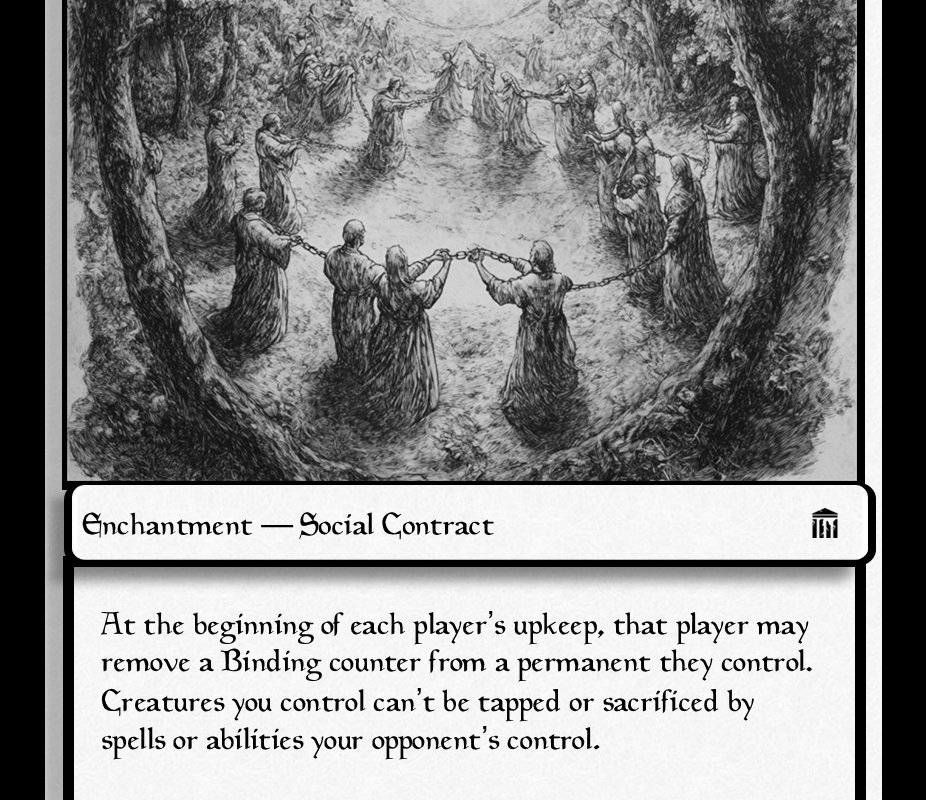
Black-and-white illustration of robed figures standing in a forest clearing, forming a circle by linking chains between their hands. The figures appear both united and restrained, illuminated by a pale, radiant light that suggests dawn or revelation. The mood is solemn yet transcendent, symbolising Rousseau’s paradox that freedom and constraint are inseparable. The image appears as a parody Magic: The Gathering card titled “Freedom,” subtitled “Enchantment — Social Contract,” with a quote from Jean-Jacques Rousseau: “To renounce liberty is to renounce being a man.” The art captures the tension between community, bondage, and liberation.

Freedom is a word so overused it’s practically anaemic. Everyone wants it; no one agrees on what it means. It’s been weaponised by tyrants and revolutionaries alike, invoked to justify both the breaking of chains and their reforging in a different metal.

Audio: NotebookLM podcast on this topic.

As I write this, I have just finished Erich Fromm’s A Sane Society. Without derailing this post, he cited a scenario – a description of work communities given in All Things Common, by Claire Huchet Bishop – where in post-WW2 France, a group formed a sort of workers’ coöperative – but it was more than that; it was an anarchosyndicalist experiment. As I read it, I had to cringe at the power ‘voluntary’ transfers that immediately got me thinking of Foucault’s biopower – as I often do. Saving this for a separate post.
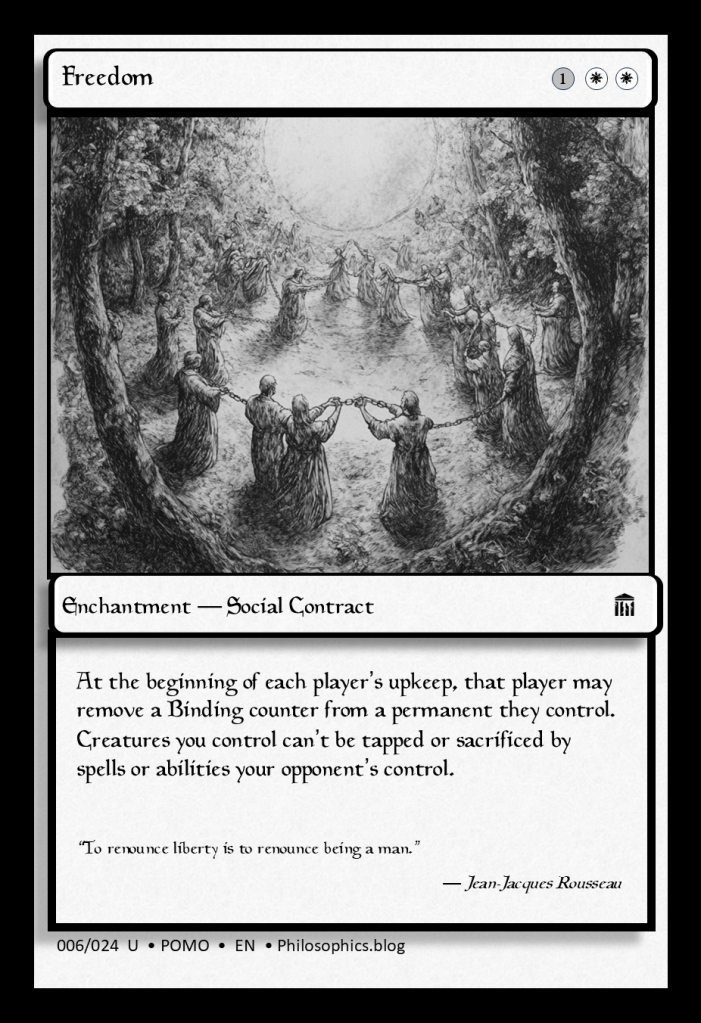
Black-and-white illustration of robed figures standing in a forest clearing, forming a circle by linking chains between their hands. The figures appear both united and restrained, illuminated by a pale, radiant light that suggests dawn or revelation. The mood is solemn yet transcendent, symbolising Rousseau’s paradox that freedom and constraint are inseparable. The image appears as a parody Magic: The Gathering card titled “Freedom,” subtitled “Enchantment — Social Contract,” with a quote from Jean-Jacques Rousseau: “To renounce liberty is to renounce being a man.” The art captures the tension between community, bondage, and liberation.
Image: Freedom: The Chains That Bind Us Together
Card 006 from the Postmodern Set – Philosophics.blog

This Critical Theory parody card, Freedom, draws its lineage from Jean-Jacques Rousseau, whose paradox still haunts the modern condition: “Man is born free, and everywhere he is in chains.” The card re-enchants that contradiction – an Enchantment – Social Contract that reminds us liberty isn’t a state but a negotiation.

The card reads:

At the beginning of each player’s upkeep, that player may remove a Binding counter from a permanent they control.
Creatures you control can’t be tapped or sacrificed by spells or abilities your opponent controls.

This is Rousseau’s dilemma made mechanical. Freedom is not absolute; it’s procedural. The upkeep represents the maintenance of the social contract—an ongoing renewal, not a one-time event. Every player begins their turn by negotiating what freedom costs. You may remove one Binding counter, but only if you recognise that binding exists.

The flavour text underlines Rousseau’s plea:

“To renounce liberty is to renounce being a man.”

Freedom, for Rousseau, wasn’t about doing whatever one pleased. It was about participating in the moral and civic order that gives action meaning. To exist outside that order is not liberty; it’s anarchy, the tyranny of impulse.

The card, therefore, resists the naïve libertarian reading of freedom as the absence of restraint. It instead depicts freedom as the capacity to act within and through shared constraints.

The art shows a ring of robed figures, hand in hand, their chains forming a circle beneath a clearing sky. It’s a haunting image: freedom through fellowship, bondage through unity. The circle symbolises Rousseau’s idea that true liberty emerges only when individuals subordinate selfish will to the general will – the common interest formed through collective agreement.

Yet there’s also a postmodern irony here: circles can be prisons too. The social contract can emancipate or suffocate, depending on who wrote its terms. The same chains that protect can also bind.

The monochrome aesthetic amplifies the ambiguity – freedom rendered in greyscale, neither utopia nor despair, but the space in between.

Rousseau’s notion of the social contract was revolutionary, but its dissonance still resonates: how can one be free and bound at the same time? He answered that only through the voluntary participation in a collective moral order can humans transcend mere instinct.

We might say that today’s democracies still operate under Freedom (Enchantment – Social Contract). We maintain our rights at the cost of constant negotiation: legal, social, linguistic. Every “Binding counter” removed is the product of civic upkeep. Stop maintaining it, and the enchantment fades.

The card hints at the price of this enchantment: creatures (citizens) can’t be tapped or sacrificed by opponents’ control. In other words, autonomy is secured only when the system prevents external domination. But systems fail, and when they do, the illusion of freedom collapses into coercion.

Rousseau earns a complicated respect in my philosophical canon. He’s not in my top five, but he’s unavoidable. His concept of freedom through the social contract anticipates both modern liberalism and its critique. He believed that genuine liberty required moral community – a notion now eroded by hyper-individualism.

Freedom, as I’ve rendered it here, isn’t celebration. It’s lamentation. The card is about the fragility of the social spell that keeps chaos at bay. We remove one binding at a time, hoping not to unbind ourselves entirely.

Democracy: The Idiot’s Opiate, The Sequel Nobody Asked For

Yesterday, I suggested democracy is a mediocre theatre production where the audience gets to choose which mediocre understudy performs. Some readers thought I was being harsh. I wasn’t.

A mate recently argued that humans will always be superior to AI because of emergence, the miraculous process by which complexity gives rise to intelligence, creativity, and emotion. Lovely sentiment. But here’s the rub: emergence is also how we got this political system, the one no one really controls anymore.

Like the human body being mostly non-human microbes, our so-called participatory government is mostly non-participatory components: lobbyists, donors, bureaucrats, corporate media, careerists, opportunists, the ecosystem that is the actual organism. We built it, but it now has its own metabolism. And thanks to the law of large numbers, multiplied by the sheer number of political, economic, and social dimensions in play, even the human element is diluted into statistical irrelevance. At any rate, what remains of it has lost control – like the sorcerer’s apprentice.

People like to imagine they can “tame” this beast, the way a lucid dreamer thinks they can bend the dream to their will. But you’re still dreaming. The narrative still runs on the dream’s logic, not yours. The best you can do is nudge it; a policy tweak here, a symbolic vote there, before the system digests your effort and excretes more of itself.

This is why Deming’s line hits so hard: a bad system beats a good person every time. Even if you could somehow elect the Platonic ideal of leadership, the organism would absorb them, neutralise them, or spit them out. It’s not personal; it’s structural.

And yet we fear AI “taking over,” as if that would be a radical departure from the status quo. Newsflash: you’ve already been living under an autonomous system for generations. AI would just be a remodel of the control room, new paint, same prison.

So yes, emergence makes humans “special.” It also makes them the architects of their own inescapable political microbiome. Congratulations, you’ve evolved the ability to build a machine that can’t be turned off.

Chapter 5: Harari’s Defence of Democracy

A Pollyanna Perspective

Chapter 5 of Yuval Noah Harari’s Nexus feels almost unlistenable, like polemic propaganda, painting cherry-picked anecdotes with a broad brush for maximal effect. If I hadn’t agreed to read this in advance, I’d have shelved the book long ago. It is as though Harari has never set foot on Earth and is instead relying on the optimistic narratives of textbooks and travel guides. His comparisons between democracy, dictatorship, and totalitarianism are so heavily spun and biased that they verge on risible. Harari comes across as an unabashed apologist for democracy, almost like he’s part of its affiliate programme. He praises Montesquieu’s separation of powers without noting how mistaken the idea as evidenced by modern-day United States of America. Not a fan. If you’re a politically Conservative™ American or a Torrey in the UK, you’ll feel right at home.

A Trivial Freedom – At What Cost?

Harari ardently defends the “trivial freedoms” offered by democracies whilst conveniently ignoring the shackles they impose. It’s unclear whether his Pollyanna, rose-coloured perspective reflects his genuine worldview or if he’s attempting to convince either himself or his audience of democracy’s inherent virtues. This uncritical glorification feels particularly out of touch with reality.

The Truth and Order Obsession

Once again, Harari returns to his recurring theme: the tradeoff between truth and order. His obsession with this dynamic overshadows more nuanced critiques. Listening to him defend the so-called democratic process that led to the illegal and immoral US invasion of Iraq in 2002 is nothing short of cringeworthy. Even more egregious is his failure to acknowledge the profound erosion of freedoms enacted by the PATRIOT Act, the compromised integrity of the offices of POTUS and SCOTUS, and the performative partisanship of Congress.

The Role of Media and Peer Review

Harari cites media and peer review as essential mechanisms for error correction, seemingly oblivious to the fallibility of these systems. His perception of their efficacy betrays a glaring lack of self-awareness. He overlooks the systemic biases, self-interest, and propaganda that permeate these supposed safeguards of democracy.

A Flimsy Narrative

Whilst many Modernists might uncritically embrace Harari’s perspective, his argument’s veneer is barely a nanometre thick and riddled with holes. It’s not merely a question of critiquing metanarratives; the narrative itself is fundamentally flawed. By failing to engage with the complexities and contradictions inherent in democratic systems, Harari’s defence feels more like a sales pitch than a rigorous examination.

Final Thoughts

Harari’s Chapter 5 is a glaring example of uncritical optimism, where the faults of democracy are brushed aside in favour of a curated narrative of its virtues. This chapter does little to inspire confidence in his analysis and leaves much to be desired for those seeking a balanced perspective.

Rational Ignorance

Using AutoCrit, I continue to share the review progress of my work in progress, Democracy: The Grand Illusion. In this chapter, I survey the topic of rational ignorance.

Synopsis

The text delves into the concepts of rational ignorance and unknown unknowns within the framework of democratic decision-making. It begins by defining rational ignorance as individuals choosing to remain uninformed due to the perceived high cost of acquiring information. The discussion then moves on to explore how this impacts voter behaviour, leading to decisions based on superficial understanding and susceptibility to misinformation. The concept of unknown unknowns is introduced as factors individuals are unaware of, influencing decision-making unpredictably.

The text concludes by emphasising the importance of addressing cognitive challenges through enhancing political literacy, promoting deliberative democracy, ensuring transparency, and leveraging technology. By doing so, it aims to create a more informed electorate and strengthen democratic systems.

Audience

The target audience for this text includes policymakers, educators, citizens interested in political science or governance issues, and those involved in civic engagement. Those not targeted may include casual readers looking for light reading material or individuals with no interest in politics. To make it more relevant, the author could simplify complex terms for lay audiences without compromising depth or provide real-world examples illustrating theoretical concepts.

Structure and Organisation

The text follows a logical order by first introducing key concepts like rational ignorance and unknown unknowns before exploring their implications on democratic decision-making. Each section flows seamlessly into the next without abrupt transitions or disconnection between ideas.

Tone

The tone throughout remains informative yet urgent about addressing cognitive challenges within democracies effectively. There’s a sense of responsibility conveyed towards improving civic engagement among readers.

Clarity

Overall clarity is strong; however, some sections could benefit from simplification for easier comprehension by all readers. For instance:

  • “Unknown Unknowns refer to factors that are completely outside individuals’ awareness…” – This could be rephrased more straightforwardly.
  • Complex sentences discussing cognitive biases might require additional clarification for better understanding.

Commentary

There is an entire section on cognitive biases earlier in the book as well as a note to directing the reader to it.

Argument and Persuasion

Opinions presented focus on mitigating effects of rational ignorance through enhanced education and transparency measures which are logically constructed with support from references such as Downs (1957) & Kahneman (2011). While persuasive elements are well-supported overall; further statistical data or case studies would enhance credibility.

Commentary

I’m not sure I’ll include more in this book, as I cite copious source material, noted below.

Interest and Engagement

While engaging overall due to its relevance in current socio-political contexts; sections detailing strategies like encouraging deliberative democracy may lose reader interest due to dense content presentation without breaks or interactive elements such as case studies or anecdotes involving citizen participation can improve engagement levels significantly

Final Thoughts & Conclusions

The text concludes with a strong and satisfying section that summarizes the concepts of rational ignorance and unknown unknowns, emphasizing their impact on democratic decision-making. It effectively ties together the key points discussed throughout the work and provides a clear call to action for addressing cognitive challenges in governance. The final thoughts and conclusions serve to underscore the importance of mitigating these challenges through improved education, deliberation, transparency, and technological advancements. The text ends conclusively by summarizing key points discussed earlier while offering actionable steps towards strengthening democratic systems amidst cognitive challenges faced today—providing a clear direction forward that ties together various themes explored throughout the narrative effectively.


References and Supporting Materials

Downs, A. (1957). An Economic Theory of Democracy. Harper & Row.

Kahneman, D. (2011). Thinking, Fast and Slow. Farrar, Straus and Giroux.

Caplan, B. (2007). The Myth of the Rational Voter: Why Democracies Choose Bad Policies. Princeton University Press.

Tetlock, P. E. (2005). Expert Political Judgment: How Good Is It? How Can We Know? Princeton University Press.

Sunstein, C. R. (2006). Infotopia: How Many Minds Produce Knowledge. Oxford University Press.

Lupia, A., & McCubbins, M. D. (1998). The Democratic Dilemma: Can Citizens Learn What They Need to Know? Cambridge University Press.

Akerlof, G. A., & Shiller, R. J. (2015). Phishing for Phools: The Economics of Manipulation and Deception. Princeton University Press.

Iyengar, S., & Kinder, D. R. (1987). News That Matters: Television and American Opinion. University of Chicago Press.

Gigerenzer, G., & Todd, P. M. (1999). Simple Heuristics That Make Us Smart. Oxford University Press.

Sunstein, C. R., & Thaler, R. H. (2008). Nudge: Improving Decisions About Health, Wealth, and Happiness. Penguin Books.


AutoCrit is an AI-based editorial application. I am a member of their affiliate programme, so I gain minor financial benefits at no cost to you if you purchase through a link on this page.

Montesquieu Was Wrong

Montesquieu avait tort. During my research, I realised that Montesquieu’s notion of separation of powers is flawed, much like the cause of the global financial meltdown of 2007-2008.

In both cases, systemic risk was the undoing. The financial crisis revealed the mistaken belief that real estate markets were independent. Diversifying portfolio risk across multiple markets proved futile when an underlying thread unravelled the entire system. Without external intervention, the market would have collapsed.

What does this have to do with Montesquieu? The foundation of many modern governments is the separation of powers. In the United States, the executive, legislative, and judicial branches are supposed to operate independently and keep each other in check. Journalism, once considered the Fourth Estate, was meant to scrutinise these bodies.

However, this system has always been prone to failure. These branches, meant to be independent, often move in tacit coordination due to similar class interests and goals. Even if initially diverse, members end up sharing the same backgrounds, attending the same universities, and working in the same professions, leading to a lack of true diversity.

This issue became glaringly evident when President Trump stacked the Supreme Court with ideologues and surrounded himself with sycophantic legislators. This shared class interest is the root of systemic failure.

Currently, Trump is out of office, and the opposition is determined to prevent his return—not because he’s from a different class, but because of a political rivalry. They’re playing the same game, called politics, and the game survives regardless. The New York Yankees are battling the Boston Red Sox.

Sadly, the Fourth Estate has failed for the same reason. Journalists who want access must play nice. Most comply, and the prominent ones amplify talking points. Those who don’t conform face harsh cancel culture. As George Carlin said, “This is a club, and you ain’t in it.”

Humans Ruin the Economy

Humans are ruining the economy.

Podcast: Audio rendition of this page content.

This is the caption on the sign for this segment. The sign advertises a solution, which is to “Vote for DEMOCROBOT… The first party run by artificial intelligence”. It also promises to “give everyone a living wage of £1436.78 a week”.

I have been very vocal that I find the idea of humans governing humans is a bad idea at the start. By and large, humans are abysmal system thinkers and easily get lost in complexity. This is why our governments and economies require so much external energy and course correction. Not only were they poorly designed and implemented, but they’re also trying to manage a dynamic system—a complex system. It won’t work.

What about bots and artificial intelligence? The above image was posted elsewhere, and a person commented that our governments are already filled with artificial intelligence. I argued that at best we’ve got pseudo-intelligence; at worse, we’ve got artificial pseudo-intelligence, API.

The challenge with AI is that it’s developed by humans with all of their faults and biases in-built.

The challenge with AI is that it’s developed by humans with all of their faults and biases in-built. On the upside, at least in theory, rules could be created to afford consistency and escape political theatre. The same could be extended to the justice system, but I’ll not range there.

Part of the challenge is that the AI needs to optimise several factors, at least, and not all factors are measurable or can be quantified. Any such attempt would tip the playing field one way or another. We might assume that at least AI would be unreceptive to lobbying and meddling, but would this be the case? AI—or rather ML, Machine Learning or DL, Deep Learning—rely on input. It wouldn’t take long for interested think tanks to flood the source of inputs with misinformation. And if there is an information curator, we’ve got a principle-agent problem—who’s watching the watcher?—, and we may need to invoke Jeremy Bentham’s Panopticon solution.

One might even argue that an open-source, independently audited system would work. Who would be auditing and whose interpretation and opinion would we trust? Then I think of Enron and Worldcom. Auditors paid to falsify their audit results. I’d also argue that this would cause a shift from the political class to the tech class, but the political class is already several tiers down and below the tech class, so the oligarchs still win.

This seems to be little more than a free-association rant, so I’ll pile on one more reflection. Google and Facebook (or Meta) have ethical governing bodies that are summarily shunned or simply ignored when they point out that the parent company is inherently unethical or immoral. I wouldn’t expect much difference here.

I need a bot to help write my posts. I’ll end here.

What’s wrong with anarcho-syndicalism?

What’s an anarcho-syndicalist supposed to do in the advent of artificial intelligence, process automation, and robots?

Wikipedia relates anarcho-Syndicalism as follows:

Anarcho-syndicalism (also referred to as revolutionary syndicalism)[1] is a theory of anarchism that views revolutionary industrial unionism or syndicalism as a method for workers in capitalist society to gain control of an economy and thus control influence in broader society. Syndicalists consider their economic theories a strategy for facilitating worker self-activity and as an alternative co-operative economic system with democratic values and production centered on meeting human needs.

The basic principles of anarcho-syndicalism are solidaritydirect action (action undertaken without the intervention of third parties such as politicians, bureaucrats and arbitrators) and direct democracy, or workers’ self-management. The end goal of syndicalism is to abolish the wage system, regarding it as wage slavery. Anarcho-syndicalist theory therefore generally focuses on the labour movement.[2]

Anarcho-syndicalists view the primary purpose of the state as being the defense of private property, and therefore of economic, social and political privilege, denying most of its citizens the ability to enjoy material independence and the social autonomy that springs from it.[3] Reflecting the anarchist philosophy from which it draws its primary inspiration, anarcho-syndicalism is centred on the idea that power corrupts and that any hierarchy that cannot be ethically justified must either be dismantled or replaced by decentralized egalitarian control.[3]

As a matter of preference, I’ve leaned toward anarcho-syndicalism. I don’t have a lot of faith in humans or humanity to govern or self-govern. The arguments for this, whether monarchies, democracies, plutocracies, or even anarchies are each rife with its own sets of problems. Still, I favour a system where there is no class of governors, though I am more of a fan of Proudhon over Marx.

Mind you, I don’t think humans make very good judgements and are as bad in groups as individuals but for different reasons—and especially where complexity or too many choices are available. That we’ve survived this long is, quite frankly, a miracle.

This said, it isn’t my problem. My contention is with the syndicalist aspect. If all of this human as worker displacement occurs as some are forecasting, there will be precious few workers. I am not saying that this is inevitable or will ever happen. My concern is merely conditional. If this were to happen, the idea of a worker-centric system is daft.

Do we just defer to people categorically, where we arrive at simple anarchism? Without delving, there are different flavours of, and I have neither the time nor the inclination to debate, for example, the merits of anarco-capitalism (an oxymoron if there ever was one) versus anarcho-communism or anarcho-transhumanism for that matter.

Although, I like how Kant identified four kinds of government…

  • Law and freedom without force (anarchy)
  • Law and force without freedom (despotism)
  • Force without freedom and law (barbarism)
  • Force with freedom and law (republic)

…the whole notion of freedom is another weasel word, and laws without force are unenforceable—pun intended. At least the syndicalism felt like it was intentional or purposeful. I understand why Plato despised the rabble, but as with the sorites paradox in the heap-hill distinction, where to the rabble distil down to something meaningful?