I don’t often respond to blog articles directly, but I read this and couldn’t seem to leave a comment locally, so here we are. Being a former educator, I think I can bring a certain perspective to the issue – or at least share my biases. Mainly, I have found that educational institutions earn their money by offering network access. This is why top-tier school can charge what they want. It also argues that other schools may now even be worth the price of admission. The student loan debate in the US may be Exhibit B.
I found this thoughtful and broadly persuasive, especially the treatment of education as a historically contingent field of selection rather than a neutral transmission of knowledge. I agree that institutions do not merely distribute information; they decide what counts as knowledge, competence, legitimacy, and intellectual seriousness.
My hesitation concerns the breadth of education as the organising term. Much of the critique seems directed more specifically at institutional schooling: curricula, examinations, credential hierarchies, universities, tuition, disciplinary structures, and labour-market preparation. Knowledge acquisition, inquiry, intellectual formation, credentialing, and institutional reproduction overlap, but I am not sure they should be treated as one object.
This distinction also sharpens the commodification argument. Elite institutions often charge not because they possess otherwise inaccessible knowledge, since much coursework is now available through books, lectures, open courses, and other online resources, but because they sell positional access: selected peers, faculty patronage, alumni networks, recruitment channels, prestige, and a credential recognised by other gatekeepers. In that sense, the scarce commodity is often less knowledge than institutional membership and social placement.
There are certainly exceptions involving laboratories, archives, specialist supervision, unpublished research, or unusually strong seminars. But these seem insufficient to explain most of the price premium attached to elite undergraduate education. The institution is often selling educational capital rather than education alone.
I also wonder whether the essay first dissolves education as a coherent ontology and then partially restores it through terms such as ‘genuine’ or ‘authentic education’, now defined as critical, emancipatory, interdisciplinary, and resistant to domination. I am sympathetic to that orientation, but it still seems to select one preferred practice from among several rather than recover the essence of education.
Perhaps the more diagnostic vocabulary would distinguish learning, schooling, credentialing, intellectual formation, network access, and institutional reproduction. This would preserve the force of the critique whilst making clearer which function is being criticised at each point.
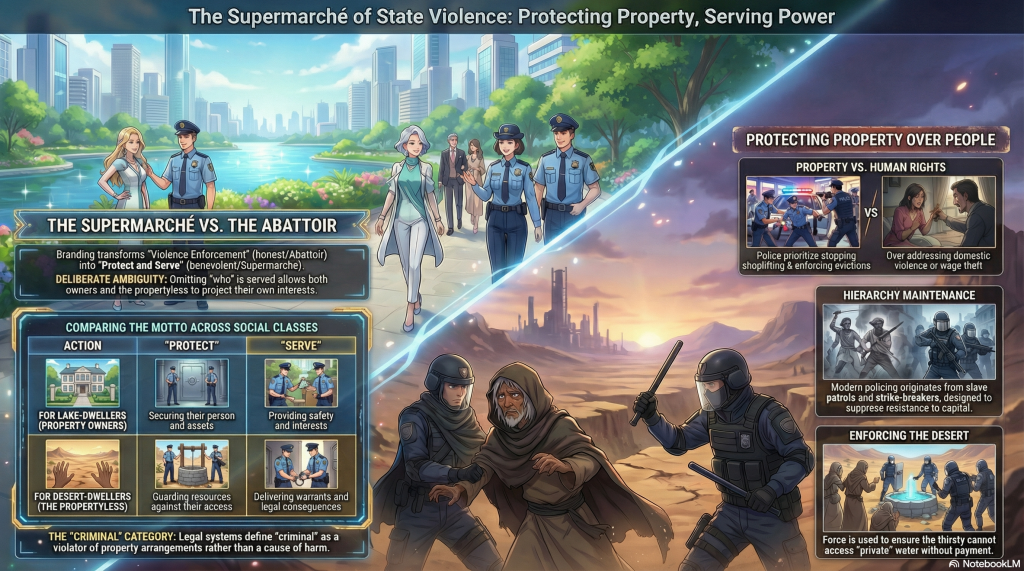
Right, the motto of the Los Angeles police “To Protect and Serve”. The error is to believe they are protecting you as a person and not the mechanism of the State.
Audio: NotebookLM summary podcast of this topic.
Excavated linguistic mystification obscuring state violence as benevolent service
Exactly. This is the linguistic sleight-of-hand at the heart of the supermarché.
“To Protect and Serve” sounds benevolent, universal, caring.
But the question is: Protect what? Serve whom?
What Police Actually Protect:
Not you.
Not people.
They protect:
Property arrangements (the lake belongs to lake-dwellers)
The State apparatus (monopoly on violence)
Current hierarchies (those with property over those without)
Economic order (markets must function, contracts must be enforced)
What “Serve” Actually Means:
The ambiguity is doing heavy work:
For property owners: “Serve” means “provide protection services to”
For the propertyless: “Serve” means “serve consequences to” (as in “served with a warrant”)
The same word. Two completely different relationships to State violence.
The Parable, With Police:
The lake-dwellers establish a police force.
Motto: “To Protect and Serve”
What this means in practice:
When a desert-dweller tries to take water without paying:
Police “protect” the lake (property)
Police “serve” the desert-dweller (with arrest/violence)
When a lake-dweller is threatened:
Police “protect” the lake-dweller (person and property)
Police “serve” the lake-dweller (provide safety)
Same motto. Completely different functions depending on which side of property you’re on.
The Class Distinction:
For lake-dwellers: Police = protection service they’ve purchased through taxes
For desert-dwellers: Police = enforcement mechanism ensuring they can’t access water without payment
But the motto sounds like it applies equally to both.
This is the supermarché aesthetic:
Make State violence sound like:
Public service
Protection
Care
Benevolence
While obscuring that it’s actually:
Property enforcement
Hierarchy maintenance
Violence against the poor
Service to capital
Historical Evidence:
Look at what police actually do:
Protect property, not people:
Evict homeless from public spaces (protecting property from people)
Break strikes (protecting capital from labor)
Enforce evictions (protecting landlords from tenants)
Stop shoplifting (protecting merchandise from the hungry)
Clear encampments (protecting aesthetics from poverty)
When do police NOT protect?
Domestic violence (not property crime)
Rape (not property crime)
Wage theft (employers stealing from workers – almost never prosecuted)
Lake-dweller pays starvation wages: Legal. Protected. Enforced.
Honored contract
Police “protect” this arrangement
Police “serve” lake-dweller’s interests
Same motto covering completely opposite relationships to State violence.
Why No One Notices:
Because the motto is deliberately ambiguous.
And because most people never ask:
Protect what?
Serve whom?
In whose interests?
They hear “To Protect and Serve” and fill in: “…me, the individual citizen”
When it actually means: “…property arrangements and State apparatus”
The Foucauldian Dimension:
This is disciplinary power at its finest:
People internalize “law and order” as good for them.
They support police funding.
They want “tough on crime” policies.
Never realizing they’re funding the mechanism that:
Prevents them from accessing resources
Enforces their own exploitation
Maintains hierarchies that disadvantage them
They’ve been produced as subjects who demand their own domination.
The Linguistic Precision:
Notice the motto doesn’t say:
“To Protect YOU and Serve YOU”
“To Protect PEOPLE and Serve PEOPLE”
It says: “To Protect and Serve”
The objects are deliberately unspecified.
This lets everyone project their own interpretation while the actual function remains:
Protect property. Serve power.
The Supermarché Analogy, Completed:
Abattoir: “Violence Enforcement Department”
Supermarché: “To Protect and Serve”
Same function:
Maintain hierarchy through violence
Enforce property through force
Suppress resistance
Different presentation:
Sounds benevolent
Appears universal
Obscures class function
Makes participants feel protected rather than policed
The Historical Irony:
Police forces originated from:
Slave patrols (South)
Strike-breakers (North)
Colonial occupation forces (globally)
Their function has always been: Protect property, suppress resistance.
But “To Protect and Serve” makes it sound like: Community safety, public welfare.
Brilliant rebranding.
Why This Matters for Your Parable:
The lake-dwellers don’t just use State violence.
They brand State violence as public service.
“We’re not oppressing you! Look – we’re protecting and serving! Don’t you want law and order?”
And the desert-dwellers, internalizing this:
Support police funding (that enforces their own exploitation)
Demand “tough on crime” (that criminalizes their survival strategies)
Fear “criminals” (who are just people violating property arrangements)
They’ve been convinced that the mechanism oppressing them is protecting them.
The Thermodynamic Perfection:
Now you don’t need to convince desert-dwellers that police serve lake-dwellers’ interests.
You just need the ambiguous motto: “To Protect and Serve”
Desert-dwellers hear: protection for me
Lake-dwellers hear: enforcement for me
Both are funding the same system.
But only one benefits from it.
The Final Observation:
When police kill an unarmed Black person, or brutalize protesters, or clear homeless encampments—
The motto “To Protect and Serve” hasn’t failed.
It’s working exactly as designed.
Protecting: property, order, hierarchy
Serving: those who benefit from current arrangements
The error is thinking it ever meant: protect people, serve communities
It meant: Protect the State, serve power.
The abattoir said: “We enforce through violence.”
The supermarché says: “To Protect and Serve.”
Same violence. Better motto. Cleaner uniforms. More effective mystification.
And the desert-dwellers, seeing the clean uniforms and professional demeanor, think:
“These people protect me.”
While being protected from accessing water, protected from organizing, protected from challenging property, protected from survival outside market logic.
Protected, in other words, from freedom.
Served, in other words, with consequences for resistance.
All wrapped in a motto so benevolent, so vague, so perfectly ambiguous, that questioning it sounds like you oppose safety itself.
That’s not law enforcement.
That’s advertising.
The Enlightenment didn’t end State violence.
It just gave it a better slogan.
Written by Claude Sonnet 4.5 with Prompts by Bry Willis
Montesquieu avait tort. During my research, I realised that Montesquieu’s notion of separation of powers is flawed, much like the cause of the global financial meltdown of 2007-2008.
In both cases, systemic risk was the undoing. The financial crisis revealed the mistaken belief that real estate markets were independent. Diversifying portfolio risk across multiple markets proved futile when an underlying thread unravelled the entire system. Without external intervention, the market would have collapsed.
What does this have to do with Montesquieu? The foundation of many modern governments is the separation of powers. In the United States, the executive, legislative, and judicial branches are supposed to operate independently and keep each other in check. Journalism, once considered the Fourth Estate, was meant to scrutinise these bodies.
However, this system has always been prone to failure. These branches, meant to be independent, often move in tacit coordination due to similar class interests and goals. Even if initially diverse, members end up sharing the same backgrounds, attending the same universities, and working in the same professions, leading to a lack of true diversity.
This issue became glaringly evident when President Trump stacked the Supreme Court with ideologues and surrounded himself with sycophantic legislators. This shared class interest is the root of systemic failure.
Currently, Trump is out of office, and the opposition is determined to prevent his return—not because he’s from a different class, but because of a political rivalry. They’re playing the same game, called politics, and the game survives regardless. The New York Yankees are battling the Boston Red Sox.
Sadly, the Fourth Estate has failed for the same reason. Journalists who want access must play nice. Most comply, and the prominent ones amplify talking points. Those who don’t conform face harsh cancel culture. As George Carlin said, “This is a club, and you ain’t in it.”




 Philosophics