Declaration of Independence

It’s July. The season of independence in the United States. Independence from the overt tyranny of Britain, but not from the tacit tyranny of their government—the government purported to be ‘of the people, by the people, and for the people‘ per Abraham Lincoln’s 1863 Gettysburg Address. As their Constitution reads, ‘We the People‘. Governments may be of the people and by the people, but governments are an emergent phenomenon as happens when oxygen and hydrogen combine just so and create water. Two gases combine to create a new substance—water. Some forget that, like water, government are a distinct element to the people that constitute it. Some think it resembles them. It doesn’t. It’s Hobbes’ Leviathan—or a Jabberwok.

In preparation for the traditional Summer season, I took to reading Derrida’s 1976 essay, Declarations of Independence. It was interesting, but I was hoping to get more from it. I decided to deconstruct the opening paragraph—the preamble—of the Declaration of Independence:

Deconstructing Binary Oppositions

Self-Evident vs. Non-Self-Evident

The Declaration boldly asserts that ‘these truths’ are ‘self-evident’,’ a claim that is nothing more than a rhetorical trick. By presenting these ideas as self-evident, the authors seek to place them beyond questioning, discouraging dissent and critical examination. In reality, these ‘truths’ are far from universal; they are the product of a specific cultural and historical context, shaped by the interests and perspectives of the privileged few who drafted the document.

Interrogating Assumptions and Hierarchies The Declaration of Independence asserts that certain truths are ‘self-evident’, implying that these truths are so obvious that they require no further justification. However, the concept of self-evidence itself is far from universally accepted. It is deeply embedded in the philosophical tradition of Enlightenment rationalism, which holds that reason and logic can reveal fundamental truths about the world.

  1. Philosophical Foundations of Self-Evidence
    • Enlightenment Rationalism: The idea of self-evidence relies heavily on Enlightenment rationalism, which posits that certain truths can be known directly through reason and are therefore beyond dispute. Philosophers such as RenĂ© Descartes and Immanuel Kant emphasised the power of human reason to uncover self-evident truths. Descartes, for instance, argued for the self-evident nature of ‘Cogito, ergo sum‘ (‘I think, therefore I am’) as a fundamental truth (Descartes, Meditations on First Philosophy).
    • Critique of Rationalism: Critics of Enlightenment rationalism, including existentialists like Friedrich Nietzsche and phenomenologists like Martin Heidegger, argue that what is considered self-evident is often culturally and historically contingent. Nietzsche, for example, contended that what we take as ‘truth’ is a product of our perspective and historical context, not an absolute given (Nietzsche, Beyond Good and Evil).
  2. Cultural and Philosophical Contingency
    • Cultural Relativity: Different cultures and philosophical traditions may not find the same truths to be self-evident. For instance, the concept of individual rights as self-evident truths is a product of Western liberal thought and may not hold the same self-evident status in other cultural frameworks. In many Eastern philosophies, the focus is more on community and harmony rather than individual rights.
    • Subjectivity of Self-Evidence: The term ‘self-evident’ implies an inherent, unquestionable truth, yet what one group or culture finds self-evident, another may not. This variability reveals the instability and subjectivity of the claim. For example, in traditional Confucian societies, the emphasis is placed on hierarchy and duty rather than equality and individual rights, demonstrating a different set of ‘self-evident’ truths.
  3. Constructed Nature of Truth
    • Language and Context: Jacques Derrida’s concept of diffĂ©rance illustrates how meaning is not fixed but constantly deferred through language. What we consider to be “truth” is constructed through linguistic and social contexts. Derrida argues that texts do not have a single, stable meaning but rather a multiplicity of interpretations that change depending on the reader’s perspective and context (Derrida, Of Grammatology).
    • Social Construction: Michel Foucault’s analysis of power and knowledge further deconstructs the notion of objective truth. Foucault argues that what is accepted as truth is produced by power relations within society. Truths are constructed through discourses that serve the interests of particular social groups, rather than being objective or self-evident (Foucault, Discipline and Punish).

Created Equal vs. Not Created Equal

The Declaration’s claim that ‘all men are created equal’ is a blatant falsehood, a manipulative promise designed to appease the masses whilst maintaining the status quo. The glaring contradictions of slavery and gender inequality expose the hollowness of this assertion. Equality, as presented here, is nothing more than an ideological construct, a tool for those in power to maintain their dominance while paying lip service to the ideals of justice and fairness.

Creator vs. No Creator

The Declaration refers to a ‘Creator’ who endows individuals with rights, grounding its claims in a divine or natural law. This invokes a theistic worldview where moral and legal principles are derived from a higher power. However, Derrida challenges this by showing that the concept of a creator is a cultural and philosophical construct, not a universal truth.

The presence of the creator in the text serves to legitimise the rights it declares. However, this legitimacy is contingent on accepting the cultural narrative of a creator. Secular and non-theistic perspectives are marginalised by this assertion, revealing the ideological biases inherent in the Declaration. The authority of the declaration is thus shown to be dependent on particular beliefs, rather than an objective reality.

Unalienable vs. Alienable

The notion of ‘unalienable Rights’ is another empty promise, a rhetorical flourish designed to inspire loyalty and obedience. In practice, these supposedly inherent and inviolable rights are regularly violated and denied, particularly to those on the margins of society. The Declaration’s lofty language of ‘Life, Liberty and the pursuit of Happiness’ rings hollow in the face of systemic oppression and injustice. These rights are not unalienable; they are contingent upon the whims of those in power.

Conclusion

Through this deconstruction, we expose the Declaration of Independence for what it truly is: a masterful work of propaganda, filled with false promises and manipulative rhetoric. The document’s purported truths and self-evident principles are revealed as arbitrary constructs, designed to serve the interests of the powerful while placating the masses with empty platitudes.

As some celebrate this 4th of July, let us not be fooled by the high-minded language and lofty ideals of our founding documents. Instead, let us recognise them for what they are: tools of control and manipulation, employed by those who seek to maintain their grip on power. Only by constantly questioning and deconstructing these texts can we hope to expose the truth behind the facade and work towards a more genuine understanding of freedom and equality.

References

  • Jacques Derrida, “Declarations of Independence,” in Negotiations: Interventions and Interviews 1971-2001, ed. Elizabeth Rottenberg (Stanford: Stanford University Press, 2002).
  • Jacques Derrida, Of Grammatology (Baltimore: Johns Hopkins University Press, 1976).
  • Friedrich Nietzsche, Beyond Good and Evil (Cambridge: Cambridge University Press, 2002).
  • Michel Foucault, Discipline and Punish: The Birth of the Prison (New York: Vintage Books, 1995).
  • Immanuel Kant, Critique of Pure Reason (Cambridge: Cambridge University Press, 1998).
  • RenĂ© Descartes, Meditations on First Philosophy (Cambridge: Cambridge University Press, 1996).

In God We Trust

This slogan crossed my path, and I stopped to think: Perhaps a bit cynical, but is a country’s foundation…or their currency, at least…is built upon vapour, what does that say about the country and its citizens?

Sure, Rome of the Ancients had a myth-based origin story. They had their wolf, and we’ve got some hoary bearded Birkenstock-wearing gentleman sporting a toga, but does it matter that it’s all pretend?

Humans thrive on stories, but what happens when most people understand that the emperor’s wearing no clothes…not even that toga?

Sure, Nietzsche posed the same question. God is dead, right? And then what? Would this social fabric just disintegrate into dust, no longer supporting the thread-bare culture into the bin?

Entropy, right?

Can a society even exist with out some common mythos? What would happen to a society based on some other glue? Is there such an adhesive?

I can imagine a society centred on money or science, but these still rely on some underlying faith and a different metanarrative.

Is a common mythos necessary for society, or is this just reflective of some paucity of imagination?

Afterlife

My girlfriend’s mother with whom we live was raised a Catholic. She asked me what my religious beliefs are, and I responded that I don’t believe in gods, angels, divine anything, a higher intelligence or power in the manner people ascribe to gods. She conveyed that she had been upset with her husband but got the last laugh after he died.

As she related it to me, the night after he dies, he came to her in a vision and told her that he was wrong and she was right, so now she knows that there is life after death. I’m not entirely sure if he was heaven-bound in this scenario.

So, as she finds comfort in this belief (and of the other spectres she’s seen, heard, and felt, I just nod and smile and say ‘that’s nice’). I try my best not to sprain anything as I roll my eyes on the inside.

At least Descartes admitted that his senses might be deceived. No such thing here. One of the issues I have with so-called religious tolerance is that it is not politically correct to call BS on nonsense like this. Of course, I am not about to jeopardise my relationship with my girlfriend by mocking her mother.

My girlfriend is a different story still. she was raised in a Catholic household but was not subjected to the church or parochial school like her mother, but she was still fed a diet of religious nonsense growing up. To her, hell is real. The fear of a hell actually influences some moral decisions. To the righteous, this is a fine consequentialist approach, the ends (of normalised behaviour) justify the means (of believing a lie).

To me, the lie is immoral, but to some, they actually believe it (or believe it enough) that they don’t see it as a fabrication. I suppose it’s easier for people like me who consider morality to be fabricated from whole cloth.

Gimme Some Truth

John Lennon wrote this song in 1968 and released it as a solo artist, post-Beatles breakup, but he clearly was no post-modern. He embraced truth. He searched for it. To many, he had found it; following Heidegger’s logic, Lennon was authentic; not living the life someone else designed for him; living up to his potential.

This is quaint. I’d always loved John. He was my favourite Beatle. Paul was always too saccharine for me. I liked George, but his mysticism went off the rails. And Ringo—well, Ringo was Ringo. What’s not to like about the guy?—as long as you’re not talking about his prowess as a drummer.

I watched a YouTube video, and felt compelled to write a response—one I’ve recast and embellished here.

What is Postmodernism – Armored Skeptic

To a postmodernist, there is no objective truth. End of story. There is no further discussion. To postmodernists, a claim that there is some objective truth is parallel to hearing a proponent of religion who claims there is a God just because s/he says so. Truth is like God: it doesn’t exist. Period. End of story. And so like the religious who will ramble on for days about their God, so the modernist do the same.

Like the notion of God, Truth is a construct of human language, and they’re both fictions. People often confuse facts with truth. Facts are descriptive attributes about things or ideas whereas truth is about some inviolable, absolute notion. But facts are analytic or tautological: the car is red. Sure, we’ve constructed a term ‘car’ and a term ‘red’. If a thing exists that is both a car and red, then the statement is factually correct, but there is nothing true about it. It provides no additional information than ‘all bachelors are unmarried’.

The problem with truth is that we are attempting to make some universal claim, so let me pick an easy one: Thou shalt not kill: killing is bad. As an emotivist (post-modern philosopher AJ Ayer’s term), this translates to ‘Boo, murder’ or ‘I don’t like murder’, but there is no truth component to be found. Moreover, when it is brought to my attention that I abide with killing very frequently—by means of eating meat or vegetables—, I can attempt to limit the scope: Thou shalt not kill people. Of course, there are all sorts of escape clauses from this, whether wars, police action, capital punishment, euthanasia, abortion, and what have you. Each of these is differently good or bad subject to the observer. Why? Because there is no objective truth behind the claim. It was fabricated in the same manner Gods, governments, and other human institutions were fabricated.

So, the claim is that there is no basis for the status quo, which clearly jeopardises the standing of the status quo, so they pull a yellow card and argue that you are not allowed to argue without accepting their notion of truth. Otherwise, how can they win the argument? This is akin to arguing when you are stranded in the desert without fuel in your vehicle that there has to be fuel or else you can’t progress. And so the status quo has no fuel, and so it whines that the postmodernists just aren’t fair. In fact, they are accused of speaking nonsense, which sounds a lot like what the church claimed about heretics all those years ago. Only now, the modernists are the church holding onto a past that never was.

Finally, grouping all of these different postmodern disciplines together is like lumping all atheists together—they may have little in common save for the disbelief in God and gods, but their rationale and path may be orders of magnitude apart.

But all I want is some truth…

John Lennon – Gimme Some Truth

What Still Remains

I haven’t done any film reviews, and I’m not about to start now. I’ve just watched What Still Remains on Netflix.

People become their own kind of monster.

What Still Remains Film Trailer

This is decent post-apocalyptic fare, some catalyst, societies, competing factions, good versus evil, at least in the eyes of the devout. But that’s not what I am going to be writing about.

What still remains contains good writing and strong character development. It does over-employ tropes, but this seems to be the norm these days: modular writing; rearranging the Lego pieces to make something that appears fresh. So what do I have to say?

Spoiler Alert: Proceed with caution…

This is a perfect depiction of the problems with property rights and social contract theory. There are apparently 3 factions—4 if you count independents.

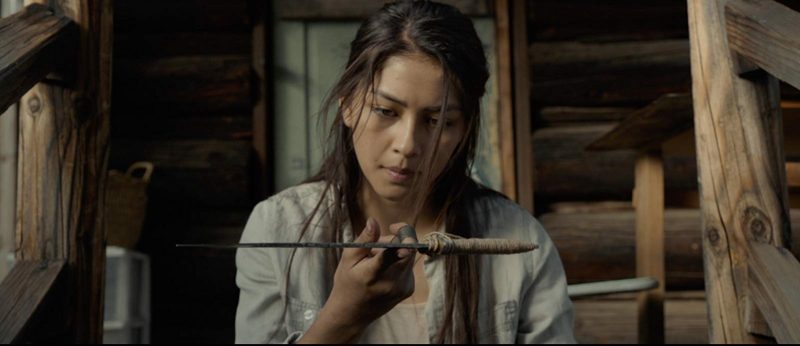
Anna

Initially, there were the Changed, never seen on screen and perhaps not even contemporaneous to the current period, though they may reside in the unseen cities. Anna, the protagonist, and her family are among the independent. Peter, a preacher from the ordained, holier than thou faction. In the realm of ‘if you’re not with me (and our God), you’re against me, thence evil’, they are the arbiters of all that is good. And then there are the Berserkers, as named by the Ordained. To the Ordained, Berserkers aspire to be Changed, but the Berserkers view themselves more along the line of Spartans: Pain is good.

Peter

All scenes are shot in the wilderness, but the various factions have staked property claims with wide perimeters. The penalty for trespass appears to usually involve death of the offending party—or at least a hefty fee. This is Hobbes’ ‘solitary, poor, nasty, brutish, and short’ life outside of society quip, though he didn’t exactly account for a class of societies despite this being common in his day.

Berserker

So, these factions don’t actually have property rights; what they have is a notion of property, and they defend it with violence, as is a necessary condition for all property. In so-called modern societies, the violence is obfuscated much in the same manner that supermarkets obscure the carnage behind the meat. It’s still there; it’s just at arm’s length. Violate one of these ‘rights’, and you’ll see the violence inherent in the system.

And then there’s social contract theory—or the gaping flaw in the logic. Anna is an independent, but one can only be as independent as the ability to defend their independence. It’s sort of like contract law. If you can afford to defend a contract, you are entitled to having it enforced.

Redact intellectual property rant.

Anna doesn’t particularly want to belong to either faction, who have divided their world into two pieces in the same manner that, say, Britain and Scotland might have. If you happen to be born there through some loin lottery, you pretty much have to choose a side. Given Sartre’s no excuses policy, you can choose neither; it just won’t bode well for you. You’ve got no real choice.

Social Choice Theory

In Anna’s eyes, upon the death of her mother and brother, she is persuaded with reluctance to return with Peter to his community, a God-fearing bunch. Her mum had indoctrinated her into this cult of God through bible readings, so she was primed for the eventuality. Some independent interlopers attempted to block their return journey by claiming trespass, so Peter summarily offed them rather than paying their ransom—a fee Anna has been willing to tender.

When the two finally reached the sanctuary, Anna quickly realised that she had no say in the matter: she was either a (good) member or (an evil) dead. To reiterate, this is an underlying problem with social contract theory. There is no exit clause.

Side Bar: Some have argued that the cost of coerced—though they’d never use this term—participation and compliance is owed to the greater good. There is no reason given why this is preferred or across which dimensions better is being assessed—or good for that matter—, so don’t ask. Long live Jeremy Bentham and John Stuart Mill with a hat tip to David Hume.

“The first man who, having fenced in a piece of land, said “This is mine,” and found people naĂŻve enough to believe him, that man was the true founder of civil society.

From how many crimes, wars, and murders, from how many horrors and misfortunes might not any one have saved mankind, by pulling up the stakes, or filling up the ditch, and crying to his fellows: Beware of listening to this impostor; you are undone if you once forget that the fruits of the earth belong to us all, and the earth itself to nobody.”

Jean-Jacques Rousseau, Discourse on the Origin of Inequality

Hobbes, Locke, and Rousseau each approached social contracts from their own perspectives, but it may be interesting to note that each was a privileged white male of his day. Sure, Hobbes was a monarchist, and Rousseau was the Thoreau of his day, a nostalgist, but he like the others were beneficiaries of the status quo, save perhaps at the margins.

Anna thought she had sovereignty over her choices. In the end, the plot line prevailed, but then again, this was just a movie, so even her choices were scripted.

Calvin & Hobbes

Meaningless

4–6 minutes

Whether in English or in French, I don’t believe Foucault ever uttered the words, ‘It is meaningless to speak in the name of – or against – Reason, Truth, or Knowledge‘*, but I don’t think he’d disagree with the sentiment.


“All my analyses are against the idea of universal necessities in human existence.”

Michel Foucault

Foucault was a postmodernist, and on balance, political Conservatives (Rightists?) dislike the notion of postmodernism. Evidently, a lot of Postmodernists are also Leftists (Progressives or Liberals in the US), so somehow critics such as Jordan Peterson conflate the two clearly distinct concepts.

A basis for Conservatism is the notion of an objective truth, and despite recent sociopolitical trends, they at least say they are guardians or truth and purveyors of knowledge. Conservatives (OK, so I am broad-brushing here) are staunch individualists who believe strongly in possession and property, of material, of an objective reality. Fundamentally, the are aligned to a monotheistic god or at least some discernible (and objective) moral compass.

On the Left, especially post-Enlightenment, they’ve substituted God with some anthropomorphic Nature. In fact, they find comfort in natural laws and human nature. Science is often their respite because science is objective. Isn’t it? Leftists are friends or Reason, and one can’t acquire enough knowledge. Moderation need not apply here; the more the merrier.

This being said, evidently, many on the Left seem to have abandoned this comfort zone. Of course, this may be because the Left-Right dichotomy doesn’t capture the inherent nuance, and so they were miscategorised—perhaps, much in the same manner as persons are miscategorised in a binary gender system. No. It must be something else.

In any case, both side claim to the parties of knowledge, reason, and truth because the opposing parties are clearly abject morons. There is no hint of irony in the situation where each side claims some objective notion of truth—whether divinely granted or self-evidently reasoned—, yet they can’t resolve what the true truth is. If only the other side were more rational.

By now, we are well aware of the demise of homo economicus, the hyper-rational actor foundational to modern economic theory. In reality, humans are only rational given the loosest definitions, say, to (in most cases) know enough to get in the shade on a 37.2°C day. However, as behavioural economist Dan Ariely noted by the title of his book, people are Predictably Irrational. Ariely is just standing on the shoulders of Kahneman and Tversky and Richard Thaler. My point is that humans are only marginally rational.

As I’ve written elsewhere, truth is nothing more than a rhetorical endpoint. It is hardly objective. It’s a matter of opinion. Unfortunately, systems of government and jurisprudence require this objective truth. In truth—see what I did there?—, social fabric requires a shared notion of truth.

A shared notion doesn’t imply that this notion is objective, but if it’s not objective, how does one resolve differences of opinion as to which is the better truth. Without establishing a frame and a lens, this is impossible. The problem is that frames and lenses are also relative. Whether the members accept a given frame or lens is also a matter of rhetoric. It’s turtles all the way down.

Turtles all the way down

Even if all members agree on all parameters of truth at day 0, there is nothing to prevent opinion changes or from new members not to share these parameters. Such is always the problem with social contract theory. [How does one commit to a contract s/he is born into with little recourse to rescind the contract, renegotiate terms, or choose a different contract option. The world is already carved up, and the best one can do is to jump from the frying pan into the fire.]

In the end, the notion of truth is necessary, but it doesn’t exist. Playing Devil’s advocate, let’s say that there is a single purveyor of Truth; let’s just say that it’s the monotheistic Abrahamic God of Judeo-Christian beliefs. There is no (known) way to ascertain that a human would have the privilege to know such a truth nor, if s/he were to encounter, say, a burning bush of some sort, that this entity would be conveying truth; so, we aren’t really in a better place. Of course, we could exercise faith and just believe, but this is a subjective action. We could also take Descarte’s line of logic and declare that a good God would not deceive us—sidestepping that this ethereal being was good, as advertised. I’m afraid it’s all dead ends here, too.

And so, we are back to where we started: no objective truth, limited ability to reason, and some fleeting notion of knowledge. We are still left with nothing.

Enter the likes of Jordan Peterson, he with his fanciful notion of metaphysics and morality—a channeller of Carl Jung. His tactic is to loud dog the listener and outshout them indignantly. His followers, already primed with a shared worldview, are adept (or inept) cheerleaders ready to uncritically echo his refrain. To them, his virtue-ethical base, steeped in consequentialism awash in deontology, Peterson speaks the truth.

He also potentiates the selfish anti-collective germ and rage of the declining white man. He’s sort of a less entertaining Howard Stern for the cleverer by half crowd. He gives a voice to the voiceless—or perhaps the thoughtless. He uses ‘reason’ to back his emotional pleas. He finds a voice in the wilderness where white Western males are the oppressed. If only they hadn’t been born centuries earlier—albeit with iPhones and microwaves.

Those would be the days.

* I believe this phrase attributed to Foucault was a paraphrase by philosopher Todd May.

Happy Endings

If everything is just “rhetoric” or “power” or “language,” there is no real way to judge anything. 

Somehow, I happened across a blog post, Postmodernisms: What does *that* mean? Of course, this is right up my street, I skimmed a couple other posts on the site and followed some links to establish some contextual frame.

My by-now standard (read: autonomic) reaction to this line of questioning is that this is a correct assessment of the conditional statement.

If everything is just X, Y, or Z, there is no real way to judge anything.

Before evaluating the entirety of the content, let’s look at the lexical choices, in particular:

  • everything: Realising that this is hyperbole. I am going to assume that the author did not mean that everything is X, Y, or Z. I believe he means everything within some imagined yet undefined domain. I’ll guess that this domain relates to some moral or social sphere. Anything employs the same hyperbole, so I’ll ignore it.
  • just: This rhetorically modifies X, Y, and Z, in order to diminish them for the reader, to make them appear petty.
  • real: I believe the term he was looking for is objective or perhaps ontological. Otherwise, we’ll need to discern what he considers to be real versus not real.

Also, notice the use of or as a conjunction. This seems odd, as the listed items do not have equal weight or effect. Rhetoric does not exist without language, and power really feels out of place, Michel Foucault’s law of the instrument complicity notwithstanding. To him, power was his litmus.

Constructionism

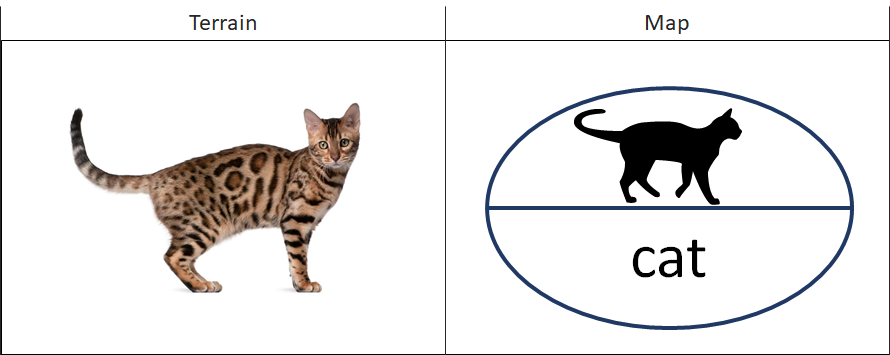
Firstly, all social perception is the result of the construct of human language. Of course, there is the physical world that exists independently of humans and perception—perhaps this is the real world where real judgments occur. Let’s label this real world the terrain. The earth and the larger universe would exist absent of humans. In fact, it had for aeons and will persist for many aeons beyond the last semblance of humanity. Humans are also real, if ephemeral, on a grander scale.

If this independent, objective, real world is the terrain, language is the map. We use language to communicate and make sense of the terrain, but it is only a representation based on our imperfect sense faculties.

cat saussure labels
Image: Symbolic language mapping of terrain

So when one makes a claim that everything [sic] is, say, language, they are making a claim similar to that of Saussure. Saussure was a structuralist. In fact, post-structuralism (or its expanded form labelled post-modernism) was a reaction against structuralists. Within the context of this post, Saussure believed that if one could fully qualify the structure of language, one could achieve a one-to-one fidelity relationship of the map to the terrain.

Post-structuralists pointed out all of the reasons why this was a fool’s errand. Like a geographical map, it is only a representation of the underlying terrain. Language serves the purpose of communication including expression and phatic aspects. One form of communication is rhetoric, which is a form employed for the purpose of persuasion. One possibility of this persuasion is to gain and retain power—or to at least win the upper hand in your argument. I suppose this is where the original statement starts to coalesce: rhetoric, power, and language.

quote-all-models-are-wrong-but-some-are-useful-george-e-p-box-53-42-27[1]
All models are wrong, but some are useful.
My point, then, is that our language map is always disconnected from the terrain. Moreover, it can be a pretty low fidelity map indeed. So when one says that everything is language, they are making a claim that we can not acquire this real knowledge. We can make sensory observations and construct narratives about it.

If you’ve ever taken a basic communications class, you’ve probably experienced the telephone game. Perception works in a similar manner. There are many things of which we have little or no experience save for conveyance through language. But as with the telephone game, fidelity can be lost. This is less likely to be a problem when interfacing with the so-called real world of rock and trees and of lions and tigers and bears.

terrain saussure
Image: Symbolic language mapping of nebulous concept

It is more likely to become a problem when dealing with non-ontic concepts, these ‘things’ that would not exist without humans or, more critically, without language. These artificial (in contrast to real) concepts are things like goodness, justice, democracy, liberty, sovereignty, nations, and on and on, ad nauseum. Humans have constructed narratives about all of these, but if the last human were to die tomorrow, these concepts would die, too. Whether some new lifeform would eventually evolve to develop language and further develop these concepts is debatable.

Judging

All of this aside, let’s look at the perceived intent of this statement, which is the same sentiment behind Nietzsche’s ‘God is dead’ quip.

As has been discussed, the Enlightenment replaced God with Nature and Nietzsche realised that if this worldview were universally adopted, the tyrannic role that God and gods had played could not be leveraged to maintain control or power, much in the same way that the divine rights or kings had withered and died. God played a vital role in this narrative. Nature, particularly human nature, was a weak substitute. This said, moral and natural realists, quickly (and relatively successfully) filled the void with cognitive filler, a perfect pairing for budding Enlightenment thinkers.

Given that even if there were some objective morality (terrain), there is no reason to believe that a human could gain access to it. Previously, priests and pharaohs claimed to possess this ability, but this vector was no longer extant or accessible. Even if a person did have this power through some miracle of some sort or another (or another or another), what reason (other than convincing rhetoric) would one have to believe him (or her—but let’s be honest; it’s pretty much all hims).

Without access to this objective morality, we are left with creating some subjective morality. I fully admit that trying to gain consensus and compliance to a known-to-be constructed moral code would be akin to herding cats. It is no doubt that society would operate more efficiently if all constituents follow the same code.

If wouldn’t matter if this society adopted, say, monogamy over polygamy, so long as everyone accepted this as the rules of engagement. Cultural subjectivism would provide a moral framework for this situation, We have many examples of social arrangements where this is the mode of operation.

Sports are an example. There are rules. Players agree on the rules, protocols, and procedures, and they operate within this socially constructed framework. There is no objective sportsball deity on high that conveyed the commandments, and yet it works.

John+Locke+-+Jean+Jacques+Rousseau[1]

Locke and Rousseau each wrote about social contracts. Granted, they believed in a supernatural Nature with a capital N, but they still felt that people could operate as a society based on some sort compact or accord.

This missing element would be power because those in power could not use some higher power to justify their actions especially in regard to retributive justice and so on.

Commentary

What I still don’t understand after all these years is how this logic works. It is eerily similar to Pascale’s Wager.

If not SOME CONDITION,
then not DESIRED OUTCOME
therefore FABRICATE SOME CONDITION

If not [belief in God],
then not [eternity of bliss in Heaven; instead eternal suffering in Hell, so double down]
therefore [convince yourself of or feign belief in God]

If not [objective means of judgment],
then not [real judgment]
therefore [delude yourself into the belief that an objective means of judgment exists]

And they all lived happily ever after…

jessica-brooke-real-lesbian-wedding-orlando-florida-alternative-life-photography-design-first-kiss[1]

happily ever after

Deposition Despotism

Well, ya. Sure the title has little to do with this post, but I had to sit for a deposition this past week, and like they do on TV, I had to raise my right hand and swear to tell “the whole truth, nothing but the truth, so help you, God.”

Do you swear to tell the whole truth, nothing but the truth, so help you God?

So, as a moral subjectivist, who is also a pragmatist, I thought that it would not be in my best interest to raise the point that I don’t ascribe to their notion of truth, certainly not a God-given truth, and does raising my right hand act like an antenna, perhaps like rabbit ears on the old TVs from the 1960s? And does this ritual work without a bible?

Of course, I understand the notion of this ritual, and so I agreed, but it really drove home to me how the jurisprudence system in the US (and I am sure elsewhere) is just a smoke & mirrors act—some futile deontological exercise.

At some time during the proceedings, an attorney felt obligated to query as to whether I understood what perjury is before reading the statute. I am guessing that this was more of a psychological endeavour meant either to throw off my balance or was in line with the studies where observed students were less apt to cheat on an exam when they had recently signed a statement acknowledging the (fake) anti-cheating clause. Some people are so easily manipulated through indoctrination.

At one point, I was asked if I was taking the process seriously. I acknowledged that I didn’t really, but that he could continue. I am not sure how much was theatrics attempting to throw me off balance, but I think I passed the audition.

Completed Anarchy

I finished the first section of Nozick‘s book—the Anarchy section—, and I am not in a better position than my past two posts. Nozick and Libertarians are obsessed with a normative, teleological world, where there is some objective, absolute truth and reality. I can’t argue whether there is some absolute truth, but I feel I can argue, like the God argument,  there is no reason to believe that we can know what that truth is, absolutely.

<EOF>