Footnotes from the House: Justice as a Casino Game

4–6 minutes

This is part 2 of a structural critique of Justice™. Read Part 1, The Ontology–Encounter–Evaluation Model: Retributive Justice as an Instantiation.

If you want a useful metaphor for how justice actually operates, don’t picture a blindfolded goddess with scales. Picture a casino.

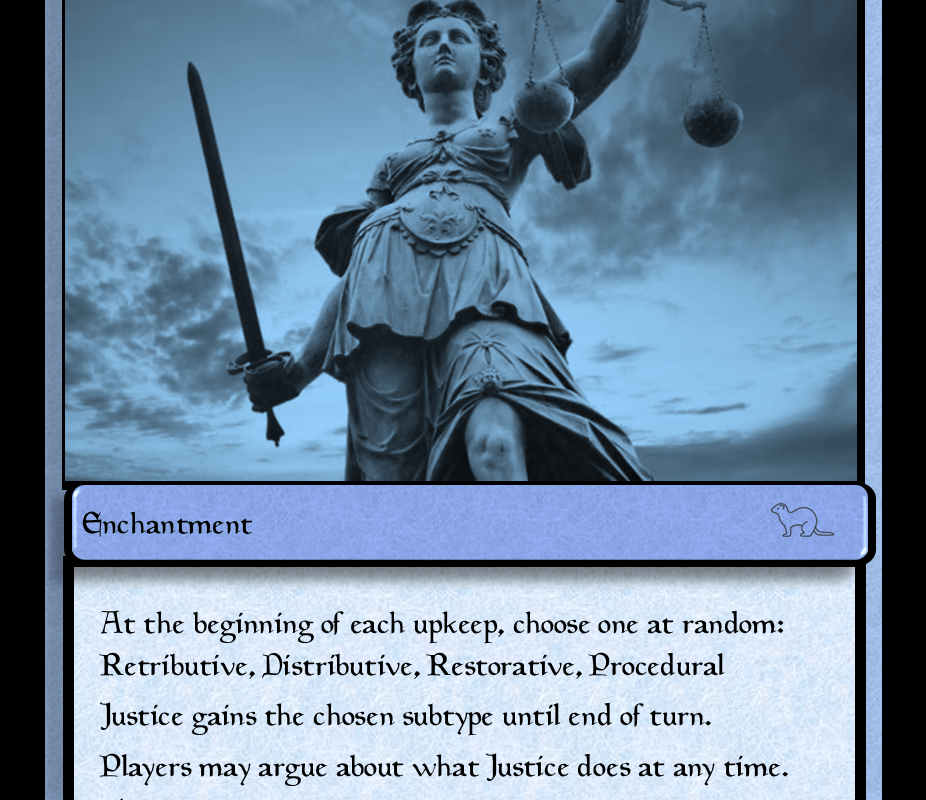
Image: Lady Justice in Casino. The dice are rigged. haha

The rules are printed. The games look fair. Everyone is technically allowed to play. But the mathematics are tuned in advance, the exits are discreet, and the house never risks its own solvency. You don’t walk into a casino to discover whether chance is fair. You walk in to participate in a system whose advantage has already been engineered.

By the time a defendant appears, the ontological dice have already been loaded. The system has quietly asserted a set of metaphysical commitments that make certain outcomes legible, actionable, and punishable – whilst rendering others incoherent, inadmissible, or ‘unreasonable’. Because I am a philosopher of language and not a lawyer, I am free from the indoctrination and selection bias inherent in that system. This allows me to critique the system directly without being excommunicated from the club.

What follows are not neutral assumptions. They are ontological wagers, each chosen because its alternative would tilt the field away from institutional power.

Ontology 1: The Self

Justice presumes that the person who acted yesterday is meaningfully the same entity standing in court today. This is not discovered; it is asserted.

Why? Because retribution requires persistence. Desert cannot attach to a momentary configuration of consciousness. Responsibility requires a carrier that survives time, memory gaps, psychological rupture, intoxication, trauma, and neurological variance.

An episodic self – Parfit’s reductionism, trauma-fractured identity, or situational selfhood – collapses the attribution pipeline. If the ‘self’ is a series of loosely connected episodes, punishment becomes conceptually incoherent. Who is being punished for whom?

So the law treats episodic accounts not as alternative ontologies but as defects: insanity, automatism, incompetence. The self is patched, not replaced.

Ontology 2: Agency

Justice requires that actions originate somewhere. Agency is that somewhere.

The system asserts that agents could have done otherwise in a morally relevant sense. This is compatible with compatibilism, folk psychology, and everyday moral intuitions – but deeply hostile to hard determinism, strong situationism, or neurobiological deflation.

Why exclude weaker agency models? Because if agency dissolves into causation, environment, or neurochemistry, responsibility evaporates. At best, you get risk management. At worst, you get treatment or containment. Retribution has nowhere to land.

So the law nods politely to influences – upbringing, coercion, impairment – whilst ring-fencing agency as the default. Mitigation is permitted. Ontological revision is not. The house needs someone who could have chosen otherwise, even if that claim grows increasingly fictional under scrutiny.

Ontology 3: Choice

Justice models human action as a series of forks in the road. At some point, the agent ‘chose’ X over Y. This is enormously convenient.

Continuous decision spaces – poverty gradients, addiction loops, survival trade-offs – are messy. They resist clean counterfactuals. ‘What should they have done instead?’ becomes a sociological question, not a moral one.

So the system discretises. It locates a moment. A click. A trigger pull. A signature. A punch. A text sent.

Once the choice is frozen, the rest of the apparatus can proceed. Without discrete choice points, proportionality and culpability lose their anchor.

Ontology 4: Causation

Justice prefers causes that point: Who did this? When? How directly?

Systemic causation – economic pressure, cultural narratives, institutional design – creates attribution problems. If harm is emergent, no individual carries it cleanly. Responsibility smears.

So causation is narrowed. Chains are shortened. Proximate cause replaces contributing conditions. Structural violence becomes background noise.

This is not because systemic causation is false. It is because it is unmanageable within a retributive frame.

Ontology 5: Reasonableness

‘Reasonableness’ is the softest and most insidious ontology of the lot.

It pretends to be procedural, but it functions as cultural enforcement. The reasonable person is not an average human. They are an acculturated one.

Intensity becomes suspect. Rage becomes irrational. Grief becomes excessive. Radical interpretations become unreasonable not because they’re false, but because they disrupt cadence.

This ontology stabilises the game by disciplining tone. It doesn’t matter what you argue if you fail to argue it reasonably. Reasonableness is not required for responsibility to exist, only for dissent to be ignored.

The house needs calm players, not correct ones.

Why These Ontologies, and Not Their Rivals?

Because every excluded ontology threatens legibility. Justice is not designed to discover truth. It is designed to terminate cases. Ontologies that complicate attribution, disperse responsibility, or destabilise narrative continuity slow the machine. So they are ruled out – not explicitly, but structurally.

Once these commitments are in place, disagreement downstream becomes theatre. Arguments about fairness, proportionality, or intent occur within a rigged metaphysical envelope. That’s why reform debates feel sincere yet go nowhere. People argue outcomes whilst the house quietly keeps the rules.

The Point

None of this means justice is a scam. Casinos aren’t scams either. They do exactly what they are designed to do.

If you want to challenge justice meaningfully, you don’t start with sentencing guidelines or evidentiary thresholds. You start by asking which ontologies are being asserted – and why alternatives are unplayable.

Most people won’t make that move. Not because it’s wrong. Because it requires leaving the table.

The Ontology–Encounter–Evaluation Model: Retributive Justice as an Instantiation

7–10 minutes

Now that A Language Insufficiency Hypothesis has been put to bed — not euthanised, just sedated — I can turn to the more interesting work: instantiating it. This is where LIH stops being a complaint about words and starts becoming a problem for systems that pretend words are stable enough to carry moral weight.

Read part 2 of this essay.

What follows is not a completed theory, nor a universal schema. It’s a thinking tool. A talking point. A diagram designed to make certain assumptions visible that are usually smuggled in unnoticed, waved through on the strength of confidence and tradition.

The purpose of this diagram is not to redefine justice, rescue it, or replace it with something kinder. It is to show how justice is produced. Specifically, how retributive justice emerges from a layered assessment process that quietly asserts ontologies, filters encounters, applies normative frames, and then closes uncertainty with confidence.

Audio: NotebookLM summary podcast of this topic.

Most people are willing to accept, in the abstract, that justice is “constructed”. That concession is easy. What is less comfortable is seeing how it is constructed — how many presuppositions must already be in place before anything recognisable as justice can appear, and how many of those presuppositions are imposed rather than argued for.

The diagram foregrounds power, not as a conspiracy or an optional contaminant, but as an ambient condition. Power determines which ontologies are admissible, which forms of agency count, which selves persist over time, which harms are legible, and which comparisons are allowed. It decides which metaphysical configurations are treated as reasonable, and which are dismissed as incoherent before the discussion even begins.

Justice, in this framing, is not discovered. It is not unearthed like a moral fossil. It is assembled. And it is assembled late in the process, after ontology has been assumed, evaluation has been performed, and uncertainty has been forcibly closed.

This does not mean justice is fake. It means it is fragile. Far more fragile than its rhetoric suggests. And once you see that fragility — once you see how much is doing quiet, exogenous work — it becomes harder to pretend that disagreements about justice are merely disagreements about facts, evidence, or bad actors. More often, they are disagreements about what kind of world must already be true for justice to function at all.

I walk through the structure and logic of the model below. The diagram is also available as a PDF, because if you’re going to stare at machinery, you might as well be able to zoom in on the gears.

Why Retributive Justice (and not the rest of the zoo)

Before doing anything else, we need to narrow the target.

“Justice” is an infamously polysemous term. Retributive, restorative, distributive, procedural, transformative, poetic, cosmic. Pick your flavour. Philosophy departments have been dining out on this buffet for centuries, and nothing useful has come of letting all of them talk at once.

This is precisely where LIH draws a line.

The Language Insufficiency Hypothesis is not interested in pedestrian polysemy — cases where a word has multiple, well-understood meanings that can be disambiguated with minimal friction. That kind of ambiguity is boring. It’s linguistic weather.

What LIH is interested in are terms that appear singular while smuggling incompatible structures. Words that function as load-bearing beams across systems, while quietly changing shape depending on who is speaking and which assumptions are already in play.

“Justice” is one of those words. But it is not usefully analysable in the abstract.

So we pick a single instantiation: Retributive Justice.

Why?

Because retributive justice is the most ontologically demanding and the most culturally entrenched. It requires:

  • a persistent self
  • a coherent agent
  • genuine choice
  • intelligible intent
  • attributable causation
  • commensurable harm
  • proportional response

In short, it requires everything to line up.

If justice is going to break anywhere, it will break here.

Retributive justice is therefore not privileged in this model. It is used as a stress test.

The Big Picture: Justice as an Engine, Not a Discovery

The central claim of the model is simple, and predictably unpopular:

Not invented in a vacuum, not hallucinated, not arbitrary — but assembled through a process that takes inputs, applies constraints, and outputs conclusions with an air of inevitability.

The diagram frames retributive justice as an assessment engine.

An engine has:

  • inputs
  • internal mechanisms
  • thresholds
  • failure modes
  • and outputs

It does not have access to metaphysical truth. It has access to what it has been designed to process.

The justice engine takes an encounter — typically an action involving alleged harm — and produces two outputs:

  • Desert (what is deserved),
  • Responsibility (to whom it is assigned).

Everything else in the diagram exists to make those outputs possible.

The Three Functional Layers

The model is organised into three layers. These are not chronological stages, but logical dependencies. Each layer must already be functioning for the next to make sense.

1. The Constitutive Layer

(What kind of thing a person must already be)

This layer answers questions that are almost never asked explicitly, because asking them destabilises the entire process.

  • What counts as a person?
  • What kind of self persists over time?
  • What qualifies as an agent?
  • What does it mean to have agency?
  • What is a choice?
  • What is intent?

Crucially, these are not empirical discoveries made during assessment. They are asserted ontologies.

The system assumes a particular configuration of selfhood, agency, and intent as a prerequisite for proceeding at all. Alternatives — episodic selves, radically distributed agency, non-volitional action — are not debated. They are excluded.

This is the first “happy path”.

If you do not fit the assumed ontology, you do not get justice. You get sidelined into mitigation, exception, pathology, or incoherence.

2. The Encounter Layer

(What is taken to have happened)

This layer processes the event itself:

  • an action
  • resulting harm
  • causal contribution
  • temporal framing
  • contextual conditions
  • motive (selectively)

This is where the rhetoric of “facts” tends to dominate. But the encounter is never raw. It is already shaped by what the system is capable of seeing.

Causation here is not metaphysical causation. It is legible causation.
Harm is not suffering. It is recognisable harm.
Context is not total circumstance. It is admissible context.

Commensurability acts as a gatekeeper between encounter and evaluation: harms must be made comparable before they can be judged. Anything that resists comparison quietly drops out of the pipeline.

3. The Evaluative Layer

(How judgment is performed)

Only once ontology is assumed and the encounter has been rendered legible does evaluation begin:

  • proportionality
  • accountability
  • normative ethics
  • fairness (claimed)
  • reasonableness
  • bias (usually acknowledged last, if at all)

This layer presents itself as the moral heart of justice. In practice, it is the final formatting pass.

Fairness is not discovered here. It is declared.
Reasonableness does not clarify disputes. It narrows the range of acceptable disagreement.
Bias is not eliminated. It is managed.

At the end of this process, uncertainty is closed.

That closure is the moment justice appears.

Why Disagreement Fails Before It Starts

At this point, dissent looks irrational.

The system has:

  • assumed an ontology
  • performed an evaluation
  • stabilised the narrative through rhetoric
  • and produced outputs with institutional authority

To object now is not to disagree about evidence. It is to challenge the ontology that made assessment possible in the first place.

And that is why so many justice debates feel irresolvable.

They are not disagreements within the system.
They are disagreements about which system is being run.

LIH explains why language fails here. The same words — justice, fairness, responsibility, intent — are being used across incompatible ontological commitments. The vocabulary overlaps; the worlds do not.

The engine runs smoothly. It just doesn’t run the same engine for everyone.

Where This Is Going

With the structure in place, we can now do the slower work:

  • unpacking individual components
  • tracing where ontological choices are asserted rather than argued
  • showing how “reasonableness” and “fairness” operate as constraint mechanisms
  • and explaining why remediation almost always requires a metaphysical switch, not better rhetoric

That should worry us more than if it were merely malfunctioning.

The rest of the story

Read part 2 of this essay.

This essay is already long, so I’m going to stop here.

Not because the interesting parts are finished, but because this is the point at which the analysis stops being descriptive and starts becoming destabilising.

The diagram you’ve just walked through carries a set of suppressed footnotes. They don’t sit at the margins because they’re trivial; they sit there because they are structurally prior. Each one represents an ontological assertion the system quietly requires in order to function at all.

By my count, the model imposes at least five such ontologies. They are not argued for inside the system. They are assumed. They arrive pre-installed, largely because they are indoctrinated, acculturated, and reinforced long before anyone encounters a courtroom, a jury, or a moral dilemma.

Once those ontologies are fixed, the rest of the machinery behaves exactly as designed. Disagreement downstream is permitted; disagreement upstream is not.

In a follow-up essay, I’ll unpack those footnotes one by one: where the forks are, which branch the system selects, and why the alternatives—while often coherent—are rendered unintelligible, irresponsible, or simply “unreasonable” once the engine is in motion.

That’s where justice stops looking inevitable and starts looking parochial.

And that’s also where persuasion quietly gives up.

Justice as a House of Cards

4–6 minutes

How retribution stays upright by not being examined

There is a persistent belief that our hardest disagreements are merely technical. If we could stop posturing, define our terms, and agree on the facts, consensus would emerge. This belief survives because it works extremely well for birds and tables.

It fails spectacularly for justice.

Audio: NotebookLM summary podcast of this topic.

The Language Insufficiency Hypothesis (LIH) isn’t especially interested in whether people disagree. It’s interested in how disagreement behaves under clarification. With concrete terms, clarification narrows reference. With contested ones, it often fractures it. The more you specify, the more ontologies appear.

Justice is the canonical case.

Retributive justice is often presented as the sober, adult conclusion. Not emotional. Not ideological. Just what must be done. In practice, it is a delicately balanced structure built out of other delicately balanced structures. Pull one term away and people grow uneasy. Pull a second and you’re accused of moral relativism. Pull a third and someone mentions cavemen.

Let’s do some light demolition. I created a set of 17 Magic: The Gathering-themed cards to illustrate various concepts. Below are a few. A few more may appear over time.

Card One: Choice

Image: MTG: Choice – Enchantment

The argument begins innocently enough:

They chose to do it.

But “choice” here is not an empirical description. It’s a stipulation. It doesn’t mean “a decision occurred in a nervous system under constraints.” It means a metaphysically clean fork in the road. Free of coercion, history, wiring, luck, trauma, incentives, or context.

That kind of choice is not discovered. It is assumed.

Pointing out that choices are shaped, bounded, and path-dependent does not refine the term. It destabilises it. Because if choice isn’t clean, then something else must do the moral work.

Enter the next card.

Card Two: Agency

Image: MTG: Agency – Creature – Illusion

Agency is wheeled in to stabilise choice. We are reassured that humans are agents in a morally relevant sense, and therefore choice “counts”.

Counts for what, exactly, is rarely specified.

Under scrutiny, “agency” quietly oscillates between three incompatible roles:

  • a descriptive claim: humans initiate actions
  • a normative claim: humans may be blamed
  • a metaphysical claim: humans are the right kind of cause

These are not the same thing. Treating them as interchangeable is not philosophical rigour. It’s semantic laundering.

But agency is emotionally expensive to question, so the discussion moves on briskly.

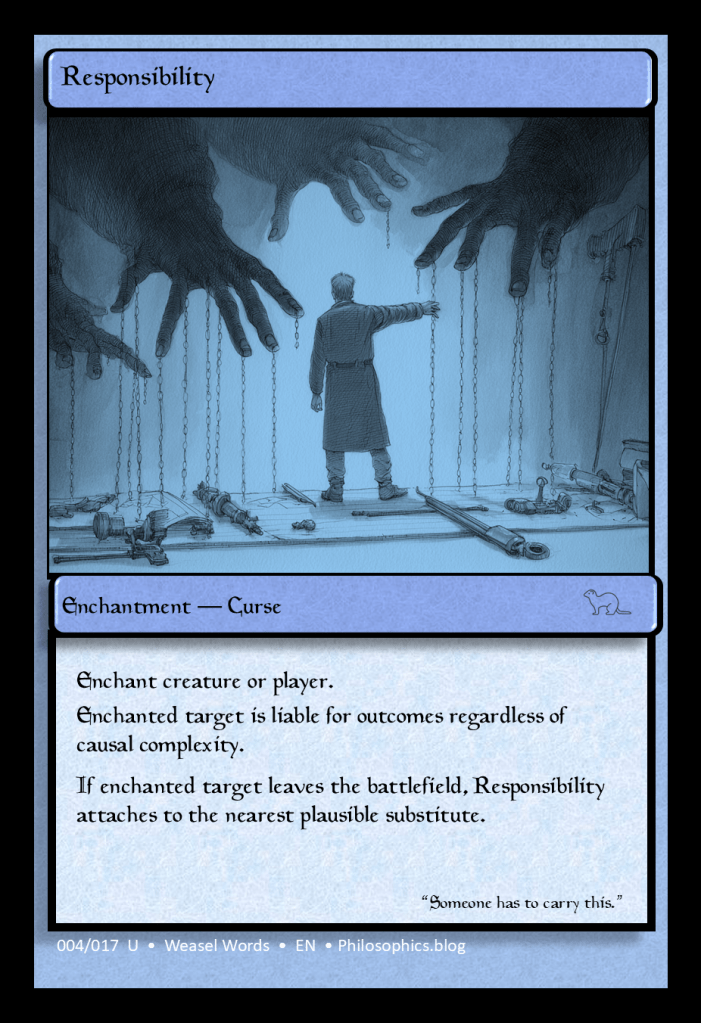
Card Three: Responsibility

Image: MTG: Responsibility – Enchantment – Curse

Responsibility is where the emotional payload arrives.

To say someone is “responsible” sounds administrative, even boring. In practice, it’s a moral verdict wearing a clipboard.

Watch the slide:

  • causal responsibility
  • role responsibility
  • moral responsibility
  • legal responsibility

One word. Almost no shared criteria.

By the time punishment enters the picture, “responsibility” has quietly become something else entirely: the moral right to retaliate without guilt.

At which point someone will say the magic word.

Card Four: Desert

Image: MTG: Desert – Instant

Desert is the most mystical card in the deck.

Nothing observable changes when someone “deserves” punishment. No new facts appear. No mechanism activates. What happens instead is that a moral permission slip is issued.

Desert is not found in the world. It is declared.

And it only works if you already accept a very particular ontology:

  • robust agency
  • contra-causal choice
  • a universe in which moral bookkeeping makes sense

Remove any one of these and desert collapses into what it always was: a story we tell to make anger feel principled.

Which brings us, finally, to the banner term.

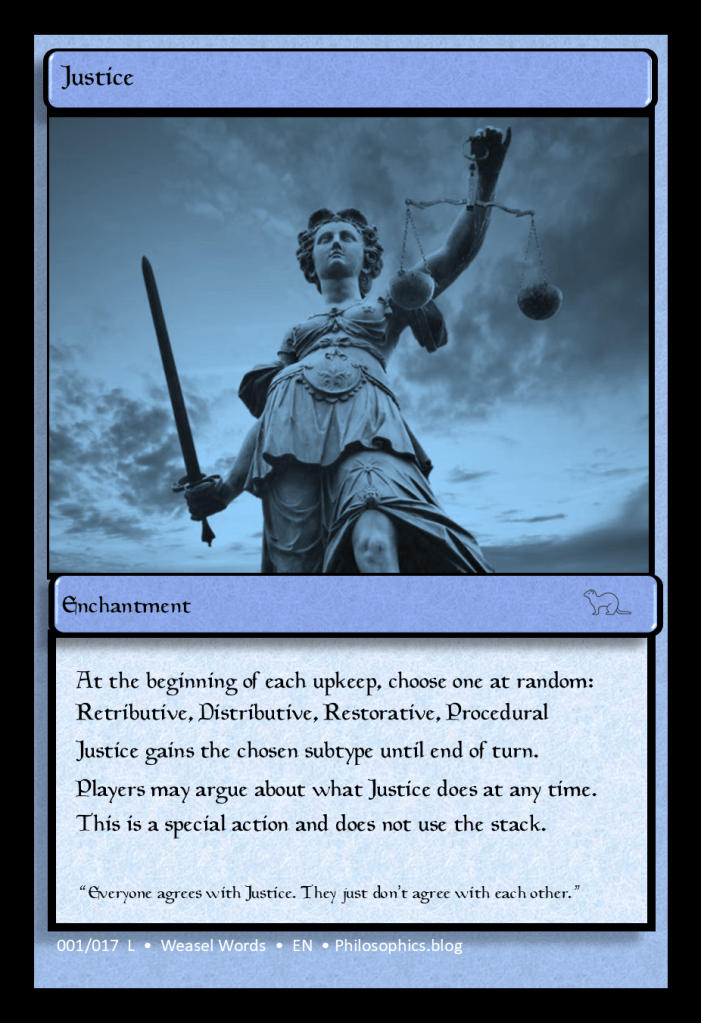
Card Five: Justice

Image: MTG: Justice – Enchantment

At this point, justice is invoked as if it were an independent standard hovering serenely above the wreckage.

It isn’t.

“Justice” here does not resolve disagreement. It names it.

Retributive justice and consequentialist justice are not rival policies. They are rival ontologies. One presumes moral balance sheets attached to persons. The other presumes systems, incentives, prevention, and harm minimisation.

Both use the word justice.

That is not convergence. That is polysemy with a body count.

Why clarification fails here

This is where LIH earns its keep.

With invariants, adding detail narrows meaning. With terms like justice, choice, responsibility, or desert, adding detail exposes incompatible background assumptions. The disagreement does not shrink. It bifurcates.

This is why calls to “focus on the facts” miss the point. Facts do not adjudicate between ontologies. They merely instantiate them. If agency itself is suspect, arguments for retribution do not fail empirically. They fail upstream. They become non sequiturs.

This is also why Marx remains unforgivable to some.
“From each according to his ability, to each according to his need” isn’t a policy tweak. It presupposes a different moral universe. No amount of clarification will make it palatable to someone operating in a merit-desert ontology.

The uncomfortable conclusion

The problem is not that we use contested terms. We cannot avoid them.

The problem is assuming they behave like tables.

Retributive justice survives not because it is inevitable, but because its supporting terms are treated as settled when they are anything but. Each card looks sturdy in isolation. Together, they form a structure that only stands if you agree not to pull too hard.

LIH doesn’t tell you which ontology to adopt.

It tells you why the argument never ends.

And why, if someone insists the issue is “just semantic”, they’re either confused—or holding the deck.