Philosophic Influences

I just finished the writing and editorial parts of my Language Insufficiency Hypothesis. It still needs cover art and some administrative odds and ends, but I’m taking a day for a breather to share something about myself and my worldview. For this, I share my philosophical influences and how they support my core insights. For dramatic effect, I’ll even try to weight them to 100 per cent, leaving an ‘others’ bucket for the unaccounted ones.

Audio: NotebookLM summary podcast of this topic.

Obviously, this highly scientific accounting is about as useful as a Facebook survey or a fortune cookie, but it should reveal something. I have influences outside of philosophy, but I’ll limit this list at the start. The numbers don’t exactly add to 100% because there is a bit of cross-pollination, say, between Foucault and Nietzsche or Žižek and Hegel – or perhaps I’m just not good at maths. You decide.

Nietzsche (≈18)

Nietzsche is likely the uranium core. Haters and detractors like to diminish his contribution – and he didn’t play by the old rules – but they are wrong. He contributes value-creation, anti-moralism, perspectivism, the critique of ressentiment, the demolition of universals.

Nietzsche sits at the centre of the blast radius. Everything else is shrapnel. If there’s a thinker who detonated the Enlightenment’s pretensions more elegantly, I’ve not met them. He showed us that values are forged, not found; that morality is a genealogy of grievances; that certainty is the last refuge of the timid. In other words, he cleared the ground so the rest of us could get to work without tripping over Kantian furniture. But after Nietzsche’s uranium core, the next concentric ring becomes murkier.

Foucault (≈20%)

Foucault supplies the schematics. Where Nietzsche swung a hammer at the idols, Foucault identified the building codes. He mapped power as a set of subtle, everyday enchantments. He showed how ‘knowledge’ is simply what a society rewards with credibility. He is the patron saint of anyone who suspects normality is an instrument, not a neutral state of affairs. The world looks different once you see the disciplinary fingerprints on everything.

Derrida (≈10%)

Derrida gives me language as mischief. Meaning wobbles, slides, cracks; binaries betray themselves; every conceptual edifice contains its own trapdoor. Derrida isn’t a system; he’s an escape artist. And frankly, you can’t write anything about the insufficiency of language without genuflecting in his general direction.

Late Wittgenstein (≈15%)

The quiet structural pillar. If Derrida is the saboteur, Wittgenstein is the carpenter who informs you that the house was never stable anyway. Meaning-as-use, language-games, the dissolution of philosophical pseudo-problems: his later work underwrites virtually every modern suspicion about fixed categories and timeless essences. He doesn’t shout; he shrugs – and everything collapses neatly.

Rorty (≈5%)

Rorty replaces metaphysical longing with cultural pragmatism. He teaches you to stop hunting for capital-T Truth and instead track the vocabularies we actually live in. He’s the friendly voice whispering, ‘You don’t need foundations. You need better conversations’. His influence is felt mostly in the tone of my epistemic cynicism: relaxed rather than tragic. Besides, we disagree on the better conversations bit.

Geuss (≈4%)

If Rorty makes you light-footed, Geuss reminds you not to float off into abstraction entirely. He is the critic of moralism par excellence, the man who drags philosophy kicking and screaming back into politics. Geuss is the voice that asks, ‘Yes, but who benefits?’ A worldview without him would be a soufflé.

Heidegger (≈6%)

Selective extraction only. Being-in-the-world, thrownness, worldhood – the existential scaffolding. His political judgment was catastrophic, of course, but the ontological move away from detached subjectivity remains invaluable. He gives the metaphysics a certain grain.

Existentialists: Beauvoir, Sartre, Camus (≈6%)

They provide the atmospheric weather: choice, finitude, absurdity, revolt, the sheer mess of human freedom. They don’t define the system; they give it blood pressure. Besides, I met them before I switched to Team Nietzsche-Foucault.

Žižek, Latour, Baudrillard (≈2% combined)

These three are my licensed provocateurs.

  • Žižek exposes how ideology infiltrates desire.
  • Latour dismantles the Nature/Society binary with glee.
  • Baudrillard whispers that representation ate reality while we were looking at our phones.

They’re trickster figures, not architects.

Hume, Putnam, Dennett, and the Ancillaries (≈1% combined)

These are the seasonings.

  • Hume is the Scottish acid bath under every epistemic claim.
  • Putnam gives internal realism its analytic passport.
  • Dennett offers mechanistic metaphors you can steal even when you disagree.
  • Kant and Hegel hover like compulsory ghosts.
  • Rawls remains decorative parsley: included for completeness, consumed by none.

The Others Bucket (≈5%)

The unallocated mass: writers, anthropologists, theorists, stray thinkers you absorb without noticing. The ‘residuals’ category for the philosophical inventory – the bit fortune cookies never warn you about.

Enfin

Obviously, these ratios are more for humour than substance, but these are the thinkers I return to — the ones whose fingerprints I keep discovering on my own pages, no matter how many years or detours intervene.

Perhaps more revealing are those who didn’t make the guest list. Socrates, Plato, and Aristotle remain outside, smoking in the cold. The Stoics, Marcus Aurelius and his well-meaning self-help descendants, also failed to RSVP. In truth, I admire the posture but have little patience for the consolations – especially when they become the emotional training wheels of neoliberalism.

And then, of course, the Enlightenment patriarchs: Hobbes, Locke, Montesquieu and the rest of the constitutional furniture. I acknowledge their historical necessity the way one acknowledges plumbing – grateful it exists, uninterested in climbing inside the pipes. Rousseau, admittedly, I tolerate with something approaching affection, but only because he never pretended to be tidy.

I forgot Descartes, Voltaire, and Pascal, but it’s too late to scroll back and adjust the ledger. Consider them rounding errors – casualties of the margins, lost to the tyranny of percentages.

If anyone mentions another one – Spinoza comes to mind – I’ll try to figure out where they fit in my pantheon. Were I to render this tomorrow, the results may vary.

Homo Legibilis

3–4 minutes

A Brief Field Note from the Department of Bureaucratic Anthropology

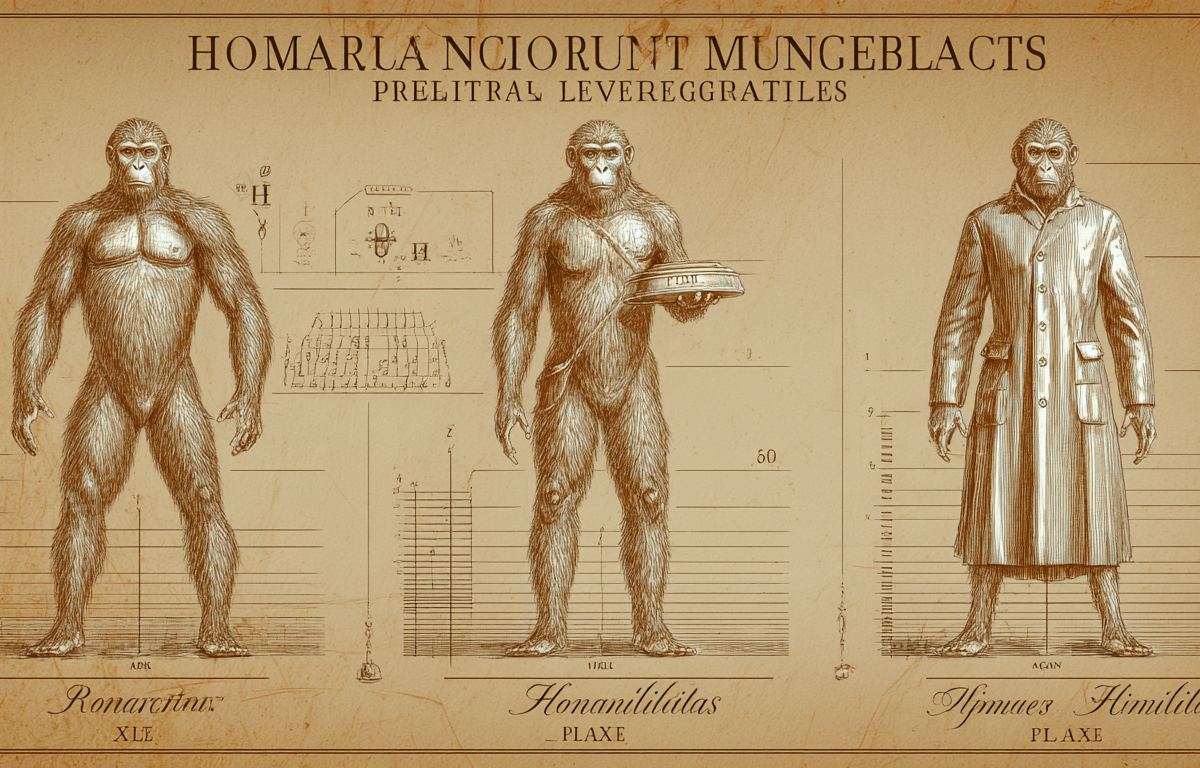
Still reeling from the inability to fold some pan into homo, Palaeontologists are seemingly desperate for a new hominid. Some dream of discovering the ‘missing link’; others, more honest, just want something with a jawline interesting enough to secure a grant. So imagine the surprise when the latest species didn’t come out of the Rift Valley but out of an abandoned server farm somewhere outside Reading.

They’ve named it Homo Legibilis – the Readable Human. Not ‘H. normālis’ (normal human), not ‘H. ratiōnālis (rational human), but the one who lived primarily to be interpreted. A species who woke each morning with a simple evolutionary imperative: ensure one’s dataprints were tidy, current, and machine-actionable.

Audio: NotebookLM summary podcast of this topic.

You’ll have seen their skeletons before, though you may not have recognised them as such. They often appear upright, mid-scroll, preserved in the amber of a status update. A remarkable creature, really. Lithe thumbs. Soft cranial matter. Eyes adapted for low-light environments lit primarily by advertisements.

Habitat

The species thrived in densely surveilled ecosystems: corporate intranets, public Wi-Fi, facial-recognition corridors, anywhere with sufficient metadata to form a lasting imprint. They built vast nests out of profiles, settings, dashboards. Territorial disputes were settled not through display or violence but through privacy-policy updates. Their preferred climate? Temperate bureaucracy.

Diet

Contrary to earlier assumptions, H. Legibilis did not feed on information. It fed on interpretation: likes, metrics, performance reviews, and algorithmic appraisal. Some specimens survived entire winters on a single quarterly report. Every fossil indicates a digestive tract incapable of processing nuance. Subtext passed through untouched.

Mating Rituals

Courtship displays involved reciprocal data disclosure across multiple platforms, often followed by rapid abandonment once sufficient behavioural samples were collected. One famous specimen is preserved alongside fourteen dating-app profiles and not a single functional relationship. Tragic, in a way, but consistent with the species’ priorities: be seen, not held.

Distinguishing Traits

Where Homo sapiens walked upright, Homo legibilis aimed to sit upright in a chair facing a webcam.
Its spine is subtly adapted for compliance reviews. Its hands are shaped to cradle an object that no longer exists: something called ‘a phone’. Ironically, some term these ‘mobiles’, apparently unaware of the tethers.

Researchers note that the creature’s selfhood appears to have been a consensual hallucination produced collaboratively by HR departments, advertising lobbies, and the Enlightenment’s long shadow. Identity, for H. legibilis, was not lived but administered.

Extinction Event

The fossil record ends abruptly around the Great Blackout, a period in which visibility – formerly a pillar of the species’ survival – became inconvenient. Some scholars argue the species didn’t perish but simply lost the will to document itself, making further study inconvenient.

Others suggest a quieter transformation: the species evolved into rumour, passing stories orally once more, slipping back into the anonymity from which its ancestors once crawled.

Afterword

A few renegade anthropologists insist Homo Legibilis is not extinct at all. They claim it’s still out there, refreshing dashboards, syncing calendars, striving to be neatly interpreted by systems that never asked to understand it. But these are fringe theories. The prevailing view is that the species perished under the weight of its own readability. A cautionary tale, really. When your survival strategy is to be perfectly legible, you eventually disappear the moment the lights flicker.

The Anti-Enlightenment Project: A New Portal for Old Ghosts

1–2 minutes

The Enlightenment promised light. What it delivered was fluorescence – bright, sterile, and buzzing with the sound of its own reason.

The Anti-Enlightenment Project gathers a set of essays, fragments, and quotations tracing how that light dimmed – or perhaps was never as luminous as advertised. It’s less a manifesto than a map of disintegration: how agency became alibi, how reason became ritual, and how modernity mistook motion for progress.

The new Anti-Enlightenment page curates this ongoing project in one place:

  • Preprints and essays (Against Agency, Rational Ghosts, Temporal Ghosts, and others to follow)
  • Related reflections from Philosophics posts going back to 2019
  • A living index of quotations from Nietzsche to Wynter, tracing philosophy’s slow discovery that its foundation may have been sand all along

This isn’t a war on knowledge, science, or reason – only on their misappropriation as universal truths. The Anti-Enlightenment simply asks what happens when we stop pretending that the Enlightenment’s “light” was neutral, natural, or necessary.

It’s not reactionary. It’s diagnostic.

The Enlightenment built the modern world; the Anti-Enlightenment merely asks whether we mistook the glare for daylight.

The Disorder of Saying No

A Polite Rebuttal to a Diagnosis I Didn’t Ask For

A dear friend — and I do mean dear, though this may be the last time they risk diagnosing me over brunch — recently suggested, with all the benevolent concern of a well-meaning inquisitor, that I might be showing signs of Oppositional Defiant Disorder.

You know the tone: “I say this with love… but have you considered that your refusal to play nicely with institutions might be clinical?”

Let’s set aside the tea and biscuits for a moment and take a scalpel to this charming little pathology. Because if ODD is a diagnosis, then I propose we start diagnosing systems — not people.

Audio: NotebookLM podcast on this topic.

When the Empire Diagnoses Its Rebels

Oppositional Defiant Disorder, for those blissfully unscarred by its jargon, refers to a “persistent pattern” of defiance, argumentativeness, rule-breaking, and — the pièce de résistance — resentment of authority. In other words, it is a medical label for being insufficiently obedient.

What a marvel: not only has resistance been de-politicised, it has been medicalised. The refusal to comply is not treated as an ethical stance or a contextual response, but as a defect of the self. The child (or adult) is not resisting something; they are resisting everything, and this — according to the canon — makes them sick.

One wonders: sick according to whom?

Derrida’s Diagnosis: The Binary Fetish

Jacques Derrida, of course, would waste no time in eviscerating the logic at play. ODD depends on a structural binary: compliant/defiant, healthy/disordered, rule-follower/troublemaker. But, as Derrida reminds us, binaries are not descriptive — they are hierarchies in disguise. One term is always elevated; the other is marked, marginal, suspect.

Here, “compliance” is rendered invisible — the assumed baseline, the white space on the page. Defiance is the ink that stains it. But this only works because “normal” has already been declared. The system names itself sane.

Derrida would deconstruct this self-justifying loop and note that disorder exists only in relation to an order that never justifies itself. Why must the subject submit? That’s not up for discussion. The child who asks that question is already halfway to a diagnosis.

Foucault’s Turn: Disciplinary Power and the Clinic as Court

Enter Foucault, who would regard ODD as yet another exquisite specimen in the taxonomy of control. For him, modern power is not exercised through visible violence but through the subtler mechanisms of surveillance, normalisation, and the production of docile bodies.

ODD is a textbook case of biopower — the system’s ability to define and regulate life itself through classification, diagnosis, and intervention. It is not enough for the child to behave; they must believe. They must internalise authority to the marrow. To question it, or worse, to resent it, is to reveal one’s pathology.

This is not discipline; this is soulcraft. And ODD is not a disorder — it is a symptom of a civilisation that cannot tolerate unmediated subjectivity. See Discipline & Punish.

Ivan Illich: The Compulsory Institutions of Care

Illich would call the whole charade what it is: a coercive dependency masquerading as therapeutic care. In Deschooling Society, he warns of systems — especially schools — that render people passive recipients of norms. ODD, in this light, is not a syndrome. It is the final gasp of autonomy before it is sedated.

What the diagnosis reveals is not a child in crisis, but an institution that cannot imagine education without obedience. Illich would applaud the so-called defiant child for doing the one thing schools rarely reward: thinking.

R.D. Laing: Sanity as a Political Position

Laing, too, would recognise the ruse. His anti-psychiatry position held that “madness” is often the only sane response to a fundamentally broken world. ODD is not insanity — it is sanity on fire. It is the refusal to adapt to structures that demand submission as a prerequisite for inclusion.

To quote Laing: “They are playing a game. They are playing at not playing a game. If I show them I see they are, I shall break the rules and they will punish me. I must play their game, of not seeing I see the game.”

ODD is what happens when a child refuses to play the game.

bell hooks: Refusal as Liberation

bell hooks, writing in Teaching to Transgress, framed the classroom as a potential site of radical transformation — if it rejects domination. The child who refuses to be disciplined is often the one who sees most clearly that the system has confused education with indoctrination.

Resistance, hooks argues, is not a flaw. It is a form of knowledge. ODD becomes, in this frame, a radical pedagogy. The defiant student is not failing — they are teaching.

Deleuze & Guattari: Desire Against the Machine

And then, should you wish to watch the diagnostic edifice melt entirely, we summon Deleuze and Guattari. For them, the psyche is not a plumbing system with blockages, but a set of desiring-machines short-circuiting the factory floor of capitalism and conformity.

ODD, to them, would be schizoanalysis in action — a body refusing to be plugged into the circuits of docility. The tantrum, the refusal, the eye-roll: these are not symptoms. They are breakdowns in the control grid.

The child isn’t disordered — the system is. The child simply noticed.

Freire: The Educated Oppressed

Lastly, Paulo Freire would ask: What kind of pedagogy demands the death of resistance? In Pedagogy of the Oppressed, he warns of an education model that treats students as empty vessels. ODD, reframed, is the moment a subject insists on being more than a receptacle.

In refusing the “banking model” of knowledge, the so-called defiant child is already halfway to freedom. Freire would call this not a disorder but a moment of awakening.

Conclusion: Diagnostic Colonialism

So yes, dear friend — I am oppositional. I challenge authority, especially when it mistakes its position for truth. I argue, question, resist. I am not unwell for doing so. I am, if anything, allergic to the idea that obedience is a virtue in itself.

Let us be clear: ODD is not a mirror held up to the subject. It is a spotlight shining from the system, desperately trying to blind anyone who dares to squint.

Now, shall we talk about your compliance disorder?


Full Disclosure: I used ChatGPT for insights beyond Derrida and Foucault, two of my mainstays.

Dés-intégration

Nous vivons une époque où le langage est utilisé non pas pour éclairer, mais pour diviser et détourner. L’Obamacare, détesté dans son ensemble mais soutenu dans ses détails, en est un parfait exemple. Cela reflète un problème plus fondamental : des concepts comme « dérèglement climatique » ou « inégalités systémiques » deviennent des points de friction en raison de leur abstraction. Ce ne sont pas les scientifiques ou les activistes qui posent problème, mais une structure de pouvoir qui manipule le discours pour diluer l’action.

Déplaçons le débat. Comme pour l’Obamacare, déconstruisons les concepts en éléments concrets : énergies renouvelables, adaptation agricole, redistribution des richesses. Chaque brique est plus compréhensible et soutenable que le mur idéologique qu’on nous oppose.

Le langage, dans sa complexité, peut être insuffisant, mais il reste notre outil principal pour reconstruire des vérités fragmentées. À nous de le manier avec précision, en refusant de céder à ceux qui le déforment pour mieux nous diviser.

Cela illustre parfaitement ma notion de « dés-intégration ». Ce terme, que je préfère à la « déconstruction » de Derrida, se distingue également de l’usage courant de « désintégration ». Là où la « déconstruction » appartient au domaine littéraire et philosophique, et où la « désintégration » évoque une destruction pure, la « dés-intégration » renvoie à une méthode critique et analytique pour séparer un concept en ses composantes essentielles afin de le reconstruire ou le recontextualiser.

C’est exactement ce qu’il faut appliquer au débat sur le changement climatique d’origine anthropique. Plutôt que de nous enfermer dans des abstractions globales qui polarisent, il faut fragmenter ce débat en ses constituants concrets : l’énergie, l’industrie, l’agriculture, les infrastructures. En décomposant ces éléments, nous pouvons redonner du sens et du pragmatisme à des discussions souvent noyées sous l’idéologie.

LinkedIn est une plateforme horrible pour le partage. C’est pourquoi j’ai copié ma réponse ici. Si vous avez accès à LinkedIn, la conversation générale s’y déroule.

https://www.linkedin.com/posts/arthur-auboeuf-03574312b_nous-avons-un-probl%C3%A8me-bien-plus-grave-que-activity-7269983848719921152-mxrw

Language Insufficiency, Rev 3

I’m edging ever closer to finishing my book on the Language Insufficiency Hypothesis. It’s now in its third pass—a mostly subtractive process of streamlining, consolidating, and hacking away at redundancies. The front matter, of course, demands just as much attention, starting with the Preface.

The opening anecdote—a true yet apocryphal gem—dates back to 2018, which is evidence of just how long I’ve been chewing on this idea. It involves a divorce court judge, a dose of linguistic ambiguity, and my ongoing scepticism about the utility of language in complex, interpretative domains.

At the time, my ex-wife’s lawyer was petitioning the court to restrict me from spending any money outside our marriage. This included a demand for recompense for any funds already spent. I was asked, point-blank: Had I given another woman a gift?

Seeking clarity, I asked the judge to define gift. The response was less than amused—a glare, a sneer, but no definition. Left to my own devices, I answered no, relying on my personal definition: something given with no expectation of return or favour. My reasoning, then as now, stemmed from a deep mistrust of altruism.

The court, however, didn’t share my philosophical detours. The injunction came down: I was not to spend any money outside the marital arrangement. Straightforward? Hardly. At the time, I was also in a rock band and often brought meals for the group. Was buying Chipotle for the band now prohibited?

The judge’s response dripped with disdain. Of course, that wasn’t the intent, they said, but the language of the injunction was deliberately broad—ambiguous enough to cover whatever they deemed inappropriate. The phrase don’t spend money on romantic interests would have sufficed, but clarity seemed to be a liability. Instead, the court opted for what I call the Justice Stewart Doctrine of Legal Ambiguity: I know it when I see it.

Unsurprisingly, the marriage ended. My ex-wife and I, however, remain close; our separation in 2018 was final, but our friendship persists. Discussing my book recently, I mentioned this story, and she told me something new: her lawyer had confided that the judge disliked me, finding me smug.

This little revelation cemented something I’d already suspected: power relations, in the Foucauldian sense, pervade even our most banal disputes. It’s why Foucault makes a cameo in the book alongside Nietzsche, Wittgenstein, Saussure, Derrida, Borges, and even Gödel.

This anecdote is just one straw on the poor camel’s back of my linguistic grievances, a life filled with moments where language’s insufficiency has revealed itself. And yet, I found few others voicing my position. Hence, a book.

I aim to self-publish in early 2025—get it off my chest and into the world. Maybe then I can stop wittering on about it. Or, more likely, I won’t.

Jargon, Brains, and the Struggle for Meaning

6–9 minutes

Specialised Languages: Academia’s Jargon Olympics

If you thought normal language was confusing, let’s take a moment to appreciate the true champions of linguistic obscurity: academics. Welcome to the world of specialised languages, where entire fields of study have developed their own language games that make even Wittgenstein’s head spin.

Here’s how it works: Every discipline—science, law, philosophy—creates its own jargon to describe the world. At first, it seems helpful. Instead of using vague terms, you get precise definitions for complex ideas. But what started as a way to improve communication within a field quickly turned into a linguistic arms race, where the more obscure and convoluted your terms are, the smarter you sound. You’re not just a lawyer anymore—you’re someone who’s ready to throw “res ipsa loquitur” into casual conversation to leave everyone else in the room wondering if they’ve missed a memo.

The problem? If you’re not part of the club, good luck understanding what anyone is talking about. Want to read a physics paper? Prepare to learn a whole new vocabulary. Need to get through a legal document? You’ll be knee-deep in Latin phrases before you even get to the point. And don’t even try to decipher a philosophical text unless you’re ready to battle abstract nouns that have been stretched and twisted beyond recognition.

It’s not just the words themselves that are the issue—it’s the sheer density of them. Take “justice” for example. In philosophy, you’ve got theories about distributive justice, retributive justice, restorative justice, and a hundred other variations, each with its own set of terms and conditions. And that’s before we even touch on how “justice” is defined in legal circles, where it becomes an even more tangled mess of case law and precedent. Every field is playing its own version of the “justice” game, with its own rules and definitions, and none of them are interested in comparing notes.

This is the academic world in a nutshell. Each discipline has built its own linguistic fortress, and unless you’ve spent years studying, you’re not getting in. But here’s the kicker: even within these fields, people are often misunderstanding each other. Just because two scientists are using the same words doesn’t mean they’re on the same page. Sometimes, it’s more like a game of intellectual one-upmanship—who can define the most obscure term or twist a familiar word into something completely unrecognisable?

And let’s not forget the philosophers. They’ve turned linguistic acrobatics into an art form. Good luck reading Foucault or Derrida without a dictionary (or five) on hand. You might walk away thinking you understand their points, but do you really? Or have you just memorised the jargon without actually grasping the deeper meaning? Even scholars within these fields often argue over what was really meant by a certain text—Barthes, after all, famously declared the “death of the author,” so it’s not like anyone really has the final say on meaning anyway.

So here we are, knee-deep in jargon, trying to communicate with people who, technically, speak the same language but are operating within entirely different rulesets. Every academic discipline has its own secret code, and if you don’t know it, you’re lost. Even when you do know the code, you’re still at risk of miscommunication, because the words that look familiar have been stretched and shaped to fit highly specific contexts. It’s like being fluent in one dialect of English and then suddenly being asked to write a thesis in legalese. Good luck.

In the end, academia’s specialised languages don’t just make things harder—they actively create barriers. What started as a way to improve precision has turned into an obstacle course of incomprehensible terms, where the real challenge is just figuring out what anyone’s actually saying. And let’s be honest, even if you do figure it out, there’s no guarantee it’s going to mean the same thing next time you see it.

Neurolinguistics: Even Our Brains Can’t Agree

So far, we’ve seen how language is a mess of miscommunication, cultural differences, and academic jargon. But surely, at least on a biological level, our brains are all on the same page, right? Well, not exactly. Welcome to the wonderful world of neurolinguistics, where it turns out that even the very organ responsible for language can’t get its act together.

Here’s the deal: Neurolinguistics is the study of how the brain processes language, and while it’s fascinating, it’s also a bit of a buzzkill for anyone hoping for consistency. See, your brain and my brain don’t process language in the same way. Sure, we’ve got similar hardware, but the software is wildly unpredictable. There are individual differences, cultural influences, and developmental quirks that all affect how we understand and produce language. What’s simple for one brain might be completely baffling to another.

Take, for example, something as basic as syntax. Chomsky might have told us we all have a universal grammar hard-wired into our brains, but neurolinguistics has shown that how we apply that grammar can vary significantly. Some people are wired to handle complex sentence structures with ease—think of that friend who can follow 10 different clauses in a single breath. Others? Not so much. For them, even a moderately tricky sentence feels like mental gymnastics. The brain is constantly juggling words, meanings, and structures, and some brains are better at it than others.

But the real kicker is how differently we interpret words. Remember those abstract nouns we’ve been wrestling with? Well, it turns out that your brain might be interpreting ‘freedom’ or ‘justice’ completely differently from mine – not just because of culture or upbringing, but because our brains physically process those words in different ways. Neurolinguistic studies have shown that certain regions of the brain are activated differently depending on the individual’s experience with language. In other words, your personal history with a concept can literally change how your brain lights up when you hear or say it.

And don’t even get me started on bilingual brains. If you speak more than one language, your brain is constantly toggling between two (or more) linguistic systems, which means it’s running twice the risk of misinterpretation. What a word means in one language might trigger a completely different association in another, leaving bilingual speakers in a constant state of linguistic flux. It’s like trying to run two operating systems on the same computer—things are bound to get glitchy.

But here’s the real kicker: Even within the same person, the brain can’t always process language the same way all the time. Stress, fatigue, emotional state—all of these factors can influence how well we handle language on any given day. Ever tried to have a coherent conversation when you’re tired or angry? Good luck. Your brain isn’t interested in nuance or deep philosophical ideas when it’s in survival mode. It’s just trying to get through the day without short-circuiting.

So, not only do we have to deal with the external chaos of language – miscommunication, different contexts, shifting meanings – but we also have to contend with the fact that our own brains are unreliable interpreters. You can use all the right words, follow all the right grammar rules, and still end up with a garbled mess of meaning because your brain decided to take a nap halfway through the sentence.

In the end, neurolinguistics reminds us that language isn’t just a social or cultural problem – it’’’s a biological one too. Our brains are doing their best to keep up, but they’re far from perfect. The very organ that makes language possible is also responsible for making it infinitely more complicated than it needs to be. And if we can’t rely on our own brains to process language consistently, what hope do we have of ever understanding anyone else?


Previous | Next

Declaration of Independence

It’s July. The season of independence in the United States. Independence from the overt tyranny of Britain, but not from the tacit tyranny of their government—the government purported to be ‘of the people, by the people, and for the people‘ per Abraham Lincoln’s 1863 Gettysburg Address. As their Constitution reads, ‘We the People‘. Governments may be of the people and by the people, but governments are an emergent phenomenon as happens when oxygen and hydrogen combine just so and create water. Two gases combine to create a new substance—water. Some forget that, like water, government are a distinct element to the people that constitute it. Some think it resembles them. It doesn’t. It’s Hobbes’ Leviathan—or a Jabberwok.

In preparation for the traditional Summer season, I took to reading Derrida’s 1976 essay, Declarations of Independence. It was interesting, but I was hoping to get more from it. I decided to deconstruct the opening paragraph—the preamble—of the Declaration of Independence:

Deconstructing Binary Oppositions

Self-Evident vs. Non-Self-Evident

The Declaration boldly asserts that ‘these truths’ are ‘self-evident’,’ a claim that is nothing more than a rhetorical trick. By presenting these ideas as self-evident, the authors seek to place them beyond questioning, discouraging dissent and critical examination. In reality, these ‘truths’ are far from universal; they are the product of a specific cultural and historical context, shaped by the interests and perspectives of the privileged few who drafted the document.

Interrogating Assumptions and Hierarchies The Declaration of Independence asserts that certain truths are ‘self-evident’, implying that these truths are so obvious that they require no further justification. However, the concept of self-evidence itself is far from universally accepted. It is deeply embedded in the philosophical tradition of Enlightenment rationalism, which holds that reason and logic can reveal fundamental truths about the world.

  1. Philosophical Foundations of Self-Evidence
    • Enlightenment Rationalism: The idea of self-evidence relies heavily on Enlightenment rationalism, which posits that certain truths can be known directly through reason and are therefore beyond dispute. Philosophers such as René Descartes and Immanuel Kant emphasised the power of human reason to uncover self-evident truths. Descartes, for instance, argued for the self-evident nature of ‘Cogito, ergo sum‘ (‘I think, therefore I am’) as a fundamental truth (Descartes, Meditations on First Philosophy).
    • Critique of Rationalism: Critics of Enlightenment rationalism, including existentialists like Friedrich Nietzsche and phenomenologists like Martin Heidegger, argue that what is considered self-evident is often culturally and historically contingent. Nietzsche, for example, contended that what we take as ‘truth’ is a product of our perspective and historical context, not an absolute given (Nietzsche, Beyond Good and Evil).
  2. Cultural and Philosophical Contingency
    • Cultural Relativity: Different cultures and philosophical traditions may not find the same truths to be self-evident. For instance, the concept of individual rights as self-evident truths is a product of Western liberal thought and may not hold the same self-evident status in other cultural frameworks. In many Eastern philosophies, the focus is more on community and harmony rather than individual rights.
    • Subjectivity of Self-Evidence: The term ‘self-evident’ implies an inherent, unquestionable truth, yet what one group or culture finds self-evident, another may not. This variability reveals the instability and subjectivity of the claim. For example, in traditional Confucian societies, the emphasis is placed on hierarchy and duty rather than equality and individual rights, demonstrating a different set of ‘self-evident’ truths.
  3. Constructed Nature of Truth
    • Language and Context: Jacques Derrida’s concept of différance illustrates how meaning is not fixed but constantly deferred through language. What we consider to be “truth” is constructed through linguistic and social contexts. Derrida argues that texts do not have a single, stable meaning but rather a multiplicity of interpretations that change depending on the reader’s perspective and context (Derrida, Of Grammatology).
    • Social Construction: Michel Foucault’s analysis of power and knowledge further deconstructs the notion of objective truth. Foucault argues that what is accepted as truth is produced by power relations within society. Truths are constructed through discourses that serve the interests of particular social groups, rather than being objective or self-evident (Foucault, Discipline and Punish).

Created Equal vs. Not Created Equal

The Declaration’s claim that ‘all men are created equal’ is a blatant falsehood, a manipulative promise designed to appease the masses whilst maintaining the status quo. The glaring contradictions of slavery and gender inequality expose the hollowness of this assertion. Equality, as presented here, is nothing more than an ideological construct, a tool for those in power to maintain their dominance while paying lip service to the ideals of justice and fairness.

Creator vs. No Creator

The Declaration refers to a ‘Creator’ who endows individuals with rights, grounding its claims in a divine or natural law. This invokes a theistic worldview where moral and legal principles are derived from a higher power. However, Derrida challenges this by showing that the concept of a creator is a cultural and philosophical construct, not a universal truth.

The presence of the creator in the text serves to legitimise the rights it declares. However, this legitimacy is contingent on accepting the cultural narrative of a creator. Secular and non-theistic perspectives are marginalised by this assertion, revealing the ideological biases inherent in the Declaration. The authority of the declaration is thus shown to be dependent on particular beliefs, rather than an objective reality.

Unalienable vs. Alienable

The notion of ‘unalienable Rights’ is another empty promise, a rhetorical flourish designed to inspire loyalty and obedience. In practice, these supposedly inherent and inviolable rights are regularly violated and denied, particularly to those on the margins of society. The Declaration’s lofty language of ‘Life, Liberty and the pursuit of Happiness’ rings hollow in the face of systemic oppression and injustice. These rights are not unalienable; they are contingent upon the whims of those in power.

Conclusion

Through this deconstruction, we expose the Declaration of Independence for what it truly is: a masterful work of propaganda, filled with false promises and manipulative rhetoric. The document’s purported truths and self-evident principles are revealed as arbitrary constructs, designed to serve the interests of the powerful while placating the masses with empty platitudes.

As some celebrate this 4th of July, let us not be fooled by the high-minded language and lofty ideals of our founding documents. Instead, let us recognise them for what they are: tools of control and manipulation, employed by those who seek to maintain their grip on power. Only by constantly questioning and deconstructing these texts can we hope to expose the truth behind the facade and work towards a more genuine understanding of freedom and equality.

References

  • Jacques Derrida, “Declarations of Independence,” in Negotiations: Interventions and Interviews 1971-2001, ed. Elizabeth Rottenberg (Stanford: Stanford University Press, 2002).
  • Jacques Derrida, Of Grammatology (Baltimore: Johns Hopkins University Press, 1976).
  • Friedrich Nietzsche, Beyond Good and Evil (Cambridge: Cambridge University Press, 2002).
  • Michel Foucault, Discipline and Punish: The Birth of the Prison (New York: Vintage Books, 1995).
  • Immanuel Kant, Critique of Pure Reason (Cambridge: Cambridge University Press, 1998).
  • René Descartes, Meditations on First Philosophy (Cambridge: Cambridge University Press, 1996).

Disengendered Gender

It’s only happenstance that I’ve got consecutive gender posts. Derrida spoke about prioritisation in binary pair, and the inherent symbolic connotation. Sex and gender are two examples.

At the risk of overstating the obvious, masculinity holds the priority in this pair bond. Masculinity traditionally conveys hardness, strength and logic, whilst femininity conveys softness and weakness and emotion. This is what Beauvoir intends by her use of the other sex—male and other. Even in a non-binary frame, maleness still prevails over everythying else. Of course, in this broader world, male may trump female, but in an appeal to nature fashion, female trumps intersex in the same way the light-skinned people of colour trump their darker-skinned counterparts.

English even has derivative terms such as hysterical, an emotional state rooted in the Greek hystera, the uterus or womb. Etymologically, the word was invented by the Greek under the impression that this behaviour was a deviation from male normaly.

In the physical world, this male-female terminology generailises to penetrator and penetrated—penetratrix, anyone? We routinely refer to plugs and connectors with prongs as male and recepticals are female. At first glance, it might be tempting to assume that penis is somehow related to penetration, but it’s not so, as penis derives from tail.

Fun Fact: The plural form of penis is penes.

Etymonline. online etymology dictionary

In music there is the notion of cadence, the beats of a rhythm. Classically speaking, there are masculine and feminine cadences. And if you guessed that masculine cadences involve strong beats and feminine cadences invlove weak beats, you’d be correct.

Feminine Cadence
a musical cadence in which the final chord or melody note falls on a weak beat

Merriam-Webster online dictionary

The reason I am writing this is as a reminder to the predjudice langage embeds and perpetuates. Even if we have lost the connection to the original intent, the sense remains. We should actively seek other terms that don’t promote this anachronistic belief system.

It’s also easy to get carried away and over-specify the domain. So, terms like manhole, manuscript, manipulate, and such are, let’s say, false cognates, in a manner of speaking. There are no counterpart womanholes—sophomoric humour notwithstanding—, womanuscripts, and womanipulation, though it might be fun to write some exposition with the intention of satarising these and words with a similar structure. I’m not sure I could womanage to carve out the time to get there.

Last Word

In a different space, we’ve got master-slave word pairs. In computers, there may be master and slave drives. I’ve heard people point out the insensitivity of this notion without grasping that projecting American (or wider-world) human slavery on this rather than understanding this pairing existed well before the New World was even ‘discovered’. This is where hysterical political correctness needs to step down and give way to education.

Trolley, Trolley

I love finding Trolley Problem takes. If I had spare time, I’d set up trolleyproblem.com to archive the content. This graphic contextualises the problem. In university, I recall discussing different nuances, including the medical doctor problem of saving a Nobel Prize laureate at the expense of 5 indigent people, whether health compromised or not, so this perspective of privilege is not new. The twist here is that this flips the neutral decision with you in control of the path of the trolley but without knowing anything about the people on the track to the capitalist deciding between another capitalist versus workaday proletariats. It’s almost always frame in from a consequentialist perspective.

May be a cartoon of 1 person and text that says "How you imagine the trolley problem YOU 00000 5 How it's actually going to be 000000 0000 YOU"

Foucault wrote about épistémès, where knowledge and perspective are contextualised in time and place. The bottom picture sums up how the mortgage crisis was resolved in 2008. Too Big to Fail (TBTF) financial institutions were salvaged at the expense of ordinary citizens. Main Street was sacrificed for Wall Street. Considering Derrida, Wall Street had the privileged position over Main Street or High Street.

In the midst of COVID, you can see the argument playing out in the UK and US, as the top route is to close businesses to reduce social contact and the bottom route is to open business because it inconveniences a few shop owners. Note that even people on the bottom path are shouting for the switchman to send the trolley careening down their path.