The Truth About Truth, Revisited

6–9 minutes

“Truths are illusions which we have forgotten are illusions.” — Nietzsche


Declaring the Problem

Most people say truth as if it were oxygen – obvious, necessary, self-evident. I don’t buy it.

Nietzsche was blunt: truths are illusions. My quarrel is only with how often we forget that they’re illusions.

My own stance is unapologetically non-cognitivist. I don’t believe in objective Truth with a capital T. At best, I see truth as archetypal – a symbol humans invoke when they need to rally, persuade, or stabilise. I am, if you want labels, an emotivist and a prescriptivist: I’m drawn to problems because they move me, and I argue about them because I want others to share my orientation. Truth, in this sense, is not discovered; it is performed.

The Illusion of Asymptotic Progress

The standard story is comforting: over time, science marches closer and closer to the truth. Each new experiment, each new refinement, nudges us toward Reality, like a curve bending ever nearer to its asymptote.

Chart 1: The bedtime story of science: always closer, never arriving.

This picture flatters us, but it’s built on sand.

Problem One: We have no idea how close or far we are from “Reality” on the Y-axis. Are we brushing against it, or still a light-year away? There’s no ruler that lets us measure our distance.

Problem Two: We can’t even guarantee that our revisions move us toward rather than away from it. Think of Newton and Einstein. For centuries, Newton’s physics was treated as a triumph of correspondence—until relativity reframed it as local, limited, provisional. What once looked like a step forward can later be revealed as a cul-de-sac. Our curve may bend back on itself.

Use Case: Newton, Einstein, and Gravity
Take gravity. For centuries, Newton’s laws were treated as if they had brought us into near-contact with Reality™—so precise, so predictive, they had to be true. Then Einstein arrives, reframes gravity not as a force but as the curvature of space-time, and suddenly Newton’s truths are parochial, a local approximation. We applauded this as progress, as if our asymptote had drawn tighter to Reality. But even Einstein leaves us with a black box: we don’t actually know what gravity is, only how to calculate its effects. Tomorrow another paradigm may displace relativity, and once again we’ll dutifully rebrand it as “closer to truth.” Progress or rhetorical re-baptism? The graph doesn’t tell us.
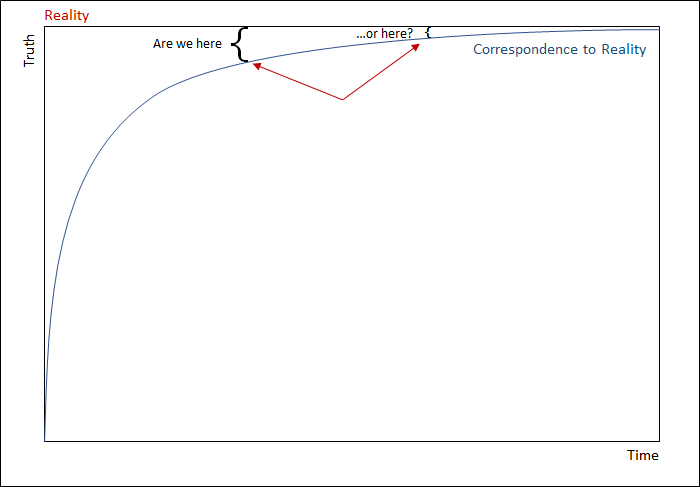
Chart 2: The comforting myth of correspondence: scientific inquiry creeping ever closer to Reality™, though we can’t measure the distance—or even be sure the curve bends in the right direction.

Thomas Kuhn was blunt about this: what we call “progress” is less about convergence and more about paradigm shifts, a wholesale change in the rules of the game. The Earth does not move smoothly closer to Truth; it lurches from one orthodoxy to another, each claiming victory. Progress, in practice, is rhetorical re-baptism.

Most defenders of the asymptotic story assume that even if progress is slow, it’s always incremental, always edging us closer. But history suggests otherwise. Paradigm shifts don’t just move the line higher; they redraw the entire curve. What once looked like the final step toward truth may later be recast as an error, a cul-de-sac, or even a regression. Newton gave way to Einstein; Einstein may yet give way to something that renders relativity quaint. From inside the present, every orthodoxy feels like progress. From outside, it looks more like a lurch, a stumble, and a reset.

Chart 3: The paradigm-gap view: what feels like progress may later look like regression. History suggests lurches, not lines, what we call progress today is tomorrow’s detour..

If paradigm shifts can redraw the entire map of what counts as truth, then it makes sense to ask what exactly we mean when we invoke the word at all. Is truth a mirror of reality? A matter of internal coherence? Whatever works? Or just a linguistic convenience? Philosophy has produced a whole menu of truth theories, each with its own promises and pitfalls—and each vulnerable to the same problems of rhetoric, context, and shifting meanings.

The Many Flavours of Truth

Philosophers never tire of bottling “truth” in new vintages. The catalogue runs long: correspondence, coherence, pragmatic, deflationary, redundancy. Each is presented as the final refinement, the one true formulation of Truth, though each amounts to little more than a rhetorical strategy.

  • Correspondence theory: Truth is what matches reality.
    Problem: we can never measure distance from “Reality™” itself, only from our models.
  • Coherence theory: Truth is what fits consistently within a web of beliefs.
    Problem: many mutually incompatible webs can be internally consistent.
  • Pragmatic theory: Truth is what works.
    Problem: “works” for whom, under what ends? Functionality is always perspectival.
  • Deflationary / Minimalist: Saying “it’s true that…” adds nothing beyond the statement itself.
    Problem: Useful for logic, empty for lived disputes.
  • Redundancy / Performative: “It is true that…” adds rhetorical force, not new content.
    Problem: truth reduced to linguistic habit.

And the common fallback: facts vs. truths. We imagine facts as hard little pebbles anyone can pick up. Hastings was in 1066; water boils at 100°C at sea level. But these “facts” are just truths that have been successfully frozen and institutionalised. No less rhetorical, only more stable.

So truth isn’t one thing – it’s a menu. And notice: all these flavours share the same problem. They only work within language-games, frameworks, or communities of agreement. None of them delivers unmediated access to Reality™.

Truth turns out not to be a flavour but an ice cream parlour – lots of cones, no exit.

Multiplicity of Models

Even if correspondence weren’t troubled, it collapses under the weight of underdetermination. Quine and Duhem pointed out that any body of evidence can support multiple competing theories.

Chart 4: orthodox vs. heterodox curves, each hugging “reality” differently

Hilary Putnam pushed it further with his model-theoretic argument: infinitely many models could map onto the same set of truths. Which one is “real”? There is no privileged mapping.

Conclusion: correspondence is undercut before it begins. Truth isn’t a straight line toward Reality; it’s a sprawl of models, each rhetorically entrenched.

Truth as Rhetoric and Power

This is where Orwell was right: “War is Peace, Freedom is Slavery, Ignorance is Strength.”

Image: INGSOC logo

Truth, in practice, is what rhetoric persuades.

Michel Foucault stripped off the mask: truth is not about correspondence but about power/knowledge. What counts as truth is whatever the prevailing regime of discourse allows.

We’ve lived it:

  • “The economy is strong”, while people can’t afford rent.
  • “AI will save us”, while it mainly writes clickbait.
  • “The science is settled” until the next paper unsettles it.

These aren’t neutral observations; they’re rhetorical victories.

Truth as Community Practice

Chart 5: Margin of error bands

Even when rhetoric convinces, it convinces in-groups. One group converges on a shared perception, another on its opposite. Flat Earth and Round Earth are both communities of “truth.” Each has error margins, each has believers, each perceives itself as edging toward reality.

Wittgenstein reminds us: truth is a language game. Rorty sharpens it: truth is what our peers let us get away with saying.

So truth is plural, situated, and always contested.

Evolutionary and Cognitive Scaffolding

Step back, and truth looks even less eternal and more provisional.

We spread claims because they move us (emotivism) and because we urge others to join (prescriptivism). Nietzsche was savage about it: truth is just a herd virtue, a survival trick.

Cognitive science agrees, if in a different language: perception is predictive guesswork, riddled with biases, illusions, and shortcuts. Our minds don’t mirror reality; they generate useful fictions.
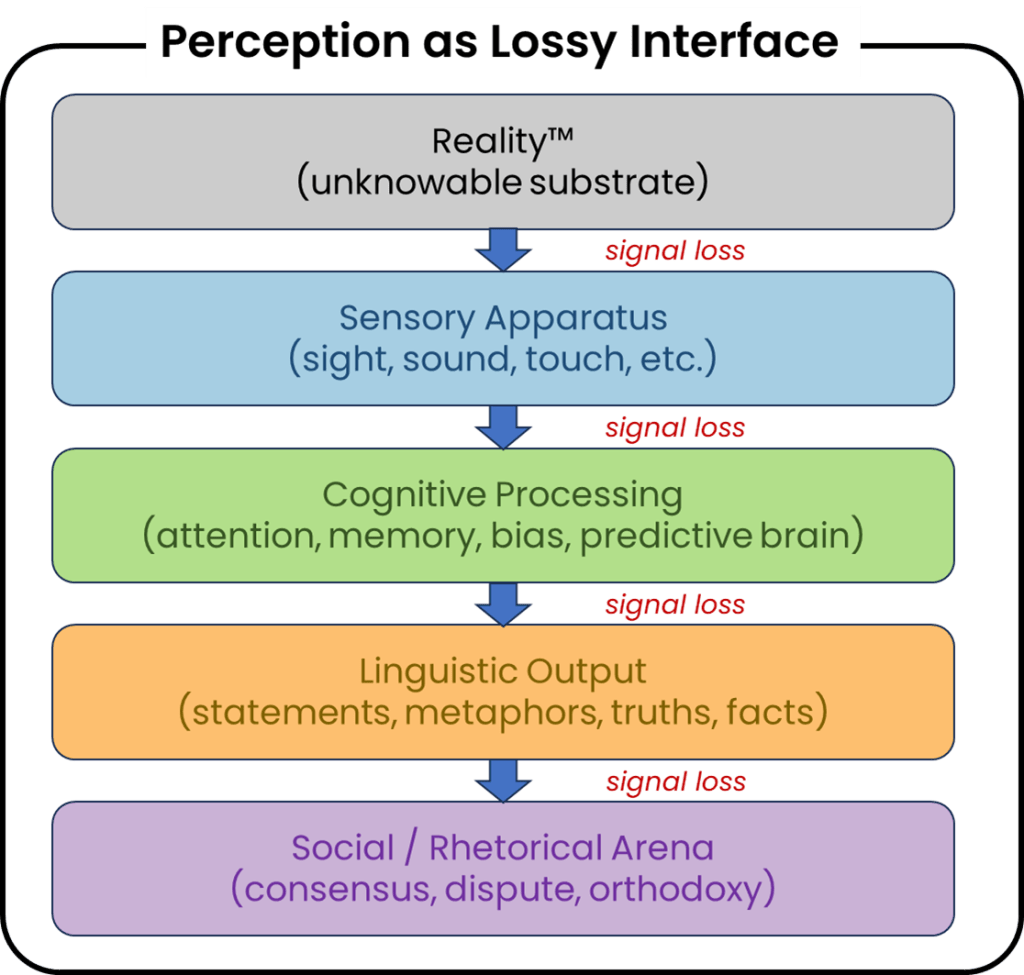
Diagram: Perception as a lossy interface: Reality™ filtered through senses, cognition, language, and finally rhetoric – signal loss at every stage.

Archetypal Truth (Positive Proposal)

So where does that leave us? Not with despair, but with clarity.

Truth is best understood as archetypal – a construct humans rally around. It isn’t discovered; it is invoked. Its force comes not from correspondence but from resonance.

Here, my own Language Insufficiency Hypothesis bites hardest: all our truth-talk is approximation. Every statement is lossy compression, every claim filtered through insufficient words. We can get close enough for consensus, but never close enough for Reality.

Truth is rhetorical, communal, functional. Not absolute.

The Four Pillars (Manifesto Form)

  1. Archetypal – truth is a symbolic placeholder, not objective reality.
  2. Asymptotic – we gesture toward reality but never arrive.
  3. Rhetorical – what counts as truth is what persuades.
  4. Linguistically Insufficient – language guarantees slippage and error.

Closing

Nietzsche warned, Rorty echoed: stop fetishising Truth. Start interrogating the stories we tell in its name.

Every “truth” we now applaud may be tomorrow’s embarrassment. The only honest stance is vigilance – not over whether we’ve captured Reality™, but over who gets to decide what is called true, and why.

Truth has never been a mirror. It’s a mask. The only question worth asking is: who’s wearing it?

Pinpointing the Messiness of Language

LinkedIn, that carnival of professional self-delusion, has a little diversion called Pinpoint. It pretends to tell you how much you “match” with other people, presumably so you’ll feel less alone as you scroll past thought-leaders peddling snake oil in PowerPoint form. In English, the results arrive in the cold, hard, dating-app idiom: “% match.” Simple, brutal, and bland.

Audio: NotebookLM podcast on this topic.

But LinkedIn, ever the polyglot, translates this phrase into other tongues. And here is where a trivial game unmasks the philosophical chaos of language itself. For in one idiom, your soul and another’s are “in correspondence.” In another, you are the product of “coincidence.” Elsewhere, you are a “hit,” a “fit,” a “suitability.” The poor Swedes, apparently exhausted, simply gave up and borrowed “matchning.”

The Romance languages, of course, are the most pedantic. Correspondência, corrispondenza — all very scholastic, as if Aquinas himself were lurking in the backend code. A match is nothing less than the degree to which one proposition mirrors another, as in the correspondence theory of truth. You can be 72% true, like a botched syllogism that half-lands. Elegant, precise, exasperating.

Spanish, on the other hand, opts for coincidencia. A “% coincidence.” Imagine it: you bump into your ex at the market, but only 46% of the way. Coincidence, by definition, is binary; either the train wreck occurs or it does not. And yet here it is, rendered as a gradable metric, as if fate could be quantified. It’s a kind of semantic surrealism: Dalí with a spreadsheet.

Then we have the Germans: Treffer. A hit. In English, a hit is binary – you score or you miss. But the Germans, ever the statisticians of fate, make Trefferquote into a percentage. You may not have killed the truth outright, but you wounded it respectably. It’s a firing squad turned bar chart.

Indonesians say cocok, which means “appropriate, suitable.” This is not about truth at all, but about fit. A match is not correspondence to reality but pragmatic adequacy: does it work? Does it feel right? The difference is subtle but devastating. Correspondence makes truth a metaphysical mirror; suitability makes it a tailoring problem.

And English? English, with its toddler’s toybox of a vocabulary, just shrugs and says “match.” A word that means as much as a tennis final, a Tinder swipe, or a child’s puzzle book. Adequate, lazy, neutered. Anglo-pragmatism masquerading as universality.

So from a silly HR-adjacent parlour game we stumble into a revelation: truth is not one thing, but a polyglot mess. The Romance tongues cling to correspondence. Spanish insists on coincidence. German goes target practice. Indonesian settles for a good fit. And English floats on ambiguity like an inflatable swan in a corporate swimming pool.

The lesson? Even a “% match” is already lost in translation. There is no stable denominator. We speak not in universals but in parochialisms, in metaphors smuggled into software by underpaid translators. And we wonder why philosophy cannot settle the matter of truth: it is because language itself cheats. It gives us correspondence, coincidence, hits, and fits, all while claiming to say the same thing.

Perhaps LinkedIn should update its UI to something more honest: % mess.

VIDEO: The Truth about Truth

I wrote about this content in 2019, but I wanted to revisit it for a video as well as create a podcast audio version.

Video: YouTube version of this page content
Podcast: Audio rendition of this page content

In today’s segment, I am going to share my perspectives on the truth about truth. To start, I’ll let the audience know that I do not believe in the notion of truth. I feel the term is ill-defined especially in the realm of metaphysics and morality. I feel that when most people employ the word ‘truth’, what they mean to say is ‘fact.’ That a fire engine is red, for example, may be a fact, if indeed the fire engine happens to be red, but it is not true. This is a misapplication of the term. If you employ truth as a direct synonym for fact, then this is not what’s being discussed here, and perhaps your time might be better spent watching some content by the Critical Drinker.   

My argument is that truth is not objective. Rather it is subjective and perspectival. I concede that there may be some objective truth out there somewhere, but it is not and will not ever be accessible to us because of limitations in our sense-perception faculties and cognitive limitations. Per Aristotle, we only have five senses with which we can connect to the world, and these senses are limited. If there is anything out there that would require another sense receptor—a sense receptor not available to us—, we would never be able to sense it, to even know of its existence. Perhaps the universe emits 100 sense signals, but we are only capable of receiving and translating five. We’d be oblivious to 95 per cent of reality.

I am not making any claims that this is the case, but human cognition is so limited, that we can’t even conceive of what another sense might be. If you can, please leave a comment.

To be clear, I am not talking about senses we know other species possess. Bats may have echolocation, and sharks may have electroreception. Some animals may have greater sensory acuity—superior vision and auditory senses, olfactory and gustatory, tactile, or whatever. Some can see into infrared or ultraviolet light spectra. Technology that includes biomimicry provides humans with microscopes for the microworld and telescopes for the macroworld. We have x-rays and sonar and radar, radios and televisions that extend our senses, but these provide no new sensory receptors.

Like the story of the blind people and the elephant, we are left grasping at parts. But even if we are able to step back to view the whole elephant, to hear the elephant, to touch and smell or even taste the elephant, if there is more to the elephant, we cannot know it. The same goes for ourselves.

I know that some people might inject gods or psychic or paranormal energy into this void, and sure, feel free, but I am looking beyond these pedestrian concepts. What else might there be?

But let’s depart this train and head in a different direction. I want us to focus on the senses we do have. For the typical human, sight is our primary arbiter of reality, at least as defined idiomatically. We tend to believe what we see, and what we see, we assume as real—even if we are later mistaken. I guess that wasn’t a unicorn or a pink elephant. I must have been hallucinating or dreaming. I could have sworn that was Auntie Em.

There are several competing theories around truth, but I’ll focus on the Correspondence theory, which is simply put, the notion that, proxying reality for truth, human perception corresponds with the real world. And a pragmatist might argue that’s close enough for the government.

Keep in mind that historically humans have contorted themselves into making calculations. Remember how long people had been tying themselves into knots to show planetary motion in a geocentric system creating epicycles and retrograde motion to map understanding to a perceived reality.

One might even argue that we’ve progressed. It wasn’t true or accurate then, but now it is. And perhaps it is. Let’s look at some illustrations.

NB: Due to an editorial mishap, this paragraph was dropped in the podcast, hence dropped from the video, which shared the podcast audio source. As such, this image was also not used in the video. This is unfortunate, as it was meant to introduce those with limited maths knowledge to the asymptotic curve, as described. Apologies, and I hope this serves to orient any travellers who may have lost their way at this point.

In this first illustration, we see Truth (or relative truthiness) on the Y-axis and Time on the X-Axis. On the top, we see a threshold representing Reality. In the plane, I’ve rendered an asymptotic curve, where over time, we get closer and closer to the Truth. But we never quite get there. More on this later.

The next illustration will help to demonstrate what’s happening.

Notice there is a gap between the curve and the Reality cap. For one thing, we don’t really know where we are relative to Reality. In the case of the geocentric system, we might have been at the leftmost space. Once we determined that the system is actually solar-centric, we might have moved right on the curve to close the gap. We might be tempted to defend that we’ve finally reached the truth, but we’d have been equally willing to make the same defence from the geocentric position, so we need to be mindful of the past.

Perhaps, this last example was too obvious. We feel comfortable staking a truth claim—or at least a claim of fact. So let’s look at another example.

Let’s re-use the same axes—Truth and Time—, but rather than an asymptotic curve, let’s presume something more polynomial in nature—or not particularly cyclic. Rather than retrograde motion in planets, let’s visit the supposed progress of Newtonian over Einsteinian physics.

This takes a bit more setup but bear with me.  In this case, I have taken liberties and illustrated the Einsteinian physics gap to capture an inferior vantage on reality over Newtonian physics. Granted, I need to rely on a bit of suspension of disbelief, but in the bigger picture, I am trying to convey a scenario where some new paradigm puts the prior knowledge in perspective.

In this instance, both Newtonian and Einsteinian flavours of physics are based on a materialistic, particles-based model, which is where the modern physics consensus resides. But, let’s say that consensus changes in such a way that it is determined that something else underlies reality, say consciousness per Analytic Idealism as proposed by Bernardo Kastrup or per Integrated Information Theory (IIT) as advanced by Donald Hoffman and others. As with retrograde motion, we might end up finding that we were barking up the wrong tree. This might be a bit different because the particles are a directly perceived manifestation of the underlying consciousness, but I wanted to create a scenario where knowledge thought to have advanced actually regressed, but this wasn’t revealed until a new perspective was available.

Yet again, an important aspect of note is that we don’t actually know the distance between our perceptions and real Reality.

This last illustration builds upon the first asymptotic chart but has an in-built error margin meant to reflect language insufficiencies. There is some concept that people feel they grasp, but the consensus is not as unified as the group thinks.

I’ll share two examples, the first being the concept of justice. To me, Justice is what I deem a weasel word. It’s a word we commonly use, but it means different things to different people. To me, it’s a euphemism for vengeance by proxy, but for others, it transcends that and mirrors some impartial dispensation of just desert—some good old-fashioned law and order.

[Justice is] a euphemism for vengeance by proxy

Without getting stuck down some rabbit hole, my point is that if we aggregate these beliefs, the asymptotic curve represents an average consensus vantage rather than something as obvious as 2 plus 2 equals 4. On this note, allow me to clear the air.

Some viewers might be clamouring to say, “but 2 plus 2 equals four is true.” But this is tautologically true, which is to say that it’s true by definition. It’s a similar tautology to saying that it’s true that snow is white, or coal is black. We’ve already defined snow, white, coal, and black, so these may be facts, but they are true by definition.

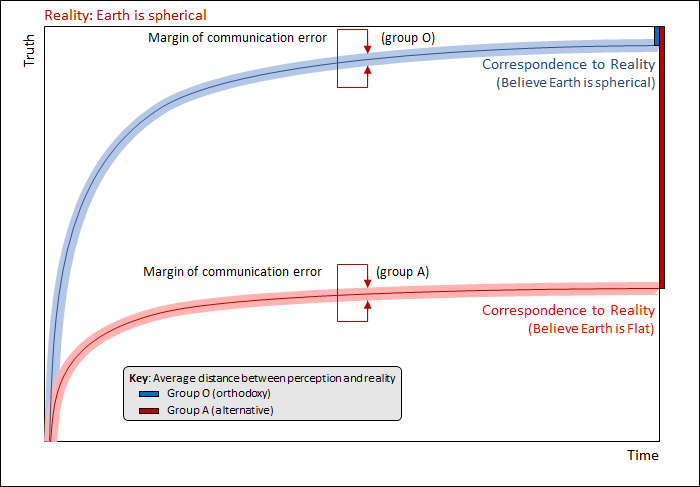
Revisiting the chart, notice that there are two curves in the space. In this case, I illustrate competing truth claims from the perspective of an omniscient narrator. The case is whether the earth is an oblate spheroid or is flat. I am going to go out on a limb and assert the earth is spherical, as represented by the top blue curve—and we have some margin of error as to what that might mean. The bottom red curve depicts the perceived truth of the flat earthers, who also have some room for semantic error.

Given that I am presuming that I am in the right adopting the majority position—please be right—, the blue curve is closer to Reality than the red curve. Of course, in the event that the earth is really flat, then it proves my point that we don’t know where we are relative to truth, so we assume that the state of knowledge at any given time is what’s real.

Again, forgive my fanciful examples. Please don’t tell me that this spheroid versus planer earth is tautological too because you’d be correct, but I am already aware. They are just nonsensical illustrations. Nonetheless, I hope they’ve served to express a point.

I could have as well created curves that depicted two cohorts’ beliefs on the efficacy of tarot or astrology in predicting the future. I am sure that it might render somewhat like the last chart, but I’d also presume that both curves would have very low truth values as seen from an objective observer. Secretly, I hope tarot wins the truth battle.

Before I end our time together, I’d like to convey that for an Analytic Idealist, these charts might be more acceptable at face value. For a Realist, Naïve or otherwise, they may argue that this curve is not asymptotic and may in fact reach some tangency. I don’t happen to believe this is the case or I wouldn’t have spent my time assembling and presenting this. Time will tell. Or will it?

The Truth about Truth (Fourth Amend)

Please note that this content has been subsumed into the originating article: The Truth about Truth.

This is a response to this comment by Landzek from The Philosophical Hack regarding the notion of intended truth in communication, the fourth amendment in a series of posts extending the concept commenced in The Truth about Truth.

Extending the simple asymptotic function from the first amend, we might see (in Graph 4a) a slight variation in interpretation due to the insufficiencies of language—providing us with a close enough for the government approximation to some shared perception. People in this group will tend to agree on some perception, say, that the earth is spherical.* The average distance from perception to reality is the same for all in-group members, give or take some small variance that I’ll dismiss as an insignificant rounding error.

Graph 4a: Correspondence of Truth to Reality (Simplified in-group concurrence)

Graph 4b, however, illustrates two opposing perceptions of reality. In this example, I show proponents of orthodoxy (group O), who claim the earth to be roughly spherical, arbitrarily closer to reality than proponents of an alternative theory (group A), who claim that the earth is flat.

Each in-group has some variance from the mean notion, but ex-group members are orders of magnitude apart, as measured by the blue and red bars to the right of the chart. If we assume some binary condition that the earth is either spherical or flat with no other options, one of these might be considered to be right whilst the other would be wrong. We can establish this situation relative to the ex-groups, but, still, neither of these is comparable to Reality™ .


Graph 4b: Correspondence of Truth to Reality (Simplified ex-group concurrence)

The intent of each group may be to promote the perspective of the group—each claiming to be closer to the truth than the other. It is easy to imagine a situation where both claimants are equally distant from the truth:

Imagine two groups, each making opposing claims:

  • Tarot is superior to Astrology in predicting the future.
  • Astrology is superior to Tarot in predicting the future.

I’ll go out on a limb here and create a reality where the future is not predictable by either measure, irrespective of what each in-group believes.


* I understand that the earth being an oblate spheroid is primarily an analytical distinction, so is tautologically true, but I am using a simplification of a commonly accepted fact.

The Truth about Truth (First Amend)

Please note that this content has been subsumed into the originating article: The Truth about Truth.

We have no idea how close or far we are from Reality on the Y (Truth) axis.

Graph: Correspondence of Truth to Reality (Asymptotic Curve)

Assuming for the time being that there is an approachable truth, we have no reference to understand how close to reality we might be. In practice, we seem to operate on a basis of always being within some level of statistical significance of where Truth = Reality, and when new information is introduced, we say, “Hooray for Science!” Aren’t we glad that science is self-correcting. And Empiricism has its own issues.

Historically, we’ve had ‘wrong’ correspondence between Truth and Reality, but then we got it ‘right’—until we didn’t.

We may all know how Einstein progressed and refined Newtonian physics. What Einstein did is to create a new narrative—a synchronous shift of paradigm and rhetoric—, which has been accepted into a new orthodoxy. In our mind, this feels like progress. How close are we to the real truth?

Taking our understanding of gravity or of the fabric of space-time, we still have no idea what’s going on or how it operates, but this doesn’t prevent us from accepting it as a black box and making pragmatic predictions from there. So, for all intents and purposes, the ‘truth’ mechanism is less important than the functional relationship, just as I can tell time on a watch I have no idea how it operates.

The Truth about Truth

The notion of Truth is not as cut-and-dry as it might appear at first glance. As a non-cognitivist, I don’t believe in the notion of objective Truth, so I am not entirely sure why it matters enough to me to continue to talk about it. I suppose I’m an Emotivist and Prescriptivist, if these terms capture the essence of my feelings. The Emotivism is what attracts me to an issue whilst Prescriptivism is why I feel the urge to transmit my beliefs. I’ll also suppose, if I adopt an evolutionary survival framework, that people do this to enhance probability of survival by minimising otherness. It also identifies me to those with a similar perspective. The inherent risk is that this attempt at community-building also broadcasts my potential—and let’s be real here, actual—otherness.

In practice, I’d venture that most people simply take the notion of truth for granted, and given an inquiry would defend it with an ‘of course it’s true‘ response with no need for additional justification. But as with human language more generally, Truth is an approximation of a notion. I like to categorise it as Archetypal.

The issue with Truth and other virtues (and pretty much everything else not analytically tautological), is that people don’t seem to believe that they operate asymptotically. They believe there is a truth, it’s objective and accessible, with enough inquiry, can be discovered.

I am self-aware that employing the language of maths and science is a problem adopted for many in philosophy, as they attempt to legitimatise a position by explaining it relative to the currently adopted metanarrative framework. I also know that by adopting this frame, I (or anyone in a similar position) am (is) twisted into convoluted knots. This is how science had been forced into retrograde motion models to explain a geocentric model of the universe, but when the paradigm was shifted to a heliocentric model, these off behaviours fell by the wayside. I suppose a superior approach would be to redefine the language and deposition the frame, but that’s easier said than done.

Graph: Correspondence of Truth to Reality (Asymptotic Curve)

The common assumption is that, over time, scientific inquiry will lead us closer to the truth. Correspondence theory supports the notion that more observations and perspectives will lead to a closer approximation, and eventually tools at our disposal will lead to more granular definitions, until we reach a point that and differences in the tangency to reality will be insignificant, a veritable rounding error. But there are several problems with these assumptions.

FIRST

We have no idea how close or far we are from Reality on the Y-axis, representing Truth.

This image has an empty alt attribute; its file name is truth-correspondence-1.png
Graph: Correspondence of Truth to Reality (Asymptotic Curve)

Assuming for the time being that there is an approachable truth, we have no reference to understand how close to reality we might be. In practice, we seem to operate on a basis of always being within some level of statistical significance of where Truth = Reality, and when new information is introduced, we say, “Hooray for Science!” Aren’t we glad that science is self-correcting. Empiricism has its own issues.

Historically, we’ve had ‘wrong’ correspondence between Truth and Reality, but then we got it ‘right’—until we didn’t. Rinse and repeat.

We may all be familiar with the story of how Einstein progressed and refined Newtonian physics. What Einstein did is to create a new narrative—a synchronous shift of paradigm and rhetoric—, which has been accepted into a revised orthodoxy. In our mind, this feels like progress. But how close are we to the real truth?

Taking our understanding of gravity as the fabric of space-time, we still have no idea what’s going on or how it operates, but this doesn’t prevent us from accepting it as a black box and making pragmatic predictions from there. So, for all intents and purposes, the ‘truth’ mechanism is less important than the functional relationship, just as I can tell time on a watch I have no idea how it operates.

SECOND

We have no idea if any changes to our perception move us closer to or further from Reality.

Rather than being asymptotic, perhaps the relationship to is polynomial (or the result of some stochastic function). See the graph above. As we move into the future (in red) and look back, we may perceive that we’ve reversed against some notion of progress. Common wisdom is that progress is directly, positively related to time. But is it?

In my first amendment, I reference how Einstein progressed and refined Newtonian physics, but in the future, this could be shown to be wrong. In our minds, what had seemed like progress may in retrospect turn out to have been a false assertion.* Moreover, we’ll dutifully accept this updated notion of truth if the rhetoric is sufficient to fit our concept of evidence, especially given humans’ propensity for pareidolia.

I am no true Sceptic, but neither do I accept the prevailing meta-narrative whole cloth. Unfortunately, I am in no better position than the next person to discern proximity to the underlying structure of reality.

THIRD

Rhetoric is a primary driver to fashion our sense of how close or distant we are from reality. Rhetoric shapes and focuses the frame.

War Is Peace, Freedom Is Slavery, and Ignorance Is Strength

1984, George Orwell

I’ve already commented at length about the primacy of rhetoric. To recap for the purpose of this disquisition, the only meaningful arbiter of truth is rhetoric—the ability to persuade the larger populace to accept something as true.

Here, I’d expect someone to counter with, ‘Just because people are convinced that something is true doesn’t make it so’, and they’d be right. However, as we cannot access the underlying reality accept through our admittedly fallible senses, who’s to argue?

Moreover—departing on a tangent—, we know that other lifeforms—let’s stick with the animal kingdom—have different senses than humans, and some humans perceive things differently to the normie (if I may adopt a spectrum term) .

Sharks have electroreception (re: The Ampullae of Lorenzini), which allows them to perceive small changes in electrical fields as well as what’s termed a lateral line ( mechanoreceptor function), which allows them to recognise changes in environmental pressure. Other known sensory adaptations are echolocation in bats and dolphins and chemoreceptors (notably in insects and snails).

We are probably also aware that different animals have differing degrees of sense acuity compared to humans. Dogs hear frequencies above the human threshold and have better olfactory discrimination. Birds of prey have superior vision. Women typically have a broader colour vocabulary.

Bees see in ultraviolet; snakes can ‘see’ in infrared; owls have night-vision.

And then there’s synesthesia, a condition in which one sense is simultaneously perceived as if by one or more additional senses. A person with synesthesia may perceive sound as colour (chromesthesia) or perhaps taste.

Given concepts of normality, we presume we are synesthesia are normal and these other people are somehow not, but for all we know, we normies are evolutionary dead ends, soon to be displaced by synesthesiacs. (Is that even a word? It is now.)

But I digress.

Perception is reality. If one can convince you of something, e.g. Donald Trump is a good president, then it’s ostensibly true to you. If one can convince an entire population that something is true, e.g. the plot of Orwell’s 1984, or The Matrix, then who’s to say otherwise.

FOURTH

Intent in communicating perception does not get one closer to some corresponding reality. It merely converges perception.

This fourth entry is a response to this comment by Landzek from The Philosophical Hack regarding the notion of intended truth in communication.

Extending the simple asymptotic function from the first section, we might see (in Graph 4a) a slight variation in interpretation due to the insufficiencies of language—providing us with a close enough for the government approximation to some shared perception. People in this group will tend to agree on some perception, say, that the earth is spherical.** The average distance from perception to reality is the same for all in-group members, give or take some small variance that I’ll dismiss as an insignificant rounding error.

Graph 4a: Correspondence of Truth to Reality (Simplified in-group concurrence)

Graph 4b, however, illustrates two opposing perceptions of reality. In this example, I show proponents of orthodoxy (group O), who claim the earth to be roughly spherical, arbitrarily closer to reality than proponents of an alternative theory (group A), who claim that the earth is flat.

Each in-group has some variance from the mean notion, but ex-group members are orders of magnitude apart, as measured by the blue and red bars to the right of the chart. If we assume some binary condition that the earth is either spherical or flat with no other options, one of these might be considered to be right whilst the other would be wrong. We can establish this situation relative to the ex-groups, but, still, neither of these is comparable to Reality™ .


Graph 4b: Correspondence of Truth to Reality (Simplified ex-group concurrence)

The intent of each group may be to promote the perspective of the group—each claiming to be closer to the truth than the other. It is easy to imagine a situation where both claimants are equally distant from the truth:

Imagine two groups, each making opposing claims:

  • Tarot is superior to Astrology in predicting the future.
  • Astrology is superior to Tarot in predicting the future.

I’ll go out on a limb here and create a reality where the future is not predictable by either measure, irrespective of what each in-group believes.


* I am not versed well enough in the history of science, but I’d be interested to know which, if any, scientific advances have been a step ‘backward’, that a belief had overtaken a prior belief only to have reverted to the former.

I am aware of the slow march of science and the ignorance of possibly valid assertions simply because the rhetoric was not strong enough or the PR just wasn’t adequate. An example might be the debate of theoretical Democracy versus Communism: which is better than the other. Of course, there are too many dimensions to consider, and the adoption or exclusion of one dimension over another might be enough to tilt the outcome.

In the real world—see what I did there—, the US spend billions upon billions of dollars to interfere with Communism—and I am not taking a position whether it would have succeeded or failed on its own terms—, just to be able to knock down the strawman some century later though propagandising and disinformation campaigns.


** I understand that the earth being an oblate spheroid is primarily an analytical distinction, so is tautologically true, but I am using a simplification of a commonly accepted fact.


DISCLAIMER: In order to keep generating new content (or even content) on this blog, I will occasionally adopt a new approach of publishing unfinished thoughts instead of waiting to complete the thought. This means, I may be editing pages in place to correct my position and alter narrative flow, of not the narrative itself.

EDIT: I’ve included my amendments in line above, though I’ve retained links to the original content.