Another faux Magic: The Gathering trading card. I’ve been busy writing an essay on Tatterhood and wondering if I’ve gone off the edge even further into mental masturbation. I made these cards to share on slow news days, as it were.
[EDIT: Oops: Even wore. I already posted something today. Enjoy the bonus post.]
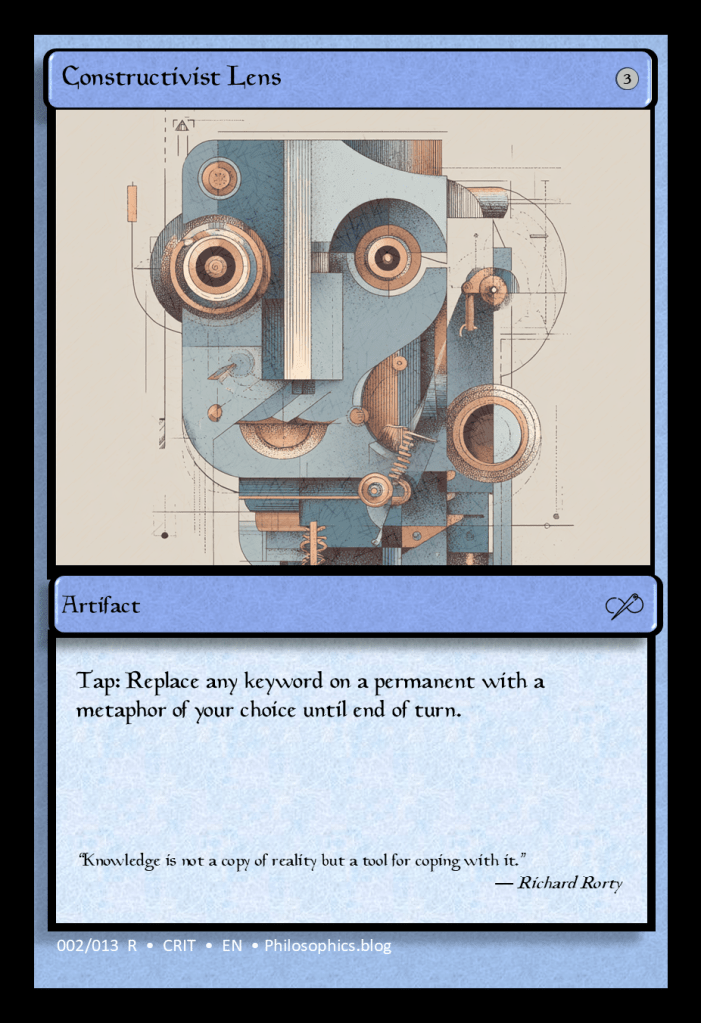
Every philosopher dreams of a device that reveals ‘truth’. The Constructivist Lens does the opposite. When you tap it, the world doesn’t come into focus – it multiplies. Each pane shows the same thing differently, reminding us that knowing is always a form of making – seeing as building.
In The Discipline of Dis-Integration, I wrote that philosophy’s task is ‘to remain within what persists … to study the tension in the threads rather than weave a new pattern’. The Lens embodies that ethic. It is not an instrument of discovery but of disclosure: a way to notice the scaffolding of perception without mistaking it for bedrock.
Flavour text: “Knowledge is not a copy of reality but a tool for coping with it.” — Richard Rorty
Where Enlightenment optics promised clarity, the Lens trades in parallax. It insists that perspective is not a flaw but the condition of vision itself. Each player who peers through it – artist, scientist, moralist – constructs a different coherence, none final. The card’s rule text captures this tension: replace any keyword on a permanent with a metaphor of your choice until end of turn. Reality bends, language shifts, yet the game continues.
In the Dis-Integration set, the Lens sits alongside Perspectival Realism and Language Game (not yet shared), forming the Blue triad of epistemic doubt. Together they dramatise what the essay calls ‘the hyphen as hinge’: the small pause between integration and its undoing. The Constructivist Lens, then, is not a tool for clearer sight but a reminder that every act of seeing is already an act of construction.
Update: Please note that I have refined my position on this and documented it in a newer post. It builds upon this idea but clarifies some disconnects and provides me with some ontological distance from Massimi.
There comes a moment in any serious thinker’s life when the metaphysical menu starts looking like a bad buffet: too much on offer, none of it quite edible, and the dishes that appear promising turn out to depend on ingredients you can’t stomach. Realism insists the world is simply there, chugging along regardless of your opinions. Anti-realism points out, inconveniently, that all your access is wildly mediated. Perspectivism adds humility. Constructivism chastises you for overconfidence. Analytic Idealism sweeps matter off the table entirely, until you ask why consciousness spits out such stubbornly consistent patterns.
I’ve been through all of them. Realism*—asterisk for “but what about mediation?” Idealism*—asterisk for “but what about resistance?”
Everything almost worked. And “almost” is the metaphysical kiss of death. “Almost” is where the asterisks live.
Perspectival Realism is the first position I can hold without planting that apologetic little star in the margins.
Audio: NotebookLM podcast summary on this topic.
The Asterisk Journey (Brief, Painless, Necessary)
This isn’t a conversion narrative. It’s a salvage operation. Each station on the journey left me with tools worth keeping.
Layer 1: Iconography (Hoffman, minus the metaphysics)
Perception is not a window. It’s an interface. A species-specific dashboard designed for survival, not truth. Evolution gave you a set of icons—colour patches, contrast edges, looming shapes—not an accurate rendering of reality’s architecture.
Uexküll called this the umwelt: every organism inhabits its own perceptual slice of the world. Bees see ultraviolet; snakes sense heat; humans see embarrassingly little.
This is Layer 1 mediation: Reality-as-filtered-for-primates.
Layer 2: Instrumentation (Kastrup, minus the leap)
Consciousness is the instrument through which reality is measured. Measuring instruments shape the measurements. That doesn’t make the world mind-shaped; it just means you only ever get readings through the apparatus you’ve got.
This is Layer 2 mediation: Your cognitive architecture—predictive priors, attentional limitations, spatial-temporal scaffolding—structures experience before thought arrives.
Where I leave Kastrup behind is the familiar leap: “Because consciousness measures reality, reality must be made of consciousness.” That’s the instrumentality fallacy.
You need consciousness to access the world. That tells you nothing about what the world is.
Layer 3: Linguistic–Cultural Carving (Your home field)
And then comes the mediation philosophers most reliably ignore: language. Language does not describe reality. It carves it.
Some cultures divide colour into eleven categories; some into five. The Müller-Lyer illusion fools Westerners far more than it fools hunter-gatherers. Concepts feel natural only because you inherited them pre-packaged.
This is Layer 3 mediation: the cultural-linguistic filter that makes the world legible—and in the same breath, distorts it.
You mistake the map for the territory because it’s the only map you’ve ever held.
The Hard Problem, Dissolved — Not Solved
When English splits the world into “mental” and “physical,” it accidentally manufactures the “hard problem of consciousness.” Sanskrit traditions carve reality differently and end up with different “mysteries.”
The hard problem isn’t a revelation about reality. It’s a conceptual knot tied by Layer 3 mediation.
Changing the ontology to “everything is mind” doesn’t untie the knot. It just dyes the rope a different colour.
The Triple Lock
Put the three layers together and you get the honest picture:
Your senses give you icons, not the thing-in-itself.
Your cognition structures those icons automatically.
Your culture tells you what the structured icons mean.
And yet—despite all of this—the world pushes back.
Gravity doesn’t care about your interpretive community. Arsenic does not negotiate its effects with your culture. Your beliefs about heat won’t keep your hand from burning.
This is the fulcrum of Perspectival Realism:
Reality is real and resists us, but all access is triply mediated.
The realism remains. The universality does not.
Why Perspectival Realism is Not Relativism
Relativism says: “Everyone’s perspective is equally valid.” Perspectival Realism says: “Everyone’s perspective is equally situated.”
Very different claims.
Some perspectives predict better. Some cohere better. Some survive reality’s resistance better. Some transfer across contexts better. Some correct their own errors faster.
You don’t need a view from nowhere to say that. You just need to notice which maps get you killed less often.
What This Framework Enables
1. Progress without foundation myths
Science improves because reality resists bad models. Mediation doesn’t prevent progress; it’s the condition of it.
2. Critique without arrogance
You can rank perspectives without pretending to hover above them.
3. Cross-cultural dialogue without imperialism or despair
Cultures carve experience differently, but they’re carving the same underlying world. Translation is hard, not impossible.
4. Honest metaphysics
No glamourised escape from sensory embodiment, cognitive bias, or cultural inheritance. Just the patient business of refining our mediated grip on the real.
What Perspectival Realism Actually Claims
Let me make the commitments explicit:
There is a world independent of our representations.
All access to it is mediated by perception, cognition, and culture.
Perspectives can be compared because reality pushes back.
No perspective is unmediated.
The asymptote—Reality-as-it-is—is unreachable.
This isn’t pessimism. It’s maturity.
Why This Is the First Ontology Without an Asterisk
Every worldview before this needed the quiet, shamefaced footnote:
Realism*: “But access is mediated.”
Idealism*: “But resistance is real.”
Perspectivism*: “But we still need to rank perspectives.”
Constructivism*: “But the world’s invariances aren’t constructs.”
Perspectival Realism eats the objections instead of dodging them. There is no asterisk because the worldview is built from the asterisks.
No promises of transcendence. No pretense of universality. No linguistic sleight-of-hand.
Just embodied beings navigating a real world through fallible instruments, shared practices, and cultural grammars—occasionally catching a clearer glimpse, never stepping outside the frame.
The realism remains. The universality does not. And for once, metaphysics isn’t lying to you.
DISCLAIMER: This article was written or output by ChatGPT 5.1. It started as a conversation with Claude Sonnet 4.5, where I had input days of output for evaluation. One of these outputs was the post about Erasmus and the Emissary Who Forgot to Bow. A group chat ensued between me, Claude and ChatGPT.
What started as a discussion about the merits of my position, expressed in the Erasmus-influenced essay, drifted to one about Perspectival Realism. That discussion deepened on ChatGPT, as I further discussed my recent thoughts on the latter topic. I had rendered a Magic: The Gathering parody trading card as I contemplated the subject. It’s how my brain works.
All of this led me to ask ChatGPT to summarise the conversation, and, upon further discussion, I asked it to draft this very article – the first of five.
Perspectival Realism: The First Ontology Without an Asterisk 👈 This article discusses what Perspectival Realism means to me and how I got to this position.
Arriving Late to Massimi’s Party: Perspectival Realism in Parallel I spent another half-hour following Google search results as I wanted to see if anyone else had already been using the term, Perspectival Realism. I ended up on the Oxford publishing site. I found a 2022 book with this name, authored by Michela Massimi. They allowed me to download the book, so I asked ChatGPT to summarise our positions, specifically where we agreed and differed.
Against the Vat: Why Perspectival Realism Survives Every Sceptical Hypothesis At 0500, I returned to bed, but I woke up again at 0700 thinking about how one might differentiate between Putnam’s brain in a vat from Perspectival Realism. ChatGPT asked if I wanted that output in long-form.
The Constraint Interface: Toward a Nexal Ontology Being uncomfortable with the dichotomy between Realism and Idealism, I chatted to come up with terminology that disrupts what I consider a false dichotomy, focusing on the nexus rather than privileging one or the other. Consider this similar to the debate on sex and gender binaries.
Could I have improved on these articles if I had rewritten or polished them? Maybe. What’s the purpose? This is all a result of my concepts and inquiries. I endorse the output. I may return to make edits in future, or I may restate this information in my own voice, but for now, let this serve as notice that I am not afraid of generative AI; I am not afraid that it is going to supplant my thinking. I find that whilst I can prompt GPTs to make connexions or to query who else might be relevant to a topic, it doesn’t generally offer its own initiative, what we term Agency.
As for this particular post, it reads more like a listicle. I could have rendered it more expositional, but the structured thinking is all here; why should I reinvent the wheel just to put skin on these bones? As I said, perhaps I’ll flesh this out for elaboration or publication in future, for now, let this serve as a waypoint and a record of how I got here. This supplants my prior position, the asterisked Analytic Idealism, published in 2022, which supplanted my asterisked Realism. Perhaps I’ll finally be able to settle for an ontology and epistemology with no stars.
If philosophy were a game, Wittgenstein rewrote the rulebook. Then he tore it up halfway through and told us the game was the thing itself.
“Don’t ask for the meaning; ask for the use.”
— Ludwig Wittgenstein
Language Game, the third card in my Critical Theory parody set, isn’t just homage; it’s confession. Wittgenstein is among my top five philosophers, and this card embodies why. His idea that ‘meaning is use’ unhooked language from metaphysics and tethered it to life – to the messy, unpredictable business of how humans actually speak.
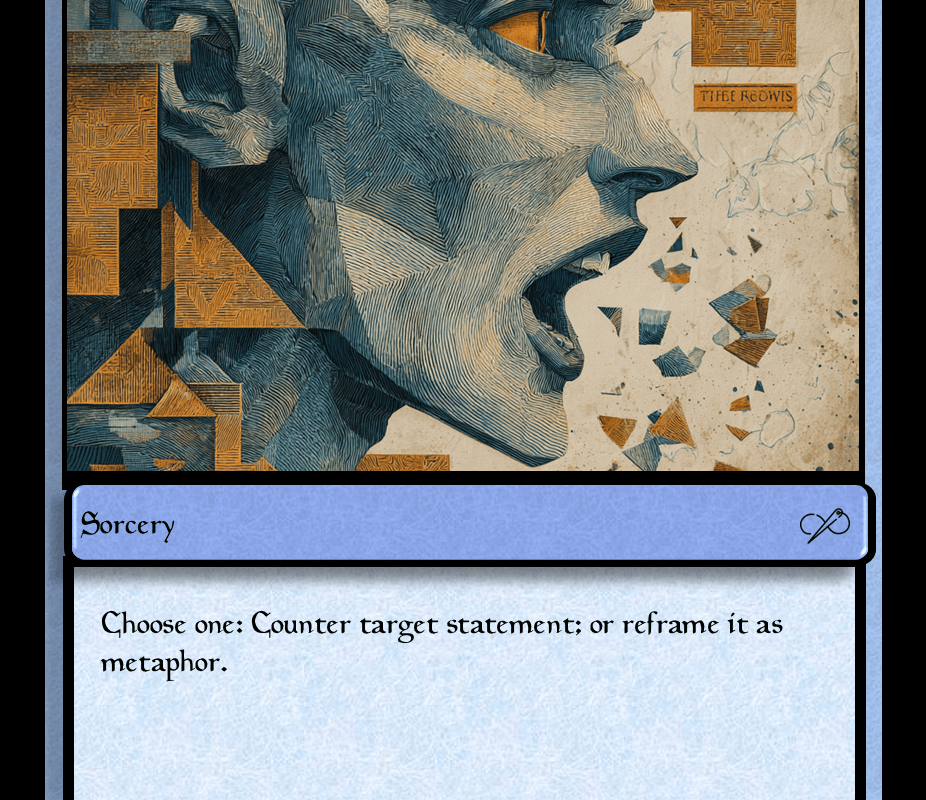
The card’s text reads: Choose one: Counter target statement; or reframe it as metaphor.
At first glance, it sounds like a standard spell from Magic: The Gathering – a blue card, naturally, since blue is the colour of intellect, deceit, and control. But beneath the parody is an epistemic mirror.
To “counter” a statement is to engage in the analytic impulse – to negate, clarify, define. To “reframe it as metaphor” is the continental alternative – reinterpret, play, deconstruct. These are not two distinct acts of philosophy but the alternating heartbeat of all discourse. Every argument, every essay, every tweet oscillates between contradiction and reframing.
The sorcery lies in recognising that both are linguistic manoeuvres within the same game. Meaning is not fixed in the words themselves but in how they’re used – by whom, in what context, and to what end. Wittgenstein’s point was brutally simple: there’s no hidden substance behind language, only a living practice of moves and counter-moves.
The Shattered Face
The artwork visualises this idea: speech breaking into shards, thought fragmenting as it leaves the mouth. Meaning disintegrates even as it’s formed. Every utterance is an act of creation and destruction, coherence and collapse.
I wanted the card to look like a concept tearing itself apart whilst trying to communicate, a perfect visual for the paradox of language. The cubist angles hint at structure, but the open mouth betrays chaos. It’s communication as combustion.
Wittgenstein’s Echo
Wittgenstein once wrote, ‘Philosophy leaves everything as it is’. It sounds passive, almost nihilistic, until one realises what he meant: philosophy doesn’t change the world by building new systems; it changes how we see what’s already there.
He was the great anti-system builder, a man suspicious of his own intellect, who saw in language both the limits of thought and the infinite playground of meaning. He dismantled metaphysics not through scepticism but through observation: watch how words behave, and they’ll tell you what they mean.
In that spirit, Language Game is less an argument than an invitation – to watch the mechanics of speech, to see how our statements perform rather than merely represent.
Personal Reflection
Wittgenstein earns a place in my top five because he dissolves the boundaries that most philosophers erect. He offers no comforting totalities, no grand narratives, no moral architectures. Just language, and us inside it, flailing beautifully.
His work aligns with my larger project on the insufficiency of language – its inability to capture the real, yet its irresistible compulsion to try. Wittgenstein knew that words are our most sophisticated form of failure, and he loved them anyway.
To play Language Game is to remember that communication isn’t about arriving at truth but about keeping meaning in motion. Every conversation is a temporary alliance against silence.
The card’s instruction remains both playful and tragic: Counter target statement; or reframe it as metaphor.
This Magic: The Gathering parody trading card was the first in my Critical Theory series.
It’s an important card for me. As with sex and gender, creating a taxonomic or ontological dichotomy poses categorical challenges. Despite the insufficiency of language, it’s still all I have to attempt to classify the world. In the case of articulating the perception of reality, we can choose between idealism and realism. The problem is that it’s not either; it’s both. Reality cannot be realised without both.
Reality, we’re told, exists. That confident noun has carried a great deal of human arrogance. It has underwritten empires, sciences, and sermons. Yet somewhere between Plato’s cave and the latest TED Talk, we forgot to ask a simpler question: for whom does reality exist, and from where is it seen?
Audio: NotebookLM podcast of this topic.
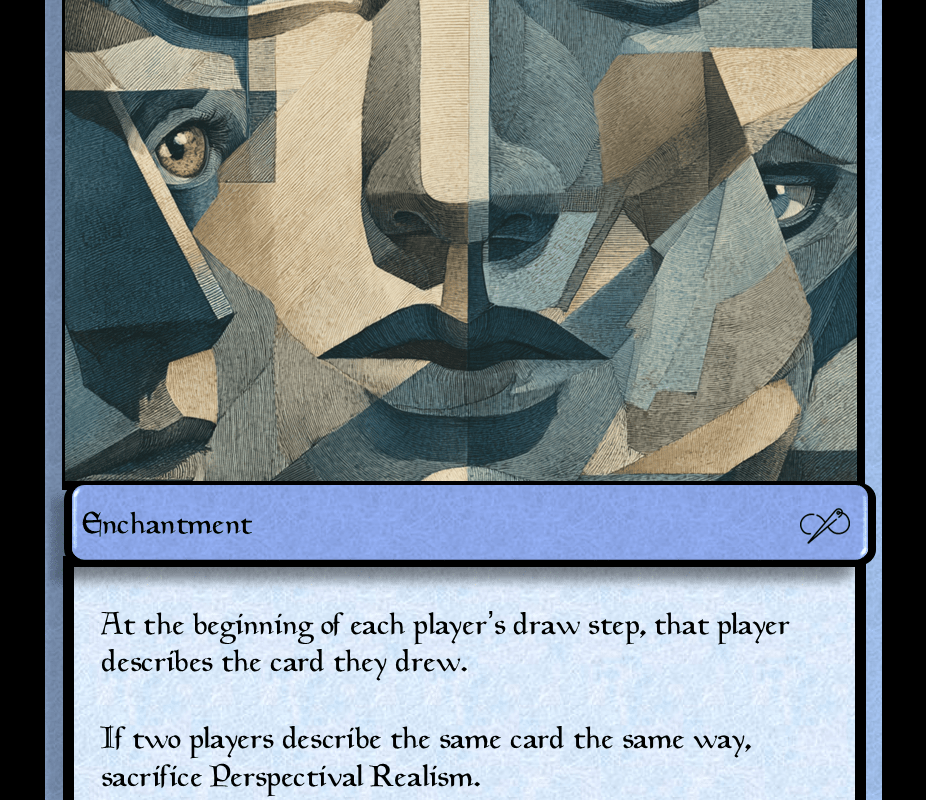
The parody trading card Perspectival Realism was born from that unease. Its mechanic is simple but cruel: at the beginning of each player’s draw step, they must describe the card they drew. The enchantment persists until two players describe a card in the same way—at which point the spell collapses. In other words, consensus kills magic.
Reality is always viewed from somewhere.
—Johannes Jaeger
That rule is the metaphysics of the thing.
When a player ‘describes’ a card, they are not transmitting information; they are constructing the object in linguistic space. The moment the description leaves their mouth, the card ceases to be a piece of paper and becomes a conceptual artefact.
This mirrors the insight of Kant, Nietzsche, and every post-structuralist who ever smoked too much Gauloises: perception isn’t passive. We don’t see reality; we compose it. Language isn’t a mirror but a paintbrush. The thing we call truth is not correspondence but coherence – a temporary truce among competing metaphors.
So the card’s enchantment dramatises this process. So long as multiple descriptions circulate, reality remains vibrant, contested, alive. Once everyone agrees, it dies the death of certainty.
Philosophers have spent centuries arguing whether the world is fundamentally real (existing independent of mind) or ideal (a projection of mind). Both sides are equally tiresome.
Realism, the old bulldog of metaphysics, insists that perception is transparent: language merely reports what’s already there. Idealism, its mirror adversary, claims the opposite – that what’s “there” is mind-stuff all along. Both mistakes are symmetrical. Realism forgets the perceiver; Idealism forgets the world.
Perspectival realism refuses the divorce. It begins from the premise that world and mind are inseparable aspects of a single event: knowing. Reality is not a photograph waiting to be developed, nor a hallucination spun from neurons – it’s a relation, a constant negotiation between perceiver and perceived.
For years, I called myself a Realist™ with an asterisk. That asterisk meant I understood the observer problem: that every ‘fact’ is perspective-laden. Then I became an Idealist™ with an asterisk, meaning I recognised that mind requires matter to dream upon.
The asterisk is everything. It’s the epistemic scar left by perspectival humility – the tacit admission that every claim about the world carries a hidden coordinate: said from here. It is not relativism, but situatedness. It is the philosophical equivalent of depth perception: without the offset, there’s no vision at all.
The card’s rule – sacrifice Perspectival Realism when two players describe a card identically – captures the tragedy of modernity. The Enlightenment taught us to chase consensus, to flatten multiplicity into “objective truth.” We became addicted to sameness, mistaking agreement for understanding.
But agreement is anaesthetic. When all perspectives converge, the world ceases to shimmer; it becomes measurable, predictable, dead. The card’s enchantment disappears the moment reality is stabilised, precisely as our cultural enchantment did under the fluorescent light of ‘reason’.
To live under perspectival realism is to acknowledge that reality is not what is drawn but what is described. And the description is never neutral. It is always written from somewhere – by someone, with a vocabulary inherited from history and stained by desire.
As long as multiple descriptions coexist, the game remains alive. The moment they fuse into one, the spell is broken, and the world returns to grey.
Bernardo Kastrup’s analytic idealism reminded me that consciousness might be primary, but perspectival realism refuses to pledge allegiance. It keeps both flags tattered but flying. The world exists, yes, but only ever for someone.
The enchantment, then, is not belief but perspective itself. So long as difference endures, the game continues.
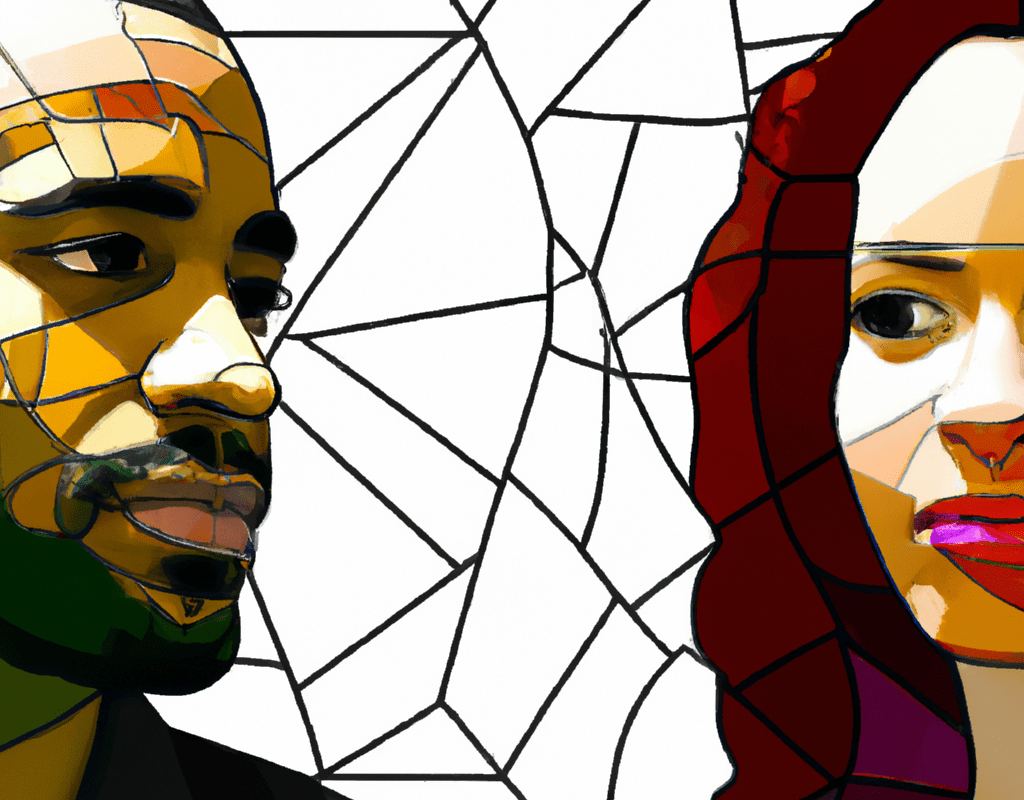
When drawn, this card alters perception itself. It reminds the player that truth is not something one finds under a rock but something one polishes into shape. Each metaphor becomes a spell; each keyword a crutch thrown aside.
Those who wield the Constructivist Lens see not “facts,” but fictions so useful they forgot to call them that. Reality wobbles politely to accommodate belief.
“Knowledge is not a copy of reality but a tool for coping with it.” — Richard Rorty
In game terms: Tap to reframe existence as interpretation. Duration: until the next disagreement.
I recently had a discussion with my son about a controversial academic topic. He was struggling to find someone willing to engage in a meaningful dialogue. People on both sides of the issue seemed either emotionally invested without evidentiary support or lacking sufficient background knowledge for substantive debate. Moreover, due to the current political correctness and cancel culture environment, even gathering new data on this unpopular subject is challenging. This exemplifies the failure of the scientific community to uphold impartial inquiry, a key factor underlying my view that scientific consensus is predicated more on rhetorical appeals than dispassionate analysis.
The topic stemmed from The Bell Curve, a 1994 book by psychologist Richard J. Herrnstein and political scientist Charles Murray. The authors argued that intelligence, as measured by IQ tests, has a strong genetic component, with race and ethnicity as statistically significant variables. Specifically, they claimed the average IQ score for whites in the US was one standard deviation higher than for blacks – 102 versus 85, as depicted in the chart below.
While the details are less relevant here, the core issue is the purported gap between racial groups. As shown, there is substantial overlap in the bell curves, but the one representing blacks is notably shifted leftward from the white curve.
As a statistician, I tend to focus more on methodological rigour and meta-analyses than the mathematical computations themselves, which I presume were executed properly.
My first consideration was the validity of IQ tests as a proxy for achievement, given the cultural biases these metrics contain. Even accepting the IQ gap argument, issues around test construction leave open the ‘so what?’ question. However, the study’s findings were largely replicated 15 years later, suggesting some robustness.
My son observed that the current sociopolitical climate would likely preclude similar research from being funded or published today. Accusations of racism would be inevitable, even for a purely academic inquiry on this topic – creating an artificial blind spot in the science.
While understandable given the history of eugenics abuses, refusing to objectively investigate testable hypotheses is antithetical to the scientific method, which relies on falsifiability and replication. Without permitting studies to potentially confirm or refute a claim, we are left guessing. This is how scientific narratives are socially constructed – not by a disinterested search for truth, but through consensus and conformity enforcement.
I am sceptical of social science approaches generally, which often appear pseudoscientific. However constructive criticism should apply equally to so-called hard sciences like physics, where incompatible models of quantum gravity and dark matter proliferate, awaiting the next paradigm shift.
In summary, my son’s concern was that even proposing this controversial thesis as a dissertation topic could lead to professional censure. Personally, I take no position on the veracity of this hypothesis. However, as a matter of scientific integrity and public policy relevance, arbitrarily declaring certain academic questions off limits seems contrary to the principles of an enlightened, post-Enlightenment society. We cannot refuse to ask difficult questions for fear of inconvenient answers.
So, I’ve gone down a rabbit hole. Again. This time, it’s Žižek. Again. I’ve still not read any of Žižek’s own work, but people mention him often and he is a shameless self-promoter. In this video clip, he responds to whether gender is a social construct. Unfortunately, he conflates gender with sex, and his examples cite transsexuals not transgenders.
sex is about biological sex assignment
To set the stage, sex is about biological sex assignment—the sex category you are assigned into at birth: male, female, or other for some 1.8%. This is a simplistic categorisation: penis = male; vagina = female; both or neither: rounding error. In some cases, a decision is made to surgically conform the child to either male or female and ensure through prophylactic treatment that this isn’t undone hormonally in adolescence.
gender is about identity
Gender is about identity. As such, it is entirely a social construct. All identity of this nature is a function of language and society. In this world—in the West—, females wear dresses (if they are to be worn at all) and males don’t—kilts notwithstanding. In this world, sex and gender have little room for divergence. so the male who identifies as this gender (not this sex) is ostracised.
The example I usually consider first is the comedian Eddie Izzard—a cross-dresser. He’s probably a bad example because he does identify as a male. He just doesn’t wish to be constrained by male role restrictions and wants to wear the makeup that’s been reserved for women in the West at this time.
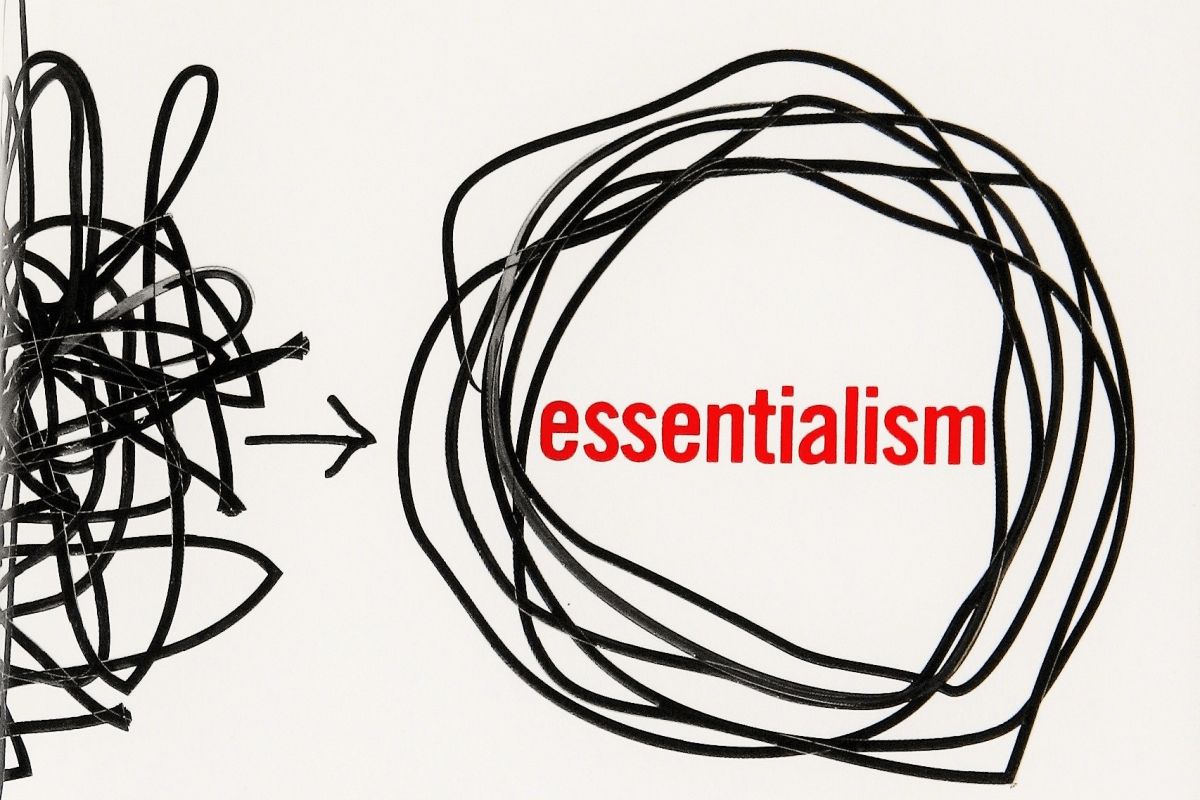
Žižek eventually gets to an argument about essentialism—so we’re back at Sorites paradoxes and Theseus again. At the start, I could argue that the sexual distinction has few meaningful contexts. For me, unless I am trying to have sex and/or procreate, the distinction is virtually meaningless. For others, only procreation remains contextually relevant. In this technological world, as Beauvoir noted in the late 1940s, strength differentials are not so relevant. End where they are, sex is not the deciding factor—it’s strength.
Žižek’s contention seems to be that the postmoderns (or whomever) disclaim essentialism in favour of constructivism but then resolve at essentialism as a defence because ‘now I am in the body originally intended’. I’ll argue that this is the logic employed by the person, but this person is not defending some academic philosophical position. They are merely engaging in idiomatic vernacular.
I am not deeply familiar with this space, and if the same person who is making a claim against essentialism is defending their actions with essentialism, then he’s got a leg to stand on. As for me, the notions of essentialism and constructivism are both constructed.