Revisiting Time Reborn

I’ve just finished with Time Reborn. I wasn’t expecting to be converted to Smolin’s proposition that time is real rather than constructed. I enjoyed the book, and he provided a solid foundational understanding of the conventional scientific perspective (circa 2013, when the book was published).

I understand that Smolin is a professional physicist with a PhD and his grasp of the fundamentals is solid, and I am a peripheral scientist at best. I fully grant that I may be on the left of the Dunning-Kruger curve and making rookie mistakes.

The biggest contention I have is that he insists that everything needs to have a reason, citing Leibnitz. His argument is based on the question of why is our universe so perfectly structured, that it would be improbable to have happened purely by chance.

Whilst I agree that everything has a cause, reasons are an artifice imposed by humans. In practice, where reasons don’t exist, we make them up. This is how we get false theories and gods. Smolin does discuss false theories of the past and attempts to claim that the prevailing theories occupy this space whilst his theory should replace it.

Any universe created without the ability to sustain life would not have us asking why it did not support life.

My reaction is that it just is. Whether Roger Penrose is correct in saying that the universe is continually recreated and destroyed, rinse and repeat, the reason the universe is constructed in such an (improbably) ordered fashion that can sustain life is that there is no reason. Any universe created without the ability to sustain life would not have us asking why it did not support life. It does. We are here to question, and so we do. End of story.

We can make up all sorts of stories, whether through science, religion, or some other origin myth. None of them is provable. As Smolin notes, this is a one-time event. If it is destroyed, so are we and our memories. If life is sustainable in a future—or even parallel—configuration, we’re sent back to start where we can fabricate new stories.

Perhaps in another universe, it will be configured so differently that some other sort of life is created, perhaps this life will not be DNA-based and be anaerobic? Who knows?

It seems that he has an interest in reserving a place for human agency, which has little room for movement in current scientific models. His model provides this room. Moreover, he further thinks that even in current models, human agency should be injected into the models. I suppose he is not familiar with Keynes’ animal spirits.

For some reason, he decided to devote the final chapter to the hard problem of consciousness. This was a particularly hot topic around that time, so he didn’t want to miss the boat. The long and the short of it, he didn’t think the qualia-consciousness answer would be found through physics—though he reserved that there was a non-zero probability that it could be. He posits this as an existential, experiential challenge, and science is not designed to address such affairs.

What is Consciousness?

This infographic helps to articulate various notions of consciousness. Not much more to add.

I think I am partial to emergent theories, but I favour property dualism over emergent. The dualism employed in property dualism doesn’t feel accurate. It’s not dual so much as it just hasn’t been described yet.

I don’t think that physics can express or descriptively characterize everything that exists.

— The Silence of Physics | Galen Strawson | Talks at Google

I want to accept the Buddhist notion, but I can’t seem to not differentiate.

I don’t feel I have enough information on the remainder of these. I could lean on the name and short description, but I feel this would necessarily establish me firmly in Dunning-Kruger territory. There may be even more hypotheses than are captured here.

Physics of Free Will

Physicist, Sean Carroll, gives Robert Lawrence Kuhn his take on free will. I was notified about this when it was posted, and given the topical subject matter, I took the 8-odd minutes to listen to it straight away.

I wish I had been there to pose a follow-up question because, although he provided a nice answer, I feel there was more meat on the table.

Like me, Sean is a Determinist who feels that the question of determinism versus indeterminism is beside the point, so we’ve got that in common. Where I feel we may diverge is that I am an incompatibilist and Sean is a compatibilist. I could be interpreting his position wrong, which is what the follow-up question would be.

I say that Sean is a compatibilist because he puts forth the standard emergence argument, but that’s where my confusion starts. Just to set up my position for those who don’t prefer to watch the short clip, as a physicist, Sean believes that the laws of physics, Schrödinger’s equation in particular.

We have an absolutely good equation that tells us what’s going to happen there’s no room for anything that is changing the predictions of Schrödinger’s equation.

— Sean Carroll
Schrödinger’s Equation

This equation articulates everything that will occur in the future and fully accounts for quantum theory. Some have argued that quantum theory tosses a spanner into the works of Determinism and leaves us in an Indeterministic universe, but Sean explains that this is not the case. Any so-called probability or indeterminacy is captured by this equation. There is no explanatory power of anything outside of this equation—no souls, no spirits, and no hocus pocus. So far, so good.

But Sean doesn’t stop talking. He then sets up an analogy in the domain of thermodynamics and statistical mechanics and the ‘fundamental theory of atoms and molecules bumping into each other and [the] emergent theory of temperature and pressure and viscosity‘. I’ve explained emergence in terms of adding two hydrogen and one oxygen atom to create water, which is an emergent molecule with emergent properties of wetness.

My position is that one can view the atomic collection of matter at a moment as an emergent property and give it a name to facilitate conversation. In this case, the label we are applying is free will. But there is a difference between labelling this collection “free will” as having an analogous function to what we mean by free will. That’s a logical leap I am not ready to take. Others have equated this same emergence to producing consciousness, which is of course a precursor to free will in any case.

Perhaps the argument would be that since one now has emergent consciousness—I am not saying that I accept this argument—that one can now accept free will, agency, and responsibility. I don’t believe that there is anything more than rhetoric to prove or disprove this point. As Sean says, this is not an illusion, per se, but it is a construction. I just think that Sean gives it more weight than I am willing to.

The self as a centre of narrative gravity

As with ‘identity’, ‘self’ is a fiction. I’ve commented on this time and again. To be fair, I haven’t done much direct research on the topic. It just always felt a bit specious to me. Yet again, I feel that hubris and apophenia get the best of humans.

And then I am reading Daniel Dennett’s Consciousness Explained—published in 1991 no less. Skimming further, I find he published an article from which I lifted the title of this post.

I’ve long adopted his position on consciousness—well before reading this book some 30-odd-years after it was published—, but to find this was a pleasant surprise.

In a nutshell, the self is a confluence of events. His centre of gravity approach is borrowed from physics. In this television interview, he does the topic better justice than I would.

This is a well-behaved concept in Newtonian physics. But a center of gravity is not an atom or a subatomic particle or any other physical item in the world. It has no mass; it has no color; it has no physical properties at all, except for spatio-temporal location. It is a fine example of what Hans Reichenbach would call an abstractum. It is a purely abstract object. It is, if you like , a theorist’s fiction. It is not one of the real things in the universe in addition to the atoms. But it is a fiction that has nicely defined, well delineated and well behaved role within physics.

Daniel Dennett

Plus, why not hear it from the source?

Before this, I viewed it more as individual frames from a film—appearing to have motion and contiguity but in fact, is an illusion that takes advantage of human sense perception deficits and cognitive gap-filling functions.

Perception Is Not Reality

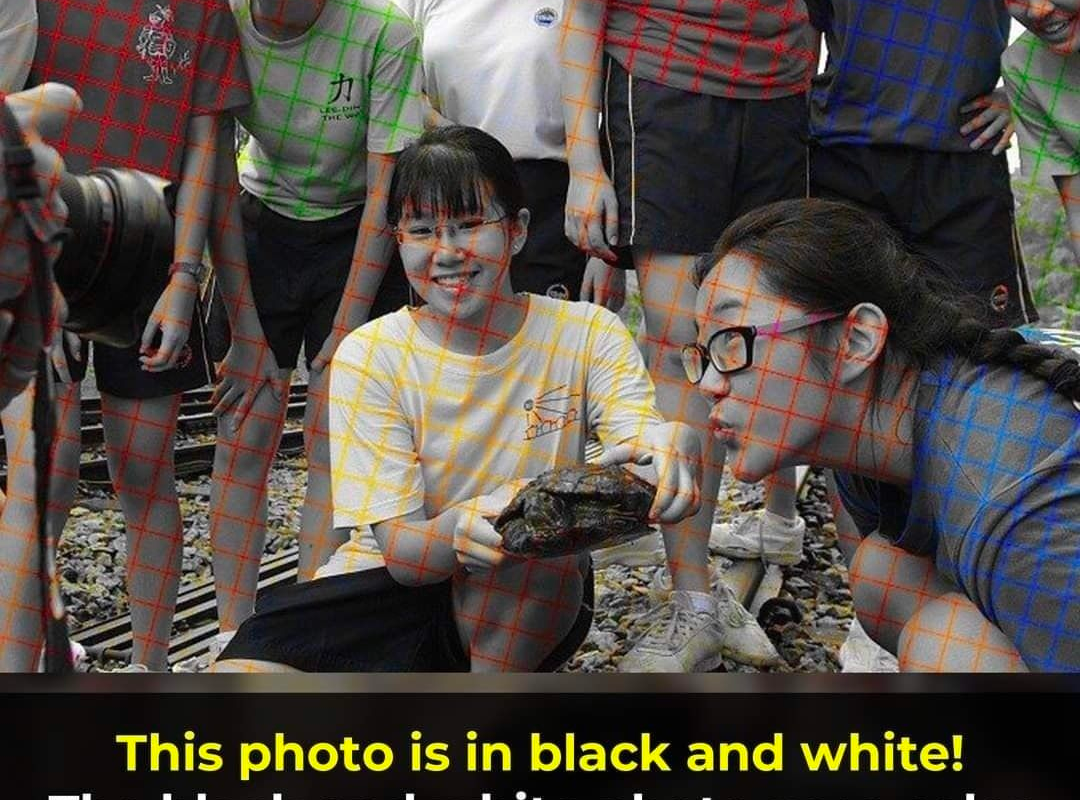
Nothing to add to what I’ve already said here. I just wanted to share another example of how our senses fill in what they expect rather than what is.

This photo is in black and white. It uses coloured grid lines to trick your brain into perceiving colour.

In other news, I just started reading Daniel Dennett’s classic Consciousness Explained. It starts with Brain in a Vat. Given that it was written in the late ’80s and published in the early ’90s, so it’s a bit behind the curve on the technology front. Artificial Intelligence—at least Machine Learning—wasn’t nearly as developed, and he didn’t quite grasp how fast and fast hardware and chip technology would advance in some 30 years. But this doesn’t alter the frame—just some peripheral details.

I’m not really even interested in consciousness. I favour Dennett’s take that consciousness is to the brain as wet is to water, so there’s not really any there there to find.

Consciousness Is Religion

I expect that consciousness is a human nominative concept. Like religion, it will become smaller as science encroaches. In 1994, David Chalmers presented his idea of the hard problem of consciousness in a lecture, Toward a Scientific Basis of Consciousness, but I feel this is more due to the insufficiency of language than anything else. To me, consciousness isn’t well defined. It’s like a medical syndrome. It’s just a grouping of seemingly related conditions that haven’t yet been parsed. In time, it may be determined that they weren’t even related in the first place. Apophenia and cognitive dissonance are two significant human biases that affect perception.

At core, consciousness might be functionally reduced to that of an interpreter. Some have posited that the only thing that exists is ‘information’, whatever that means, so there only needs to be an interpreter—a translater. If that interpreter is defined as consciousness, then so be it. This appears to lead us to a Cartesian place—though it doesn’t follow that the self or ego exists. This would be a second-order event.

Anyway, just rambling. As seems to be the case lately, I’ve got little time to develop my thoughts. At least I’ve captured them for now.

Dear diary…