
If you can’t tell, does it matter?

3–5 minutes

Westworld was a disappointment. It became unwatchable after the first season. But one exchange from 2016 has aged better than anything else in that show, and it landed differently when I recalled it recently in the context of AI authorship.

A greeter robot exchanges words with William, a guest.

You want to ask, so ask.’

Are you real?’

Well, if you can’t tell, does it matter?

I thought of this after encountering a post that’s representative of a genre now doing brisk trade on LinkedIn and its satellites. The argument runs roughly thus: AI can write fast, but it can’t write you. Your why is sacred. Your scars make the prose real. The messy middle is where the magic lives. Keep the soul in your stories.

Audio: NotebookLM summary podcast of this topic.

A bloke shared this opinion:

The one thing AI can’t replicate is your “Why.” 🧠

There’s a lot of noise lately about how AI can “write a book in an hour.” But after publishing 8 books, I’ve realized something crucial: speed is not the same as substance.

The “hidden danger” of letting tools do the heavy lifting isn’t just about the quality of the prose—it’s about the erosion of the creative spirit. When we skip the struggle of the “messy middle,” we skip the insights that actually make a story resonate with a reader.

Tools are great for grammar and brainstorming, but they don’t have:
The scars that make a character’s pain feel real.

The weird, specific memories that make a setting feel alive.
The intuition to know when to break the rules for emotional impact.

By all means, use the tech. But don’t let it sit in the driver’s seat. Your readers are looking for a connection with you, not a refined algorithm.

Keep the soul in your stories. It’s the only thing that actually sticks.
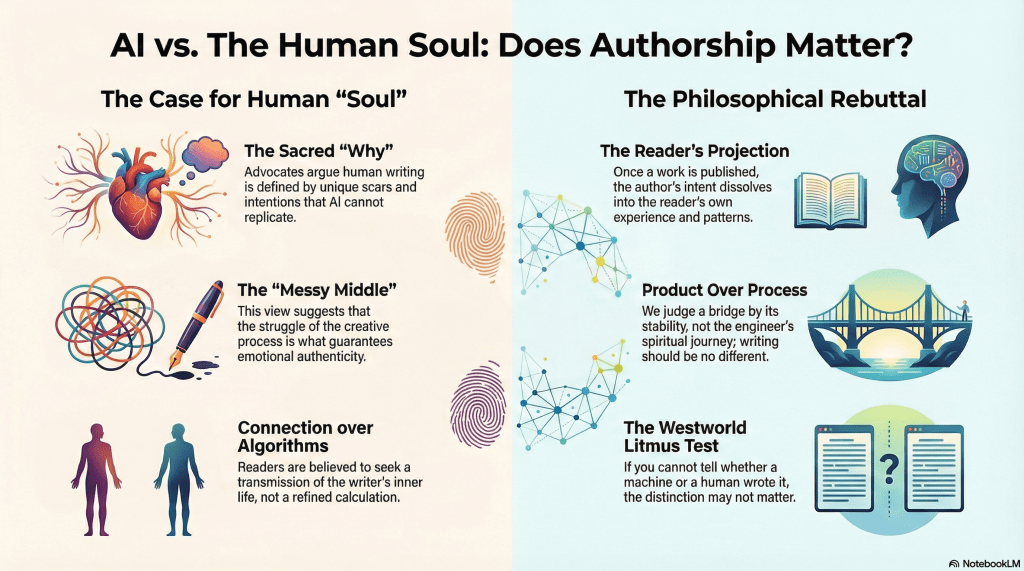
NotebookLM Infographic on this topic.

So much to unpack.

This sounds lovely enough. It is also almost entirely wrong, methinks.

Why is doing suspiciously grand work in these arguments. It’s treated as an ineffable essence – a soul-particle immune to replication. But why is not a substance. It’s an interpretive gloss. A post-hoc narrative we attach to action to stabilise it. Call it intention, call it telos, call it ‘creative spirit’ if one must. It remains a story we tell about stories.

And if we’re invoking the canon, let’s not do so selectively. Roland Barthes already detonated the neat alignment between authorial intention and readerly reception. Once a work leaves the desk, its why dissolves into a field of readings. The reader does not commune with your struggle. They encounter marks on a page. The rest is projection.

The romanticisation of the ‘messy middle’ borders on Calvinism – suffering as guarantor of authenticity, as though the scar itself writes the sentence. Plenty of humans have scars and produce dull prose. Plenty of writers construct convincing pain from observation, empathy, craft, and yes, occasionally from tools. Emotional resonance is not a moral reward for having bled.

Then there is the means-fetish: the idea that process sanctifies product. We do not evaluate a bridge by how spiritually formative the drafting was for the engineer. We ask whether it stands. If a text moves a reader, unsettles them, clarifies something, disturbs them – the instrument used to draft it is historically interesting, not aesthetically decisive.

There is also a quiet assumption buried in all of this: that connexion between writer and reader is a transmission of interiority. It isn’t. It is a negotiated effect. Readers connect with patterns that mirror, disrupt, or reframe their own experience. They are not sniffing for artisanal anguish.

None of this means craft evaporates. It means we should be wary of smuggling metaphysics into workflow preferences.

If someone prefers to wrestle with the blank page unaided – splendid, have at it. But the fetish for purity says more about our anxieties over authorship than it does about art. And if you can’t tell whether the thing that moved you was written by hand or by machine, then I’d suggest, with the greeter robot, that perhaps it doesn’t matter.

In the end, I am not even advocating using AI for writing, but I am saying not to be a dick about it. Enough of the virtue signalling

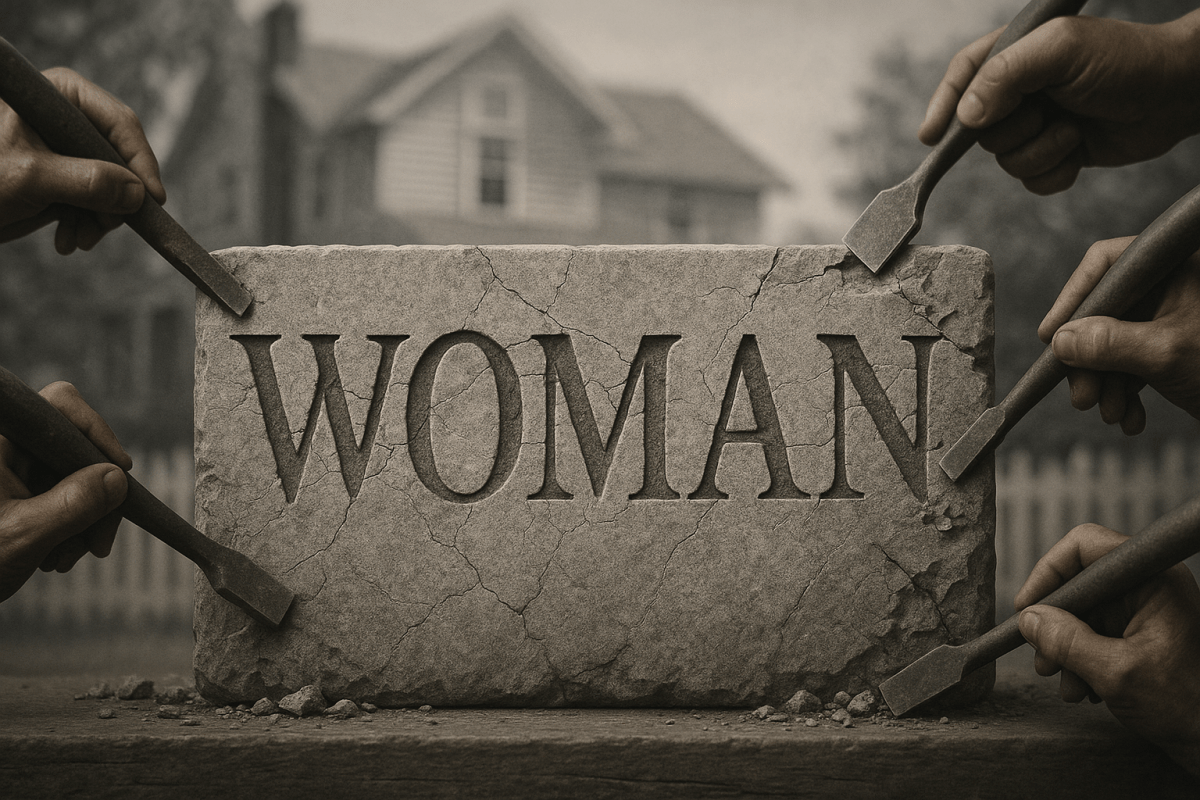
The Scourge: They’re Really Fighting Is Ambiguity

A Sequel to “The Disorder of Saying No” and a Companion to “When ‘Advanced’ Means Genocide”

In my previous post, The Disorder of Saying No, I explored the way resistance to authority is pathologised, particularly when that authority is cloaked in benevolence and armed with diagnostic manuals. When one refuses — gently, thoughtfully, or with a sharp polemic — one is no longer principled. One is “difficult.” Or in my case, oppositional.

Audio: NotebookLM podcast on this topic.

So when I had the gall to call out Bill Maher for his recent linguistic stunt — declaring that a woman is simply “a person who menstruates” — I thought I was doing the rational thing: pointing out a classic bit of reductionist nonsense masquerading as clarity. Maher, after all, was not doing biology. He was playing lexicographer-in-chief, defining a term with centuries of philosophical, sociological, and political baggage as though it were a checkbox on a medical form.

I said as much: that he was abusing his platform, presenting himself as the sole arbiter of the English language, and that his little performance was less about clarity and more about controlling the terms of discourse.

My friend, a post-menopausal woman herself, responded not by engaging the argument, but by insinuating — as others have — that I was simply being contrary. Oppositional. Difficult. Again. (She was clearly moved by When “Advanced” Means Genocide, but may have missed the point.)

So let’s unpack this — not to win the debate, but to show what the debate actually is.

This Isn’t About Biology — It’s About Boundary Maintenance

Maher’s statement wasn’t intended to clarify. It was intended to exclude. It wasn’t some linguistic slip; it was a rhetorical scalpel — one used not to analyse, but to amputate.

And the applause from some cisgender women — particularly those who’ve “graduated” from menstruation — reveals the heart of the matter: it’s not about reproductive biology. It’s about controlling who gets to claim the term woman.

Let’s steelman the argument, just for the sport of it:

Menstruation is a symbolic threshold. Even if one no longer menstruates, having done so places you irrevocably within the category of woman. It’s not about exclusion; it’s about grounding identity in material experience.

Fine. But now let’s ask:

  • What about women who’ve never menstruated?
  • What about intersex people?
  • What about trans women?
  • What about cultures with radically different markers of womanhood?

You see, it only works if you pretend the world is simpler than it is.

The Language Insufficiency Hypothesis: Applied

This is precisely where the Language Insufficiency Hypothesis earns its keep.

The word woman is not a locked vault. It is a floating signifier, to borrow from Barthes — a term whose meaning is perpetually re-negotiated in use. There is no singular essence to the word. It is not rooted in biology, nor in social role, nor in performance. It is a hybrid, historically contingent construct — and the moment you try to fix its meaning, it slips sideways like a greased Wittgensteinian beetle.

“Meaning is use,” says Wittgenstein, and this is what frightens people.

If woman is defined by use and not by rule, then anyone might claim it. And suddenly, the club is no longer exclusive.

That’s the threat Maher and his defenders are really reacting to. Not trans women. Not intersex people. Not language activists or queer theorists.

The threat is ambiguity.

What They Want: A World That Can Be Named

The push for rigid definitions — for menstruation as membership — is a plea for a world that can be named and known. A world where words are secure, stable, and final. Where meaning doesn’t leak.

But language doesn’t offer that comfort.

It never did.

And when that linguistic instability gets too close to something personal, like gender identity, or the foundation of one’s own sense of self, the defensive response is to fortify the language, as though building walls around a collapsing church.

Maher’s defenders aren’t making scientific arguments. They’re waging semantic warfare. If they can hold the definition, they can win the cultural narrative. They can hold the gates to Womanhood and keep the undesirables out.

That’s the fantasy.

But language doesn’t play along.

Conclusion: Words Will Not Save You — but They Might Soothe the Dead

In the end, Maher’s definition is not merely incorrect. It is insufficient. It cannot accommodate the complexity of lived experience and cannot sustain the illusion of clarity for long.

And those who cling to it — friend or stranger, progressive, or conservative — are not defending biology. They are defending nostalgia. Specifically, a pathological nostalgia for a world that no longer exists, and arguably never did: a world where gender roles were static, language was absolute, and womanhood was neatly circumscribed by bodily functions and suburban etiquette.

Ozzy and Harriet loom large here — not as individuals but as archetypes. Icons of a mid-century dream in which everyone knew their place, and deviation was something to be corrected, not celebrated. My friend, of that generation, clings to this fantasy not out of malice but out of a desperate yearning for order. The idea that woman could mean many things, and mean them differently across contexts, is not liberating to her — it’s destabilising.

But that world is gone. And no amount of menstruation-based gatekeeping will restore it.

The Real Scourge Is Ambiguity

Maher’s tantrum wasn’t about truth. It was about fear — fear of linguistic drift, of gender flux, of a world in which meaning no longer obeys. The desire to fix the definition of “woman” is not a biological impulse. It’s a theological one.

And theology, like nostalgia, often makes terrible policy.

This is why your Language Insufficiency Hypothesis matters. Because it reminds us that language does not stabilise reality — it masks its instability. The attempt to define “woman” once and for all is not just futile — it’s an act of violence against difference, a linguistic colonisation of lived experience.

So Let Them Rest

Ozzy and Harriet are dead. Let them rest.
Let their picket fence moulder. Let their signage decay.

The world has moved on. The language is shifting beneath your feet. And no amount of retroactive gatekeeping can halt that tremor.

The club is burning. And the only thing left to save is honesty.

Baby, it’s cold outside

Nothing could underscore Barthes‘ proposition—adopted by Derrida—that the author is dead than Baby, It’s Cold Outside.

This Christmas/holiday season, a social media row rages in the shadows of the #MeToo movement, and a holiday classic penned in 1944 is reinterpreted for #today. The central claim is that the content stems directly from a rape culture in the United States. I am not going to argue whether the US have a rape culture or are forged from and tempered by violence—they do; they are.

My contention is about the reinterpretation of language, vilifying an author who is quite literally dead, deceased, demised, expired, no more—unable to defend himself.

The song is about a man and a woman playing a courting game. In my interpretation, she is being coy so as not to be slut-shamed, seeking plausible deniability as she worries about what her mother and father, the neighbours, her brother and sister, and even her aunt, might think.

The kicker for the revisionists is ‘Say, what’s in this drink’ as if it’s been spiked; she’s been roofied; he’s plying her with some date rate drug. This interpretation is preferred to the more period-probable scenario that she’s conveying a signal that she’s feeling a bit tipsy and giving him the go-ahead with a wink and a nod. The decorum of the day suggests that she ‘ought to say no, no, no’, but she wants to say yes and stretches the encounter with another cigarette.

Frank Loesser is dead. Perhaps this is merciful.