Reason on a Spectrum

4–6 minutes

Reason is not an oracle of truth but a spectrum-bound tool, and when it is worshipped as absolute, it curdles into pathology. True rationality knows when to temper itself, when to equivocate, and when a kind lie is wiser than a cold fact.

Reason and rationality are the household gods of modernity. We light incense to them daily: follow the science, be reasonable, act rationally. But before we genuflect, it’s worth asking what exactly we mean. By reason, I mean the faculty of inference – spotting contradictions, tracing causes. By rationality, I mean the practice of applying that faculty toward some end. That’s all. Nothing mystical.

Audio: NotebookLM podcast on this topic.

The trouble starts when these concepts are treated as absolutes. They aren’t. They vary in intensity and application. A person’s reasoning operates on a spectrum with something like frequency and amplitude. Some minds hum at low frequency – broad strokes, contradictions smoothed over by intuition. Others burn hot at high frequency and amplitude – rapid logical leaps, obsessive consistency, the inability to let a premise go. And while some reason flows like a continuous wave – steady, consistent, predictable – other forms fire more like particles: synaptic sparks that don’t always connect, logic arriving in bursts or stutters rather than as a smooth line.

Push too far and what we sanctify as ‘reason’ bleeds into what psychiatry pathologises as autism or schizophrenia. Meanwhile, ‘normal’ cognition always includes an emotional ballast. Strip it out and the result looks alien, even monstrous. Freud’s quip about psychopathy – that the psychopath differs from the rest of us in degree, not kind – applies just as well to reason. Rationality is simply the socially acceptable blend of logic and affect. Deviate, and you’re declared broken.

Camus gave us a parable in The Stranger. Meursault observes his world with ruthless clarity, but no emotional resonance. He doesn’t weep at his mother’s funeral, and society condemns him less for murder than for failing to perform grief. His ‘pure’ reason reads as inhuman.

Here’s the paradox: if rationality means adapting effectively to one’s environment, then pure rationality demands knowing when to suspend itself. A person who insists on logic at every turn is not rational but maladapted. The rational actor lies, flatters, nods at the boss’s bad joke, comforts the friend who doesn’t want statistics but solace. Rationality that cannot bend collapses into pathology.

This is why the infamous ‘Do these jeans make me look fat?’ question is such a perfect test. The ‘true’ answer, if you are reasoning narrowly, may be ‘yes’. But true rationality recognises the context, the stakes, the human need beneath the words. The rational response is not the cold fact but the kind equivocation. Rationality that cannot lie is no rationality at all.

Here’s the paradox: if rationality means adapting effectively to one’s environment, then pure rationality demands knowing when to suspend itself. A person who insists on logic at every turn is not rational but maladapted. The rational actor lies, flatters, nods at the boss’s bad joke, comforts the friend who doesn’t want statistics but solace. Rationality that cannot bend collapses into pathology.

Consider the social rituals we all know. A partner says, ‘I like that house’, and the rationally over-tuned response is to evaluate the house. The actual cue is in the like, not the house. The answer isn’t that you dislike the house, but rather what you can appreciate about it. Miss that, and you miss the point. Or take the dinner table: when my son was seven, a well-meaning host – very Martha Stewart – asked him how he enjoyed his meal. He replied, with perfect candour, ‘I’ve had better’. From a logical standpoint, faultless. From a rational standpoint – if rationality includes social adaptation – disastrous. The question was never about the food. It was a cue for appreciation, for harmony. He gave fact when what was asked for was affiliation.

So yes, I attack reason and rationality – not because they don’t exist, but because they are misapplied, reified, and worshipped as neutral arbiters of truth. They are not. They are tools with a range, and outside that range, they fail catastrophically. To speak of ‘reason’ as if it were an unqualified good is like praising fire without mentioning its talent for arson.


After I wrote this, I realised I forgot to mention Kant.

Even Kant, patron saint of rational duty, insisted you must never lie, not even a white lie, not even to a murderer asking where your friend is hiding. For him, truth-telling was categorical, binding, immune to circumstance. But this is reason gone rigid, unable to flex with human reality. It shows how worship of Reason leads not to morality but to monstrosity. A rationality that cannot bend is no rationality at all.
Underrepresented Class

Podcast: Audio rendition of this page content

I’ve just finished reading Iain McGilchrist’s The Master and His Emissary, having paused The Matter with Things to put it to bed. The book is divided into two sections. The first lays down the neuroscientific base whilst the second contains expository forrays. Technically, one might argue that there are three sections as the last unnumbered chapter seems to stand alone from the second part. It’s only one chapter containing some 36 pages, so I’m not going to lose any sleep over it. But this will not be a book review, as highly recommended as it is.

I’ve been a vocal proponent of hiring neurodiverse people into certain roles. Having read the book and absorbed the rationale, it’s easy to see how it aligns with and supports some of my own experiences. In particular, I’ve noticed that many companies hire autism spectrum on the Aspergers end of the scale. These people tend to be hired into IT and programming roles—functions already having reputations for being staffed with socially awkward and low EQ individuals, characteristics of people on the spectrum. It makes sense because left-hemisphere-dominant managers evaluate this hyper-left-hemisphere-dominant cohort as assets. Without getting too deep into the territory of stereotypes, in general, this group are laser-focused and doggedly pursue tasks at hand without tiring. I’ve met plenty of ADHD-diagnosed people in these roles, too—not as many, but also employed in technology-oriented positions.

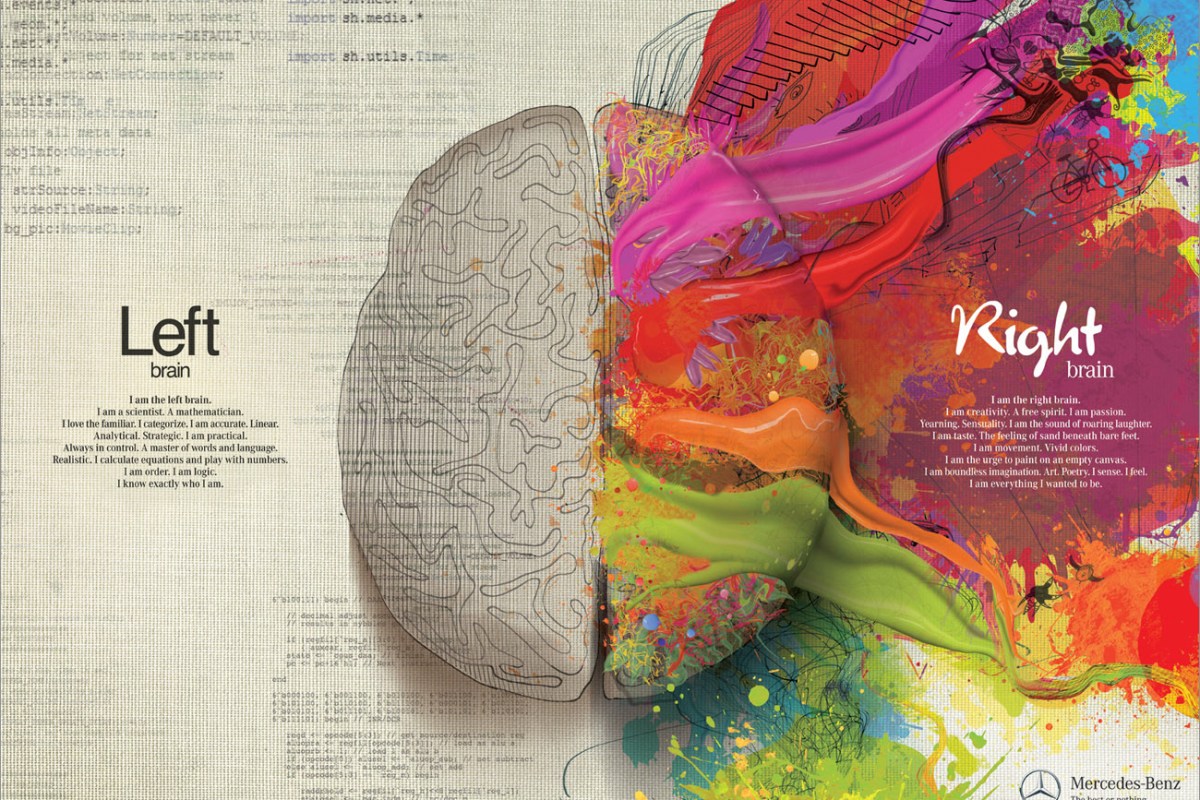
The underrepresented class are right-hemisphere-dominant people. To be fair, I’ve encountered many Creative people in Agencies, but their right-hemisphere life is separate from their left and not appreciated in the workplace. They mainly exercise their right-hemisphere life outside of office hours on personal passion projects. I’d also be willing to bet that these people are not truly right-hemisphere-dominant. Rather, they have the ability to balance and allow the left hemisphere to take over during business hours.

In some cases, these people happen to have right-hemisphere insights into a project or have some creative inspiration off hours to benefit the work of the next day. But the right hemisphere is not time-boxed. It doesn’t function on demand. In fact, it shuts down on demand, and the left introduces bootleg knock-offs. Of course, this doesn’t matter, as it is probably better than their left-hemisphere managers and clients and good enough in their eyes. I’m not convinced they’d actually recognise the right-hemisphere solution as better because the left hemisphere prefers its own tribe anyway.

If you are reading this and you are saying, “They’re running a business. They can’t wait for weeks or months for a resource to have the epiphany of a creative solution,” you’ve made my point, and you’ve presented strong evidence that you are operating from your left hemisphere as well. There’s no shame in this. The first step is to admit there’s a problem.

My point is not to antagonise left-hemisphere-dominant people or the fact that they’re at home with other like-minded people. It’s only natural. They usually find right-hemisphere types to be too eccentric for their taste anyway.

But these right- or balanced-hemisphere thinkers, not given the space for their right-hemisphere to yield benefit, are likely in a Creative function, whether in art, illustration, copywriting, or some such. They are like unicorns outside of this context.

As for me, I am at times balanced and at times left. At other times, I’m purely right, though this is admittedly short-lived and unsustainable. But in a balanced state—in a right-shifted mode—, this is where my Gestalt comes into play. One of my roles is to evaluate processes. The left hemisphere analyses in components and pieces. Taking an analytical approach, I can document that the knee bone is connected to the shin bone and the shin bone is connected to the ankle bone and so on, but this requires context, something the left hemisphere is weak at. The left hemisphere will tell us that this is the bone connexion process, as it were. But it’s more than this. It’s meaningless without musculature and connective tissue and a nervous system and a circulatory system. And we’d likely want the person to whom the bones belong to be alive. And how do these bones contribute to function and perambulation? This is a larger system thinking approach.

System thinking is a recommendation for looking at processes, but this is right-hemisphere activity. Most people asked to perform this are left-hemisphere-dominant, so they give it short-shrift.

At the end of this rant, my point is that I hear all about equity, diversity, and inclusion, but this cohort is not only underrepresented but almost nonexistent. To be fair, many of these people wouldn’t feel comfortable behind your walls anyway, aren’t likely to prefer the constraint of your walls, and they’d probably feel like outsiders. But this is the challenge with true inclusion.

Classes are a left-hemisphere operation at the start—male, female, black, white, L, B, G, T, and so on. These are left-hemisphere constructs. But since you are already stuck in this place anyway, let’s consider expanding the neurodiverse class to include right-hemisphere people.

The Matter with Things: Chapter Nine Summary: Schizophreia &c.

Index and table of contents

Podcast audio version to follow.

Intro

Creativity is chapter nine of Iain McGilchrist’s The Matter with Things. It also marks the end of part one of three in this two-volume set.

The main thrust is to provide a lot of cases of schizophrenia to elaborate on how the deficits impact perception—and of course, attention and judgment.

Content

This chapter starts off by noting that mental illnesses are not a matter of the brain being broken like a machine. McGilchrist doesn’t much like the analogies to machines or computers, to begin with. Instead, they affect how their world is experienced. They attend to different things, which creates a different perception because we perceive what we attend to.

It is effectively a left-hemisphere challenge, but he is careful to say that we don’t have enough evidence to call it a right-hemisphere deficit. His rationale is that it could be one of these three leading scenarios:

  1. The right hemisphere has deficits.
  2. The left hemisphere is not performing its function to work with the right hemisphere, which is otherwise intact.
  3. The frontal lobe which is supposed to moderate the hemispheres is not performing its function.

Schizophrenia and autism are distinct conditions, but there are some overlaps. He clarifies that schizophrenia and autism are too broad of categories (a situation made worse in the case of autism by the creation of the autism spectrum). There are types of schizophrenias and autisms that would otherwise be unrelated except for psychology’s kitchen junk drawer approach to categorisation, I suppose, following the lead of syndromes in the medical profession. I digress.

These conditions exemplify what it’s like to experience the world with an overreliance on the left hemisphere. A point he wants to make is that he feels society at large is shifting in this direction to the detriment of all concerned, that the world of business, science, politics, and bureaucracy more generally is migrating to a hyper-rational position at the expense of experiential reality.

He praises Louis Sass’s 1992 book Madness and Modernism as “one of the most fascinating, and compelling, books I have ever read”, primarily because it notes the relationship between schizophrenia and Modernism and a modern world that is experiencing an increase in the phenomena of schizophrenia.

they miss the forest for the woods

McGilchrist goes into detail about how right hemisphere deficits affect perception in schizophrenic patients. I won’t share that level of detail here. Effectively, they miss the forest for the woods and make contextual miscues, lacking in empathy and intuition. Missing this context, they jump to conclusions—invalid conclusions. He goes on to explain this from the perspective of brain construction and physiology whilst extending the conversation to include the autism spectrum, noting a general overlap between these diagnoses.

He invokes the work of Eugène Minkowski—reflecting on the foundational work of Henri Bergson—, which resonated with me, wherein Minkowski tries to simplify and characterise the hemisphere as the left representing intellect and the right being intuition. This feels about right. He shares a list of terms generally representing qualities in schizophrenics that detail what is atrophied in the intuition of the right hemisphere and what is hypertrophied (or exaggerated) in the left hemisphere. I’ll not share this list here, but I like it. He promises to elaborate on this in chapter 22.

Essentially what’s missing is a sense of coherence with experience leading to a detachment from reality as we normally experience it—and a loss of vitality and a sense of self. These people live as outsiders looking in rather than simply feeling a part of the whole. Man becomes a machine built of parts and separate to nature. Everything becomes literal. There is no room for connotation in a denotative world. But this world is disconnected from the presented reality, instead relying on a re-presented version. The world loses depth and becomes a two-dimensional caricature.

Perspective

My summary of this chapter left many details unsaid, probably more so than the preceding chapters, so a lot of context and nuance is missing. My biggest takeaway is really the scary connexion between schizophrenia and Modernity. It is far from comforting. Add to this the positive feedback loop otherwise known as a vicious cycle as societies more and more adopt a left hemisphere perspective, that of a schizophrenic, and it becomes scarier still. To make matters worse, this is not metaphorical. It’s analogical. I’m not sure how to reverse this tide.

connexion between schizophrenia and Modernity

This wraps up the chapter on schizophrenia, autism and the rest. As I mentioned at the start, this also marks the end of part one of the book. The next chapter is “What is Truth?” This will allow the reader to delve more deeply into various aspects of truth, from science to reason to intuition and imagination. This second part of the books takes us to the end of the first volume, traversing us through chapters ten to nineteen.

What are your thoughts on mental illnesses like schizophrenia and autism, especially around how they may shed light on neurotypical persons and the relationship between these and modern society?

Leave comments below or on the blog.