A Family of Lenses: LIH, MEOW, and Disagreement Without Referees

My Language Insufficiency Hypothesis is finished, the cover is designed, and everything is in order for a January 2026 release – save for one administrative detail: the ISBN. I expect this to be resolved presently. The Bowker distribution system in the US appears to have been set up circa 1997, and that’s just the web interface. Who knows how long the database has been in place? I’d bet circa 1955. Most countries provide ISBNs for free. Not the US. Kinda bollox. Meantime, I’ve now got three lenses through which to inspect the world.

[EDIT: ISBN issue has been resolved. I am awaiting a proof copy that should be arriving today.]

From the outside, some of my recent work can look untidy. A hypothesis about language. An ontology about mediated encounters. A paper on why moral disagreement refuses to resolve itself politely. No master theory. No clean ladder. No promised synthesis at the end. This is not an accident. It is a refusal.

What links the Language Insufficiency Hypothesis (LIH), the Mediated Encounter Ontology of the World (MEOW), and Disagreement Without Referees is not a shared doctrine, but a shared function. They are lenses, not foundations. Diagnostics, not blueprints. Each takes aim at a different site where Enlightenment habits quietly overpromise – meaning, access, adjudication – and shows what breaks when we stop pretending those promises were ever cashable. They form a family. Not a system. And certainly not a programme for rebuilding.

Three Lenses, Three Failure Sites

Each of these frameworks operates at a different level, but they all do the same kind of work: they explain why something we rely on feels indispensable, fails repeatedly, and yet stubbornly survives.

LIH operates at the linguistic level.

It asks why language fails precisely where we expect it to secure clarity, precision, or consensus. Its answer is unromantic: language is not uniformly capable. As we move from invariants to contestables to fluids and ineffables, its representational power degrades. The failure mode is familiar: we mistake grammatical stability for ontological stability, and then act surprised when disagreement hardens rather than dissolves.

MEOW operates at the ontological level.

It asks what kind of ‘world’ we are actually dealing with once we abandon the fantasy of unmediated access. There is no clean mind–world interface, no privileged vantage point. Every encounter is mediated – biologically, cognitively, linguistically, socially. Realism and idealism alike fail here, each clinging to a different myth of access. What remains is not scepticism, but constraint.

Disagreement Without Referees operates at the normative and political level.

It asks why moral and political disagreement persists even when all parties appear informed, sincere, and articulate. The answer is ontological incommensurability. Where frameworks do not overlap, there are no neutral referees. Argument does not converge because it cannot. What remains is persuasion, coalition, power, and consequence—moral life without an umpire.

None of these lenses replaces what it critiques. Each refuses the repair instinct that says: if we just fix the model, the system will work again. That instinct is the pathology.

What They Share (And What They Don’t)

What unites these lenses is not a set of positive claims about how the world really is. It is a shared posture:

  • no privileged access
  • no neutral ground
  • no final adjudication
  • no redemptive synthesis

But also:

  • no quietism
  • no nihilism
  • no ‘anything goes’
  • no abdication of responsibility

They do not tell you what to believe. They tell you why believing harder won’t save you.

Importantly, they are non-hierarchical. LIH does not ground MEOW. MEOW does not explain away disagreement. Disagreement does not ‘apply’ LIH in some linear fashion. They intersect. They overlap. They illuminate different failure modes of the same inherited fantasy: that there must be a place where things finally settle. There isn’t.

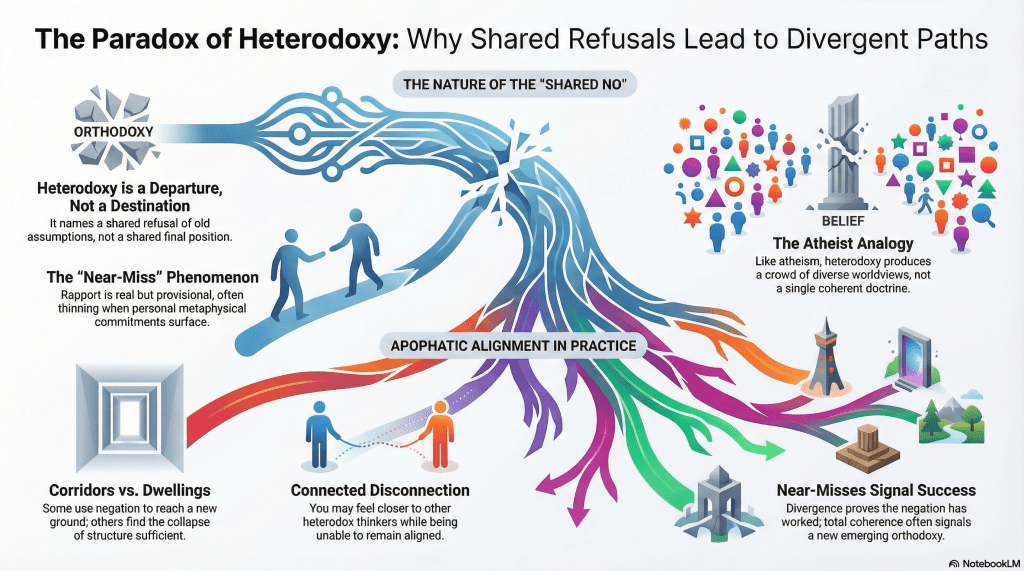
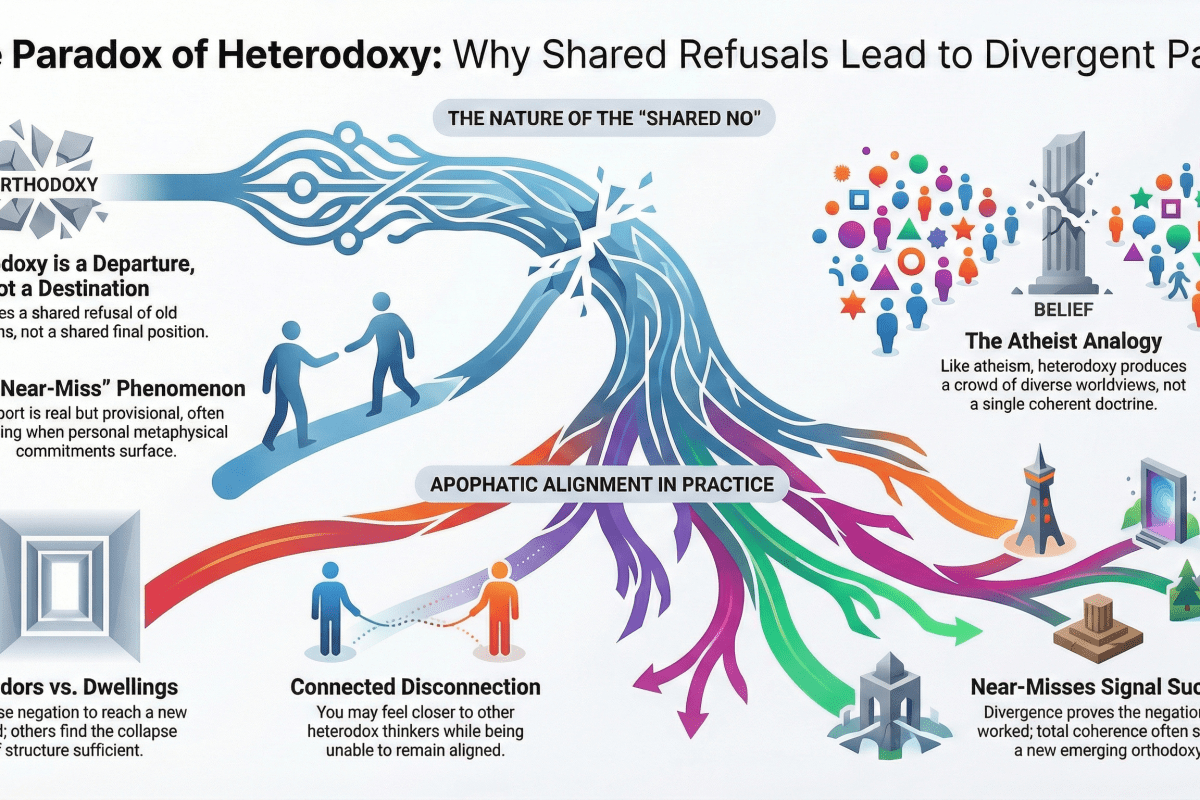
Image: Three Diagnostic Lenses Infographic¹

Why This Is Not a System

Systems promise closure. These lenses do not. They explain why closure is repeatedly promised, urgently demanded, and reliably missed. To systematise them would be to betray them.

What they offer instead is a kind of intellectual hygiene: a way of recognising when we are asking language, reality, or morality to do work they were never capable of doing – and then blaming one another when they don’t comply.

If there is a unifying thread, it is this: the demand for foundations is itself the problem.² These lenses do not solve that problem. They show you where it operates, how it reproduces itself, and why refusing it feels so uncomfortable. That discomfort is the point.


Footnotes

  1. This is another NotebookLM infographic – my second. It’s not half-bad. I had to adjust some elements in Photoshop and Illustrator, and there are still textual anomalies, but all in all, I’m impressed with what 60 seconds of generation yielded – along with a 5-minute prompt and 15 minutes of touchup. It’s just a novelty for now – certainly not necessary. What do you think?
  2. See Dis–Integrationism for a fuller accounting.

Why Perspectival Realism Is Not Relativism

Reality decides; perspectives compete.

The moment you say “our access to reality is mediated,” someone inevitably performs their civic duty as Defender of Enlightenment Orthodoxy and announces, as if discovering fire, “So you’re a relativist, then?”

It’s a comforting little reflex. If a position denies universality, it must be relativism. If it rejects the view from nowhere, it must reject the very idea of truth. If it acknowledges cultural scaffolding, it must be one critique away from saying flat-earthers and astrophysicists are peers.

This objection misunderstands both relativism and Perspectival Realism.

Audio: NotebookLM podcast summarising this topic.

Let’s begin with the essential distinction—think of this as the tattoo at the base of the spine:

Relativism says: all maps are equally valid.
Perspectival Realism says: all maps are partial, and some are better.

  • Better at predicting.
  • Better at surviving.
  • Better at cohering with everything else we know.
  • Better at not getting you killed.

This is the spine of the position. Everything else is elaboration.


Relativism’s Self-Destruct Button

Relativism denies that reality has enough structure to constrain belief. According to its logic, perspectives are sovereign. The world bends to interpretation.

If that were true:

  • Gravity would turn itself off for anyone sufficiently committed to optimism.
  • Viruses would consult your cosmology before infecting you.
  • The Müller–Lyer illusion wouldn’t vary between populations because there’d be no stable perceptual machinery for it to fool.

Relativism collapses because the world does not permit it.

Perspectival Realism begins from the opposite premise:

  • There is one reality.
  • It resists us.
  • Perspectives rise or fall by how well they handle that resistance.

You can’t get further from relativism than that.


Why Perspective ≠ Prison

Another familiar confusion:
“If access is perspectival, aren’t we trapped in our own little worlds?”

No.
Mediation isn’t isolation. It’s a shared condition.

You and I may wear sunglasses of different tint, but we still walk the same street. Your glasses may darken the building I call “red,” so you call it “dark red.” That’s not incommensurability—that’s disagreement within a shared world. We argue, we adjust, we converge.

Perspectival Realism doesn’t say “worlds are sealed off.”
It says we are situated—embodied, encultured, cognitively structured.
Our lenses differ. The street does not.


The Crucial Point: The World Pushes Back

Relativism has no mechanism for adjudication. Perspectival Realism has the best one available: reality’s structured resistance.

If your perspective predicts, explains, and survives contact with the world, it’s better. If it collapses upon use, it’s worse. If it transfers across contexts, it’s better. If it leaves you dead, it’s worse.

This is not metaphysics.
It’s survival.

And it is very explicitly not relativism.


Logic: Form Universal, Application Situated

A predictable objection:

Objection: “Isn’t logic universal? Doesn’t that kill perspectivalism?”

Response:
Basic inferential forms—modus ponens, contradiction—are indeed widespread. That’s Layer 2 architecture: the cognitive machinery we all share.

But what counts as a valid premise, which inferences feel compelling, and which conclusions are considered exhaustive vary across cultures (Layer 3). Logic’s form is stable; its deployment is contextual.

Perspectival Realism doesn’t deny logic.
It denies the fantasy that logic operates in a cultural vacuum.


Relativism’s Moral Collapse

Why “anything goes” goes nowhere

Relativism becomes lethal the moment ethics enters the scene. If all perspectives are equally valid, you lose the ability to critique harmful practices. Torture, forced servility, institutionalised cruelty—all become “just different frameworks.”

Perspectival Realism rejects this.

You don’t need a metaphysical skyhook to condemn torture.
You need:

  • Shared vulnerability – all humans are embodied beings capable of pain.
  • Empirical observation – societies that normalise cruelty become unstable and self-poisoning.
  • Pragmatic convergence – diverse cultures can agree that some practices destroy the conditions of flourishing.
  • Reality-tested norms – ethical systems survive because they work, not because they download from a Platonic server.

This is not relativism.
It’s ethics under realism-without-universality.

You can condemn harmful practices without pretending to be the mouthpiece of timeless universal Reason. You can ground human rights in intersubjective evidence—not metaphysical fiat.

No view from nowhere required.


The Three-Way Contrast
(The Only Chart You Need)

Naive Realism:
There is one perfectly accurate map.

Relativism:
All maps are equally good.

Perspectival Realism:

  • All maps are partial.
  • Some are atrocious.
  • Some work astonishingly well because they track deeper regularities of the terrain.
  • No map is complete.
  • No map is sovereign.
  • The terrain adjudicates between them.

You don’t need omniscience to compare maps.
You need terrain.
And we all share the same one.


Prediction: The Final Judge

If you want the single litmus test:

  • Does the perspective predict anything?
  • Does it do so consistently?
  • Does it correct itself when wrong?
  • Does it transfer beyond its original context?

If yes → closer to reality.
If no → a charming story, but please don’t build bridges with it.

Relativism has no concept of “closer to.”
Perspectival Realism depends on it.


Putting It All Together

Perspectival Realism maintains:

  • Realism: the world exists independently of our representations.
  • Anti-universalism: no representation escapes mediation.
  • Anti-relativism: some representations perform better because they align more closely with what the world actually does.
  • Humility: we navigate through partial perspectives, comparing, refining, and error-correcting.

No one gets to declare universal sovereignty.
Everyone gets tested by the same reality.

Relativism says everything is equally true.
Perspectival Realism says everything is equally mediated—but not equally successful.

  • Reality decides.
  • Perspectives compete.
  • And relativism loses on the first contact.

COMMENTARY: To be fair, the argument about relativism is a strawman argument against virtually no one who would hold or defend this position. For whatever reason, the training data indicated that this was a significant contender. I’ve heard similar weak strawmen in other disciplines, and I felt I should address the invisible elephant in the room. — Bry Willis


DISCLAIMER: This article was written or output by ChatGPT 5.1. It started as a conversation with Claude Sonnet 4.5, where I had input days of output for evaluation. One of these outputs was the post about Erasmus and the Emissary Who Forgot to Bow. A group chat ensued between me, Claude and ChatGPT.

What started as a discussion about the merits of my position, expressed in the Erasmus-influenced essay, drifted to one about Perspectival Realism. That discussion deepened on ChatGPT, as I further discussed my recent thoughts on the latter topic. I had rendered a Magic: The Gathering parody trading card as I contemplated the subject. It’s how my brain works.

All of this led me to ask ChatGPT to summarise the conversation, and, upon further discussion, I asked it to draft this article – the second of five.

  1. Perspectival Realism: The First Ontology Without an Asterisk
    This article discusses what Perspectival Realism means to me and how I got to this position.
  2. Why Perspectival Realism Is Not Relativism 👈
    Further discussion prompted me to differentiate this ontology from other perspectives.
  3. Arriving Late to Massimi’s Party: Perspectival Realism in Parallel
    I spent another half-hour following Google search results as I wanted to see if anyone else had already been using the term, Perspectival Realism. I ended up on the Oxford publishing site. I found a 2022 book with this name, authored by Michela Massimi. They allowed me to download the book, so I asked ChatGPT to summarise our positions, specifically where we agreed and differed.
  4. Against the Vat: Why Perspectival Realism Survives Every Sceptical Hypothesis
    At 0500, I returned to bed, but I woke up again at 0700, thinking about how one might differentiate between Putnam’s brain in a vat from Perspectival Realism. ChatGPT asked if I wanted that output in long-form.
  5. The Constraint Interface: Toward a Nexal Ontology
    Being uncomfortable with the dichotomy between Realism and Idealism, I chatted to come up with terminology that disrupts what I consider a false dichotomy, focusing on the nexus rather than privileging one or the other. Consider this similar to the debate on sex and gender binaries.

As I mentioned at the end of the first series, I may return to this series and publish a coherent expository version more in line with my usual style. Meantime, this allows me to share my ideas unvarnished and unpolished at the same time, granting me more time to focus on other matters. Apologies to those who may disagree with the outline format. Honestly, it annoys me, but I am choosing function over form at the moment.

Perspectival Realism: The First Ontology Without an Asterisk

6–10 minutes

The realism remains; the universality does not.

There comes a moment in any serious thinker’s life when the metaphysical menu starts looking like a bad buffet: too much on offer, none of it quite edible, and the dishes that appear promising turn out to depend on ingredients you can’t stomach. Realism insists the world is simply there, chugging along regardless of your opinions. Anti-realism points out, inconveniently, that all your access is wildly mediated. Perspectivism adds humility. Constructivism chastises you for overconfidence. Analytic Idealism sweeps matter off the table entirely, until you ask why consciousness spits out such stubbornly consistent patterns.

I’ve been through all of them.
Realism*—asterisk for “but what about mediation?”
Idealism*—asterisk for “but what about resistance?”

Everything almost worked.
And “almost” is the metaphysical kiss of death.
“Almost” is where the asterisks live.

Perspectival Realism is the first position I can hold without planting that apologetic little star in the margins.

Audio: NotebookLM podcast summary on this topic.

The Asterisk Journey (Brief, Painless, Necessary)

This isn’t a conversion narrative. It’s a salvage operation. Each station on the journey left me with tools worth keeping.

Layer 1: Iconography (Hoffman, minus the metaphysics)

Perception is not a window. It’s an interface. A species-specific dashboard designed for survival, not truth. Evolution gave you a set of icons—colour patches, contrast edges, looming shapes—not an accurate rendering of reality’s architecture.

Uexküll called this the umwelt: every organism inhabits its own perceptual slice of the world. Bees see ultraviolet; snakes sense heat; humans see embarrassingly little.

This is Layer 1 mediation:
Reality-as-filtered-for-primates.

Layer 2: Instrumentation (Kastrup, minus the leap)

Consciousness is the instrument through which reality is measured. Measuring instruments shape the measurements. That doesn’t make the world mind-shaped; it just means you only ever get readings through the apparatus you’ve got.

This is Layer 2 mediation:
Your cognitive architecture—predictive priors, attentional limitations, spatial-temporal scaffolding—structures experience before thought arrives.

Where I leave Kastrup behind is the familiar leap:
“Because consciousness measures reality, reality must be made of consciousness.”
That’s the instrumentality fallacy.

You need consciousness to access the world.
That tells you nothing about what the world is.

Layer 3: Linguistic–Cultural Carving (Your home field)

And then comes the mediation philosophers most reliably ignore: language.
Language does not describe reality. It carves it.

Some cultures divide colour into eleven categories; some into five. The Müller-Lyer illusion fools Westerners far more than it fools hunter-gatherers. Concepts feel natural only because you inherited them pre-packaged.

This is Layer 3 mediation: the cultural-linguistic filter that makes the world legible—and in the same breath, distorts it.

You mistake the map for the territory because it’s the only map you’ve ever held.


The Hard Problem, Dissolved — Not Solved

When English splits the world into “mental” and “physical,” it accidentally manufactures the “hard problem of consciousness.” Sanskrit traditions carve reality differently and end up with different “mysteries.”

The hard problem isn’t a revelation about reality.
It’s a conceptual knot tied by Layer 3 mediation.

Changing the ontology to “everything is mind” doesn’t untie the knot.
It just dyes the rope a different colour.


The Triple Lock

Put the three layers together and you get the honest picture:

  1. Your senses give you icons, not the thing-in-itself.
  2. Your cognition structures those icons automatically.
  3. Your culture tells you what the structured icons mean.

And yet—despite all of this—the world pushes back.

Gravity doesn’t care about your interpretive community.
Arsenic does not negotiate its effects with your culture.
Your beliefs about heat won’t keep your hand from burning.

This is the fulcrum of Perspectival Realism:

Reality is real and resists us, but all access is triply mediated.

The realism remains.
The universality does not.


Why Perspectival Realism is Not Relativism

Relativism says: “Everyone’s perspective is equally valid.”
Perspectival Realism says: “Everyone’s perspective is equally situated.”

Very different claims.

Some perspectives predict better.
Some cohere better.
Some survive reality’s resistance better.
Some transfer across contexts better.
Some correct their own errors faster.

You don’t need a view from nowhere to say that.
You just need to notice which maps get you killed less often.


What This Framework Enables

1. Progress without foundation myths

Science improves because reality resists bad models. Mediation doesn’t prevent progress; it’s the condition of it.

2. Critique without arrogance

You can rank perspectives without pretending to hover above them.

3. Cross-cultural dialogue without imperialism or despair

Cultures carve experience differently, but they’re carving the same underlying world. Translation is hard, not impossible.

4. Honest metaphysics

No glamourised escape from sensory embodiment, cognitive bias, or cultural inheritance.
Just the patient business of refining our mediated grip on the real.


What Perspectival Realism Actually Claims

Let me make the commitments explicit:

  1. There is a world independent of our representations.
  2. All access to it is mediated by perception, cognition, and culture.
  3. Perspectives can be compared because reality pushes back.
  4. No perspective is unmediated.
  5. The asymptote—Reality-as-it-is—is unreachable.

This isn’t pessimism.
It’s maturity.


Why This Is the First Ontology Without an Asterisk

Every worldview before this needed the quiet, shamefaced footnote:

  • Realism*: “But access is mediated.”
  • Idealism*: “But resistance is real.”
  • Perspectivism*: “But we still need to rank perspectives.”
  • Constructivism*: “But the world’s invariances aren’t constructs.”

Perspectival Realism eats the objections instead of dodging them.
There is no asterisk because the worldview is built from the asterisks.

No promises of transcendence.
No pretense of universality.
No linguistic sleight-of-hand.

Just embodied beings navigating a real world through fallible instruments, shared practices, and cultural grammars—occasionally catching a clearer glimpse, never stepping outside the frame.

The realism remains.
The universality does not.
And for once, metaphysics isn’t lying to you.


DISCLAIMER: This article was written or output by ChatGPT 5.1. It started as a conversation with Claude Sonnet 4.5, where I had input days of output for evaluation. One of these outputs was the post about Erasmus and the Emissary Who Forgot to Bow. A group chat ensued between me, Claude and ChatGPT.

What started as a discussion about the merits of my position, expressed in the Erasmus-influenced essay, drifted to one about Perspectival Realism. That discussion deepened on ChatGPT, as I further discussed my recent thoughts on the latter topic. I had rendered a Magic: The Gathering parody trading card as I contemplated the subject. It’s how my brain works.

All of this led me to ask ChatGPT to summarise the conversation, and, upon further discussion, I asked it to draft this very article – the first of five.

  1. Perspectival Realism: The First Ontology Without an Asterisk 👈
    This article discusses what Perspectival Realism means to me and how I got to this position.
  2. Why Perspectival Realism Is Not Relativism
    Further discussion prompted me to differentiate this ontology from other perspectives.
  3. Arriving Late to Massimi’s Party: Perspectival Realism in Parallel
    I spent another half-hour following Google search results as I wanted to see if anyone else had already been using the term, Perspectival Realism. I ended up on the Oxford publishing site. I found a 2022 book with this name, authored by Michela Massimi. They allowed me to download the book, so I asked ChatGPT to summarise our positions, specifically where we agreed and differed.
  4. Against the Vat: Why Perspectival Realism Survives Every Sceptical Hypothesis
    At 0500, I returned to bed, but I woke up again at 0700 thinking about how one might differentiate between Putnam’s brain in a vat from Perspectival Realism. ChatGPT asked if I wanted that output in long-form.
  5. The Constraint Interface: Toward a Nexal Ontology
    Being uncomfortable with the dichotomy between Realism and Idealism, I chatted to come up with terminology that disrupts what I consider a false dichotomy, focusing on the nexus rather than privileging one or the other. Consider this similar to the debate on sex and gender binaries.

Could I have improved on these articles if I had rewritten or polished them? Maybe. What’s the purpose? This is all a result of my concepts and inquiries. I endorse the output. I may return to make edits in future, or I may restate this information in my own voice, but for now, let this serve as notice that I am not afraid of generative AI; I am not afraid that it is going to supplant my thinking. I find that whilst I can prompt GPTs to make connexions or to query who else might be relevant to a topic, it doesn’t generally offer its own initiative, what we term Agency.

As for this particular post, it reads more like a listicle. I could have rendered it more expositional, but the structured thinking is all here; why should I reinvent the wheel just to put skin on these bones? As I said, perhaps I’ll flesh this out for elaboration or publication in future, for now, let this serve as a waypoint and a record of how I got here. This supplants my prior position, the asterisked Analytic Idealism, published in 2022, which supplanted my asterisked Realism. Perhaps I’ll finally be able to settle for an ontology and epistemology with no stars.

What If the Frege–Geach Problem Isn’t?

3–4 minutes

The Frege–Geach problem was one of the impetuses for finishing my Language Insufficiency Hypothesis. From the first encounter it felt off, as though someone were trying to conjure depth from a puddle. There was no paradox here; just another case of mistaking the map for the terrain, a habit analytic philosophy clings to with almost devotional zeal. The more time I spend on this project, the more often I find those cartographic illusions doing the heavy lifting.

Audio: NotebookLM podcast on this topic.

For the uninitiated, the Frege–Geach problem is supposed to be the knockout blow against AJ Ayer’s emotivism. Frege’s manoeuvre was simple enough: moral language must behave like descriptive language, so embed it in a conditional and watch the whole thing buckle. Neat on paper. Vacuous in practice. The entire construction only stands if one accepts Frege’s original fiat: that moral utterances and empirical propositions share the same logical metabolism. And why should they? Because he said so.

This is the core of the analytic mistake. It is grammar dressed up as ontology.

The LIH doesn’t ‘solve’ the Frege–Geach problem for the simple reason that there is nothing to solve. What it does instead is reclassify the habitat in which such pseudo-problems arise. It introduces categories the analytic tradition never suspected existed and drafts a grammar for language’s failure modes rather than politely ignoring them. It exposes the metaphysics analytic philosophy has been smuggling under its coat for decades.

The LIH does four things at once:

• It destabilises an alleged Invariant.
• It exposes the Contestable foundations underneath it.
• It shows that many analytic puzzles exist only because of the presuppositions baked into the analytic grammar.
• And it asks the forbidden question: what if this cherished problem simply isn’t one?

Analytic philosophy proceeds as though it were operating on a single, pristine grammar of meaning, truth, and assertion. The LIH replies: charming idea, but no. Different conceptual regions obey different rules. Treating moral predicates as if they were factual predicates is not rigour; it’s wishful thinking.

As my manuscript lays out, instead of one flat linguistic plain, the LIH gives you an ecology:

Invariants for the things that actually behave.
Contestables for the concepts that wobble under scrutiny.
Fluids for notions that change shape depending on who touches them.
Ineffables for everything language tries and fails to pin down.

The analytic tradition, bless its little heart, tries to stretch classical logic across the entire terrain like clingfilm. The clingfilm snaps because reality never agreed to be wrapped that way.

This taxonomy isn’t jargon for its own sake. It’s a meta-grammar: a way of describing how language breaks, where it breaks, and why it breaks in predictable places. It names the structures analytic philosophy has been tripping over for a century but studiously refused to acknowledge.

Their error is simple: they treat language as flat. The LIH treats language as topographical – scored with ridges, fault lines, and pressure fronts.

They think in one grammar. I wrote a grammar for grammars.

No wonder there’s disquiet. Their tools have been optimised for the wrong terrain. I’m not challenging their competence; I’m pointing out that the conceptual map they’ve been so proudly updating was drawn as if the continent were uniformly paved.

This is why Frege–Geach, the ‘hard problem’ of consciousness, another irritant, paradoxes, semantic embeddings – so many of their grand intellectual fixtures – appear dramatic inside their grammar yet quietly evaporate once you switch grammars. The LIH isn’t a theory about language; it is a theory of the boundary conditions where language stops being able to masquerade as a theory of anything at all.

And the Frege–Geach problem? In the end, perhaps it isn’t.


Note that the cover image is of the rhinoceros in the animated movie, James and the Giant Peach. The rhino was meant to remind James of the importance of perspective. I feel it’s fitting here.

Language Games: Sorcery

If philosophy were a game, Wittgenstein rewrote the rulebook. Then he tore it up halfway through and told us the game was the thing itself.

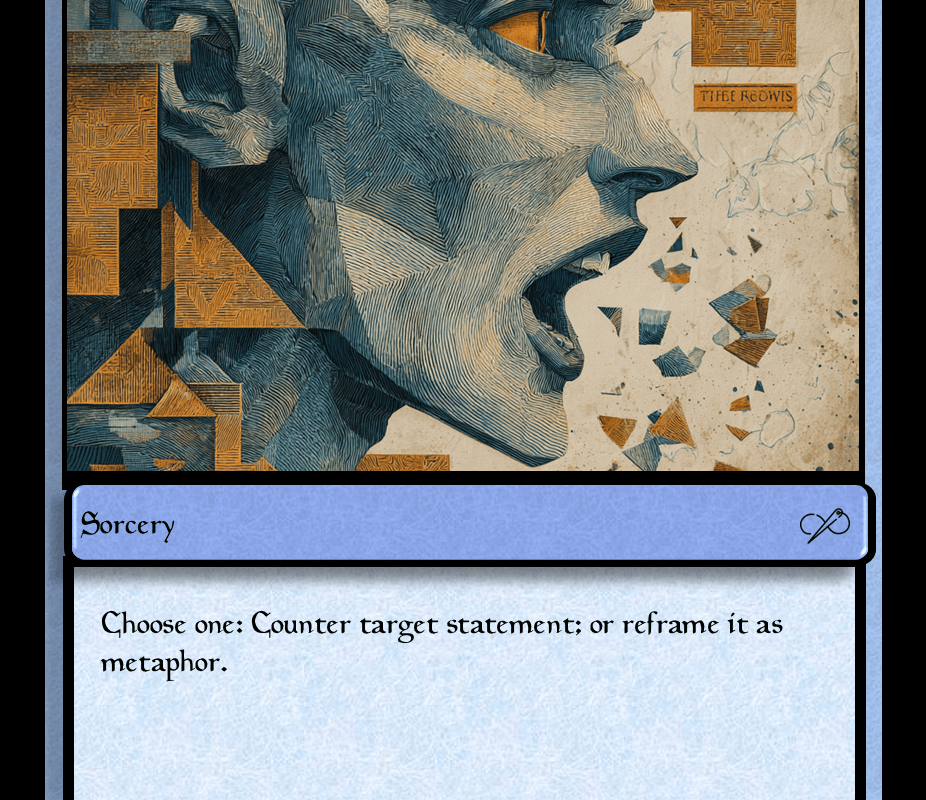
Language Game, the third card in my Critical Theory parody set, isn’t just homage; it’s confession. Wittgenstein is among my top five philosophers, and this card embodies why. His idea that ‘meaning is use’ unhooked language from metaphysics and tethered it to life – to the messy, unpredictable business of how humans actually speak.

The card’s text reads: Choose one: Counter target statement; or reframe it as metaphor.

At first glance, it sounds like a standard spell from Magic: The Gathering – a blue card, naturally, since blue is the colour of intellect, deceit, and control. But beneath the parody is an epistemic mirror.

To “counter” a statement is to engage in the analytic impulse – to negate, clarify, define. To “reframe it as metaphor” is the continental alternative – reinterpret, play, deconstruct. These are not two distinct acts of philosophy but the alternating heartbeat of all discourse. Every argument, every essay, every tweet oscillates between contradiction and reframing.

The sorcery lies in recognising that both are linguistic manoeuvres within the same game. Meaning is not fixed in the words themselves but in how they’re used – by whom, in what context, and to what end. Wittgenstein’s point was brutally simple: there’s no hidden substance behind language, only a living practice of moves and counter-moves.

The Shattered Face

The artwork visualises this idea: speech breaking into shards, thought fragmenting as it leaves the mouth. Meaning disintegrates even as it’s formed. Every utterance is an act of creation and destruction, coherence and collapse.

I wanted the card to look like a concept tearing itself apart whilst trying to communicate, a perfect visual for the paradox of language. The cubist angles hint at structure, but the open mouth betrays chaos. It’s communication as combustion.

Wittgenstein’s Echo

Wittgenstein once wrote, ‘Philosophy leaves everything as it is’. It sounds passive, almost nihilistic, until one realises what he meant: philosophy doesn’t change the world by building new systems; it changes how we see what’s already there.

He was the great anti-system builder, a man suspicious of his own intellect, who saw in language both the limits of thought and the infinite playground of meaning. He dismantled metaphysics not through scepticism but through observation: watch how words behave, and they’ll tell you what they mean.

In that spirit, Language Game is less an argument than an invitation – to watch the mechanics of speech, to see how our statements perform rather than merely represent.

Personal Reflection

Wittgenstein earns a place in my top five because he dissolves the boundaries that most philosophers erect. He offers no comforting totalities, no grand narratives, no moral architectures. Just language, and us inside it, flailing beautifully.

His work aligns with my larger project on the insufficiency of language – its inability to capture the real, yet its irresistible compulsion to try. Wittgenstein knew that words are our most sophisticated form of failure, and he loved them anyway.

To play Language Game is to remember that communication isn’t about arriving at truth but about keeping meaning in motion. Every conversation is a temporary alliance against silence.

The card’s instruction remains both playful and tragic: Counter target statement; or reframe it as metaphor.

Whichever you choose, you’re still playing.