Fischer, One of Four Views on Free Will

I’ve finally returned to the second author of Four Views on Free Will. The first author was Robert Kane. Here, I was introduced to John Martin Fischer, who wrote a section on Compatibilism. I’ve never read anything by Fischer. Indeed, I have no familiarity with him or his work. Allow me to start by saying that I was not impressed. Before diving into the content, let’s just say that he was extremely repetitive and circumlocutive. I found myself questioning whether the book was assembled with duplicate pages. Hadn’t I just read that? I’ll spare the reader the examples.

I repeat myself when under stress

I repeat myself when under stress

I repeat myself when under stress

I repeat myself when under stress

— King Crimson, Indiscipline

The topic was 44 pages on compatibilism. The first 30 pages were compatibilism before he changed to his brainchild, semi-compatibilism. Full disclosure: I am not a compatibilist. My recollection is that the majority of contemporary philosophers are compatibilists. Joining Fischer are Dan Dennett, Frithjof Bergmann, Gary Watson, Susan R. Wolf, P. F. Strawson, and R. Jay Wallace. Historically, this cadre are joined by Hobbes, Locke, Hume, and Mill. This motley crew has been opposed by Peter van Inwagen and historical figures, Arthur Schopenhauer, William James, and Immanuel Kant.

Semi-compatibilism is the idea that regardless of whether free will and determinism are compatible, moral responsibility and determinism are.

At a meta-level, Fischer repeatedly—I’ll discontinue using this term as, like Fischer, it will become very, very repetitive—invoked law and common sense. Law is not a moral structure in search of truth. It’s a power structure employed to retain the status quo. And, as Voltaire quipped, ‘common sense is not so common.’ This is an argumentum ad populum (appeal to popularity) fallacy. It also relies on belief and perception. I suppose he’s not familiar with Descartes’ Meditations. It seems he is trying to forge Compatibilism into a cast of soft determinism with hopes that no one notices the switcheroo.

Fischer targets some quotes buy Kant, James, Wallace Matson, and Nietzsche with the general critique that they are expecting too much of an agent by expecting it to be the cause of its own actions. Nevermind, that he is guilty of just this in attempting to parse passive and active agents—passive being insentient dominos and active being conscious entities.

I’m not convinced that maths is a strong point. He sets up a hypothetical scenario where physics has proven that causal determinism is true, so 100 per cent of everything in the universe can be known with certainty. But then he does two things.

First, he exempts human agency—cuz reasons. Second, he creates a parallel scenario where 100 per cent might be 99 or 99.9 per cent.

Second, he claims that because he feels free, he must be free.

Similarly, it is natural and extraordinarily “basic” for human beings to think of ourselves as (sometimes at least) morally accountable for our choices and behavior. Typically, we think of ourselves as morally responsible precisely in virtue of exercising a distinctive kind of freedom or control; this freedom
is traditionally thought to involve exactly the sort of “selection” from among genuinely available alternative possibilities alluded to above. When an agent is morally responsible for his behavior, we typically suppose that he could have (at least at some relevant time) done otherwise.

— Fischer, p. 46

Nothing is such that thinking doesn’t make it so.

It seems that when watching a movie for the third time, the victim who gets killed in the cellar won’t descend the stairs this time. Fisher must get perplexed when she does every time. Of course, he’d argue without evidence that an active agent would be able to make a different decision—even under identical circumstances. He insists that the agent possesses this free will.

Whilst sidestepping physicalism and materialism, he simply posits that consciousness is just different and not subject to other causal chain relationships—and that these cannot be deterministic even if everything else is.

I’m going to digress on his next point—that the person who knows not to cheat on taxes, and who does so anyway, is responsible as any normal person would be. Perhaps the person feels that the taxes are being used for illegal or immoral purposes and is taking the moral high ground by depriving the institution of these proceeds.

Around 2007 or so, I paid my taxes due minus about $5,000, which was the calculated amount of the per capita cost of the illegal and immoral Iraq invasion by the United States and its cadre of war criminals in charge. I attached a note outlining my opposition and rationale.

Some months later, the Internal Revenue department sent a legal request to my employer for the withheld sum. Payroll summoned me and conveyed that they were required to comply with the request. I told them my perspective and said if they could sleep with that on their conscience, then they were in their power. And so no nights of sleep were lost.

The point of this anecdote is to say that morals are social constructs. Clearly, Fischer is just an old-fashioned conformist. I suspect he thinks of Valjean as a bad person.

Like many if not most people, he employs a compos mentis approach, exempting persons of reduced cognitive capacity and those under duress or coercion, but he is not a proponent of the causa sui defence.

He has an entire subsection devoted to the libertarian notion of freedom. To recapitulate, he simply regurgitated all of the standard arguments and exempts the aforementioned agents and adds people under hypnosis, the brainwashed, and so on. Nothing to write home about—not here either.

In the next subsection, his focus is on consequences. He calls out Peter van Inwagen’s Consequence Argument.

Similarly, the skeptical argument about our freedom employs ordinary ideas about the fixity of the
past and the fi xity of the natural laws (putatively) to generate the intuitively jarring result that we are not ever free, if causal determinism turns out to be true (something we can’t rule out apriori). If this skeptical argument is sound, it calls into question any compatibilist analysis of freedom (that is, freedom of the sort under consideration – involving the capacity for selection among open alternatives). If the argument is sound, then not only both the simple and refined conditional analysis, but any compatibilist analysis (of the relevant sort of freedom) must be rejected.

Fischer p. 53

He leans on Borges’ garden of forking paths and claims (without support) that although the past might be fixed, freedom is the ability to add to the future, citing Carl Ginet as the source of this notion. He misses the point that that’s what the future is, tautologically. It adds now to the past and generates a future. Choice is not necessary for this function to operate, but he continues to insist on invoking it.

Standard Frankfort examples are referenced as well as Locke. Here he wants to point out regulative control—but he skirts the question of where the volition comes from by saying ‘for his own reasons‘, as if these reasons are somehow meaningful. In the end, he recites the scenarios, performs some hand-waving, and summons his accord with Robert Kane’s “dual voluntariness” constraint on moral responsibility.

He leaves us with the thought that if the Consequence Argument were true, it would be compatibilism’s death knell, but it’s not true (in his mind), so all is well in Whoville. Crisis averted.

Source incompatibilism is next. His focus here is on the “elbow room” necessary to exercise free will.

Elbow Room is the title of a book by Daniel Dennett originally published in 1984 and republished in 2015. I’ve recently read this on holiday, but I haven’t had time to review it. Please stand by.

His approach in this subsection is to attack opposing perspectives as reductionist. Of course, he’s right, but they are no more reductionist than anything he’s suggested thus far. Besides, simply injecting favoured concepts to add to a model to make it compatible with one’s hypothesis doesn’t make it less reductionist. It just makes the model more convoluted.

Here he attempts to elevate consciousness into a special category in order to shield it from the physics of the universe. We can’t say for sure what consciousness is, but you can bet it’s a magical place where practically anything can happen. OK, that’s a bit of hyperbole.

He uses the metaphor of trying to assess how a television works by only studying the components. Of course, if that is all one did, one would be left with questions. But that is not where one stops. To be fair, neuroscience has come a long way since this was published in 2007. Neuroscientists are asking questions beyond the hardware.

He sets up a strawman by labelling total control as a chimaera as if anyone is arguing that if a theory doesn’t allow for total control, it will not be accepted. He does allow that…

We do not exist in a protective bubble of control. Rather, we are thoroughly and pervasively subject to luck: actual causal factors entirely out of our control are such that, if they were not to occur, things at least might be very different.

— Fischer, p. 68

We agree on this point, but I feel that he underestimates the remaining degrees of freedom after all of this is accounted for.

He attempts to create a mental model with vertical and horizontal lines. At least he admits that he does “not suppose [to] have offered a knockdown argument” because he doesn’t.

Finally, he wraps up this subsection by invoking Nietzsche’s famous Munchausen Causa Sui statement in Twilight of the Idols. He attacks this rationale as being “both ludicrous and part of commonsense.” He loves his commonsense.

Next, he wants to convince us, Why Be a Semicompatibilist? Semicompatibilism just needs enough elbow room to assert freedom. I suppose that’s the ‘semi‘ part. It feels to me an exercise in self-delusion.

The main idea behind semicompatibilism is to shrink the target size of compatibility and focus centrally on moral responsibility and agent control rather than the larger realm of free will.

Fischer makes what might be considered to be a religious argument. We should adopt this perspective because it feels better and is in our best interest. He cites Gary Watson’s view of using indeterminism to undermine determinism, but he feels that rather etiolates control rather than strengthening it because it “becomes unclear that our choices and actions are really ours.”

In the next subsection, he leads with the argument “that moral responsibility does not require regulative control, but only guidance control, and further that it is plausible that guidance control is compatible with causal determinism.” At least, this is the story he’s sticking to.

In Fischer’s “approach to guidance control, there are two chief elements:
the mechanism that issues in action must be the “agent’s own,” and
it must be appropriately “reasons-responsive.””

As for the “agent’s own” constraint, he simply notes that counterclaims exist, but he asserts that he doesn’t accept them.

As for reasons-responsiveness, he cites his own publication written with Mark Ravizza, Responsibility and Control: A Theory of Moral Responsibility, and declines to elaborate in this essay.

In the final subsection, he writes about the Lure of Semicompatibilism. I do feel he is lured by the concept and makes light of the label. He advances the notion that “Kant believed that compatibility and incompatibilism are consistent“. Say what? But he takes a weaker position on this claim, using the Kant name-drop for cover.

As I said at the start, I don’t know anything about Fischer, but he is obsessed with legal theory as if it has any bearing on philosophical standing. Perhaps I’ll include a summary from a quick internet perusal. After I’ve wrapped this up. He mentions moral desert, which is a concept employed in matters of restorative and retributive justice.

The section concludes with a list of publications by him and others. Perhaps I’ll list them here in future as an addendum. For now, I’ll pop outside of this edit window and see what I can find on John Martin Fischer.


John Martin Fischer (born December 26, 1952) is an American philosopher. He is Distinguished Professor of Philosophy at the University of California, Riverside and a leading contributor to the philosophy of free will and moral responsibility.
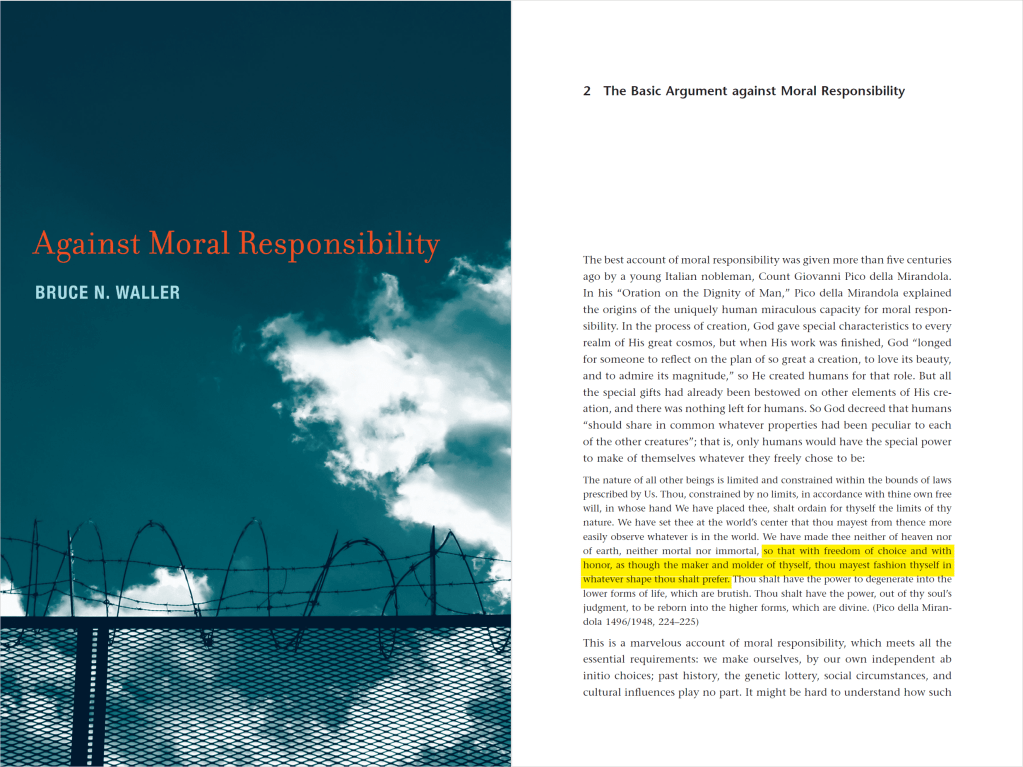
Against Moral Responsibility

We have made thee neither of heaven nor of earth, neither mortal nor immortal, so that with freedom of choice and with honor, as though the maker and molder of thyself, thou mayest fashion thyself in whatever shape thou shalt prefer.

Bruce Waller
Bruce Waller, Against Moral Responsibility

Nothing really to add here now, but more on the way. Meantine, sharing this for reference.

Blame

Even the moral sceptic is not immune from his own form of the wish to over-intellectualize such notions as those of moral responsibility, guilt, and blame. He sees that the optimist’s account is inadequate and the pessimist’s libertarian alternative inane; and finds no resource except to declare that the notions in question are inherently confused, that ‘blame is metaphysical’.

PF Strawson, Freedom and Resentment
Quote from Freedom and Resentment and Other Essays by PF Strawson

Part of my central thesis of non-agency is centred on the notion of blame, and it seems PF Strawson has a lot to contribute in this arena. In short, given my lack of belief of material human agency, I wish to investigate the connection between seemingly innate impulses to project blame and the absence of a blameworthy object.

In order to devote more time to researching and writing my thesis and less time editorialising elsewhere, I may post some shorter content such as these gems that I stumble upon along the way. This facilitates my desire to create and share content without the burden of devoting hours to render it. It also gives me places to come back to.

I only hope that you don’t blame me for doing so.


Meantime, indulge my recording my thoughts here in the public space.

What is blame?

We don’t have very precise definitions of blame, we have an intuitive sense of what it means. There is a subject (or object, as the case might be) that creates (or has been attributed to have created) an action that results in an interaction on an object (or process) with a subsequent effect and a notion of intentionality. But we have to parse casual effect, responsibility, and blame as they are not strictly equivalent. Let’s begin with a causal event.

I believe that on balance the causal event process and object interaction is uncontroversial. A billiard ball (Object A), through directed (or undirected) motion, collides (action) with a second billiard ball (Object B) with the subsequent effect of displacing the second ball.

What we can claim in this scenario is that A → B, A causes B to move. Except in the loosest of idiomatic speech, we can’t really extend this causal relationship to claim that A is responsible for B’s movement. Even further removed, one can’t claim that A is to blame for B’s movement.

Responsibility and blame are different moral claims attributed to an agent. I feel I am safe to claim that a billiard ball has no agency. Whilst human agency is defined as an individual’s capacity to determine and make meaning from their environment through purposive consciousness and reflective and creative action (Houston, 2010), an agent in a more general sense is a being with the capacity to act, and ‘agency’ denotes the exercise or manifestation of this capacity.

The word blame is infused with negative connotations. Praise is a loose antonym with positive connotations, but I won’t focus on it because it is not nearly as heavy and operates semantically differently. In any case, I feel justified to cross blame from the list of possible qualifiers for the billiard ball scenario.

Is A responsible for B? Again, I believe that most people do not assign responsibility to inanimate objects—notwithstanding animism, pantheism, and possibly panpsychism.

Here are some diagrammes.

Above, there is only cause and effect. We can intuit that the movement of Object A is not uncaused. Even so, it careens into Object B, causing it to move. And while one could say A is responsible for moving B, this would be non-standard English language use.

If one pulls back to catch a wider glimpse, one can see that the cause of Object A striking Object B, was a person striking Object A (possibly with a cue stick). Here, the casual event chain is the person causing A to strike B. Two cause-effect relationships at a macro level. However, in this case, we can also say that the person is responsible for the event to set A into motion. We can also say that the person caused B to move (by the way of Object A). Even here, blame would be inappropriate to assert.

We may be able to reframe the scenario slightly differently to get blame into the picture, but let’s take a short detour and create a praise situation. If Object B is hit into a pocket, we can praise the person. Perhaps this shot wins the game. The person is responsible for making the shot.

In scenario B, the person misses the shot. Moreover, Object A does collide with Object B, but perhaps Object B is the 8 ball, and it was not supposed to be pocketed yet. Or perhaps the cue ball deflects off of Object B causing A to scratch because it falls into a pocket. Either of these situations might cause the person to lose the match. A mate may blame this person for being responsible for the loss.

Before moving on, I’ll point out that one distinction that affords blame more weight than praise is the ongoing psychology. Whilst with praise, a person may reflect fondly on a positive event, there is not really a counter to a grudge in the case of blame. And while praise can be misattributed with benefits to social capital, misdirected blame can result in a loss of social capital with longer-term implications.

Perhaps someone unseen pushes you into another person causing them to be injured. You may have been the cause of this person being injured, but like the billiard ball, Object B, you are not morally responsible. Moreover, you may be the target of blame.

These are rather low-stakes scenarios. Imaging these as legal negligence or in a criminal setting. Innocent people are routinely convicted for crimes they never committed. Perhaps, they had been previously unaware of any of the actors or events, yet they are blamed and fined or incarcerated.

This isn’t my interest to discuss at the moment. This is a different scope, so let’s return to the main theme.

In the low-stakes billiards example we can say that the person seems to have agency. For trivial events, we can ignore whether this is more than seeming. In essence, we can ignore the antecedent event arrow that caused the person to be in a situation to have the opportunity to strike the ball in the first place. We’ll return to this later.

Can We Just Stop Talking About Free Will

The problem with free will is that we keep dwelling on it. Really, this has to stop.

Owen D. Jones, The End of (Discussing) Free Will, 18 March 2012

This quote was made by Owen Jones in an article published in 2012. I share it because I feel the author is not only being cavalier but wrongly so. According to the bio at the end of the article, Owen D. Jones is a professor of law and biological sciences at Vanderbilt University. As I see it, the problem is not some theoretical—What is the sound of one hand clapping?—pseudo-problem. Human agency is the basis of our legal and jurisprudence systems.

Like good magicians, people like Owen want to redirect your focus to neuroscience and consciousness rather than have to explain how the causal engine that is the brain manifests itself ex nihilo.

Doubling down on my causa sui position, humans may be able to make constrained solutions, and yet they never have control over the constrained system they inherit. I discuss this at length elsewhere, but I wanted to address this comment forthright.

I’ll leave with a quote I tend to trot out a lot.

It is difficult to get a man to understand something when his salary depends on his not understanding it.

— Upton Sinclair, prepared speech, I, Candidate for Governor (1935)

Free will is a necessary illusion for power structures to propagate or they will lose a cornerstone of their control mechanisms. And since humans want to feel they are in control, they are willing to accept the downside for the illusion of an upside.

Individual and Collective Agency and Freedom

As a person dismissive of individual human agency, of course, I am not going to rate the probability of collective agency highly. However, I am very drawn to this topic because I am sure there will be attempts to make parallels and connexions between the individual and the collectives. My guess is that attacks by those who support individual agency yet deny collective agency will pose arguments that will in the end undermine their own position that they will nonetheless cling to.

Colloquium Poster

This event is being broadcast on Zoom on 21 through 23 July 2022 from 17:00 – 21:00 Tawain Time (GMT +8).

Conversational topics will be (i) The Reality of Free Will and (ii) The Loci of Responsibility, two topics near and dear to my interest.

Details can be read here: https://www.lmpsttw.org/ch/events/5thtmc-schedule-721-723

A colleague had this to add.

A question that exercises the minds of philosophers is the existential status and role of groups and collectives. Do ‘forests’ exist, or are there just trees in proximity? Do “herds” exist, or are there just elephants? Perhaps the answers to these questions are of little consequence, but there are other, more interesting questions like, for example:

Do collectives act as single units, and if so, how? Do properties of individuals ‘scale’? For example, we readily attribute consciousness and intelligence to individual humans, can we also attribute consciousness and intelligence to a committee, or community? How is a collective conscious or intelligent? Also, individuals have ‘agency’ – they can/do exercise their individual “will” – but does a collective have a “will”, or “agency”? Does a large population of agents (a ‘country’, say) have a ‘will’ of its own? Does a country have ‘free will’,, and ‘know’ what it is ‘doing’? Do such questions even make sense?

On July 21-23, the National Taiwan University is holding a mini-conference about such “social ontology” conundrums, via ZOOM: https://ucl.zoom.us/j/98941995734, Zoom room ID:989 4199 5734

Revisiting Time Reborn

I’ve just finished with Time Reborn. I wasn’t expecting to be converted to Smolin’s proposition that time is real rather than constructed. I enjoyed the book, and he provided a solid foundational understanding of the conventional scientific perspective (circa 2013, when the book was published).

I understand that Smolin is a professional physicist with a PhD and his grasp of the fundamentals is solid, and I am a peripheral scientist at best. I fully grant that I may be on the left of the Dunning-Kruger curve and making rookie mistakes.

The biggest contention I have is that he insists that everything needs to have a reason, citing Leibnitz. His argument is based on the question of why is our universe so perfectly structured, that it would be improbable to have happened purely by chance.

Whilst I agree that everything has a cause, reasons are an artifice imposed by humans. In practice, where reasons don’t exist, we make them up. This is how we get false theories and gods. Smolin does discuss false theories of the past and attempts to claim that the prevailing theories occupy this space whilst his theory should replace it.

Any universe created without the ability to sustain life would not have us asking why it did not support life.

My reaction is that it just is. Whether Roger Penrose is correct in saying that the universe is continually recreated and destroyed, rinse and repeat, the reason the universe is constructed in such an (improbably) ordered fashion that can sustain life is that there is no reason. Any universe created without the ability to sustain life would not have us asking why it did not support life. It does. We are here to question, and so we do. End of story.

We can make up all sorts of stories, whether through science, religion, or some other origin myth. None of them is provable. As Smolin notes, this is a one-time event. If it is destroyed, so are we and our memories. If life is sustainable in a future—or even parallel—configuration, we’re sent back to start where we can fabricate new stories.

Perhaps in another universe, it will be configured so differently that some other sort of life is created, perhaps this life will not be DNA-based and be anaerobic? Who knows?

It seems that he has an interest in reserving a place for human agency, which has little room for movement in current scientific models. His model provides this room. Moreover, he further thinks that even in current models, human agency should be injected into the models. I suppose he is not familiar with Keynes’ animal spirits.

For some reason, he decided to devote the final chapter to the hard problem of consciousness. This was a particularly hot topic around that time, so he didn’t want to miss the boat. The long and the short of it, he didn’t think the qualia-consciousness answer would be found through physics—though he reserved that there was a non-zero probability that it could be. He posits this as an existential, experiential challenge, and science is not designed to address such affairs.

Physics of Free Will

Physicist, Sean Carroll, gives Robert Lawrence Kuhn his take on free will. I was notified about this when it was posted, and given the topical subject matter, I took the 8-odd minutes to listen to it straight away.

I wish I had been there to pose a follow-up question because, although he provided a nice answer, I feel there was more meat on the table.

Like me, Sean is a Determinist who feels that the question of determinism versus indeterminism is beside the point, so we’ve got that in common. Where I feel we may diverge is that I am an incompatibilist and Sean is a compatibilist. I could be interpreting his position wrong, which is what the follow-up question would be.

I say that Sean is a compatibilist because he puts forth the standard emergence argument, but that’s where my confusion starts. Just to set up my position for those who don’t prefer to watch the short clip, as a physicist, Sean believes that the laws of physics, Schrödinger’s equation in particular.

We have an absolutely good equation that tells us what’s going to happen there’s no room for anything that is changing the predictions of Schrödinger’s equation.

— Sean Carroll
Schrödinger’s Equation

This equation articulates everything that will occur in the future and fully accounts for quantum theory. Some have argued that quantum theory tosses a spanner into the works of Determinism and leaves us in an Indeterministic universe, but Sean explains that this is not the case. Any so-called probability or indeterminacy is captured by this equation. There is no explanatory power of anything outside of this equation—no souls, no spirits, and no hocus pocus. So far, so good.

But Sean doesn’t stop talking. He then sets up an analogy in the domain of thermodynamics and statistical mechanics and the ‘fundamental theory of atoms and molecules bumping into each other and [the] emergent theory of temperature and pressure and viscosity‘. I’ve explained emergence in terms of adding two hydrogen and one oxygen atom to create water, which is an emergent molecule with emergent properties of wetness.

My position is that one can view the atomic collection of matter at a moment as an emergent property and give it a name to facilitate conversation. In this case, the label we are applying is free will. But there is a difference between labelling this collection “free will” as having an analogous function to what we mean by free will. That’s a logical leap I am not ready to take. Others have equated this same emergence to producing consciousness, which is of course a precursor to free will in any case.

Perhaps the argument would be that since one now has emergent consciousness—I am not saying that I accept this argument—that one can now accept free will, agency, and responsibility. I don’t believe that there is anything more than rhetoric to prove or disprove this point. As Sean says, this is not an illusion, per se, but it is a construction. I just think that Sean gives it more weight than I am willing to.

No Agent, No Agency

There is no spoon” is a classic line from The Matrix. Reality is a construct. I agree, but I’m not sure I believe that we can get under this reality to experience it differently. And this might hinge on a distinction between experience and perception.

Losing Ourselves is a book just published in the US and forthcoming (July 2022) in the UK promoting the Buddhist notion of no-self or selflessness. I’ve been partial to Buddhism since, when I lived outside of Tokyo, I was exposed to it in 1980.

Book Cover: Losing Ourselves

For me, this intersects with my anti-Agency endeavour. If the Self is a construct, there is no Agent, and without an agent, there is no Agency. I realise that this is a meta-position and not uncontroversial, but I do like to collect ideas and perspectives in my quiver.

Obviously, there seems to be a strong drive (at least in the West) to construct selves, not the least of which serves the purpose of an object to confer praise or blame. Interestingly, I’ve heard much about objectification, but not many seem to care about this form. It’s more about sub-objectification.

It’s OK to parse the person from the fabric of the universe, but don’t further disintegrate that person.

Moral Responsibility

Can we be held morally responsible for our actions? Yes, says Daniel Dennett. No, says Gregg Caruso. Reader, you decide

Aeon Article, 4 October 2018

Caruso: [Dan,] you have famously argued that freedom evolves and that humans, alone among the animals, have evolved minds that give us free will and moral responsibility. I, on the other hand, have argued that what we do and the way we are is ultimately the result of factors beyond our control, and that because of this we are never morally responsible for our actions, in a particular but pervasive sense – the sense that would make us truly deserving of blame and praise, punishment and reward. While these two views appear to be at odds with each other, one of the things I would like to explore in this conversation is how far apart we actually are. I suspect that we may have more in common than some think – but I could be wrong. To begin, can you explain what you mean by ‘free will’ and why you think humans alone have it?

Gregg Caruso

Dennett: A key word in understanding our differences is ‘control’. [Gregg,] you say ‘the way we are is ultimately the result of factors beyond our control’ and that is true of only those unfortunates who have not been able to become autonomous agents during their childhood upbringing. There really are people, with mental disabilities, who are not able to control themselves, but normal people can manage under all but the most extreme circumstances, and this difference is both morally important and obvious, once you divorce the idea of control from the idea of causation. Your past does not control you; for it to control you, it would have to be able to monitor feedback about your behaviour and adjust its interventions – which is nonsense.

In fact, if your past is roughly normal, it contains the causal chains that turned you into an autonomous, self-controlling agent. Lucky you. You weren’t responsible for becoming an autonomous agent, but since you are one, it is entirely appropriate for the rest of us to hold you responsible for your deeds under all but the most dire circumstances. 

Daniel Dennett

if your past is roughly normal, it contains the causal chains that turned you into an autonomous, self-controlling agent

Dan Dennett

So commences this debate. The argument unfolds largely on semantic grounds. Even here, one can see the debate over the distinction between control and causation. I understand what Dennett is attempting to parse here, but I object on the grounds of causa sui.

I recommend reading the Aeon article as there is much more than this distinction, but it does remain a semantic issue. I started a post on backwards- and forward-looking perspectives, that better articulate Caruso’s perspective, but I am also working on other things. This was quicker to post and I wanted to keep a bookmark anyway, so it’s a win-win.