In the spirit of full disclosure and to set the stage, I’m an atheist and can’t remember being otherwise. I’ve discussed this here before at length. Iain McGilchrist is not.
Religion is the topic of chapter nine of The Master and His Emissary. I understand what the author is saying, and I think a question I have about a fundamental issue is coming to head. Although I’ve spoken at greater length before, I’ll recapitulate here.
An assertion of McGilchrist’s is that we should judge the hemispheres by how well each corresponds to the truth of reality. He goes on to tell us that the left hemisphere is the controller of words, so we shouldn’t get hung up on the word truth and the definition that pales relative to the intuition of truth. I have an issue with this, but I’ll return to it in a moment.
As I’ve stated countless times by now, the left cerebral hemisphere is convergent and closing whilst the right is divergent and expansive. The left is intellect whilst the right is intuition. The left is categorisation, naming, and re-presentation whilst the right is Gestalt and presentation. The left is literal whereas the right is metaphorical. I’ll return to this presently.
Before touching on religion, I’ll articulate my challenge. He makes an unsubstantiated assertion that we can’t build a whole from a sum of parts. Instead, we need to accept the whole as presented as is, and realise that we may not be able to fully account for all of the parts. Just trust our intuition of the experience.
My contention here is that neither is quite right. Whilst the left hemisphere has the possibility of leaving things out, the right hemisphere has the possibility of adding irrelevant or otherwise injected content. In the case of religion, this would be along the lines of inserting a god of the gaps. I’ll come back to this.
All religions are not created equal. McGilchrist argues that Catholicism is a right-hemisphere religion whilst Protestantism, in particular Lutherans, operates from the left hemisphere. He even cites Max Weber’s writings noting the connexion between Protestantism and Capitalism. Despite being raised in an area with seventy-odd per cent Roman Catholics, I don’t know enough about Catholicism to critique that part of his assertion, but I agree with his statement on Protestants. As for my intuition, I’d say that all of the rote ritualism is a left-hemisphere function, but I’m not sure.
As he continues his argumentation he makes a case that religion needs to be taken metaphorically and cannot be deconstructed. This is to lose the proverbial woods for the trees. Of course, this is not only precisely what the left hemisphere does it’s also what the Protestant reformation did and Protestantism continues to do today. Like Capitalism, the focus is on the individual. For Catholics, it’s communal. Although he doesn’t cite Calvanlism and the ideal of work, the result is the same. Hard work yields a preternatural payoff.
I have no problem with metaphor, whether in speech, writing, art, or music. I’ve been a musician and dabbled in art. Much of my favourite fiction is metaphorical, and I don’t need to dissect it any of these to enjoy the experience.
religion can be experienced metaphorically
I am even willing to grant that religion can be experienced metaphorically. I have no quarrel here. Where his argument tends to lose ground is when it becomes prescriptive and systematised. Again, I am no expert on Catholicism, but I have attended Catholic church ceremonies. I even got ejected from CCD classes I had attended with a mate when I was eight or nine years old—not a great way to win hearts and minds.
When I lived in West Los Angeles—Palms to be exact—, my apartment was across the street from an Anglican church. Down the road, there was a Hare Krishna ashram—very diverse. I poked my nose into each. In fact, the Anglican church was my designated voting location, so I visited there on that occasion periodically. The spectacle of the smoke of frankincense and myrrh billowing out and wafting up is still a pleasant recollection. Frankly, I hadn’t thought of it in years, but writing about it returned the memories. Of course, the ashram had its own incense; only it was nag champa.
Some self-professed ‘spiritual’ people I have encountered, love the spectacle of a Catholic ceremony. There are candles, rituals, chanting, kneeling, chorals, and incantations. I can see how these can be taken metaphorically, but it’s also rote. But that’s not where my difficulty lay.
My problem is not that religion can’t be interpreted metaphorically. In fact, I can’t agree more. My problem is that this metaphor further aligns to God or to gods. But wait. I know what you’re thinking. Those are just metaphors, too. And I agree. The problem isn’t that I don’t grant or understand that. It’s that the parishioners don’t. They think there is an old bearded man in the clouds issuing commandments and listening for their prayers. And if you don’t toe the line and play nice, your eternal life prospects don’t look good.
He does argue that this fire and brimstone are artefacts of the Protestants, but this is what I see depicted in films and books. Obviously, the Southen Baptist preacher at the pulpit shrieking sermons is Protestant fare. On the other hand, Catholics have demons to exorcise and rosary beads and confession. I can see that these are metaphorical. Perhaps he’s right. I don’t know if Catholics have the equivalent of eternal hell. They do have—or did have—a purgatory. Do they have a decalogue. As far as I know, they do. Perhaps he was just speaking in relative terms—that Catholic tradition is just more right-hemisphere-oriented than Protestantism.
If this is the extent of his claim, we agree, but he goes further and invokes the divine. Yet again, I can accept this as a metaphor, but I feel he means it to be taken more literally. In any case, the followers seem to tend to.
With meditation … the idea is to let go and forego attachment
This brings me back to God of the gaps. Metaphors are concepts or notions. I say this because, metaphors don’t, for example, answer prayers. The act of praying may be metaphorical—perhaps I could equate it to singing or meditation—, but no physical action is expected in return. With singing, the effect may be a connexion or an emotion. The music is aiming to lift spirits or make one reflective or sad—perhaps add tension in a suspense movie. With meditation—guided meditation notwithstanding—, the idea is to let go and forego attachment. What do your suspect we are letting go of? What are we detaching from? The fetters of the left hemisphere—the bastion of judgment.
Prayer is different. On one hand, there is the metaphorical aspect of compassion and sharing, But it doesn’t end there. Susie has surgery and we pray for her recovery. Metaphorically, a believer may feel consoled by compassion. Even Susie may feel better, which will lead to a more positive disposition that may lead to faster recovery and healing, even if by placebo effects. On the other hand, perhaps not. And then there’s distance healing where the recipient isn’t even aware of the prayers, but they are either brokered by God or simply permeate the fabric of the universe or Jung’s collective unconsciousness. This is where it goes off the rails.
So, when I am asked to accept religion metaphorically but am also asked to accept magical thinking as part of that equation, I’m just not on board. Sorry. It makes no sense and doesn’t even feel intuitively right.
religion is about power
Call me a cynic, but for me, religion is about power. Perhaps at one time, the religious experience was a feeling, but all evidence points to this being almost immediately exploited by the priest classes and then by Government and other nefarious actors. Some countries are worse than others, but that’s no consolation.
In the end, I get the religion-metaphor connexion, and I trust that Iain is not so naive to see the Foucauldian power-control angle. Besides, if culture is shifting to the left hemisphere and can’t interpret metaphors very well—something experience demonstrates—, so I’m not sure the defence holds as much water as he wants it to.
Most people have heard the term schizophrenia. It’s a mental health pathology wherein people interpret reality abnormally. To oversimplify to make a point, in a ‘normal’ brain, the left and right hemispheres operate together to regulate bodily functions and to interpret the world we live in. In brief, schizophrenia is a condition where the left cerebral hemisphere overly dominates the right. Some might be led to believe that schizophrenics interpret reality irrationally, but the opposite is true. Schizophrenics are hyperrational to a fault.
Schizophrenia has been on the rise this past half century or so, but this might just be a symptom of Modernity, as cultures are also experiencing a leftward shift—a shift toward hyperrationality. Cultures have swung like a pendulum from left-hemisphere-dominance to right dominance and back through the ages, but we may be seeing an uncorrected swing further and further to the left, led by science, followed by commerce and politics, dangerously close to the territory of schizophrenia, if not already occupying this territory. Allow me to briefly summarise how the hemisphere function to help the reader understand what it means to be too far left or right.
Cerebral Bilateral Hemispheres
Most people experience the world—what some otherwise known as reality—with both cerebral hemispheres, and each hemisphere has a function. In a nutshell, the right hemisphere experiences reality holistically, which is to say that it views the world through a Gestalt lens. The right hemisphere is open and divergent. It is creative—generative. It knows no categories or subdivisions. All is one and connected. I like to refer to this as Zen. Many people can relate to this Zen notion. The right hemisphere is a creative and empathetic centre that only knows the world as it is presented—without words or naming. Intuition lives here. It distinguishes differences in the world in a manner similar to that of a preverbal child who can tell mum from a bowl of porridge without knowing the word for either. Children are right hemisphere creatures. As we mature toward adulthood, the function of the left hemisphere increases to offset the dominance of the right.
The left hemisphere is the sphere of intellect. Its function is to categorise, to create symbols—words, names, labels, icons, and so on. It doesn’t know how to create, intuit, or empathise. In fact, it doesn’t even experience the world as presented; it relies on re-presentation. To borrow from a computer analogy, when it experiences something in the world, it caches a symbol. Where the right hemisphere experiences a tree and just appreciates its ‘treeness’, and it doesn’t know that it’s a tree by name. It’s just another thing in the world. The left hemisphere, on the other hand, notices these things with ‘treeness’ and categorises them as trees—or des arbres, árboles, Bäume, 木, درختان , पेड़, or whatever. And it reduces the tree to an icon, so it can file it away for later retrieval to compare with other tree-like inputs.
The left hemisphere is where difference, the sense of self, and ego come from
The left hemisphere is where difference, the sense of self, and ego come from. Where the right hemisphere is open and divergent, the left hemisphere is closed and convergent. It is particularly egotistical, stubborn, and always thinks it’s right if I can anthropomorphise analogically. The left hemisphere knows no nuance, and it doesn’t recognise connotation, metaphor, allegory, or allusion. Everything is literal.
The left hemisphere can use similes and understand that a man is like a tiger, but it takes the right hemisphere to know that a man is a tiger, has metaphorically embodied the tiger and assumed its form, say in the manner of indigenous Americans. Poetically, there is a difference between being a tiger and being like a tiger. The left will have none of this. The response to hearing ‘he was a tiger’ would either result in ‘no he isn’t, he’s a human’ or ‘someone must be talking about a male tiger’. The nuance would be lost.
At the risk of further digression, this is why a poem can’t be dissected for meaning—this despite so many valiant attempts by high school teachers and undergraduate professors. Dissecting a living poem is like dissecting a living animal. You might learn something, but at the risk of devitalisation—you’ve killed the subject. It’s like having to explain a joke. If you have to explain it, it didn’t work. You can’t explain a work of art or a piece of music. The best you can do is to describe it. Although we’re likely familiar with the adage, “A picture is worth a thousand words”, a thousand words is not enough to do more than summarise a picture. This sentiment is captured by Oscar Wilde when he wrote, “Education is an admirable thing, but it is well to remember from time to time that nothing that is worth knowing can be taught.” Education is a left-brain function, that can be stuffed like a sausage, but no amount of education can make someone feel a work of art, music, or poetry. This can only be experienced and is apart from language.
A Tree is not a Tree
As already noted, schizophrenics are hyperrational. They are devoid of the empathy and intuition afforded by the right hemisphere. So, they fail to connect the parts to a constructed whole. They presume that a whole is constructed of parts. This is the mistake of Dr Frankenstein, that he could construct a man from parts, but all he could manage is to construct a monster.
In the experienced world, there are only whole objects as experienced by the right hemisphere. As humans, we break them down for easier storage and retrieval, but this is like lossy compression if I can risk losing some in technical lingo.
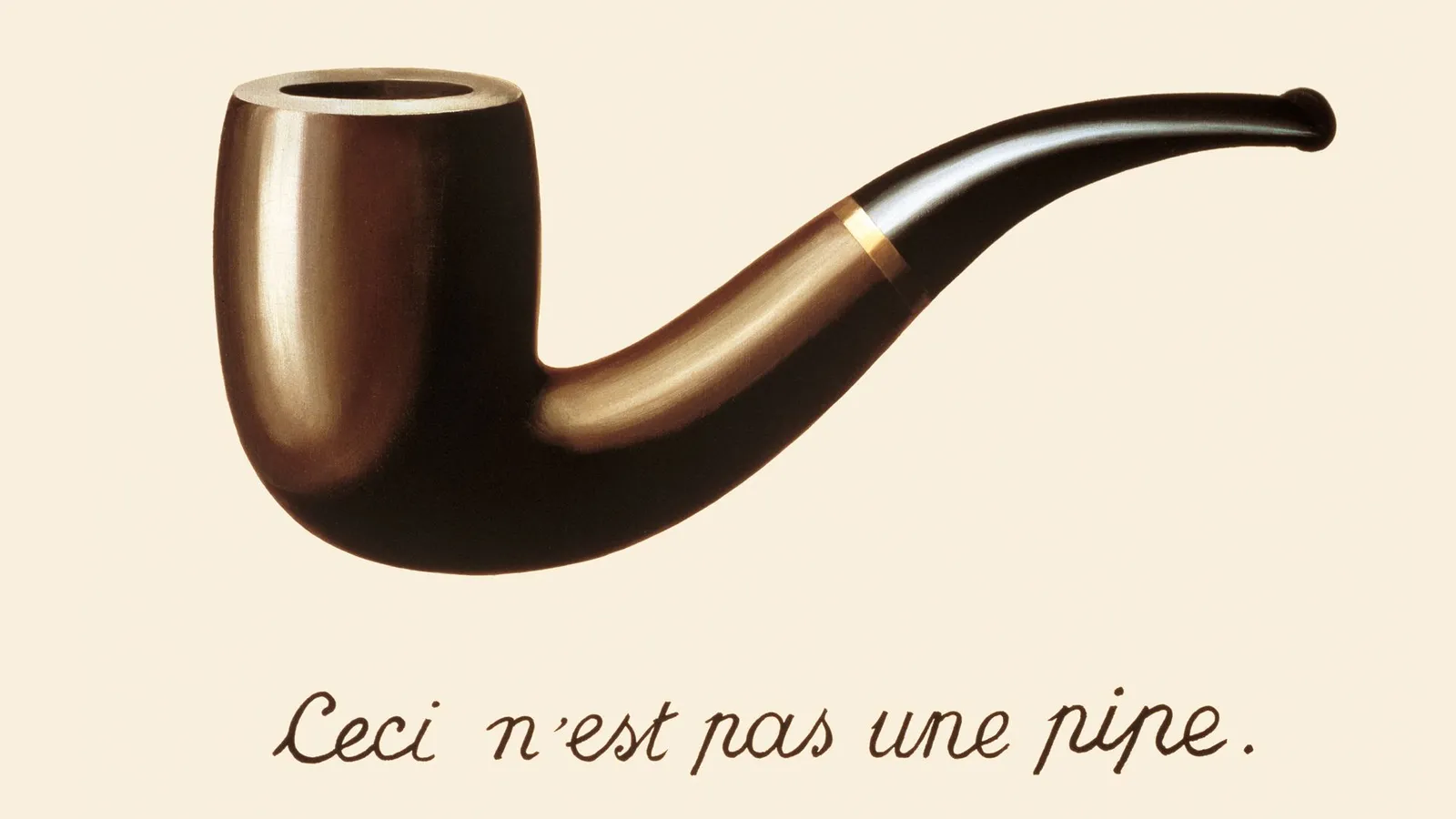
But a tree is not built from parts. It’s just a tree. We can articulate that a tree has a trunk and roots and branches and leaves and seeds and blooms, but it’s just a tree. The rest we impose on it with artificially constructed symbol language. This is what post-modern painter Rene Magritte was communicating with the “Ceci n’est pas une pipe” inscription in his work The Treachery of Images—This is not a pipe. He was not being cute or edgy or trying to be clever. He was making the point that the symbol is not the object.
In the manner that the image is not the pipe, it’s been said that to document a system is to make an inferior copy. The documented system is less optimal. This may feel counterintuitive. In fact, you may even argue that a documented system allows subsequent process participants to plug into the system to allow it to continue to operate into perpetuity. Whilst this is true, it comes at a cost. I’ll leave this here for you to ponder. The right hemisphere understands the difference. The document is not the process.
Getting Down to Business
If you’ve been following along, you may have already noticed that the left hemisphere looks and sounds a lot like the business world. Everything is systematised, structured, and ordered. We have all sorts of symbols and jargon, processes, and procedures. Everything is literal. There is no room for metaphor. There is no room for empathy. HR instructs that there be empathy, but they might as well instruct everyone to speak Basque or Hopi. In fact, it’s worse because at least Basque and Hopi can be learnt.
Sadly, this leftward shift isn’t limited to the world of commerce. It’s affected science, politics, and entire cultures. It’s caused these entities to abandon all that isn’t rational as irrational. But empathy and intuition are irrational. Science says if you can’t measure it and reproduce it, it’s not worth noting, but science is not the arbiter of the non-scientific realm. Business takes a similar position.
Politics of the Left (Hemisphere)
And politics creates categories: left and right, red and blue, black and white, men and women, gay and straight, and this and that. All of this is all left-hemisphere debate.
Categories and names are exclusive provinces of the left hemisphere. If you are hung up on an ideology, whether Democracy, Republicanism, Marxism, or Anarchism, you’re stuck in your left hemisphere. If you defend your positions with logic and words, you’re stuck in your left hemisphere. If you can’t imagine an alternative, you are really stuck in the left. I’ll stop here.
Science and Scientism
How did we get here and come to this? Science was receptive to right hemisphere influence up until about the 1970s. That’s where Scientism began to take hold. Scientism is when faith in science becomes a religion. I feel that many scientists today are less likely to hold a belief in Scientism as a religious belief. Paradoxically, I think this is more apt to be a faith held by non-scientists. Unfortunately, this faith is exploited by politics as exemplified by the recent trust in science campaign perpetrated by politicians, which is to say non-scientists with their own agenda, whether they practised Scientism or not.
The problem is that the left hemisphere has an outsized ego. It thinks it’s always right. In practice, it’s right about half the time. Because of its reliance on stored data and a ‘belief’ that it doesn’t need to fresh its data until it’s effectively overwhelmed and acquiesced. It fails to give enough weight to the experienced world, so that it shifts belief further and further left, which is to say further from reality as it is.
It trusts the symbol of the tree more than the tree itself. We may all be familiar with stories of cars driving down train tracks and off cliffs because the SAT-NAV user put more faith in their device than the world outside. This is the risk companies face as well, choosing to believe that the documented process is superior to the system in and of itself.
Getting on About?
You may be wondering what inspired me to write this and where I get my information. My realisation started in chapter 9 of The Matter with Things and was reinforced by this video interview by its author, Iain McGilchrist.
Actually, it started even before this with The Corporation, a Canadian documentary and companion book released in 2003. One of the points of The Corporation is to articulate the parallels between corporate behaviour relative to the definition of psychopathy as presented in The Diagnostic and Statistical Manual of Mental Disorders, henceforth DSM. Per Wikipedia, the DSM ‘is a publication by the American Psychiatric Association for the classification of mental disorders using a common language and standard criteria and is the main book for the diagnosis and treatment of mental disorders in the United States and is considered one of the “Bibles” of psychiatry’. Essentially, corporations ticked all the boxes.
Methodologically, this assertion is a bit weak, but it is at least sometimes entirely valid despite provoking an emotional trigger reaction. Nonetheless, this established corporations as pathological entities. But that is not my focus here. It simply tilled the soil for me to be more receptive to this topic. This topic is less about the legal fiction that is a corporation and more about the people embodied in it. From the height of the C-suite to the workaday staff, floor workers, warehouse workers, and the mailroom. Do they still have mailrooms? I digress.
I can’t claim to know what it is to be schizophrenic or schizoaffective, but I’ve known enough people who have these diagnoses. My brother was one of those. Although I use these and other labels, I am not a fan of labels, generally, especially psychological labels, specifically this label. Autism is another nonsensical label. Both fall into the realm of medical syndromes, which for the uninitiated is the equivalent of your kitchen junk drawer. It’s equivalent to the other choice when all others fail. I don’t want to go off on a tangent from the start, so I’ll leave it that these categories are overly broad and reflect intellectual laziness. There is no single schizophrenia or autism. There are many, but the distinction is lost in the category. The push to create an autism spectrum for DSM obscures the problem, but it helps for insurance purposes. As the saying goes, follow the money and you can gain clues to the driving force behind why this happened. I suppose you can also label me a conspiracy theorist. If I learned one thing in my undergrad Sociology classes, it’s to eschew labels.
Almost finished
Given the length of this segment, I am not going to summarise it here, save to say that this leftward shift in business and culture doesn’t have a good outlook. We are not only being replaced by machines, but we are also forced into becoming machines, and we aren’t even questioning it. All we need to do is to become more analytic, right?
What I suggest is to watch the six-minute video of Dr Iain McGilchrist discussing this topic, and if you really want a deep dive, read The Matter with Things, an almost three-thousand-page tome, to fill in the details.
Postscript
Here’s a music analogy to help to express why the whole is more important than the sum of the parts. If I want to learn to play a new piece, I will listen to the piece first. Depending on the length and genre, I may have to listen many times. In some cases, once or twice is enough, but let’s say this is at least somewhat complex and not some repetitive three-chord pop song. I’ll probably break the song into pieces or movements—verse, chorus, bridge, and whatever—, and then, I’ll learn each note and each pattern of notes, perhaps as musical phrases. Once I figure out the verse, I might either learn how the next verse differs or move on to the chorus and defer that verse-to-verse step. I’ll rinse and repeat until I’ve got through each of the sections. If I’ve had the luxury of hearing the piece, I’m at an advantage as far as tone, timbre, and dynamics are concerned; otherwise, I’d better hope these are all documented and that I interpret them in the manner they were intended. If the audience is familiar with a tune, they’ll notice the difference.
When I am practising, I need to get the mechanics down pat. All of what I’ve described thus far is left-hemisphere fare. It’s translating the symbolic representation of notes—like letters and words in writing—into an utterance. In this case, it’s a musical utterance. But once I am ready to perform the piece, it needs to be performed through the right hemisphere or it will feel mechanical and stilted.
I used to earn my living as an audio recording engineer and producer. Most of the time I was working with unknown artists recording demo records and trying to get a record deal. For the uninitiated, that usually translated into not having a large recording budget. Occasionally, we want, say string parts—violins, viola, cello, or whatever—but we couldn’t afford union players. We’d hire music students from USC or UCLA. These players would be more than willing to play for cheap in exchange for something to add to their portfolios or experience chops.
Somebody would transcribe the musical notation, and we’d give it to the string player. Of course, it could be a keyboard or wind or reed part, but I’ll stick to strings. Part of music is the vibe. This is something that can’t be captured in symbols. Revisiting Scientism and the left-hemisphere analogy, vibes can’t be real because they can’t be notated.
Almost invariably, if we got someone with Classical training, they could not get the vibe. The music was right in front of them. We’d play it for them on piano, maybe on a synthesiser, but they couldn’t get it—even if they were playing along to a reference track just trying to double the synth part. They would hit every note for the specified duration and dynamic, but it might have as well been the equivalence of a player piano or music box. We could have played it on a synthesiser, but we might be seeking the nuance a real instrument would bring.
We never had the luxury of auditioning players or recording several players and grabbing the best parts. That’s for the bigger-budget artists who go through a half-dozen or more performers to get just the right one. When we got lucky, it was usually because we got someone from the jazz program. These cats seem to have a natural feel for vibe inaccessible to the classical performers.
In business, the classical performer is good enough, but for art, it wasn’t. Business might appreciate the difference if it happens to get it, but it won’t seek it, and it won’t pay for it. A pet peeve of mine is a quip in business I heard often—don’t let perfection be the enemy of the good. This is obviously a left-hemisphere sentiment based on Voltaire’s statement. Besides, even from a left hemisphere perspective, reciting, “Don’t let perfection be the enemy of the good” doesn’t mean you shouldn’t at least strive for good enough because I noticed that mark was missed often enough, too.
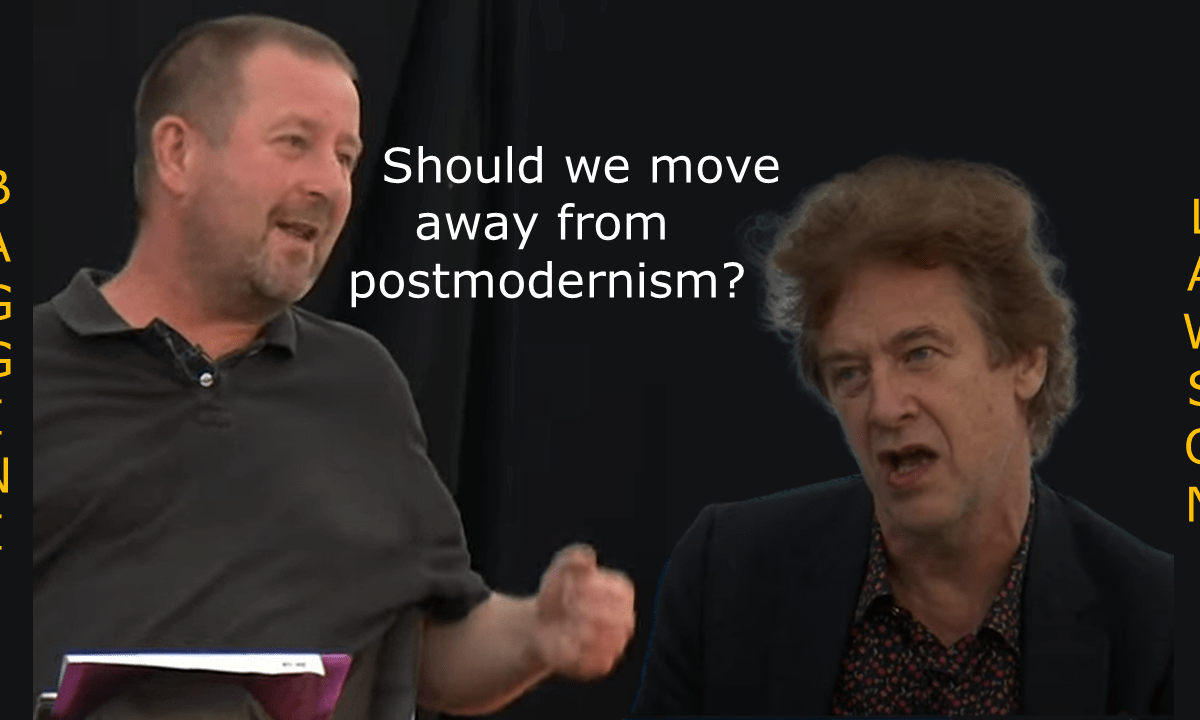
The theme of this Institute of Art and Ideas video is ‘Should we move away from postmodernism?‘
Podcast: Audio rendition of this page content
EDIT: Find my version of this content on YouTube:
Video: Postmodern Defence
At the start, I feel as usual, that the definition of postmodernism is nebulous, and the fora agree, methinks. Toward the end, Hilary Lawson concedes that key actors tied to the early postmodern movement denied being postmoderns, singling out Foucault and Derrida. More on this. Keep reading.
Julian Baggini, the bloke sat on the left and whose positions I am only getting familiar with, starts off the clip. He makes some points, some of which I agree with and others not so much.
He makes a play at claiming that there is some objective truth to be attained, following on with the statement that without this notion, it’s anything goes. I disagree with both of these assertions. Then he cites Thomas Nagel’s The View from Nowhere, wherein he posits that subjectivity and objectivity are extrema on a spectrum and that experience is somewhere in between. This conforms to my beliefs, but there are two provisos. First, the extremum of objective truth is unattainable, objectively speaking. Moreover, as I’ve written before, we have no way of adjudicating whether a given observation is truer than another. It seems that he leaves it that we don’t need to know the absolute truth to know “true enough”, but I think this is both a copout and wrong—but not too wrong for pragmatism to operate.
For example—not mentioned in the clip—, I can imagine that physicists feel that Einsteinian motion physics is truer than Newtonian physics, especially as we need to take measurements nearer to the speed of light. In my thinking, this might provide a better approximation of our notion of the world, but I can also conceive of an Ideal, non-materialistic perspective where both of these are rubbish from the perspective of truth. I feel that people tend to conflate truth with utility.
Julian makes an interesting point about semantics with the claim that “some people” define certain things in such a way as to not possibly be attainable and then claim victory. But what are his three examples? Free will, the self, and objectivity. If you’ve been following me, you’ll know that I might be in his crosshairs because I tend to be in the camp that sees these concepts as sketchy. And to be fair, his claim of defining something in a manner to keep a concept out of bounds is the other side of the same coin as defining something in such a way as to get it into bounds.
The self is different to free will insomuch as it’s a construction. As with any construction, it can exist, but it’s a fiction.
I’ve spoken at length about my position on free will, but I am fairly agnostic and don’t particularly care either way. I feel that the causa sui argument as it applies to human agency is more important in the end. The self is different to free will insomuch as it’s a construction. As with any construction, it can exist, but it’s a fiction. Without interacting with Julian or reading his published works on the self, if there are any, I don’t know how he defines it. And here we are discussing objectivity.
Given Nagel’s objective-subjective polarity, it seems they want to paint postmodernism as claiming that everything is subjective and that science (and religion) hold claims to objectivity. Hilary Lawson, the geezer on the right takes a position between extremes, but he denounces Julian’s claim about objective truth, noting that many people (especially of religious persuasions) make claims on Truth that are diametrically opposed, ostensibly labelling the same object simultaneously black and white. And the object for all intents and purposes is red.
I’ve gotten out of order, but Julie Bindel makes some good points on Feminism and suggests that the philosophical feminists—may I call them pheminists? No? OK then—such as Judith Butler have set women’s rights back by claiming that the category of ‘woman’ is invalid. Minni Salami defended Judith by noting that Butler has helped constructively in some ways and, citing Simone de Beauvoir, that woman is a category established by men to create The Other Sex. Still, Julie—not incorrectly—states that without a category, women (or whatever collective term one decides is representative) cannot be afforded legal protections—because law, as facile as it is, is all about categories and classes.
Hilary reenters the fray and states that it is not acceptable for one person to claim that their lived experience is all that is needed just because that is their truth. To be fair, this feels like a bit of a strawman argument. Perhaps I need to get out more, but I am not familiar with anyone credible making this claim.
I enjoyed watching this clip and processing the information. I hope you do as well. If you have any comments, I’d love to read them.
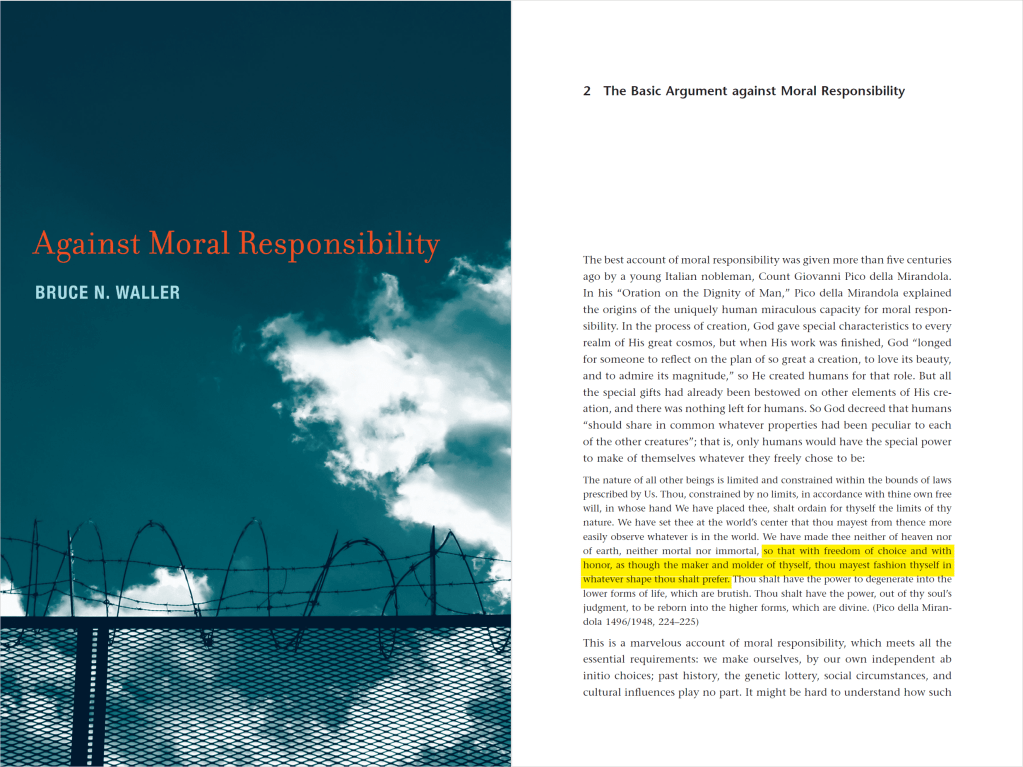
We have made thee neither of heaven nor of earth, neither mortal nor immortal, so that with freedom of choice and with honor, as though the maker and molder of thyself, thou mayest fashion thyself in whatever shape thou shalt prefer.
Bruce Waller
Bruce Waller, Against Moral Responsibility
Nothing really to add here now, but more on the way. Meantine, sharing this for reference.
I just wrapped up chapter eleven of The Righteous Mind by Jonathan Haidt. I’ve got only 35 pages to go to get through chapter twelve. I’ve been tempted to stop reading. Chapter eleven—and I am tempted to inject a bankruptcy pun here—has been more frustrating than the rest thus far. And yet I am glad to have persisted.
My intellectual focus these past months has been on agency. Et voilà, paydirt. Chapter eleven’s title reveals the context: Religion is a Team Sport. Let’s walk through this garden together.
A goal of Haidt is to educate the reader on his third principle of moral psychology: Morality binds and blinds. He establishes parallels between sports and religion. And here’s the thing—I don’t disagree. But here’s the other thing—I feel that are equally vapid—, with no apologies to sports fans or the religious. Let’s keep moving.
“A college football game is a superb analogy for religion.”
Jonathan Haidt, The Righteous Mind, Chapter 12: Religion is a Team Sport
He talks about the organising and unifying functions of both. But here’s the thing. It unifies the like-minded. Haidt claims to be irreligious and not be into sports, and yet he cites these as somehow desirable. I find him to be an apologist for religion.
I am not a psychologist, but if I were, I’d be tempted to claim that Haidt’s conclusions follow from his personal beliefs. He believes in morals, society, order, intuition, and institutions. He is a textbook Modern and an extrovert to boot. I think he also falls into teleological fallacy traps. Was that a play on words?
Although he views religion through rose-coloured glasses, he comes to the conclusion that religions have done a great deal of harm over the millennia, but the good outweighs the bad, especially if you consider it through a social-moral lens. But if religion creates in-groups versus out-groups, which they do, and religious in-groups outlive even non-religious ingroups, then this is a winning option. But what if you don’t like that option?
Personally, I am a collectivist, but this is not willy-nilly any collective.
Haidt contrasts the New Atheist vantage that religious belief is an evolutionary byproduct versus a position that what started as a byproduct evolved into group selection and then, perhaps, an epigenetic phenomenon.
Here’s my contention:
Borrowing from New Atheism, Haidt adopts the notion of a “hypersensitive agency detection device [that] is finely tuned to maximize survival, not accuracy”.
The first step in the New Atheist story—one that I won’t challenge—is the hypersensitive agency detection device. The idea makes a lot of sense: we see faces in the clouds, but never clouds in faces, because we have special cognitive modules for face detection. The face detector is on a hair trigger, and it makes almost all of its mistakes in one direction—false positives (seeing a face when no real face is present, e.g., ), rather than false negatives (failing to see a face that is really present). Similarly, most animals confront the challenge of distinguishing events that are caused by the presence of another animal (an agent that can move under its own power) from those that are caused by the wind, or a pinecone falling, or anything else that lacks agency.
The solution to this challenge is an agency detection module, and like the face detector, it’s on a hair trigger. It makes almost all of its mistakes in one direction—false positives (detecting an agent when none is present), rather than false negatives (failing to detect the presence of a real agent). If you want to see the hypersensitive agency detector in action, just slide your fist around under a blanket, within sight of a puppy or a kitten. If you want to know why it’s on a hair trigger, just think about which kind of error would be more costly the next time you are walking alone at night in the deep forest or a dark alley. The hypersensitive agency detection device is finely tuned to maximize survival, not accuracy.
Op Cit, p. 292
I fully agree with the assertion that the brain values fitness over truth, and I’ve commented in several posts that pareidolia and apophenia create false-positive interpretations of reality.
But now suppose that early humans, equipped with a hypersensitive agency detector, a new ability to engage in shared intentionality, and a love of stories, begin to talk about their many misperceptions. Suppose they begin attributing agency to the weather. (Thunder and lightning sure make it seem as though somebody up in the sky is angry at us.) Suppose a group of humans begins jointly creating a pantheon of invisible agents who cause the weather, and other assorted cases of good or bad fortune. Voilà—the birth of supernatural agents, not as an adaptation for anything but as a by-product of a cognitive module that is otherwise highly adaptive.
Op Cit, p. 293
For me, this supports my contention that agency is a wholly constructed fiction. The same agency we ascribe to unknown natural events, we ascribe to ourselves. And perhaps this ability served an egoistic function, which was then generalised to the larger world we inhabit.
I have an issue with his teleological bias. He feels that because we have evolved a certain way to date; this will serve as a platform for the next level as it were. I’ll counter with a statement I often repeat: It is possible to have adapted in a way that we have been forced into an evolutionary dead end. Historically, it’s been said that 99 per cent of species that ever occupied this earth are no longer extant. That’s a lot of evolutionary dead ends. I am aware that few species could have survived an asteroid strike or extended Ice Ages, but these large-scale extinction events are not the only terminal points for no longer extant species.
So finally, Haidt essentially says that it doesn’t matter that these religious and cultural narratives are wholly fictitious, if they promote group survival, we should adopt them. This seems to elevate the society over the individual, which is fine, but perhaps the larger world would be better off still without the cancer? Just because it can survive—like some virulent strain—doesn’t mean we should keep it.
Finally, given these fictions, what’s a logical reasonable person to do? I don’t buy into ‘this country is superior to that country’ or ‘this religion is better than that religion’ or even ‘this sports team is better than that’ or ‘this company is better than that’.
Haidt does idolise Jeremy Bentham, but this is more Pollyannaism. It sounds good on paper, but as an economist, I’ll reveal that it doesn’t work in the real world. No one can effectively dimensionalise and define ‘good’, and it’s a moving target at that.
No thank you, Jonathan. I don’t want to buy what you are selling.
News Flash: From the time I started this content, I’ve since read the final chapter. Where I categorically reject a lot of what Haidt proposes in this chapter, I tend to find chapter twelve to fit more amicably with my worldview. Perhaps I’ll share my thoughts on that next.
If you’ve reached this far, apologies for the disjointed presentment. I completed this over the course of a day through workaday interruptions and distractions. I wish I had an editor who could assert some continuity, but I am on to the next thing, so…
Bonus: I happened upon this journal article, and it somehow ended up here. I haven’t even read it yet, so I’ve got no commentary. Perhaps someday.
Rai, T. S., and A. P. Fiske. 2011. “Moral Psychology Is Relationship Regulation: Moral Motives for Unity, Hierarchy, Equality, and Proportionality.” Psychological Review 118:57–75
There is a battle being waged in the United States today, but it is not centred on the lack of separation of Church and State. I suppose this may be a uniquely American issue given its Constitutional roots, but the root cause is rather a lack of separation between Natural and Supernatural, not between Church and State.
Separation of Church and State
Tomorrow America is celebrating Independence Day [sic], but until we are independent of religion, we cannot be independent. The only real independence is for the politicians who are independent of British control. There is nothing more substantial than this, and nothing for the ordinary citizen, who might as well be taking orders from England. Canada doesn’t look any worse for the wear and tear. I’m not a Monarchist, but it’s no less ridiculous than the Oligarchy or Plutarchy in play today.
I’ve got nothing again churches, per se. I don’t prefer the brainwashing that passes as organised religion, but neither am I fond of the brainwashing that is organised politics. And why is it called ‘brainwashing’? It’s clearly mind-muddling. I digress.
I do believe that it’s in the best interest to separate Church and State, not least because I need freedom from religion. It is already force-fed down my throat and codified into laws. We need less, not more.
Of course, a key topical debate is the abortion issue. This is strictly a religious issue. Even if you want to argue that it’s a moral rather than religious issue, it is still the result of supernatural beliefs. This is where the separation needs to happen.
Why won’t it happen? It won’t happen because people who believe in supernatural forces—especially active supernatural forces—are easy to manipulate. This has been true historically as well as contemporaneously. It’s too convenient for politicians to pull the old Santa Claus trick—if you aren’t good, Santa won’t give you any presents; and if you’re bad, he’s going to bring you coal instead.
I’ve said my peace. In the end, I don’t really even care if you believe in the supernatural, but if you believe that you (or anyone) can interpret these forces, I claim foul and out of bounds. This belief is not different to believing that you can understand what your dog or cat is ‘saying’—or your pet unicorn in the garden. It’s certifiable.
I know that other countries have to contend with this interference. Some even don’t mind the union. Is this a problem in other countries? Is it a problem in yours? Or do you consider it to be a necessary solution?
DISCLAIMER: This post has absolutely nothing to do with the Supernatural television series.
In chapter 71, Ultimate Responsibility, in Intuition Pumps and Other Tools for Thinking, author and philosopher, Daniel Dennett presents a counterargument to the notion that an agent, a person, is not absolutely responsible for their actions. He questions some premises in the ‘the way you are’ line of argumentation, but I question some of his questions.
Here is a nice clear version of what some thinkers take to be the decisive argument. It is due in this form to the philosopher Galen Strawson (2010): 1. You do what you do, in any given situation, because of the way you are. 2. So in order to be ultimately responsible for what you do, you have to be ultimately responsible for the way you are—at least in certain crucial mental respects. 3. But you cannot be ultimately responsible for the way you are in any respect at all. 4. So you cannot be ultimately responsible for what you do.
Dennett, Daniel C.. Intuition Pumps And Other Tools for Thinking (p. 395). W. W. Norton & Company. Kindle Edition.
Dennett continues.
The first premise is undeniable: “the way you are” is meant to include your total state at the time, however you got into it. Whatever state it is, your action flows from it non-miraculously.
Dennett and I are in agreement with Strawson. There is not much to see here. It’s akin to saying the now is the result of all past events until now. This is “the way you are”.
The second premise observes that you couldn’t be “ultimately” responsible for what you do unless you were “ultimately” responsible for getting yourself into that state—at least in some regards.
This second premise asserts that one cannot be responsible for any action that one had no part in performing. Two scenarios come immediately to mind.
First, you are not responsible for being born. As Heidegger notes, we are all thrown into this world. We have no say in when or where—what country or family—or what circumstances.
Second, if one is hypnotised or otherwise incapacitated, and then involved in a crime, one is merely a cog and not an agent, so not responsible in any material sense.
But according to step (3) this is impossible.
Whilst Dennett fixates on the absolute aspect of the assertion, I’d like to be more charitable and suggest that we still end up with a sorites paradox. Dennett will return to this one, and so shall I.
So step (4), the conclusion, does seem to follow logically. Several thinkers have found this argument decisive and important. But is it really?
As Dennett invalidates step (3), he insists that the conclusion is also invalid. He asserts that the notion of absolute responsibility is a red herring, and I argue that Dennett doesn’t get us much further, perhaps redirecting us with a pink herring.
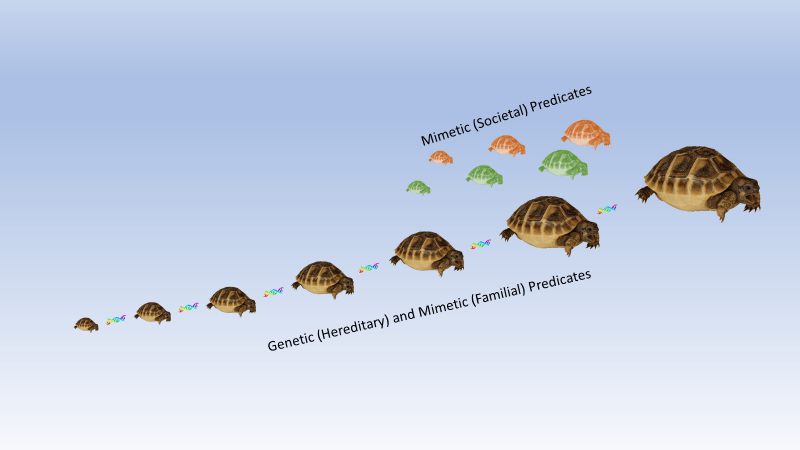
I’ve created an image with tortoises to make my point. There are actually two points I wish to make. The first point is to determine where the responsibility is inherited. This point is meant to articulate that the world can not be strictly deterministic and yet one can still not have significant agency. The second point is that culpability is asserted as a need, and acceptance of this assertion is the problem.
Testuditude
The image depicts an evolution of an agent, with time progressing from left to right. The tortoise on the right is a product of each of the recursive tortoises to its left. The image means to convey that each subsequent tortoise is a genetic and social and social product of each tortoise prior. Of course, this is obviously simplified, because tortoises require pairs, so feel free to imagine each precedent tortoise to represent a pair or feel free to add that level of diagrammatic complexity.
This is not meant to distinguish between nature and nurture. Instead, the claim is that one is a product of both of these. Moreover, as genetic, epigenetic, and mimetic influences are transmitted in family units, they also occur through social interaction and the environment, as represented by the orange and green tortoises.
…if one is a product of genetic and mimetic forces, how much agency remains for culpability?
The point here is that if one is a product of genetic and mimetic forces, how much agency remains for culpability? Each person is an emergent unit—autonomous, yes, and yet highly programmed.
If I programme a boobytrap to kill or maim any intruder, the boobytrap has no agency. I assert further, that the maker of that boobytrap has no more responsibility than the killing device.
The old hand grenade wired to a doorknob boobytrap trick
But who do we blame? you ask, and that’s precisely the problem. Asking questions doesn’t presume answers. This is a logical fallacy and cognitive bias. This heuristic leaves us with faulty jurisprudence systems. Humans seem hardwired, as it were, to blame. Humans need to believe in the notion of free will because they need to blame because they need to punish because vengeance is part of human nature to the extent there is human nature. There seems to be a propensity to frame everything as a causal relationship. Dennett calls this the Intentional stance. To borrow a from Dennett…
This instinctual response is the source in evolution of the invention of all the invisible elves, goblins, leprechauns, fairies, ogres, and gods that eventually evolve into God, the ultimate invisible intentional system.
Dennett, Daniel C.. Intuition Pumps And Other Tools for Thinking (p. 374). W. W. Norton & Company. Kindle Edition.
Fire Trap in Home Alone
Sins of the Fathers (and Mothers)
Let’s wrap this up with a sorites paradox. As I’ve already said, I agree with Dennett that the absolute aspect is unnecessary and undesired. The question remains how much agency™ does a person have once we account for the other factors? Is it closer to 90 per cent or 10 per cent? Apart from this, what is the threshold for culpability? Legal systems already have arbitrary (if not capricious) thresholds for this, whether mental capacity or age, which basically distils back to the realm of capacity.
I have no basis to even venture a guess, but that’s never stopped me before. I’d argue that the agency is closer to zero than to one hundred per cent of the total, and I’d propose that 70 per cent feels like a reasonable threshold.
I could have sworn I’d posted a position on this after I read Robert Sapolsky’s Behave. Perhaps it’s never made it out of drafts.
In closing, I don’t think we need to settle the question of determinism versus free will to recognise that even without strict determinism, personal agency is still severely limited, and yet as our political systems presume a level of rationality that is not apparent, so do legal systems presume a level of agency not present.
The lamb spends all its time worrying about the wolf and ends up being eaten by the shepherd.
— Unknown
I think one could look at this from several perspectives or through different lenses.
We worry about the wrong things.
At some level, this is about trust.
We trust the wrong people. Those whom we most entrust do us in. But I feel this is contextual.
One might feel this shepherd is Capitalism or the State or organised religion. Perhaps it’s culture or identity cohorts. Or all or these or none of these.
On another level, it recalls the inevitability of death. This shepherd reaper is always waiting in the wings whether or not one worries.
Curse YouTube and Drew—but in a good way. Drew created a video titled I took a Christian class about atheism. It was worse than I expected. Although I don’t find I need to engage with anyone to defend my atheism, I sometimes do. Perhaps, the devil made me do it. I’ve been an atheist for decades—literally for at least half a century. (Man, that’s revealing.)
Spotify Link
The magic gods of social media tossed this gem in my face, and I was fated to watch it—a 45-minute video nonetheless. Who posts long-format content on YouTube these days? Honestly, I didn’t think I was going to watch the entire thing—at least without skipping ahead.
I jotted down my thoughts—on paper no less—as I engaged the content. But before delving into that, I want to say that Greg Koukl is a formidable communicator. He knows how to engage his audience. Drew, the Genetically Modified Skeptic, is a strong communicator himself, employing cogent logic in defence of atheism—well-considered and articulated. Although I was watching the clock—cuz 45-minutes; plus I was stopping to take notes. Capturing a couple dozen bullet points, I’d comment here instead of in situ. I’ll link from there to here when I’ve published my reaction.
Drew responds so well that, generally, I avoid stepping on his responses, with which I am in agreement. Instead, I share my own observations either on topics Drew did not address or that I have a nuanced take on.
Below are the points I make with a time reference to the clip. In some cases, the link starts earlier than the point I am addressing if only to provide a reader with context.
3:25 Greg points out that he is going to focus on areas where Christianity can make sense but atheism cannot.
Response: Things do not have to make sense. This is a belief humans impose on the world. Even if one believes in a world of causes and effects, it does not follow that we have a privileged perspective into these causes. Some effects may be caused by any number of correlated and covariant factors, and to claim that A causes Z, because it’s expedient and somewhat linear over some more complex multifactor causal model, is weak tea. As humans, we want things to make sense. It’s effectively in our nature, but it doesn’t follow that the universe needs to comply with this need. Human psychology compensates knowledge and perception gaps with any number of tricks from Gestalt to apophenia. It may be comforting for some to use gods as putty to fill the cracks, though, in my mind, it’s rather Silly Putty.
3:35 Greg defines the terms theism and atheism. Drew points out the reduced, self-serving definitions Greg tries to slide by.
4:44 Greg tries to frame atheism as an assertion rather than an absence, so he can fabricate a strawman to attack.
Response: As Drew points out, this is sometimes, but not always, true. Here my thoughts (or soul, as the case might be—orthogonal, or otherwise) wandered to the Dawkins Scale, which parses atheism and agnosticism into a spectrum rather than a binary pair. Idiomatically, it’s a non-assertion. If you claim there’s a dog in my yard, it’s incumbent for you to provide evidence. If I claim, there is no dog in my yard, I am under no such obligation. Besides, my looking for evidence of a non-dog in my yard would require additional scrutiny. Perhaps it’s hidden.
Moreover, Greg attempts to make this a semantic issue. Drew points this out. For me, I reflected on the political situation where some cohorts within the US public decried Obamacare (AKA the Affordable Care Act or ACA) and yet were substantially supportive of its features. Obamacare acted as a pejorative to taint the act with negative connotations for Obama detractors. People’s cognitive faculties as deficient as they are, this was super easy—barely an inconvenience. Anarchism triggers the same sort of reaction. I attribute this to an unceasing negative propaganda/indoctrination campaign.
Response: Translation: We have subjective experience, and we are going to pose this as some objective reality.
9:40 Greg asks: Where did everything come from? What caused the beginning of the universe.
Response: Where is thy stuff? I don’t even need to engage this question directly because the chestnut of an argument he is presenting has a recursion problem. If everything needs a beginning, then God needs a beginning. This argument just kicks the can down the kerb. And ‘He just is‘ works just as well as ‘It just is‘. Nuff said.
11:25 Greg recounts a scenario where he purportedly asks a recently converted atheist, Do things exist? to which the subject responded affirmatively.
Response: The nature of existence and reality is not resolved science. ‘“Things” are perceived‘ is about the best we can get to at this moment in time, and this doesn’t even define things very precisely.
11:30Have things always existed? is the question posed next.
Response: I like Drew’s response here. Instead, I went to the definition of time because the notion of time is a social construct. It could be that there was a Biblical void from which the universe sprang whole cloth as depicted in the Genesis version or a Big Bang version. It could as well be that at some point time was invented. An imperfect analogy is the BCE-CE split. CE simply starts at year 1 and we’ve run with it. The universe doesn’t have an equivalent notion of BCE, but perhaps it’s similar to spinning up the universe as a virtual machine. There was a literal void of bits awaiting a cue to instantiate a VM universe. For all intents and purposes, this is the beginning of time for that virtual machine. In this example, we could extend the metaphor to a multiverse, or we could stay with a physical machine and virtual machine metaphor. Sure, the physical machine might be a god or another meta-universe—I refuse to say metaverse—, but the virtual machine has no insights earlier than its own time-zero.
The other things Greg’s approach misses are the notions of quantum mechanics and emergent properties. I won’t spend any time elaborating here.
Response: Without getting into the weeds of Kahneman and Tversky’s Systems 1 and 2, intuition and heuristics have a place, but they are very fallible for all but the most mundane of tasks. They are not very precise and are a poor foundation for any theory. I can feel it in my bones just doesn’t go very far—and that includes intuitions about reality
22:15The problem of evil is apparently the most common objection to the existence of God.
Response: This is a sophomoric position to adopt. Greg tries to frame this as an out-there objective reality affair as opposed to an in-there subjective, emotional problem. He posits that things in the world—including people—are inherently bad or evil. Again, Drew reframes this as a uniquely Christian problem. As for me, I don’t even believe in the existence of evil. Good and bad are functional yet still social constructs. Evil is just trebled bad with a metaphysical twist. The problem with evil is more of a problem with bad narrative than anything more substantive. Somebody created a storyline and didn’t run it by strong editors or continuity reviewers.
26:15 Lawmaker Transcendence: In order for there to be laws to be broken, there have to be laws…
Response: Knowing his intended audience, Greg keeps hammering on the objective reality nail. Whilst this may play well to the choir, as Drew points out, it’s not likely to score any points in a debate with atheists. Morals, as well as laws, are social constructs. And as universals, they don’t map as closely across cultures except at the most abstract of levels.
It should go without saying that even if there were a god passing out commandments, there would be no way to validate the authenticity of this exchange.
32:30 All people have souls… You are not just a piece of meat in motion
Response: Just rambling. I’m not even going to waste my time on this one except to redirect you to my previous response relative to human psychology and apophenia.
Response: This bit is juvenile, too. Here Greg explains that the soul is not the brain, that you can’t disassemble your brain to find thought. But, he doesn’t mind ignoring that your soul is nowhere to be found either. This feels quite similar to the need for a creator, but these evidentiary needs don’t apply to their positions. Drew’s computer analogy is apt here.
39:10 Existential crisis is a problem for Greg and other Christians.
Response: Because Christians are wired the way they seem to be, any modality that severs the connection to meaning sets them off. Greg confuses hubris and ego for something more substantial, attributing meaning to it. As it happens, people also cherish their pets more than some random squirrel.
40:30 Humans feel guilty because humans are guilty.
Interestingly, there is a school of belief, psychologically speaking, that the default state of humans is one of anxiety, but given that I don’t give psychology any more credibility than religion, I’ll just leave that here. People feel guilty because they are indoctrinated to feel guilt. A hypothetical person raised on a desert island or in the woods, like Victor, the feral child of Aveyron, or in the jungle, like Tarzan or Mowgli, would not know guilt, empathy, shame, or any of a host of other social “emotional” responses.
All told, Greg raised nothing new nor offered any new support for Christian belief, let alone a broader theistic defence. Ostensibly, the approach he takes is more akin to choir preaching than any other rhetorical purpose. In the end, he’s promoting a smug superiority complex in believers. He understands that although people will accept blind faith rationale for religious belief—especially those indoctrinated from birth—that people do have a mild penchant for rationality. I don’t think most humans operate beyond a cursory level of reasoning, but it’s enough to exploit and construct social reflection mechanisms as part of personal image-building. This allows Greg to propose a homoeopathic logical, rational framework and have it uncritically adopted as being rational.
As for otherwise rational Christians, they likely see through the charlatanism, but since emotion proceeds reason, they are allowed to check out and compartmentalise this nonsense whilst otherwise simultaneously retaining the ability to process the most challenging and tortuous logical conundrum.
Reading Dennett has gotten me down a rabbit hole. I decided to take a break from book-reading and spend the day reading essays and blogs and watching YouTube vids such as this one. The question posed by the title is Which Laws of Nature are Fundamental? The topic I find curious is an established dichotomy where intelligent design or multiverses are the only possible reasons why we as humans are here to question our existence.
Full disclosure: I don’t pretend to be a physicist, so although I have tried to keep current on, let’s call it, lay physics, there is much I don’t know. But that doesn’t make me stop questioning propositions.
In the case of intelligent design versus multiverses, I feel that both go overboard. I don’t particularly cherish Occam’s Razor, but I do find it apt here. As David Deutsch states in this piece, intelligent design only manages to kick the can down the kerb.
In a nutshell, intelligent design arrives at a place with a claim that all of this can’t have been the result of chance and random events, so [insert the entity of your choosing] had to have designed and constructed it, leaving open the question of how that entity came to be. This is a spin on the age-old issue that many defenders of intelligent design-like theories seem to cling to: The universe cannot have spawned from nowhere, so its genesis must have been due to an intelligent (read: divine) entity without recognising or admitting the circular reasoning involved.
On the other hand, the multiverse solution—which I don’t entirely rule out—also seems unnecessary. In another nutshell—or perhaps repurposing the first—, the main idea is that there are many if not infinite parallel universes. Given the large number—in the manner of the infinite monkeys typing Shakespeare’s sonnets, at least one is bound to be configured just so to enable life and humans in particular.
Typing Monkeys
I don’t subscribe to intelligent design in the least. I dismiss it as implausible. And whilst multiverses may exist, I fail to see why there can’t be a single universe—this one—that just so happens to be configured. If it had been configured any other way, there would have been no life as we know it—and certainly no human life and no life to question how it get there and why.
In my mind, just because we can ask why doesn’t mean there is an answer or that we can find it. More to the point, even in a world of cause and effect, the results can be emergent on one hand and multlivariant on the other. So whilst we want to discover a causal chain of A ⇒ B ⇒ C ⇒ n, it is not likely so linear. Humans do understand the notions of stochsticism and chaos, but we don’t necessarily know how to deal with them causally. Moreover—and Deutsch has specialised in the quantum space—, our understanding of quantum processes is extremely primative. We are probably operating more from conjecture than knowledge, but one needs to start someplace. The trick is not to believe you’ve reached India when you’ve only just departed Spain.










 Philosophics