The Matter with Things: Chapter Seven Summary: Cognitive Intelligence

Index and table of contents

Following Emotional and Social Intelligence and the rest, Chapter 7 of The Matter with Things is Cognitive Intelligence.

In the last chapter, we learned that Emotional and Social Intelligence are the provinces of the right hemisphere. In this chapter, we discover more of the same. Whilst the left hemisphere has its duties and functions, it’s primarily a delegate. Let’s jump right in.

Podcast: Audio rendition of this page content

Under the old pseudoscientific mode of thinking, the left hemisphere was the logical side whilst the right hemisphere was creative. It turns out that this is not correct.  At its core, intelligence is about understanding. Keep in mind that there are multiple kinds of intelligence—not referring to multiple intelligence theory, per se. Besides the emotional and social sort discussed at length in the last chapter, there is a sort of rote intelligence. This is where the left hemisphere excels. The left hemisphere is symbolic and algorithmic. It has facilitated the making of computers and other instruments that allow us to extend our intelligence, but these are not sources of intelligence. In a conceit to his previous book, The Master and His Emissary, McGilchrist notes that the left brain is effectively the emissary, the junior partner in the relationship, and not really even a partner as the right hemisphere seems to call all the shots when it’s intact.

He tells a story about a geneticist who declared to a biologist that the notion of intelligence was quite meaningless. The biologist retorted that he (the geneticist) was unintelligent, and the two never spoke again. Clearly, the notion is that whilst it may be ill-defined, it nonetheless contains meaning.

I share the working definition of intelligence that he shared, taken from the journal Intelligence and cited in the Wall Street Journal in 1994.

Intelligence is a very general mental capacity which, among other things, involves the ability to reason, plan, solve problems, think abstractly, comprehend complex ideas, learn quickly and learn from experience. It is not merely book learning, a narrow academic skill, or test taking smarts. Rather, it reflects a broader and deeper capability for comprehending our surroundings – ‘catching on’, ‘making sense’ of things, or ‘figuring out’ what to do.

As noted, there are several flavours of intelligence, even if they are attempted to be captured as G, general intelligence. This can be separated into crystallised intelligence (Gc) and fluid intelligence (Gf). Crystallised intelligence is more culturally bound than fluid intelligence and is more the domain of the left hemisphere. Generally, this is what IQ tests aim to measure.

Two criticisms of IQ tests are the cultural bias and the rote nature of the tests. As it happens, trends show that IQ is generally on the rise despite a feeling that people are getting dimmer. This may be because this rise represents the shift toward left hemisphere thinking, an alarming topic he’ll cover more in future chapters. We’re witnessing a trade-off between creative thinkers for intelligent rote automatons—the type of people more easily supplanted by computers and automation. Even as IQs are apparently increasing, undergraduate professors are complaining in higher numbers about how unprepared their incoming students are. I can add my experience anecdotally to this list. I recall chatting with a physics professor who complained that he had to devote some 20 per cent of his class time to teach students the same prerequisite maths, which meant that he had to cut this from his intended time to teach physics.

As a student, one of my physics teachers said he wouldn’t demerit much for maths errors because this was, after all, a physics course. Again, this was a reaction to many students not being prepared. They just had different approaches to handling the deficits. And don’t get me started on grade inflation.

The right hemisphere is the realm of fluid intelligence and is activated more in gifted persons. This affords creative problem-solving.

The right hemisphere is the realm of fluid intelligence and is activated more in gifted persons. This affords creative problem-solving.

Let me editorialise here in place. Sometimes we hear that this or that person is good at maths, but it turns out that this is not a simple declaration. A person who studies geometry, trigonometry, and calculus and can perform the functions may simply perform all of this rote activity in the left hemisphere. Because someone can do maths a few levels above us may feel like this person is good at maths, but this may not make this person actually good at maths.

A few years ago, I read the introduction to a book whose title I’ve long forgotten. In this introduction, the author had excelled at left hemisphere maths and got his bachelor’s and master’s degrees in mathematics. Whilst pondering whether to pursue a PhD, in a moment of self-reflection, he decided not to. He was an A student and the pride of his family, but he had to work hard at maths. Then he considered some of the other classmates who seemed to perform the tasks effortlessly. He could do maths, but they could think maths.

This reminds me of the story of a young Carl Gauss whilst he was still in elementary school. Don’t worry. I’ll get back to the summary presently. Gauss’ teacher was hoping to keep the students occupied, so he assigned them the task of summing the numbers 1 through 100.

Eight-year-old Gauss considered the problem. He noticed a pattern and worked out the answer in his head after a few seconds—5050. Gauss excelled at maths naturally. He noticed that pairing each ascending integer from 0 to 100 created values of 100; 1 and 99; 2 and 98, 3 and 97 … 49 and 51. There are 50 such groupings with a product of 5,000 and 50 left over, so 5,050. Easy Peezy.

And now we return to regularly scheduled programming.

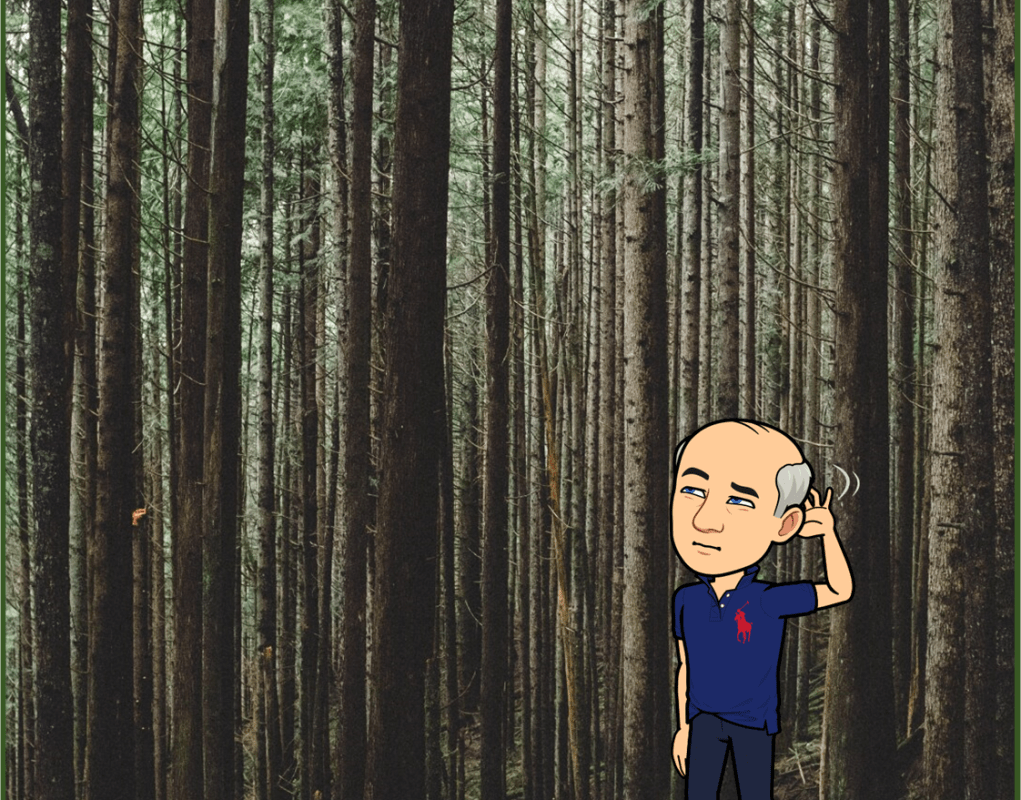
Another interesting characteristic of the hemispheres is that the left hemisphere operates serially whilst the right hemisphere operates in parallel, metaphorically speaking, of course. The right hemisphere is the Gestalt operator, which is a problem as McGilchrist sees it given the leftward shift in the sciences, losing the woods for the trees. Moreover, as we are forced into the constraints of business and bureaucracies, we are forced into a left hemisphere perspective, which may create a vicious epigenetic cycle or a downward spiral.

Perspective

In summary, the right hemisphere not only contributes to the majority of emotional and social intelligence as discussed in the last chapter, but it is also the workhorse of cognitive power.

Before ending, I want to share one more elucidation. I was reading elsewhere about critical thinking, and an example given was an emergency room nurse triaging patients—prioritising the treatment of patients. I wholly disagree. This is algorithmic thinking, not critical thinking. It could easily be done by a computer. In fact, in the late 1980s, I was working with so-called expert systems, which were the AI hype of the day in wave 3.0. We are now in wave 4.0 and it is still hype. Only nowadays it’s deep learning, machine learning, visual recognition, edge computing, and robotic process automation. The only difference is that technology has driven costs down, so they are more accessible to more people and can be run on more powerful computers. For the uninitiated, there is no intelligence in artificial intelligence. So, it’s less artificial and more non-existent.

Yet again, I am left wondering what this left hemisphere is good for.  It seems to do less than 20 per cent of the work and does half of that poorly. Not exactly someone you’d pick for your team. Of course, I wouldn’t want to sacrifice my left hemisphere, but still.

That about wraps up the chapter on Cognitive Intelligence. Next up is chapter eight on Creativity. If you think this will focus more on the right hemisphere, I’ll bet you’re right. I hope you’ll join me.

What are your thoughts on intelligence and the hemispheres’ split duties? Did anything surprise you? Was there anything of particular interest?

Leave comments below.

Limits of Reason and Critical Thinking

Hear me out. The Age of Enlightenment and after is based on the notion that ordinary people are rational, capable of reason, and critical thinking. I may not get out much, but I don’t notice a lot of evidence of this. In fact, I feel that the original proponents of this didn’t get out much either. And when they did, they congregated together.

I’m not talking about rote learning and being functionally literate. I’m talking about being able to suss out solutions to novel challenges. Call me an elitist, but I noticed this in my classmates at both university and grad school. I could count on one hand the number of people I would consider to be more than rote learners. I can report similar results when I taught undergrad economics. And to be honest, even rote learning seemed to be a challenge beyond reach for many.

Some may accuse me of being an elitist or a misanthrope, and I understand the motivation, but I could also be critiqued for claiming elephants to be large land mammals or ice to be cold. To be fair, notions of intelligence are sketchy enough without trying to measure reason and rationality, so I am speaking generically and metaphorically as I have no good measure either. I’m operating on intuitions.

The right hemisphere is about creative problem-solving.

In reading Iain McGilchrist’s books, he might argue that these people are just left-hemisphere dominant. That’s all rote activity. The right hemisphere is about creative problem-solving. I may be wrong, but I think it’s more than that.

As a metaphor, pick your favourite high-performing athlete. I’m not into sports, so I’ll toss out some names. Perhaps you’ve heard of some: Cristiano Ronaldo, Kylian Mbappé, Leo Messi, Virat Kohli, Micheal Jordan, LeBron James, or whomever. Who’s your favourite athlete? Leave a comment.

I might have practised some 10,000* hours a year for decades and I wouldn’t have been able to elevate my skills to the level of any of these. Moreover, even if I were to target someone in the lowest centile of all professional athletes in any given sport, I wouldn’t likely reach that level. I was holding out for curling, but alas, I still don’t think so. If you happen to be a professional athlete, then switch metaphors to music or art and ask if you could then reach the pinnacles of these disciplines.

The point I am trying to make is that when it comes to reason, most people aren’t even rank amateurs. They are more like pigeons playing chess. And let’s be serious, whether these pigeons are playing chess, checkers, go, or croquet, they aren’t going to fare any better.

Phenotypes such as brown eyes or red hair are determined. Aspects such as height and intelligence have propensities.

When a person is born into this world, some aspects are determined outright, whilst others have propensities. Phenotypes such as brown eyes or red hair are determined. Aspects such as height and intelligence have propensities.

At birth, a person’s height is limited by some upper limit under optimal conditions. If I encounter nutritional deficits or some other stressors, this theoretic height may never be reached. I feel the same is true for intelligence and how well we can reason. I don’t particularly agree that IQ scores are a great measure, but I’ll use the notion conceptually since most people likely know of them and generally how they work. In a nutshell, a score of 100 is considered average, give or take a standard deviation in either direction, so roughly speaking about 68.26 per cent of people in a population fall between 85 and 115. This leaves about 16 per cent above and below average. By extension, about 85 per cent of people are average and below.

I’d like to assert is that the majority if not the entirety of this cohort cannot reliably reason or think rationally or critically.

What I’d like to assert is that the majority if not the entirety of this cohort cannot reliably reason or think rationally or critically. They can memorise that 1 + 1 = 2 and Paris is the capital of France, but novelty and synthesis are pretty much out of scope. And they can reason about small things in small doses.

Practically, this means a couple of things. Firstly, on the positive side, they can be trained to be drones. Wage slaves. Most jobs in the world are rote. Insert tab A into slot B. Follow an algorithm or procedure. This is not limited to so-called unskilled labour. This goes all the way up the food chain to doctors and lawyers, two rote professions if there are any.

Secondly, on the negative side, they cannot be trained to participate in democratic processes. This is a failure of insight of the Fathers of the Enlightenment. Is that a thing? Moving on. To be fair, they did notice. Plato noticed, too. This is why, among other reasons, they sought a republic over a pure democracy. The problem, besides bad incentives and ulterior motives, is that many of these people aren’t any, or materially better, thinkers. Recall my previous reference to lawyers. How many politicians are lawyers? Q.E.D. OK, so I’m being irascible, but still.

The problem is that the masses have been taught that participative democracy is both good and a right to be cherished. And it would be if the population were up to par. In the United States, they’ve had challenges in the past with literacy tests to limit access to the polls, but one, this wasn’t testing the right thing, and two, as I said at the start there isn’t really a test for this particular capacity.

Let’s imagine that there was a test. And let’s further imagine that it was somewhat aligned to IQ score. Let’s say that the threshold kicks in just over 115. This would mean that only 15.9 per cent of the adult population would be able to vote. Even if the threshold was met at 100, that would still eliminate 50 per cent of eligible voters. That would not go over very well. Remember these people are rote learners, and they learned that (1) rights are inalienable and sacred and (2) voting is a right. Justified or otherwise, you could expect a revolt, even in America where people are afraid of their own shadows. They aren’t the French showing their numbers in yellow vests. They are much more docile when it comes to things like this. Gun-related violence is another story, but unless they are shooting each other this is where fending for their rights end.

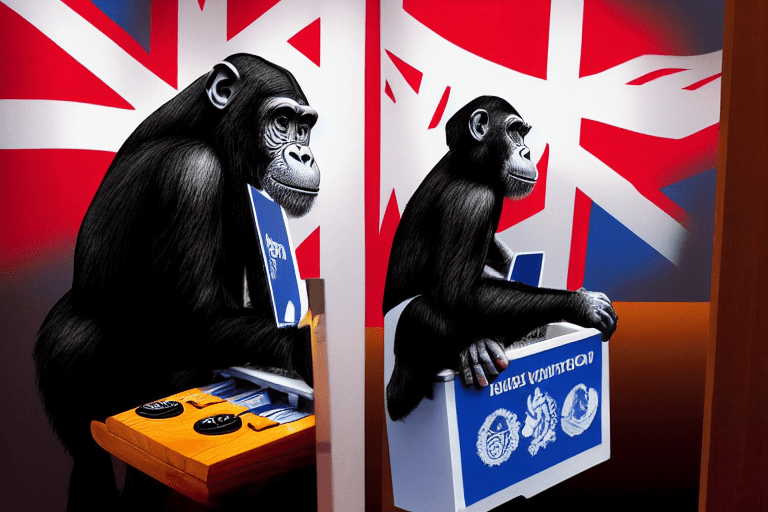
perhaps we could start allowing chimps to participate in the process

And maybe I am wrong, perhaps we could start allowing chimps to participate in the process. I’ve heard a lot of good things about dolphins and octopuses. I look around me, and I see a lot of nice people. People who enjoy life and are nice to talk with, maybe even about the weather. But being affable doesn’t make one a critical thinker. It doesn’t make a great foundation for government or even the selection of government.

Voting Chimps

The 64,000 question is what to do. The problem, as with any challenge involving people, is that it involves people. We could construct a test, and the affluent would find a way to bribe to get a favourable result or pay for the rote information and strategy to pass the test. They already use both of these approaches for college admissions, so I wouldn’t expect anything different here.

On a final note, some including Kant and Chomsky have argued that there are limits to human reason on a global level. I am just applying this to the local level, and there are many more local limits that never come close to encountering this higher global limit. That’s a challenge in and of itself.

In the end, you can rest assured. No one is going to voluntarily give up their voting rights any time soon. No meaningful test is on the horizon. The system will likely implode on itself first. In some places sooner than others.


* Yes, I know there are only 8,760 hours in an earth year. I was hoping you didn’t notice.

Not Only the Queen Is Dead

“The Queen is dead. Long live the King,” I believe it goes. There is propaganda through symbolism and spectacle. And there is detachment. Witness in this photograph of Queen Elizabeth II’s funeral procession, a sea of mobile devices—black mirrors.

Audio: Podcast rendition of this page content

Are these people living in the moment? I can’t say for sure, but I am thinking they are more interested in laying claim to bragging rights that they were present (in body)—pictures or it didn’t happen, eh?—, but at the same time, they were missing the moment. Perhaps it would have been overwhelming otherwise.

I recall a Buddhist meme where a traveller was more (or as) interested in taking photographs than experiencing the moments—well before the Social Media Age. And what are photographs, except attachments to the past? As if the memory is not enough in and of itself.

I am neither a Royalist nor a Statist, yet I understand that many people are and they have emotional connexions to transitions of this nature. Some ask if the system will persist whilst others wonder if there might be changes conforming to their worldviews. Time will tell.

As for me, I am flexible. Were I Charles, I’d likely abdicate the throne and pass the sceptre to William, whom I would hope would usher the monarchy out of existence in favour of something more modern—and by modern, I mean something in the order of an anachronistic constitutional republic such as (poorly) employed by the United States of America.

Obviously, my preference would be for some autonomous syndicalist structure, but I am not holding my breath, nor do I feel that would fare much better anyway. I feel that’s just another pipe dream anyway as it involves people.

Would you look at the time? I’m off wittering again. Cheers.

The Matter with Things: Chapter Six Summary: Emotional and Social Intelligence

Index and table of contents

Intro

Chapter 6 of The Matter with Things is titled Emotional and Social Intelligence, following the previous chapters, Attention, Perception, Judgment, and Apprehension. Chapter 7 is about cognitive intelligence.

The gist of chapter 6 is to convey the importance of emotional and social intelligence in forming a full picture of the world. Absent these, reality becomes increasingly tenuous to retain a grip on because the left hemisphere just doesn’t have the emotional awareness to grasp the full picture. 

Audio: Podcast version of this page content

Content

At the start, this chapter reminds us that the right hemisphere not only constructs our sense of self, but it also facilitates the construction of other selves, which allows us to empathise with others. It also allows us to assess intent. And it goes deeper than this.

McGilchrist shares some anecdotes about schizophrenic patients with impaired right hemispheres who believe that nothing is real and that people are play-acting. In hospital, they perceive the ward to be a stage and the medical staff to be actors.

As if by a control knob, changes to the right hemisphere may create a diminished sense of reality as well as an intensified sense—of being hyperaware. This is not dissimilar to certain claims by some with heightened lucidity; however, the data do not permit a clear-cut conclusion. On a related note, the intensified sense may also increase emotional reactions, so one might be more prone to crying—whether tears of joy or sadness.  

Abnormal electrical activity in the right hemisphere can heighten a sense of familiarity leading to a sense of déjà vu. A diminished sense has the contrary effect, reducing a sense of familiarity, leading to a sense of jamais vu, ‘never before seen’, Related to déjà vu, there have been cases of déjà vécu, ‘already experienced’ (rather than seen). Together, over 86% of these phenomena are associated with the right hemisphere.

Recall that each hemisphere controls the body contralaterally, so the right hemisphere controls the left side of the body—hands and arms, eyes, and so on. And it’s deeper than this. For example, being the arbiter of empathy, the left hand (being controlled by the right hemisphere) is used for empathetic touch. Beyond humans, bottleneck dolphins tend to stroke other dolphins with their left flippers.

This affects humans and other animals with a sort of left-eye empathy that even affects how babies are held or otherwise attended to, preferring the left side of the body over the right.

Theory of mind (ToM), a topic in its own right, is a right hemisphere-dominant capability that allows us to empathise with another or to put ourselves into another’s shoes. This ability extends to other species like elephants, apes and dogs, whales and dolphins, crows and magpies, and goats and seals.

The left hemisphere is good at understanding the what of actions

The left hemisphere is good at understanding the what of actions, say picking up a cup or flicking a switch; it’s not so great at discerning the why. Recall in a previous chapter the case of the person with right hemisphere damage automatically picking up a pen or pencil but then not having anything particular in mind to write. The left hemisphere noticed the pen as a writing instrument and picked it up. Without the right hemisphere to provide the why, this person just kept accumulating writing implements.

This can be seen in children with autism. They recognise well enough that a person is doing something—performing some action—, but they just can’t understand why.

He tells us that “a huge body of evidence confirms that the right hemisphere is much superior to the left in receiving, interpreting, recalling or understanding anything that involves emotion.”

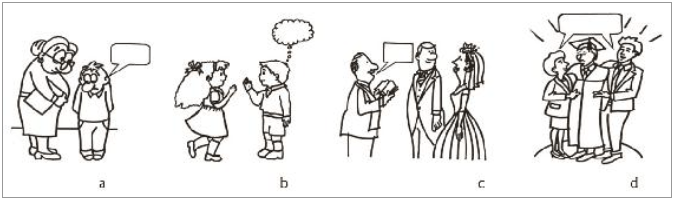
I’ll just share one example, and McGilchrist provides common responses from persons with both hemispheres intact as well as responses with right hemisphere deficits. For image b, a ‘normal’ response is for the respondent to fill in the boy’s talk bubble with ‘Boy, she’s cute.’ A couple of right hemisphere deficit responses were ‘I wonder how big her allowance is’ and ‘Let’s arm-wrestle’, obviously missing context.

The right hemisphere is responsible for understanding emotion, irony, jokes and humour—and the ability to tell the difference between jokes and lies. When told a joke and given an opportunity to fill in the punchline, the language of right hemisphere deficit patients ‘is often excessive and rambling; their comments are often off-colour and their humour is frequently inappropriate; they tend to focus on insignificant details or make tangential remarks’. Moreover, when asked to reconvey a story, the right hemisphere deficit people produced an ‘abundance of embellishments’ to it.

One subject with right hemisphere resection asked, ‘how do you feel?’ responded ‘With my hands’

Other right hemisphere functions are the ability to grasp the semantic nuance and intonation of a speaker. One subject with right hemisphere resection asked, ‘How do you feel?’ He responded, ‘With my hands,’ but he wasn’t joking.

People who have undergone a right hemispherectomy demonstrate a ‘shallow affect, rigidity, [and] lack of imagination’. The left hemisphere seems to prefer denotative speech whilst the right prefers connotative, hence a broader set of possible meanings. Interestingly, yet perhaps not surprisingly, clichés are the domain of the left hemisphere. Poetry and music reside on the right.

Wrapping up this chapter, the right hemisphere tends to serve as the emotional centre, save for anger, which is a left hemisphere activity.

Perspective

In summary, the left brain is very focused. Damage to the right hemisphere mimics the responses of autistic and schizophrenic individuals who interpret inputs differently and without nuance. This nuance often contains emotional or empathetic content that is lost on this cohort.

I am left wondering if schizophrenia and autism are right hemisphere problems, as it were, or if I would be reading into things to arrive at this conclusion.  

Having completed Emotional and Social Intelligence next up is a chapter on Cognitive Intelligence. I hope you’ll join me.

What are your thoughts? What did you think of this chapter? Were there any surprises? Anything of particular interest?

Leave comments below.
Cerebral Hemisphere Differences: Woods and Trees

Iain McGilchrist feels that the world is moving too much toward a left hemisphere-dominated world. This has happened before, ebbing and flowing, and perhaps it will change direction again at some point. Although this compartmentalised thinking has its roots at the beginning of the Age of Enlightenment, it has accelerated in the past century as specialisation has too many of us losing the woods for the trees.

Podcast: Audio rendition of this page content

Humans have “a sufficiently strong propensity not only to make divisions in knowledge where there are none in nature, and then to impose the divisions on nature, making the reality thus conformable to the idea, but to go further, and to convert the generalisations made from observation into positive entities, permitting for the future these artificial creations to tyrannise over the understanding.”

— Henry Maudsley, The Physiology and Pathology of the Mind,1867

I hope McGilchrist explores extreme right hemisphere dominance more in The Master and His Emissary, whether relatively due to a deficient left hemisphere or because of the right hemisphere running amok.

McGilchrist warns the reader time and again that both hemispheres are involved in many activities, and it is what they are doing or how they are processing the events that differ. But when we generalise some primary competencies—a decidedly left hemisphere activity—, we notice that the left hemisphere is about constrained thinking with a focus on elements rather than the whole as illustrated previously and creating a map to re-present those data.

A Woman’s Face in the Trees: Gestalt in Action

Conversely, the right hemisphere is about openness and experiencing the world as it is presented rather than a re-presentation. I likened this to a Zen approach. It would probably not be unfair to relate this to the Buddhist notion of oneness and selflessness.

Given Iain’s assessment, perhaps right hemisphere dominance is not our biggest concern at the moment. However, I perceive a potential problem. Given the right hemisphere’s proclivity toward Gestalt, I am concerned that it also overgeneralises things into a whole where they shouldn’t be connected, as such. Gestalt is what fills in spaces in perception to make it appear as a whole. I’ll consider this to be an interpolation. But if it interpolates wrong, we may incur fitness penalties. Aside from this, I consider extrapolation—or perhaps misidentified boundary states, which is to say we include aspects outside of the ‘real’ domain boundary and glom it onto the model because, cognitively speaking, we don’t know what to do with it or how to interpret it. Once it gets passed to the left hemisphere, it (incorrectly) codifies it, from that point onward being mis-re-presented.

So where the left hemisphere loses the woods for the trees, the right hemisphere annexes the neighbours’ woods.

The Unbearable Preciseness of Language

First, accept my heartfelt apology in advance for employing the word preciseness over precision. I was seeking a term closer to lightness, a conceit to the Unbearable Lightness of Being.

Audio: Podcast rendition of this page content

It appears that I am at odds with Iain McGilchrist if I am interpreting The Master and His Emissary correctly, His position is that verbal and written language is too precise for accurate communication. Gestures and facial queues are necessary to convey the entire payload; otherwise, it is easy to miss nuances in empathy and metaphor. Missing most are signals conveyed by the eyes, which are interpreted by the right hemisphere. The left hemisphere is more concerned with the mouth.

Before I get too far ahead of myself, the position I’ve asserted for years is that of the insufficiency of language. As diametric as this might seem at face value, I feel that it’s both, and it depends on the words and the contexts, though it feels that we are in disagreement here as well.

It’s long been said that the eyes are the window to the soul, and these people were onto something. The eyes convey emotional content to be interpreted by the right hemisphere. This hemisphere is all about seeing the big picture as well as metaphor.

The left hemisphere is more concerned with maps and symbols, so it is looking at the mouth and lips for minute details.

People with right hemisphere deficits can’t decode meta information conveyed by the eyes. Practically, this means that they can’t interpret metaphor, innuendo, sarcasm or humour. This is also the case for schizophrenics and people further right on the autism spectrum, including those with Asperger’s syndrome. I don’t know if the connexion between these psychological conditions and right hemisphere effects is due to a deficient right hemisphere or something related to the communication channel between the hemispheres. This has not yet been mentioned.

I also find it interesting that this deficit creates a situation where a sufferer can’t discern a joke from a lie, which is telling. In a manner of thinking, a joke is a bit of an untruth or stretching a fact or omitting some details to make a point, so without the larger context that this is the purpose of the joke, it might easily be interpreted as a lie.

All of this is interesting, but these are not the insufficiencies I am concerned with. In these cases, these deficits inhibit the receipt of relevant information. My contention involves the majority of people—the ones we term as ‘normal’.

One of my pet peeves is weasel words. Justice is a big one among these. I wonder if he feels that the Gestalt of the right hemisphere is what I am missing. This is the pornography the US Supreme Court judge, Potter Stewart, who says he can’t define it, but he’ll know it when he sees it. I say that this imprecision is meant to allow for arbitrary and capricious application on a whim or to meat some ulterior motive. This is decidedly not a problem of over-precision, and this is where I hold issue. Can it be too precise, too sharp to a point it needs the edges rounded? Yes. I can see that as well.

Intermission

I feel that missing non-verbal cues is a massive challenge for videoconference calls—even when the audience is one-to-one. First, the resolution needs to be high enough to see the eyes and face, so the person needs to be in frame and not one of several people barely discernible, presume, of course, that they are showing themselves on camera at the start.

Assuming that the resolution and lighting are appropriate and the person’s face is framed in a manner to reveal their eyes and mouth, gesticulation and body language are likely missing, so we are missing more non-verbal cues. I’ll also assume that we can discern aspects of prosody which as timbre, pitch, and intonation.

Add to this a videoconference with multiple participants. Sure, you might be able to see all of the faces, but there is still something missing from these thumbnail views. In some cases, I’ve seen long shots, say, in a conference room, but the detail is notably lacking. No nuance here.

Can we adapt to this situation? Yes, Of course. Should you meet in person where it’s possible and importance is of the utmost? Of course. You’d be a tone-deaf fool not to.

Epilogue

The last point I’d like to make about language being too precise is that for an erudite person like McGilchrist, it just might be, but most people don’t have large vocabularies and have barely adequate grammatical skills. They are hardly at risk of precision. An apt analogy might be to liken them to three-year-olds with crayons—no offence to three-year-olds with crayons. Plenty of people are a step or two above functional illiteracy, but that’s not saying much. To these people, language is less of a sword than it is a blunt instrument, a proverbial bag of bowling balls.

Voltaire once quipped that he’d have written a shorter letter if he had the time, noting the effort necessary for concision. The problem with trying to encode a message not conveyable by body language into a document is that its word count might need to double or treble, which I argue would at the same time reduce interest and comprehension, opening room to misinterpret the intent—all because missing non-verbal queues were lost.

In the end, I am doubling down on my position. Language is insufficient for all but the simplest and basic communication, and it is not too precise. The word McGilchrist is looking for is blunt.

Cerebral Hemisphere Differences: The Colour and the Shape

One key aspect of left and right hemisphere differences is the notion of identification versus naming and categorisation. I tend to view the right hemisphere as rather Zen. It just sees things as they are without particular care, judgment, or attachment.

Podcast: Audio rendition of this page content
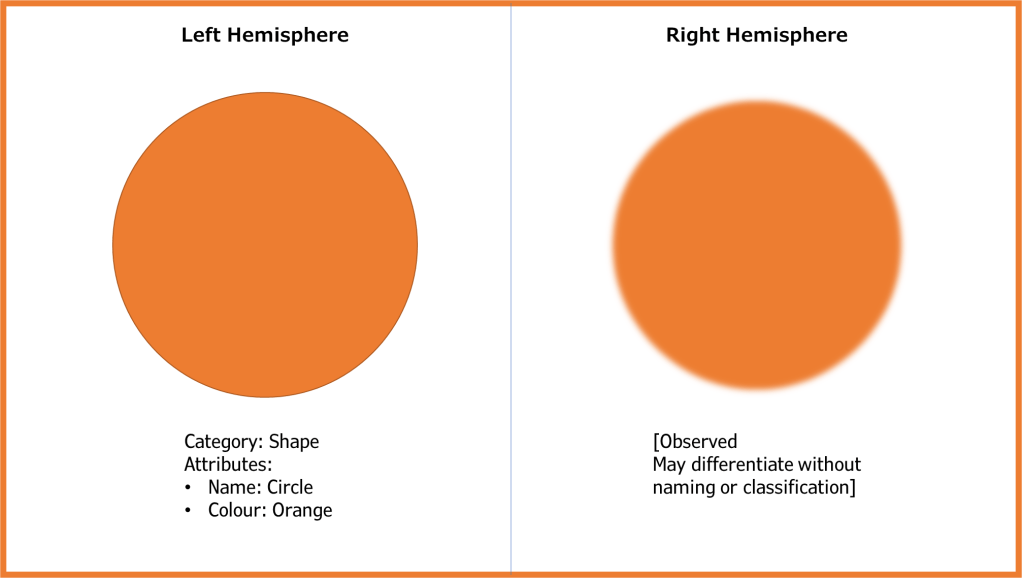
2 Orange Circles as tentatively experienced by the left and right hemispheres of the brain.

I composited a quick illustration to convey the difference. Starting with the right hemisphere, the object is recognised in a global context. Whilst it can be distinguished from a blue thing or a square thing, this is done by holistically surveying the world. The difference is perceived but rather without reflection on memory.

Generally speaking, both hemispheres ‘see’ the object, but where the right hemisphere is interested in the object as presented, the left hemisphere is interested in re-presentation. Where the right hemisphere is about being open to the experience itself, the left closes.

From an evolutionary vantage, the right hemisphere is interested in surveying the world at large and being alert to potential danger or survival queues, perhaps a food source. If the right hemisphere is triggered, the left hemisphere jumps in. This said, the left hemisphere is tightly focused, so if something does alert it—remembering that it is not switched off awaiting the right brain to activate it—, it will respond more quickly than the right hemisphere, though as I’ve noted previously, accuracy is not it’s forte, as the right hemisphere may have to convey that the snake that startled you was, in fact, a garden hose.

The left hemisphere is where categorisation and naming take place. Moreover, it stores the object for later retrieval, creating a map. If a subsequent observation is made, it is compared and contrasted relative to the map. After enough observations are made, the left brain isn’t so interested in observing the external world. It perceives a circle-y shape or perhaps an orangy colour and is convinced (metaphorically) that its cached version is satisfactory.

There is a book named Drawing from the Right Side of the Brain. I don’t want to comment on the book in depth, save to say that the author’s premise is that the so-called left-hemisphere person will look at the face of a subject and draw a generic oval shape. The eyes will be general eye shapes, following the same pattern for the nose and mouth. In the end, they will have rendered a portrait on the level of a child.

Whistler’s Mother, a restoration as reimagined by Mr Bean in the movie Bean.

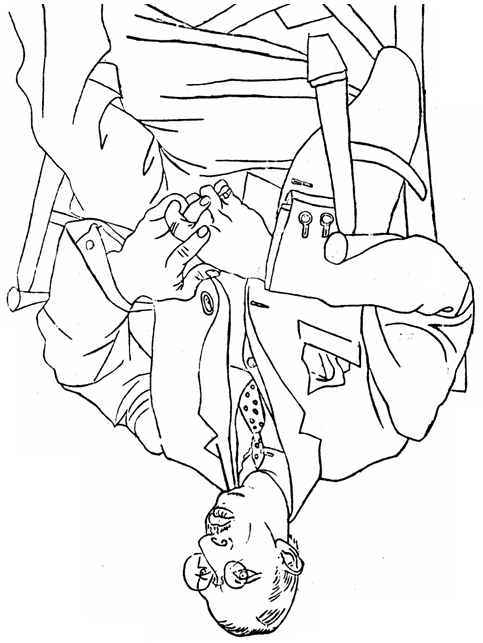
The artist who inhabits the left brain will instead note the contours, shadows, and colours of the face in front of them. One exercise that I had learned in some art class years before I read this was to draw from an inverted portrait. Not being so common as upright faces, the left brain has no representations modelled and so defers to the right hemisphere that is now looking at the object—the terrain—rather than the model.

Inverted image of Igor Stravinsky, a popular subject for breaking left-brain fixedness

I find the divided hemisphere activity in animals without stereoscopic vision to be fascinating. Perhaps, I’ll comment on this next.


* I am not claiming that the right hemisphere sees the world as fuzzy or hazy. Rather, this was me taking artistic licence to not ascribe strict boundaries to the objects in the world, especially as constrained by language.

VIDEO: The Truth about Truth

I wrote about this content in 2019, but I wanted to revisit it for a video as well as create a podcast audio version.

Video: YouTube version of this page content
Podcast: Audio rendition of this page content

In today’s segment, I am going to share my perspectives on the truth about truth. To start, I’ll let the audience know that I do not believe in the notion of truth. I feel the term is ill-defined especially in the realm of metaphysics and morality. I feel that when most people employ the word ‘truth’, what they mean to say is ‘fact.’ That a fire engine is red, for example, may be a fact, if indeed the fire engine happens to be red, but it is not true. This is a misapplication of the term. If you employ truth as a direct synonym for fact, then this is not what’s being discussed here, and perhaps your time might be better spent watching some content by the Critical Drinker.   

My argument is that truth is not objective. Rather it is subjective and perspectival. I concede that there may be some objective truth out there somewhere, but it is not and will not ever be accessible to us because of limitations in our sense-perception faculties and cognitive limitations. Per Aristotle, we only have five senses with which we can connect to the world, and these senses are limited. If there is anything out there that would require another sense receptor—a sense receptor not available to us—, we would never be able to sense it, to even know of its existence. Perhaps the universe emits 100 sense signals, but we are only capable of receiving and translating five. We’d be oblivious to 95 per cent of reality.

I am not making any claims that this is the case, but human cognition is so limited, that we can’t even conceive of what another sense might be. If you can, please leave a comment.

To be clear, I am not talking about senses we know other species possess. Bats may have echolocation, and sharks may have electroreception. Some animals may have greater sensory acuity—superior vision and auditory senses, olfactory and gustatory, tactile, or whatever. Some can see into infrared or ultraviolet light spectra. Technology that includes biomimicry provides humans with microscopes for the microworld and telescopes for the macroworld. We have x-rays and sonar and radar, radios and televisions that extend our senses, but these provide no new sensory receptors.

Like the story of the blind people and the elephant, we are left grasping at parts. But even if we are able to step back to view the whole elephant, to hear the elephant, to touch and smell or even taste the elephant, if there is more to the elephant, we cannot know it. The same goes for ourselves.

I know that some people might inject gods or psychic or paranormal energy into this void, and sure, feel free, but I am looking beyond these pedestrian concepts. What else might there be?

But let’s depart this train and head in a different direction. I want us to focus on the senses we do have. For the typical human, sight is our primary arbiter of reality, at least as defined idiomatically. We tend to believe what we see, and what we see, we assume as real—even if we are later mistaken. I guess that wasn’t a unicorn or a pink elephant. I must have been hallucinating or dreaming. I could have sworn that was Auntie Em.

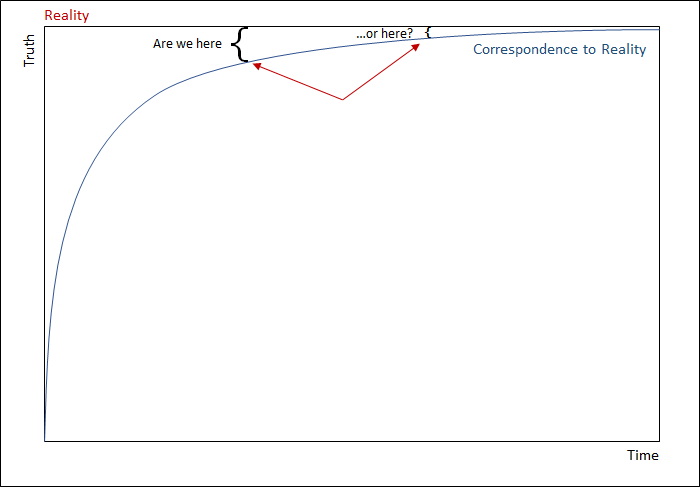
There are several competing theories around truth, but I’ll focus on the Correspondence theory, which is simply put, the notion that, proxying reality for truth, human perception corresponds with the real world. And a pragmatist might argue that’s close enough for the government.

Keep in mind that historically humans have contorted themselves into making calculations. Remember how long people had been tying themselves into knots to show planetary motion in a geocentric system creating epicycles and retrograde motion to map understanding to a perceived reality.

One might even argue that we’ve progressed. It wasn’t true or accurate then, but now it is. And perhaps it is. Let’s look at some illustrations.

NB: Due to an editorial mishap, this paragraph was dropped in the podcast, hence dropped from the video, which shared the podcast audio source. As such, this image was also not used in the video. This is unfortunate, as it was meant to introduce those with limited maths knowledge to the asymptotic curve, as described. Apologies, and I hope this serves to orient any travellers who may have lost their way at this point.

In this first illustration, we see Truth (or relative truthiness) on the Y-axis and Time on the X-Axis. On the top, we see a threshold representing Reality. In the plane, I’ve rendered an asymptotic curve, where over time, we get closer and closer to the Truth. But we never quite get there. More on this later.

The next illustration will help to demonstrate what’s happening.

Notice there is a gap between the curve and the Reality cap. For one thing, we don’t really know where we are relative to Reality. In the case of the geocentric system, we might have been at the leftmost space. Once we determined that the system is actually solar-centric, we might have moved right on the curve to close the gap. We might be tempted to defend that we’ve finally reached the truth, but we’d have been equally willing to make the same defence from the geocentric position, so we need to be mindful of the past.

Perhaps, this last example was too obvious. We feel comfortable staking a truth claim—or at least a claim of fact. So let’s look at another example.

Let’s re-use the same axes—Truth and Time—, but rather than an asymptotic curve, let’s presume something more polynomial in nature—or not particularly cyclic. Rather than retrograde motion in planets, let’s visit the supposed progress of Newtonian over Einsteinian physics.

This takes a bit more setup but bear with me.  In this case, I have taken liberties and illustrated the Einsteinian physics gap to capture an inferior vantage on reality over Newtonian physics. Granted, I need to rely on a bit of suspension of disbelief, but in the bigger picture, I am trying to convey a scenario where some new paradigm puts the prior knowledge in perspective.

In this instance, both Newtonian and Einsteinian flavours of physics are based on a materialistic, particles-based model, which is where the modern physics consensus resides. But, let’s say that consensus changes in such a way that it is determined that something else underlies reality, say consciousness per Analytic Idealism as proposed by Bernardo Kastrup or per Integrated Information Theory (IIT) as advanced by Donald Hoffman and others. As with retrograde motion, we might end up finding that we were barking up the wrong tree. This might be a bit different because the particles are a directly perceived manifestation of the underlying consciousness, but I wanted to create a scenario where knowledge thought to have advanced actually regressed, but this wasn’t revealed until a new perspective was available.

Yet again, an important aspect of note is that we don’t actually know the distance between our perceptions and real Reality.

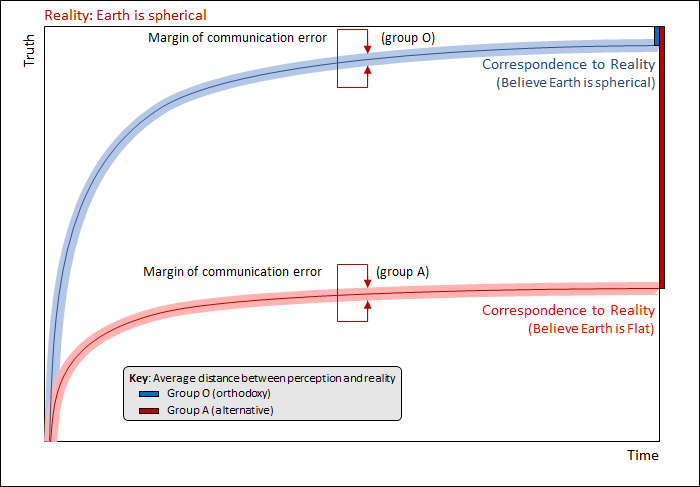
This last illustration builds upon the first asymptotic chart but has an in-built error margin meant to reflect language insufficiencies. There is some concept that people feel they grasp, but the consensus is not as unified as the group thinks.

I’ll share two examples, the first being the concept of justice. To me, Justice is what I deem a weasel word. It’s a word we commonly use, but it means different things to different people. To me, it’s a euphemism for vengeance by proxy, but for others, it transcends that and mirrors some impartial dispensation of just desert—some good old-fashioned law and order.

[Justice is] a euphemism for vengeance by proxy

Without getting stuck down some rabbit hole, my point is that if we aggregate these beliefs, the asymptotic curve represents an average consensus vantage rather than something as obvious as 2 plus 2 equals 4. On this note, allow me to clear the air.

Some viewers might be clamouring to say, “but 2 plus 2 equals four is true.” But this is tautologically true, which is to say that it’s true by definition. It’s a similar tautology to saying that it’s true that snow is white, or coal is black. We’ve already defined snow, white, coal, and black, so these may be facts, but they are true by definition.

Revisiting the chart, notice that there are two curves in the space. In this case, I illustrate competing truth claims from the perspective of an omniscient narrator. The case is whether the earth is an oblate spheroid or is flat. I am going to go out on a limb and assert the earth is spherical, as represented by the top blue curve—and we have some margin of error as to what that might mean. The bottom red curve depicts the perceived truth of the flat earthers, who also have some room for semantic error.

Given that I am presuming that I am in the right adopting the majority position—please be right—, the blue curve is closer to Reality than the red curve. Of course, in the event that the earth is really flat, then it proves my point that we don’t know where we are relative to truth, so we assume that the state of knowledge at any given time is what’s real.

Again, forgive my fanciful examples. Please don’t tell me that this spheroid versus planer earth is tautological too because you’d be correct, but I am already aware. They are just nonsensical illustrations. Nonetheless, I hope they’ve served to express a point.

I could have as well created curves that depicted two cohorts’ beliefs on the efficacy of tarot or astrology in predicting the future. I am sure that it might render somewhat like the last chart, but I’d also presume that both curves would have very low truth values as seen from an objective observer. Secretly, I hope tarot wins the truth battle.

Before I end our time together, I’d like to convey that for an Analytic Idealist, these charts might be more acceptable at face value. For a Realist, Naïve or otherwise, they may argue that this curve is not asymptotic and may in fact reach some tangency. I don’t happen to believe this is the case or I wouldn’t have spent my time assembling and presenting this. Time will tell. Or will it?

The Matter with Things: Chapter Five Summary: Apprehension

Index and table of contents

This is my take on the fifth chapter of The Matter with Things. I suggest reviewing the previous chapters before you delve into this one, but I won’t stop you from jumping queue.

Podcast: Audio rendition of this page content

Intro

Chapter five of The Matter with Things is titled Apprehension, following the previous chapters, Attention, Perception, and Judgment. From the start, let’s clarify that apprehension is not meant in the manner of being nervous or apprehensive. It’s meant to pair with comprehension. More on this presently.

Whilst the previous chapters have been heavily focused on the importance of the right hemisphere, this chapter is focused on the left, which may be given the chance to redeem itself. Not surprisingly perhaps, given the relative function of the right hemisphere versus the left, this chapter is much shorter than prior chapters.

Content

This chapter opens by asking what happens to a person who experiences left hemisphere damage. But let’s return to the chapter title. Apprehension is retaken etymologically and means to hold onto or to grasp. This is the function of the left hemisphere. The right hemisphere is about comprehension. The root ‘prehension’ is Latin for hold; the added ap prefix suggests holding on, whilst the com prefix suggests holding together.

Whilst conceptualising and abstract language is a right hemisphere function, spoken words are a left-brain function. It turns out that so is pointing and other gesticulation, reminding me of some ethnic stereotypes of people who speak with their hands. We need to keep in mind that the right hemisphere controls the left part of the body whilst the left hemisphere controls the right. What this means is that the right hand, being guided by the left hemisphere is marching to a different drummer.

Also, keep in mind from the previous chapters that the right hemisphere is holistic whilst the left is atomistic. Where right hemisphere damage is evident, a person has difficulty viewing the parts of a whole, whilst if the damage is on the left, a person has difficulty constructing a whole from its constituent parts. Namely, it may recognise that a body is constructed from an inventory of pieces—head and shoulders, knees, and toes—, but it can’t seem to grasp the cohesive orchestrated picture.

Apart from body continuity, when the left hemisphere is damaged, it might know all of the steps of a given process—McGilchrist shares the example of a person trying to light a smoking pipe—, but there may be difficulty in some of the instrumentation along the way. He cites an example by Czech neurologist, Arnold Pick, which I share here intact:

The patient is given a pipe and brings it correctly to his mouth, then expertly reaches for the tobacco pouch and takes a match from the box but when asked to light it, sticks the head of the match into the mouthpiece and puts the other end in his mouth as if to smoke it. Then he takes it out of his mouth, draws it out of the mouthpiece and sticks the other end of the match in the mouthpiece of the pipe, pulls it out again, holds it for a while in his hand apparently thinking, and then puts it away.

a person when encountering a pencil would feel compelled to grab it and start writing nothing in particular

To underscore the apprehension, where there is damage evident in the right hemisphere, the right hand (under control of the left hemisphere) may just grasp at things for no reason, perhaps reaching arbitrarily out to doorknobs. In one case, a person when encountering a pencil would feel compelled to grab it and start writing nothing in particular. In each case, the right hemisphere was not available to contextualise the experience. This right hemisphere is opening and exploratory whilst the left is closing and instrumental. It seems one might tend to meander without the left to provide a certain will and direction.

McGilchrist makes some correlations between humans and other great apes, but I’ll just mention this in passing.

I am going to pause to editorialise on McGilchrist’s next claim. He argues that Saussure’s claim that language signs are arbitrary is false and gives some examples—sun, bread, and spaghetti—but I am not ready to accept this stance. For now, I am remaining in the camp with Saussure and Wittgenstein that language is both arbitrary and self-referential.  Getting down off my soapbox.  

Recall again that whilst the right hemisphere takes the world as presented, the left hemisphere can only re-present. This is why language symbols are handled by the left hemisphere. Coming back to Saussure, the right-brain experiences a ‘cat’ whilst the left-brain names that object a ‘cat’ and classifies it as a mammal, feline, quadruped, and whatever else.

The right hemisphere is about metaphor, prosody, and pragmatics whilst the left hemisphere, though not exclusively, is about syntax and semantics.

The right hemisphere is about metaphor, prosody, and pragmatics whilst the left hemisphere, though not exclusively, is about syntax and semantics.  The left hemisphere is about symbols. As such, lipreading and interpreting sign language are both left-brain activities.

An interesting conveyance is a case study of a person with left hemisphere damage reading a book who recites the elephant in place of the written word India, so making an association by not recognising the word itself. And there may be a naming problem, so if there was a problem related to an ankle, they would point to an ankle but substitute the name of the part.

Finally, to reiterate the holistic versus atomistic divide, some people with left hemisphere damage can articulate the parts of the body or a bicycle, but when queried can’t relate that the mouth is beneath the nose or some such.

Perspective

To summarise, McGilchrist leaves with a comment, “The fabric of reality typically goes for the most part unaltered when the left hemisphere is suppressed.”

As I’ve been editorialising a bit throughout, I don’t have much to add at this point. Aside from my Saussure nit, I am still very interested in the concept that the right hemisphere constructs reality. I feel that I interpret this construction differently to Iain.

I believe that we agree that there is a world out there, and we interpret this world by interacting with it. Where I feel we differ is that he feels there is a world of objects that we interact with and perceive whilst I believe that we construct this world of objects by means of constructing the underlying material, from particles to fields. I think he’ll discuss this more in later chapters and I could be off base. Time will tell.

Having put Apprehension to bed, next up is a chapter on Emotional Support and Intelligence. I hope you’ll join me.

What are your thoughts? What did you think of this chapter? Were there any surprises? Anything of particular interest?

Leave comments below or on the blog.

The Matter with Things: Chapter Four Summary: Judgment

Index and table of contents

This is my take on the fourth chapter of The Matter with Things. Chapters one and two have been posted previously.

Podcast: Audio rendition of this page content

Intro

Chapter four of The Matter with Things is titled Judgment. Following the previous chapters, Attention and Perception, it’s about how we reach conclusions based on what we perceive.

Trust in left versus right hemisphere processing. The right hemisphere is responsible for anchoring us into reality, so if there are cognitive deficits on the right, the left has a tendency toward delusion.  

Content

This chapter opens with a quotation by Maurice Merleau-Ponty, “Perception is a judgment, but one that is unaware of its reasons, which is as much as to say that the object perceived gives itself as a whole and as a unity before we have grasped its intelligible principle.”

Nearly all delusions are due to right hemisphere damage or dysfunction. Distinguishing delusions, which are distorted reality judgments, from hallucinations, which are distorted perceptions, is to some degree arbitrary, since misperceptions can give rise to misbeliefs, and misbeliefs give rise to misperceptions.

Reinforcing previous chapter content, the right hemisphere is holistic whilst the left is narrowly focused. To borrow the metaphor of McGilchrist’s previous book, the right hemisphere is the master whilst the left is the emissary. The right serves as an anchor to the flighty left.

I’ll share the quote he cites by Orrin Devinsky: The unchecked left hemisphere unleashes a creative narrator from the monitoring of self, memory, and reality by the frontal and right hemisphere areas, leading to excessive and false explanations. Further, the left hemisphere’s cognitive style of categorization, often into dual categories, leads it to invent a duplicate or impostor to resolve conflicting information. Delusions result from right hemisphere lesions. But it is the left hemisphere that is deluded.

This serves as an apt summary. The left jumps to conclusions and seems to need closure, so its first answer is its final answer, no matter how implausible. He cites that this need for closure is also a feature of modernity that seems to insist on closure. This need is evidently amplified in schizophrenics.

Here is where I will take liberties and skip the examples of prosopagnosia, delusional misidentification, paranoia, and the rest, save to inform the reader that clinically speaking paranoia has a broader meaning than used idiomatically. It’s not simply the feeling that someone is watching us or out to get us. It also extends to any number of mistaken references to oneself and includes grandiose and religiose delusions.

Another condition that I’ll pause to mention is that of mirror agnosia, where a subject cannot recognise itself in a mirror, and Cotard’s syndrome where a person believes themselves to be dead.

The right hemisphere supports the body’s schema. Rather contrary to previous mentions that the left hemisphere is the map maker, the right hemisphere seems to contain the blueprint for the assembled body. In fact, children born without limbs may still experience phantom limb sensation due to this mapping.

He writes about the connexion between depression and insight, noting “that depression has repeatedly been shown to be associated with greater realism.” And “the evidence is that this is not because insight makes you depressed, but because, up to a point, being depressed gives you insight.” Moreover, depression is linked to the perception of time.

Next, he touches on false memories and confabulation. Quoting Michael Gazzaniga, he writes, “the left hemisphere generates many false reports. But the right brain does not; it provides a much more veridical account.

Next, he writes about the phenomenon of magical thinking, which is “defined as ‘belief in forms of causation that by convention are invalid’.” The jury is still out on which hemisphere this is more dominant. He tells us that, quote, “Magical thinking may not be pathological at all, except in extreme cases.” And citing Peter Brugger writes that “to be ‘totally “unmagical” is very unhealthy’, and reduces one’s capacity to appreciate value and to take enjoyment in life.” Take this as you may.

In describing the role of reasoning in forming judgments, he clarifies that “reasoning is classically associated with the left hemisphere, but in reality, most studies show that both hemispheres contribute to reasoning; and the part played by the right hemisphere is significant.” Interestingly, if not paradoxically, citing Sass and Pienkos, we learn that ‘The most deluded patients with schizophrenia tend to be those whose thinking is more logical.’ And “Eugène Minkowski’s insight that the problem in psychosis is not loss of reason, but its hypertrophy: ‘The mad person is much less frequently “irrational” than is believed: perhaps, indeed, he is never irrational at all.’”

Discussing inductive and deductive reasoning, the left hemisphere is the whipping boy again. Inductive reasoning needs stasis and normalcy—the domain of the left hemisphere—, so much so that it keeps trying to convince us that everything is normal, so when things like the 2008 financial collapse or Covid-19 come along, the left brain defends ‘Who could have predicted that?” whilst the right hemisphere rolls its proverbial eyes. The right brain is the Sherlock Holmes of deductive reasoning.

Humorously, McGilchrist’s conveys in his words, and I quote, “To put it crudely, the right hemisphere is our bullshit detector” whilst the left hemisphere is a pigeon that is easily duped.

Perspective

To summarise, it’s difficult for me to get past my own conviction that the left hemisphere is an abject wanker. This is the part of the brain always looking for order and reason and constructing patterns where they don’t exist. He doesn’t mention pareidolia or apophenia, but I’m willing to wager that the left hemisphere is responsible for this. I’d also be willing to bet that it is responsible for creating nonsensical categories such as race and gender. It just seems like a half-arsed busybody.

The right hemisphere is responsible for constructing a self or a contiguous self and other assemblages, but I don’t want to lose sight of the implication that these are nonetheless constructions. I don’t prefer the term ‘illusion’, as I am more partial to the notion of ‘fiction’. Our sense of self is a fiction, a confluence of senses. And like the notion of money and so many other fictions, whether countries, nationalities, economies, and so on, this fiction can be useful. But it leaves me wondering what the non-fiction version looks like. I am not saying that the delusional state is perhaps driven by some left hemisphere dominance. This is just a different, perhaps less useful fiction. It seems that some self-less model or slices of selves would be a more truthful rendition, if not notably less practical. I suppose the question might be, “What would life be like in a world where there were no constructed selves?”

Of particular interest to me is the prevalence of so-called mental illnesses and the Age of Enlightenment and the sciences, notably mechanistic thinking.

Now that we’ve covered attention, perception and now judgment, we’ll be covering apprehension in the next chapter.  And heads up, by apprehension he doesn’t mean foreboding, so don’t be apprehensive. I hope you’ll join me.

What are your thoughts? What did you think of this chapter? Were there any surprises? Anything of particular interest?

Leave comments below or on the blog.