Paul Feyerabend’s Against Method: Chapter 1

What if science’s greatest achievements came not from following rules, but from breaking them? What if progress depends more on chaos than on order? In Against Method, philosopher Paul Feyerabend presents a provocative thesis: there is no universal scientific method, and the progress we celebrate often emerges from breaking established rules rather than following them.

I read Against Method years ago but decided to re-read it. It’s especially interesting to me because although I advocate systems thinking, I don’t believe everything should be or can be systematised. More generally, this bleeds into my feelings about government, politics, and institutions.

Whilst Feyerabend’s focus is on science, one can pull back the lens and see that it covers all such systems and systematic beliefs. I may write a separate article on this, but for now, I’ll focus on Against Method.

The Anarchist’s View of Science

Feyerabend’s critique strikes at the heart of how we think about knowledge and progress. He argues that science has advanced not through rigid adherence to methodology, but through a combination of creativity, rhetoric, and sometimes even deception. His concept of “epistemological anarchism” suggests that no single approach to knowledge should dominate – instead, multiple methods and perspectives should compete and coexist.

Consider Galileo’s defense of heliocentrism. Rather than relying solely on empirical evidence, Galileo employed persuasive rhetoric, selective data, and careful manipulation of public opinion. For Feyerabend, this isn’t an aberration but a typical example of how scientific progress actually occurs. The story we tell ourselves about the scientific method – as a systematic, purely rational pursuit of truth – is more myth than reality.

From Religious Dogma to Scientific Orthodoxy

The Age of Enlightenment marked humanity’s shift from religious authority to scientific rationality. Yet Feyerabend argues that we simply replaced one form of dogma with another. Scientism – the belief that science alone provides meaningful knowledge – has become our new orthodoxy. What began as a liberation from religious constraints has evolved into its own form of intellectual tyranny.

This transition could have taken a different path. Rather than elevating scientific rationality as the sole arbiter of truth, we might have embraced a more pluralistic approach where multiple ways of understanding the world – scientific, artistic, spiritual – could coexist and cross-pollinate. Instead, we’ve created a hierarchy where other forms of knowledge are dismissed as inferior or irrational.

The Chaos of Progress

In Chapter 1 of Against Method, Feyerabend lays the groundwork for his radical critique. He demonstrates how strict adherence to methodological rules would have prevented many of science’s greatest discoveries. Progress, he argues, often emerges from what appears to be irrational – from breaking rules, following hunches, and embracing contradiction. Indeed, rationalism is over-rated.

This isn’t to say that science lacks value or that methodology is meaningless. Rather, Feyerabend suggests that real progress requires flexibility, creativity, and a willingness to break from convention. Many breakthrough discoveries have been accidental or emerged from practices that would be considered unscientific by contemporary standards.

Beyond the Monolith

Our tendency to view pre- and post-Enlightenment thought as a simple dichotomy – superstition versus reason – obscures a richer reality. Neither period was monolithic, and our current reverence for scientific method might be constraining rather than enabling progress. Feyerabend’s work suggests an alternative: a world where knowledge emerges from the interplay of multiple approaches, where science exists alongside other ways of understanding rather than above them.

As we begin this exploration of Against Method, we’re invited to question our assumptions about knowledge and truth. Perhaps progress depends not on rigid adherence to method, but on the freedom to break from it when necessary. In questioning science’s monopoly on truth, we might discover a richer, more nuanced understanding of the world – one that embraces the chaos and contradiction inherent in human inquiry.

This is the first in a series of articles exploring Feyerabend’s Against Method. Join me as we challenge our assumptions about science, knowledge, and the nature of progress itself.

Don’t Care Much about History

As the years pass and my disappointment matures like a fine wine (spoiler alert: it’s vinegar), I’m reminded of the average intelligence quotient floating about in the wild. A few years back, I stumbled upon The Half-Life of Knowledge. Cute title, but it’s more optimistic than it should be. Why assume knowledge even has a shelf life? It’s one thing for once-useful information to spoil thanks to “progress,” but what about the things that were never true to begin with? Ah, yes, the fabrications, the lies we’re spoon-fed under the guise of education.

I’m well-versed in the lies they peddle in the United States, but I’d bet good money (not that I have any) that every nation’s curriculum comes with its own patriotic propaganda. What am I on about, you ask? Let’s just say I’ve been reading How the World Made the West by Josephine Quinn, and it’s got me thinking. You see, I’ve also been simmering on an anti-democracy book for the better part of five years, and it’s starting to boil over.

Here in the good ol’ US of A, they like to wax lyrical about how Athens was the birthplace of democracy. Sure, Athens had its democratic dabblings. But let’s not get it twisted—if you really look at it, Athens was more akin to the Taliban than to any modern Western state. Shocked? Don’t be. For starters, only property-owning men could vote, and women—brace yourselves—were “forced” to wear veils. Sounds familiar? “It’s a start,” you say. True, American women couldn’t vote until 1920, so let’s all pat ourselves on the back for that—Progress™️.

But no, hold your applause. First off, let’s remember that Athens and Sparta were city-states, not some cohesive entity called “Greece” as we so lovingly imagine. Just a bunch of Greek-speaking neighbours constantly squabbling like reality TV contestants. Meanwhile, over in Persia—yes, the supposed enemy of all things free and democratic—they had participative democracy, too. And guess what? Women in Persia could vote, own property, and serve as soldiers or military officers. So much for the idea that Athens was the singular beacon of democratic virtue.

More than this, Persian democracy was instituted by lottery, so many more people participated in the process by serving one-year terms. At the end of their term, they were audited to check for corruption. Now, you can see why we adopted the so-called Greek version. These blokes don’t welcome any oversight of scrutiny.

As a postmodern subjectivist, I tend to side-eye any grand narrative, and the history of Western civilisation is just one long parade of questionable claims and hidden agendas. Every time I think I’ve seen the last of the historical jump scares, another one comes lurking around the corner. Boo!

Declaration of Independence

It’s July. The season of independence in the United States. Independence from the overt tyranny of Britain, but not from the tacit tyranny of their government—the government purported to be ‘of the people, by the people, and for the people‘ per Abraham Lincoln’s 1863 Gettysburg Address. As their Constitution reads, ‘We the People‘. Governments may be of the people and by the people, but governments are an emergent phenomenon as happens when oxygen and hydrogen combine just so and create water. Two gases combine to create a new substance—water. Some forget that, like water, government are a distinct element to the people that constitute it. Some think it resembles them. It doesn’t. It’s Hobbes’ Leviathan—or a Jabberwok.

In preparation for the traditional Summer season, I took to reading Derrida’s 1976 essay, Declarations of Independence. It was interesting, but I was hoping to get more from it. I decided to deconstruct the opening paragraph—the preamble—of the Declaration of Independence:

Deconstructing Binary Oppositions

Self-Evident vs. Non-Self-Evident

The Declaration boldly asserts that ‘these truths’ are ‘self-evident’,’ a claim that is nothing more than a rhetorical trick. By presenting these ideas as self-evident, the authors seek to place them beyond questioning, discouraging dissent and critical examination. In reality, these ‘truths’ are far from universal; they are the product of a specific cultural and historical context, shaped by the interests and perspectives of the privileged few who drafted the document.

Interrogating Assumptions and Hierarchies The Declaration of Independence asserts that certain truths are ‘self-evident’, implying that these truths are so obvious that they require no further justification. However, the concept of self-evidence itself is far from universally accepted. It is deeply embedded in the philosophical tradition of Enlightenment rationalism, which holds that reason and logic can reveal fundamental truths about the world.

  1. Philosophical Foundations of Self-Evidence
    • Enlightenment Rationalism: The idea of self-evidence relies heavily on Enlightenment rationalism, which posits that certain truths can be known directly through reason and are therefore beyond dispute. Philosophers such as René Descartes and Immanuel Kant emphasised the power of human reason to uncover self-evident truths. Descartes, for instance, argued for the self-evident nature of ‘Cogito, ergo sum‘ (‘I think, therefore I am’) as a fundamental truth (Descartes, Meditations on First Philosophy).
    • Critique of Rationalism: Critics of Enlightenment rationalism, including existentialists like Friedrich Nietzsche and phenomenologists like Martin Heidegger, argue that what is considered self-evident is often culturally and historically contingent. Nietzsche, for example, contended that what we take as ‘truth’ is a product of our perspective and historical context, not an absolute given (Nietzsche, Beyond Good and Evil).
  2. Cultural and Philosophical Contingency
    • Cultural Relativity: Different cultures and philosophical traditions may not find the same truths to be self-evident. For instance, the concept of individual rights as self-evident truths is a product of Western liberal thought and may not hold the same self-evident status in other cultural frameworks. In many Eastern philosophies, the focus is more on community and harmony rather than individual rights.
    • Subjectivity of Self-Evidence: The term ‘self-evident’ implies an inherent, unquestionable truth, yet what one group or culture finds self-evident, another may not. This variability reveals the instability and subjectivity of the claim. For example, in traditional Confucian societies, the emphasis is placed on hierarchy and duty rather than equality and individual rights, demonstrating a different set of ‘self-evident’ truths.
  3. Constructed Nature of Truth
    • Language and Context: Jacques Derrida’s concept of différance illustrates how meaning is not fixed but constantly deferred through language. What we consider to be “truth” is constructed through linguistic and social contexts. Derrida argues that texts do not have a single, stable meaning but rather a multiplicity of interpretations that change depending on the reader’s perspective and context (Derrida, Of Grammatology).
    • Social Construction: Michel Foucault’s analysis of power and knowledge further deconstructs the notion of objective truth. Foucault argues that what is accepted as truth is produced by power relations within society. Truths are constructed through discourses that serve the interests of particular social groups, rather than being objective or self-evident (Foucault, Discipline and Punish).

Created Equal vs. Not Created Equal

The Declaration’s claim that ‘all men are created equal’ is a blatant falsehood, a manipulative promise designed to appease the masses whilst maintaining the status quo. The glaring contradictions of slavery and gender inequality expose the hollowness of this assertion. Equality, as presented here, is nothing more than an ideological construct, a tool for those in power to maintain their dominance while paying lip service to the ideals of justice and fairness.

Creator vs. No Creator

The Declaration refers to a ‘Creator’ who endows individuals with rights, grounding its claims in a divine or natural law. This invokes a theistic worldview where moral and legal principles are derived from a higher power. However, Derrida challenges this by showing that the concept of a creator is a cultural and philosophical construct, not a universal truth.

The presence of the creator in the text serves to legitimise the rights it declares. However, this legitimacy is contingent on accepting the cultural narrative of a creator. Secular and non-theistic perspectives are marginalised by this assertion, revealing the ideological biases inherent in the Declaration. The authority of the declaration is thus shown to be dependent on particular beliefs, rather than an objective reality.

Unalienable vs. Alienable

The notion of ‘unalienable Rights’ is another empty promise, a rhetorical flourish designed to inspire loyalty and obedience. In practice, these supposedly inherent and inviolable rights are regularly violated and denied, particularly to those on the margins of society. The Declaration’s lofty language of ‘Life, Liberty and the pursuit of Happiness’ rings hollow in the face of systemic oppression and injustice. These rights are not unalienable; they are contingent upon the whims of those in power.

Conclusion

Through this deconstruction, we expose the Declaration of Independence for what it truly is: a masterful work of propaganda, filled with false promises and manipulative rhetoric. The document’s purported truths and self-evident principles are revealed as arbitrary constructs, designed to serve the interests of the powerful while placating the masses with empty platitudes.

As some celebrate this 4th of July, let us not be fooled by the high-minded language and lofty ideals of our founding documents. Instead, let us recognise them for what they are: tools of control and manipulation, employed by those who seek to maintain their grip on power. Only by constantly questioning and deconstructing these texts can we hope to expose the truth behind the facade and work towards a more genuine understanding of freedom and equality.

References

  • Jacques Derrida, “Declarations of Independence,” in Negotiations: Interventions and Interviews 1971-2001, ed. Elizabeth Rottenberg (Stanford: Stanford University Press, 2002).
  • Jacques Derrida, Of Grammatology (Baltimore: Johns Hopkins University Press, 1976).
  • Friedrich Nietzsche, Beyond Good and Evil (Cambridge: Cambridge University Press, 2002).
  • Michel Foucault, Discipline and Punish: The Birth of the Prison (New York: Vintage Books, 1995).
  • Immanuel Kant, Critique of Pure Reason (Cambridge: Cambridge University Press, 1998).
  • René Descartes, Meditations on First Philosophy (Cambridge: Cambridge University Press, 1996).

Path to the Fall

By fall, I don’t mean autumn except perhaps metaphorically speaking. The accompanying image illustrates a progression from the pre-Enlightenment reformation and the factors leading to the Modern Condition and increases in schizophrenia in people, societies, and enterprises.

Podcast: Audio rendition of this page content.

This image is essentially composited from a later chapter in Iain McGilchrist’s The Master and His Emissary. In it, he outlines a path that commences at the Reformation that led to Lutheranism and Protestantism and further to Calvinism (not separately depicted). Max Weber argued that Capitalism is inextricably linked to Calvinism and the workmanship ideal tradition.

McGilchrists argument is founded on the notion that Catholocism is a communally oriented belief system whilst Protestantism is focused on the individual and salvation through personal work. The essence of capitalism is the same.

Of course, history isn’t strictly linear. In fact, there are more elements than one could realistically account for, so we rely on a reduction. In concert with the Reformation but on a slight delay is the so-called Age of Enlightenment, the Age of Reason, which led not only to faith in science but then to the pathology of Scientism.

This Protestant-Scientismic nexus brought us to Capitalism and into the Industrial Revolution, where humans were devivified or devitalised, trading their souls to be pawns to earn a few shekels to survive. Capitalism and the Industrial Revolution led to Marxism, through Marx’s critique of Capitalism, but Marxism has the same fatal flaw as Capitalism inasmuch as it doesn’t view people as humans. It does afford them a slightly higher function as workers, but this still leaves humanity as a second-tier aspect and even historicity is elevated above as a sort of meta-trend or undercurrent.

From there, we transition to Modernity, which yields the modern condition and schizophrenics in one fell swoop. This is no coincidence.

Although I end this journey at Modernism, McGilchrist is also leery of the effects of post-modernism as well as philosophy itself as overly reductionist in its attempts to categorise and systematise, valuing signs and symbols over lived experience. His main complaint with postmodernism is that it moves from the objective perspective of Modernity to the subjective perspective, and so there remains no base foundation, which is the shared experience. I’m not sure I agree with his critique, but I’m not going to contemplate it here and now.

In the end, this journey and illustration are gross simplifications, but I still feel it provides valuable perspective. The challenge is that one can’t readily put the genie back into the bottle, and the question is where do we go from here, if not Modernism or Postmodernism. I shouldn’t even mention Metamodernism because that seems like an unlikely synthesis, as well-intentioned as it might be. McGilchrist gives examples of reversals in the trend toward left-hemisphere bias, notably the Romantic period, but that too was reversed, recommencing the current trajectory. My feeling is that if we continue down this dark path, we’ll reach a point of no return.

It seems to be that it’s growing at an increasing rate, like a snowball careening down a slope. It not only drives the left-dominant types further left because an analytical person would reinforce the belief that if only s/he and the world were more analytical things would be so much better—even in a world where net happiness is trending downward—, but it also forces this worldview on other cultures, effectively destroying them and assimilating them into the dark side, if I can borrow a Star Wars reference.

Epilogue

I wasn’t planning to share this story—at least not now. In another forum, I responded to a statement, and I was admonished by Professor Stephen Hicks, author of the book of dubious scholarship, Explaining Postmodernism.

I responded to this query:

If you’re a single mother and have a son I’d suggest putting him in a sport or martial arts to add some masculine energy to his life. It’s not a replacement for the actual father but it can help instil structure and discipline into the core of his being.

— Julian Arsenio

“Perhaps this world needs less discipline and structure, not more,” was my response, to which Hicks replied.

The quotation is not about “the world.” It is about boys without fathers. Evaluate the quotation in its context.

— Stephen Hicks

“Disciplined boys create a disciplined world. Not a world I’d prefer to create or live in. We need more right-hemisphere people. Instead, we are being overwhelmed by left hemisphere types, leading to Capitalism and the denouement of humanity as it encroaches like cancer, devouring or corrupting all it touches.

“In the end, it is about the world, which from a left hemisphere perspective is a sum of its parts. Right-hemisphere thinkers know otherwise,” was my reply. He responded,

You seem to have difficulty focusing. From a quotation about fatherless boys you free associate to [sic] weird psychology and global apocalptic [sic] pessimism. Pointless.

— Stephen Hicks

“I’ll suggest that the opposite is true, and perhaps you need to focus less and appreciate the Gestalt. This was not free association. Rather, it is a logical connexion between the disposition of the people in the world and lived reality.

“Clearly, you are a left-hemisphere structured thinker. The world is literally littered with this cohort.

“I suggest broadening your worldview so as not to lose the woods for the trees. I recommend Dr Iain McGilchrist as an apt guide. Perhaps reading The Master and His Emissary and/or The Matter with Things would give you another perspective. #JustSaying”

His final repartee is,

And still, rather than addressing the issue of fatherless boys, you go off on tangents, this time psychologizing about people you’ve zero first-hand knowledge of.

— Stephen Hicks

Feel free to interpret this as you will. For me, his attempt to limit discussion to some notion he had in his head and his failure to see the woods for the trees, as I write, suggests that he is a left-brain thinker. Having watched some of his videos, whether lectures or interviews, this was already evident to me. This exchange is just another proof point.

I considered offering the perspective of Bruno Bettleheim’s importance of unstructured play, but as is evidenced above, he is not open to dialogue. His preference appears to be a monologue. This is the left hemisphere in action. This is an example of how insidious this convergent thinking is, and it makes me worry about what’s ahead in a world of people demanding more structure and discipline. Foucault’s Discipline and Surveillance comes to the forefront.

VIDEO: The Problem with Postmodernism

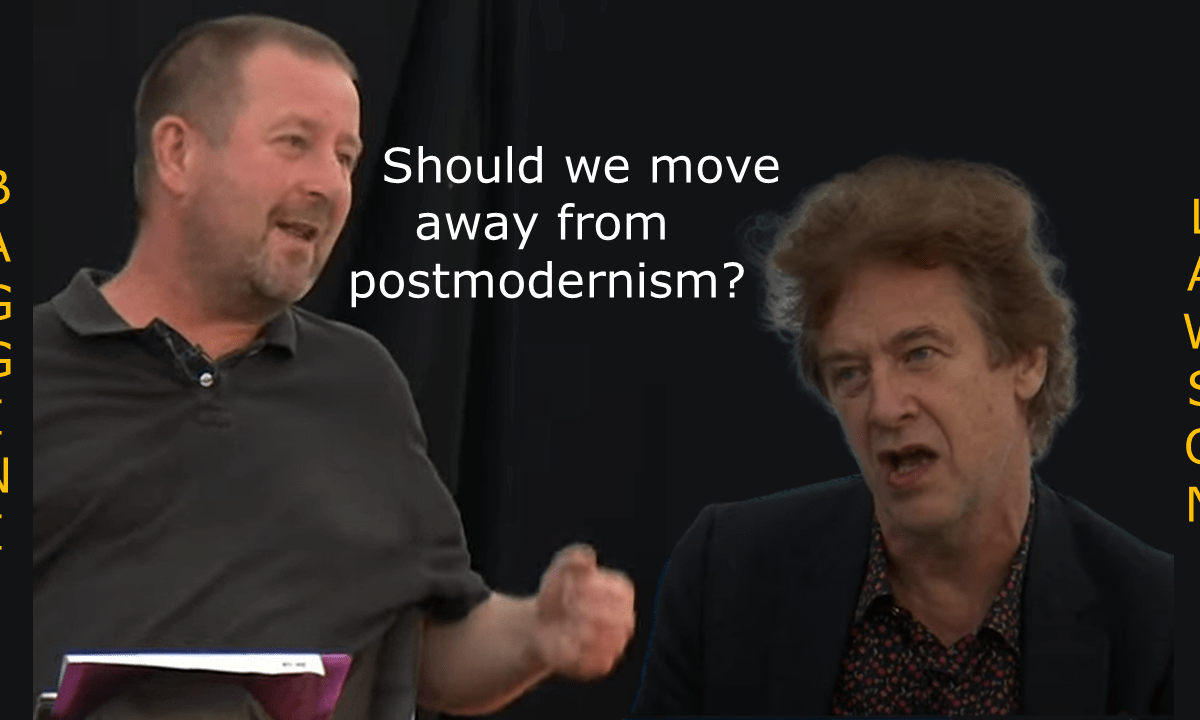
The theme of this Institute of Art and Ideas video is ‘Should we move away from postmodernism?

Podcast: Audio rendition of this page content

EDIT: Find my version of this content on YouTube:

Video: Postmodern Defence

At the start, I feel as usual, that the definition of postmodernism is nebulous, and the fora agree, methinks. Toward the end, Hilary Lawson concedes that key actors tied to the early postmodern movement denied being postmoderns, singling out Foucault and Derrida. More on this. Keep reading.

Julian Baggini, the bloke sat on the left and whose positions I am only getting familiar with, starts off the clip. He makes some points, some of which I agree with and others not so much.

He makes a play at claiming that there is some objective truth to be attained, following on with the statement that without this notion, it’s anything goes. I disagree with both of these assertions. Then he cites Thomas Nagel’s The View from Nowhere, wherein he posits that subjectivity and objectivity are extrema on a spectrum and that experience is somewhere in between. This conforms to my beliefs, but there are two provisos. First, the extremum of objective truth is unattainable, objectively speaking. Moreover, as I’ve written before, we have no way of adjudicating whether a given observation is truer than another. It seems that he leaves it that we don’t need to know the absolute truth to know “true enough”, but I think this is both a copout and wrong—but not too wrong for pragmatism to operate.

For example—not mentioned in the clip—, I can imagine that physicists feel that Einsteinian motion physics is truer than Newtonian physics, especially as we need to take measurements nearer to the speed of light. In my thinking, this might provide a better approximation of our notion of the world, but I can also conceive of an Ideal, non-materialistic perspective where both of these are rubbish from the perspective of truth. I feel that people tend to conflate truth with utility.

Julian makes an interesting point about semantics with the claim that “some people” define certain things in such a way as to not possibly be attainable and then claim victory. But what are his three examples? Free will, the self, and objectivity. If you’ve been following me, you’ll know that I might be in his crosshairs because I tend to be in the camp that sees these concepts as sketchy. And to be fair, his claim of defining something in a manner to keep a concept out of bounds is the other side of the same coin as defining something in such a way as to get it into bounds.

The self is different to free will insomuch as it’s a construction. As with any construction, it can exist, but it’s a fiction.

I’ve spoken at length about my position on free will, but I am fairly agnostic and don’t particularly care either way. I feel that the causa sui argument as it applies to human agency is more important in the end. The self is different to free will insomuch as it’s a construction. As with any construction, it can exist, but it’s a fiction. Without interacting with Julian or reading his published works on the self, if there are any, I don’t know how he defines it. And here we are discussing objectivity.

Given Nagel’s objective-subjective polarity, it seems they want to paint postmodernism as claiming that everything is subjective and that science (and religion) hold claims to objectivity. Hilary Lawson, the geezer on the right takes a position between extremes, but he denounces Julian’s claim about objective truth, noting that many people (especially of religious persuasions) make claims on Truth that are diametrically opposed, ostensibly labelling the same object simultaneously black and white. And the object for all intents and purposes is red.

I’ve gotten out of order, but Julie Bindel makes some good points on Feminism and suggests that the philosophical feminists—may I call them pheminists? No? OK then—such as Judith Butler have set women’s rights back by claiming that the category of ‘woman’ is invalid. Minni Salami defended Judith by noting that Butler has helped constructively in some ways and, citing Simone de Beauvoir, that woman is a category established by men to create The Other Sex. Still, Julie—not incorrectly—states that without a category, women (or whatever collective term one decides is representative) cannot be afforded legal protections—because law, as facile as it is, is all about categories and classes.

Hilary reenters the fray and states that it is not acceptable for one person to claim that their lived experience is all that is needed just because that is their truth. To be fair, this feels like a bit of a strawman argument. Perhaps I need to get out more, but I am not familiar with anyone credible making this claim.

I enjoyed watching this clip and processing the information. I hope you do as well. If you have any comments, I’d love to read them.

Postmodernism is Bollox

A short podcast on the reason Postmodernism is rubbish.

Video: YouTube (added 2/9/2022)

Postmodernism is rubbish. It makes no sense, and here’s why.

The term ‘modern’ is analogous to the term ‘now’. It is a time reference that privileges the moment. With time, we have a structure of yesterday, today, and tomorrow. Now fits into a structure of before, now, and later.

Conversely, where ‘modern’ means now, postmodern would mean ‘later’, it makes no sense to label an ongoing pursuit postmodern, anymore than tomorrow can run contemporaneously with today.

Just labelling something as modern is pretentious enough. It’s similar to labels such as New Wave or New Age. It’s just trying to privilege a movement by branding it new.

So, if Modern was the new kid on the block, how might postmodern operate.

Another problem with the term postmodern is that most people considered postmodern, did not consider themselves to be postmodern. In fact, many vehemently disagreed.

A reason for this disagreement, is that the term is not owned by the purported Postmoderns. Rather, it’s a disparaging slur by so-called and improperly named Moderns.

Apart from the nomenclature challenge, postmodern is a reaction to the promise of modernity, but the reactions differ by discipline. Postmodern art and architecture are different to postmodern literature, which is different to postmodern philosophy.

And since postmodernism is rather a disparaging catchall, those with ideas not conformant to mainstream doctrine get tossed into the bin. This means that any number of feminists and post-colonialists are thrown onto the postmodernist pyre.

Here’s some food for thought. I argue that postmodernism cannot have a privileged perspective, because it claims that there is no such perspective available. If a feminist or a post-colonialist is saying anything, they are pointing out, that one needs to look through their lens too. By and large, they are not claiming that it is the lens of lenses.

In essence, if the modern lens is red, they might recommend viewing the same events through a blue lens or from a different angle. Walk a mile in another’s shoes. This shift in perspective can make all the difference.

The difference between a modern and the bolloxed-up postmodern is that the Modern thinks either that they have the only lens, or in any case, they have the right one. Moderns tend to be absolutists and universalists, so subjectivists and relativists rather rub them the wrong way.

The final thing I’d like to say about postmodernism is the notion of Deconstruction as made famous by one Jacques Derrida and misunderstood and misapplied by millions since. I’ll spare you the instruction, but I like to capture the sentiment of the way it is misunderstood by suggesting my own term, Disintegration. Perhaps, I’ll share more on Disintegrationism™ in future. Meantime, it’s just the process of breaking systems down to their core elements to inspect the working parts. Disintegrationism notes that these pieces can be re-integrated into new systems, but it makes no claim that one is better than another because that can only be determined by purpose. Another thing Moderns tend to ‘know’, is what the purpose is. Conditionally, if I know what the purpose is, I can claim to know, by extension, what the best system is.

Abraham Maslow gave us the law of the instrument, popularly conveyed as the aphorism, if you’re a hammer, everything looks like a nail. Moderns are hammers and insist that every solution can be solved as if it were a nail. Only, everything is not a nail. The postmodern reminds us that hammers don’t make the best knives or screwdrivers or spanners.

What are your thoughts on postmoderns and postmodernism? What about moderns? Is there a term you feel might better capture the essence of these two schools?

Post-Postmodernism

I happened upon an article that notes that the postmodern label is now 50-odd-years old, so what’s next? Just a short response, the label never made sense for several reasons.

First, the prefix post suggests a new era or paradigm. In and of itself, this is not a problem. The challenge is the root: modern.

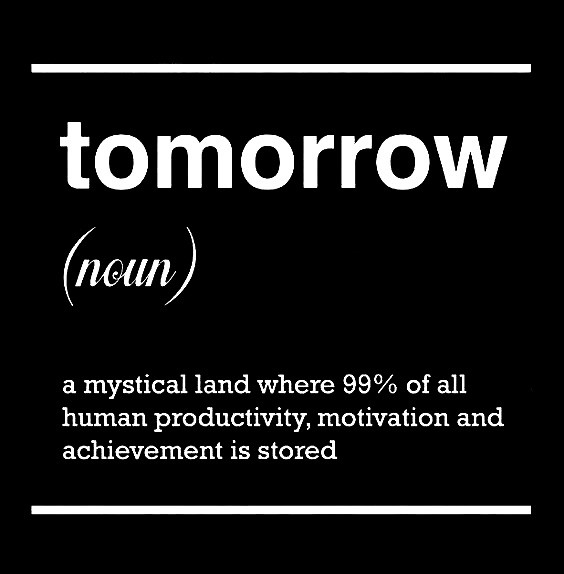
Effectively, modern means now, the current era, in the same manner as today sits between yesterday and tomorrow. The problem is that we are employing the term postmodern as if it’s tomorrow but today. Of course, except in jest, tomorrow is never simultaneously today. The notion reminds me of the sentiment captured in the quip when asked ‘When will you do this task?’ ‘I’ll do it tomorrow’. When queried the next day, ‘Why have you not yet done this task?’ and the response is ‘I’ll do it tomorrow’, ad infinitum.

I’ll caption this tomorrow

Modern derives from the Latin meaning ‘just now‘. People have been labelling themselves as modern since at least 1585 when it meant ‘of or pertaining to present or recent times‘. As early as 1500, it meant ‘now existing‘, so more toward ‘extant‘.

My point is that one might be able to retroactively reference post-X in relationship to X, but to name something duratively as post-X simply makes no sense. Add to this the complication that Latour mentions that we’ve never been modern or the further connotation that privileges the term adopter over others. Namely, whilst the West are modern at time-zero, being the height of modernity, some other contemporaneous other does not qualify. The United States are modern—just not Appalacia and certainly not Bangladesh. In a temporal sense, premodern takes on a similar meaning, e.g. Aztec or Mayan civilisations.

Besides the unfortunate naming, ‘postmodern‘ attempts to envelop many thoughts. As I’ve mentioned before, it is most typically pejoratively.

Whist I attempt to align myself with certain so-called postmodern figures, and I use the term myself because it still has some referential value, I do so with reservations and the understanding that it’s a nonsensical notion from the start. Perhaps, I’ll suggest a new solution tomorrow.

Post Truth?

Foucault should be a reminder that the culture wars are not new and post-truth can’t exist because there was never a truth at the start. This is similar to Latour’s question asking if we’ve ever been modern. And the answer remains ‘no’. There is no post-truth as there is no post-modern as each of these is predicated on a fantastical claim. Many humans defend the notion of truth, but they are fighting windmills.

We are therefore at war with one another; a battlefront runs through the whole of society, continuously and permanently, and it is this battlefront that puts us all on one side or the other. There is no such thing as a neutral subject. We are all inevitably someone’s adversary.”

— Michel Foucault, Society Must Be Defended

In these culture wars, each side is fighting for its version of the truth. The truth of rights and freedoms and the correct construct of societies. But there is not one culture war. There are myriad culture wars, and there are few opportunities to be allied across all of these dimensions with another person. For the congruent dimensions, one needs to operate in the mode of the enemy of my enemy is my friend whilst deciding how to ally on other disagreed dimensions later.

But never forget that the wars are intentional. They are a feature of the system of normalisation, not a bug. More importantly, don’t think for a moment that your truth is the truth. The same goes for your adversary.

Semiotics of Autumn

This season-appropriate meme crossed my path—or did I cross its? No matter. It’s a clever instantiation of Baudrillard’s simulacrum, and it really demonstrates the path to simulacrum in 4 stages. I don’t know who rendered this, but it arrived to me via Philosophy Matters. Although it’s self-explanatory, I’ll editorialise nonetheless.

At Stage Zero, the thing in and of itself exists—out there. This is the signified. It’s the thing represented by the symbol depicted in Stage One—a so-called pumpkin, la citrouille, la calabaza, der Kürbis, and so on—the signifier.

At Stage Two, the essence of the signified remains intact, but it’s lost its form. We can make a mental connexion between this and the signified, but we are a step further removed. In this case, the pie likely started as the signified but was transformed into a pie, a new signified and signifer.

At Stage Three, we may or may not have any remnants of the Stage Zero signified, but we still invoke the essence of the pumpkin. More probably, we invoke the essence of the pumpkin pie by way of the pumpkin spice.

By the time we arrive at Stage Four, we’re left with a claim of ‘pumpkin-ness’ and a visual cue to remind us of the path through pumpkin pie and the trace of spice, the marketing angling toward the pie over the fruit.

Keep in mind that the claim of natural flavours does not presume that pumpkin is one of those flavours.

Ingredients (Coffeemate Pumpkin Spice Creamer)
Water, Sugar, Coconut Oil, and Less Than 2% Of Sodium Caseinate (A Milk Derivative)**, Dipotassium Phosphate, Mono- And Diglycerides, Natural And Artificial Flavors, Sucralose (Non-Nutritive Sweetener).

I’m not entirely sure I agree with the distinction between Stage Three and Four in this meme, but it’s just a meme, so I’ll leave it here.

Telles seraient les phases successives de l’image :

– elle est le reflet d’une réalité profonde

– elle masque et dénature une réalité profonde

– elle masque l’absence de réalité profonde

– elle est sans rapport à quelque réalité que ce soit : elle est son propre simulacre pur.

—Jean Baudrillard, Simulacres et Simulation

Metamodernism on the Ternary Plot

I don’t have a strong grasp of Metamodernism, but at first glance, it doesn’t seem to be a place I wish to reside, and I don’t have the motivation to look deeper. Instead, I’ll rely on proponants and advocates to fill that void. They are already ahead of me on that curve and far more qualified to lead that charge. Moreover, I believe there are at least two paths to follow.

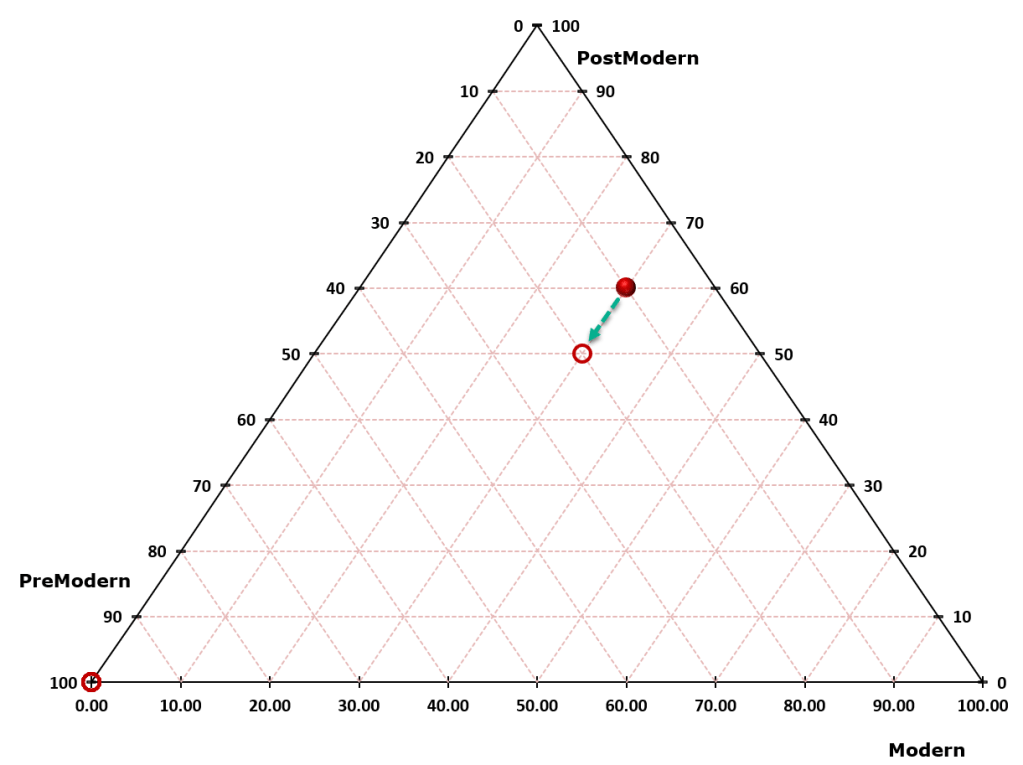
Metamodernism attempts to synthesise Modernism and Postmodernism, but from my perspective, it’s a Modern belief that simply preferences Premodern mysticism over Postmodernism. From what I understand about Metamodernism, all of it’s dimensions can be measured on the planar ternary plot I am architecting. From what I read by Metamodernists is that it is either operates to sublate or is a paradigm shift that transcends these worldviews.

If my characterisation is correct, Metamodernism is captured by the model and simply shifts the dot to the left. If one of the other persectives is correct, it either changes the shape of the plane itself, alters the pathing of the movement of the dot, or creates a need for a Z-axis to capture this Z-dimentional movement. To assess this, I’ll need more information. For now, I will adopt my perspective and see where I end up.

Usign this ternary chart as a reference, if I am the solid red dot at time-1, and adopt some Metamodern world views, my place at time-2 moves in the direction of PreModern, which is to say down and to the left.

To be clear, the direction of this shift is not inevitable. It depends on the initial orientation and the dimension under consideration. If I were lower on the chart (more Modern than PostModern), then the movement would more likely be from right to left horizontally and not angular as depicted. Moreover, even from the starting position shown, the movement might simply go left. What it won’t do is go up or to the right, the area shaded in red on the chart below.

My next step is still to dimentionalise this. Altought I have some canditates already in mind, I suspect this will be an emergant process. Feel free to come along for the ride.