Any system built on the presumption of widespread capacity for reason is bound to fail. The ability for most humans to ‘reason’ is clearly abridged and homoeopathic. And this is before one factors in cognitive deficits and biases. This is separate from sense perception limitations.
Nietzsche was right to separate the masters from the herd, but there are those in both classes with these limited capacities, though in different proportions.
People are predictably irrational
In economics, we have to define reason so narrowly just to create support the barebones argument that humans are rational actors—that given a choice, a person will take the option that leaves them relatively better off—, and even with this definition, we meet disappointment because people are predictably irrational, so they make choices that violates this Utilitarian principle. And it only gets worse when the choices require deeper knowledge or insights.
Democracy is destined to fail
This is why democracy is a destined to fail—it requires deeper knowledge or insights. The common denominator is people, most of whom are fed a steady diet of the superiority of humans over other species and lifeforms and who don’t question the self-serving hubris. They don’t even effectively evaluate their place in the system and their lack of contribution to it.
To the masters, who are aware of the limited abilities of the herd to reason, it seems like hunting fish in a barrel. If we convince the herd that they have some control over their destinies, that’s as far as it needs to go, but among the masters, there are subclasses, so people in these factions are also vying for position, so each employs rhetoric to persuade herd factions.
No one is sheltered from the limitations of reason
To the people out reading and writing blogs and such, confirmation bias notwithstanding, they may more likely to be ‘reasonable’ or able to reason, but try as they may, no one is sheltered from the limitations of reason.
My base belief is that what people believe is their truth, and rhetoric is a primary way to convince them. Part of the rhetorical mechanism is to introduce evidence, but this, too, is shrouded in rhetoric.
I’m not talking about the evidence that ‘standard’ water boils at 100°C at sea-level. This is tautological. Water is defined as H₂O. Literally, 100°C is the definition of where water boils under these conditions.
But things that cannot be repeated in controlled environment with the ability to alter parameters within the environment rely on rhetoric. This is why Newton’s laws seemed som compelling until a new narrative (somewhat) supplanted it. Still, this is not the point I want to make. I want to concentrate on the socio-poliotical domain.
I feel that given two equally viable explanations, the one offering more hope will prevail. Donald Trump knows this. This is why in the midst of the COVID-19 pandemic, he railed at a presser how he chastised a reporter for questioning his (false) narrative of hope. Politics relies on more than one rhetorical thread, and many already have the disposition of reviling Trump, so any messages from him are discounted at the start.* But, ceteris paribus, if a person assesses two equally probable outcomes—a typical door number 1 or door number 2 scenario—, and (for whatever exogenous reason) hope is associated to particular door.
In a survival scenario, perhaps you are one of three people lost in a cave and there are two possible paths forward. One person asserts that s/he feels that—without evidence—the left path is best way out but adds logically there is no way to tell, that you might as well flip a coin. The other person confidently conveys that s/he knows—without evidence—that the right path is the path to salvation. Being otherwise indifferent, you are likely to acquiesce to the second person, the one who offers hope over logic.
I fully admit that this is 100 per cent fabricated whole cloth from thin air, but the reason I come to this point is when you compare atheists to theists, anarchists to statists, nihilists to Existentialists, and any such analogic pair, the right side gets more traction and requires much more evidence to sway people to the left.
So when Occupy Wall Street (effectively anarchists) made demands, the status (read: the general population) asked ‘Who’s your leader?’ When the media-industrial complex broadcast this, the public was immediately sympathetic to the structured system. This is slightly different in that it’s not necessarily hope, rather a comfort zone—an endowment effect. It’s a benefit accruing to the incumbent.
My point is: hope floats. It acts to buoy otherwise rhetorically equivalent arguments. Or perhaps hope is simply an employed rhetorical device, so it’s unnecessary to call it out. Now, I’ve convinced myself to adopt this position.
* This is why ad hominem attacks can be effective, as persons swayed by the attack discount messages delivered by this person despite there not being a necessary connection between the grounds for debasement and the claim being asserted.
That perception and memory work hand in hand is mostly taken for granted, but this case reminds us that this sometimes breaks down. This is not the case of the neurotypical limitations to fallible sense organs and standard cognitive boundaries and biases. This subject can’t discern the arabic numerals from 2 through 9.
To recap the study, the man can perceive 0 and 1 as per usual, but numerals 2 through 9 are not recognisable. Not even in combination, so A4 or 442 are discernible.
In a neurotypical model, a person sees an object, a 3 or a tree, and perhaps learns its common symbolic identifier—’3′, ‘three’, or ‘tree’. The next time this person encounters the object—or in this case the symbol—, say, 3, it will be recognised as such, and the person may recite the name-label of the identifier: three.
It might look like this, focusing on the numerals:
For each observation, the impression of 3 is different.
Phenomenologically, this is different to the question of whether two subjects share the same perception of, say, the colour red. Even if you perceive red as red, and another perceives red as red, as long as this relative reference persists to the subject, you can still communicate within this space. When you see a red apple, you can remark that the apple is red—the name marker—, and the same is true for the other, who can also communicate to you that the apple is indeed red because the word ‘red’ become a common index marker.
But in the anomalous case, the name marker would have little utility because ‘red’ would be generated by some conceivably unbounded stochastic function:
Colourₓ = ƒ(x), where x is some random value at each observation
It would be impossible to communicate given this constraint.
This, as I’ve referenced, is anomalous, so most of us have a stronger coupling between perception and memory recall. Interesting to me in this instance is not how memory can be (and quite often is) corrupted, but that fundamental perception itself can be corrupted as well—and not simply through hallucination or optical illusion.
Neil Gaiman, an articulate, imaginatory writer. He makes a claim:
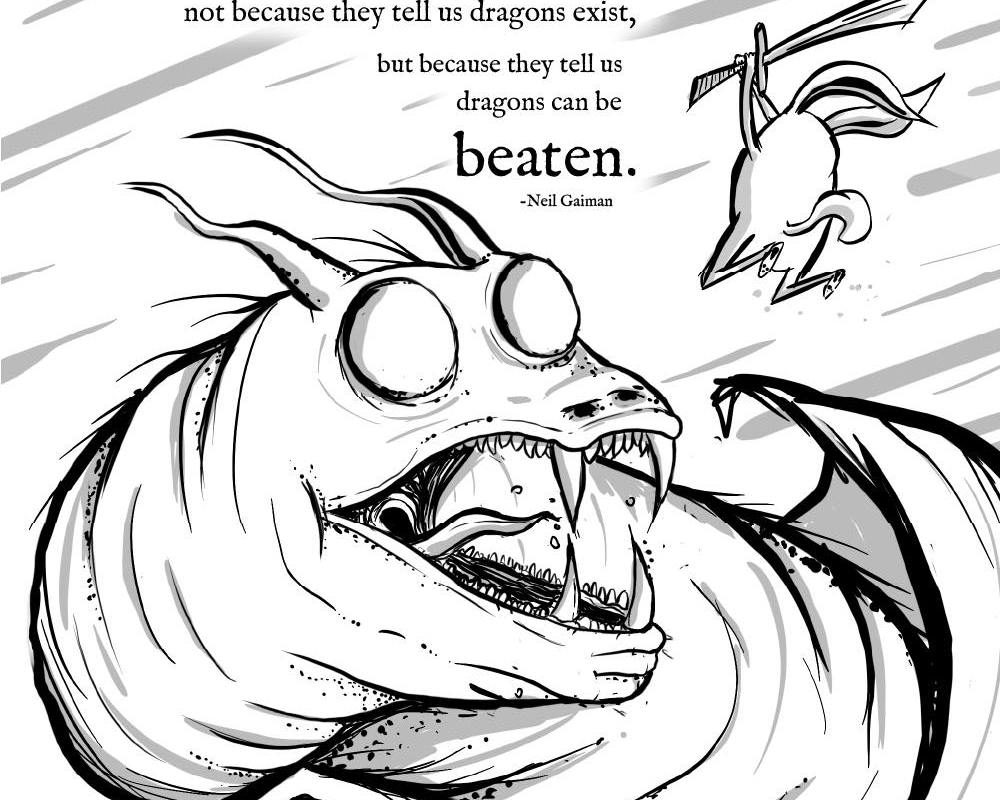
Fairy tales are more than true — not because they tell us dragons exist, but because they tell us that dragons can be beaten.
Neil Gaiman
To me, this is a problem with correlating imagination with truth. Moreover, many a war was lost on the story that it could be won.
Of course, we can still play the metaphor game. I’ve been a fan of metaphor since Joseph Campbell. Metaphor is strength. There was a time when I read Jung and had a stronger interest in Depth and Archetypal Psychology. And fairy tales per Marie-Louise von Franz or her more contemporary cantadora, Clarissa Pinkola Estes. Archetypes are metaphor, but this doesn’t render them real. Still, we can operate as if they are. The trick is to remember that they are not.
I find the notion of authenticity interesting. I believe that Heidegger was the first philosopher to promote the issue. As I have a contention with matters of identity in general, the notion of authenticity has no foundation in my eyes. As I don’t believe that the notion of identity is valid, it follows that I don’t ascribe to notions of authenticity either—the question is: authentic to what?
Essentially authenticity can be described as ‘being true to one’s own essence or true self’—whatever that might be. Heidegger presents authenticity as a response to our place in the world. An inauthentic person conforms to society and in the loses their own identity in the process to become assimilated into the society.
Carl Jung had a related concept, individuation. This is where a person strips off all of the ego and superego to get to the core of their being, to unpeel the onion, but to find a centre—and to become that true unadulterated self. This is not what Heidegger means by authentic.
To Heidegger, an authentic person remains true to themself within the constraints of society. As with Camus’ acceptance of the Absurd, Heidegger’ authenticity accepts the ‘real world’ as is it whilst retaining with awareness one’s self, even if this is more limiting than Jung’s individuation or Sartre’s freedom with no excuses.
Sartre’s vein of Existentialism contained within it the notion of authenticity. This is in common with other Continental philosophies. According to Sartre, when people hyper-constrain their identities to preclude their larger humanity, they are operating in bad faith, mauvaise foi (eidétique de la mauvaise foi). A while back, a story from an incident in 2013 was circulating on social media, where a Spanish runner, Ivan Fernandez Anaya, assisted another runner, Kenyan athlete, Abel Mutai, who errantly believed that he had already passed the finish line, so he stopped with another 10 metres to go.
The reaction was split—some praising Anaya for his humanity and other chastising him for not following the rules of the competition. These critics are guilty of mauvaise foi, of prioritising the minuscule for the larger picture. In fact, all sports do this. One might argue that all competition does this, but this is a matter of perspective. I think that Sartre’s scope was a bit narrower than this, but I believe it’s not off-point.
Evidently, I am just typing stream of consciousness, and the stream has come to an end.
I was engaged in a conversation in a Facebook Philosophy group for Pragmatists. I feel that these groups take me as adversarial because I question their system of belief. To the extent that I accept any categorical distinction, I consider myself to be a Postmodernist first and foremost and a Pragmatist second. In a similar fashion, I am at once an atheist first, but I operate as a Buddhist. I am a nihilist first, but I operate as an Existentialist. In any case, in explaining this, I hit upon an analogy that I hadn’t considered before.
everything just ‘is’
Pragmatism is Samsara. In Buddhism, there is the concept of Samsara, which contains the realms we reside in before we reach Enlightenment, the state of realising that everything just ‘is’, is , and is undifferentiated, at which case we either exit the system or remain as aware (woke anyone?) Bodhisattvas.
everything is a constructed illusion
The ‘just is’ is the postmodern condition. Nothing is as it seems and everything is a constructed illusion. There is no good, no bad, no right or wrong—not even black or white. This is all perception of difference, but there is no difference.
I am a Buddhist in the same way I am a Pragmatist. I know that this is all a cognitive construct—or constructs—, but I am still stuck in the middle of it, ‘thrown in’ (Geworfenheit) to echo Heidegger, and I attempt to make the best of it. None of it is real, but, as with people of the Matrix, I can’t perceive my way out of it.
The risk for Pragmatists is that they are empiricists. They trust that the past will ostensibly operate the same as the future. It’s been generally that way thus far, and we’ve misinterpreted how things operate in the past, but we’ve corrected this interpretation, and we’ll correct and refine these interpretations in future. That’s the employed logic. I’ve not got a better plan, so as shoddy or rickety as it might be, it’s my life raft replete with holes, but I’ll patch them as swiftly as I can and hope my history of having not encountered any sharks or tidal disruptions or undertows persists.
none of this exists
All the while, my core beliefs are that none of this exists—not in a solipsistic way, just not as we imagine it does. It’s the wall constructed of atoms and molecules that is more space than not, and yet we can’t pass through it. If only we could all be Neo and overcome this misperception.
I’ve been pondering the notion of democracy. This is not new for me. I’ve looked around and asked myself, ‘If democracy is so great, why is it not more widely adopted’. I don’t mean why don’t other countries try it? And I don’t mean to confound the issue by arguing that a republic is not a democracy, the last refuge of the desperate.
Democracy is a pathetic belief in the collective wisdom of individual ignorance.
What I wonder is why, if it’s so good, why don’t companies structure democratically? Why not the military? I’ve always found this particularly humorous: An autocratic, socialised structure defending democracy. Some of the biggest democratic flag-wavers are military and ex-military.
I know that most military members in the US would be lucky to work flipping burgers at McDonald’s. Some speak of the mental illness and homelessness of military veterans, but this misses the direction of the arrow of causation. These people had a free ride, room, and board on Uncle Sam’s dime in the States—some other denomination elsewhere. It’s really no wonder that one wouldn’t want to give these people a voice in military affairs, and yet they do get a voice in civilian affairs. It’s a good thing almost half of Americans eligible to vote don’t.
The best argument against democracy is a five-minute conversation with the average voter.
Winston Churchill
I’ve already mentioned that democracy is a sham and its best feature is the illusion of control. I suppose if I come up with something better, I might write about it. Until then, it’s just one of many mediocre options.
Interestingly, some people’s options are asinine. Frank Karsten hawking his book and ideology on Beyond Democracy thinks that downsizing is the answer. Hans-Hermann Hoppe agrees, as he posits in several essays in Democracy: The God that Failed. I don’t disagree, but his basic point seems to be that 300MM people deciding is too much, so perhaps 10MM or 20MM might work better. What’s the limit? Why not 150? How is conflict among this smaller political units adjudicated? With this downsizing, how does the system control the urge for upsizing? In the end, this feels like more Libertarian, anarcho-capitalistic mental masturbation, which as I type this feels redundant. Unfortunately, the common denominator is people, and that’s Achilles’ heel.
As part of my indictment against language and its insufficiency to facilitate precise and accurate transmission of abstract concepts, I happened upon a quote by Karl Popper:
It is impossible to speak in such a way that you cannot be misunderstood.
—Karl Popper
“However, the problem still remains: what should we do in order to make our meaning clearer, if greater clarity is needed, or to make it more precise, if greater precision is needed? In the light of my exhortation the main answer to this question is: any move to increase clarity or precision must be ad hoc or ‘piecemeal’. If because of lack of clarity a misunderstanding arises, do not try to lay new and more solid foundations on which to build a more precise ‘conceptual framework’, but reformulate your formulations ad hoc, with a view to avoiding those misunderstandings which have arisen or which you can foresee. And always remember that it is impossible to speak in such a way that you cannot be misunderstood: there will always be some who misunderstand you. If greater precision is needed, it is needed because the problem to be solved demands it. Simply try your best to solve your problems and do not try in advance to make your concepts or formulations more precise in the fond hope that this will provide you with an arsenal for future use in tackling problems which have not yet arisen.
— Unended Quest: An Intellectual Autobiography, Karl Popper
Popper’s point here is more that some people won’t understand what you are saying, which differs from my concept that some ideas just can’t be conveyed. Some people will assume their interpretation is the true meaning, but this assumption may be incorrect. Even more problematic is when different people assume to know the true meaning, yet their definitions differ materially.
Charles makes another point commenting on this quote on his Thing Finder blog.
And there will be even more who deliberately choose to misunderstand you. The man in search of truth will always be at risk from the man of conviction.
Charles Bayless, Thing Finder blog
Some if not most of this deliberate misunderstanding is captured in Upton Sinclair’s quip:
It is difficult to get a man to understand something, when his salary depends upon his not understanding it!
—Upton Sinclair
But this still doesn’t capture the point the some concepts are actually nebulous; there is nothing there there.
I’ll leave this post with a quote from Le Petite Prince:
Language is the source of misunderstandings.
—Antoine de Saint-Exupéry
Indeed, language is simultaneously expanding and limiting, but like faith in technology, faith in language may lead to an untimely end.
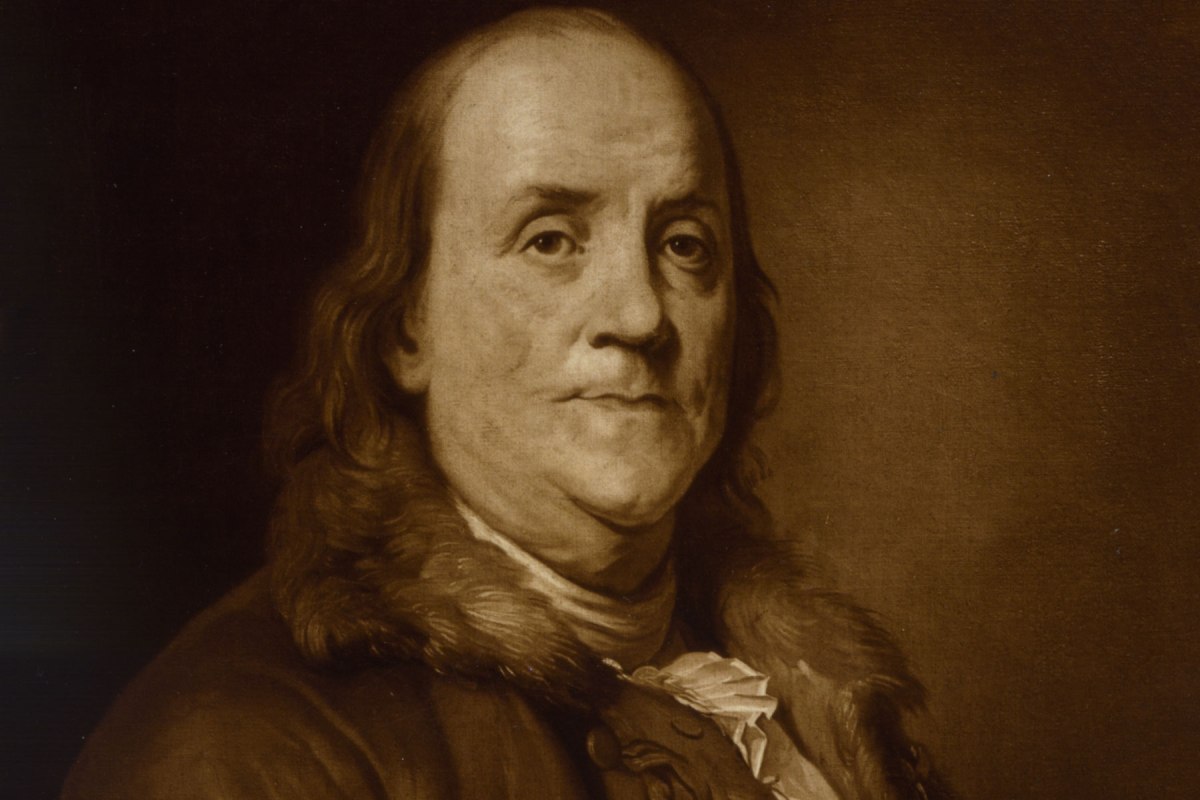
Interestingly, I started this blog exploring property, a concept that makes no sense to me, and continued on a Postmodern journey to discount rights and truth. And then Enlightenment thinking in and of itself. I think of these still, most recently turning onto the concept of Democracy. Whilst researching de Tocqueville, I happened upon this letter by Ben Franklin. What on? Property. And taxation.
Property
CHAPTER 16|Document 12
Benjamin Franklin to Robert Morris
25 Dec. 1783
Writings 9:138
The Remissness of our People in Paying Taxes is highly blameable;
the Unwillingness to pay them is still more so.
Benjamin Franklin
The Remissness of our People in Paying Taxes is highly blameable; the Unwillingness to pay them is still more so. I see, in some Resolutions of Town Meetings, a Remonstrance against giving Congress a Power to take, as they call it, the People’s Money out of their Pockets, tho’ only to pay the Interest and Principal of Debts duly contracted. They seem to mistake the Point. Money, justly due from the People, is their Creditors’ Money, and no longer the Money of the People, who, if they withold it, should be compell’d to pay by some Law.
Franklin calls out those citizens unwilling to contribute their fair share to the commonwealth.
Property superfluous to [the Conservation of the Individual and the Propagation of the Species] is the Property of the Publick
Benjamin Franklin
All Property, indeed, except the Savage’s temporary Cabin, his Bow, his Matchcoat, and other little Acquisitions, absolutely necessary for his Subsistence, seems to me to be the Creature of public Convention. Hence the Public has the Right of Regulating Descents, and all other Conveyances of Property, and even of limiting the Quantity and the Uses of it. All the Property that is necessary to a Man, for the Conservation of the Individual and the Propagation of the Species, is his natural Right, which none can justly deprive him of: But all Property superfluous to such purposes is the Property of the Publick, who, by their Laws, have created it, and who may therefore by other Laws dispose of it, whenever the Welfare of the Publick shall demand such Disposition. He that does not like civil Society on these Terms, let him retire and live among Savages. He can have no right to the benefits of Society, who will not pay his Club towards the Support of it.
Franklin is supportive of Locke’s property of ‘life, liberty, and property’ fame, but he is decidedly not a fan of passing along excess generational wealth. In fact, he feels that such excess property should accrue to the public.
To those unwilling to play by these rules, banishment to the wolves is not too good for them. Stripping them of citizenship is not too harsh a punishment.
He that does not like civil Society on these Terms, let him retire and live among Savages
In the furtherance of my critique of Democracy, I’ve gone back to re-read de Tocqueville’s Democracy in America, an original critique, though with much promise at the time.
In the introductory chapter, de Tocqueville notes the tradeoffs democracy makes. Essentially, he recognises the mediocrity, but he senses it’s somehow worth it. I break up his paragraphs and italicise for emphasis.
I admit that, in a democratic State thus constituted, society will not be stationary; but the impulses of the social body may be regulated and directed forwards;
Here de Tocqueville presumes the metanarrative of progress and all it entails.
if there be less splendor than in the halls of an aristocracy, the contrast of misery will be less frequent also;
The middle class served this purpose, but this benefit is being eroded as the acquisitive classes have learnt how to game the system and pillage the public coffers.
the pleasures of enjoyment may be less excessive, but those of comfort will be more general;
Here he considers the masses, but he fails to distinguish them from the aristocracy, now manifest as the 1%.
the sciences may be less perfectly cultivated, but ignorance will be less common;
Literacy may be elevated under this system, perhaps owing as much to the needs of Capitalism than of Democracy. In the US, the pair are inextricable.
Here, de Tocqueville is spot on. I won’t defend science or progress, but if this is a goal, the post-truth era is testament to the need for cultivation. Science is like investing: there is a compounding effect. Failing to progress effects downstream advancements, not linearly, but geometrically.
the impetuosity of the feelings will be repressed, and the habits of the nation softened;
there will be more vices and fewer crimes.
Interesting point, but I won’t linger; vices are morality plays, and crimes are tautological—though I suppose he is hinting that the demos will consider fewer situations to qualify as crimes, and so they’ll be relinquished to the realm of vices.
In the absence of enthusiasm and of an ardent faith, great sacrifices may be obtained from the members of a commonwealth by an appeal to their understandings and their experience;
each individual will feel the same necessity for uniting with his fellow-citizens to protect his own weakness; and as he knows that if they are to assist he must coöperate, he will readily perceive that his personal interest is identified with the interest of the community.
The nation, taken as a whole, will be less brilliant, less glorious, and perhaps less strong
Alexis de Tocqueville
The nation, taken as a whole, will be less brilliant, less glorious, and perhaps less strong;
Indeed.
but the majority of the citizens will enjoy a greater degree of prosperity, and the people will remain quiet, not because it despairs of amelioration, but because it is conscious of the advantages of its condition.
Tocqueville gets partial credit for this insight.
If all the consequences of this state of things were not good or useful, society would at least have appropriated all such as were useful and good;
Tocqueville misses the mark a bit here, tripping himself up on a somewhat Utilitarian—if not Pollyanna—worldview.
and having once and for ever renounced the social advantages of aristocracy, mankind would enter into possession of all the benefits which democracy can afford.
But here it may be asked what we have adopted in the place of those institutions, those ideas, and those customs of our forefathers which we have abandoned.
The spell of royalty is broken, but it has not been succeeded by the majesty of the laws;
the people has learned to despise all authority, but fear now extorts a larger tribute of obedience than that which was formerly paid by reverence and by love.
Here de Tocqueville appears to suggest a citizenry that fears rather than reveres its government in classic Machiavellian splendour.
I perceive that we have destroyed those independent beings which were able to cope with tyranny single-handed;
the weakness of the whole community has therefore succeeded that influence of a small body of citizens, which, if it was sometimes oppressive, was often conservative.
the Government that has inherited the privileges of which families, corporations, and individuals have been deprived
Alexis de Tocqueville
but it is the Government that has inherited the privileges of which families, corporations, and individuals have been deprived;
Ever the Madisonian, de Tocqueville shows concern of the consolidation of power.
the weakness of the whole community has therefore succeeded that influence of a small body of citizens, which, if it was sometimes oppressive, was often conservative.
The division of property has lessened the distance which separated the rich from the poor;
Although there was more egality…
but it would seem that the nearer they draw to each other, the greater is their mutual hatred, and the more vehement the envy and the dread with which they resist each other’s claims to power;
…and Tocqueville was prescient here—, the enmity of the haves of the moneyed classes crashes full-force into the have nots as the fabric of separation becomes more and more threadbare, as with Samhain this weekend.
the notion of Right is alike insensible to both classes, and Force affords to both the only argument for the present, and the only guarantee for the future.
The poor man retains the prejudices of his forefathers without their faith, and their ignorance without their virtues;
he has adopted the doctrine of self-interest as the rule of his actions, without understanding the science which controls it, and his egotism is no less blind than his devotedness was formerly.
If society is tranquil, it is not because it relies upon its strength and its well-being, but because it knows its weakness and its infirmities;
a single effort may cost it its life;
everybody feels the evil, but no one has courage or energy enough to seek the cure;
Alexis de Tocqueville
everybody feels the evil, but no one has courage or energy enough to seek the cure;
the desires, the regret, the sorrows, and the joys of the time produce nothing that is visible or permanent, like the passions of old men which terminate in impotence.