Mindfulness*

Mindfulness, as with yoga and other Eastern concepts, gets diluted for consumption by the West becoming McMindfulness. I learnt Buddhism circa 1980 in Japan, introduced by a friend from New Zealand. He translated for me because all services and teachings were given in Japanese. I won’t get into how the mind-body-spirit connection of yoga has devolved into an exercise regimen in the West.

Yoga

a Hindu theistic philosophy teaching the suppression of all activity of body, mind, and will in order that the self may realize its distinction from them and attain liberation

Most Westerners have attention spans of gnats, so many Eastern concepts need to be homogenised for the Western consumer and then dosed homoeopathically. Only then can the typical Westerner performatively claim to understand these Eastern notions. To be fair, some of the loss occurs because of the lack of depth of cultural understanding—the same loss happens from West to East as well—and some is language—the concept doesn’t have a direct translation, so we end up with close enough.

A simple but hopefully instructive anecdote might help. Westerners, especially English-speakers, are typically well-aware of the native Japanese speaker’s inability to articulate the L sound, and so ‘fried rice‘ is rendered something like ‘flied lice‘. Only, this not what’s being said. What we are hearing only approximates an L to our ears, but the L sound is not what’s being uttered. The Japanese language doesn’t have L or R phonemes, respectively /l/ and /r/. So the absence of the R-sound in Japanese and the lack of this alveolar sound in English brings us close to the L sound we presume to perceive. What they are saying is /ɹ/, which is in between these two sounds. They don’t have /l/ or /r/, and we don’t have /ɹ/, so the misinterpretation goes both ways. Only a person trained in this aspect of linguistics can map the relationship, but this mapping is imperfect but satisfactorily explanatory.

Mindfulness

the practice of maintaining a nonjudgmental state of heightened or complete awareness of one’s thoughts, emotions, or experiences on a moment-to-moment basis

Mindfulness is a member of the eightfold path of Buddhist doctrine. Mindfulness is about being conscious of ‘the world’ of one’s environment and yet not be focused or ‘attached’ to any particular aspect of it. it’s simply being aware. In Buddhism, the scope of mindfulness is particular to the dharma, of which the Four Noble Truths and the Eightfold Path are constituents, so technically speaking, one would need to have these aspects available in inventory.

* This post is a reaction to Landzek’s post, Mindfulness Mythology.
Whom do you serve?

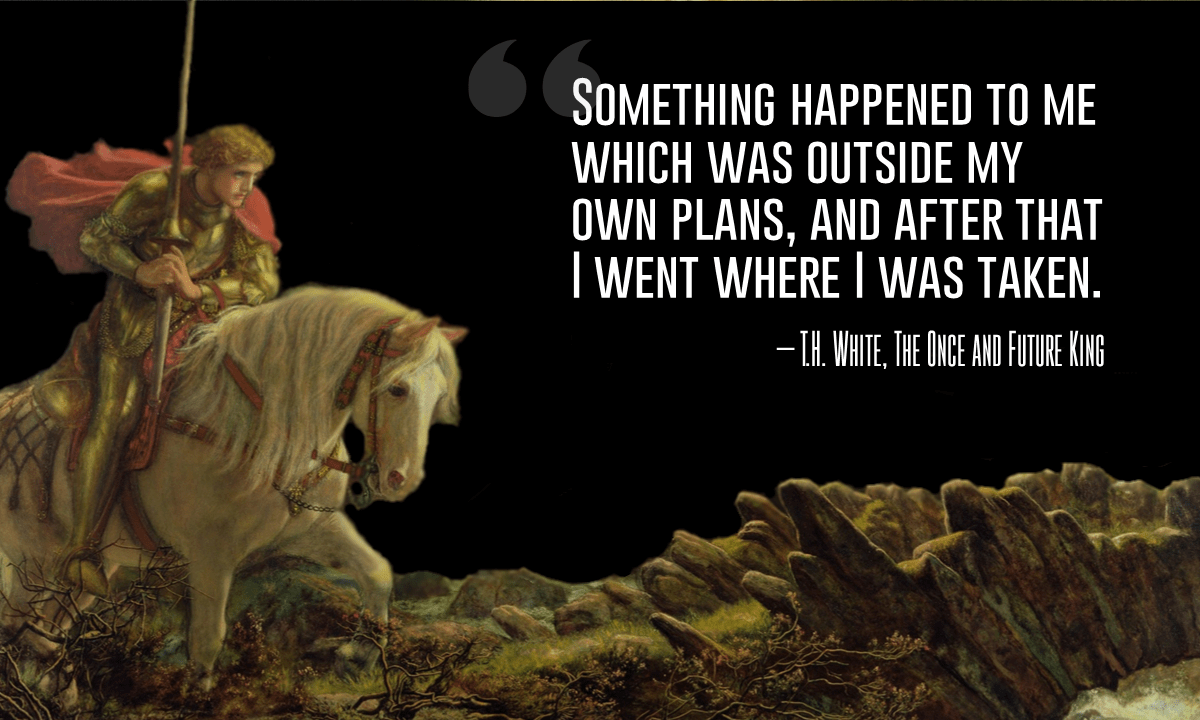
Something happened to me which was outside my own plans, and after that I went where I was taken.

TH White, The Once and Future King

An Internet friend led me to this quote. I felt it was appropriate to share in reflection of 2020, not only for me but many people who were forced to go with the flow.

The quote reminded me of the mid-1990s, a time when I was steeped in the archetypal and depth psychology of Jung and Hillman. I also read a lot of works pertaining to the Holy Grail. I decided to composite the quote onto the cover image. I’m not asking for a holy grail. Let’s just hope 2021 fares better than 2020 by most accounts.

Future Forward

How Soon Is Now? Is there anything beyond now—is there a future? Was there a past? What better occasion to reflect on this than the turn of a new year, of a new decade?

Now is easy. It right here, and here, and here, and here… and interminable series of heres. The past is easy, too, we were there—the accumulation of former heres—, so at least we can claim it was real at the time—or as real as we could perceive and can imagine. Memory frailties notwithstanding, the past is indelible. Whether we are or can be aware is another story.

Past is different to history. Past is an event or events. We may not even become aware of these events until they have passed—perhaps centuries or millennia later. These may be historicised. History is a story. In French, the terms aren’t even separated. L’histoire is simultaneously a story and history, a reminder of how inextricable they are.

But what about the future? A conceptual future is a fairly new human construct. Some events occuring after now have happened since the beginning of time. In fact without time or the invention of a notion of time, there can be no future or past. It’s been said that time is what keeps everything from happening at once.

“Time is what keeps everything from happening at once.”

Ray Cummings

We talk about the future, but when we reference it now, it’s only some speculative future—some admixture of uncertainty and probabilities. There are no guarantees any given event will actually manifest, whether we will be there to experience it, or whether any future will even arrive. This is a known limitation of empiricism. That the sun has risen for some 4 billion years doesn’t guarantee it will rise tomorrow. There is nothing necessarily preventing the universe from ceasing to exist tomorrow or in an instant, pardoning the nomenclature of time.

Where our perception of now is already quite limited in scope and experience, any notion of future is decidedly worse. And of all of the possible threads and imagined threads, only one will manifest—unless you subscribe to parallel universe models, in which case you can still only experience one and only one, at least for the time being.

From the perspective of now, the future, like history, is just a story. In these times of COVID, we should realise that some stories hadn’t been written. Similar storylines had been imagined and authored, but the one that manifest was different still. Truth is stranger than fiction—and worse.

But does the future exist? Can we discuss the future other than conceptually? Is the notion of future reserved for a privileged few? One so-called cognitive bias is that humans favour now and near-term events over further future events? From an evolutionary perspective, this makes perfect sense. First, I am here now, and whether I am here to experience the future remains to be seen. This bias is the basis for why most people don’t save enough for a comfortable retirement—a retirement with a comparable standard of living and quality of life as one’s ‘productive’ years.

One consideration is expected lifespan. Actuarially, a person might be expected to live on average, say, 76 years. If people my family historically live to 65 and I expect to retire thereabouts, saving past that is inefficient—transferring wealth across generations notwithstanding. If I die at 65, there is no mismatch. If I die at 76, then oopsie. Retirement income and savings is predominantly a First-world problem—a challenge for people who live in an income-based, consumerist society, so worrying about the future takes on a more relevance.

Even if I expect my village, tribe, or family care for me in my twilight years, there is still a notion of future to consider. Will they be there for me. But from an evolutionary perspective, this doesn’t necessitate a future beyond a generation, so the probability of an uncertain event is lower than, say, a thousand years from now.

NB: What had been a concept riffing on Hoffman’s evolutionary argument against reality was intercepted by the related notion of the future. I hope to return to Hoffman presently—if the future allows.

Perspective on Theseus

Chump in Chief* wrote a piece on dementia using analogue of the ship of Theseus. As a topic, Hobbes’** Theseus thought experiment has been well-covered, but that’s never stopped me before.

This is all about identity. Essentially, there are two perspectives. To an observer not on the ship or aware of the transformation, they would be none the wiser. For all intents and purposes, if they had ever seen the ship before, it’s the same. But what about those on the ship?

For nearly all of these observers, it’s almost unquestionably still the same ship. In a manner paralleling a person’s cells being sloughed off every 7 years, the cells in place at the start aren’t there after 7 years. Most will not doubt that you are the same person.

the average human cell is about 7 to 10 years old

As cells are continually dying and replacing themselves, for an adult the average human cell is about 7 to 10 years old, which might be interpreted as saying in the fashion of Theses’ ship that a person is anew each 7 to 10 years. Let’s ignore that this is an average, and many cells have a lifespan of only a few days whilst others—cerebral cells in particular—are here from the start and so are as old as the person.

Another perspective is to consider the replacement parts: would it matter if the colour of the parts changed in the process? What about the materials? What about the underlying architecture? What if the departing sloop arrived a schooner? Weight? What then?

My favourite extension of this thought experiment is to ask the question two-fold: Not only do we ask if this ship built with new materials is still Theseus’ ship—which to be fair is more a question of ownership than of identity—, but what if I reconstruct the original ship with the original materials. Are these both Theseus’ ships? Can we continue this exercise with new material ad infinitum?

As far as I know, we can’t repurpose cells in this fashion, but what if we could? There are many such Star Trek transporter mishap thought experiments, or the Duplicates Paradox.

In these experiments, a transporting device disintegrates the subject, and replicates the subject at a distance—but this replication presumably uses different atoms and cells, and so what if a duplicate copy is made rather than the replacement copy? Who’s identity prevails? Is it murder to eliminate one of the duplicates? Similar questions have played out in the science fiction / fantasy space.

Locke and others suggest that for people, memory and the continuity of thought are key, but your thoughts of me are not the same as my thoughts of me. This is why an amnesiac may no longer maintain some original identity, and yet to the familiar outside observer, this shell of a person remains intact. This is pretty much how it plays out with zombies and dementia patients. This sense of identity is projected upon the person rather than exuded from them.

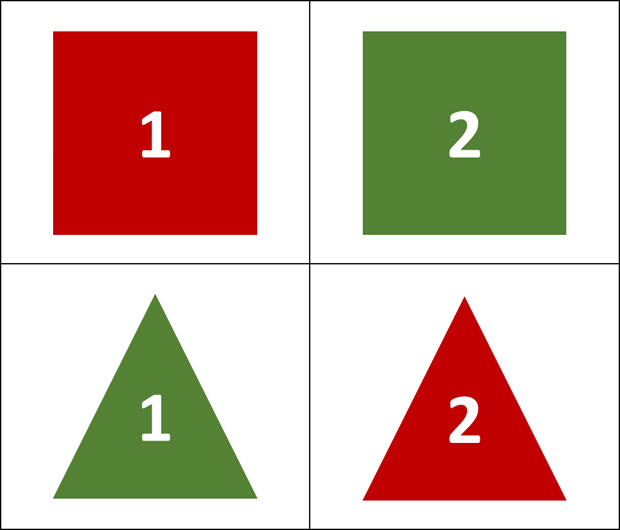
So what is my perspective? Rather than a paradox, it is more a problem of vaguity or ambiguity and how we’re defining sameness. There are many dimensions to similarity. I can present you a red square, a green square, a blue triangle, and a green triangle and play the Sesame Street ‘one of these things is not like the other game.

Is the sameness the colour, the shape, or the number? Could one be comparing area or perimeter?

So, I’ve gone off the reservation. I don’t put a lot of weight in notion of identity. It has evolutionary merit and is an effect of humans’ nature (as it were) to categorise and taxonomise.

* This Chief Chump charge may be unwarranted or even understated, as I don’t know this bloke.
** This is the same Hobbes with the ‘solitary, poor, nasty, brutish, and short’ claim to fame.

Police State

Bad police dramas on TV have gotten me in the mood to rail. First, there was the topic of lying, and then there was the Unabomber. This post is broader.

We laugh of the notions of Barney Fife, Chief Wiggum, and Paul Blart, but in my estimation these are closer to the norm than the stereotype of the bad-ass cop.

My armchair pop-psychology assessment is that people who are drawn to police work are underachievers with power and control issues and conformity and morality fetishes.

Advantage goes to the house

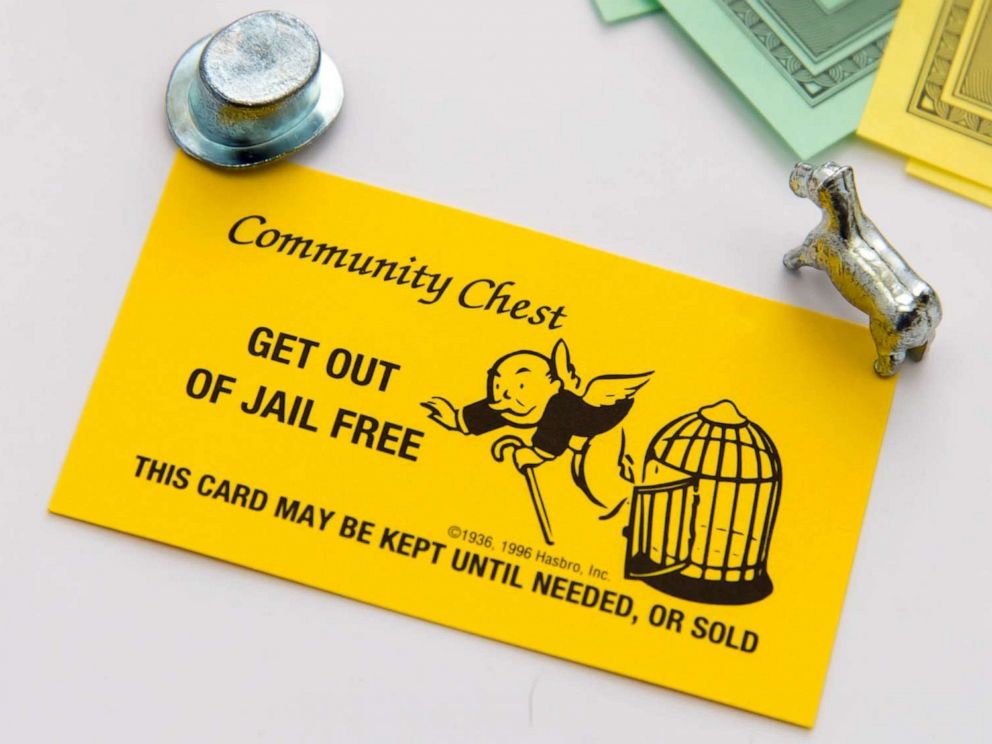
Law enforcement and jurisprudence systems wouldn’t work if they didn’t stack the decks in their favour. They give themselves get out of jail free cards and rely on lies and deception to create an advantage. Watching these TV shows, they have permission to lie, withhold, misrepresent, coerce, and entrap without repercussion. They make ‘deals’ in domains where they have no authority. They are even allowed to engage in criminal activity if it serves the better interests of a case. They can buy drugs and property, engage with prostitutes, and any number of otherwise illegal activities.

I won’t even spend more digital ink commenting on the lack of due process judges commit in the courtroom—personal fiefdoms.

Domestic abuse

Over 40% of active police officers have domestic abuse histories.

Over 40% of active police officers have domestic abuse histories. These people have records of abusing the wives, children, domestic partners, and pets. And these are only the ones who have been caught. Statistically, the percentage is very likely to be over 50%. This is not shining endorsement. Sadly, domestic abuse is inversely correlated with IQ, so this doesn’t fair well with the next topic.

Low IQs

The average IQ of a police officer in the United States is about 104. In and of itself, this might not seem strange. This seems to imply that these IQs are in line with average, but there’s a problem. The courts have ruled that is not discriminatory to exclude people with high IQs from being police officers because they are more likely to be independent thinkers and not conformant.

Conformity

Because cops are usually and expectedly conformant, it should come as no surprise that they feel the urge to prescribe this conformity on others. Given the opportunity, I’d argue that in many instances this conformity is superficial and performative, but that’s a topic for another day.

Lying in the name of…

Among other things, my girlfriend likes cop and crime movies and TV series. I don’t see the reason, but I watch some with her. Most recently, my post on the Unabomber interrupted this one. Philosophically, I key into two things in particular: deception and conformity.

I recall Jung saying that cops and criminals are two sides of the same coin. The best criminals understand the mind of the police, and the best cops have criminal minds. But for the grace of God, we go…

lying to serve the greater good is OK

Cops and law enforcement live by deception. The philosophy here is consequentialist, lying to serve the greater good is OK. This feels somewhat akin to the ‘God works in mysterious ways’ line. The end is more important than the means.

Afterall, lying is not illegal, and it is only immoral if taken out of this ‘greater good’ context.

Biblically, the only lying off limits is ‘bearing false witness’, so I suppose no one is going to hell for this transgression.

It seems that lying by law enforcement might fall into the same category of a ‘Do these jeans make me look fat?’ response.

In fact, people in positions of power routinely justify their own lying for the better good, which I’ll translate as self-preservation, which for the uninitiated further translates to ‘my/our system is the best system, and we must maintain it’.

I’ve been in several situations where police officers lied blatantly.

no mechanism exists to call lying police officers to task

In one, I was on a jury in Beverly Hills. The police accused a Mexican man of armed robbery. The thing is that the lie was so poorly constructed, it wasn’t even close to consistent with the events they said happened. And this wasn’t one bad police officer. It was a conspiracy of at least two, as they shared corroborating accounts. The problem was that the lie superimposed on the physical layout and timeline couldn’t have possibly happened—Schrödinger’s criminal notwithstanding. I won’t restate the evidence beyond this. The jury proclaimed his to be innocent, Sadly, no mechanism exists to call lying police officers to task. Perjury is not an option in these cases. In my opinion, they should at the very least be fined. I’d rather see them fired and jailed.

I was once stopped for running an amber light. I protested and received a citation for running a red light. I immediately brought this the attention of the issuing officer, with whom I had just had a dialogue about running amber lights, and he said ‘tell it to the judge. He was quite willing to lie about something as trivial as a traffic citation. This was before the days of dash cams.

To be fair, I was once stopped for making a turn at stop sign without stopping. I thought I stopped, so when the cop pulled me over, I protested that I had stopped. He offered to review the dash cam on the spot. He rewound it, and sure enough I barely slowed down. I apologised, commended him for the ‘customer experience’, and accepted the citation without further incident. I’ll admit when I am wrong.

Conformity is the other dimension, but I’ll defer this to another post…

Industrial Society and Its Future

I was writing a post about cop and crime shows and fittingly commenting on cops and crime, when my girlfriend turned on Manhunt: Unabomber, a series about serial bomber Ted Kaczynski. I remember when the FBI finally caught Ted and publicised this story, but I don’t know how much of the series was dramatised versus the facts, so my comments will be on the series and not the underlying events.

I title this post after his published ‘manifesto’, Industrial Society and Its Future, but it otherwise has nothing to do with this topic or his manifesto. To me, Ted Kaczynski seems to be a contemporary Thoreau or Rousseau, a primitivist born into the wrong century.

From a philosophical position, the series depicted the perils of taking a deontological approach. Process prevailed over consequences, which resulted taking 18 years to identify and capture Kaczynski. Time and again, process and pushing paper were promoted over new methods.

criminal profiling is the astrology of forensics

As people familiar with me know, I find the discipline of psychology to be pseudoscience (or perhaps simply a parascience), and so-called criminal profiling is the astrology of forensics, which are already a bit sketchy from the start.

Television promotes the logical rationalism underlying forensic science, connecting the dots to a forgone conclusion, if only the right dots are found. As with most law enforcement and court dramas, the focus is on the good guys overcoming the bad guys. Sometimes, it’s the good cop rooting out the bad cops or the perils of a cop who crosses the line to the dark side. These shows want to show how procedural criminology is in order to dissuade people from taking this path.

Knowingly or otherwise, this is propaganda. The fact is that most crime goes unsolved. Most criminals don’t get caught. Many who get caught are not convicted. Some convicted didn’t commit the crime they have been charged with. From an economic perspective, the vast monetary value is taken by white collar professionals with MBAs not burglars and bank robbers.

Systems need people to have confidence in systems. It’s self-serving. The propaganda is important to shore up confidence in the system of law & order, but it’s analogous to slot machines in Vegas or Atlantic City or wherever. When a person wins, there are bells and lights to increase the excitement in the room. But this misses the losers. If the sound was for losers and not winners, the cacophony might be deafening.

Henry Ford failed at 7 business before succeeding

This propaganda overplays winners and concentrates focus. This is classic cognitive survivorship bias. But don’t ask about the losers. This framing isn’t limited to law enforcement. It is also employed in the prevailing Capitalist narrative, but it under advertises the fact that most entrepreneurs fail. Counter arguments are presented in the likes of Henry Ford failed at 7 business before succeeding. If you fail, just try again. It has to work out for you eventually—unless, of course, you aren’t working hard enough—not working as hard as the winners, not paying your dues.

Whilst watching, I found myself scoffing time and again. I am not a Romantic and not a Primative, so I didn’t exactly side with Kaczynski, but I definitely didn’t side with the system, even if that’s not what he was railing against.

Of interest to me was the forensic linguistics. Humourous to me was his choice of spelling. Like me, he wrote in international English. The series represented his spelling as accepted variants, but this is a US-centric position. In fact, most the the world that speaks English employes the British flavour, which is closer to international English than so-called American English, which is only spoken in the US and Central and northern South America. The rest of the world doesn’t use American English. I chose to use international English after high school. Occasionally I get comments and criticisms, but my grammatical footing is stronger than the vast majority of these. The biggest factor is that I don’t identify as an American. Rather, I am a citizen of the world. Perhaps Esperanto?

Cultural Diversity

Humans seem to be hard-wired to prefer in-groups over out-groups, family and tribe over outsiders. In the business world, we hear about corporate culture. But these days, diversity is all the rage. Companies strive to convince the world that that have diverse and inclusive cultures, but what does this mean? Is there such an animal as a diverse culture? And how does one balance the familiarity of in-group homogeneity versus out-group heteronormativity?

you can’t spell culture without ‘cult’

In corporate-speak, there is the concept of cultural fitness. Afterall, we want efficient and productive humans and processes? People who don’t fit this mould are disruptive, right? So, we are justified in excluding people from the group, right? Remember, you can’t spell culture without ‘cult’.

Although the United States brand themselves as a cultural melting pot, this is only partially correct, and mostly in more populous areas, and even this occurs in pockets.

Diversity—in hiring and otherwise—is only accepted if it is along approved superficial dimensions—skin colour, national origin, sex, religious orientation, maybe gender, perhaps some latitude around lifestyle choices. But more substantial diversity need not apply. They are interested in hiring conforming normies. The gay guy is OK, so long as he toes the rest of the line. That woman: ditto. That Muslim: same. That black person: so long as s/he acts white in public.

everything needs to distil down to the white male ethic

Performatively, they’ll accept the diversity proponent as a PR prop. This person is proof that they hire [target group]. This person broadcasts how s/he can wear their cultural garb, bring cultural dishes to potlucks, put up posters and advertise about support groups outside of work. But in the end, everything needs to distil down to the white male ethic.

Talk about work-life balance is fine, so long as work gets the upper hand. You need to be able to talk about charity, but you need to be motivated by money and status. There are exceptions to this motivation, say, public health and healthcare, education, and so on, but the boundaries in these professions are narrow, too. Not acting ‘professional’ is a key criticism. So, if your diversity counters some perceived professionalism, your diversity is not welcome.

not acting ‘professional’ is a key criticism

If the company hires people who routinely put in 60 hours for 40 hours of salary, they are not interested in the person with boundaries, insisting on 40 hours of work for 40 hours of salary. They aren’t interested in people who might question the ethics of the company’s business practices. Companies aren’t generally interested in rebels.

You need to be Sartre’s waiter. You’ve got a role to perform. In fact, you are evaluated specifically how well you perform that role. So, whilst you may be a singing waiter or a dancing waitress, your boundaries aren’t much broader than this. It’s easy for an observer to dismiss the call for diversity. S/he’s a waiter, right? Why should I expect anything different to that? And this is what locks in a lack of diversity.

DISCLAIMER: This ended up more of a meandering rant, but I’m distracted and out of time. And so it goes…

Institutionalised

This LA Times Op-Ed piece, Why so many people want to believe the election was stolen, got my mind wondering…

The United States have seen ‘stolen elections‘ before, but the last time this happened in a presidential election—hanging chads, and all—, Al Gore was on the losing end of a misguided Supreme Court decision that landed George W Bush into the Whitehouse. This time, we see Donald J Trump on the losing end and Joe Biden running the victory lap—except Trump was running a victory lap himself until the weight of reality stalled him.

Gore is an Institutionalist.

Many Gore supporters felt upset (and somewhat betrayed) as he conceded the election to Bush. Gore is an Institutionalist. For all of their hubris, some politicians still see the institution as a higher power greater than them. Al Gore is one of these. Despite all of their faults, most of the past presidents have been institutionalists—systemists. One of the benefits of the US system is a peaceful transfer of power. To preserve a system, proponents need to maintain the mythos of that institution.

Gore said that he fought the good fight, but by the rules of the system, he lost. Not different to a court case lost on technical grounds rather than merit, he sucked it up and demurred to the system. It may not be perfect, but it works.

Trump is not an institutionalist.

Enter Donald Trump. Trump is not an institutionalist. He is entirely self-serving—a narcissist in pop-psychology vogue. He makes no qualms about disparaging the system. He seeded the fraud argument just to be able to say, ‘I told you so’, in the event of a loss. And so he did.

— Fin —

Donald J Trump, like others before him—Homer J Simpson, Barney J Rubble, Forrest J Gump?—is a simple man—a simpleton. George W Bush was another. Many of their followers are simple, too, though not all are simpletons. They just want to believe. It’s human nature.

I am not an institutionalist, but I understand the comfort zone institutions provoke. And beyond nostalgia, there can be a certain benefit to institutions. For one, it’s easier to navigate charted territory. So, whilst I don’t have a horse in the institutional race, I can see how one’s disposition towards can be a factor in how it treats it.

— Bumper Trailer —

Problem of Evil

I’m not religious, so that might be why I don’t understand the so-called ‘problem of evil’. To me, it’s a sophomoric question: If God exists—and is all-good, all-loving, and created everything—, then explain how evil came to be and why it seems to be so prevalent. There’s no reason to accept Occam’s Razor, but this might be a good time to adopt it. A narrative of God is created, and then—as with retrograde planetary motion to justify a geocentric ‘solar’ system—one needs to create odd sub-narratives to fill holes in the main storyline.

The problem of evil is that it doesn’t exist. Evil doesn’t exist. Denotatively, it can be defined as very bad. Connotatively, a moral element is manifest in the term, but the word is unnecessary judgmental hyperbole.

Etymologically, the word evil derives from the

Old English yfel (Kentish evel) "bad, vicious, ill, wicked," from 
Proto- Germanic *ubilaz (source also of Old Saxon ubil, Old Frisian 
and Middle Dutch evel, Dutch euvel, Old High German ubil, 
German übel, Gothic ubils), from PIE *upelo-, from root *wap- "bad, evil"
 (source also of Hittite huwapp- "evil").

In Old English and other older Germanic languages other than
Scandinavian, "this word is the most comprehensive adjectival
expression of disapproval, dislike or disparagement" [OED]. 
Evil was the word the Anglo-Saxons used where we would use bad, cruel, 
unskillful, defective (adj.), or harm (n.), crime, misfortune, disease (n.). 
In Middle English, bad took the wider range of senses 
and evil began to focus on moral badness. 
Both words have good as their opposite. 
Evil-favored (1520s) meant "ugly." Evilchild is attested as an 
English surname from 13c.

The adverb is Old English yfele, originally of words or speech. 
Also as a noun in Old English, "what is bad; sin, wickedness; 
anything that causes injury, morally or physically." Especially of 
a malady or disease from c. 1200. The meaning "extreme moral
wickedness" was one of the senses of the Old English noun, but it did
not become established as the main sense of the modern word until
 18c. As a noun, Middle English also had evilty. 

Adolf Hitler is evil. Pol Pot is evil. Charles Manson is Evil. This employment of evil intends to communicate that these are bad (versus good) people. The intent is that these people are possessed by evil—as in an evil metaphysical spirit controlling these people. They were born with an evil soul. That’s how the term is typically employed, but this is a kin to a 4-year-old. Having yet to adopt the term, a child might, upon reflection, assert that these so-called evil people as very, very, very, very (…) bad.

One could argue that the term is shorthand for the 4-year-old’s version, but this missing the connotative subtext.

Nietzsche gave an interesting account of the origins of the term in Beyond Good and Evil. I recommend reading it along with the Genealogy of Morals. I don’t have more to add, but somehow got on this tangent after reading Nagel’s defence of religion.