Justification

Why is it that one can only justify reason through reason?

Yellow card infraction.

Within Critical Thinking, we have a useful definition: Grounds, for example, for making a claim to knowledge or holding a belief. (Black et al., 2012, p. 100.) In fleshing out this particular definition, let’s consider what grounds means within a critical thinking context. It means, “a reason or reasons for a claim or belief,” (Black […]

Justification

Bonjourno, Adorno

I’ve recently read Adorno’s publication, The Authoritarian Personality, and I share my perspective and thoughts.

This study was performed post-World War 2 and published in 1950. It was meant to determine if a relationship existed between anti-semitism, ethnocentrism, and fascism (cum authoritarianism) and compared several psychometric tests to determine the correlation between cohort groups. The new test was called the F Scale test, a pale attempt to hide the purpose of the Fascism Test.

What’s interesting to me, is how these map to the épistémè of the day, but perhaps that’s more a reflection on how ripe some populations were for fascism. In many ways, it’s dated,and many have questioned the approach and methodology. Moreover, some have noted that the correlation with fascism may simply be a correlation with authoritarianism more generally.

Before I get to the main content, I admit that I don’t agree with the psychoanalytical vantage. In fact, I equate psychoanalysis with astrology and tarot cards. To this end, I ignore the etiological aspects. I also feel that the fixation on anti-semitism is overspecified, so the effects would map to any targeted out-group. Finally, I feel that the chosen categories are not mutually exclusive, so there are unnecessary covariances. I discuss these in turn. Adorno created 9 categories. The first is conventionalism.

Conventionalism:
Adherence to conventional values

By conventional, Adorno means traditional — people who find solace in the familiar. In my experience, most people are conventional and to a large degree. When I  consider conventionalism, it’s about how people present themselves when they think they are being observed. I’m not sure that I’d differentiate closet rebels from people who are simply conventional to the bone. Many people will tell their closest confidantes how rebellious and unconventional they are…but only behind closed doors because they fear being judged and reprisals. In practice, they will even call out and chastise a person who has been caught being unconventional.  This extends to beliefs, sexuality, and other propensities, such as recreational drug use.

Authoritarian Submission:
Towards ingroup authority figures

Authoritarian submission also over-indexes across the board. Ostensibly, this is about obedience and deference. Even if one disagrees with an authority figure, they are unlikely to voice the disagreement and will quickly cave any defence when push comes to shove. 

Note the in-group qualifier. In the United States, when George W Bush was president, the authoritarians railed on about how important it was to support whoever was president — until Obama became president. When Trump became president, it was important to fall into line behind the new leader, leaving differences in the past — until Biden became president. In practice, some of these people couch the ousted leader as the better or legitimate leader. Historically, this has led to fractures that have taken down nations. This is also the story behind the Sunni-Shia conflict of Islam.

Authoritarian Aggression:
Against people who violate conventional values

Authoritarian aggression is a natural extension of conventionalism and submission. I submit, and so should you — if only performatively, I will call you out. We can witness this when closet gay legislators not only pass laws against their own beliefs and activities, but they do so vocally, aggressively. The best defence is a strong offence. And better to be the accuser than the accused.

Anti-Intraception:
Opposition to subjectivity and imagination

Anti-Intraception is a fancy way of saying that one is an objectivist. Anti-intraception is a characteristic of the authoritarian personality which results in a low tolerance for creative thinking and emotion-importance; people who are anti-intraceptive (i.e. are not particularly self-aware) reject subjective thinking in favour of more concrete thinking (e.g. placing high importance on clearly observable facts instead of thoughts and feelings). There is no room for subjectivity or relativity. This is one god, one truth, and whatever the prevailing position of the day, with no room for perspective or interpretation. Other sources equate prescriptive optimism to be an effect of an anti-inceptive disposition.

Superstition and Stereotypy:
Belief in individual fate; thinking in rigid categories

I would have distinguished between superstition and stereotypy, but perhaps there is a strong correlation between the two. Stereotypy is where we get the need for strong categories and things like binary sex and no distinction between sex and gender. Superstition is obviously belief in improbable metaphysical forces and entities. This is where gods enter the equation. With superstition comes fatalism. Things are not within their control. Things just happen to them. They feel powerless, and so seek to align with the powerful, being somewhat subsumed by the bully. This is a perfect segue to the next characteristic.

Power and Toughness:
Concerned with submission and domination; assertion of strength

Power and toughness are where militarism and domination come into frame — Nietzsche 101. This is also projected and reflected onto leaders and representatives. Brawn is privileged over brains. Affiliated bullies are copacetic. It also manifests in ethnocentrism, jingoism, nationalism, and patriotism. We’re number one. We’ve got the best this and that, whether country, state, school, sports team, or Girl Scout Troop. It doesn’t matter. Everything is a competition, and I need to come out on top — if even only by association.

Destructiveness and Cynicism:
hostility against human nature

Excerpting from the text, this is about ‘the inability to identify with humanity [that] takes the political form of nationalism and cynicism about world government and permanent peace. It takes other forms, all based on ideas concerning the intrinsic evil (aggressiveness, laziness, power-seeking, etc.) of human nature; the idea that this evil is unchangeable is rationalized by pseudoscientific hereditarian theories of human nature. The evil, since it is unchangeable, must be attacked, stamped out, or segregated wherever it is found, lest it contaminate the good. The democratic alternative — humanitarianism — is not a vague and abstract “love for everybody” but the ability to like and dislike, to value and oppose, individuals on the basis of concrete specific experience; it necessarily involves the elimination of the stereotypical ingroup-outgroup distinction and all that goes with it‘.

As one can notice, this fits into the religious mindset. It’s also a prime motivation for genocide.

Projectivity:
Perception of the world as dangerous; tendency to project unconscious impulses

Projectivity takes us to the Leviathan of Hobbes’ ‘solitary, poor, nasty, brutish, and short‘ natural existence. It’s also takes the most blatant psychoanalytical aspect: projection. Enough said.

Sex:
Overly concerned with modern sexual practices

Sex and sexuality ties back nicely to conformity and conventionalism as well as stereotypy. It manifests as repression, to borrow from psychoanalytical nomenclature. By and large, the reason these people want privacy in the bedroom is because of modesty. Make no mistake, these people practise plenty of deviances and excuse themselves in typical attribution bias fashion. When caught in the act, they make excuses for their deviance rather than to defend their personal rights. Some of these deviances are not actually deviance from practice. Rather, the deviation is versus belief.

Whilst I agree with the sentiment of sexuality, this feels like it’s already been captured as a special case of conventionalism and is a quaint throwback to the Freudian obsession.

Closure

Speaking for myself, I’m not certain that a post-modern can be a fascist. First, what post-modern is a conventionalist or traditionalist. The only recognised authority is the underside of a power relationship. Without a recognised authority, there is nothing to react against. A key element of postmodernism is subjectivity over objectivity, which helps to explain why authoritarians like Jordan Peterson so vehemently oppose even the notion of postmodernism. Postmoderns eschew categories or make them so expansive as to not provide much gravity for stereotypes. I can’t speak for other postmoderns, but I am a pacifist and conscientious objector. I’ve got no tolerance for power plays, alpha males, and machismo. I am a bit of a cynic, but it’s not from some sense of evil caricatures. I don’t even believe in the notion of good or evil. I don’t believe in nature, let alone human nature. These are just facile categories to contain stereotypes. Where have I seen that before? Do I project my unconscious as my perception of the world? The shadow knows. And then there’s sex. My sex life and my insouciance of others’ sex lives are not necessarily in sync. I’m no pansexual, but neither do I care if someone is. Not my monkeys. Not my circus. I am not overly fixated on sex — especially what everyone else is or isn’t doing.

I’ve avoided reading much Adorno over the years, primarily because I was put off by his work on media and culture. And in general, I am put off by people holding onto teleological propositions. I’m amazed that I hadn’t tripped over his work on authoritarianism. 

I’ve always questioned authority, and authoritarians and even mainstream people have painted me as being oppositional to authority because of my upbringing, taking a psychoanalytic approach. Being suspicious of psychoanalysis and its tendency towards conformitivism, I received similar criticism. In the 1980s, Robert Altemeyer renamed the authoritarian personality Right-Wing Authoritarianism, as this was in step with the times and in recognition that there other authoritarian constructs outside of the Right and Fascism.

I’m not sure I ever needed permission to question authority and confirmation, but somehow Adorno does just that. The blind faith Adorno attributes to Fascism, has always rubbed me like a priest. For all intents and purposes, I ignored the Semitic and psychoanalytic aetiology, focusing instead on the attributes. 

All of this said, it is easy to create a stereotypical heuristic strawman, if you will, and live in fear for the many people who seem to fit this bill. Meantime, I’ll occupy my time elsewhere.

Je m’accuse

I’ve been an absent owner. I’ve not been fertilising this blog as I’ve been attending to my professional blog and many other things IRL. But my brain doesn’t stop thinking, and I don’t stop reading just because my fingers stop typing contributions here. Today, I type.

No Free Will

The topic is the absence of free will debate. To be fair, I believe the notion of free will is a holdover from religious belief. And, like religion, it is used to control people and to formulate social cohesion and serve as the basis of legal systems. Free will and agency are core to any justice system. There is a system of laws. Conforming is good. Nonconformance is bad. People have agency to decide whether to conform. Relative to the system, a person is either conformant or not. Justice prevails. Nonconformance is punished, as it were. Society wins.

But let’s say there is no free will. I’m going to skip the entire argument and present this piece as a hypothetical. There is no free will. The universe is entirely deterministic. Now what?

Does anything happen? Does anyone notice?

If there is no free will, the universe already has embedded ‘code’ that will either reveal or conceal this information. If we are destined to know this, we’ll know it. If not, our future will unfold all the same.

If people have no real agency, can we punish them? Sure. We do it already. We inadvertently punish the innocent. We even punish those known to be innocent. But if history is pre-written and you are destined to be punished, the script has not only been written, but it’s already been recorded indelibly on film. We’re just waiting for the scene to come into view.

Given this, the so-called knowledge that there is no free will is useless. What’s the goal—to break the fourth wall and and liberate ourselves from the script? Wouldn’t that have already been scripted? What do you get—a director’s cut?

No Agency

What if it’s not so strict but that people don’t have agency? If people are all automatons, is it still ethical to punish them? Can rehabilitation be a goal if people are ostensibly wind-up dolls? If a person is a wind-up doll run amok, are we justified for separating them from the population at large?

I can see an argument for removing axe-wielding automatons from the public. And I’m sorry if they have no agency over their actions—like zombies. We all know what happens to zombies—and unmanaged zombies.

This scenario is different to that of a person who robs a store for food to eat—think Valjean in Les Misérables. This is an indictment of the system. If something needs fixing in this situation, it’s the system not the thief. But that’s not what generally happens. It’s easier to scapegoat a person than a system—even if that system is comprised of other people.

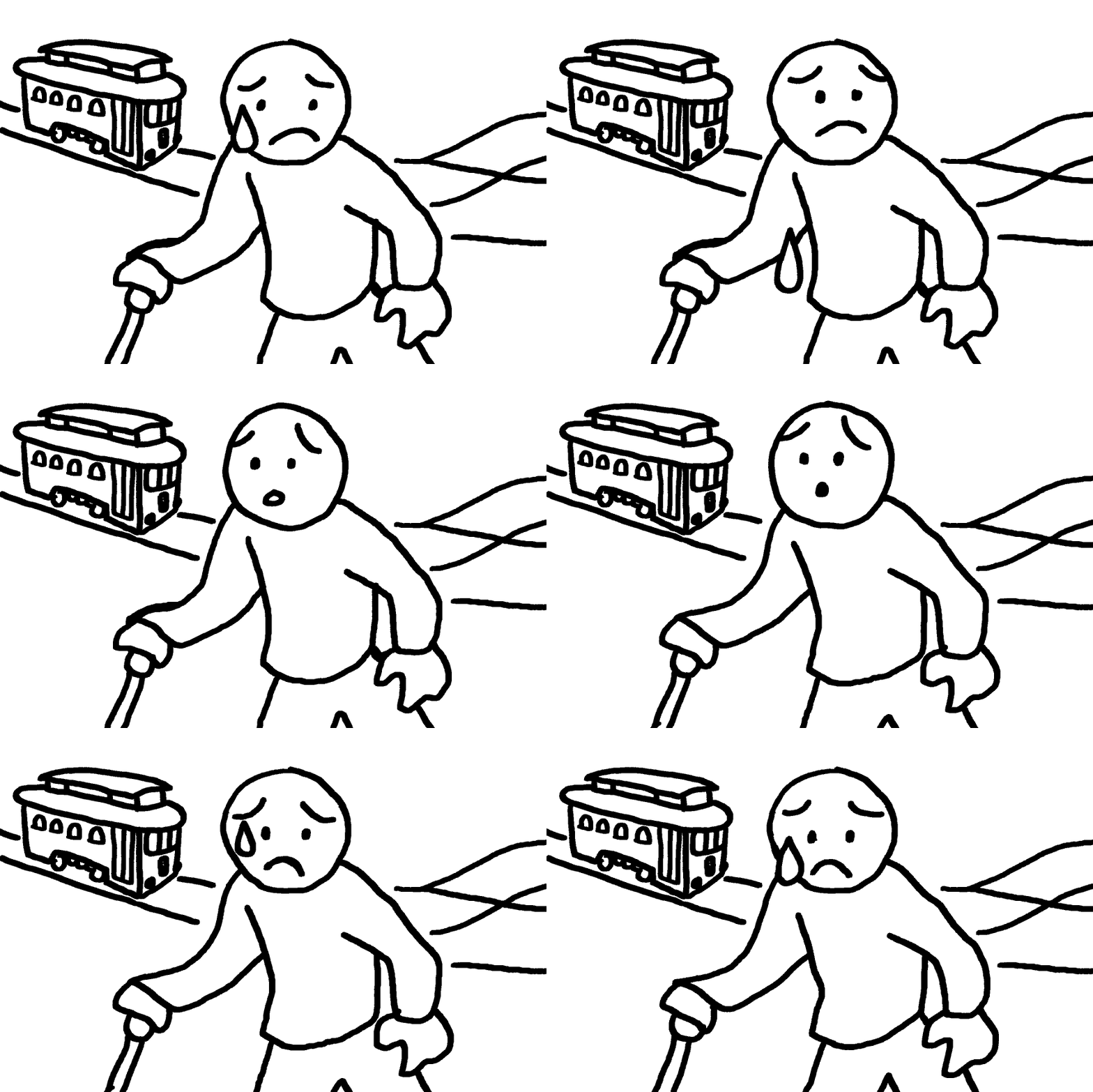
Trolley, Trolley

I love finding Trolley Problem takes. If I had spare time, I’d set up trolleyproblem.com to archive the content. This graphic contextualises the problem. In university, I recall discussing different nuances, including the medical doctor problem of saving a Nobel Prize laureate at the expense of 5 indigent people, whether health compromised or not, so this perspective of privilege is not new. The twist here is that this flips the neutral decision with you in control of the path of the trolley but without knowing anything about the people on the track to the capitalist deciding between another capitalist versus workaday proletariats. It’s almost always frame in from a consequentialist perspective.

May be a cartoon of 1 person and text that says "How you imagine the trolley problem YOU 00000 5 How it's actually going to be 000000 0000 YOU"

Foucault wrote about épistémès, where knowledge and perspective are contextualised in time and place. The bottom picture sums up how the mortgage crisis was resolved in 2008. Too Big to Fail (TBTF) financial institutions were salvaged at the expense of ordinary citizens. Main Street was sacrificed for Wall Street. Considering Derrida, Wall Street had the privileged position over Main Street or High Street.

In the midst of COVID, you can see the argument playing out in the UK and US, as the top route is to close businesses to reduce social contact and the bottom route is to open business because it inconveniences a few shop owners. Note that even people on the bottom path are shouting for the switchman to send the trolley careening down their path.

Ownership and Democracy

A Facebook friend is pushing for the adoption of a new phrase: red washing, where it indicates a false sense of ownership and control. This friend has collectivist leanings, so perhaps that’s where the red comes from. It doesn’t make logical sense to me, but rather than focus on the phrase itself, I want to discuss the sentiment and intent. Essentially, his contention is that some forms of ownership don’t offer the same sense of control as others. If I own a car, or a pencil, it’s mine to do with it what I please. But if I only own a piece of something, my control diminishes. This is especially true where my ownership is a minority share.

The first mistake my friend makes is to presume that ownership and control are one in the same. I don’t feel we need to discuss the case where the State controls the limits of any ownership. You can own property, but what you can construct on it is limited by zoning laws and perhaps community guidelines. You can own a car, but you can’t drive it on public roads at 200 MPH, or paint it like a police car affixed with blue and red lights. You can’t stab your neighbour with the pencil you own. And you can’t own or even possess heroin under normal circumstances. I feel that these ownership restrictions are obvious. These are aspects of control ceded to the State. Some Libertarians may baulk, but for the most part, these are generally accepted limitations.

My interest here is the notion of diluted ownership. This really underscores the difference between ownership and control. A simple illustrative example is a publicly traded company. One can own a share in that company, but ostensibly, this gives you no control. If one holds a million shares, maybe they have a voice. If one has a majority share or can create a coalition to compose a majority share, one ostensibly has control. Otherwise, although your ownership may grant you other advantages, control is not one of them. One can benefit by price increases in the marketplace, perhaps collect dividends, and you can cast your proxy vote, but these don’t represent control.

Likewise, this is how democracy operates in practice. One has a vote. Theoretically, it’s one person, one vote—one vote per person. Though in the United States this is the system de jure, not de facto system, where it’s closer to one vote per dollar.

Consider the United States. In 2020, there were 239,000,000 eligible voters. Each eligible voter is an owner of this democracy or republic. Pick your poison. Effectively, this means that one’s ownership share affords them 1/239,000,000 control. This wouldn’t even qualify as homoeopathic, and that’s a pretty low bar.

Dehydrated Water

I’ve commented elsewhere on how democracy is a specious proposition. That it only provides an ‘illusion of control‘. This is fine for the power structure. All they need to operate is to maintain this illusion and for the people to defend their voiceless voices.

Of course, the Republican flavour of Democracy is even worse. Not the Republican party. The sense of representative democracy over direct democracy or even anarchy. Republicanism adds a principle-agency challenge to it’s already weak-tea proposition.

And all I have is a keyboard.

Language Lessons

By definition, language is an arbitrary construct, and it doesn’t map as well to ‘reality’ as many believe. As my understanding of language drops precipitously after French and English but includes a smattering of Japanese from the years I lived in Japan and conversational Spanish from Los Angeles, I’ll limit this to French and English.

Here’s a short table I’ll use as a reference.

EnglishFrenchEnglish Transliteration
How old are you?Quel âge avez-vous?What age have you?
I am 10 years old.Je suis 10 ans.I have 10 years.
I am cold.j’ai froidI have cold.
It is I.C’est moi.It is me.

Notice the response to the age question, ‘how old are you?’ « quel âge avez vous? » is ‘I am 10 years old’ « Je suis 10 years. » Ignoring the grammar-defying use of how in English, and the fact that the question relates to age and the response relates to years, the English verb is are, the infinitive to be, whilst the French verb is avez, conjugated from avoir.

In English you are years. They are an existential part of your essense—of your being. In French, they are an attribute—something you have or possess, like a coat or a morsel of food.

In language, we don’t even consider these things. We just use the language as we’ve been taught. In English we are, but en français, we have.

It makes me wonder if this construction doesn’t give native English language speakers a greater sense of entitlement. Just a thought. They don’t have coldness; they are cold. It’s the difference between being and having. To be deprived of a possession (endowment effects notwithstanding) as a opposed to your core person feels less significant—a pencil versus a finger.

Diversion

The last example isn’t so existential, but why not? It’s a subject versus object distinction. Of the people I know, when speaking English and asked the question, ‘Who is it?’ (‘To whom am I speaking?’), the response is invariably ‘It’s me‘ (‘It is me) despite the given grammatically correct prescription of ‘It is I‘, where I is the subject pronoun and me is the object pronoun. In French, using the object pronoun for this response is the prescription, c’est moi, and I feel that English will eventually catch up and lose the distinction. Some pidgin English already accepts me as a subject form. This is captured in Star Wars reviled Jar Jar Binks’ character’s use is mesa, as with: Mesa called Jar Jar Binks, mesa your humble servant!

Disclaimer

My time has been occupied all over the map. I haven’t posted anything here in a while, so I thought I’d at least share a cursory thought.

Pride

“Tell me about an accomplishment that made you proud?”

I received this question in a recent interview. This question is an awkward position for a postmodern to respond to.

For someone like me, it’s like asking me what’s my favourite dinosaur. I suppose it’s fine to ask a 7-year-old, but it doesn’t work for me for several reasons.

The Brontosaurus has been officially classed as a dinosaur again | The  Independent | The Independent
Brontosaurus

First, I don’t really react to ‘proud’. I’m a collaborator. Even so, I don’t see why I (or we) would be proud of an accomplishment. And. I’m not much into the notion of attachment. Siddhartha would be proud. (Just kidding. )

For this piece, I looked up the definition of ‘proud’:

feeling deep pleasure or satisfaction as a result of one’s own achievements,
qualities, or possessions or those of someone with whom one is closely
associated.

So, it’s not enough to be satisfied that you’ve accomplished what you’ve set out to do. Proud and pride are odd concepts to me. Some people are proud to be part of some nationality or ethnic group—proud American or proud Italian. Obviously, these are not accomplishments. I suppose if one has to pass a citizenship test, then it might count as an accomplishment. I’m not sure it rises to the level of ‘pride’. I’m proud because we won the football match?

But the question posed to me was about work accomplishments. I’m not sure that my response was taken as authentic. And how could it have been? If I respond that the bronotsaurus is my favourite dinosaur, do you think they’ll catch on that I just blurted out the first thing that came into my head?

My first response was that I was proud of the time I spent teaching and giving back. It was a fulfilling experience. Proud feels a bit of an overstatement. There was a project that ended up yielding longtail benefits, but again, what’s there to be proud of? And for the group or team to be proud doesn’t feel any better. ‘Yay! We won the Superbowl. Isn’t the winning enough’? Sour grapes, I guess. Right?

LA FONTAINE : Le Renard et les raisins (Livre III, fable 11) - PODCAST
Le Renard et les Raisins

As a think about it, pride is about attachment—specifically ego attachment. Christians have a saying that ‘Pride cometh before a fall’. It’s one of their cardinal sins. I’m not a Christian, but it seems to me that it is not to be encouraged.

As a Buddhist, one might focus on the attachment aspect. Pride is about living in the past instead of the now. It’s not very Zen. I’m not judging.

My biggest problem is that I presume that a person who asks this type of question actually buys into the whole pride thing. That doesn’t help my cause.

“Not to come across as a Marxist, but I’m not really into the ‘Proud’ thing. Here are some stock responses.

I ask myself, is pride related to competition, or can one be proud in a different environment? It seems that there’s a connection. And, of course, there’s ego.

I wasn’t sure whether to share this on my philosophical blog or my business blog. In the end, I opted for philosophics.

Language of Life

I want to write about this Quanta Magazine article: What Is Life? Its Vast Diversity Defies Easy Definition. but I’ve not got enough spare time. Too many irons in the fire or plates spinning or which ever metaphor you favour.

My interest in the insufficiency of language is what attracted me to the article, and is probably how it ended up in my feed. To highlight some aspects, in 2011, Russian geneticist Edward Trifonov reviewed 123 definitions of life and found as many definitions as authors. Although he discovered some core shared features. His version distilled to self‐reproduction with variations.

The article mentions Wittgenstein’s language games—and rightfully so. But it underscores the point that language is an approximation of reality. My working position was that naming objects is simple—in fact trivial—, but naming abstract concepts presents challenges. Now, I find that the challenge sets in earlier than even I expected. Language is truly insufficient.

The first step to recovery is to admit there’s a problem.

Metanarrative Problem

Audio: Philosopher Bry Willis discusses this topic.

Postmodernism was summarised by Lyotard as having an incredulity toward metanarratives.

What does this mean? What are metanarratives, and why harbour incredulity toward them?

Audio: NotebookLM podcast on this topic.

Metanarratives are narratives. Stories presented through a lens with a certain perspective. These stories provide a historical account of how a culture arrived to where it has. They can be viewed as origin stories. Metanarratives are also teleological, as they provide the foundation to progress, to advance the culture to a better future. Embedded in these metanarratives are the rules and conditions necessary to navigate, both from the past and into the future.

We’ve got stories. In his book Sapiens: A Brief History of Humankind, historian, Yuval Noah Harari tells us how important stories are for having made human progress. Hooray for us!

This sounds good so far. Right? We’ve got Caesar, Cornwall, and Kahn. We’ve got triumph of us over others. Good prevailing over evil. Right over wrong. So why the incredulity?

Let’s keep in mind that Lyotard is suggesting incredulity and not rejection. The narrative could be fine and accurate enough. One might argue that the benefit of the narrative for the purpose of cohesion outweighs the detriments posed.

There are several notable problems with metanarratives.

Firstly, the past suffers from a cherry-picked survivorship bias. The story threads that don’t support the narrative are abandoned, and some threads are marginalised. So, there’s a dimensional problem. As with any historical account, one needs to adopt a perspective and create a story. Let’s not forget that the word history comes from the word story. In fact, French only has one term: l’histoire. History is story.

Secondly—and this is somewhat related to the survivorship bias problem—, is that we privilege the perspective we take to view this history. In his book, We Have Never Been Modern, Latour uses this line of argumentation to arrive at the conclusion that we have never been modern. It is only because we are here now and surveying history through a rearview mirror that we can even look into the past. And we feel that we have somehow overcome this past. The past was primitive, but we are modern. Some time in the future we’ll deservedly be viewed in the same light because that’s how progress works. But there is no reason to accept this privileged assignment. It’s a function of ego—and to be even more direct: hubris.

Lastly, there’s the issue of teleology. Through this privileged vantage, we orient toward some alleged destination. Like fate, it’s just there for the taking. The only barriers are time, not keeping your eyes on the prize, and not following the rules to get there. There’s an embedded deontology. Those other societies don’t understand what it takes. You need to follow this path, this religion, this sports team. Because this is the best there is.

But there are no crystal balls. We cannot divinate the future. There is no particular reason to believe that our imagined path is the best path. If you don’t believe this, just ask the culture next door.

I’d like to think that somehow Progressives would be more aware of this tendency—and perhaps in some sense they are, but it’s not very apparent pragmatically. I don’t want to get distracted by the notion of institutionalism, but that is evidence of taking a privileged position regarding the status quo—even if your vision of the future would take a different path than your more conservative brethren and sistren.

In closing, this has been a summary of the problem postmoderns have with metanarratives. It could be that the metanarrative you believe to be valid is valid. It could be that your religion is the true religion. It could be that your sports team is the best sports team. That your system of government is the best of all other alternatives. It’s more likely that you’ve convinced yourself that these things are true than them being true.

We can either adopt the perspective of Voltaire’s Dr Pangloss and consider our world to be the best of all possible worlds, or we can step back and consider that we haven’t exhausted all of the possibilities.

ADHD Drivers

I’m typing this on my mobile in fear.

Not trying to shame, but ADHD should disqualify a person from having a driver’s licence.
The next cigarette became the next snack became the next drink became readjusting the mirror became readjusting the seat became the next drink became the next application of lipstick became flicking an ash became changing the radio station became looking for a lighter to fire up the next cigarette  became opening a window became adjusting the temperature became rinse and repeat ad infinitum….or until the trip ends or distraction kills.